Archive for October, 2014

4 minsJames Fritz’ new one-act play unfolds like a detective story, making it difficult to elaborate too much on the plot details. Suffice to say that the title relates to the duration of an intimate film clip involving two teenagers, which goes viral on social networks. The pair themselves are almost incidental to the story – 17-year-old Jack never appears and his (now ex) girlfriend Cara (Ria Zmitrowsicz) turns up in just a few short scenes. This is a play about the dilemmas of parenting in the age of the internet, focussing on Jack’s pushy mother Di (Kate Maravan) and his “boys will be boys” father David (Jonathan McGuinness). Fritz examines clashes between family devotion, social responsibility and ethics in the role of parenting, whilst throwing in a discussion on the dividing line between consensual sex and rape. The play is structured as a succession of short scenes, all involving no more than two characters (predominantly Di and David) and Anna Ledwich’s stripped down production, with the audience seated on either side of an oblong stage, always holds the attention. Two very strong central performances from Maravan and McGuinness also help to keep us gripped, but the characters’ words and deeds stretch the boundaries of credibility and lead us to question whether the play’s whole central premise is fundamentally flawed. Worse still, as the plot becomes progressively less believable in the later stages, so do the characters, leaving us not really caring too much for them or about them. As a result, this play is always interesting, but rarely moving.

Performance date: 6 October 2014
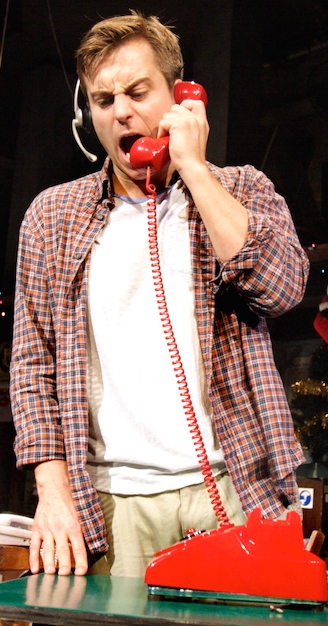
menier chocolate factoryIn 2004, I paid my first visit to the newly-opened Menier Chocolate and fell in love with the place instantly. Even before The Shard towered above it in the near distance and Borough Market had undergone its makeover, something magical had descended upon what had been a dreary and neglected area of London. That first production was Fully Committed, a small-scale, one-man play which gave few clues as to the treasures that were to follow.  Glossing over the ghastly Paradise Found, the Menier has effectively re-defined musical theatre for London, scaling down big shows, many by Stephen Sondheim, to fit into a studio setting. This revival is a happy reminder of that first visit. The play’s only character is Sam, a resting actor who operates the telephones and takes the bookings for a chic, in-demand New York restaurant. Written by Becky Mode and directed by Mark Setlock, who was Sam in the first production here, the play is a frantic hour of non-stop comedy in which Sam speaks not only as himself but also as the voices at the other end of the phones – diners desperately seeking reservations, the ogreish chef, the maitre d’hôte, his own father, his agent, a fellow actor gloating that he has got a part, etc. With no computers in sight, Sam takes all the reservations by hand, thereby making the play look at least ten years out of date, but, otherwise it is as fresh as when it first appeared. Here, Sam is played by the British actor/comedian Kevin Bishop who gives a virtuoso display of voice mimicry and facial contortions, taking us through the piece at breakneck speed; he also brings to the character a quality of real likability which draws us in and makes us root for him as he juggles the priorities of making bucks, furthering his acting career and staying close to his family. Highly entertaining.

photo: Catherine Ashworth

Performance date: 3 October 2014

blueDid you know that William Shakespeare once lived in Shoreditch? He did and, to commemorate the fact, RIFT is presenting two cycles of new short plays, performed at various locations during a walking tour of the borough. On a chilly but dry evening, I saw the cycle of five plays (rather four and a film) on The Hoxton Path. The works reflect an area in which traditional London is meeting modern London, where jellied eel stores and sushi bars trade side-by-side and where social housing estates stand proud, resisting the creeping onset of gentrification. Three Loose Teeth by Thomas McMullan features three characters and takes place in a side alley. Touching upon marital infidelity, domestic violence and vagrancy, it has an edgy feel, but needs a sharper focus. Disnatured by Sabrina Mahfouz takes place in a small flat and is a monologue by a young woman, damaged by a horrific childhood incident and embittered by social injustice in the old Hoxton; rather than seeking revenge, she has reconciled herself to playing the game and becoming part of the new Hoxton. Beautifully written and acted, this play is a moving study of subdued anger. The Isle is Full of Noises is a short film (shown in an open shed) by James Soldan and Katie Lambert; the supernatural story concerns a vagrant who befriends and assumes the voice of a teenage girl. Shot in bleak urban locations, it is intriguing and creepy. Community Payback by Ali Muriel is performed in a small park by two good-humoured rappers with some audience participation; it is witty and has a twist in the tail which, although not new, works brilliantly here. This little gem is pure fun. Finally, The Best Pies in London by Abi Zakarian takes place in a real pie shop, splattered with blood for the occasion; here a lady who looks as if she is auditioning for the part of Mrs Lovett in Sondheim’s Sweeney, recounts a gory tale centring on the contents of her pies. This play is predictable, but well done. It all adds up to an unusual and entertaining Autumn evening stroll.

Performance date: 4 October 2014

Seminar**** (Hampstead Theatre)

Posted: October 2, 2014 in Theatre

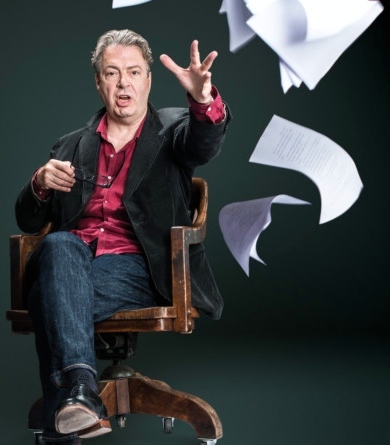
seminarThere is something warmly satisfying about seeing a character actor, who has given immeasurable pleasure in quality productions over the years, finally being elevated to name-above-the-title status. Bill Nighy was an example and now Roger Allam has established himself firmly alongside him. Theresa Rebeck’s play is the sort of semi-intellectual froth that American audiences seem to lap up, but Allam stands astride it like a giant. He plays Leonard, a writer, editor and tutor for aspiring novelists. Paid an exorbitant fee, he takes under his wing four young writers and, in between trips to Somalia, fronts a series of seminars, mostly devoted to dumping heaps of destructive criticism all over their efforts. Kate (Charity Wakefield), a Kerouac-hating feminist, acts as hostess in her dad’s large apartment on New York’s Upper West Side (beautifully realised in Lez Brotherston’s set) and she is the first victim of Leonard’s bilious onslaughts. Next up is Douglas (Oliver Hembrough), who uses long words to mask the fact that he is talking complete rubbish; advising him that his work is hollow, Leonard tells him that he will find a lucrative career in Hollywood. He is kinder to the nymphomaniac Izzy (Rebecca Grant), paving the way to bedding her, but has to reserve judgement on the diffident, hotheaded Martin (Bryan Dick) when he refuses to show his work. Allam revels in playing a monster; his world weary demeanour and sardonic delivery are a joy from start to finish, papering over many of the cracks in the script. Rebeck dissects the modern literary world and charts the shifting relationships between her five characters, but inconsistencies in her arguments and her characterisations abound, credibility often becoming stretched. At least once too often, one character reads about half a page of another’s work and declares it to be “a great novel” or some such. It is tempting to suggest that Rebeck could be the real life equivalent of Douglas, except that her target is Broadway rather than Hollywood; and guidance from a Leonard figure could possibly have taught her how to round off a story rather more convincingly than in this play’s clumsy final scene. Nonetheless, her dialogue often crackles, Terry Johnson’s light-touch direction always ensures that we never take things too seriously and Allam spearheads a quintet of sparkling performances. In the end, despite the play’s flaws, this production provides just about as much good light entertainment as anything currently running in London.

Performance date: 2 October 2014

Ring* (Battersea Arts Centre)

Posted: October 1, 2014 in Theatre

For those of us old enough to remember, the advent of stereophonic sound in the late 1960s was a time of wonder. It seemed a miracle that Paul Simon could sing to us in one ear, whilst, at the same time, Art Garfunkel was singing into the other. This show plays upon the same sense of discovery; we hear voices in the distance, voices closer, voices to our left, right, front and rear and then someone whispers into our ears. The only problem is that the novelty of stereo wore off almost half a century ago. Sitting in complete darkness and wearing headphones, we are firstly told that the seating is being moved to form a circle and we hear the shuffling of chairs. Then the presenter opens a discussion with what he claims to be members of the audience, but that deceit is blown to smithereens in about 30 seconds when it becomes clear that the actor-like voices that we are hearing are, in fact, those of actors. The publicity for this show claims that it “places the audience at the heart of a thrilling attack on their own identity”, but maybe that is as tongue in cheek as a press quote which declares a show, the essence of which is that nothing is visible, to be  “an absolute must see”. The same experience could be achieved by sitting at home and listening to a radio play (hopefully one better than this) with the lights off, which many may feel would have been a more profitable way of spending the evening.

Performance date: 1 October 2014

Electra***** (Old Vic)

Posted: October 1, 2014 in Theatre

electra2014 is turning out to be an unforgettable year for the Old Vic as it moves from one triumph to another. The decision to re-configue the auditorium to in-the-round was inspired, so memo to Messrs Spacey and Warchus: this is a space that London theatre cannot afford to lose. Here, the auditorium becomes a Greek amphitheatre; the stage is set as the forefront of a palace, the imposing doors of which have concealed betrayal and murder. Electra is the female equivalent of Hamlet in the simplest sense, her father, Agamemnon, having been slain and her mother, Clytemnestra, having married his killer. Hamlet is shackled by indecision, Electra by female frailty and she looks to the return of her exiled brother, Orestes to gain the vengeance with which she has become obsessed. Sophocles’ play, here using Frank McGuinness’s lean and lucid translation, is not a tragedy, it is a revenge thriller and director Ian Rickson piles on the tension in every scene, using original music by PJ Harvey to ratchet it up. It never matters that the casting pays little regard to relative ages, because almost every part of the production and every performance is totally mesmerising. Diana Quick is fearsome as Clytemnestra, a woman who, when told that her son is dead, enquires whether there will be anything in it for her. Jack Lowden, a heroic Orestes, could well become regarded as a lucky talisman for leading actresses; in the Almeida’s Ghosts, he played opposite last year’s Olivier award winner and it will be major shock if he does not do the same this year. As Electra, Kristen Scott Thomas is magnificent. Playing very much against type, she appears in a plain robe with hair dishevelled, howling and raging in grief and frustration. She and the chorus of three women turn the stage into a cauldron of hatred, but it is her demonstration of uncontainable joy that is likely to remain longest in the memory – waving her arms, touching, hugging, smelling what she has seen, but still disbelieving what her eyes have told her. The production meanders just a little in the middle, but, at 100 minutes straight through, there is rarely time to draw breath and the final third scales the heights of theatrical magic. Electrafying!

Performance date: 30 September 2014