Archive for December, 2014

Cinderella and the BeanstalkThis review was originally written for The Public Reviews: http://www.thepublicreviews.com

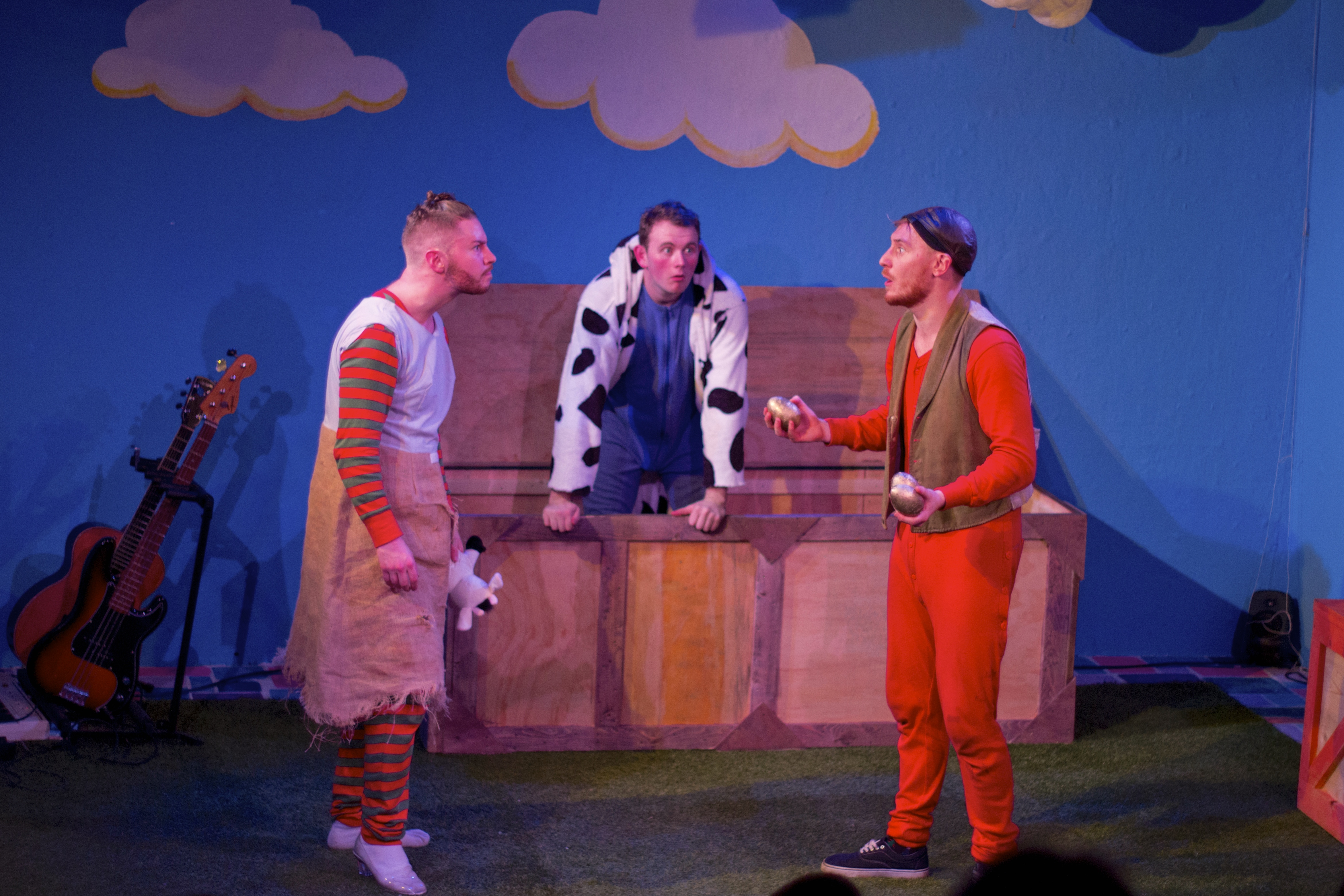
If you fancy a couple of pantos this Christmas, but are a bit short of time or cash, here is the answer – the theatrical equivalent of buy one get one free. Presented by three young men known collectively as Sleeping Trees, this is a mishmash of two traditional children’s stories served up with a Grimm cocktail of assorted characters from several more. James Dunnell-Smith, Joshua George Smith and John Woodburn arrive in dinner jackets to introduce the show that they have written, only to discover that no-one has remembered to hire any actors. Undeterred, they change into brightly-coloured long johns and perform the show themselves, taking on multiple roles, male and female. What follows is a pantomime of many dames and rapid costume changes. Bearded James is uncomfortable in the role of Cinders, who has only one sister because Josh does not consider himself ugly enough to play the other one, whilst John panics when several of his characters are on stage at the same time. Mark Newnham, composer of the show’s songs, sits in a back corner playing accompanying music and occasionally joins in the mayhem. A single set of pale blue, with fluffy white clouds provides the backdrop and several crates litter the stage; they contain costumes and a beanstalk which, rather sadly, grows horizontally. This is probably due to cost constraints, but, thankfully, this is a pantomime for which the budget does not run to soap stars either. A quick enactment of the entire film Home Alone at the start of the second half is near brilliant. Otherwise, knowing jokes aimed at adults and sure to go over children’s heads are notably absent and there is absolutely no smut. The script may be short on wit, but the compensation is a a tidal wave of simple, unforced jollity which deluges the audience and even Scrooge would have difficulty sitting through it without a broad smile on his face. Children (recommended age 8+) should revel in all the clowning, but maybe the younger ones would find a straightforward telling of a single story more enchanting and a scene in which “Mr” Cow gives birth could cause them quite a bit of confusion. Pantomime is often said to be the starting point from which children go on to develop a lifelong love of theatre, having been told magical stories, gazing in awe at the glitter and spectacle. Here we have the opposite of all that – a muddled plot, tiny cast, makeshift props and costumes. So welcome to the world of fringe theatre, kids, you’re going to enjoy the ride.

Performance date: 5 December 2014

thepublicreview_hor_web copy

Hope****+ (Royal Court Theatre)

Posted: December 4, 2014 in Theatre

hope-rcIt is hard to believe it possible that a play about local authority spending cuts could be quite as entertaining as this. Jack Thorne’s terrific new play is neither satirical nor cynical, rather it is a factual account of a fictional Labour council’s efforts to square  a familiar circle and it becomes so engrossing because of the way in which the writer skilfully develops his characters, weaves in personal stories and spikes the cocktail with generous infusions of laugh-out-loud humour. Faced with a £22 million cut in national government funding and denied any means to raise its own further revenue, this council prepares to set a budget for the coming year, deciding where the axe will have to fall – day care centres, libraries, swimming pools, public conveniences, etc are all lined up as likely victims. The Councillors all know that, when an assault takes place in an area where street lighting has been removed, they will be blamed and their level of personal involvement with public decisions is further emphasised by the ex-wife of deputy leader Mark running a special needs centre faced with closure. Fresh from a long run in Handbagged, Stella Gonet does not quite shed the Thatcher persona as council leader Hilary, but the character’s self-sacrificing sense of duty makes her far more sympathetic. Paul Higgins is perfect as the wavering Mark, battling with alcoholism, managing a tentative relationship with fellow councillor Julie (Sharon Duncan-Brewster) and taking responsibility for his excessively smart teenage son Jake (Tommy Knight). John Tiffany conjures up a carefully measured and superbly acted production, energising the dry but necessary discussions of detailed cuts with expressionist physical movement. Thorne could easily have made this a simple exercise in Tory bashing, but he has the wisdom to remember from whom the Coalition Government inherited economic chaos and, whilst his characters may call Cameron a ****, they are at least as disdainful of Ed (without specifying which one). Indeed, the play’s keynote speech, spoken by retired council leader George (the splendid Tom Georgeson), sounds like a eulogy for Britain’s deceased labour movement. In depicting a conundrum to which there is no solution, Thorne could well have called his play “Hopeless”, but then he tags on a wonderful final scene. Elderly George and young Jake sit together on a park bench discussing Dickens’ Great Expectations and, as the conversation develops, the simple optimism of youth overpowers the tired cynicism of age and the chosen title now seems perfect. It is late enough in 2014 to be able to say with reasonable confidence that Hope is one of the best new plays of the year.

Performance date: 3 December 2014

Obama-ology**** (Finborough Theatre)

Posted: December 2, 2014 in Theatre

obamaology-mainThis review was originally written for The Public Reviews: http://www.thepublicreviews.com

Looked at from the perspective of late 2014, the old adage that all political careers end in failure seems destined to find living proof in the shape of Barrack Obama. Aurin Squire’s biting critique of the state of modern democracy views the seeds of failure as having already been sown in November 2008, as he shows us an Obama campaign consumed by cynicism, compromise and personal ambition. Even so, the play also questions whether, taking a much longer view, failure will in fact be the final verdict of history. Squire looks at events through the eyes of Warren, a college graduate from New York and a newcomer to the campaign team. Being young, educated, black and gay, he seems to tick all the boxes to succeed on the liberal wing of American politics, except that he lacks the ability to connect with the disadvantaged electorate in the deprived area of East Cleveland to which he is assigned. At first, he cannot see beyond his narrow aim to be “part of history”, but the campaign takes him on a journey which leads him to want to make a difference to people’s lives in ways that charismatic politicians cannot directly bring about. As Warren, Edward Dede takes centre stage for much of the play and holds this production together. Ranging from a comic figure of wide-eyed innocence to a passionate advocate for self-improvement, he gives a commanding performance. No less impressive is Pearl Mackie as Cece, an illiterate mother of two whose ambitions do not extend beyond a job in a burger joint. The bond which develops between Warren and Cece forms the emotional core of the play. Mackie shows her versatility by also playing Caits, a feisty street kid and a campaign “instructor”. Peter Caulfield, Katherine Newman and Amanda Wright are all excellent, primarily playing senior members of the campaign team and sharing all the other roles. Campaign posters and urban graffiti around all sides of the stage create a feeling of chaotic energy and Tommo Fowler matches this by giving us a fast flowing production in which comedy, suspense and high emotion are delivered with equal confidence. In all respects, this production is in tune with Squire’s smart and incisive dialogue. On election day, as naive idealists utter platitudes such as “this is post-racial America”, the realists in the campaign team are already busy lining up jobs for themselves in the new administration. Squire’s play understands that momentous changes cannot be brought about on one day nor can they be achieved by one politician, but it also tells us that, If that politician can inspire hope within downtrodden individuals, he will not have failed.

Performance date: 1 December 2014

thepublicreview_hor_web copy