Archive for March, 2015

Lardo**** (Old Red Lion Theatre)

Posted: March 6, 2015 in Theatre

LardoThis review was originally written for The Public Reviews: http://www.thepublicreviews.com

It is many years since wrestling disappeared from the schedules of the main television channels and icons such as Big Daddy and Giant Haystacks have faded into distant memory. So it will come as a surprise to many that the sport is still going strong, at least in Glasgow where Mike Stone’s new play is set. Lardo is a rotund, not too bright young man who has not quite grown up. He believes that his father died in the wrestling ring when he was a child and sets his heart on going into the same profession. Daniel Buckley is ideal in the role; wearing spandex to emphasise every unflattering bulge, it is easy to believe that he would create a sensation on You Tube and generate the following needed to draw crowds to Wrestling. Buoyed by his internet success, he turns his back on his pregnant girlfriend (Laura Darrall) and knocks on the door of ruthless promoter Gavin Stairs (Nick Karimi). The set for Finn Caldwell’s production could not be simpler – a wrestling ring filling almost the entire performance space – and it provides the stage for several breathtakingly realistic fight sequences. The close proximity of the audience, on two sides of the ring, is a key factor and the actors/fighters milk audience participation for all it is worth. Wrestling in the liberated era includes both sexes and Zoe Hunter gives a strong performance as “Whiplash Mary”, a fighter bruised inside and out. As operated by Stairs, played by Karimi as an ugly thug, Wrestling is a seedy business, at odds with the modern world. When a Health and Safety officer (Rebecca Pownall) intervenes, Stairs’ response is to seduce her and carry on regardless to push for further extremes of violence. Lardo’s friend who fights under the name of “Wee Man” (Stuart Ryan), takes the worst of the resulting knocks. Due to doubling up of roles, all six actors get turns in the ring and the action eventually climaxes in a Rocky-style showdown. Those who have always seen Wrestling as part sport, part theatre, may well be inclined to comment that it has at last found its natural home. Stone touches on serious social issues – the irresponsibility of exploiting uneducated youngsters who are greedy for fame and wealth and the immorality of feeding the public hunger for ever more realistic violence. However, he does not dig too deep, preferring to wrap his play in a simple and sometimes trite storyline, leaving plenty of room for the action sequences. On balance, his approach seems to have paid dividends and he could well have created a sizeable popular hit.

Performance date: 5 March 2015

thepublicreview_hor_web copy

jerrys-girls266This review was originally written for The Public Rviews: http://www.thepublicreviews.com

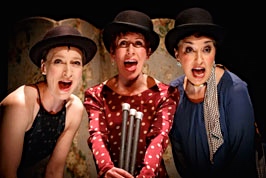
Jerry Herman is what he is – a master of traditional Broadway musicals. He is also the creator of some formidable female characters, even if the best known of them are a little too seasoned to be called “girls” and, in the case of La Cage Aux Folles, they are really not female at all. This cabaret-style revue of songs from Herman shows started life in New York and comes to London featuring three sassy dames, all leading musical comedy stars who are well capable of giving plenty of welly to material like this. The stage is set up to resemble a star’s dressing room, with a grand piano at the side and hanging on the wall are photographs of Jerry’s real life “girls” – Ethel Merman, Carol Channing, Angela Lansbury, Barbra Streisand – seemingly to remind this show’s stars of what they have to live up to. Herman had three Tony Award winning smash hits on Broadway – Hello Dolly, Mame and La Cage… – and another which flopped, but has since grown in stature and is now considered by many to contain his finest score – Mack and Mabel. These four shows provide the majority of the songs in this revue. Anna-Jane Casey, fresh from a successful run in Forbidden Broadway, Sarah-Louise Young, a cabaret regular who has worked with Fascinating Aida, and Ria Jones, star of countless musicals, are just about perfect for this blend of comedy, pathos and gutsy determination. They combine for a hilarious version of Tap Your Troubles Away, bringing into the dance routine accompanists Edward Court and Sophie Byrne, and then, leading up to the interval, they take the title songs from Dolly and Mame, along with When Mabel Comes in the Room to perform a memorable medley. It seems unfair to single out any one of the three stars for special praise, but it has to be said that Jones grasps at every opportunity to steal the show. Starting with a wonderfully self-deprecating response to Take it All Off (written for this revue), she then fills in for the absence of an authentic “Mack” with a stunning version of the beautiful I Won’t Send Roses, breaks our hearts with Time Heals Everything and climaxes by bringing the house down with I Am What I Am, gaining in conviction and confidence with every line. Jerry Herman has enjoyed a mini-renaissance in the last couple of years with UK premieres of “forgotten” shows Dear World and The Grand Tour. This revue should add to his reputation and next up is a revival of Mack and Mabel, in Chichester and then touring from the Summer. The appetite is well and truly whetted.

Performance date: 4 March 2015

thepublicreview_hor_web copy

Heavens-of-intentionsThis review was originally written for The Public Reviews: http://www.thepublicreviews.com

Laurence Olivier and Ian Fleming were born little more than a year apart when King Edward VII was on the throne, they moved in touching circles (Noel Coward, for example was known to both) and, in their different fields, they became British icons of the 20th Century. Mark Burgess’ two one-hour monologues show these figures in their declining years, looking back over their lives. Larry, directed by Daniel Finlay has topical poignancy at a time when Michael Gambon and Maggie Smith have announced that they can no longer cope with the rigours of live theatre. We first see Olivier in 1975, when his last stage appearance at the Old Vic is behind him and the National Theatre is established. He has recovered from two life- threatening illnesses, but is frail, suffers from stage fright and has even dried on the first night of Ibsen’s The Master Builder. He is in New York to shoot Marathon Man, doing battle with Dustin Hoffman over his method acting techniques and learning the skills of dentistry. Keith Drinkel show’s Olivier as a man still filled with insecurities and uncertainties even though he has reached the pinnacle of his profession, playing him as an actor who knows no other way but to go on acting when the tools which he needs are failing him. When we see him again in 1983, he is packing a suitcase full of of old scripts and using it in a lifting exercise to give his arms the strength to carry Cordelia in a television version of King Lear. A professional to the end, he remains adamant that he will not allow her to be supported by strings. The Man with the Golden Pen, directed by Louise Jameson, begins in 1952 at Ian Fleming’s Jamaican home. He is dressing for his wedding and, having just completed his first novel, holding a conversation with its hero, James Bond. From a privileged background, Fleming is a man who has lived a hedonistic lifestyle, ridden his luck and got away with it. Setbacks, such as contracting an unfortunate disease are skimmed over and we hear mostly of a life filled with booze, women and extravagance. However, when only in his 40s, his excesses are already beginning to take a toll on his heath. It emerges that Bond is a cocktail – one part extracted from Fleming’s own life, one part people he has known and several parts wish fulfilment fantasy. Michael Chance plays Fleming as debonair, but regretful that maybe he has let slip some of the more important things in life. When we meet him again, ten years and ten Bond novels later, he has suffered a heart attack, his marriage is in ruins, his fictional hero having become the third person in it, and he resents being sneered at by literary intelligentsia. He expresses reservations over the casting of a rugged Scotsman as Bond in Dr No, but he was not to live to know the phenomenal success of the film franchise that would follow. There is little that is revelatory in these two short plays, most of the anecdotes being well known previously, even to those with only a smattering knowledge about these two men. However, both plays are performed competently and Burgess strikes a good balance between factual detail and humour which always entertains.

Performance date: 2 March 2015

thepublicreview_hor_web copy