Archive for February, 2024

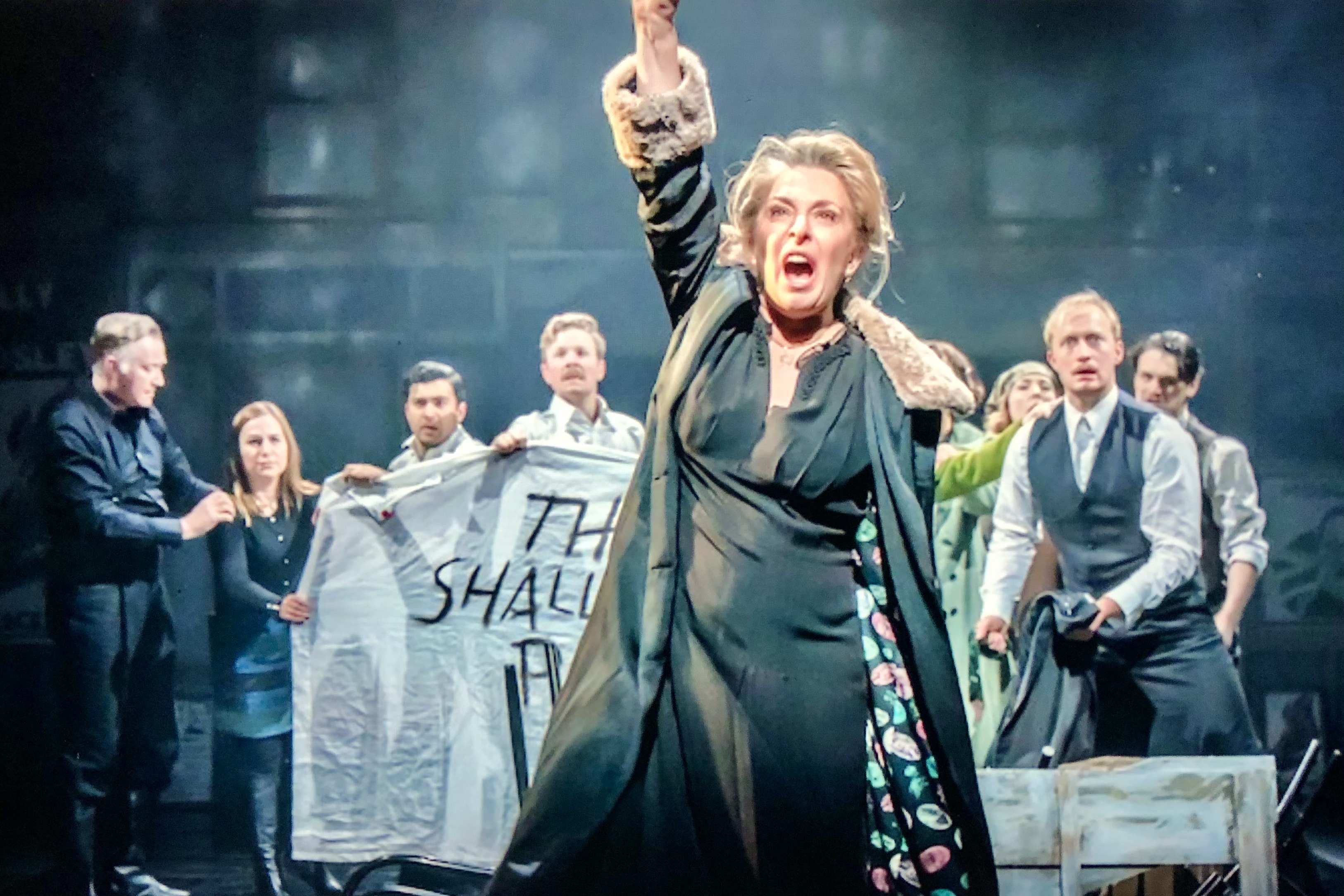
Photo: Marc Brenner

Writer: William Shakespeare

Director: Brigid Larmour

⭐️⭐️⭐️⭐️

Increasingly in recent years, The Merchant of Venice has come to be regarded as one of William Shakespeare’s problem plays, due to the perceived antisemitism in its treatment of the vengeful Jewish moneylender, Shylock. Perhaps cutting the most offensive lines could sweep some of the difficulties under the carpet, but, courageously, director Brigid Larmour’s revival takes exactly the opposite approach by tackling the problem head on.

The production lands in the West End for a limited run almost a year after it began touring. Therefore, it was conceived well before the sequence of events triggered on 7 October 2023 added new urgency to its anti-antisemitic sentiments. This version of the play is set in the East End of London in 1936, when mobs of black-shirted demonstrators, led by former Labour Member of Parliament Oswald Mosley, were swarming the streets in ugly protests against the Jewish community, aligning themselves with activities of Adolf Hitler’s Nazis in Germany. Real life newsreel footage from the time and newspaper cuttings are projected onto the set, accompanied by British nationalist images and patriotic songs.

The change of setting does not explain the change in Shylock’s gender, but making the character a woman takes nothing away from the power of the messaging. In fact Tracy-Ann Oberman’s compelling performance in the role provides more than adequate justification. Abandoned by the elopement of her daughter Jessica (Gráinne Dromgoole) with the gentile Lorenzo (Priyank Morjaria), she becomes an isolated figure and it is made abundantly clear why the racist abuse which she receives, particularly at the hands of the arrogant merchant Antonio (Raymond Coulthard), is unbearable and why she is driven to claim her pound of his flesh.

The lack of colour in Liz Cooke’s set and costume designs establishes a sombre tone which runs throughout. This makes the rather silly romcom  that takes up a large part of the play’s first half seem even more ill-fitting than usual. Portia, played as a very modern professional woman by Hannah Morrish, has inherited great wealth from her late father and now has to choose between suitors by getting them to open caskets. There is much more potential for comedy here than Armour chooses to squeeze out, but perhaps it is wise to understate these scenes rather than risk undermine the gravity of the production’s overriding themes.

Portia’s chosen suitor is Bassanio (Gavin Fowler), Antonio’s close friend, and thus she is drawn into the merchant’s conflict with Shylock. The stage is now set for a searing, all-female courtroom battle of breathtaking intensity. Very lucidly, the question is asked as to who is in the right – the persecuted and abused Shylock, fighting for her honour, her heritage and her faith or Antonio, defending his flesh and his life.

in this adaptation by Armour and Oberman, the play runs for a manageable 130 minutes and, even if the brief sermonising which rounds it off feels unnecessary, it underlines the deep passion of all involved in the project. When the quality of mercy prevails here, we are left hoping that the same will soon happen universally,

Performance date: 21 February 2024

Photo: The Other Richard

Writer: Neil D’Souza

Director: Alice Hamilton

⭐️⭐️⭐️💫

Have you ever wondered what goes on in a holiday resort such as Ibiza after the young revellers have departed? Have you ever wondered what becomes of fun-seeking lads when they are not lads any longer? Neil D’Soiza’s bitter-sweet new coming of middle age comedy sets out to answer these questions and to peel back layers of male friendships.

Chris. a small-time guitarist and singer is about to celebrate his 50th birthday. It is October and he arrives in Ibiza with his slightly older friend Dev, 30 years after they first holidayed at the same hotel in the same room 547. Dev is a somewhat geeky music teacher who has “I love Dvorak” tattooed  in a privates place and brings along a Thomas Mann novel for bedtime reading. Neither has maintained a successful relationship.

This is a character driven play that relies on strong performances. Peter Bramhill’s Chris is a likeable extrovert who occasionally lets slip a feeling of low self-esteem and regret for missed opportunities. The writer himself gives a beautifully understated performance as Dev, a British Asian who is withdrawn and has allowed himself to play the role of an underling. The two men’s inner characters start to be revealed when they meet two women, also holidaying from England – Holly (Kerry Bennett) and Amy (Catrin Aaron).

The play meanders rather aimlessly through an amusing but insubstantial first act, but it then springs to life with the appearance of Michael, the third member of the lads’ holiday of 30 years earlier, who immediately orders five magnums of Champagne. James Hillier gives Michael the unpleasant swagger of a man who has achieved success as a music agent but has shown a callous disregard for others, particularly women, encountered along the way.

Director Alice Hamilton’s breezy production allows all five actors to shine in a compact studio space. A lot is crammed into Janet Bird’s set design, representing a standard Spanish tourist class hotel room, dominated by a large double bed, which, we are assured, can be split into two singles.

D’Souza’s writing reveals a subconscious hierarchy in the structure of male friendship groups. Here, Michael is clearly the alpha and the other two fall in line behind him. Patterns of behaviour that are established at the start of their friendship prevail over decades and are repeated, with seemingly harmless banter turning into bullying which can leave permanent scars. 

Out of Season is a gentle comedy with subtle insights. The writer leaves his characters with faint hints that, even in their Autumnal years, brighter futures can still be found.

Performance date: 22 February 2024

Photo: Mark Douet

Writer: Jez Butterworth

Director: Sam Mendes

⭐️⭐️⭐️⭐️⭐️

It is now almost seven years since The Ferryman hit the London stage, making it a long wait for Jez Butterworth to stake another claim to be dubbed our greatest living playwright. That 2017 Ireland-set drama went on to pick up both the Olivier and Tony awards for Best New Play, so, whatever the fate of The Hills of California, its arrival must rank as a major event in theatre.

Belying the play’s title, its setting is the Northern English seaside resort, Blackpool. It begins in the long hot Summer of 1976. The Sea View guest house lacks air conditioning and it has seen better days, but it has never viewed the sea. The set, designed by Rob Howell and reaching up to the theatre’s ceiling, is a labyrinth of steep staircases, brown furniture and bric-à-brac. A non-functioning juke box sits centre stage.

The owners are the Webb family and three sisters belonging thereto – Jill (Helena Wilson), Ruby (Ophelia Lovibond) and Gloria (Leanne Best) – gather in the guest house while their mother, Veronica, lies dying upstairs. They await the arrival of a fourth sister, Joan, who had left to pursue a show business career in California 20 years earlier. It will be for the four to decide whether to authorise a final dose of morphine to end their mother’s pain.

The writer sees this dysfunctional family as a microcosm of a wider world that was caught in a vice-like grip by American culture in the early years of movies, radio and television. Flashback scenes transport us to the mid-1950s when Veronica (Laura Donnelly in blazing form) is seen moulding her young daughters to become the next Andrews Sisters, targeting the London Palladium, Carnegie Hall and beyond. This pushy showbiz mum is a Mamma Rose from Gypsy for whom nothing is coming up roses.The Andrews Sisters themselves are already yesterday’s news, having been replaced in popularity by the likes of Nat King Cole, and Elvis Presley lies on the horizon.

An understanding that the Hollywood dream is actually a mirage runs through the play like the lettering in a stick of Blackpool rock. Butterworth’s dialogue merges the lyrical and the earthy, threaded together by strong, dark humour. He writes as if he has spent half a lifetime surrounded by Northern matriarchs.

The play reunites Butterworth with director Sam Mendes, who showed with  The Ferryman a flair for marshalling enormous casts. Here 22 actors have speaking parts and they come up with several delightful cameos in support of the four wonderful principals. This production’s greatest strength lies in the loving care devoted to giving every character depth and meaning.

From the ashes of shattered dreams, the play seeks reconciliation. Arguably the third act is a little overlong and brings in unnecessary plot asides, but a climax in which truths and falsehoods become inseparable brings the drama to a wistful and wise conclusion. Yes, at three hours including an interval, it is a long play, but sometimes it is impossible to have too much of a good thing.

Performance date: 8 February 2024

Photo: Manuel Harlan

Writer: Beth Steel

Director: Bijan Sheibani

⭐️⭐️⭐️⭐️

As we leave January behind us, we can embrace the warming prospect that we shall soon see the arrival of Spring, traditionally the season when wedding bells fill the air. Beth Steel’s new comedy/drama adds a dash of trepidation to this thought as she sets out the routines  attaching themselves to a working class wedding in Northern England and then tears them apart.

Sylvia (Sinéad Matthews) is getting married to Marek (Marc Wootten), a self-made businessman of Polish origin. She panics as she fails to zip up her wedding dress while her father, Tony (Alan Williams), a widower, is waiting to give her away. Hazel (Lucy Black) and Maggie (Lisa McGrillis) are her sisters, the former married to unemployed John (Derek Riddell) and with two mischievous young daughters, the latter  having moved away from the area a year earlier for mysterious reasons.

Steel reserves her most acerbic lines for the forthright Aunty Carol (a stand-out performance from Lorraine Ashbourne), who is married to Tony’s estranged brother Pete (Philip Whitchurch). Carol takes control on arrival and suffers the indignity of having her flamboyant hat attacked by the cat. The perceptive comedy rolls along briskly during the first act, but appears to be going nowhere until everything starts to unravel.

The writer’s proposition is that the rituals in place at weddings, partly designed to paper over cracks in family life, in fact serve to magnify them and bring them to the surface. She harks back to themes in her 2014 play, Wonderland, to find lingering resentments resulting from the 1984/85 Miners Strike and she exposes the racism that underlies the family’s reluctant acceptance of Malek. Most telling are the long suppressed passions that are unleashed by an excess of Polish vodka, seen when John and Maggie are caught in an embrace and when Tony becomes Tarzan and, hilariously, wrestles with a crocodile before carrying Jane (Aunty Carol) over his shoulder to safety.

Director Bijan Sheibani’s slick production thrives on magnificent ensemble acting that brings the many characters to vivid life. Designer Samal Blak takes full advantage of the staging that is in-the-round, literally, marked out like the centre circle on a football pitch, perhaps symbolising a wedding band, or, more likely, a circus ring. The reception, for which the family convenes around a giant revolving top table is a first act highlight.

Steel’s play lulls the audience into a false sense of security by starting out as a cosy comedy and then turns itself into a raw and real family drama, building to an explosive climax which rattles the foundations of the Dorfman Theatre.

Performance date: 31 January 2024