Archive for April, 2024

Stephen

Posted: April 26, 2024 in Cinema

Writers: Melanie Manchot and Leigh Campbell

Director: Melanie Manchot

⭐️⭐️⭐️

Lying in the archives of the British Film Institute is a groundbreaking 1901 crime thriller set in Liverpool. Normally, its existence may only be of interest to cinema historians, but it now provides the inspiration for director Melanie Menchot’s new film within a film.

On one level, Stephen is an account of the devastating effects of addictions in a working class community. On another level, it is a penetrating study of the craft of film acting. Maybe the two levels do not always connect cleanly, but this 78-minute drams proves to be consistently intriguing.

Actor Stephen Giddings stands before a casting panel, auditioning for the central role of Thomas Goudie in the 1901 film. Taking method acting techniques to extremes, he immerses himself in the role, experiencing addictions to gambling, alcohol and drugs and mixing with real life addicts who play themselves in the film. The labyrinthine narrative structure, merging past with present, fact with fiction, comes to mirror ways of life from which there is no easy escape.

Menchot offers little help to audiences trying to wade through the complexities. There are no period costumes and the locations are all modern day. Areas of Liverpool that tourists are least likely to visit are captured in cinematography that is in cold and unwelcoming, underlining the key point that that addiction problems can strike the lest privileged and most vulnerable in society.

Giddings binds the film together sturdily, expressions of hopelessness on his face as he becomes Goudie, falling victim to forces beyond his control and facing up to the mental health problems that addictions bring. He leads a group of actors, mostly little known, with the exception of former soap star Michelle Collins, who is cast against type as a menacing loan shark. Her brief contributions send shivers down the spine. The appearance of non-professional actors in scenes, such as those set in Alcoholics Anonymous meetings, adds valuable authenticity to the drama.

Manchot’s unorthodox approach pays dividends, but it also draws its toll, as moments of truth are revealed abruptly to be moments of deception. If we are to invest fully in these characters, their emotions and their dilemmas, we need to believe in them and repeated reminders that they are actors on a film set that is itself on a film set prove to be counter-productive. Particularly frustrating is a potentially moving scene in which Stephen/Thomas meets his brother (Kent Riley) in a pub, the latter trying trying to persuade him to mend his ways for the sake of a loving family. The emotional power builds, but then the camera pull out and it all mets away. 

Stephen is bold in style and harrowing in content, but, in places, its complex structure softens its impact. 

Photo: Mark Senior

Writer: Samuel Adamson

Director: Richard Twyman

⭐️⭐️⭐️

Ever since the release of David Lean’s classic 1945 film, Brief Encounter, middle-aged couples, classical piano music and railway stations seem to have been linked inextricably. All three elements figure in the mix for The Ballad of Hattie and James, Samuel Adamson’s new play, which is a complex study of the adversarial platonic friendship between the title characters, spanning almost 50 years.

The play begins in 2019 with Hattie playing the piano at St Pancras International station. This leads to a reunion with James, a professional musician who she had first met in 1976, and we then see how their on-off relationship develops over the years. When they come together, they cannot even agree on who contacted whom to arrange the meeting, but their conflicts lead to a strange form of mutual dependency that, repeatedly, draws them back to each other.

Hattie is eccentric, wears two scarfs and has ambitions to play the piano at the Royal Albert Hall, but she settles for a job in a tax office. James is gay, stuffy, wears old corduroy trousers and is passionate about Benjamin Britten. They could be the proof that opposites attract and music unites them until it tears them apart. 

There are few actors more accomplished at playing eccentric characters than Sophie Thompson and, as Hattie, she is terrific, pushing the comedy as far as she can without going over the top, while finding the pathos in a life of promise unfulfilled. Charles Edwards’ James, an awkward, impassioned academic, is the perfect contrast. Suzette Llewellyn provides solid support to these precisely judged performances, playing multiple roles, and Berrak Dyer plays the piano beautifully.

The product, directed by Richard Twyman, navigates through the play’s crescendos and decrescendos fairly successfully, only getting stuck in some overlong and over-analytical scenes. Adamson packs the script with details of the characters’ back stories which prove to be of little use in helping us to understand their emotions and the strange bond that holds them together. 

There are minor quibbles about what is, overall, an engrossing and unusual drama, but maybe just a little fine tuning could give it a lot more clarity.

Performance date: 18 April 2024

Writer and performer: Tom Walker

⭐️⭐️⭐️

If anyone has ever wondered what BBC News would be like if it lost its balance, Jonathan Pie (alter ego of Tom Walker) could provide the answer. Pie is the BBC’s Westminster correspondent and, having worked previously for Russia Today, he knows all about democracy.

Perhaps realising that preaching Socialism to an audience that has paid West End ticket prices may not be too good an idea, Pie begins by promising that his “lecture” will not be a Party Political Broadcast on behalf of the Labour Party and, instead, he makes it a Party Political Broadcast against the Conservative Party (and others). All Prime Ministers since Thatcher are in the firing line, with Rishi Sunk being named the most evil of all for having once worked as a hedge fund manager. There are many villains, but where are the heroes that the show’s title promises?

The evening begins with a so-so 20-minute set from Egyptian-American comedian Maria Shehata. Presumably, her job is to warm up the audience for Pie, but, having done so, she sends us out for a 20-minute interval and cools us down again. Very odd.

Pie’s style is to launch into ferocious, foul-mouthed tirades, pitched at such a level that they cannot be good for his blood pressure. A Socialist who sends his son to a private school and is a member of BUPA, a conservationist who cannot be bothered to re-cycle waste and regards David Attenborough as overrated, we figure out that Pie’s Achilles heel is hypocrisy long before he owns up to it.

Moving at break neck speed, Pie leaves us little time to dwell on the nonsenses or to figure out the other side of his arguments. Corruption, cronyism, privilege, greed, etc are all sitting targets and, when he hits them, his observations are often very funny. His overlong “lecture” only flounders when he asks us to take him seriously.

Pie rants against every political and social convention that comes, apparently randomly, into his head, reserving special venom for British democratic institutions. However, it is all reminiscent of Basil Fawlty beating up his motionless car and maybe this self-confessed hypocrite’s hopes for real change are just pie in the sky

Performance date: 16 April 2024.

Player Kings (Noël Coward Theatre)

Posted: April 14, 2024 in Theatre

Photo: Manuel Harlan

Writer: William Shakespeare

Director: Robert Icke

⭐️⭐️⭐️⭐️💫

With a title that alludes to a character in Hamlet, Robert Icke’s production of Player Kings is a mash-up of the two parts of  Henry IV, William Shakespeare’s stirring coming-of-age saga, which tracks the progress of the heir to the throne, Prince Henry (Hal), from wastrel to warrior. Its themes are timeless and universal.

King Henry (Richard Coyle) appears with regalia not dissimilar from that seen at the coronation of King Charles III, as Icke gives an immediate signal that no opportunity to link the play to the modern world will be missed. Henry’s grip on the throne is tenuous, with descendants of his deposed predecessor gaining momentum, but how he wishes that he had a son to match the valiant Hotspur (Samuel Edward-Cook), that of his adversary. Instead, his own oldest son is absent, attending the “court” of Sir John Falstaff, a battle-hardened retired soldier, who is set on growing old disgracefully in the bawdy ale houses of East London.

The jewel in Player Kings’ crown is youthful octogenarian Ian McKellen’s marvellous Falstaff. As written, the character is truly ridiculous and McKellen goes flat out to squeeze every drop of pitiable absurdity from him, knowing that, in these plays more than any others, Shakespeare connects comedy to drama with absolute precision.

Toheb Jimoh’s Hal is angry and petulant, as if holding off his inevitable accession. But this is not a gullible kid who simply falls for Falstaff’s boasts, exaggerations and lies. He is fully aware that, while he joins in the boozing, whoring and pranking, his heritage sets him apart. On stage together, McKellen and Jimoh generate magical chemistry, lighting sparks off each other.

Running at well over three hours, including one interval, this could have become a hard slog and, very briefly, Icke’s production gets bogged down in 15th Century politics. However, mostly, it skips lightly over them, leaving scene-setting factual details to appear occasionally as surtutles. Using minimal sets, designer Hildegard Bechtler opts for varies 20th Century costumes and the staging relies on hand-drawn curtains at scene changes. The overriding mood is inflamed much by dim, atmospheric lighting, designed by Lee Curran. The climax to the first half is the Battle of Shrewsbury, staged with long shadows, gun shots and explosions. What is lost in historical accuracy is made up for in dramatic intensity and Icke tops it off with a wonderful coup de théâtre.

The second half is more subdued and reflective, giving it the potential to feel like an anticlimax. However, rich characterisations save this production from that fate and foundations laid down in raucous earlier scenes add power and poignancy to the Bard’s melancholic study of ageing and renewal.

Popularised by star casting, revivals of Shakespeare plays in commercial theatres seem to be going stronger than ever before. Player Kings certainly sets a high bar for those that follow.

Performance date: 12 April 2024

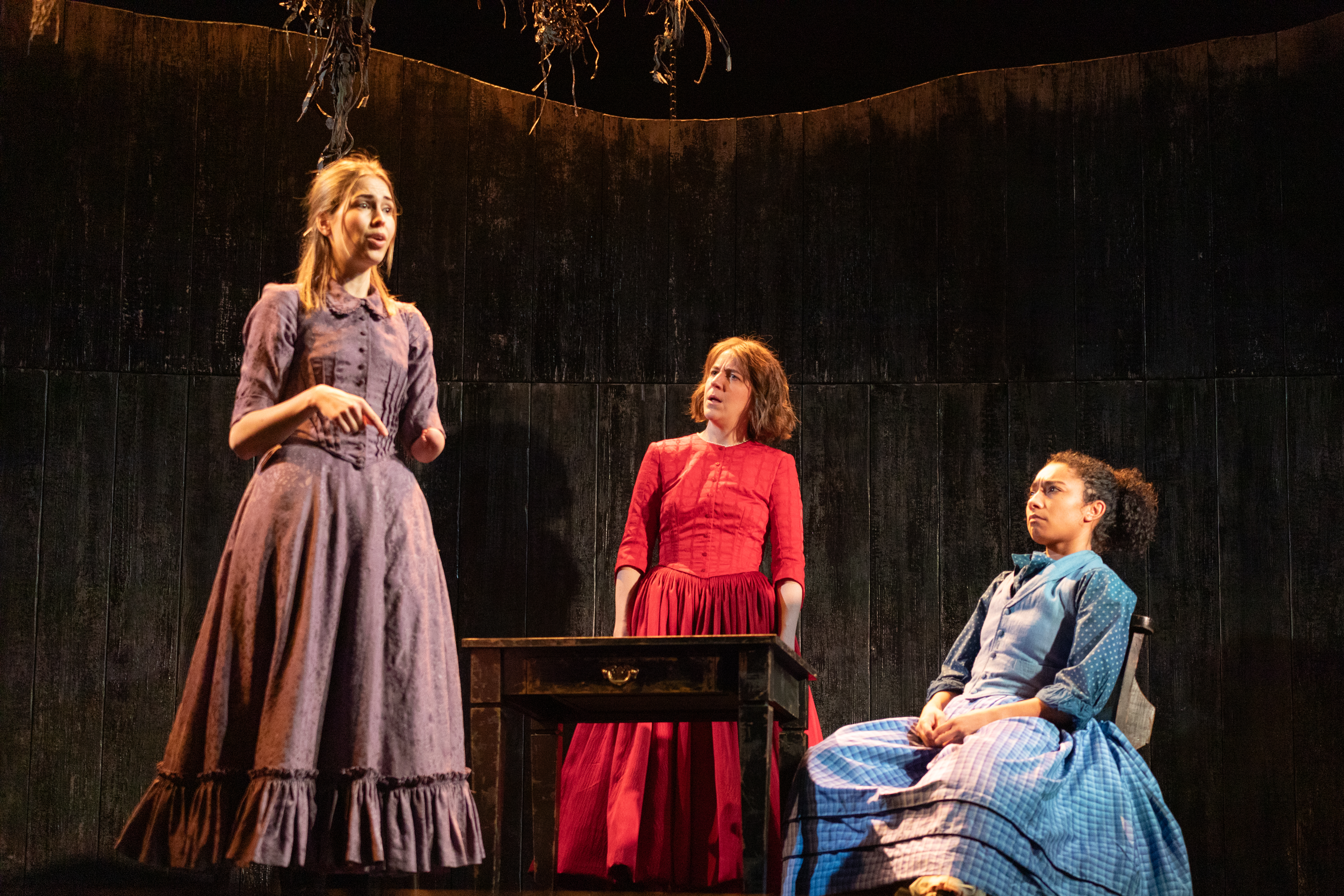
Photo: Isha Shah

Writer: Sarah Gordon

Director: Natalie Ibu

⭐️⭐️⭐️⭐️

In the 1840s, when the nights were cold and blustery on the Yorkshire Moors, if there were no good books to read, it seems that the best thing to do would have been to write them. Such was the case with the legendary Brontë sisters who provide the inspiration for Sarah Gordon’s new play, a compelling tale of sisterly rivalries blended in with 19th Century gender politics an 21st Century celebrity culture.

The Dorfman Theatre is introduced to re-wilding in set designer Grace Smart’s representation of the drama’s primary location and, even though the vegetation disappears from view, it leaves behind a sense of the characters’ earthiness, their language being peppered generously with fruity modern-day expletives. As Gordon examines the dynamics of female relationships, her hypothesis is that the “other other” sister is Anne, the youngest, who is overshadowed unjustly by the domineering Charlotte, the oldest, and by Emily, whose novel Withering Heights is already acknowledged to be a great work.

Gemma Whelan’s Charlotte, dressed all in bright red,  is ambitious and surprisingly cold-hearted. It is she who advocates the sisters working together, encouraging and supporting each other as they strive to succeed as writers. In fact, collaboration turns into competition and jealousy. Gordon shows us Charlotte shamelessly plagiarising Anne’s debut novel, Agnes Grey, when writing Jane Eyre and, later, going on to suppress The Tenant of Wildfell Hall, Anne’s hard-hitting account of early Victorian society.

Anne (Rhiannon Clements) fights in vain to resist Charlotte’s dominance, while Emily (Adele James) stands between them. With the sisters being forced to publish their works under male pseudonyms, Gordon turns a strong spotlight on the subservience of women in Victorian society, adding sly references to modern-day gender inequalities. She also shows sympathy for the fourth sibling, rarely sober brother Branwell (James Phoon), who finds himself incapable of living up to the expectations for a man in that era.

Written with strong hints of sarcasm, the play is a sometimes uneven mix of drama and broad comedy, held together by an overriding tone of irreverence. Director Natalie Ibu’s snappy production, making good use of a revolving stage, captures the tensions of the sisters’ clashes and then switches seamlessly to something like pantomime, with Nick Blakeley making a couple of appearances as “dames”.

The story of these three women who left an indelible mark on English literature has been told many times before and, in factual terms, Gordon adds little that is new. However, she uses the story as a vehicle for expressing many intriguing ideas and, seen in a production that is acted with conviction and impressively staged, her play is richly entertaining. The National Theatre is on a high at the moment and the clumsily titled Underdog: The Other Other Brontë looks likely to become another another success.

Performance date: 4 April 2024