Archive for June, 2024

What Comes Next for Next to Normal

Posted: June 24, 2024 in Theatre

At first sight, a Broadway musical dealing with mental illness and bereavement is far from normal. Yet, as director Michael Longhurst points out, many of the greatest musicals cover very dark themes and a song can be more effective than a paragraph of words in exploring the human condition.

Longhurst was chairing a discussion among cast and creatives on the stage of Wyndham’s Theatre in London’s West End, to where his critically-acclaimed 2023 production of Next to Normal at the Donmar Warehouse is transferring. The group sat scattered around a nondescript family kitchen, being the solitary set on which all the drama unfolds.

The show’s American composer, Tom Kitt, reflected on the 26-year journey that has brought him here. It all started when he and book writer and lyricist, Brian Yorkey, were challenged to write a 10-minute musical. He cites Stephen Sondheim and Kander and Ebb as his main influences, being writers who are not afraid to delve into serious issues nor to venture through previously unexplored territory. The development of Next to Normal led to an off-Broadway premiere in 2008, transferring to Broadway in 2009, picking up a Tony Award for Best Original score and a Pulitzer Prize for Drama. Now, Kitt roams daily around London’s theatre district, looking in wonder as he realises that he is becoming part of it all.

During the 15 years or so that it has taken for the show to cross the Atlantic, it developed something of a cult status here, fuelled by clips on the internet. One avid fan was actor Jack Wolfe, who had bought tickets for the Donmar Warehouse before auditioning for the key role of Gabe. He got the part and, with it, the show-stopping song, I’m Alive. When reading the script, Longhurst recalls that he kept hearing the voice of American actor Caissie Levy as Diana, the troubled wife and mother. He had directed her in the New York production of Caroline, or Change and, happily, she accepted the role, which she is now reprising.

The intimate Donmar Warehouse has around 200 seats and is configured so that the audience is almost sitting in Diana’s kitchen. Longhurst talked about the challenges of transferring his production to a medium-sized, traditional proscenium arch theatre. Olivier Award-winning actor, Jamie Parker, who plays Diane’s husband Dan, has starred in musicals at many West End and London fringe venues and he believes that this transfer gives the show the chance to exercise its muscles. He says that, through rehearsals and previews, the actors have been finding new dimensions for their characters and in the story.

With the costs of staging extravagant new musicals spiralling upward, risk-averse producers on Broadway and in the West End seem to be turning either to safe bets or to smaller scale, more intimate shows. Maybe Next to Normal is confirming a trend towards what is becoming the new normal.

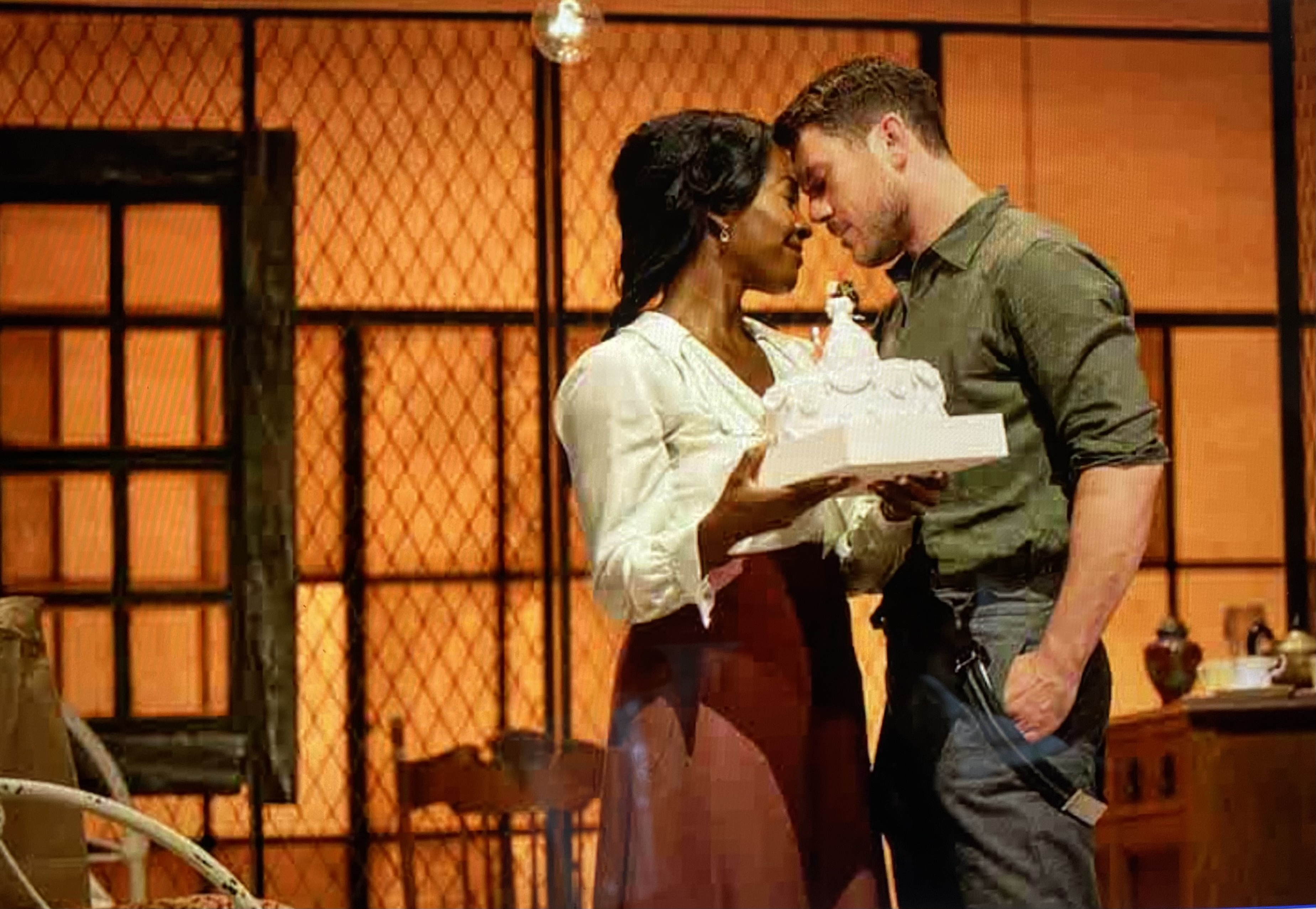
Photo: Mark Senior

Writer: Alice Childress

Director: Monique Touko

⭐️⭐️⭐️⭐️

American writer Alice Childress wrote during turbulent times about other turbulent times. Her play, Wedding Band… was first performed in 1966, when Civil Rights protests were at their height and war was raging in Vietnam, and it is set in the Deep South in 1918, when racial tensions were at boiling point, Spanish Flu was beginning to spread across the world and war was raging in Europe. There is more than enough drama here to warm up a cool Summer evening in Hammersmith.

Childress tells a Romeo and Juliet-type story of two lovers coming from opposite sides of a community that is torn apart. Julia (Deborah Ayorinde) is a black seamstress and Herman (David Walmsley) is a white baker. They have been together for 10 years in a covert relationship, but interracial marriage is still illegal in their State, South Carolina and they know that they must move north to formalise their union. However, once their relationship becomes known, the law is a lesser problem than the deep-rooted prejudices of their friends and families.

With a strong company of 11, director Monique Touko’s lively production paints a vivid picture of the divided community. Buildings are represented in skeletal form in Paul Wills’ set design, enriched by changing colours in lighting designed by Matt Haskins. The atmospheric staging is enhanced further by the playing of gospel music in the background.

The trigger for the drama comes when Herman comes down with Spanish Flu. Julia pleads for a doctor to be called, but she meets resistance all round as Herman’s domineering sister and his spiteful, foul-mouthed mother seek to take control. Herman in his sick bed lies centre stage while competing forces circle like vultures around him. Throughout, Touko provides the imagery to match the poetry in the writing.

An astonishingly powerful performance by Ayorinde lies at the heart of this production’s success. Defiantly wearing a white wedding dress, she exudes love and anger in equal measures. This play could easily have lunged towards romantic melodrama, yet it stops well short of that partly due to skilful playing, but mainly due to the writer’s clarity in making her central characters common people with simple aspirations and not heroes.

Wedding Band…is written to shock, but it would be interesting to know if the audiences’ gasps of horror in the London of 2024 come at the same points as those in the play’s home country in 1966. Much has changed, but Childress asks questions of the modern world as much as she interrogates history.

Performance date: 6 June 2024

Photo: Steve Gregson

Writer: Noël Coward

Director: Tom Littler

⭐️⭐️⭐️

By 1966, following the emergence of Harold Pinter, John Osborne and other notable British playwrights, Noël Coward’s world of the affluent upper middle classes must have felt anachronistic. Yet it was in that year that Suite  in Three Keys, the writer’s trilogy of plays, premiered in the West End.  Now, over  half a century later, director Tom Littler invites us to immerse ourselves for around five hours among Coward’s people and assess whether the plays continue to stand the test of time.

Littler’s revival is a three for the price of two offer, comprising a double bill of the shorter plays and a single production of the longer one. The plays are linked by the same setting, a lakeside hotel suite in Switzerland. Felix (Steffan Rizzi), a genial room service waiter, is a further link and he also entertains us at intervals with music, including 60s American songs sung in Italian. The Orange Tree’s in-the-round configuration gives a fly-on-the-wall feel, which is perfect for the plays.

The double bill begins with Shadows of the Evening, a melancholic piece in which Coward could well be contemplating his own mortality. When George (Stephen Boxer) is diagnosed as terminally ill, his partner, Linda (Tara Fitzgerald) panics and asks Anne (Emma Fielding), the wife that he had left 20 years earlier, to fly out and join them. Coward passes on opportunities to draw laughter from bitchiness between the two women and, instead, opts for a rambling light drama which repeatedly drives up blind alleys. If nothing else, the playlet reminds us that there were times in the not too distant past when divorce was a social taboo and when dying patients were not told automatically by their doctors of their condition.

After an interval enlivened by Felix, Come into the Garden, Maud follows. Verner (Boxer) is a rich American who is married  to Anna Mary (Fielding), an insufferable social climber. The arrival of Maud (Fitzgerald), a British-born Italian princess, brings disarray as Coward revels in differences between European and American cultures, one obsessed by social status and the other by money. Fielding has enormous fun as the ghastly Anna Mary, her blue-rinsed bouffant hairstyle giving her the look of an early prototype for Marge Simpson. Fitzgerald also excels as the mischievous temptress who sets her sights on driving a wedge between the couple and giving Anna Mary the comeuppance that Coward clearly believes she deserves.

The two-act play, A Song at Twilight, could and arguably should stand alone. Hugo (Boxer) is an eminent writer who lives with his wife of 20 years, the dullish and dutiful Hilda (Fielding). Unexpectedly, he receives a visit from Carlotta (Fitzgerald), a mediocre British actress who had, briefly, been his lover many years earlier. But what does she want? The first act builds slowly, climaxing with the revelation that Hugo had once had a male lover.

Coward is most commonly associated with breezy comedies, but, here, he adopts a style of high drama similar to the works of his contemporary, Terence Rattigan. There are too many coincidences for us not to connect Hugo to Coward himself and, during blazing second act exchanges in which Boxer and Fitzgerald are both magnificent, the writer seems to be challenging himself over a lifetime of deception. Written on the eve of momentous changes in British laws relating to homosexuality, the play feels highly significant and deeply personal.

The sense of daring that flavours much of the writer’s theatre work survives and thrives in these late plays. As a whole, Suite in Three Keys is uneven, but its flaws are by far outweighed by its strengths.

Performance date: 5 June 2024