Archive for July, 2024

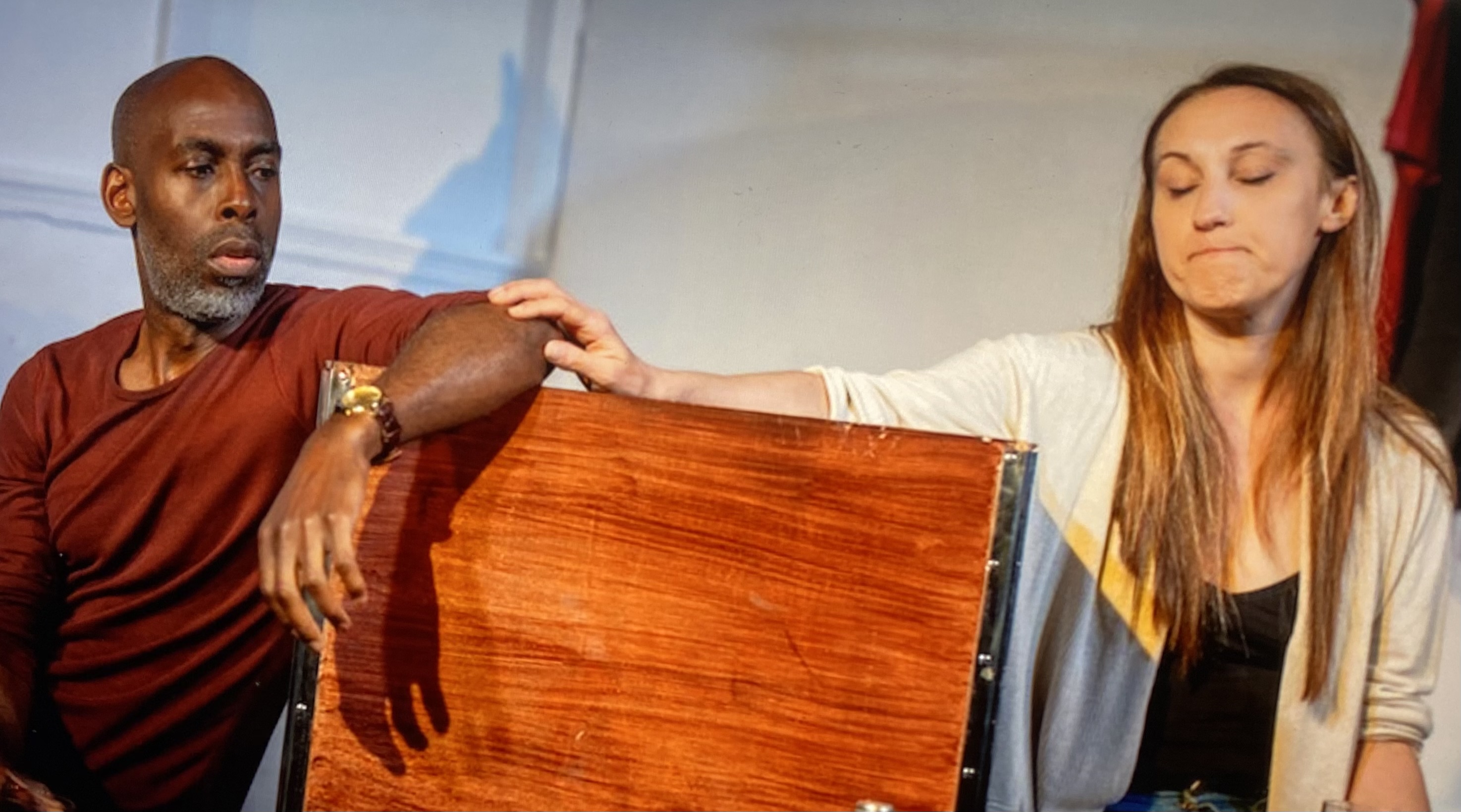
The Box (White Bear Theatre)

Posted: July 28, 2024 in Theatre

Photo: Alex Walton

Writer: Brian Coyle

Director: Jonathan Woolf

⭐️⭐️⭐️⭐️

It may not seem so unusual for an object referred to as “the box” to be the centre of attention in a shared living space, but, for Tom and Kate, the characters in Brian Coyle’s hour-long one-act play, such a box has far more sinister significance than would be normal. 

Wrapped in bright orange paper, the box contrasts with the plain white walls of the couple’s abode, giving an immediate surreal feel to director Jonathan Woolf’s production. That feel is supported by the characters’ movement and initial verbal exchanges, which make little sense to us, the eavesdroppers. Eventually, it becomes clear that Tom (Martin Edwards) and Kate (Sarah Lawrie) have been in a relationship for many years and their aggression towards each other is part of a well-rehearsed ritual to avoid facing up to the truth, which, symbolically, might entail opening the box.

Once its semi-absurdist facade has begun to melt away, the play gains in strength and in emotional depth. Layer by layer, the deceptions are peeled away and the shared grief, guilt and pain are revealed. Perhaps Coyle is hitting on a common trait here – don’t we all divert attention from the elephant in the room, preferring to watch the box in the room? Skilfully, the writer transforms the play from a near-comic sketch into a raw, visceral drama in which two real people tear into each other with verbal and physical ferocity.

Outstanding performances from Edwards and Lawrie add enormously to the sharpness of this strikingly original piece of new writing. Seeking out fresh ideas for exploring the human condition, Coyle is always springing surprises and thinking outside the box.

Performance date: 24 July 2024

Photo: Marc Brenner

Writer: Christopher Hampton

Director: Chelsea Walker

⭐️⭐️⭐️⭐️

Vienna in 1934 was not a welcoming place for a Jewish writer such as Stefan, a central character in Christopher Hampton’s new play. He enjoys the fruits of his success, living the high life to the full and womanising to excess, but, just as he contemplates leaving the city, he meets a woman with a strange allure. She claims to know him well from the past and he has absolutely no idea who she is.

Hampton’s 70-minute drama, adapted from a short story by Stefan Zweig, is a mystery that develops into a tale of unrequited infatuation. The woman, who we later learn is named Marianne, is ushered in as if she is yet another of Stefan’s anonymous one-night stands, but she confesses to having loved him obsessively since childhood, while he has consistently ignored or forgotten her. In modern parlance, Marianne’s behaviour might be classed as that of a stalker, but she acts out of pure, untainted love, without any trace of malice.

James Corrigan plays Stefan with the nonchalant air of a serial seducer of women. Natalie Simpson is spellbinding as Marianne, a woman overwhelmed by her obsession, yet reconciled to repeated rejection. She bares her soul to Stefan, occupying a space in his smart bachelor pad that many other women have passed through, but only briefly. Stefan’s trusted aide, Johann (Nigel Hastings), stands by loyally.

The story is recounted rather than acted out and it falls to director Chelsea Walker to add a visual dimension to what, on paper, looks like a radio play. Dim lighting, designed by Bethany Gupwell, casts long shadows on designer Rosanna Vize’s boxed-in set, while Mariann’s younger self (Jessie Gattward) lurks around the peripheries. If the production is low on movement, it is high on atmosphere.

Brevity enriches the power of the drama. Hampton does not overplay political parallels, but, telling a story of misguided obsession being met by casual indifference, the play can be viewed as both a metaphor for  the time and place of its setting and a warning for the present. This is a dark and haunting romance.

Performance date: 11 July 2024

Photo: Pamela Raith

Music: Andrew Lloyd Webber

Lyrics: Richard Stilgoe

Director: Luke Sheppard

⭐️⭐️⭐️⭐️⭐️

In 1984, when at his creative peak, Andrew Lloyd Webber may have been entitled to feel that he could walk on water or, perhaps even skate on wheels. So, could he craft a hit musical out of a story in which all the characters are trains and their carriages? Well that show, Starlight Express, ran for almost 18 years at London’s Apollo Victoria Theatre, but the logistical problems involved in converting a conventional auditorium into a skating arena could have hindered plans to get it back on track. Until now. 

The Troubadour is a character-less, purely functional structure in the shadow of the InWembley arch. It needs a big splash of starlight to offset its drabness and that is exactly what it gets, together with every other conceivable form of light. At first sight, the set (designer Tim Hatley), which includes “tracks” running through the audience, looks as if it could have cost almost as much as HS2 to construct and a company of 40 fills it with vibrant energy and colour.

The show serves as a reminder that, before being lured into musical theatre, Lloyd Webber’s roots lay in 1970s concept albums. Around 20 entirely separate songs, sometimes in very different styles, are strung together without any linking dialogue, leaving Richard Stilgoe’s delightfully tongue-in-cheek lyrics to do the storytelling work. In a vain attempt to attach some logic to the nonsense that unfolds, the narrative is encased within the dream of a small child.

In an era of transition for the railways, dilapidated old steam locomotive Rusty (Jeevan Braich) is competing with diesel engine Greaseball (Al Knott) and electricity-powered Electra (Tom Pigram) for supremacy and the right to pull (literally) first class carriages Pearl (Kayna Montecillo) and dining car Dinah (Eve Humphrey). Their rivalry culminates in a race at breakneck speed around the stage and auditorium. Guessing that Lloyd Webber and Stilgoe could possibly be sentimentalists, it is not difficult to predict the winner.

Predominantly, the music is loud and proud rock. On press nighy, Green Day were performing at the neighbouring stadium and there were many moment when it might have been possible to wander between the two shows without hearing much difference. However, the writers also thrown in some blues (sung gloriously by Jade Marvin), gospel and, with Uncoupled, a neat parody of Tammy Wynette’s D-I-V-O-R-C-E, a dash of country and western.

Director Luke Sheppard  has assembled not so much a team as an army to put all this together. Original choreographer Arlene Phillips is back on board, credited as creative dramaturg, leaving it to new choreographer Ashley Nottingham to bring order to the hordes of skaters. Gabriella Slade’s imaginative costume designs dazzle when viewed under breathtaking lighting, designed by Howard Hudson,

This extravagant revival should appeal to all ages. It offers a feast for the eye and ear and, if there is less nourishment for the brain, who’s complaining?

Performance date: 29 June 20

Photo: NUX Photography

Writers: Vicki McKellar and Guy Masterson

Director: Guy Masterson

⭐️⭐️

According to Bernie Taupin’s song lyric, Marilyn Monroe “lived her life like a candle in the wind”. If this is so, the new drama co-written by Vicki McKellar and Guy Masterson investigates the intriguing question of what or who was the source of the gust that snuffed her out. She was found dead at her Los Angeles home, supposedly having taken an overdose of sleeping pills, on 4 August 1962 at the age of 36.

The play intercuts scenes from the final days of Marilyn’s life with scenes of gatherings of her friends and associates in the hours after her death. It is a structure that comes close to strangling the drama, leaving it with few places to go as the characters present the patchy evidence to the audience in excessive detail and the survivors conspire to conceal the truth which, they believe, points to wrong doings in very high places.

Genevieve Gaunt’s Marilyn is adept as an impersonation of the Hollywood icon, but there are only small traces of the tarnished innocence which her on-screen persona represented. We see a woman who is in full control of her sexual allure and is beginning to realise the power which she holds over the most powerful – her alleged lovers United States President John F (“Jack”)  Kennedy and his brother, Robert (“Bobby”), the Attorney General.

Conspirator in chief is Peter Lawford (Declan Bennett) a B-list Hollywood actor more famous for being a member of Frank Sinatra’s Rat Pack. Lawford’s wife Patricia (Natasha Colenso) is the sister of Jack and Bobby and his first imperative is to retrieve Marilyn’s diaries which it is believed not only name names, but contain details of very indiscreet pillow talk. His second imperative is to conceal the full truth about the circumstances of Marilyn’s death from the authorities and, most importantly, the press.

Director Guy Masterson’s production, on an open stage that occasionally revolves and is over-cluttered with furniture, sees seven characters arguing it out and trying to find a resolution. This resembles the denouement scene from a whodunnit, sprinkled with flashbacks to the victim herself. Stretched out to two-and-a-half hours, there is not enough wit in the script nor energy in the staging to sustain interest, while the “murder” method that is suggested is so bizarre that even Agatha Christie might have gasped in disbelief.

Little more than a year after the events depicted here, Jack too was dead, sparking a whole new round of never-proven conspiracy theories. For those who revel in such things, there is much in the play to mull over (an over), but, for the rest of us, this over-cooked melodrama has little to say and it takes far too long in saying it.

Performance date: 27 June 2024