Archive for August, 2024

When It Happens to You (Park Theatre)

Posted: August 10, 2024 in Theatre

Photo: Tristan Kenton

Writer: Tawni O’Dell

Director: Jez Bond

⭐️⭐️⭐️⭐️

So, what is “it”? The title of American writer Tawni O’Dell’s new 90-minute play gives no clues and all the characters appearing skirt around the issue like the elephant in the room, dodging use of the actual word. Even the Park Theatre, in the publicity for the play, talks of “a devastating event”, without specifying what that event is. Well, no spoiler alerts, because it becomes clear in the first few minutes that “it” is rape.

O’Dell shows no interest in the perpetrator of the crime, who, we are told, is caught quickly, tried fairly and sentenced justly. Her focus is firmly on a small family unit comprised of the victim, Esme (Rosie Day) and the secondary victims, her mother Tara (Amanda Abbington), a twice divorced writer, and brother Connor (Miles Molan). Tok Stephen appears as a police officer and several other characters cropping up in the story.

Director Jez Bond keeps all four actors in view throughout, their movement across a bare rectangular stage exaggerated to express urgency at critical points. This simplest possible staging gives the play uncluttered lucidity that contrasts sharply with the evasiveness of the characters when facing up to what has happened to them. 

An extraordinarily powerful performance by Abbington is the drama’s driving force. She brings out Tara’s anger and frustration at her own helplessness in easing her daughter’s pain. Esme is a trainee chef who has moved from the family home in Pennsylvania to live in her own apartment in New York City, with only her cat for company; with great subtlety, Day shows how the confidence of an independent woman can be dented and how the wrong choices can be made easily. Molan’s Connor is a geeky science student who is blown off course by strains in family relationships, but sees the damage caused by failures to face up to the truth. He opts for an uncomfortable Christmas with his estranged father rather than returning to the family home.

Based on true events, the play addresses the social stigmas and prejudices linked to rapes victims. Connor wonders why his sister’s plight cannot be looked at in the same way as a broken leg, which would be discussed openly. The writing walks a fine line between a drama and a lecture and the only strong criticism is that it sometimes veers too far towards the latter, particularly in the closing stages when, in turns, characters speak directly to the audience.

Taken as a whole, this is meaty stuff, raw, riveting and revelatory. The message is let’s talk about the things that hurt and this play itself certainly sets the ball rolling.

Performance date: 6 August 2024

The Years (Almeida Theatre)

Posted: August 5, 2024 in Theatre

Photo: Ali Wright

Writer: Annie Ernaux

Adaptor and director: Eline Arbo

⭐️⭐️⭐️⭐️

For anyone now approaching the end of their life, it may be possible to skim through prints of photographs taken over many decades in just a couple of hours, which is about the length of this play. Future generations, born into the age of digital photography, could find this process taking much more time, but will the memories that the imag evoke be anything like as vivid?

Adapted from Les Années by Annie Ernaux, The Years tells, in autobiographical form, the life story of one unremarkable woman. Each memory triggered by an old photograph. Connecting the play’s framework to Shakespeare, an alternative title could be “The Five Ages of Woman” as it moves from “mewling and puking” to “sans everything”, represented by five women, all sharing in the storytelling and each acting out scenes from specific times in the writer’s life.

Written down, this sounds dull, but adaptor and director Eline Arbo makes sure that her production is anything but that. The five women are Deborah Findlay, Romola Garai, Gina McKee, Anjli Mohindra and Harmony Rose-Bremner. The calibre of these actors should be enough to alert us to the quality of the material and they energise a production that is, throughout, animated and inventive.

The play matches the the trivial with the momentous. Born during World War II in German-occupied France, the writer tells of living through an era of enormous changes for women against the backdrop of distant wars in Algeria, Iraq and the Balkans. She experiences sexual awaking, abortion, marriage, motherhood and divorce. She has many loves, but never finishes her novel, except that this is probably it. An ordinary life lived in extraordinary times.

The play is captivating, funny and harrowing. A scene in which the five women celebrate the arrival of the 1980s by partaking in an aerobics class is pure joy, while the abortion scene, depicted in excruciating detail, is sheer agony. Half-forgotten brand names are mourned and new arrivals such as fridges, vacuum cleaners and hair dryers are welcomed. At the same time, thoughts of the Holocaust lurk in the air and the rise of the French far right sends shivers down the spine.

The Years is a wonderfully literate and totally absorbing piece of storytelling. At its heart lies an account of female emancipation, but those of us who are not women need not be put off by that. These memories can be enjoyed by all.

Performance date: 1 August 2024

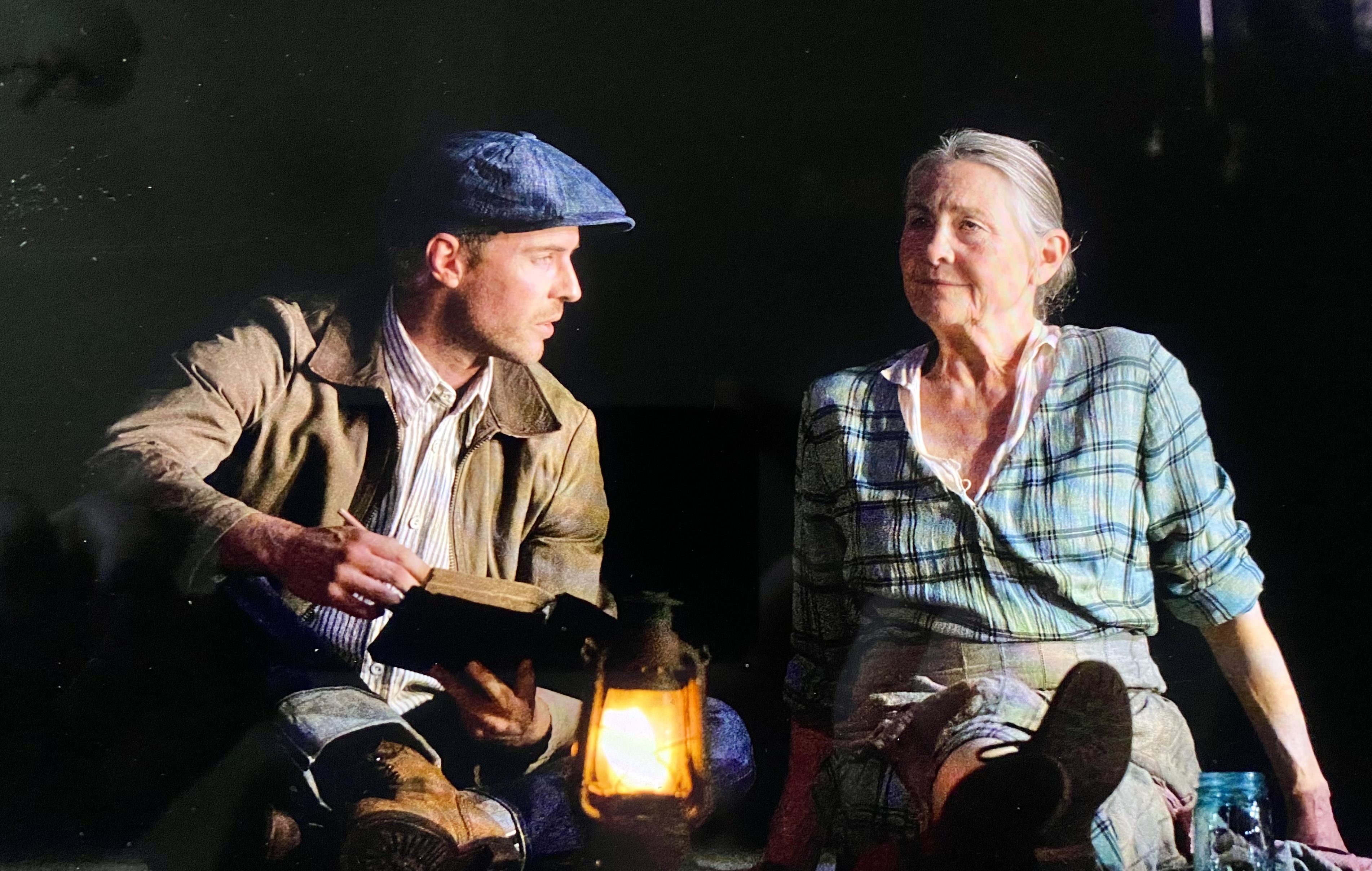
hoto: Richard Hubert Smith

Writer: John Steinbeck

Adaptor: Frank Galati

Director: Carrie Cracknell

⭐️⭐️⭐️

The first thing to say about the Nation; Theatre’s dramatisation of John Steinbeck’s classic 1939 novel, The Grapes of Wrath, is that anyone who is seeking a cheerful offering to add sunshine to their 2024 Summer should be looking elsewhere. Director Carrie Cracknell’s vivid production is relentlessly bleak, lightened only by some startling staging and first class acting.

In Frank Galati’s faithful adaptation, Steibeck’s feel for social injustice survives intact; the novel is set during America’s Great Depression of the 1930s. It follows the fortunes of three generations of the Joad family as they up their roots in the dust bowl of Oklahoma and head for the promised fertile vineyards of Northern California, a trek of motor than 1,000 miles. The penniless family’s trek is epic and, by its nature, the drama is episodic, thereby posing the challenge to both adaptor and director to keep the link to the central narrative thread strong and to bring to the fore the characters’ intimate stories.

Hotheaded young Tom Joad is released on parole after four year in prison and he returns home to find that his tenant farming family is already on the move. Tom is the story’s lynchpin and Harry Treadaway’s strong presence in the role is often the force that holds this production together. Making a rare UK stage appearance, the wonderful Cherry Jones matches him as the formidable Ma Joad, a pillar of strength in the face of adversity. Natey Jones as Jim Casey, a former preacher who joins the trek, and Greg Hicks as Pa Joad are among others giving stand out performances.

Cracknell has assembled a company of 26, all but the principals playing multiple roles, for this large scale production. Using the full width of the Lyttelton Theatre stage, Alex Eales’ set design has a perpetually grey sky overhead, with characters emerging from blacknes; period costumes (designed by Evie Guerney) and atmospheric lighting (designed by Guy Hoare) add to the gloom. The overall visual image often resembles a vast, over-populated, near-monochrome tableau of human suffering.

The main problem with all of this is that, particularly in the first act, the director is piling on the misery just a little too thickly. As a consequence of this excess, too many lines of dialogue come across as trite homespun philosophising and original songs in traditional folk/blues style, written by by Maimuna Memon, begin to sound like dirges. At the interval, many members of the audience could be asking themselves whether they are up to sitting through another hour or so of their own great depression.

The second act brings no more joy and is still episodic, but Cracnell fills it with memorable dramatic set pieces and stirring special effects. A fight, a thunderstorm, etc heighten the human dramas which grow in intensity. Billed as a tribute to the endurance of the human spirit, this stage version of The Grapes of Wrath often becomes a trial of the endurance of the audience’s spirit as it impresses and depresses in more or less equal measures.

Performance date: 31 July 2024