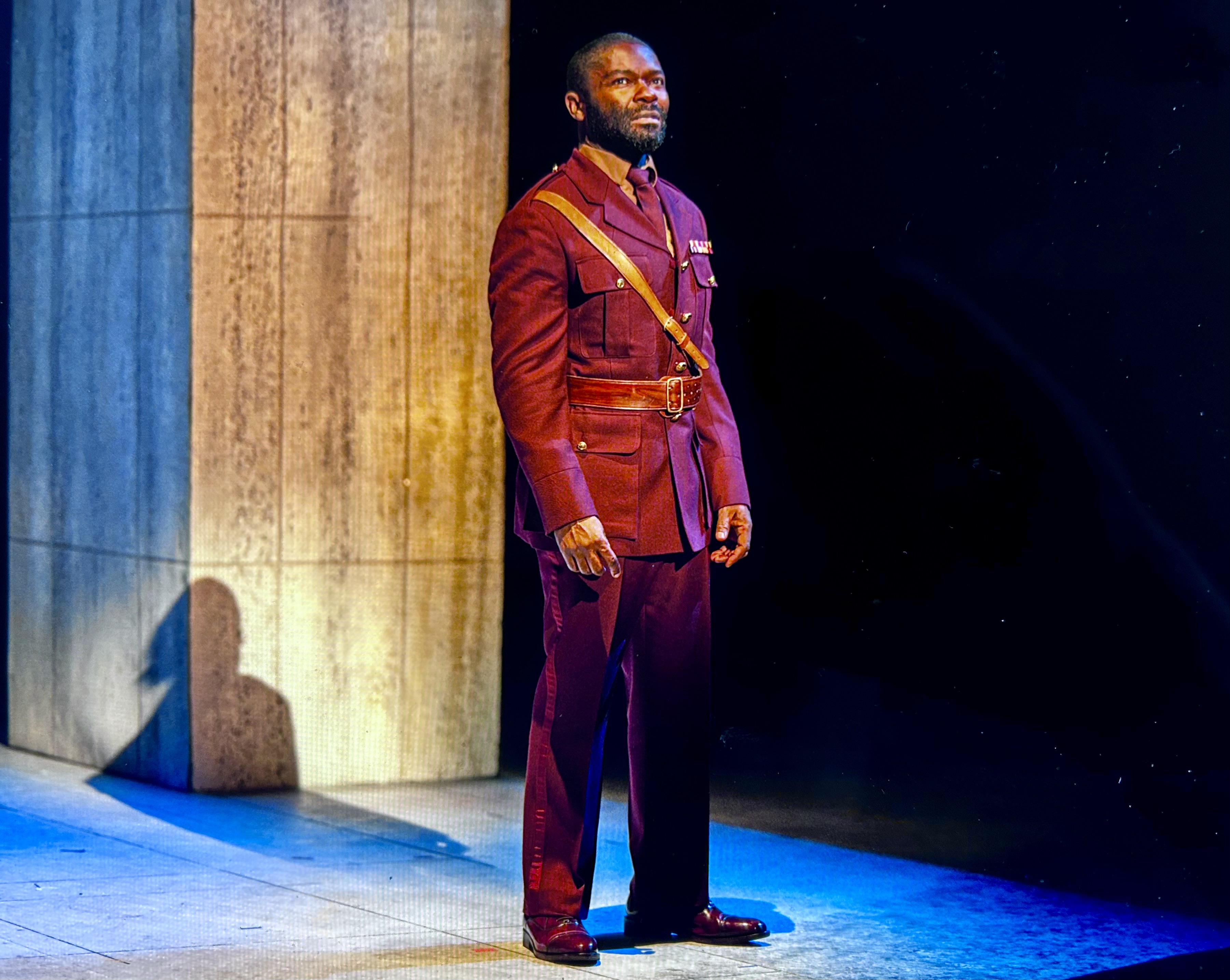
Photo: Misan Harriman
Writer: William Shakespeare
Director: Lyndsey Turner
⭐️⭐️⭐️
At a time when populist movements are gaining ground in many western democracies, the topical relevance of Coriolanus could not be clearer. William Shakespeare’s political thriller, set in Ancient Rom, follows the progress of the titular character from victorious warrior to popular hero and then to enemy of the State, advocating radical reforms which infuriate the ruling elite.
Director Lindsey Turner’s revival forsakes togas for modern dress, with video images and Zoom meetings emphasising the connection to the 21st Century. Es Devlin’s set designs are timeless, serving mainly to expand and contract the vast Olivier Theatre stage, which opens out fully for the early battle scene. The thrilling staging of the combat owes much to the lighting, designed by Tim Lutkin. However, after the ectio, words replace warfare to capture our imagination,
When first appearing, David Oyelowo’s Coriolanus falls short on displaying the powerful presence of a triumphant conqueror, but the actor grows into the role and comes close to exuding the charisma and inner strength that explain the character’s actions. The visceral performance for which we had sought is not completely there yet, but, hopefully, it will develop.
The trajectory of the narrative is established firmly in the first half of the play and does not change in a second half which feels like an anticlimax as it moves predictably towards its inevitable conclusion. The chief highlights in these later stages are impassioned speeches by Coriolanus\ mother, Volumnia (Pamela Nomvete) and the arbiter between him and the ruling Tribune, Menenius (Peter Forbes). Both are delivered with fire.
Supprting roles are shared among the relatively small company, doubling-up to an extent that is perhaps unusual for the National Theatre. The effect of this is to diminish the minor characters and sharpen the focus on the principals. However, Shakespeare gives little help in getting inside the head of Coriolanus and understanding his emotional drive. Turner keeps him at a distance from his mother, wife and son, revealing nothing of his connection to them and his inner feelings.
Turner’s production has many flourishes and creates striking, if occasionally puzzling images, but nothing quite as spectacular as the physical destruction of Elsinore in her 2015 production of Hamlet. After its stirring start, the production rarely achieves an epic feel, but, in many ways, this is commendable in that it places the emphasis on the political manoeuvring which forms the heart of the story.
This is a flawed revival of a flawed play, but, nonetheless, much of it remains intriguing.
Performance date: 24 September 2024



 The Beast's Pen