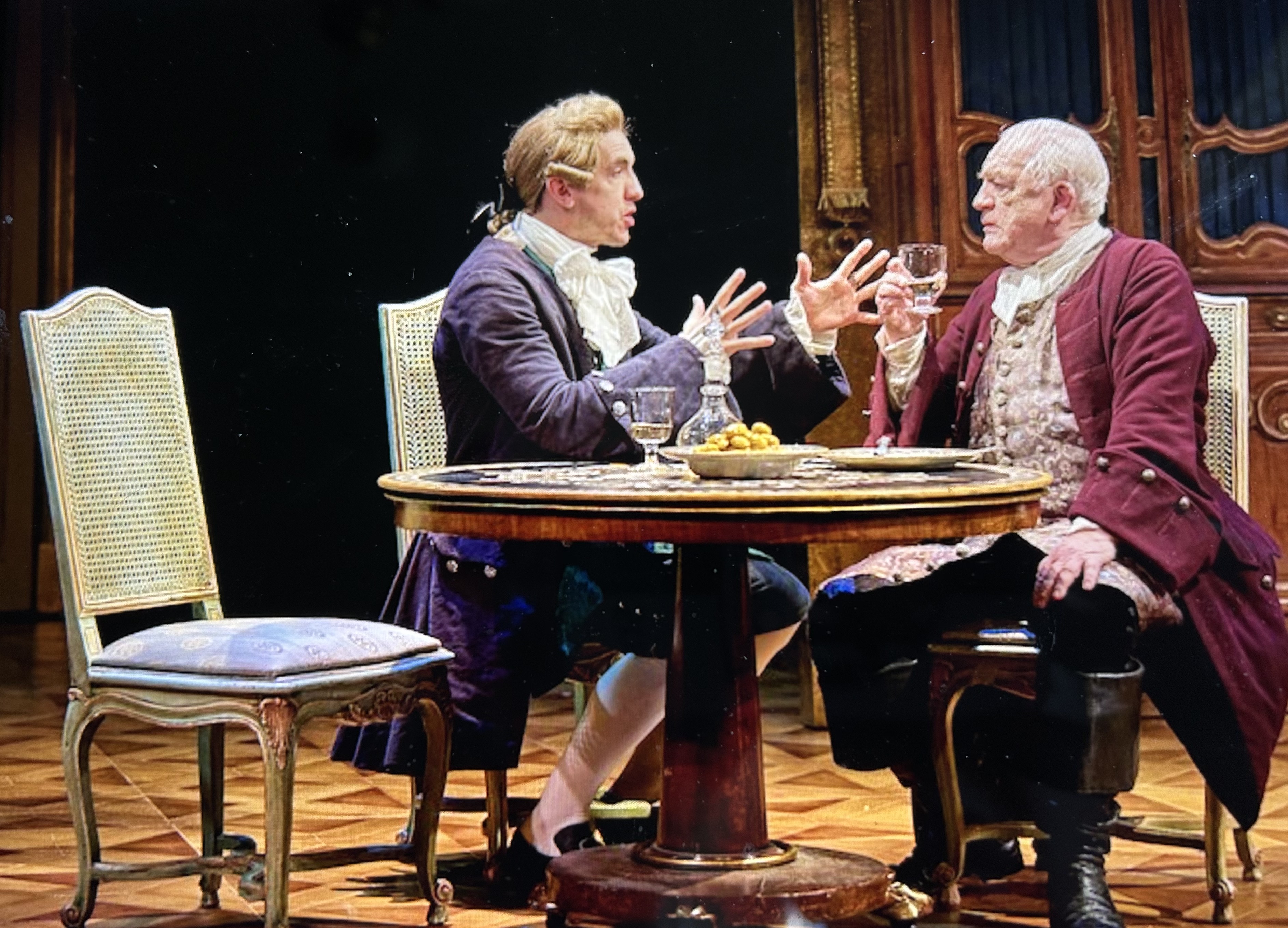
Photo: Manuel Harlan
Writer: Oliver Cotton
Director: Trevor Nunn
⭐️⭐️⭐️💫
Prepare to be transported back to the 18th Century. Having begun life in the Regency splendour of Bath’s Theatre Royal, Oliver Cotton’s 1747-set play, The Score, now finds a seemingly natural new home at the London equivalent, the Theatre Royal Haymarket. The question is whether or not the production, with veteran director Trevor Nunn at the helm, is destined to feel more than a couple of hundred years past its sell-by dare.
Contrasting the Earthly with the Heavenly, Cotton’s play revisits many of the themes of Peter Shaffer’s Amadeus. On this occasion, the composer is Johann Sebastian Bach, a 62-year-old with failing eyesight. He lives in Leipzig, a city recently overrun by Prussia, whose KIng, Frederick II, summons him to his court. Bach is devoutly religious and loathes warfare, while Frederick is an atheist who, instinctively, leads armies into battle. They are opposites drawn together by a common love of music.
Brian Cox’s Bach barks loudly and often. The Scottish actor who once played Hannibal Lecter seems born for this role and his commanding performance, inevitably, fights off all comers to grab centre stage and hold onto it. Stephen Hagan’s slightly effete Frederick is not the warrior King that the early dialogue leads us to expect, but his nonchalant air makes him a fascinating foil for Cox’s bellowing Bach.
Bach leaves behind his doting wife Anna (Nicole Ansari-Cox) in Leipzig and answers the KIng’s call to his court in Potsdam. There he is greeted by his young son Carl (Jamie Wilkes), who holds a position there, and by the friendly maid Emilia (Juliet Garricks), who recounts stories from Frederick’s past. The King’s constant companion is the French philosopher Voltaire, played in flamboyant style by Peter De Jersey. Nunn’s production is mounted handsomely, with Robert Jones’ unfussy set designs transitioning effortlessly between Bach’s humble home and the Royal Palace.
The play’s big flaw is a slow-paced first act in which it takes the two main protagonists four scenes and almost an hour to come face-to-face. The result is all talk and hardly any dramatic tension. Happily, things improve immeasurably after the interval when the writing becomes more eloquent and focussed and the acting more powerful. Frederick and his sycophantic courtiers bet against Carl that “old” Bach will not be able to improvise on a theme composed by the King; this brings a refreshing dash of fun to scenes that could have, otherwise, become too dry.
Bach argues that music emerges from divine intervention, even when it comes into the head of a non-believer such as Frederick. This belief provides the play with one of its central theses, the other being the morality of war and oppression. In this, Frederick can be seen as an arrogant autocrat who compares with certain modern day figures, but, otherwise, the play is little more than a dip into history, imperfect yet nonetheless entertaining.
Performance date: 28 February 2025

 The Beast's Pen