Archive for June, 2025

Photo: Amanda Searle

Creator and performer: Dickie Beau

Director: Jan-Willem Van Den Bosch

⭐️⭐️⭐️⭐️

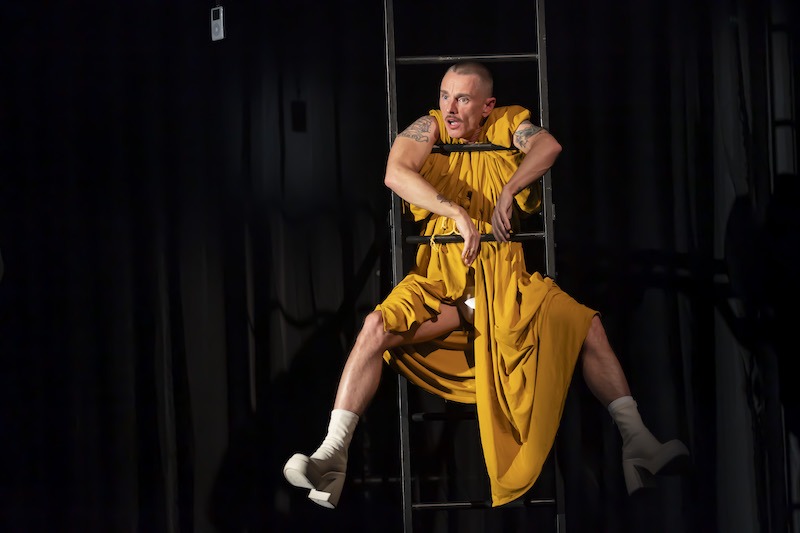
Early arrivals for performances of Showmanism can look up towards the high ceiling of Hampstead Theatre’s main house to see the show’s creator and star clambering around precariously on scaffolding while reciting familiar tongue twisters. He is actor, impersonator, drag artist and flamboyant showman Dickie Beau. It is a startling prelude and when, eventually, the show comes down to earth, it does so only in the most literal sense.

First seen at the Theatre Royal Bath in 2022, Showmanism is a discussion of all things theatre, looked at from a perspective that is wildly eccentric and mildly queer. Beau is self-analytical when considering the psyche of actors, going on to assert that audiences are themselves key parts of performances. His illustrations range from Ancient Greece, through the Shakespearean era and the Oberammergau Passion plat to the present day. As Beau’s last appearance here was in Tom Stoppard’s The Invention of Love, he may feel that Hampstead audiences have been well prepared for a certain level of intellecyia;ism, particularly with regard to the classics.

So, in essence, is this a lecture best suited for scholars or RADA students? Well, maybe, but Beau livens it up with voices ranging from David Cameron to Cilla Black. Most notably, it is the comforting tones of Sir Ian McKellen that guide us through, almost as if the actor himself had lived through all the ages of civilisation. Also, director Jan-Willem Van Den Bosch makes sure that Showmanism is a real show for the whole of  its running time of 95 minutes straight through.

Justin Nardella’s elaborate set and dazzling costume designs would be fit for a West End musical, while Marty Langthorne’s lighting designs create striking images. However, none of these fireworks  can eclipse the astonishing fire of Beau himself, which is fuelled by insight, honesty and mischievous humour. The lasting effect is weirdly mesmerising, funny, profound and even spiritual. 

Beau finds time for an excoriating assessment of the contributions of critics, so, in retaliation, it feels necessary to point out that his show is uneven, often losing focus and cohesion. Showmanism is a very long way from being perfect, but its star has a magnetic presence which makes it extraordinary.

Performance date: 23 June 2025

Photo: Marc Brenner

Writer: David Adjmi

Original songs: Will Butler

Director: Daniel Aukin

⭐️⭐️⭐️⭐️

By the mid-1970s, the Beatles-led invasion of British pop had faded in America, being replaced in part by country influenced soft rock bands such as The Eagles and Fleetwood Mac, who sold millions of vinyl albums to be heard by avid fans on their stereo music centres. David Adjmi’s multiple Tony Award-winning play with songs focuses on a fictional band in this mould. It proposes that out of chaos magic emerges, a theory that is advanced further by the play itself.

In style, director David Aukin’s production could be seen as a cross between an Annie Baker play and a juke box musical. Baker is an American dramatist whose work, seen several times during the last decade at the National Theatre, is noted for its slow progression and long silences. Here, the lethargic feel purports to imitate real life, but, at the same time, it gives a surreal air to the production which, over time, becomes mesmerising.  Undoubtedly, the pace and pauses are factors contributing to a perhaps excessive running time of three and a quarter hours (including interval).

Baker located one of her plays in a near empty art house cinema and Adjmi consigns his characters to being dwarfed equally in a Los Angeles recording studio, which is realised beautifully in David Zinn’s imposing two-level set design. Remarkable work by lighting designer Jiyoun Chang further heightens the production’ visual impact.

Adjmi does not use a central narrative to drive the play, instead examining the behaviour of the seven individuals gathered together to record their new album. These are people for whom the pressure of fame is equalled only by the fear of anonymity. We witness their egos in full flow, their neuroses, their make-ups and break-ups, their drug taking and we get to glimpse their musical talent. Lucy Karczewski is particularly striking as the unstable singer/songwriter Diana, Zachary Hart impresses as the addicted Brit bass player Reg. However, it feels unfair to single them out from the other outstanding actor/musicians who are: Andrew R Butler, Eli Gelb, Jack Riddiford, Chris Stack and Nia Towle.

When the drama gets sluggish, as it often does by design, Will Butler’s excellent 1970s-style rock songs act as an instant pick-me-up. They are so authentic that it is tempting to check that they were not genuine smash his of that era. They were not, but they should have been.

Stereophonic, already a huge hit with New York critic, could present challenges for West End audiences who are unaccustomed to this style of theatre. It is long and slow, but it is also bold and rewarding. The best advice is to go to see it and stick with it. 70s rockers and many others should find it a blast.

Performance Date: 14 June 2025

Photo: Johan Persson

Writer: Bernard Shaw

Director: Dominic Coole

⭐️⭐️⭐️⭐️

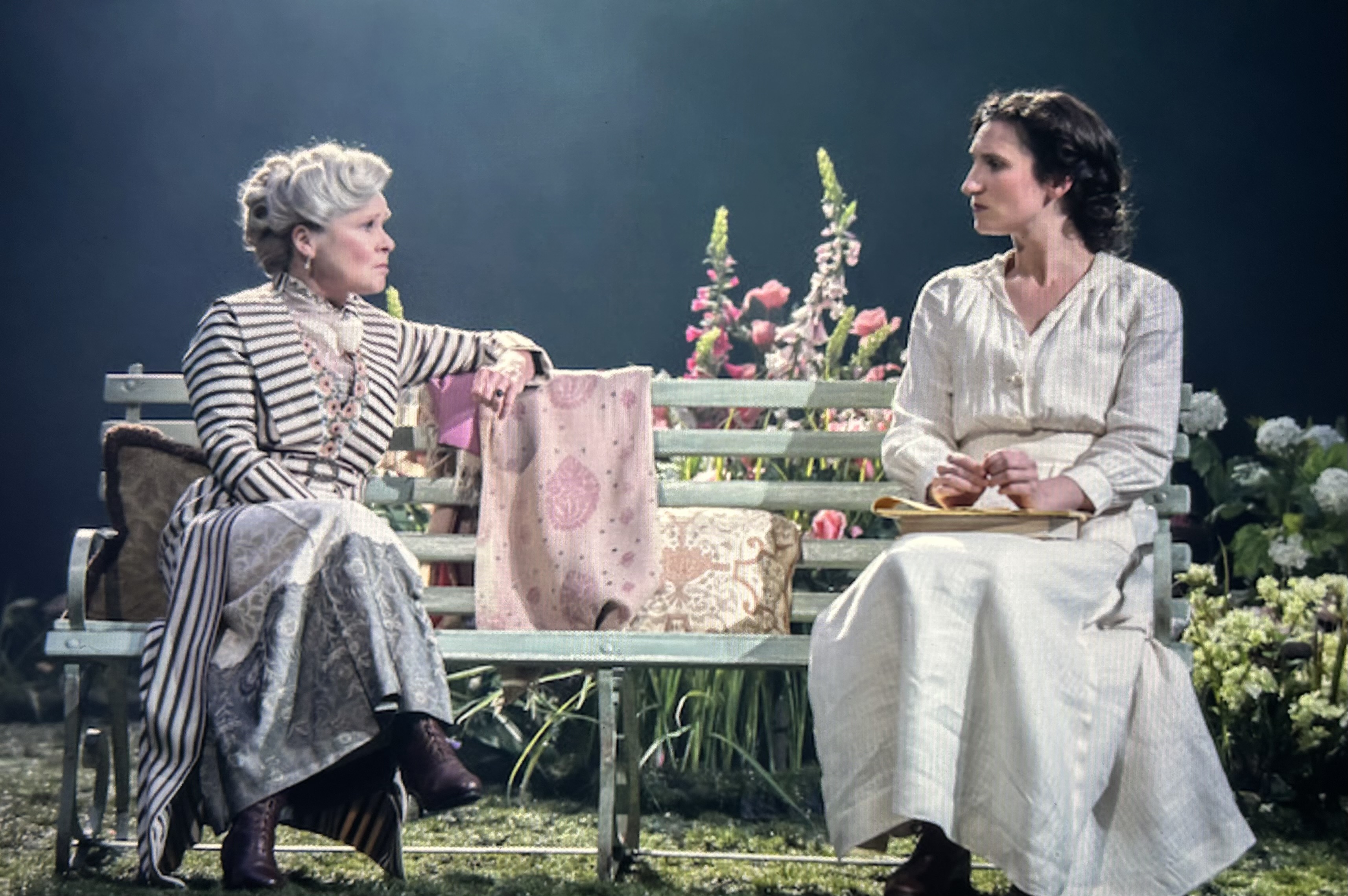
Ignoring the advice offered in Noël Coward’s famous song, Dame Imelda Staunton has gone ahead and put her daughter, Bessie Carter, on the stage. Indeed, she now goes one stage further by sharing a stage with her in director Dominic Cooke’s classy revival of George Bernard Shaw’s 1902 play Mrs Warren’s Profession; perhaps inevitably, the pair play mother and daughter.

Not for the only time, Shaw sets out to puncture the facade of refinement and gentility surrounding the English upper middle classes of his age and he expose the hypocrisy  that hides behind it. The profession of the play’s title is that which is often referred to as “the oldest” one and, accordingly, it was only performed in private members’ clubs for many years after it was written. Nowadays, it should be regarded as, in more ways than one, family friendly, notwithstanding the theatre’s somewhat surprising 14+ age recommendation. Could it be that traces of Edwardian prudishness still linger on?

Writing at the dawn of female emancipation, Shaw uses the play to examine the changing roles of women in society. Vivie Warren has been raised and tutored in rural England and she is now ready to make her own way in the world, not as a dutiful wife, but as an independent professional woman. Carter is splendid in the role. instantly dispelling thoughts of nepotism. Vivie awaits the arrival of her mother, Kitty, breaking into her business travels around Europe to make a rare visit. Staunton slightly underplays the role, surprisingly not fully exploiting the comic potential of Kitty, although, very occasionally, she allows glimpses of vulgarity to appear through the character’s air of refinement.

The balance between the two key performances could reflect a view by Coole that Shaw wanted the play’s primary focus to be on Vivie. Kitty had financed her daughter’s upbringing, expecting her to grow into the role of a lady of her own generation, only to see the emergence of a very modern woman. Vivie has suitors in the earnest Mr Praed (Sid Sagar) and the naive Frank Gardner (Reuben Joseph), son of a clergyman (Kevin Doyle) who had known Kitty in the past, but she rejects them in favour of keeping control over her own life. Kitty is accompanied by her friend and, it transpires, business partner Sir George Crofts (Robert Glenister in villainous mode), who also has his eyes on Vivie, but his offers of status and financial security are swiftly turned down.

Essentially, Shaw sees Kitty and Vivie as the same woman born into different generations and now divided by the circumstances into which society has forced them.  Cooke counters the writer’s reputation for being wordy and worthy with a streamlined staging in which even Chloe Lanford’s elegant set designs are notable for their simplicity. Scenes change quickly and speeches are delivered briskly, all fitting into 105 minutes with no interval. Strangely, the company is augmented by the occasional appearances of a non-speaking chorus in the style of ancient Greek drama. It is not entirely clear what purpose this serves, but if it keeps decent actors away from having to wait tables, it is to be welcomed,

Leaving aside the play’s slightly scandalous subject matter, Coole’s revival gives us a flavour of what a night out in the West End may have been like a century or more ago. The Garrick Theatre has probably not changed very much and the production is utterly conventional without ever being dull.

Performance date: 28 May 2025