Archive for the ‘Theatre’ Category

Photo: Ellie Kurttz

Writer: Bernard Shaw

Director: Paul Miller

⭐️⭐️⭐️⭐️

It comes as no surprise that Paul Miller has chosen another Bernard Shaw comedy to mark the end of his tenure as Artistic Director of Richmond’s Orange Tree Theatre. In recent year’s, Miller has done more than most to confound perceptions among some modern theatregoers that the Irish-born playwright’s brand of humour with a social conscience has gone past its sell-by date. First performed in 1894, Arms and the Man mocks warfare, class, wealth and romance with equal bite and this sparkling revival makes it all feel fresh and new.

The three-act play is set during a brief 1885 war between Bulgaria and Serbia, which has Austria and Russia meddling on the sidelines. Shaw eyes Central European politics with some prescience, bearing in mind what the 20th Century and beyond would bring. With her father and fiancé away fighting for Bulgaria, Raina, girlish and excitable as played by Rebecca Collingwood, is at home with her mother Catherine (Miranda Foster) and the household servants, when a dashing young soldier breaks in through her bedroom window. He is Bluntschli (Alex Waldmann), a Swiss mercenary fighting for the Serbs, who has a passion for chocolate creams.

Raina gives refuge to her “chocolate cream soldier” and, inevitably as this is a prototype romcom, she becomes captivated by his swashbuckling charm and falls for him. Peace breaks out, due, Shaw tells us, to the sheer incompetence of both armies, and Raina’s father, Major Petkoff (Jonathan Tafler) and her fiancé, Sergius (Alex Bhat), come home. Things begin to unravel, while, in a sub-plot which brings to the fore the hypocrisy of the class system, the relationship between the two servants, rebellious Louka (Kemi Awoderu) and obsequious Nicola (Jonah Russell) also shows strains.

Costumes and furnishings from designer Simon Daw give the in-the-round staging a delightful period feel. Overall, the casting is impeccable, but, in particular, as the love rivals, Bhat’s over-the-top buffoonery and Waldmann’s calm and collected rationality contrast beautifully. While Shaw’s wit highlights the ridiculousness of love and war, Miller’s consistently buoyant production boosts the laughs quota by paying meticulous attention to the detail in every line and by adding deft visual touches.

The first two acts are quite short, with the first of two intervals between them. Surely this disruption could have been avoided by moving furniture around quickly with the audience present. However, there are no quibbles about the longer third act, which turns into a riotous romp and rounds off this splendid re-discovery of a classic.

Performance date: 23 November 2022

Baghdaddy (Royal Court Theatre)

Posted: November 25, 2022 in Theatre

Photo: Helen Murray

Writer: Jasmine Naziha Jones

Director: Milli Bhatia

⭐️⭐️

The audience waiting for Baghdaddy to start is left to work out why British wartime songs would be relevant to a play that is ostensibly about Iraq. The lights go down as Flanagan and Allen’s Underneath the Arches plays loudly and we see an Iraqi man with his daughter in 1991, eating burgers on steps in front of giant golden arches; the images gel together perfectly. Ironically, Iraqis are seen absorbing western culture just as the owners of that culture are bombing their homeland into oblivion.

This clarity comes early in Jasmine Naziha Jones’ debut play, but, sadly, it is rarely equalled in the two hours or so that follow. In turns, the play becomes a comedy, a tragedy, a history lesson, a pantomime and, briefly, a musical, crying out for a solid structure to hold it all together. The writer’s decision to abandon conventional narrative forms is a bold one, but the result is a show that is often baffling.

The girl is Darlee, played by the writer herself, who is eight years old in 1991. Born in Britain, all she has known is British life and she has little patience with her Dad (Philip Arditti) who had moved to the United Kingdom as a student in 1980. His obsession with Iraqi history, culture and modern events is of little interest to Darlee. The play charts her growing awareness of the importance of blood ties in establishing self identity.

Souad Faress, Hayat Kamille and Noof Ousellam make up the company to five as we are presented with a surreal montage of life in Britain and Iraq, seen through Darlee’s eyes. At this point, the play is at its strongest when it hits the level of pantomime, but a sequence going back to Dad’s arrival in Britain becomes a comedy of culture clashes to which the audience responds with gales of laughter. The new arrival grapples with strange food and language barriers, wondering if a newsagent is in a similar profession to that of 007. With reports of the Iran/Iraq War flowing daily, Dad’s concerns for the family from which he is separated never diminish.

Designer Moi Tran’s imposing set, stone steps leading up to more arches which reflects classic Middle Eastern architecture, give director Milli Bhatia’s production a grandeur which may not be best suited to a play that is more often intimate than epic.

The second act fast forwards to 2003 when Darlee is a young woman and Iraq is under bombardment yet again. The comedy which had redeemed much of what went before is now missing. Eventually, Darlee turns to address the audience directly and, for the first time, the play becomes overtly political. The speech comes across as a long, stern lecture and it suggests that the writer could have run out of options for expressing her ideas in the form of drama

Following on, Dad is left alone on an empty stage to render his own soliloquy, this one in rhyming verse. Beautifully written and spoken though this passage is, it further exemplifies the stylistic muddle which bedevils the entire play.

Performance date: 24 November 2022

Photo: Danny Kaan

Writer: Deli Segal

Director: Kayla Feldman

⭐️⭐️⭐️💫

A “welcome home” atmosphere is prevalent at the Park Theatre before Pickle get underway. Deli Segal’s hour-long one woman show had a successful run here in the Spring of 2022 and it now returns like an old friend to form half of a double bill with the umbrella title Make Mine a Double.

Segal plays Ari, a 30-year-old single Jewish woman who still lives in Finchley with her parents. The play is a natural magnet for members of North London’s Jewish communities. Others might benefit from a glossary of terms before getting fully to grips with it, but its core theme of embracing modern life while feeling held back by family, faith and heritage should resonate widely.

Ari works as a journalist, mingling with work colleagues and old school friends, all of whom express surprise on discovering that she is Jewish. She dates gentile men, while her family tries to set her up with “a nice Jewish boy”. Ari comes across as something between passive and aggressive, more exasperated than angry. She mocks with gentle humour both the conflicting forces in her life, listening to an admonishing voice in her head whenever she strays too far from her roots.

The character’s struggles to reconcile the two worlds which she straddles form the basis of this amiable comedy, performed with confidence by its writer. Under the direction of Kayla Feldman, Segal’s bounce and timing gives the play the feel of a slick stand-up routine. She begins with a witty whinge about the drawbacks of her character’s cultural roots and ends with a sweet and tangy celebration of belonging and being different.

Performance date: 16 November 2022

Blackout Songs (Hampstead Theatre)

Posted: November 12, 2022 in Theatre

Photo: Robert Day

Writer: Joe White

Director: Guy Jones

⭐️⭐️⭐️⭐️⭐️

A young woman announces that she lives by two rules: “stay single and drink doubles”. She encapsulating key themes of Blackout Songs, Joe White’s devastating study of love and alcoholism. The woman, known simply as “Her”, bumps into “Him” at an Alcoholics Anonymous meeting and the play then tracks the rollercoaster ride of their relationship.

Wright enters the heads of his characters as they engage with each other and with the distorting force of alcohol. He takes us into a misty world of momentary bliss and faulty memory, where reality makes occasional appearances as if a grim intruder. The two people connect emotionally, drift apart, meet again having half forgotten previous encounters, reconnect and so on. It is a stuttering relationship of growing affection and mutual dependancy, matched by the couple’s joint on-off reliance on  the demon drink.

He is an aspiring artist and she shows potential as a poet. The play  pulls no punches in making clear that heavy drinking leads to despair and destruction, but it also understands that it can bring temporary joy, a refuge from life’s troubles and a stimulus to artistic talents. The writer uses insight and wit to find the characters’ inner turmoil as they embrace and then repel each other, while battling to come to terms with  the lure of the bottle.

An intense two-hander such as this can only succeed if the level of the acting rises to the level of the writing. Bravely, Alex Austin and Rebecca Humphries dispense with the stereotypical outward signs of drunkenness; there is no slurred speech and no staggered walking, which could have provided cheap laughs, but would also have drawn attention away from the play’s focus on the characters’ inner experiences and emotions.

Austin resembles Rodney in Only Fools and Horses, a bemused innocent navigating his way through a dangerous terrain. Humphries exudes the false confidence of a woman who has been drinking heavily from the age of 12, hanging around male dominated bars. Together, their chemistry is spellbinding and the physicality of their performances adds a visceral dimension to White’s razor sharp dialogue.

The large, square stage is used to exciting effect in director Guy Jones’ highly animated yet still intimate production. At the end, a Champagne toast to the whole creative team feels appropriate. Well, maybe not.

Performance date: 11 November 2022.

Noor (Southwark Playhouse)

Posted: November 10, 2022 in Theatre

Photo: Ikin Yum

Writer: Azma Dar

Director: Poonam Brah

⭐️⭐️⭐️

The return of war to modern day Europe adds a chilling dimension to Azma Dar’s new play, which gives an account of living in a city that is occupied by enemy forces. Set during World War II, the play tells the true story of the heroism and sacrifice of a young woman who was later to be awarded the George Cross.

Noor Inayat Khan, in her late 20s at the start of the War, is of Indian/American parentage. She was born in Moscow and grew up mostly near Paris. Having joined the British Women’s Auxiliary Air Force, she is recruited in 1943 to join the Special Operations Executive. In peacetime, she was a writer of children’s books, but, notwithstanding her relative inexperience, she is sent on a highly dangerous mission to work as a radio operator in Paris, sending back vital information about German activities.

Noor’s vulnerability and selfless determination are brought out beautifully in Annice Boparai’s compelling performance. Her story is framed by the post-war interrogation of German officer Kieffer by Noor’s senior officer Vera Atkins, who, we are told, is of Hungarian Jewish descent. The complexities of nationalities and loyalties are emphasised by the writer. As Kieffer, Chris Porter manages to avoid most of the clichés associated with such characters and make him seem almost human, while Caroline Faber shows all sides of the ruthless, compassionate and slightly ambiguous Atkins.

Laurence Saunders and Ellie Turner appear as characters encountered by Noor in Paris, where she has just a few minutes to transmit messages before radio signal are detected and traced back by the Germans. At first glance, the play should be, in part at least, a gripping suspense thriller, but Dar’s decision to frame the narrative as she does reveals the story’s outcome at the beginning, thereby lessening the suspense and robbing scenes of potential thrills.

Director Poonam Brah sets her production on a long traverse stage, but makes little effective use of it. When characters converse from opposite ends, the visual experience for the audience is comparable to that of watching a tennis match, but, more significantly, the staging does nothing to inject tension into the drama.

The writer packs the play with detail, not all of it wholly relevant to the core story, but she achieves the worthy objective of generating wider awareness of an important contribution to the allies’ war effort. However, the story’s potential for forming the basis of an exciting work of theatre is not fully realised.

Performance date: 9 November 2022

Not Now (Finborough Theatre)

Posted: November 4, 2022 in Theatre

Photo: Lidia Crisafulli

Writer: David Ireland

Director: Max Elton

⭐️⭐️⭐️⭐️

Perhaps a David Ireland play would not be a David Ireland play if it failed to question Northern Irish identity. Irish or British? Both or neither? Not Now, receiving its English premier here, continues that tradition, but expands its themes to explore false identities assumed by ordinary individuals in everyday life.

In plays such as Cyprus Avenue, Ireland’s other most notable trademark has been black, sometimes savage, comedy. That style is hardly evident in this miniature gem, being replaced by a much gentler, even warm-hearted, strain of humour. A breakfast table, set for four with a cafetière as its centrepiece, dominate Ceci Calf’s neat design, but only two characters appear: Matthew (Matthew Blaney), an aspiring actor about to depart for London to audition for RADA, and his uncle Ray (Stephen Kennedy) who remains rooted in Belfast, believing, as he approaches his 50th birthday, that life’s opportunities have passed him by.

It is the morning after the funeral of Matthew’s father, Ray’s brother, who, it seems, could have been living a lie. The play’s comedy emerges from the contrasts between the cultured, ambitious Matthew and his less enlightened uncle, who has trouble distinguishing George Michael from George Clooney. Ray is baffled by the world that Matthew is entering, one in which David Hare is a “Sir” and the supposed greatest, William Shakespeare is not. Fair point, but his own nomination for greatest writer of all time is Stephen King.

In brisk and very funny exchanges, superbly acted, the characters’ outer layers are stripped away and their true selves are revealed.Matthew’s audition piece is to be the opening speech from Shakespeare’s Richard III, hammed up hilariously by Blaney. Later, when Matthew accepts Ray’s challenge to deliver the speech in his own Belfast accent, all the artifice falls away naturally, making a stinging point about theatre technique which could have been noted by director Max Elton, whose quietly effective production never feels over-cooked.

Bringing to mind the playwright’s previous work, it comes as a surprise that this latest play includes no acts of violence. There is a clear sense that Ireland has great affection for the two characters and the actors bring this out beautifully. Playing for a mere 50 minutes, Not Now is a human comedy, pared down to its bare essentials. Not a syllable is wasted and it is not a second too long.

Performance date: 3 November 2022

Elephant (Bush Theatre)

Posted: October 26, 2022 in Theatre
Photo: Henri T

Writer: Anoushka Lucas

Director: Jess Edwards

⭐️⭐️⭐️

Elephant is a very small show, named after a very large animal. Its writer and performer, Anoushka Lucas, has worked on grander projects, having played a leading role in the Young Vic’s revival of Rodgers & Hammerstein’s Oklahoma earlier this year. Here, however, when she sings and plays piano, the Bush’s studio space assumes the ambience of a sophisticated cocktail lounge, with only the drinks service missing.

In her monologue, directed by Jess Edwards, Lucas plays Lylah, a mixed race woman of Cameroon/Indian descent. The story jumps between 1996, when Lylah is a seven-year-old girl being moulded by her family, and around 20 years later when she is a talented musician whose career is being shaped by her record label. She meets and falls in love with Leo, a drummer, but comes into conflict with his upper class parents.

The other love of Lylah’s life is her upright piano, which needed to be lowered into her parents’ council flat through a window space. The piano makes beautiful sounds, but Lylah becomes increasingly aware of alarming facts: its frame is made from mahogany, an endangered wood; its keys are ivory, which has come from an elephant, brutally slaughtered; and, in past times, the elephant tusks would have been transported to Europe part using slave labour.

There is a lot going on in what is, on the face of it, a light comedy. Conservation, black history, personal identity, race and class are all touched upon humorously in passing, but the script does not settle on any of them and it becomes difficult to grasp what is the point of it all. For nearly an hour, the show ambles along, relying mainly on the performer’s charm, of which there is ample, to keep it going. 

Finally, almost miraculously, Lucas brings all her seemingly disparate ideas together and finds a sting in the pachyderm’s tail with a ten minute denouement, brilliantly thought through, which makes profound sense. All now becomes clear: big animal, small show, huge themes.

Performance date: 25 October 2022

Photo: Ellie Kurttz

Writer: Jack Thorne

Director: Indiana Lown-Collins

⭐️⭐️⭐️⭐️💫

Phil hates the word “perfect”, largely because he knows that it could never be applied to him. It is Phil’s relationship with Alice, a deaf girl, that lies at the heart of The Solid Life of Sugar Water, Jack Thorne’s one-act play which illustrates amply that those of us who could never aspire to becoming contestants on Love Island can have lives as full as anyone else.

The play, a two-hander, premiered at the 2015 Edinburgh Fringe Festival, before the writer’s Olivier and Tony Award-winning triumph with Harry Potter and the Cursed Child. This beautifully judged revival has important thing to say in support of social inclusivity and it says them without shying away from harsher truths, while never forgetting that its primary purpose is to entertain.  

Phil, a skinny young man who is losing weight, is given a cocky manner to mask his low self-esteem by disabled actor Adam Fenton; Alice has down-two-earth warmth, as played by Katie Erich, who is herself deaf. Together they make a terrific team, switching effortlessly between comedy and tragedy, hilarious and heartbreaking in equal measures.

The couple’s story is told in non-linear form, jumping backwards and forwards in time, scenes of high comedy intercutting with those of high drama. The dialogue fizzes and it pulls no punches, especially when discussing, with unusual frankness, the explicit anatomical details of the pair’s physical relationship. This provokes many laughs as the play warms up, but Thorne pays just as much attention to the emotional connection as the two young lovers clear the obstacles of everyday living and face up to sterner challenges.

Director Indiana Lown-Collins’ in-the-round production is meticulous in ensuring that it is performed evenly to all sides and all corners of the theatre. The rapid movement of the actors around the stage which this necessitates injects added energy into the entire staging. Designer Ica Niemz places a king-sized bed, draped in white linen in a central position and all of the action takes place on or around it. The play’s script is projected onto the theatre’s upper level, as the lines are delivered, a device with is particularly useful when a short scene is performed using only sign language.

The production grows in confidence as the play takes a tighter hold, reaching a climax when scenes of ecstasy and agony are performed simultaneously, as if two sides of the same coin. Thorne’s play is small and, if not exactly perfectly formed, then pretty close to it.

Performance date: 19 October 2022

Photo: Steve Gregson

Writer: Peter Gill

Directors: Peter Gill and Alice Hamilton

⭐️⭐️⭐️

“…the revolution’s here” proclaims Thunderclap Newman’s 1969 hit song, Something in the Air, which shares its title with Peter Gill’s short play, receiving its world premiere here. An octogenarian, Gill has been a leading light in British theatre for more than half a century and he finds himself well placed to assess a mostly peaceful social revolution in this elegy for people, places and ideals now half forgotten.

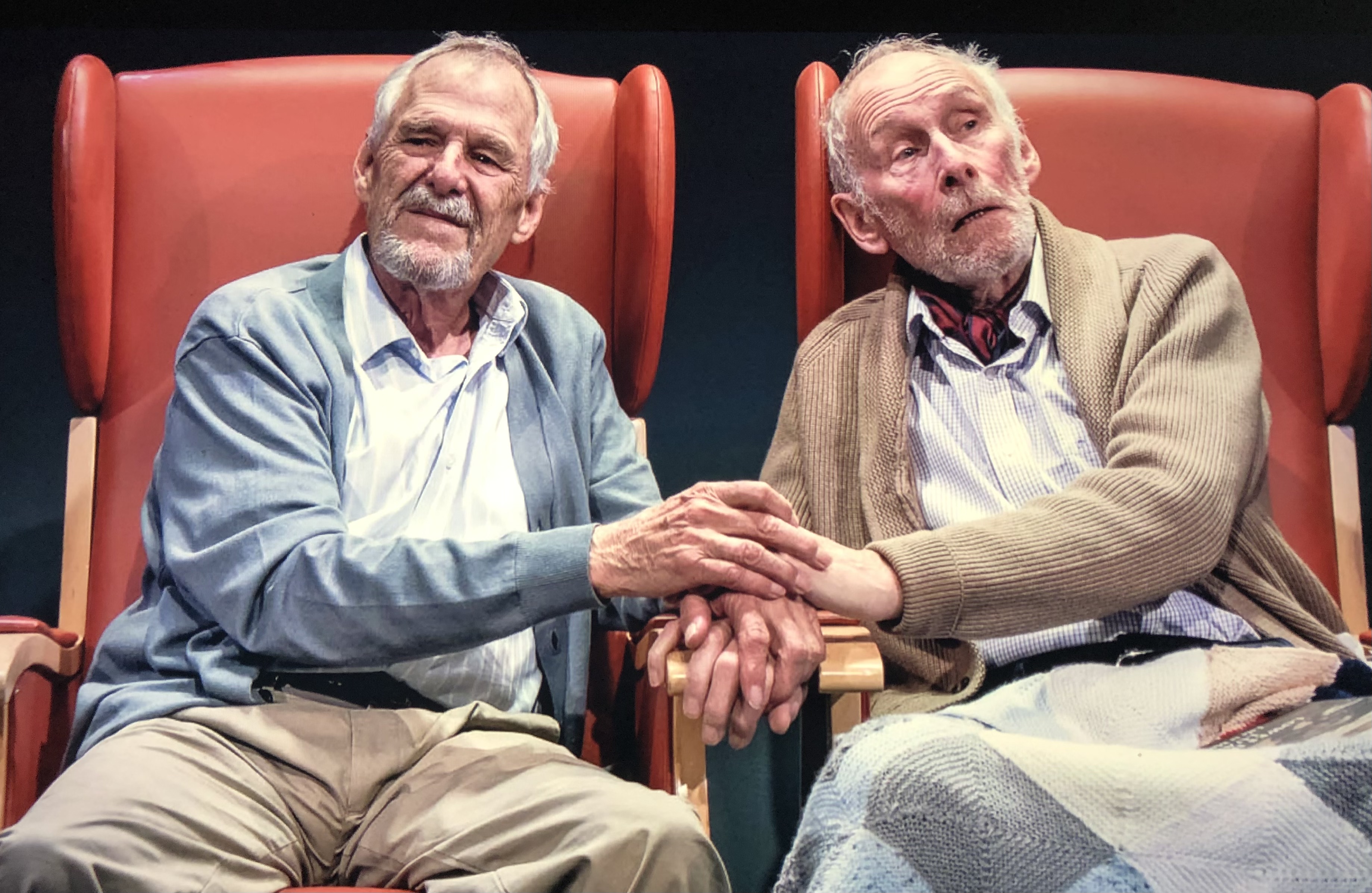
Colin (Ian Gelder) and Alex (Christopher Godwin), both in their late 70s,  sit side-by-side in large orange armchairs in what is, unmistakably, a nursing home. Occasionally, they hold hands and each takes a turn to reminisce while the other falls gently to sleep. They talk of walks along the riverside at Hammersmith and through the narrow streets of Soho, of living through the age of CND marches, rock ’n’ roll and liberation for  LGBTQ+ communities. We gather that they were once lovers and may be again now.

The old men are joined, unseen to them, by Gareth (Sam Thorpe-Spinks) and Nicholas (James Schofield), both in their early 20s, who seem to represent younger versions of themselves, partaking in on/off flirtations. They stand or sit on opposite sides of the stage, as if an invisible barrier has been erected in the middle, where Colin and Alex sit. Conversations overlap, creating an air of confusion and contradiction, indicating symptoms of dementia.

Alex’s son, Andrew (Andrew Woodall) and Colin’s niece, Clare (Claire Price) visit and sit, mainly motionless, facing their relatives. Indeed, the production, co-directed by Alice Hamilton and Gill himself, is, as a whole, largely static, leaving the writing and the vocal performances to do most of the work in selling the play to the audience.

Gelder and Godwin are both marvellous, finding the lyricism in Gill’s words with ease. However, the four subsidiary characters are underused by the writer and it becomes difficult to understand fully what purpose they serve. It feels as if Gill had planned a longer, more profound study of ageing and change in which these characters would have formed part of the narrative, but decided to settle for just a 65-minute taster.

Something in the Air is a poignant twilight play, touching on themes and covering territory which can be taken to be deeply personal to this significant writer. As such, the play cannot be dismissed lightly, even though it leaves behind a feeling of slight disappointment.

Performance date: 18 October 2022

Photo: Charles Flint

Original story: Oscar Wilde

Writers and directors: Olivia Jacobs and Toby Mitchell

⭐️⭐️⭐️

Christmas has arrived early at Southwark Playhouse, where Oscar Wilde’s short story, The Canterville Ghost, has been turned into a coat hanger for a set of Music Hall turns, featuring the kinds of trickery and all-round merriment that are normally held back for the pantomime season.

If it matters, the story concerns Mr Hiram B Otis (Steve Watts),

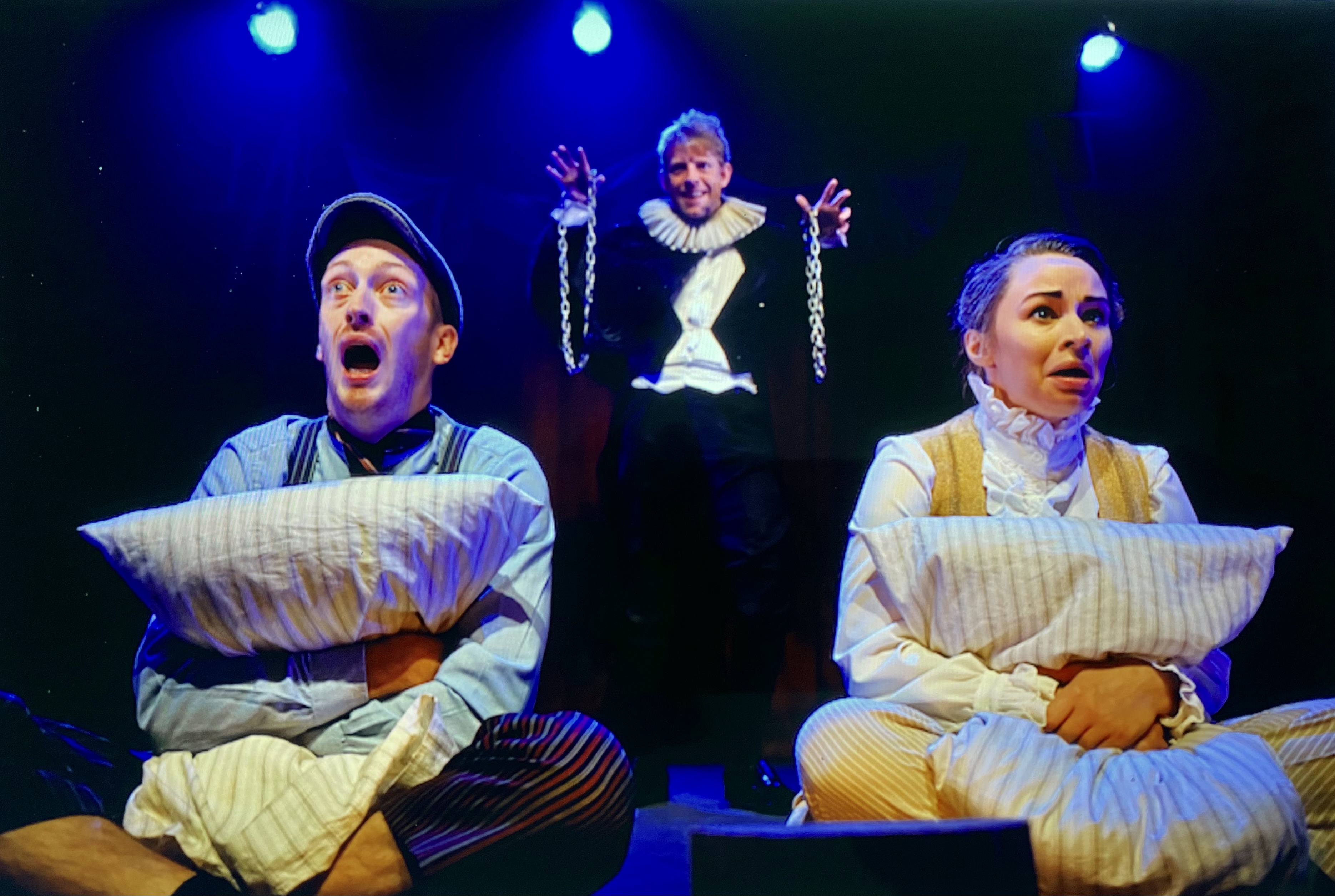
who acquires Canterville Hall and moves in with his twin offsprings (Matt Joplin and Katie Tranter), only to find that the family is sharing its new home with the ghost of Sir Simon de Canterville (Callum Patrick Hughes), the alleged murderer of his wife back in the 16th Century. Rather than run away scared, as most previous occupants of the Hall had done, the family takes on the ghost and attempts to lay matters to rest.

This brief, thin storyline is broken into six sections, in between which the performers are given longish interludes to demonstrate their specialist skills. Hughes proves himself to be an accomplished illusionist with a string of fairly familiar magic tricks. Joplin turns his hand (the right one) to operating Eddie, a ventriloquists’ dummy, in a highly amusing comedy double act and Tranter lays claim to being a psychic, interacting with the audience in a less than successful stab at mind reading. Watts acts as master of ceremonies and pianist.

Directors Olivia Jacobs and Toby Mitchell, also the adapters of Willde’s story, seem to give the four performers the freedom of the stage, always sticking to the flavour of Victorian Music Hall. They are aided in achieving this by designer Barney George’s moveable sets, consisting primarily of red velvet theatre curtains. Original songs in fitting style, with music and lyrics by Jon Fiber and Andy Shaw, add to the entertainment.

A separate, slightly more chilling tale emerges near the end, but, largely,  this ghost story is pleasingly silly, inoffensive and almost everything else, apart from spooky.

Performance date: 13 October 2022