Archive for the ‘Theatre’ Category

This review was originally written for The Public Reviews: http://www.thepublicreviews.com

Emily Bronte’s classic novel has received many film and television adaptations, inspired a Kate Bush hit song and even a Cliff Richard stage musical, but no interpretation comes to mind that is quite as unorthodox as this 60 minute performance piece, first seen at the Edinburgh Fringe Festival. With the audience seated on all four sides of the performance area, four men, all bearded and bare-footed, play the characters male and female, the horses, the wind and anything else that needs portraying. They are the creator, Peter McMaster and his collaborators Nicholas Anderson, Thom Scullion and Murray Wason. They use words, movement and music (Kate Bush recordings and traditional folk songs which they sing themselves). This is not a cohesive telling of Bronte’s story, rather it is a collection of sequences drawing inspiration from her characters, settings and themes. The unifying concept is an exploration of masculinity, in which the four men delve into their inner feelings as their characters face various challenges. At times, there is a sense of improvisation, giving rise to uncertainty as to whether the performers are speaking as their characters or as themselves, drawing from their personal experiences and emotions. It is this uncertainty that makes the piece so riveting. In contrast to any perceived improvisation, the movement is balletic and perfectly choreographed. Moments of intensity are followed by moments of levity, we are always expecting the unexpected, always on edge and filled with curiosity. The bleak and harsh landscape of the Yorkshire Moors overhangs every scene. We hear of love and loss, freedom and attachment, wanderlust and belonging to a place. At times our senses are assaulted visually and aurally – decibels rise as a mother harangues her son in a brutal interrogation, all four men have simultaneous coughing fits, the horses neigh loudly as they run across the open moorland. This is an unconventional and at times exciting piece of theatre. The narrative thread and character detail of Bronte’s novel have been jettisoned, but their loss is made up for by the sincerity and energy of the performers who give their all.

thepublicreview_hor_web copy

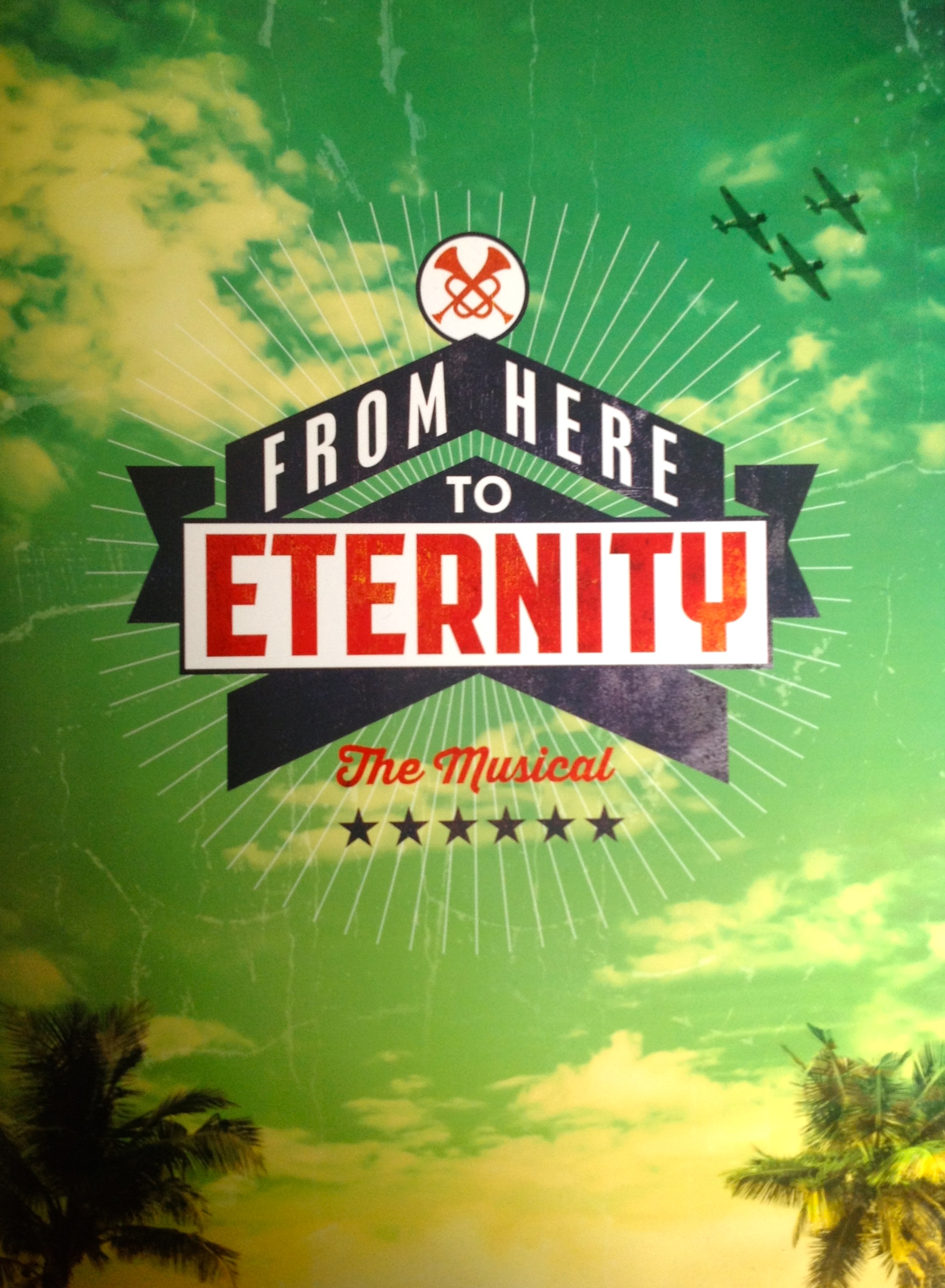
photo-95The producers and backers of this show are brave people. Nowadays, new musicals are either manufactured using already familiar hit songs or, if they have an original score, they are usually scaled down for smaller, less expensive venues, as with the recent London premiers of “Titanic” and “The Color Purple”. In a large theatre, with a 30+ little known cast, a full orchestra and an original score by an unknown composer, this show completely bucks the trend in modern musical theatre. The only recognisable name on the posters is that of the lyricist, Tim Rice who, since his hay day 30 years and more ago, has hardly been prolific. “From Here to Eternity” was originally a novel by James Jones, then turned into a 1953 film which, although hugely successful in it’s day, may not mean much to many modern theatregoers. It is set in 1941 amongst US soldiers stationed in Hawaii during the period leading up to the Japanese invasion of Pearl Harbour. It tells two parallel love stories: Private Prewitt is a defiant rebel who falls for Lorene, a hooker; Sergeant Warden starts a torrid affair with Karen, the wife of his commanding officer. It matters little that the nature of these relationships now seems dated, but there is an ugly gay sub-plot that clashes more than a little with 2013 sensitivities. Knowing the setting before the curtain rises could lead to expectations for something like “South Pacific”, which had a similar location, similar characters and remarkably similar plot lines. However, it is as if everyone involved realised these similarities at the very beginning and set about avoiding comparisons at all costs. The score includes hardly any Hawaiian influences, which is a pity because there are several sections when an injection of lightness and brightness is much needed. Rodgers and Hammerstein knew what they were doing and the creators of this show could have learned from them without copying them. Worse still are the dreary sets with subdued lighting that makes it seem as if we are viewing through a sepia-tinted lens. It is a mystery why director Tamara Harvey and designer Soutra Gilmour would think that an island paradise looks like the inside of a seedy Soho night club. Lack of spectacle could well lead to the show’s downfall and things are not helped by dance sequences that are, at best, perfunctory. With a company of this size, we are entitled to expect more. From here, the news gets better. Rice has lost none of his skills and his lyrics are first rate even if their integration into Bill Oakes’ book is not as seamless as it could be. Stuart Bravson’s score is full of strong melodies and powerful anthems. It is always a good sign when the audience leaves the theatre humming tunes from the show and appreciation of these songs could well improve with repeated hearings. The leading performances are also excellent. Robert Lonsdale is a stubborn and later pugnacious Prewitt, delivering his big song, “Fight the Fight” with gusto. Darius Campbell (formerly known as Danesh and before that just Darius) has a formidable stage presence and a rich, deep singing voice, so that, even if his acting is sometimes slightly wooden, he is just about perfect as Warden. As Lorene and Karen, Siubhan Harrison and Rebecca Thornhill are both alluring and have beautiful singing voices. Additionally, Ryan Sampson as Angelo, the role famously played by Frank Sinatra in the film, is a bundle of energy, railing against the system until ultimately being defeated by it. The Shaftesbury has, in the past, been the graveyard for many musicals. Although this one is a curate’s egg, it has sufficient quality to merit the hope that those who had the courage to bring it to the stage should be rewarded by not seeing it follow in the path of unfortunate predecessors here. My fear is that it is too old fashioned and does not have enough of the ingredients needed to capture the public’s imagination, but I sincerely hope that I am wrong.

photo-91If Rufus Norris wants to ensure that his tenure as head of the National is a success, maybe he should simply appoint Marianne Elliott to direct every production. Returning to the home of her triumphs with “War Horse” and “The Curious Incident…”, she has created a musical show that is, in the first half at least, as magical as anything I have seen in six decades of theatregoing. Taking a children’s story of a princess who loses her gravity and her ability to cry whilst grieving for her mother and then floats around aimlessly until saved by her handsome prince, she has conjured up a world of wonder. The princess defies gravity, birds fly around, small animals inhabit all parts of the stage, characters swim with fish in a lake and it all comes together seamlessly. The “War Horse” trick of using near invisible puppeteers is repeated, but, in this case the princess is often a human puppet and Rosalie Craig in the title role shows astonishing balletic skill. It all provides a stunning spectacle, choreographed to perfection, giving so much magic to a show that, sadly, brings very little magic of its own. The story is as light as the princess herself, the hero and heroine are not consistently sympathetic and the villains are not sufficiently villainous. However, most disappointing of all is Tori Amos’ score which is bland and lacking in both variety and melody; it is difficult to identify songs as such, mostly we just get sung dialogue, but when the characters sing about gravity, it reminds us of another similar show and puts everything here into perspective. Leaving aside the brilliant staging, this is nowhere near as good and nowhere near as much fun as “Wicked”. It also seems crazy that the National is promoting the production as suitable for 13+ ages, thereby excluding a large part of the audience to which it will appeal most; if this is because the story includes a pregnancy out of wedlock, someone needs reminding that this is 2013. In the end the show may be judged as another triumph for Ms Elliott, but perhaps the nature of her achievement should be seen less as creating a hit, more as saving us from the biggest turkey this side of Christmas.

photo-88Entering the theatre, there is the smell of freshly sawn wood, befitting a set that looks like the warehouse at IKEA. Exactly what this has to do with 14th Century monarchy never becomes clear, but it is the first of countless eccentric touches to staging, costumes and casting that embellish this version of Christopher Marlowe’s play. As played by John Heffernan, Edward is a hapless figure, pilloried by the nobility over his relationship with his gay lover, Piers Gaveston (Kyle Soller, who, fittingly, also plays the King’s executioner). Joe Hill-Gibbins’ production is lively, inventive, fast-moving and lucid always offering something interesting to catch the eye. Maybe it is not entirely appropriate for the hokey-cokey to be played after a battle or for the Queen to be a chain smoker and, indeed, some of the weird ideas work better than others. However, overall it is fun and, considering the grizzly nature of parts of the story, fun is quite an achievement. A conventional interpretation of this play is likely to have proved more than a little turgid, so the National is to be congratulated.

photo-94It is remarkable to realise that a play that delves into infidelity, illegitimacy and the effects of inherited syphilis, and includes suggestions of incest and euthenasia, could have emanated from the late 19th Century, but this is that play. Richard Eyre directs his own new translation of Henrik Ibsen’s work, having streamlined it to a mere 90 minutes with no interval. Eyre’s approach means that the neatly ordered world that we see at the beginning of the play disintegrates completely in a very short and continuous time span, seemingly during the course of one evening. So, suspension of disbelief is essential. However, once that hurdle has been cleared, the rewards are enormous, because this condensed version delivers drama of a rare intensity, culminating in a shattering climax. Eyre’s next masterstroke is the casting of the magnificent Lesley Manville in the lead role of Helene Alving, who describes her home as “a university of suffering”. Her heart-rending performance is complemented well by Jack Lowden as her doomed son, but not so well by Will Keen, who is slightly unconvincing as the oily and hypocritical Pastor Manders. Beyond the acting, the production is impressively mounted; a beautiful set, predominantly dark green with translucent walls, is half lit to suggest a bleak Norwegian Winter during which the sun hardly ever shines. Here is a place that readily invites the ghosts of past misdemeanours to return and destroy the present. This is a top class production, brave and powerful.

This review was originally written for The Public Reviews: http://www.thepublicreviews.com

Union Jacks draped across trestle tables, a notice board plastered with parish council news, Women’s Institute announcements and a photo of a lost guinea pig. We are unmistakably in a community hall in rural England. In the Derbyshire town of Bakewell to be precise, where the annual baking contest is taking place. The seven finalists proudly parade their cakes and compete for the chance to create the definitive Bakewell tart (or is it a pudding? or maybe a cake?). This musical is the work of The Baking Committee, a group consisting of the 11 performers in the show plus three others who all came together at Guildford School of Acting, sharing a common love for musical theatre and for cake. It is not high art but it is relentless fun, leaving no pun unturned and discarding no double entendre for being too awful. Alexandra Spalding is a jolly presence throughout as Victoria Sponge, the MC. The contestants include: a saucy Lucy Emmott as “the original Bakewell tart”; Tom Beynon as Henrietta Apfelstrudel, a German transvestite who champions her Black Forest gateau and complains that “you always bake alone when you sound like a baritone”; Victoria Humphreys as a singing nun who glows over her angel cake; and Tim Stuart as a shy postman who strikes up a romantic chord with one of the judges and, clutching his mixing bowl to his chest, sings to her “you make me rise”. Individually, the singing is passable, but the team seems to have decided that they sound better as a chorus and they deliver several well-harmonised numbers, culminating in the excellent How Do I Feel? The lyrics are of variable quality, occasionally bland but often quite witty, with some sparkling rhymes. They combine well with the tunes which, if not too memorable, are always easy on the ear. Musical director Kevin Michael Cripps ensures that all the numbers are performed with aplomb. Choreography by Nicole Tiffany Rushing and Kayleigh Thadani also adds to the merriment. Undoubtedly this show is a little rough around the edges, but what it lacks in polish and sophistication is more than made up for by the energy, good humour and enthusiasm of the performers. As a first stab at a musical it is not bad at all and shows considerable promise in all departments. If the Baking Committee turns out to include a budding Sondheim, that will really be the icing on the cake.

thepublicreview_hor_web copy

Not content with just being one of the finest stage actors of his generation, Rory Kinnear now  makes an outstanding debut as a playwright. He has constructed a heart-warming comedy on the foundations of a heart-rending drama, dealing with the strains put on a family when one of its members is severely disabled. The family is gathered to celebrate the 21st Birthday of Andy, never seen but ever-present, who suffers from an unspecified disorder that is described as “much worse than Downs Syndrome”. The production is very strongly cast with Amanda Root and Louise Brealey superb as Andy’s brittle and bruised mother and sister. Kenneth Cranham and Anna Calder-Marshall contribute splendid comedy turns as his grandparents. Unusually for a fringe production, the performance area is much too expansive, it taking eight large rugs to cover the floor of the living room set; much of the space is never used and the actors sometimes look lost in it. However, this is a very minor criticism. Kinnear’s play is beautifully written and performed, making for a highly entertaining evening.

This review was originally written for The Public Reviews: http://www.thepublicreviews.com

Alexandra is a Greek Cypriot who was driven from her homeland by the 1974 Turkish invasion and now runs a small shop in London. She lives alone with only Neil Diamond’s music for company and she dreams of returning to her home city of Famagusta, the Greek name for which is Ammochostos, meaning “hidden in the sand”. But the city is now part of Turkish Northern Cyprus, so she can only cling to memories of her lost life, unable to move forward until, one day, Jonathan, an English academic, walks into her shop and they fall in love. James Philips’ tender and passionate new play is a middle-age romance taking place against the backdrop of 20th Century European conflicts. The play is set in 1999 and Alexandra’s niece (Daphne Alexander) is a photo journalist working in Kosovo; she has seen at first hand the terrible consequences of war and displacement, but she is a generation removed from the Cyprus invasion and she does not even speak Greek. Alexandra’s estranged sister (Yolanda Vazquez) has re-married and cut her ties with her home country. Just Alexandra herself remains stuck in a time warp, still believing that her former lover, who disappeared on the day of the Turkish invasion, will return; she cries “to give up hope is to betray”. Can Jonathan help her to become reconciled with the past and reclaim her so that she can live and love again? As Jonathan, Scott Handy is earnest and sincere, even if his character is slightly under-written. However, it is a luminous performance by Sally Dexter as Alexandra that elevates this production to a higher level. She simply lives the part, conveying emotional turmoil, confusion and vulnerability as her character confronts her demons. Quite literally, she moves us to tears at several points during the course of this play and few better performances are likely to be seen on the London stage this year. The story begins in London and ends in Cyprus, but Timothy Bird’s predominantly white set design is more Mediterranean than British and back projections of faces from the past effectively evoke sadness for worlds now lost. This studio space is so small and the drama, particularly in the second act, is so intense and intimate that we feel like intruders who have no right to be there. Phillips’ writing is truthful and believable, always holding our interest and, whilst political themes are always present, he never allows them to overshadow the human drama. His writing and direction rightly focus primarily on Alexandra. She and the actor who plays her tower above everything else.

thepublicreview_hor_web copy

This review was originally written for The Public Reviews: http://www.thepublicreviews.com

A remote Welsh cottage made inaccessible by the worst snowstorm in decades and, inside, a dead body. No, this is not an Agatha Christie whodunnit, rather it is a curious little play that edges between black comedy, family drama and suspense thriller. The body is that of Granny, who, having called a family reunion, rather thoughtlessly goes to meet her maker after only two family members, sibling grandchildren, have arrived. Left alone with little food, faltering water and electricity supplies, no mobile phone signal and no wifi, the pair settle in for a night of opening up the wounds from past traumas, whilst Granny lies rolled up in a carpet on the floor. This is rather a neat opening premise for a black comedy and the setting is nicely realised in Jenny Davies’ design; cluttered with old fashioned crockery, bric-a-brac, sheep skulls and quail egg shells, this is just where an eccentric old lady could have lived and died However, for the first 40 minutes of this 70 minute play, there is nothing black and very little comedic as the siblings simply bicker childishly over trivia; they each complain of being driven mad by the other, but, in fact, it is us being driven mad by both of them. In the later stages, events take a sinister turn and become more interesting and suspenseful, but there is still little real bite in the writing. Mark (Mathew Foster) is a high-flyer working in New York, whilst his sister Elyse (Pascale Morrison-Derbyshire) is recovering from the breakdown of a five year relationship. Yet, in this production, both look, sound and behave like adolescents. If the characters had been played older, maybe they would have had the gravitas to bring out the play’s darker undertones. As it is, the inconsistency between the characters brought to life on stage and their back stories damages the play significantly and, if Marietta Kirkbride’s intention was to show how adults revert to their childhood selves when with family in pressured situations, the point is lost. So, from a promising start, this all turns out to be rather a disappointment. There are entertaining moments and, being so short, the play does not drag on, but it ends up being lightweight and insubstantial, when we had hoped for much more.

thepublicreview_hor_web copy

photo-103The West End is awash with adaptations from films, using non-original music, but, if any film ever cried out for a stage version, it is “The Commitments”. Roddy Doyle adapts his own novel about the emergence of a soul band in working class Dublin and director of the moment, Jamie Lloyd, injects much the same level of raw energy that made the film so likeable. The first half is a musical with hardly any music and some of the comedy falls flat, but things get much livelier in the second half once the band has been formed. In any event, the story is fairly thin and anticlimactic, so the show relies heavily on the songs. Killian Donnelly as the obnoxious lead singer with the golden voice, is terrific in delivering them. Denis Grindel, as the young manager, carries us though most of the narrative energetically. There is enough entertainment here to ensure a decent run, but anyone who just wants to hear a bunch of soul classics reasonably well performed could do better by simply getting a ticket to see a real band.