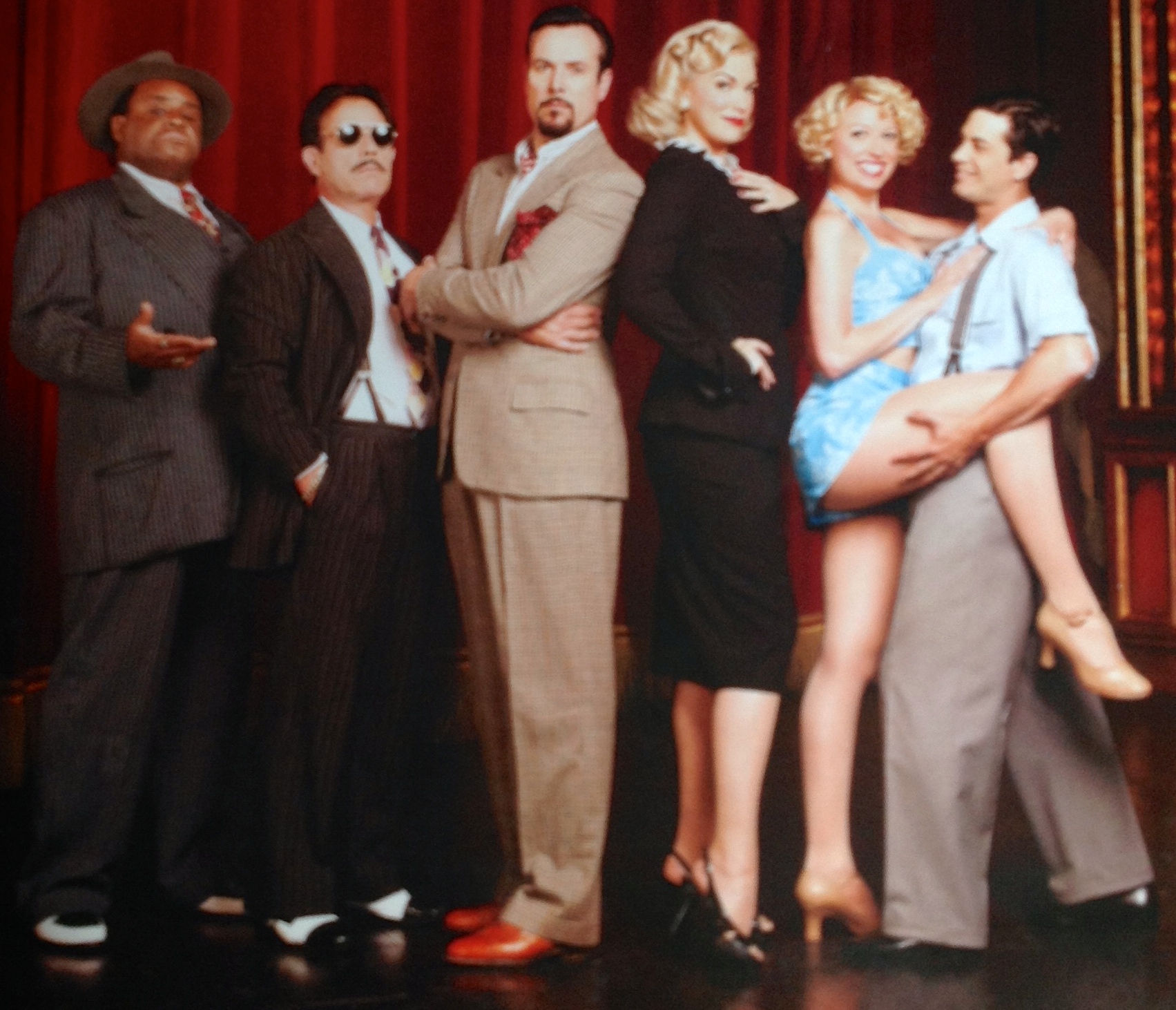
 In the list of all-time great musical comedies, this comes pretty near the top and inevitably it reappears in London every decade or so. However it is hard to imagine that it has ever been done better than in this wonderful production directed by Trevor Nunn. In an impeccable cast, Hannah Waddingham is outstanding as “the shrew”‘ spitting out “I Hate Men” with real venom, Alex Bourne is excellent as her ex-husband, Holly Dale Spencer makes a delightful dim-witted starlet, partnered by Adam Garcia who “can’t behave” but dances like a dream. In support, David Burt and Clive Rowe stop the show with “Brush Up Your Shakespeare” and Jason Pennycooke opens Act II with “Too Darn Hot”‘ leading a spectacular song and dance routine that brings the audience to its feet. Cole Porter’s glorious songs are too many to mention and the book is bubbling with wit. Brisk direction, dazzling choreography, there is absolutely nothing to fault. Blissful!
Archive for the ‘Theatre’ Category
The Captain of Kopenick**** (National – Olivier, 15 February 2013)
Posted: February 16, 2013 in TheatreBorrowing from football, this could be described as a play of two halves. A satire on German society and the military, set in 1910, it centres on Wilhelm Voigt (Antony Sher in top form), a petty thief just released from jail and struggling to cut through layers of senseless bureaucracy. The first half is vaguely Brechtian with dashes of comedy, superbly staged but somewhat stodgy and it climaxes with a funeral. However, it is necessary to sit through it in order to fully appreciate all the gags that are to follow and doing so gives the added advantage of lowering expectations, so that the second half comes as a complete surprise. Shortly after the interval, the action moves to a public toilet and what follows is around 40 minutes of sublime comedy, as Voigt assumes the identity of a captain and takes command of a unit which he leads to reek havoc in Kopenick Town Hall. We are treated to an explosion of verbal and visual gags, utter lunacy that plays like a cross between “The Goon Show” and the Marx Brothers. Who ever said that the Germans have no sense of humour? It reaches the heights of hilarity and Sher brilliance. At the end. all the audience can do is stagger from the theatre, still aching from laughter and pitying the poor souls who decided to leave at the interval.
This review was originally written for The Public Reviews: http://www.thepublicreviews.com
Jerry Herman clearly has a liking for formidable middle-aged ladies. Having struck gold with Hello Dolly and Mame, he chose to adapt The Madwoman of Chaillot, a play by Jean Girardoux and this musical is the result. But sadly, the hat trick of hits eluded him when it opened on Broadway in 1969 and only now is it getting its first UK staging. So the key question was whether this is a forgotten treasure from a golden age of Broadway or was there a very good reason for its long spell in obscurity? The “madwoman” is Countess Aurelia, played here by Betty Buckley, who marshals a group of her equally eccentric friends to thwart a plot by business moguls to turn the Paris of 1945 into an oil field. It is described as “a musical fable”, making it clear at the outset that Dear World will have very little foundation in the real world and, accordingly, the charming sets, designed by Matt Kinley, conjure up familiar romanticised Parisian images. Even so, amidst all the whimsy, there is satire of corporate greed and environmental ruin that is even more topical now than when the show was written It is interesting that Angela Lansbury, who played the lead originally, has been quoted as partly blaming the show’s failure on the size of the theatre, feeling that the staging needed intimacy and charm. No such excuses can be offered here, as the theatre is both small enough to allow intimacy and large enough to have proper sets and choreography. Yet this is still not quite the lost gem that we hoped for. It is all very uneven, at its best rousing, but at its worst plodding. The title song and One Person are catchy anthems typical of Herman, and most of the comedy numbers work very well, but some other songs, particularly in Act I, are riddled with cliches and instantly forgettable. Buckley has got what it takes to carry a show like this and she does so with aplomb. Paul Nicholas clearly enjoys himself leading the support and Ayman Safiah is very affecting, dancing and miming as the Mute. Katy Treharne has a delightful soprano voice but she and Stewart Matthew Price are given very little opportunity to make a lasting impact as the young lovers. As two other “mad” ladies, Rebecca Lock and Annabel Leventon are highly amusing in their routines with Buckley, whilst Peter Land, Jack Rebaldi and Robert Meadmore playing the moguls, relish the cynical lyrics of their songs together. In view of her background as a choreographer, it is a little disappointing that the director does not include more dance and, generally, that she fails to liven things up during some dull patches between songs. But leaving aside the many quibbles, there is still a great deal to enjoy and it should not have taken over 40 years to get this show to these shores.

Five Kinds of Silence**** (White Bear Kennington, 13 February 2012)
Posted: February 14, 2013 in TheatreThis review was originally written for The Public Reviews: http://www.thepublicreviews.com
A gunshot rings out and an aggressor falls to the ground; a young woman is holding the gun and another young woman grabs it to fire a second shot and make sure that the man is dead. An older woman, their mother, looks on. The dead man is the father in the family, but he is not dead to the three women so long as he continues to haunt their minds and his threatening presence on the stage dominates throughout the play’s 90 minutes. This a study of violence inside a family which never resorts to simplistic explanations nor points the finger of blame in a single direction. Yes, the father is guilty of appalling physical, psychological and sexual abuse but the play, whilst never excusing him, is able to show how he was himself a victim of childhood traumas. It also questions the extent to which the three women were complicit in their own and each other’s torment. Set on a near empty stage in a small studio space, the fluid direction ensures that every member of the audience is drawn into the intense drama, as the women gradually reveal their secrets and attempt to understand what has happened so as to rid their minds of the horrors. As Billy, the father, Zach Lee is stunning, making it perfectly credible that the three women could loathe and love him at the same time; his character is both a perpetrator and a victim of violence, suffering from alcoholism and epilepsy, yet, however monstrously he behaves, the actor is still able to eke out a degree of sympathy for him. As Mary, the mother, Tessa Wood gives a moving performance, her character was a neglected child who seemed cast by nature into the role of victim; yet she is aware of her own inability to stop the abuse and, understanding that it crosses generations, she is determined that she does not want grandchildren. Violet Ryder plays Janet, the older daughter as clear-thinking and resolute in determining the only way to end the horror, but equally vulnerable and prone to emotional outbursts. Olivia Dennis plays her younger sister Susan as more confused by her own emotions and racked by personal guilt. Anthony Hoskyns as the women’s interrogator completes the quintet of fine actors. This play is produced by Stepping Out Theatre, the leading mental health theatre group. The writing is stark and unflinching, but still able to allow for occasional dashes of humour. The characters in the play are people who live amongst us. Their plight was allowed to continue because all four remained silent. Yet the outside world saw signs too and also remained silent. Even in its title, this play asks questions of us all.
 Described as a “comedy of terror”, this adaptation of Franz Kafka’s surrealist novel first opened here in 2006, so its return indicates that it has gained a reputation and/or a loyal audience; it was something of a surprise to find a near-full house for Kafka in West London on a cold Tuesday evening in February. It begins with a man emerging one morning having, for no stated reason, turned into some kind of insect; his family recoil in disgust and reject him. The single set is on two levels, a downstairs living room and the upstairs room, cleverly designed to alter perspectives, where the man/insect becomes imprisoned. Playing him Gisli Om Garoarsson displays impressive gravity-defying agility and provides many of the striking visual images that are threaded through the entire evening. The music by Nick Cave and Warren Ellis also adds much to the prevailing mood of weirdness. However, if the production is at its best when it is a visual piece underscored by music, it is at its very worst when the characters are speaking; their dialogue is uninteresting and repetitive being delivered in an irritating, stylised manner. None of Kafka’s antiauthoritarian messages would have been lost if this had been performed as a mime. Indeed, this is a production that would have spoken much louder if it had not used words.
This review was originally written for The Public Reviews: http://www.thepublicreviews.com
Ivor Novello remains an iconic name in British theatre but, unlike contemporaries such as Coward and Rattigan, his works are largely unknown to modern audiences. This production gives clear clues both as to how he gained his stature and as to why his works are now hardly ever staged. To avoid confusion with modern connotations, the *Gay* of the title is Gay Daventry, a fading musical theatre star who founds a school of dramatic arts. There is no more plot worth recounting. Beginning with the positive, the tunes are varied and melodic, the lyrics are sharp and witty. This production has evolved from concert performances at the Finborough Theatre last year and it is easy to see why those performances were successful. They would have accentuated the songs and the book would have been relegated to secondary importance. However, in a full staging, the songs and the book matter equally and the show’s major weakness becomes more exposed. Musical theatre began to change forever after the opening of OKLAHOMA on Broadway in 1943, so this show was already on its way to becoming a relic when it was first staged in 1950, the year before Novello’s untimely death. In the second half of the 20th Century and beyond, musicals have become fully-developed works of theatre in their own right with integrated music and lyrics that serve to augment and drive forward the drama or comedy. Now a musical with a weak book is unlikely to go far, but in Novello’s days, the book of a show, this one included, was usually no more than a loose structure to which a collection of songs could be attached. The cast is 20-strong plus a pianist, not many fewer than a capacity audience in this tiny venue. Many musicals have benefitted enormously from being scaled down to be performed in a small venue, but this is not one of them. It is about musical theatre and, to have even a remote chance of working, it needed to be staged in a traditional theatre, where the big numbers could be made bigger, full dance routines could be added and the show’s critical weakness could be more easily overlooked. Here the spotlight is fixed firmly for long periods on the abysmal script and the performers can find no escape route. The company, led by Sophie-Louise Dann, Josh Little and Helena Blackman are all good singers and all likeable, but between musical numbers, they seem uncertain whether to play it straight or as a parody. In truth, neither option would succeed and their only salvation comes with the next song. The sad conclusion is that the main value of this revival is for it to serve as the equivalent of a museum exhibit, showing us what musical theatre used to be like. It may be a while before a Novello show is seen again.
Robert Lepage has gained sufficient renown as a theatre-maker to have his name dominating the posters, so, when a director is given such prominence, it was to be expected that this new production would be mostly about visual impact. It is the first of four plays, each shaped around one card suit, this one supposedly having the theme of war and set in the underbelly of Las Vegas, where gambling addiction, prostitution, illegal immigration, etc are rife. With a technical crew that far outnumbers the performers, there is certainly much to impress. Characters and objects emerge from and sink into the huge round stage, which is frequently revolving. Unfortunately, however imaginative the staging may be, there is little point to it when it evokes neither the magic of Las Vegas that forms its allure nor the seediness that lies beneath its surface. Furthermore, when the action calms and there are just two or three actors performing a scene, they are unable to create any dramatic impact because they seem remote and lost. I saw the first preview performance, so I have to forgive most technical glitches, but, as some scenes are performed in French or Spanish, it was very sad that the surtitles should have been out of sync. Last and certainly least what about the script? Leaving aside quibbles about the staging, this is the biggest problem with the show; eight writers are given credit, which could explain why there is a lack of both cohesion and focus, but the script is also plodding and inexcusably dull. Overall, a big disappointment.
This review was originally written for The Public Reviews: http://www.thepublicreviews.com

In 2011 at the same theatre (then named The Comedy), Ian Rickson directed what many regard as the definitive version of Pinter’s 1978 play Betrayal, which depicted a love triangle of two men and a woman. Now he returns with the same leading actor to direct this three-hander for two women and a man, so expectations were high. This play dates from 1971 and is set in the country home of Deeley, a film-maker, and his wife Kate. The third character is Anna, who had been Kate’s room-mate 20 years earlier. The three recollect events from the past which may have really happened, may have been distorted by time or may have been invented. We are never told. Kate is brunette, brooding and introverted, Anna is blond, flamboyant and outgoing. Do they represent two sides of the same woman? Well, probably, but this is too simplistic to be the complete answer and Pinter never lets us off so lightly. He asks us to ponder on how our present lives can be shaped by what we think may have happened in the past just as much as by what actually happened and on how the people that we once were inhabit us as much as the people that we later became. The art of acting Pinter lies in an understanding of what is meant but not always written. In Betrayal, the character of Emma is defined by her duplicity and, when playing her in Rickson’s production, Kristin Scott Thomas frequently needed to speak a line whilst conveying to the audience that her character is thinking the exact opposite. In achieving this so successfully, she marked herself as a consummate actor of Pinter. Her mature beauty and natural elegance can mask an inner turmoil that is revealed only by the slightest changes in body language, maybe no more than a flicker or a grimace, but, without needing words, she is able to project the truth within of the character that the writer has created. In this play, the characters are not deceiving others so much as themselves as they recall past events and emotions, struggling to distinguish what is real and what is not and it takes an actor with Scott Thomas’s skills to convey this to an audience. She is matched here more than adequately by Lia Williams. The two are alternating the roles of Kate and Anna and this reviewer saw Scott Thomas as Anna and Williams as Kate. Rufus Sewell is also superb as Deeley, veering between playfulness and exasperated rage. The production values are high. Hildegard Bechtler’s sparsely furnished but richly coloured sets and Peter Mumford’s lighting contribute to the sombre and reflective atmosphere that prevails throughout as does Stephen Warbeck’s haunting piano music, particularly in the wordless closing moments. As always with Pinter, many questions are posed but straightforward answers are never given. Running for just 80 minutes without an interval, this play is enigmatic, perhaps even baffling, but it will linger in the mind long after the curtain falls. Maybe this production of the play will be talked of 20 years hence as the one that could never be bettered and maybe such recollections will be true.
This review was originally written for The Public Reviews: http://www.thepublicreviews.com
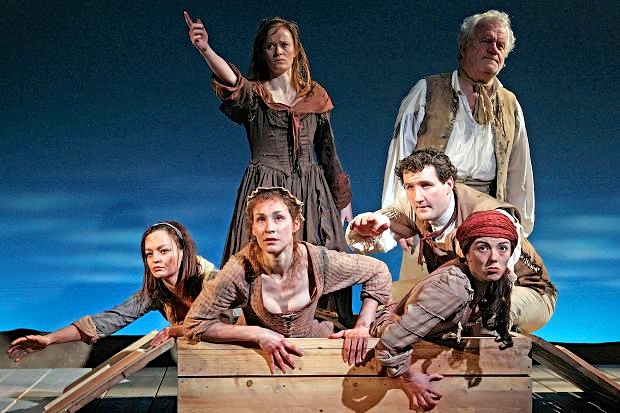 At its heart, this play argues that theatre is a medicine for many ills, capable of soothing troubled souls and giving meaning to abandoned lives. Based on Thomas Keneally’s 1987 novel THE PLAYMAKER which drew from real events, it was first produced at the Royal Court in 1988 and won great acclaim. This new production with the same director is by the Out of Joint company in conjunction with the Octagon Theatre, Bolton. and it is well worth its transfer to the West End’s newest theatre. In the late 18th Century, a ship from Britain, carrying convicts destined for a penal colony, arrives on Australia’s shores after an eight month voyage. The Governor of the colony questions the value of the brutal regime that has become accepted and charges a young Lieutenant with staging a play in which the convicts will perform. The play within the play is George Farquhar’s THE RECRUITING OFFICER (seen at the Donmar only last year). At first the Lieutenant sees it as a career opportunity, but his enthusiasm for the project grows as he becomes more closely involved with his company. Whilst much of what follows is comic, as is inevitable when a group of novices fumble to learn new skills, we are never allowed to forget the injustices and brutality which form the backdrop to the story and we know that the threat of the gallows always looms. On this serious level, whilst more liberal attitudes prevail today, the debates in the play on finding the right balance between punishment and rehabilitation are still as relevant as at the time when the play is set. This is a vibrant and exciting production. The steeply-raked auditorium gives the effect of a bear pit which heightens the confrontational aspects of many of the scenes. The company of ten needs to double up on many roles and the inevitable downside of this is some confusion as to which character is appearing, a problem that is referred to humorously in the play’s text. However, on this occasion, the disadvantage is offset by creating the appearance of having a small and energetic company with limited resources, which is completely consistent with the themes of the play. Only Dominic Thorburn as the Lieutenant plays a single role throughout, but, of the others, Ian Redford deserves a mention for exceptional versatility. Also, the four women, Helen Bradbury, Laura Dos Santos, Lisa Kerr and Kathryn O’Reilly display resilience, dignity and tenderness to great effect. As a diversion, the writer occasionally indulges herself with cutting theatrical in-jokes, particularly at the expense of actors, but the balance between the comic and the dramatic is effective and switches of mood are handled very adeptly. Overall, the play is funny, disturbing, moving and, most endearingly, it is a strong affirmation of the power of theatre. Highly recommended
 The staff room of a Cambridge school of English for foreigners in the early 1960s is the setting for Richard Eyre’s welcome revival of Simon Gray’s 1981 comedy. Seven characters appear in the room but it is a host of others who are spoken of but unseen who drive the action. This really is the point as Gray sets out to show how people exist in their own separate orbits, hardly making any meaningful contact with others they meet every day in the workplace; here the truth is never spoken when a platitude can be found to replace it and everyone relates their own triumphs and disasters to others who show only mock interest or concern. For six of the characters, the real world is that which exists outside the staff room. The exception to this is St John Quartermaine, a shambolic teacher whose only world is the staff room; he is unable to engage with his pupils, unable to teach, incapable of even attending all his own lessons, but he vainly seeks to be admitted into the worlds of his colleagues who would only welcome him when they see him as being useful to them. He slouches in the same chair every day, even it is once jokingly suggested during school holidays. He is a true English eccentric and Rowan Atkinson needs to do little more than just be himself in order to capture his essence. However, this is an ensemble piece and Matthew Cottle, Louise Ford, Conleth Hill, Will Keen, Felicity Montagu and Malcolm Sinclair are all perfectly cast, balancing comedy and tragedy as their characters’ individual stories evolve. The main justification for bringing this play in to a West End theatre may have been to provide a star vehicle for Rowan Atkinson, but it also gives a new generation the opportunity to discover Gray’s sharp and wryly funny writing, which cannot be a bad thing.
 The Beast's Pen