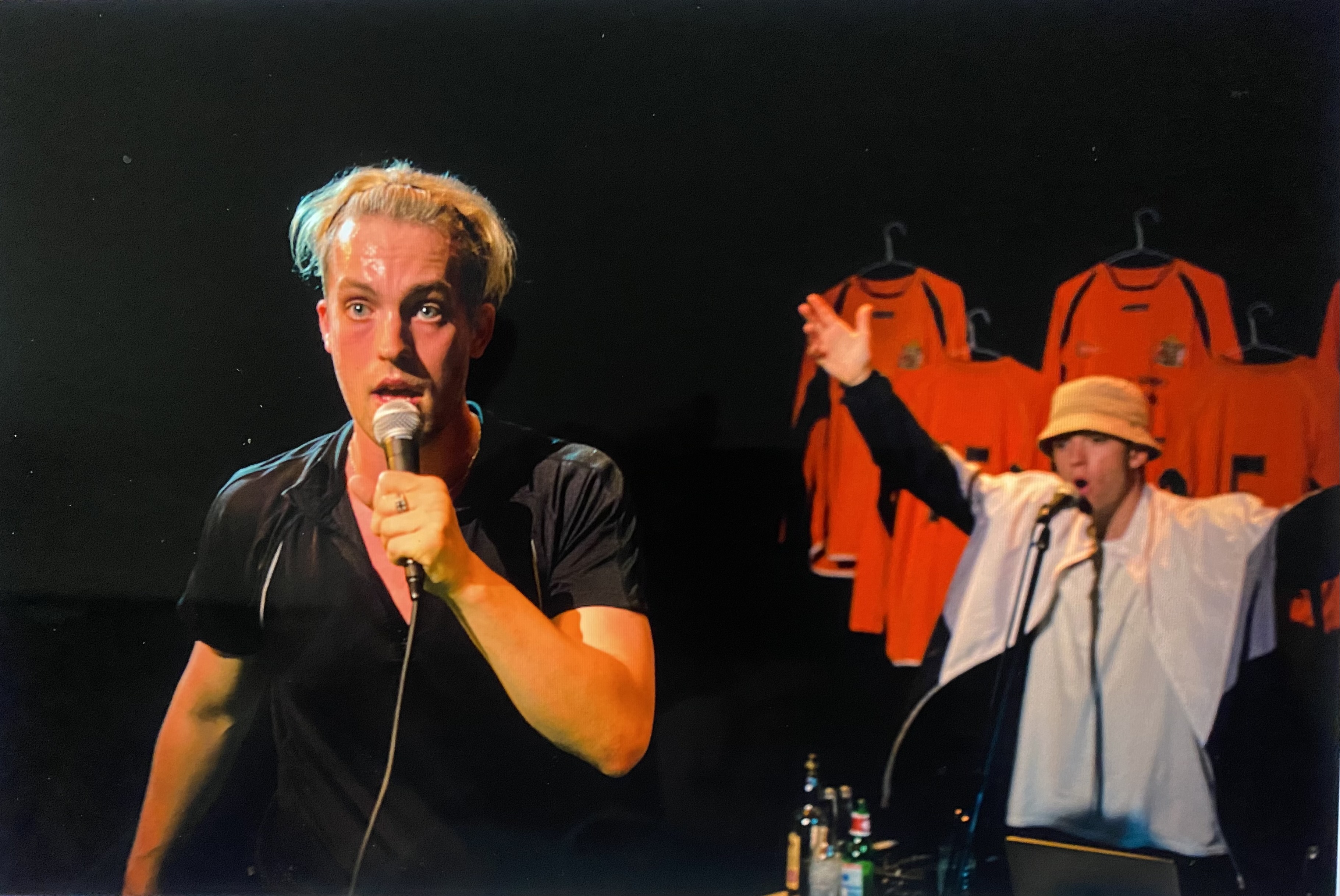
The legendary manager Bill Shankly famously said: “Some people think football is a matter of life and death. I assure you it’s much more serious than that”. The quote springs to mind while hearing Kieron, the central figure of Same Butters’ 65-minute play Hand of God, describe how the game reaches into every corner of his daily existence.
The play, set in the heart of the Black Country, is transplanted by Tectum Theatre to this pub theatre, which is little more than a long goal kick from Arsenal’s stadium. Kieron (played by Butters himself) supports West Bromwich Albion in the professional game and plays irregularly for Blackheath Town in a local five-a-side league. In frustration, he forms a breakaway team, Dyslexia Untied, recruiting drug dealers to fill the remaining four places.
This show is no Hamilton, but it borrows from the hit musical’s trick of using hip-hop to develop a narrative. Music, described as “garage” in style is composed by Charlie O’Connor, who performs frantically as the DJ and also comes on as substitute for the first team. Co-directors Charlie Derrar and Joseph Siddle keep the production close to boiling point and also provide lyrics.
The play makes only passing references to Diego Maradonna, to whom its title alludes, but draws on the natural humour that is ingrained in football and its followers. However, Butters is at his strongest, both as writer and actor, when focussing on the serious issues of drug abuse and the strained relationship between Kieron and his father. For long periods, the pathos is suppressed, making it all the more powerful when it is finally unleashed.
Hand of God shows a genuine understanding of the role played by football in shaping otherwise ordinary lives and in strengthening cross-generational bonds. So, the critical question is whether Butters’ modest offering is sufficiently on the ball to lure audiences away from the women’s game on their television screens on sweltering July evenings. The short answer must be that it just about is.
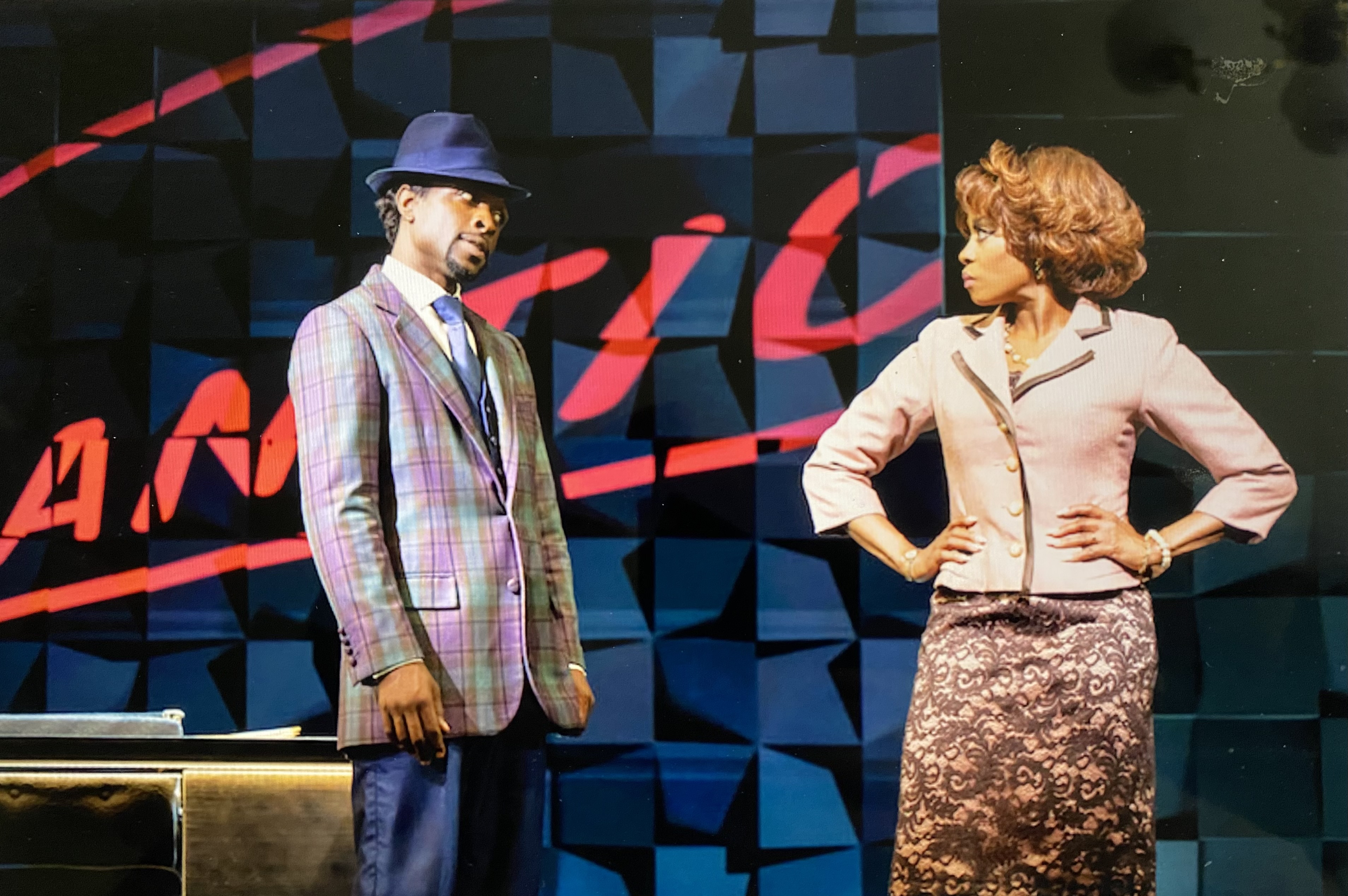
With Beverley Knight having gone off to a nunnery (she’s now starring in Sister Act), The Drifters Girl sails on with new crew at the helm. Stepping in is Grammy-nominated Broadway star Felicia Boswell, who brings with her enough pizazz to make sure that West End audiences will stand by the show for quite a while longer.
Unapologetically, this is a juke box musical, packing the hits (a couple of dozen at a rough count) of The Drifters, a four-man American vocal group of the 1950s and 60s, into 140 minutes of low brow, high energy entertainment. Audiences are likely to enter the theatre already humming the show’s tunes and to leave it singing them loudly. If expectations are set no higher than that, then, from the dazzlingly-staged opening medley through to the heartwarming finale, nothing will disappoint.
Normally, shows like this tell the rags-to-riches story of a musical act catapulted to fame, but the over-familiar format is thwarted here by the fact that The Drifters is more a brand name than a fixed group of individual singers. Working from an idea by Tina Treadwell, Ed Curtis’ book turns the spotlight on the group’s ambitious and single-minded manager, Faye Treadwell and her struggles to steer the group to international success. She combats law suits, frequent changes in the group’s composition and loss, while racial and gender prejudice add some real meat to the story. Interestingly, problems encountered on a tour of the United Kingdom are seen as comparable to those in America’s Deep South.
Boswell’s gutsy performance holds it all together and she throws in a show stopping belter in each half. Child actors in rotation play Tina, to whom Faye narrates the story, but the company consists of just four others; it seems like a lot more. Adam J Bernard, Tarinn Callender, Matt Henry and Tosh Wanogho-Maud are always The Drifters, fitting in neatly with the concept that, regardless of changes in personnel, the group remains essentially the same. The four sing and dance to Karen Bruce’s choreography superbly and they also take on all the other roles (including, to much amusement, Bruce Forsyth).
Anthony Ward’s set designs make much use of fluorescent lighting, combining with Fay Fullerton’s glam costumes to give the show a glitzy feel fitting for its era, while a nine-strong orchestra, under the direction of Will Stuart, backs up with a full sound. Director Jonathan Church’s slick, fast-paced production had already become a well-oiled machine in waiting for its new star to step in and light up the West End. The Drifters Girl remains undemanding and often predictable, but it is still irresistible.
Romanian-born playwright Eugène Ionesco became a darling of the French avant-garde movement in the 1950s and some of his absurdist comedies, most notably Rhinoceros, were also celebrated on this side of the Channel. The Lesson is a short one-act play dating from 1953, but what, if anything, can we learn from it today?
The big challenge for director Max Lewendel is to give the kiss of life to a dated piece which many could regard as already moribund. Using a translation by Donald Watson, he starts promisingly with a trio of excellent performances. Jerome Ngonadi is the bombastic and increasingly tyrannical Professor, charged with tutoring his 40th student of the day. Hazel Caulfield is the bouncy, over-enthusiastic Pupil who aims to sit for her doctorate in three weeks’ time and begins by struggling to learn how to count from one to ten.
Julie Stark, playing a cross between a housekeeper and a dominatrix, interrupts the lesson from time to time with pleas for the Professor to keep his actions under control. As the Professor fails to heed the warnings and the Pupil develops a raging toothache, the lesson moves from mathematics to languages and a tussle for power develops, edging ever closer to mortal combat.
Set designer Christopher Hone comes up with a traditional study with fittings which open out to reveal an array of blackboards. Ben Glover is credited for video design and creative captioning, using the blackboards to display imaginative graphics at all stages of the production and also, for the benefit of the hearing impaired, the play’s text. There is no shortage of invention in Lewendel’s energetic revival, but all of it combined is not enough to cover up the fact that long stretches in the middle of the play are almost unbearably turgid.
Ways of interpreting Ionesco’s intent could include seeing the play as a satire on the rigidity of formal learning, or as a dire warning against the perils of fascism. However, it may be best not to look too deeply for hidden meanings and simply accept it as an absurd load of nonsense, possibly as the writer meant it to be. Neither particularly educational nor enough fun, sitting through The Lesson most resembles serving out 80 minutes as a punishment in after school detention.
How long does it take for an immigrant community and its new home country to adjust fully to each other? This is the key question asked by Roy Williams in The Fellowship, his newest state of the nation play, receiving its world premiere here. Sisters Marcia and Dawn are descended from the Windrush generation and the play, set in present day London, tells how their lives have followed different courses, while the bond between them has remained strong.
Having stepped in at very short notice to take the pivotal role of Dawn, Cherrelle Skeete emerges in triumph, giving a remarkably assured, almost word perfect performance. Dawn and her partner Tony (Trevor Laird) have had two sons, one of which was murdered in a racially motivated attack. Marcia (Suzette Llewellyn) is a successful barrister who has become involved in a relationship with a high-flying politician and is heading for a fall.
Dawn and Tony’s surviving son, Jermaine (Ethan Hazzard), is now involved in a relationship with a white girl, Simone (Rosie Day). Adding to the family’s woes, the sisters’ mother is upstairs dying, it is revealed that Marcia and Tony were once lovers and both Marcia and Dawn have separate brushes with the law, represented by a black officer, PC Spencer (Yasmin Mwanza). Yes, Williams packs in enough plot, some of it trivial, to fill a whole week’s episodes of Eastenders and the soap-style melodrama frequently threatens to submerge the writer’s cutting and burningly relevant social observations.
Inserting references to infamous real life event, Williams examines the roles of heritage, identity and family in modern life. He paints a picture of a community which remains ill at ease with its adopted homeland, still harbouring suspicion and mistrust many decades after planting roots there. Marcia is said to be accepted in the corridors of power only because “they” have allowed her to be there and Dawn violently opposes her son’s romance with Simone, because she is white. Williams sees prejudice between minority and majority communities as operating in both direction, but he also expresses hope that barriers are, very gradually, being broken down.
Libby Watson’s set design seems peculiar to say the least. A curved modern staircase embraces the entire stage and a giant overhead halo (representing a much used smart speaker) is mirrored on the floor. Overall, the set resembles the interior of a chic fashion store more than the intimate family living space that it is meant to be and it adds to the muddle of a play which often feels uncertain of its direction.
Director Paulette Randall’s production is at its best when it gives life to the humour in Williams’ writing and at its worst when it substitutes excessive shouting for genuine emotion. The comedy highlight comes with a long speech by Dawn, effectively apologising for becoming immersed in “white” culture. It is delivered by Skeete with total conviction before she dances joyfully to a track by Kylie Minogue.
Part drama and part comedy, part serious social commentary and part soap opera, The Fellowship is, in close to equal measures, entertaining, enlightening and exasperating.
In these days, few of us have servants and that is a blessing if judged by the conniving bunch in Pierre Marivaux’s 18th Century anti-romantic comedy, The False Servant. The French writer’s play in this translation by Martin Crimp was seen previously at the National Theatre in 2004 and director Paul Miller’s revival looks well merited.
The first servant to appear and then disappear is Frontin (Uzair Bhatti). He is despatched to Paris by his master, the Chevalier, and he recruits former acquaintance, Trivelin, a once wealthy man who has fallen on hard (and debauched) times, as his temporary replacement. Before leaving, he informs Trivelin that the Chevalier is actually a woman and also a servant, her disguise being part of a plot to stop the forthcoming marriage of heartless nobleman, Lelio (Julian Moore-Cook), to the elegant but gullible Countess (Phoebe Pryce).
Will Brown revels in the seediness of his Trivelin, his every word spiked with impudence. He alone appears as a dishevelled down-and-out, while all around him are attired in smart, modern day outfits. Lizzy Watts is a not so masculine but ruthless Chevalier, flirting with the Countess sweetly and thwarting the dastardly Lelio without mercy. Many playwrights, Shakespeare included, would allow their cross-dressing heroines to show a softer side, but Marivaux does not go there. Affairs of the heart take a distant second place to affairs of the bank balance in this play’s relentlessly cynical humour.
Silas Wyatt-Barke chips in as Arlequin, Lelio’s scheming, heavy drinking servant. During Miller’s tenure as Artistic Director of the Orange Tree Theatre, shortly coming to an end, many of his own productions have been distinguished by memorably strong ensemble playing. That happy tradition continues here. The play’s ridiculous plot may be too convoluted to follow, but the dexterous wit of Marivaux/Crimp’s dialogue enlivens it and bang-on performances carry it along at a breezy pace.
Marivaux could not have known 21st Century attitudes towards gender and relationships, but Crimp and Miller certainly do and they squeeze every drop of innuendo out of the characters’ antics. The False Servant’s promise of a couple of hours of non-stop fun is not a deception; in that respect, the play is the genuine article.
Last seen in the West End as recently as 2017 at this same theatre, Tennessee Williams’ semi-autobiographical play, The Glass Menagerie seems to have become elevated to a place alongside the writer’s better known and most frequently performed works. A study of how family ties draw in and repel, the play embraces themes that resonate widely and it includes a larger-than-life central female character who is equally as fascinating as other Williams creations, such as Maggie “the cat” and Blanche DuBois.
The play, Williams’ first success, premiered in 1944 and is set in 1930s depression era America. The Wingfields, abandoned by their patriarch 16 years earlier, have an impoverished lifestyle and Amanda, now in middle age, yearns for bygone days while still nurturing her two grown children, Laura and the younger Tom, who is forced to work in a menial job to support the family.
Director Jeremy Herrin breaks with custom by casting two actors to play Tom, a character who we take to be based on Williams himself, at different ages. Paul Hilton is the older version, narrating the play as he looks back on his family life with perhaps faltering memory, torn between feelings of relief and guilt for his escape. Tom Glynn-Carney is the rebellious Tom in his early 20s, suffocated by natural affection and his duty as the breadwinner, while finding nightly refuge in trips to the movies and longing to become a poet. This separation of the character enhances a sense of distance between past and present, without obscuring the writer’s essential point that none of us can ever break free completely from our roots.
Amy Adams is a memorable Amanda, defiantly proud and still sprightly as she dons a ball gown, saved from her glory days as a Southern belle, in readiness for the arrival of a now rare gentleman caller. “I know all about the tyranny of women” she declares and, showing no trace of malevolence, she becomes a monster, crossing the line between caring for her offspring and controlling them. Amanda refuses to let go of the past, recalling that she once attracted 17 gentleman callers in a single day, thereby demeaning her daughter who has none in any normal day. Adams brings out the strength and the sadness of a woman who is in denial about the present and deluded about her children’s futures, specifically the prospects of marrying off crippled and introverted Laura and keeping restless Tom on his leash.
Lizzie Annis is a childlike 24-year-old Laura, her shyness reinforced by her mother’s domination. She is overwhelmed by the gentleman caller, Tom’s work friend Jim O’Connor (a smooth talking Victor Alli). Their scene together, taking place during a power failure, should be pivotal, but it feels slightly overlong and laboured in this production.
Laura’s treasured glass menagerie becomes Williams’ metaphors for family and illusion, both of them fragile and inanimate. It gains prominence in Vicki Mortimer’s set design of the Wingfield’s shabby St Louis apartment; unfortunately, the writer’s direction that a memory play should be dimly lit is at times taken a little too literally by lighting designer Paule Constable.
A reflective and melancholy piece, The Glass Menagerie has no fireworks and contains none of the salacious themes that would become a Williams trademark in his later masterpieces. Herrin’s unspectacular yet beautifully acted revival captures the play’s tone fittingly throughout and its status as a classic of American theatre remains undiminished.
In her 2014 play, Wonderland, writer Beth Steel dissected the Miners’ Strike of 1984/85, showing remarkable balance when attributing blame for the consequences to specific parties. That was some feat and she now widens her perspective to chart the decline of industrial Britain and its human cost from 1965 to 2019 through the experiences of one family. The play is both epic and intimate.
The Websters are a working class family, living in an industrial community. Father Alistair (Stuart McQuarrie) is a trade union official and a fervent supporter of the Labour party. Mum stays at home because husbands in that area do not allow their wives to work; three teenage kids come and go and grandma Edith (Carol Macready) sits in a corner knitting and reminiscing about her late husband. Director Blanche McIntyre’s intense production has a strong opening, recreating an era of the Rolling Stones and hula hoops with the authentic feel of an early 60s “new wave” play or film. In this, she is ably supported by Anna Fleischle’s carefully detailed set designs and Liam Bunster’s period costumes.
The writer’s most compelling creation is the character of Mum, Constance, brought to vivid life by a magnificent performance from Anne-Marie Duff. Bound to Alistair in mutual antipathy, Constance insists that she is middle class, having been denied a place at a grammar school because a tyrannical father refused to buy her uniform. She is the heart and soul of the family and, at the same time, an outsider trapped by convention and imagining an alternative life as a professional singer. As an upholder of social respectability in an era of rigid rules, her actions are to have tragic consequences.
The play’s social themes are most strongly channeled through Constance, while its political themes come out through Alistair and his children, Jack and Agnes. As a teenager, Jack, always at odds with his father, announces that he is joining the Communist party and, as an adult (given a defiantly resilient air by Michael Grady-Hall), he becomes an arch Thatcherite, going on to prosper in business. Agnes ((Kelly Gough) remains true to the principles held by her beloved father and lives a life of struggle and disappointment. The political arguments are written and performed with clarity and fiery passion.
Beginning with the heady optimism brought by the new Wilson government, the action moves though the industrial strife of the 1970s and the deindustrialisation of the 1980s; new family members are born and others die. Steel navigates this with wry observations, deft touches of humour and even very effective excursions into surrealism, which see the dead meeting the living. The most striking example of this is an encounter of mutual reassurance between Alistair and his hero, Aneurin Bevan (Mark Meadows).
Steel seems to conclude that, broadly over the years, the Tories have done what should have been expected of them, while the Labour movement has consistently failed those that it has existed to represent. When articulated through the angry voice of Agnes, the writer’s views are potent, but they could prove to be a bitter pill for many to swallow, particularly when delivered here, in the heart of Islington.
The final section takes us from 1996, with Blair’s New Labour on the ascendancy, through to 2019’s collapse of the red wall and a play that is already feeling overlong begins to show signs of strain. There are times when The House of Shades is weighed down by over ambition and times when the human and political dramas do not quite gel, but, when all the elements are working together as they should, this is a house on fire.
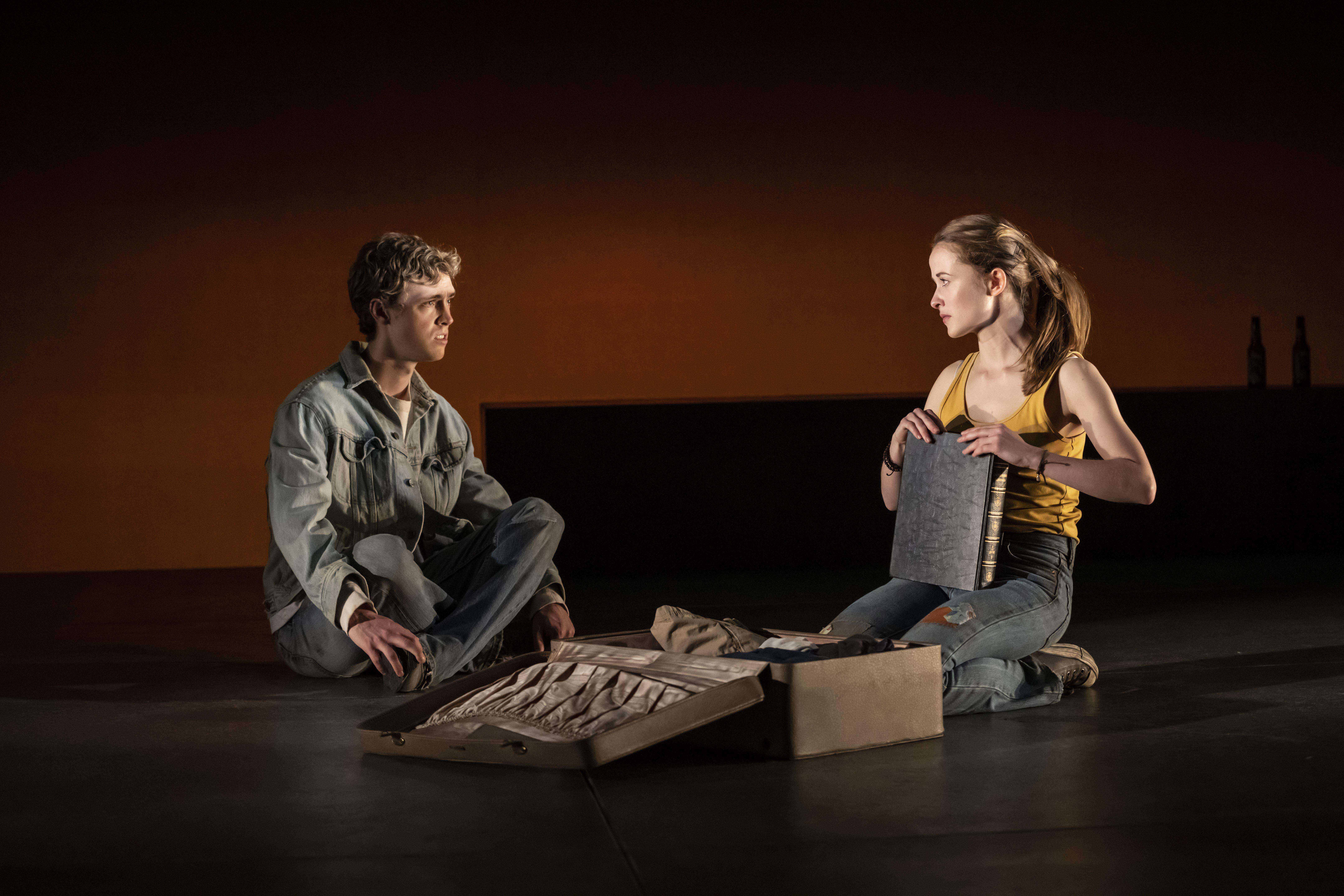
How easily the careless follies of exuberant youth can turn into regret and disappointment in later life. American born writer Naomi Wallace expands on this theme in her play, receiving its UK premiere here, and also examines the bonds of friendship and family, testing the strength of one against the other.
Set in Kentucky, the play begins in 1977. Teenager Acton (Stanley Morgan) and two of his friends, Frayne (Charlie Beck) and Hoke (Alfie Jones), form a club, meeting in the basement of his family home in the poorer part of town. Acton’s father is dead, following a fall from a high rise building, leaving his mother as the struggling breadwinner and his big sister, 17-year-old Jude, becomes de facto family head.
In alternating scenes, the play leaps forward to 1991, when the characters reunite, apart from Acton, who is missing. Shannon Tarbet as the young Jude is vibrant and controlling, extracting power from her position as the outsider. 14 years later, Jasmine Blackborow’s Jude is bitter and resentful, haunted by breaches of trust and loss, as she confronts Frayne (Douggie McMeekin) and Hoke (Tom Lewis) in a quest to uncover the truth of past events.
The storytelling is clear and compelling, but perhaps Wallace allows the focus to drift too much in the direction of Jude, leaving the male characters less well rounded and, crucially, only sketching in the details of Acton’s fate. The boys require each other to make significant personal sacrifices as demonstrations of commitment to their club and it is these actions which are to have lingering consequences, but, with the characters thinly drawn, the sacrifices made strain credibility.
Director Sarah Frankcom stages the play without sets, sharing the writer’s focus on Jude. The male bonding is, possibly, judged too much from a female perspective, but there is no questioning the depth of sibling devotion as Jude and Acton roll down the sloping stage, imagining the thoughts of their father when he was flying through the air to his death. Tarbet and Morgan make an endearing pair, grasping at the last straws of youthful innocence before adulthood encroaches on their lives.
The story is almost complete by the interval, leaving a gloomy second act of reflection and recrimination. This is not exactly a breach of promise, but it brings a disappointing climax to what is, for the most part, an unusual and gripping drama.
In 1943, during the darkest days of World War II, Rodgers & Hammerstein’s Oklahoma! premiered on Broadway, promising beautiful mornings, fresh beginnings and brighter tomorrows. The show captivated audiences and transformed musical theatre, but can it still work its magic almost 80 years later?
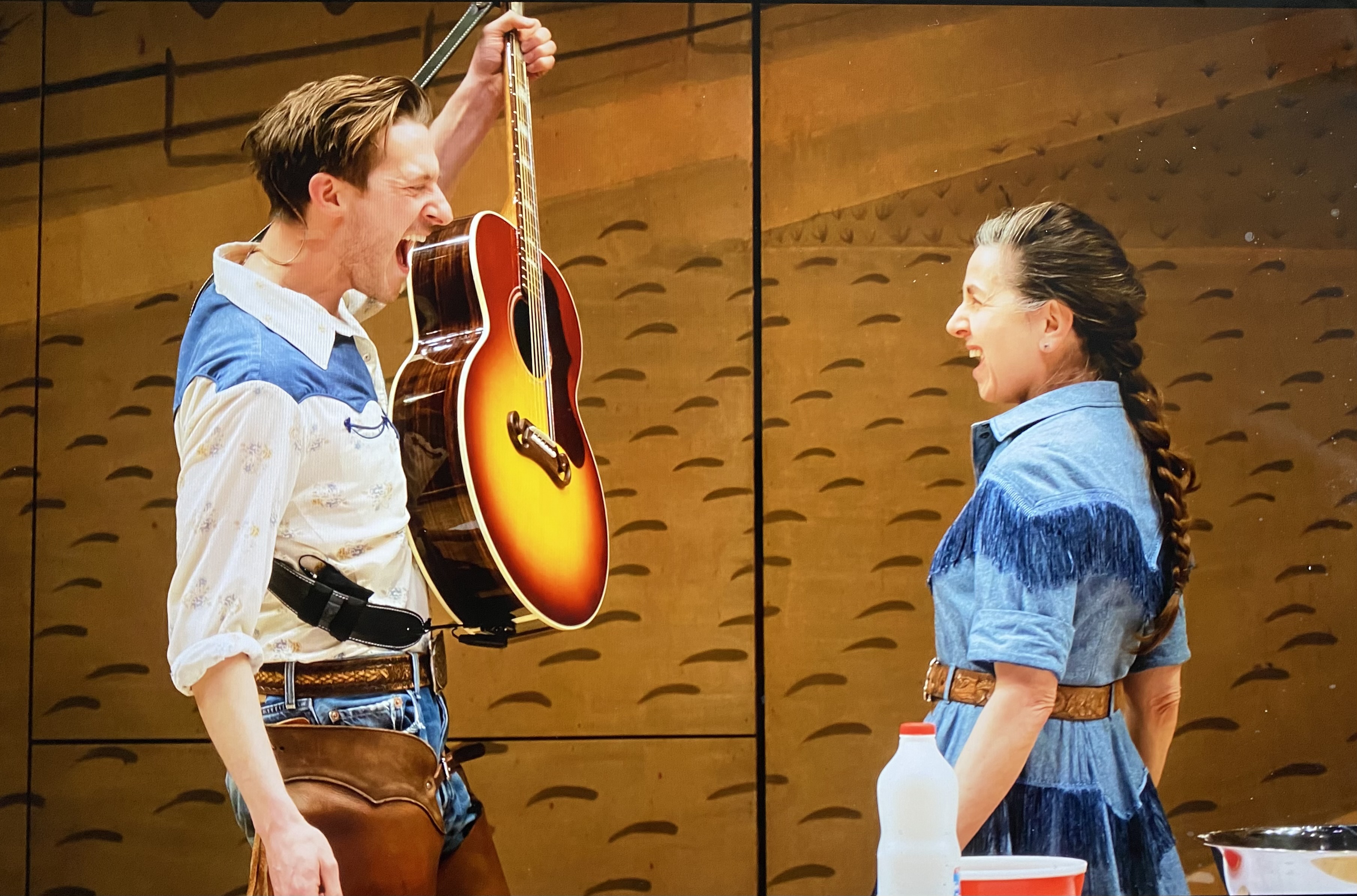
The Young Vic’s auditorium is re-designed to look like a school hall and there is no room for wide open prairies in this transfer of Daniel Fish’s stripped back Tony Award winning 2019 revival, now co-directed with Jordan Fein. When Arthur Darvill steps out to perform the show’s famous opening song, Oh What a Beautiful Morning, the contrast with Hugh Jackman roaming the vast Olivier stage, in Trevor Nunn’s 1998 National Theatre production, could not be starker. Oscar Hammerstein II bases his book on the 1931 play Green Grow the Lilacs by Lynn Riggs, which follows the lives of a pioneering community in the American West as their territory progresses towards full Statehood.
With a guitar hanging from his shoulders, Darvill looks more like a travelling minstrel than a cowboy and he gives the character of Curly McLain a sinister look which significantly alters the hero/villain balance between him and his rival for the affections of the fair Laurey (Anoushka Lucas). A parallel, more comical love triangle sees the dim witted Will Parker (James Davis) vying with the wily Ali Hakim (Stavros Demetraki) to win, or perhaps lose, the hand of the formidable Ado Annie. Marisha Wallace’s Annie is, emphatically, a girl who can’t say no, giving a powerhouse rendition of her key song to prove it. Liza Sadovy is a stabilising presence as Aunt Eller, the wise head in the community who bravely brokers peace between the farmers and the cowmen.
Weaving dark themes into even the fluffiest storylines would become one of Hammerstein’s trademarks and, in Oklahoma!, the darkness is channeled through the character of Jud Fry (Patrick Vaill, attired in black, looking sullen and despondent), a loser in life and in his love rivalry with Curly. Many productions have seen Jud as a simple baddie, a stock character brought in to create dramatic conflict and then readily disposed of. Here he represents an acknowledgement that, whenever mankind moves forward, someone gets left behind and he is viewed altogether more sympathetically. It becomes crystal clear that Hammerstein is reminding us that American society may be built on good Christian principles, but violence and injustice are also embedded firmly in its foundations.
In this product, dark means very, very dark, as in the pivotal confrontation between Curly and Jud, projected with menacing close-ups onto a large wall. In the second act, the darkness very briefly drains the show of its momentum and it makes transitions back to a celebratory mood feel awkward, but, overall, the directors’ bold emphasis pays rich dividends.
A company of 12 is unusually small for this show, but, when the house lights are up, the audience blends into the action. John Heginbotham’s choreography (from Agnes de Mille’s original) is somewhat cramped by the first act staging, but the second act overture features a solo ballet, danced with enchanting freedom by Marie-Astrid Mence and, then, a rousing The Farmer and the Cowman brings the show to exuberant life.
Arguably the most radical innovations come with the total reimagining of the songs in orchestrations and arrangements by Daniel Kluger. A small band of seven sits inside the performance area, playing instruments including a banjo and electric guitars and embracing styles from Country and Western to Soul, Heavy Metal to Gospel, with many more in between. The surprises seem endless and, if composer Richard Rodgers is turning in his grave, it can only be to join in a toast to the durability and versatility of his marvellous score.
Yes, there are times when the corn is definitely “as high as an elephant’s eye” and, yes, parts of this revival are less uplifting than some may expect, but Oklahoma!’s depiction of honest values in simpler times proves once more that it has enduring appeal.
World War II has thrown up many unlikely stories and they continue to emerge, but few could be so strange as a meeting to discuss peace between a Jewish leader and Adolf Hitler’s deputy. We are told that such a meeting actually happened in the early hours of an April morning in 1945 and Ben Brown’s new one-act play imagines how events transpired.
Dr Felix Kersten (Michael Lumsden) is an eminent Finnish physiotherapist based in Sweden, who has as a client Heinrich Himmler. He sees himself able to act as a go-between, bringing together Himmler and the Swedish Jew, Norbert Masur, representing the World Jewish Congress. The objective is to secure the release to the international Red Cross of Jews held in concentration camps, thereby preventing a much worse fate for them before the War comes to its now inevitable end.
The meeting takes place in Kersten’s Berlin home, occupied by his housekeeper, Elizabeth (Audrey Palmer). Allied bombers are flying overhead and the Russians are advancing from the East as we listen to the voice of Goebbels over the radio, paying an annual birthday tribute to Hitler, who is holed up in his bunker, unaware of Himmler’s mission.
Richard Clothier’s Himmler has the arrogant air of an old Etonian and, thankfully, no affected German accent. It is clear from the outset that Ben Caplan’s mild manner Masur would be no match for him. The key mystery is why Himmler, one of the chief architects of the Holocaust, would want to justify himself to the Jewish community and seek atonement; the play solves it in a manner that is persuasive when spoken, but leaves lingering doubts. This Himmler is a man who has come to believe in his own propaganda, yet he is also a realist who sees a remote chance that he can lead post-War Germany in an alliance with former enemies against the rising threat of the Russian Bolsheviks.
The playwright’s lucid style is largely humourless, but he brings to the fore all the bitter ironies in the conversations, without overplaying them, while focussing firmly on the detailed facts of the history that he is relating. Director Alan Strachan’s unspectacular staging matches the text perfectly, never seeking dramatic flashpoints, but bringing out solid performances to carry the weight. A testimony from a concentration camp survivor (Olivia Bernstone) ends the play movingly, making it clear that there are no Oscar Schindlers in this story, just pragmatists working to achieve their own different goals.
Brown exposes the dirty business of ending a dirty war. While watching this chilling play, it becomes impossible to stop the mind wandering to current events in Eastern Europe, which will also, at some point, have to be resolved. The night over which this drama unfolds comes to an end, but, seemingly the nightmare is endless.








 The Beast's Pen