Archive for the ‘Theatre’ Category

Music: Jule Styne      Lyrics: Leo Robin      Book: Anita Loos and Joseph Fields      Director: Sasha Regan

⭐️⭐️⭐️💫

The 1953 film Gentlemen Prefer Blondes took us back to the 1920s, an era when predatory young ladies might have crossed the Atlantic by environmentally friendly means in pursuit of wealthy gentlemen. This stage version, originally seen on Broadway in 1949, seems terribly dated, but a lively revival makes the Union Theatre feel much larger than it is and it still packs quite a punch.

As the blonde Lorelei Lee, Abigayle Honeywill does not look to be unduly daunted by the knowledge that the role is most famously associated with Marilyn Monroe. Her assumed squeaky voice may not help to make her songs easy listening, but she delivers the key number. Diamonds Are a Girl’s Best Friend, with genuine panache. Eleanor Lakin also has bucketsful of sass as the brunette Dorothy Shaw, Lorelei’s chaperone for the voyage from New York to Paris.

The plot, if it can be called that, has Lorelei going to France to meet her intended, Gus Esmond (Aaron Bannister-Davies), heir to a button manufacturing fortune. Thinking that Gus will abandon her, Lorelei makes a beeline for Josephus Gage (George Lennan) who claims to be the inventor of the zip. Meanwhile, Henry (Freddie King), the geeky son of another millionaire, drunkard Mrs Spofford (Virge Gilchrist), takes a shine to Dorothy. Also aboard  are the flamboyant showgirl Gloria (Ashlee Young) and Sir Francis Beekman (Tom Murphy) a lecherous English gentleman whose eye for the opposite sex rarely wanders in the direction of his wife, Lady Phyllis (Maria Mosquera).

The book, written by Anita Loos and Joseph Fields, creaks throughout and all but falls apart in the second half. There are times when we wish that these passengers were sailing on the Titanic, but director Sasha Regan gives the show sufficient buoyancy to see it through choppy waters. Set designer Justin Williams opts for an open stage, giving ample room for Zak Nemorin’s choreography, which blends traditional show routines with distinct, imaginative sequences, particularly in scenes set in France.

Jule Styne’s catchy tunes and Leo Robin’s clever lyrics are of their era, but they still come across strongly today, musical director Henry Brennan helping to make them sound fresh. Period costumes (designer Penn O’Gara) are changed at a frantic rate, posing the question as to where they are all stored at this small venue.

The show is all profoundly silly, but quality songs, zestful dance and an exuberant 18-strong company redeem it. In the end, of course the girls get their millionaires and we get a jolly good evening.

Performance date: 8 October 2019

This review was originally written for The Reviews Hub: http://www.thereviewshub.com

Velvet (Above the Stag Theatre)

Posted: October 6, 2019 in Theatre

Writer and performer: Tom Ratcliffe      Director: Andrew Twyman

⭐️⭐️⭐️

“Don’t put your daughter on the stage, Mrs Worthington” Noël Coward advised famously, but he could well have added “not your son either”. Tom Ratcliffe’s hour-long monologue, first seen at the 2018 Edinburgh Fringe Festival, maps out some of the pitfalls awaiting young actors who are trying to make it in their chosen profession.

Directed by Andrew Twyman, Ratcliffe himself plays Tom, a sharp-tongued drama school graduate who is scrambling around auditions and playing bit parts for less than the minimum wage in fringe theatres. He relies on his partner of three years, Matthew, a strait-laced investment banker to help him along. He dreams of his big break, but believes naively that he can take the virtuous route towards achieving it. When a casting director invites him for drinks at his flat, Tom nervously declines and then fails to follow up on a suggestion of going for a coffee, even though he knows that, if he does not do what is necessary to get a part, some other actor will.

In the wake of the Harvey Weinstein scandal, alleged abuses of power in show business and other professions have been well publicised, but knowledge of the infamous casting couch goes back to well before that. Appropriately, a chaise longues is the only piece of furniture on stage with Ratcliffe throughout the show, as Tom details how he gets dragged into what he thinks of as “borderline prostitution”. His own mother encourages him to do what is necessary to achieve his goals, urging him only to stay safe.

The big decisions come when Tom makes contact on Whatsapp with an American called Daniel, who offers him big film roles in exchange for sexual compliance. We hear Daniel’s sinister voice over the telephone, with text messages and exchanged images projected on a screen. In comparison with some of the harrowing real life allegations which have been reported, Tom’s experiences seem fairly innocuous, but they still highlight further the urgent need to expose all sexual predators who hold positions of power.

With the emphasis on gentle comedy, Velvet is lightweight fare, but the hour passes quickly and the likeable Ratcliffe finds an ironic twist to round it all off, bringing wry smiles over the state of the world in which we now live.

Performance date: 5 October 2019

This review was originally written for The Reviews Hub: http://www.thereviewshub.com

The Niceties (Finborough Theatre)

Posted: October 6, 2019 in Theatre

Writer: Eleanor Burgess      Director: Matthew Iliffe

⭐️⭐️⭐️

Dramatists are often accused of re-writing and falsifying history, but here, in a twist, we have a playwright who is accusing historians of getting it all wrong. Eleanor Burgess’ play, receiving its European premiere after a successful run Off-Broadway, challenges perceived truths about America’s past, going right back to the Revolution.

The setting is an elite university in the northeast United States. Zoe (Moronke Akinola) is a black 20-year-old student and political activist who has submitted a thesis on the American Revolution to history professor Janine (Janie Dee). Janine is in her 60s, white, liberal and a lesbian. It is early in 2016 and, in unity, the pair sigh sorrowfully that it is Barrack Obama’s last year in office, not having an inkling of what was to follow.

When Janine asserts that America had been lucky to have figures such as George Washington and Thomas Jefferson around, Zoe retorts that this ignores the fact that both owned slaves and she goes on to argue that the version of history that Janine is teaching is “white” history, editing out the half a million black Americans who were also involved. As the daughter of Polish immigrants fleeing persecution, Janine points out that racist atrocities have impacted on her own family’s past, but the student still dismisses the professor’s supposedly liberal credentials as representing being “more afraid of looking like a racist than of being a racist”.

Akinola and Dee are both excellent. If they had been less so, Matthew Iliffe’s production would have been even heavier going than parts of it still are. The play makes us flies on the wall overlooking an academic debate, but this alone is not enough to create a drama. With the roles of teacher and pupil effectively reversed, too often it feels as if Burgess is preaching at us through Zoe. It is only when there is friction between the two protagonists that the drama gains momentum and the writer’s belated attempts to generate a narrative feel contrived.

Zoe’s advocacy of the need for history to be re-examined and re-taught from the black perspective becomes increasingly angry and she becomes increasingly vindictive. In the face of this, Janine’s defence of the conventional “white” history that she has devoted her life to teaching is feeble and Dee makes her responses seem patronising, even cowardly. Perhaps Burgess found it impossible to counter the passionate and eloquent arguments that she has written for Zoe to speak, which is understandable, but, by not finding such counters, she robs key parts of her play of dramatic tension.

Everything in The Niceties is worthy, formulating an articulate case that demands to be heard. It is only in moulding her arguments into a compelling work of theatre that Burgess disappoints.

Performance date: 3 October 2019

This review was originally written for The Reviews Hub: http://www.thereviewshub.com

Writer: Athol Fugard      Director: Roy Alexander Weise

⭐️⭐️⭐️⭐️💫

By 1950, the year in which Athol Fugard’s play is set, the political system of Apartheid was in its infancy, but the social attitudes around which it was founded had much deeper roots. Initially banned in the writer’s native South Africa, ‘Master Harold’…and the boys premiered in the United States in 1982.

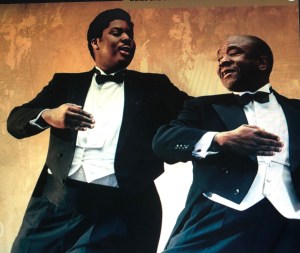
Like so many of Fugard’s works, this play transcends the specific context for which it was written and still speaks loudly to modern audiences. The setting is a tea room in Port Elizabeth, realised in gleaming detail by Rajha Shakiry’s set design. It is a rainy afternoon, the customers have gone, leaving the white-coated black waiters, Sam and Willie, to practice the fox trot for a ballroom dancing competition two weeks ahead. They are joined by Hally (aka Harold), the teenage son of the tea room’s white owners. He is making his way home from school, where he is doing badly, but he consoles himself with the thought that so did Churchill and Tolstoy.

The dignity of Lucian Msamati’s Sam dominates Roy Alexander Weise’s masterful revival. Clearly educated and able to discuss history, literature and philosophy, he is forced to withstand Hally’s rebuke: “don’t try to be too clever, it doesn’t suit you”. Proud but compliant, 45-year-old Sam talks of equality as a Napoleonic principle arising from the French Revolution, but he is in no doubt that equality in his own society is well hidden behind a thick veil of injustice.

Willie (Hammed Animashaun) is Sam’s not too bright junior, pre-occupied with learning steps and finding a partner for the dance competition. At first, Fugard writes the exchanges between “the boys” and Hally as comedy, much of it sharp and very funny when played with the precision that it gets here. However, increasingly, discordant words and phrases puncture the humour until, eventually, the play develops into a drama of blistering intensity.

Anson Boon’s Hally is petulant and precocious, even bossing around his own mother in telephone calls. Having an unhappy family life, the tea room is his second home, Sam and  Willie are his friends and the three share happy memories going back many years. Boon brings out the conflict that lies at the heart of the play – that between Hally’s friendships and his ingrained sense of supremacy, both as an employer over employees and, more sinisterly, as a white person over black people.

Fugard’s writing becomes rich with metaphors, such as a the ballroom, where dancers never bump into each other being seen as a blissful haven from a world where people are always colliding. Performed in the Lyttelton Theatre over 100 minutes without an interval, Reise’s production is consistently entertaining and deeply moving. As Sam and Willie fox trot gracefully to the sweet voice of Sarah Vaughan, they leave us with thoughts of unrealised hopes and unfulfilled potential, but also of a human spirit that is defiant and irrepressible.

Performance date: 1 October 2019

This review was originally written fo The Reviews Hub: http://www.thereviewshub.com
Valued Friends (Rose Theatre, Kingston)

Posted: September 29, 2019 in Theatre

Writer: Stephen Jeffreys      Director: Michael Fentiman

⭐️⭐️⭐️

We hear a great deal today about the difficulties that young people face in getting a foothold on the property ladder, which makes it easy to forget that, only 30 years ago, during the era of the Margaret Thatcher Government, home ownership was almost mandatory and the property ladder could often turn out to be a fast-moving escalator. Stephen Jeffreys’ comedy/drama, first seen at Hampstead Theatre in 1989, centres on four friends just gaining that now elusive foothold,

By June 1984, 30-somethings Sherry, Howard, Marion and Paul have completed a decade sharing a rented basement flat in a run-down converted mansion in London’s Earl’s Court. When a property developer wants to take over their building, they face a range of choices which could take them on a road to riches at a time when “greed is good” was an oft used mantra, but at what cost to their friendships?

Natalie Casey’s chaotic Sherry is the play’s fun character. She is a wannabe comedienne with no regular income and no instinct for dealing with money. The rest of the quartet are rather a dull bunch in Michael Fentiman’s production. Howard (Michael Marcus) is a geeky lecturer and writer with strong Socialist leanings; Marion (Catrin Stewart) works in computers and likes to be the one who pulls all the strings, taking to capitalist wheeler-dealing like a duck to water; Paul (Sam Frenchum), is a freelance music radio presenter and Marion’s on-off boyfriend, who develops a passion for DIY home renovations, perhaps making him one of the original gentrifiers.

Their lives are changed by the arrival of the ruthless developer Scott (Ralph Davis) who starts making offers that can’t be refused. The play has a keen grasp on what happens when a living space turns into a valuable asset – the strains on friendships, romantic relationships and political principles – but it tends to become a little dry, particularly in the second act and Jeffreys seems to recognise this by introducing the comic figure of the philosophising labourer Stewart, played exuberantly by Nicolas Tennant.

Michael Taylor’s set designs for a revolving stage suggest that this production could have been better if seen in the round. Fentiman throws in flashing lights and loud music of the era (and earlier) between scenes, but such effects are not really consistent with the body of the play. However, the biggest problem with his revival is that several of the characters do not come across strongly enough to make us care about them.

As a reflection on the way we were, Valued Friends is interesting more than involving. In a sense, the piece is introspective, representing a decade looking critically at itself. Seen in 2019, it cries out for stronger links that would connect it to modern dilemmas and lifestyles; without them, it feels as if time has devalued the play’s relevance.

Performance date: 26 September 2019

Photo: Pamela Raith

This review was originally written for The Reviews Hub: http://www.thereviewshub.com

Amsterdam (Orange Tree Theatre, Richmond)

Posted: September 12, 2019 in Theatre

Writer: Maya Arad Yasur      Translator: Eran Edry      Director: Matthew Xia

⭐️⭐️⭐️

Amsterdam today remains a city of distinctive architecture and criss-crossing canals, but, in the past, it was also a city of Nazi occupation, collaborators, resistance fighters and Anne Frank. Maya Arad Yasur’s one-act 80-minute play, seen here in a translation by Eran Edry,  seeks to reconcile present with past, probing the origins of modern identity and questioning lingering heritage.

A group assembles as if a team of scriptwriters, bouncing ideas off each other to create characters and develop storylines. Their starting point is an old man living at the top of a modern day Amsterdam building, a nine months pregnant Jewish violinist and the mystery of a 75-year-old unpaid gas bill for 1,700 Euros. As they piece together assorted information and dig into their imaginations, a story emerges that tells of wartime struggles and suggests parallels between 1940s antisemitism and 21st Century racist attitudes.

The play puts itself at risk of being undone by its unorthodox structure, which often proves just as challenging as its disturbing themes. The writer has a tendency to draw us into the story that is being constructed, only to shoot off sharply in a different direction. However, she keeps attention alive with moments of playfulness in her script and director Matthew Xia’s highly animated in-the-round staging brings more of the same. This is Xia’s first production in his role as Artistic Director of the Actors Touring Company.

The play gives the director the freedom to decide upon the number of actors (minimum three) and the lines which they speak. Xia opts for four actors – Daniel Abelson, Fiston Barek, Michal Horowicz and Hara Yannas – all of whom attack their roles with vigour and conviction. The story developed by the “writers” is rounded off with poignancy and irony, but the niggling feeling remains that a conventional dramatisation could have given it much greater power.

Performance date: 11 September 2019

This review was originally written for The Reviews Hub: http://www.thereviewshub.com

Hansard (National Theatre, Lyttelton)

Posted: September 6, 2019 in Theatre

Writer: Simon Woods      Director: Simon Godwin

⭐️⭐️⭐️⭐️⭐️

Most of us may feel that we have had enough of politics in our lives right now, but actor turned playwright Simon Woods seems to think otherwise. His play is a forensic examination of the murky territory where the public and private lives of a politician and his wife intersect. It is quite something for a debut play to be premiered at this hallowed venue, taken on by in-form director Simon Godwin and blessed with the dream casting of Lindsay Duncan and Alex Jennings, but this is quite some play.

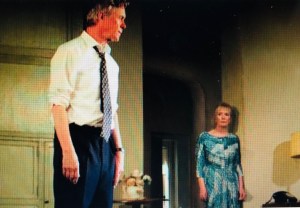
Robin Hesketh (Jennings) is a minister in the Margaret Thatcher Government of 1988. Every weekend, he negotiates the Hanger Lane gyratory and the Oxford by-pass to reach his constituency home in the Cotswolds and be greeted by his bored, heavy drinking wife Diana (Duncan). Hildegard Bechtler’s design for the Hesketh living space is expansive, stretching to the entire width of the Lyttelton stage, and elegant, but it is entirely soulless, not personalised in any way, and we know before a word is spoken that there is emptiness in the lives of the occupants.

Acted out over just under 90 minutes in real time, the play begins as a battle of wills in which both combatants denounce each other with excoriating wit, sharpened over many years of marriage. Left-leaning Diana despises the old school tie brigade represented by her husband, while Robin scoffs at Diana’s favoured artsy set, citing theatregoers and readers of Ian “McKellen” novels in particular.. Woods’ style has the feel of Oscar Wilde, who delved into similar political territory in The Ideal Husband. Under Godwin’s unobtrusive direction, the fun flows freely, but we are always aware of more serious themes lying beneath the surface.

The pompous, upstanding, possibly promiscuous Tory politician and his obedient wife could easily have been seen as stereotypes, but Woods resists temptations for caricature, giving Duncan and Jennings every opportunity (which both seize with relish) to make the characters three-dimensional. We sense from the beginning that something more than duty binds the pair together and the gradual discovery of what that factor is becomes one of the play’s great pleasures.

Woods is even-handed in political debates, allowing both sides of each argument to be heard. A recurring theme is spurred by Diana’s objections to Robin’s advocacy of the infamous Section 28, which prohibited the teaching of LGBT+ lifestyles in schools. He claims to be fearful that white heterosexual men could become extinct within 20 years, but we see him as conforming to the role for which he was born by upholding the traditional values of his times and not as a monster. That said, the play is not just a history lesson, making us aware that the Section 28 arguments have re-emerged in 2019 and that elitist politicians have never gone away.

There are times when Hansard feels like an enjoyable ride without a clear destination, but, when we arrive at the play’s dénouement, it hits with the force of a sledgehammer. Showing consummate skill, Duncan and Jennings move from splitting sides to breaking hearts at the blink of an eyelid. Woods has set the bar high for his second play.

Performance date: 3 September 2019

Photo: Catherine Ashmore

This review was originally written for The Reviews Hub: http://www.thereviewshub.com
World’s End (King’s Head Theatre)

Posted: August 30, 2019 in Theatre

Writer: James Corley.     Director: Harry Mackrill

⭐️⭐️⭐️

It hardly seems like two decades since the war in Kosovo was raging and video games were in their infancy. James Corley takes us back to this era in his debut play, which skilfully blends comedy and tragedy into a teenage gay love story.

World’s End is an estate on the least fashionable part of Chelsea’s King’s Road. Divorcée Viv and her son Ben move into flat 13 in a block, next door to Kosovan refugee Ylli, a widower, and his son Besnik. The two boys strike up a friendship over games of Super Mario and Zelda and the friendship grows. Anyone who remembers the premise of Jonathan Harvey’s groundbreaking comedy Beautiful Thing will know where this is going, but predictability is offset by quirky character details, which keep the play afloat and Corley is eventually bold enough to overturn some of the Harvey feel good factor.

Patricia Potter’s Viv shows the frustration of a woman who is often between jobs and between men, but who retains a hankering for life’s finer things. Tom Milligan’s Ben is a stammering, housebound nervous wreck who can find no place for himself in the world. He contrasts with Mirlind Bega’s confident Besnik, who is more like his late mother than his father, a struggling artist, played fierily by Nikolaos Brahimllari. Ylli is a patriot who yearns to fight for his home country, but the play brings a stark reminder that sickening violence can also occur less distantly.

Director Harry Mackrill’s well-balanced production is at its best when scenes of domestic conflict are played over each other. The characters take turns to have bouts of hysteria and over-playing works well when it is generating comedy. However, it works less well when it nudges more serious scenes in the direction of melodrama. Disappointingly, Mackrill and designer Rachel Stone add little to give the production a period feel; for example, we hear no contemporary pop tracks. Also, a pedantic note to the writer for including a mention of The Sixth Sense in the dialogue: the film was first released several months after the very specific time when the play is set.

The play runs for 90 minutes without an interval and it says much for Corley’s writing that it ends with a feeling that there is plenty of scope for developing the characters further and expanding their storylines. World’s End is no world beater, but it is quietly touching.

Performance date: 29 August 2019

Photo: Bettina Adela

This review was originally written for The Reviews Hub: http://www.thereviewshub.com

Book and lyrics: Lynn Ahrens      Music: Stephen Flaherty      Director and choreographer: Lee Proud

⭐️⭐️⭐️⭐️

Continuing The British Theatre Academy’s 2019 Summer Season, Once On This Island is a revival of a short musical which was seen on Broadway in 1990 and in the West End in 1994, the latter production winning the Olivier Award for Best New Musical.

The show is based on My Love, My Love; or, The Peasant Girl, a 1985 novel by Rosa Guy, telling a mystical tale that has strong echoes of Hans Christian Andersen’s The Little Mermaid. The story is infused with the flavour of its Caribbean island setting, with local superstitions and folklore intervening along the way.

A little girl, Ti Moune (Kassidy Taylor at this performance), is orphaned in a storm and adopted by the peasants Euralie (Marie-Anna Caufour) and Tonton (Andre Beswick).

Having grown up, Ti Moune is played by Chrissie Bhima, who gives a terrific star performance. It is now her turn to become a rescuer and, when she finds the young upper class Frenchman, Daniel (Sam Tutty), injured in a car crash, she nurses him back to health. After his family has reclaimed Daniel, Ti Moune pursues him across mountains to the far side of the island only to find man-made barriers standing in her way. The social divisions in the story are about class and director Lee Proud takes care to make sure that they are not seen to be about race.

Proud, a vastly experienced choreographer, packs the traverse stage with movement and colour, sometimes using the entire company of 19. Atmospheric lighting, designed by Andrew Exeter, and Simon Wells’ flamboyant costumes help to transport us to a tropical paradise and the overflowing exuberance of the performers does the rest. The show is virtually sung through, Lynn Ahrens’ lyrics telling the story concisely and clearly. Stephen Flaherty’s easy listening, melodic score combines calypso influenced numbers with power ballads, all sung and played beautifully under the musical direction of Chris Ma.

Running at around 85 minutes without an interval, the show is just short enough to ensure that it runs out of neither story not musical variety, not to mention energy. It brings a brief splash of tropical sunshine into our lives.

Performance date: 14 August 2019

This review was originally written for The Reviews Hub: http://www.thereviewshub.com

River in the Sky (Hope Theatre)

Posted: August 12, 2019 in Theatre

Writer and director: Peter Taylor

⭐️⭐️⭐️⭐️

Peter Taylor’s riveting 70-minute one-act play, River in the Sky, was seen briefly at the Lion and Unicorn Theatre in London just a few months ago. Its quick return for a longer run here is richly deserved.

Taylor explores how a couple, both devastated by the loss of their child, find ways to come to terms with their grief by creating worlds of wild fantasy. We first meet Ellie (Lindsey Cross) and Jack (Howard Horner) when they are planning the size of their family, settling on the number one. We then learn that, after an earlier miscarriage, their one child has died in infancy. Immediately after the funeral, Ellie disappears to a dilapidated caravan on a rugged coast, seeing no one, apart from visits by Jack to bring her supplies of Earl Grey tea and custard creams.

We know that Ellie is a writer, but, otherwise, Taylor gives us only scant back stories for the couple, leaving it to his capable actors to flesh out the characters. There is little to distract from the assured writing and the acting in Taylor’s in-the-round staging and deliberately understated performances from Cross and Horner convey the depth of individual and joint suffering. Ellie and Jack find their own way of coping, embarking on flights of Game of Thrones style fantasy to divert their minds from reality and give themselves time to heal. 

Ferocious monsters, flying cars, roaring winds and turbulent seas feature in the stories which Ellie and Jack relate to themselves, each other and their dead child. They become the heroes, saving their limbs from the jaws of hungry carnivores and slaying dragons, as they act out their brave deeds. The tales feel less like metaphors for the cruelty of real life than examples of the wild fantasy worlds in which we all may seek refuge when life becomes too hard to bear.

The play has progression, taking the couple on a journey from deep depression, alienation and attribution of blame to a common understanding which shines a beacon of hope. The journey is marked out by subtle changes in writing style and performances which suggest the potency of fantasy as a cathartic force. The couple’s method of dealing with grief may not necessarily find approval from psychologists, but we feel that it gives them the strength to move on.

Performance date: 8 August 2019

This review was originally written for The Reviews Hub: http://www.thereviewshub.com