Archive for the ‘Theatre’ Category

The Price (Wyndham’s Theatre)

Posted: February 12, 2019 in Theatre

Writer: Arthur Miller      Director: Jonathan Church

⭐️⭐️⭐️⭐️

Superficially, all of Arthur Miller’s great plays are deeply rooted in American culture and history, but their enduring appeal on this side of the Atlantic reflects the universality and timelessness of the writer’s human themes. Transferring from the Theatre Royal Bath, Jonathan Church’s production of the 1968 play The Price is the first of two major Miller revivals opening in London this week and two more will follow in the coming months. Any living playwright would surely be envious.

Having been born in 1915, America’s Great Depression impacted significantly on Miller’s early life, as it has done on the lives of brothers Victor and Walter Franz, the play’s chief protagonists. Their father had been broken by the Depression and Victor had felt compelled to take care of him, giving up a promising career in science. The price that he has paid is 30 years as a uniformed police officer, a job that he hates. Walter had turned in the opposite direction, building a successful and lucrative career in medicine, but paying a price in terms of personal fulfilment. The estranged brothers are reunited at their father’s home, 16 years after his death, to sell off his possessions and raise cash that 50-year-old Victor needs for his impending retirement.

The tone is set perfectly by Simon Higlett’s design for the attic of the Franz family home. A harp that is never played sits in a corner, a Queen Anne-style chair and matching chaise longue take centre stage, surrounded by assorted clutter. We recognise this as a place from which the present has departed and the past lives on, the only thing missing seeming to be Miss Haversham. Miller is telling us that the past always hovers over us and that every decision taken in life bears a cost. He argues that laying the blame on others for our own actions is futile.

Brendan Coyle is superb as Victor, outwardly solid and upright, but always questioning the foundations for a code of honour that puts duty and self-sacrifice ahead of personal gain. There is bitterness in Sara Stewart’s Esther, Victor’s wife, as she pushes for a better life than a police officer can give her, perhaps needing to fund her drinking habit. Adrian Lukis’ Walter has an arrogant air, but we see the cracks in his veneer as the truth behind versions of past incidents is challenged. Walter would seem to be the obvious villain of the piece, but Miller never fully endorses this view, showing that life is always much more complex than first impressions show.

Much of the strength of Church’s vivid revival is drawn from the play’s masterful construction, Miller using a richly comic character to hold together his stern examination of family division, guilt and regret. Gregory Solomon is an 89-year-old Jewish furniture dealer who can put a price on anything. Apart from giving light relief exactly when it is needed, the character adds an ironic perspective to the emotionally-charged drama that is unfolding all around. David Suchet plays him to the hilt in a performance that, on its own, makes the ticket price good value.

Performance date: 11 February 2019

This review was originally written for The Reviews Hub: http://www.thereviewshub.com

Writer and performer: Apphia Campbell      Directors: Arran Hawkins and Nate Jacobs

⭐️⭐️⭐️💫

Born on 21 February 1933 in Tyron, North Carolina, Eunice Kathleen Waymon, sixth child of a preacher man, was to become Nina Simone, internationally renowned soul singer and American Civil Rights activist. Her story is told here in Black is the Color of My Voice, a 70-minute monologue, written and performed by New Yorker Apphia Campbell. The play is followed at some performances by Soul Sessions, a 50-minute celebration of Simone’s music, which is ticketed separately. 

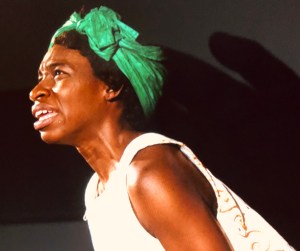
The small stage is furnished with just a single bed, a wooden table and chairs and a screen when Campbell emerges, looking waifish and vulnerable as Simone. The play is structured as a conversation with the singer’s late father, with whom she seeks a posthumous reconciliation. We hear of a child who trains to become a gifted concert pianist, incurring the wrath of her mother when, as a young adult, she turns to “the devil’s music”.

We feel that this is a woman in search of her own identity, whose life is driven by a deep-rooted love of music in all its forms. A telling moment comes when the young Eunice refuses to continue with a piano recital because racial segregation in the audience discriminates against her parents and a lifelong campaign for equality and justice begins. 

Otherwise the storytelling is sketchy and the monologue, interrupted too infrequently by extracts from songs, occasionally feels over-contrived. This is a life lived against the backdrop of huge social turmoil, but, with the exception of one account of an abusive relationship, it is not, as told here, a life of high personal drama and Campbell struggles to make the story gripping.

Soul Sessions is presented in simple cabaret style. Campbell, accompanied by Tim Shaw on keyboards, performs a selection of Simone’s best known songs, linking them with relaxed, good-humoured banter. Sinner Man, Don’t Let Me Be Misunderstood, Feeling Good, I Got Life and To Love Somebody all feature and her rendition of George Gershwin’s I Love You Porgy is outstanding.

Seen together, the two shows are less revelatory about Simone than we may have hoped, but they work much better as a showcase for the considerable talents of Campbell. When she opens her arms wide as if to embrace the whole audience, singing I Put a Spell on You, she really means it.

Performance date: 7 February 2019

This review was originally written for The Reviews Hub: http://www.thereviewshub.com
Writer: Harold Pinter      Director: Jamie Lloyd

⭐️⭐️⭐️⭐️⭐️

If Jamie Lloyd had written a memo-to-self before embarking on this, the seventh of his anthologies of Harold Pinter’s short plays, it could well have read “less is more”. The two plays are from the late 1950s and Lloyd strips back the first to near its original form (which was for radio); in the second, he allows precise typecasting to do much of his work and both decisions prove to be masterstrokes.

A Slight Ache (1958) reflects the changing nation of its time. Edward and Flora are a quarrelsome upper middle class couple who, on Midsummer day, have little else to do but sit around their country home and talk about the shrubs. Edward wakes with a slight ache in his eye and becomes troubled firstly by a wasp in the marmalade jar and then by a mysterious match seller who has taken to standing in a lane at the bottom of his garden. He commands Flora to invite the stranger inside, which she duly does, offering him a glass of sherry and naming him “Barnaby”.

Soutra Gilmour’s set is a radio studio and the actors speak directly into microphones throughout, barely reacting to each other in a visual sense. Lloyd puts the focus on the words and the voices, just as it would have been in the original production, and, crucially, as the match seller has no lines, there is no need for him to be in the studio. As a result, he becomes an invisible menace that hovers over the play for almost its duration.

John Heffernan’s Edward is a man who knows that he has become an irrelevance, like a member of the officer classes now redundant in post-Imperial Britain. Gemma Whelan gives the obedient and sexually repressed Flora an air of resentment, her Home Counties accent falling somewhere between the earnestness of Celia Johnson and the mockery of June Whitfield. She urges “Barnaby” to “come into my garden” squeezing every drop of innuendo out of Pinter’s loaded dialogue.

Hidden menace links this play with The Dumb Waiter (1957), which follows it. Gilmour’s set is now a spartan basement room, resembling a prison cell with a single bed against each wall. Its occupants, attired in business suits, are Ben and Gus, two hit men awaiting instructions for their next job. Instead, all they get is a dumb waiter descending repeatedly with orders for meals which they cannot possibly provide. The play highlights two prominent features of ‘50s drama – realism and, paradoxically, absurdism. Written a few years after Waiting for Godot, there are obvious echoes of Beckett, but, more significantly, the writing captures the essence of early Pinter and brings out themes that were to recur throughout the writer’s career.

Ben is the “senior partner”, gaining authority from his junior’s nervousness and using leadership as a mask for his own uncertainty. Danny Dyer has built a career out of playing loveable, if slightly roguish, Cockney geezers and his appearance as Ben makes the character instantly recognisable. Similarly, we think of Martin Freeman as playing life’s seconds-in-command, bemused ordinary blokes who question all the extraordinary happenings around them. Thus, he is exactly right for Gus. However, the fact that both actors are so firmly within their comfort zones should not detract from their command of the rhythm and tone of Pinter.

Two intriguing plays, four tremendous performances and impeccable staging. These little gems are as close to perfection as it is reasonable to hope for.

Performance date: 7 February 2019

This review was originally written for The Reviews Hub: http://www.thereviewshub.com

My Dad’s Gap Year (Park Theatre)

Posted: February 4, 2019 in Theatre

Writer: Tom Wright      Director: Rikki Beadle-Blair

⭐️⭐️⭐️

For all its modern touches, My Dad’s Gap Year draws its humour from a well-tried and tested source – the age-old clash between the reserve of the British and the liberated attitudes of the rest of the world. Tom Wright’s 90-minute play begins as a warm-hearted, if unsubtle comedy which tells us to shed our inhibitions and run free, but then, confusingly, it turns into a sombre drama warning us to keep one foot on the brake pedal.

Sarah Beaton’s set design has the audience sitting on all four sides of a pool bar, conjuring up welcome dreams during a snowy London February. 18-year-old William (Alex Britt) is “a boring poof” (his Dad’s description), out of school and with a year to kill before starting university. Dad Dave (Adam Lannon) is an out-of-work alcoholic whose wife Cath (Michelle Collins) has left him out of exasperation. Insisting that his son is in desperate need of some chillaxing, Dave hops on a plane to Thailand with William in tow, while, staying at home, Cath uses her new-found freedom to dip her toes in the over-40s dating scene.

On arrival in the far east, Dave hooks up with Mae (Victoria Gigante), a transgender lady who runs a bar staffed by lady boys. William is slower to loosen up, still wearing a business shirt to the beach, but he eventually succumbs to the charms of Matias (Max Percy) a 30-year-old Spanish/Thai architect, who introduces him to the gay bars and saunas of Bangkok.

The scene in which the confident Matias chats up the diffident William is hilarious, as is William’s Face Time call with Cath in which he tells her excitedly the barely believable news that has a boyfriend. Mother and son then swap details of their sexual exploits, pausing only to query what is the correct plural for the word “penis”. All this is wittily written and skilfully acted and it seems that the play cannot possibly go wrong, but then it does.

The drink takes its inevitable toll on Dave’s health, William gets drawn deep into a dangerous world of hard drugs and wild sex and things start to fall apart for both of them. The problem is that, once the play is no longer funny, it is not very much at all.  The thinly-drawn characters are just what is needed to pull off the light comedy, but they have neither the depth nor the credibility to serve the heavier stuff that follows and Rikki Beadle-Blair’s production loses all its early bounce.

Although performed without an interval, this is a play of two halves, amiable enough, but, if Wright had been able to steer a consistent course, it could have been so much better.

Performance date: 2 February 2019

This review was originally written for The Reviews Hub: http://www.thereviewshub.com

Beast on the Moon (Finborough Theatre)

Posted: February 1, 2019 in Theatre

Writer Richard Kalinoski      Director: Jelena Budimir

⭐️⭐️⭐️⭐️

Richard Kalinoski’s Beast on the Moon, which premiered in 1996, covers events beginning almost a century ago, but its relevance to the plight of refugees in the modern world is striking. The main characters, Aram and Seta are Christian Armenians, newly arrived in Milwaukee in 1921, having fled from persecution by the Turks in their homeland. “Where are all the Americans?” asks Aram as he meets only Poles, Italians and other immigrants, reminding us not only of the scale of human displacement, but of how much more welcoming America has been to immigrants throughout its history than perhaps it is in the Trump era.

Aram (a beautifully judged performance by George Jovanovic) is 23 and, like his late father, he is a photographer. His father’s overcoat hangs in the hallway of his home, but is never worn and he keeps a photograph of his family, with their heads cut out, on display in the living room. His grief simmers beneath the surface as he looks forward to his new life, preserving his cultural heritage and raising a family of his own to replace the one that he has lost.

The play begins with the arrival from Armenia of 15-year-old Seta to enter into an arranged marriage with Aram. She clutches a rag doll, which we learn reminds her of her late mother, and she cowers under a table in fear of her new husband, but Zarima McDermott’s remarkable portrayal transforms her from a quivering child to the confident and independent-minded woman that she has become 12 years later.

The story is narrated by an elderly man (Hayward B Morse) who we learn had been a 12-year-old orphan boy named Vincent, encountering the couple in 1933. Morse also plays Vincent, which is the one false step in Jelena Budimir’s otherwise unerring revival. Aram and Seta have remained childless and the emotional impact of Vincent on both of them could, perhaps, have been made clearer if the boy had been more believable,

The play focusses narrowly on the past and ongoing traumas suffered by its main characters and Budimir, rightly, keeps her production simple and similarly focussed, Sarah Jane Booth’s set and period costumes suiting perfectly. As tension builds, Aram and Seta are forced slowly to accept their losses and come to terms with their grief in scenes which are given passion and force by Jovanovic and McDermott. The overall impact is deeply moving. 

Beast on the Moon is returning to the Finborough theatre where it was performed first in 1996. Today we hear much of horrors in faraway lands and of the practical problems associated with the resettlement of surviving victims, but Kalinoski’s study of the psychology of refugees fleeing persecution adds an important dimension to urgent debates.

Performance date: 31 January 2019

This review was originally written for The Reviews Hub: http://www.thereviewshub.com

Cuzco (Theatre 503)

Posted: January 29, 2019 in Theatre

Writer: Victor Sánchez Rodriguez      Director: Kate O’Connor

⭐️⭐️

Tourists visiting the city of Cuzco, high in the Peruvian Andes, tend to observe that remnants of the Inca civilisation seem to be outliving those of their Spanish conquerors. This 70-minute one act play, named after that city, likens the legacy of Spanish colonialism to the crumbling relationship of a modern Spanish couple, one of whom develops an obsession for Inca traditions and culture.

This bleak drama by Spanish writer Victor Sánchez Rodriguez, translated by William Gregory, centres on two people who believe that they can refresh their stale relationship by following in the footsteps of their ancestors to South America. “She” (Dilek Rose), at first overcome by altitude sickness, describes herself as being like a “ruined city” and “He” (Gareth Kieran Jones), frustrated by his partner’s vagueness, is drawn into casual promiscuity with fellow tourists.

The play’s opening line comments on hotel rooms all over the world being much the same and Stephanie Williams’ neat set design follows that prompt on a square stage that is the perfect size. Beginning in Cuzco, the rooms are scattered along the descending Inca Trail towards Machu Picchu. As the journey progresses, the couple’s relationship goes downhill too.

Sánchez Rodriguez leaves himself little chance of winning over audiences after a drab opening scene consisting of banal conversations. Having explored the city separately, “She” and “He” relate to each other details of places seen and people met. Neither of them seems particularly interested, but, for us, it is the equivalent of being forced to plough through the holiday snaps of a stranger.

Rose and Jones deliver spirited performances, but the writer does not give the actors enough for them to make us care about their characters. Too many of the exchanges are dull and humourless and, when director Kate O’Connor’s production eventually starts to heat up, it moves in the direction of melodrama. Cuzco attempts find links between history, mysticism and modern reality, but it rarely succeeds and the end result is often baffling and, sadly, boring.

Performance date: 28 January 2019

Photo: Holly Lucas

This review was originally written for The Reviews Hub: http://www.thereviewshub.com

The Alexandra Palace Theatre in north London was displayed like a prize trophy by The Theatres Trust at the launch of its Theatres at Risk Register for 2019. After 80 years of darkness, restoration work was completed in 2018 and Ally Pally’s magnificent performance space has again become a fully functioning theatre. As such it has now been removed from the Register, but 31 other theatres are not so fortunate.

New additions in 2019 are Theatr Ardudwy, Tottenham Place Theatre and the Intimate Theatre in Palmers Green, not far from Alexandra Palace. The list spans the length and breadth of the United Kingdom, from the King’s Theatre Dundee to Plymouth Palace, Swansea Palace to the Theatre Royal Margate. Factors putting theatres at risk include loss of public funding, escalating costs of maintaining and repairing buildings and plans for property redevelopment.

Actor/comedian Jack Dee, an Ambassador for The Theatres Trust, hosted the launch, quipping that it is unusual for him to appear in front of a sober audience. Representatives from past and present theatres at risk spoke to outline the progress that they are making, but the first speaker was Michael Ellis MP, the Parliamentary Under-Secretary of State for the Arts, Tourism and Heritage. Mr Ellis emphasised that the Government is committed to making art and culture available to everyone and he spoke of the role played by theatres at the heart of communities and in rejuvenating dying town and city centres.

The Theatres Trust dedicates itself to preserving both architectural and cultural heritage, although some conflicts between the two can lead to further problems. Many may argue that historic buildings must stay intact, but others may counter that the work that goes on inside them is more important. 21st Century audiences expect comfortable seats, uninterrupted sight lines and good amenities, which are not always easy to provide in Victorian theatres and the cost of maintaining old buildings can push up ticket prices. Challenges facing many theatres are indeed daunting, but It becomes a question of striking the right balance between old and new, always keeping in sight the clear objective of ensuring that quality theatre is accessible to all sections of society in all parts of the country.

The Reviews Hub believes passionately in the important roles played by theatres in bringing together and strengthening communities throughout the United Kingdom and we give our full support to the work being carried out by The Theatres Trust. 31 theatres at risk is far too many, so let’s hope for a big improvement by 2020.

Photograph of the interior of the renovated Alexandra Palace Theatre

This article was originally written for The Reviews Hub: http://www.thereviewshub.com


Writer: David Greig      Director: Jessica Lazar

⭐️⭐️⭐️⭐️

The great appeal of David Greig’s Outlying Islands stems from its unpredictability. Audiences are left always uncertain as to whether they are watching a slapstick comedy, a brittle romance or a suspense thriller as the writer skirts around dramatic conventions with canny skill.

The play received its London premiere at the Royal Court Theatre in 2002 and this revival by the Atticist theatre company is the first time that it has been seen in the capital since then. Atticist’s last venture, Steven Berkoff’s East, also at the King’s Head, would seem more obviously suited to outlying Islington, but Greig’s refreshingly different play, set on an island 40 miles off the Scottish mainland, is no less welcome. The writer pits the forces of nature against those of civilisation and, along an undulating path, he wrestles with sub-themes that range from conservation to sexual awakening, biological warfare to Laurel and Hardy.

In the Summer of 1939, two young ornithologists are despatched by “the ministry” in faraway London in to count and study the island’s bird population. Robert (Tom Machell), from Cambridge, is confident and assumes the role of leader. He also boasts of his prowess as a ladies’ man. John (Jack McMillan), from Edinburgh, is uncertain and priggish, bound by the rules of polite society even in this untamed environment. For much of the early part of the play, the pair resemble Stan and Ollie, emulating their comedy routines, but, as the play gets progressively darker, they begin to look more like Leopold and Loeb.

Director Jessica Lazar’s engrossing, strongly atmospheric production manages the play’s rapidly shifting moods seemingly effortlessly. The audience envelops Anna Lewis’s craggy set and, enhanced by David Doyle’s lighting design, a disused chapel with a dodgy door becomes a place of mystery, where the natural world and the supernatural one feel equally unnerving.

As Robert and John tuck into their meal of puffin stew, Greig asks big questions. The time is specific and the play acknowledges that the start of World War II is imminent, but modern day battles to save our planet from manmade destruction are brought to mind and the validity of the unnatural constrictions forced on us by society are challenged. The writing is punchy, humorous and, at times, lyrical. 

The island’s owner is the cantankerous Kirk (Ken Drury), whose sole interest lies in what money he can make from the government as a result of the ornithologists’ visit. His niece Ellen has seen Way Out West 37 times and the similarity between that film’s stars and the island’s new arrivals may make them more endearing to her. Rose Wardlaw completes a quartet of powerful performances, expressing suppressed emotions and leading us to suspect that Ellen’s outward naivety could be a mask for a much more worldly young woman. 

Predictably, a love triangle involving Ellen and the ornithologists emerges, but like most other things in this play, it is unconventional and underpinned by deeper significance. This is a long overdue revival, given a production that never loosens its grip.

Performance date: 15 January 2019

Photo: Clive Barda

This review was originally written for The Reviews Hub: http://www.thereviewshub.com


Anomaly (Old Red Lion Theatre)

Posted: January 14, 2019 in Theatre

Writer: Liv Warden      Director: Adam Small

⭐️⭐️⭐️

“Post-Weinstein. Post-Spacey. Pre-Preston” reads the publicity for Liv Warden’s debut play, Anomaly, Philip Preston being the pivotal, albeit unseen, figure. However, in an hour-long drama that is sharp, sensitive and powered by topicality, the writer concerns herself less with Preston’s misdemeanours than with the impact on his three daughters. 

The oldest daughter, Piper (Natasha Cowley) lives in Los Angeles, running her father’s film production company. She has been seduced by Preston’s power and a desire to replicate it. Next oldest, Penny (Katherine Samuelson) is a new mother, living in London and an aspiring actor, enticed by the industry’s glitz and glamour and getting a helping hand by using her father’s name. The youngest is a freer spirit, Polly (a particularly engaging performance from newcomer Alice Handoll) who has countered abuse within her family by turning to abuse of substances and is now in rehab.

The women are seen together on the same stage for almost the entirety of the play, talking directly to the audience or responding remotely to their sisters or to pre-recorded voices. However they are never in the same room, the closest to communication between them coming with telephone calls and a three-way interview on a radio programme. 

Warden’s account of a show business world of instant fame and media prurience resonates, but it is her depictions of power and complicity that chill most. All three women had known for many years that their father was a serial adulterer and a violent abuser within their family, but they had remained silent. The play searches for their motives.

The non-appearance of the villain leaves a hole in the play, but his inclusion could have blurred its focus and it is doubtful if any actor could have made him more odious than his description. Possibly more damaging is the lack of the direct confrontations which could have provided much needed dramatic force. Adam Small’s production builds up tension effectively but the climax lacks impact and, intriguing though the play’s ideas are, it ends leaving us feeling slightly underfed.

Performance date: 10 January 2019

Photo: Headshot Toby

This review was originally written for The Reviews Hub: http://www.thereviewshub.com

Writer: Harold Pinter      Director: Jamie Lloyd

⭐️⭐️⭐️💫

Harold Pinter’s career as a writer encompassed an era of unprecedented social mobility in Britain. Sparked by the end of post-War austerity, new opportunities opened up for the once disadvantaged, London’s East End and West End began to merge and members of the working classes moved up society’s ladder. The sixth in Jamie Lloyd’s Pinter at the Pinter season brings together two perceptive social satires which, perhaps, reflect on aspects of the playwright’s own life journey.

Party Time, first performed in 1991, is interpreted by director Lloyd in the form of a funeral. The characters, all dressed entirely in black, sit in a row facing the audience as solemn music plays and, seemingly, the arrival of a coffin is imminent. So this is a party? Well, yes and, as the eight revellers rise in groups to sip cocktails, nibble canapés and chatter inanely, we quickly realise what an absurd gathering this is.

Hosted by Gavin (Phil Davis), the partygoers are made up of male social climbers and power brokers, accompanied by sedentary women. Terry (John Simm) boasts of membership of an exclusive club and orders his wife never to ask “what’s happened to Jimmy?” Melissa (Celia Imrie) bemoans the fact that good swimming and tennis clubs are all gone. Society’s ascenders and descenders meet in a sort of bourgeois cocoon, oblivious to a world outside in which, we are told, there is significant disorder. We wonder who Jimmy could be and, when Lloyd presents the answer as a near-apocalyptic event, the very foundations of the wealth which funds parties like this are challenged.

Celebration (1999), Pinter’s final play is about upstarts and interjectors. Lambert (Ron Cook) and Julie (Tracy-Ann Oberman) are celebrating their wedding anniversary at London’s most expensive restaurant, along with Lambert’s brother Matt (Davis) and his wife Prue (Imrie) who is also Julie’s sister. At another table (although seen at extreme ends of the same table as the celebrators in this production) are Russell (Simm) and his tarty wife Suki (Katherine Kingsley). They are hoping to get a leg-up in business from the brothers whose occupations, we suspect, may not be entirely legitimate.

All six diners come from lowly origins and Pinter finds comedy in clashes between their coarseness and the expected refinement of a high class establishment. The writer sees a new social order in which money and good taste no longer match up, with the restaurant owners, Richard (Gary Kemp) and Sonia (Eleanor Matsuura) striving to bridge the gap. Abraham Poppoola’s waiter, repeatedly interjecting with preposterous stories about his grandfather, steals many of the laughs. In the hands of a company of comedy actors as accomplished as this, Lloyd’s production could never have been less than highly entertaining.

The passage of time has softened the satire in Celebration. The nouveau riche have now become the established rich and the codes of good manners with which they once clashed have faded into the more distant past. Furthermore, the misogyny in both these plays should not figure in modern attitudes and, to some extent, their revivals feel a little like watching old Carry On films and laughing at how things once were. That said, with six laps of his Pinter marathon now successfully completed, the time is approaching when, deservedly, it will be Lloyd’s turn to celebrate.

Performance date: 5 January 2019

This review was originally written for The Reviews Hub: http://www.thereviewshub.com