Archive for the ‘Theatre’ Category

“This is such a great social space..,it has such character to it, it’s the perfect place” enthuses Liv Warden as she surveys the bar of The Old Red Lion pub, in Islington, little more than a mile from London’s West End. There to meet her is The Reviews Hub’s Stephen Bates to chat about the new play, her first to be produced professionally which will be premiering in the small fringe theatre upstairs early in 2019.

The play is called Anomaly and its highly topical theme is the scandals that have engulfed show business following allegations made against film producer Harvey Weinstein in 2017. However, Liv’s play is less concerned with abuse of power and the victims who have spurred the #MeToo movement, than with the impact on the family of an accused man. So what is the significance of the play’s title? “The idea that it’s a one-off is brought up in the play” Live explains, “the past experiences of the protagonist, the youngest daughter Polly…had with her father was referred to in her school report as like an anomaly, a one-off, when clearly as it transpires in the story, it’s not a one-off, it’s a pattern of behaviour that is played down rapidly by the people around the family.

“The family knows” she continues “but it’s always been brushed under the carpet and kind of healed and healed and healed until it comes to a blow”. The accused man is a film producer, “he is my version of not only Weinstein but also (others)”. This sounds like a typical casting couch scenario, which Liv confirms: “ Well yes, Philip Preston, who’s the main character, he’s not in the play, but he’s the father and he’s a version of all these (true life) men who have been accused of things, he’s accused in the play, but it’s not about him. It’s a female three-hander, it’s the three daughters and the impact on them”.

Obviously real events have influenced the play, but that is not where it began: “well originally it was about a woman who had a complex relationship with her family, notably her father…it was never about Hollywood or fame or anything like that” Liv explains, “and I didn’t know what to do with it and then the Harvey Weinstein case came out and I thought that this could really be quite interesting if we looked at how fame and sensationalism in the media could play a huge part in family dynamics, and how it completely blows everything to a different level”.

The sisters are aged 28, 26 and 24. “the oldest is one of the board members of (her father’s) company, she’s his protégé I guess; the middle one is more of a socialite and she’s taken on the famous role I guess of the three sisters and she has, arguably, used her name…she is pushed into doing interviews in the aftermath of this, she’s pushed into saying things that maybe she regrets saying about the situation, but she’s definitely the most vulnerable of the three” Completing the characters, Liv describes the youngest sister: “she’s been in an out of rehabilitation and therapy, but she’s definitely the most switched-on, she’s very, I find her very charismatic, she tells the truth and the others don’t necessarily do that; she is essentially not a narrator, but she pushes the story forward, addresses the audience directly and she kind of tells the truth about what it is being a Preston”.

Often Liv has begun with a one-woman show that she has written herself to perform herself , but things have taken a different route this time. “When Adam (Small), he’s the director, read it, he said these three woman are  so well-rounded and have their own story to tell that it would be a shame not to explore them fully and I totally agree now” she says with a smile of satisfaction; “I would say that these three women are different versions of myself…formidable…vulnerable…softer…the three never actually meet fully, all three are in separate places and they only ever talk to each other by phone or in a television interview and then, at the end, they come together in a theatrical way”.

So how did the play arrive at the Old Red Lion? “Through Adam” Liv replies, “he had a list of theatres that he would like to approach and the Old Red Lion was on top of the list; I met him through his girlfriend, I worked with (her) and she said…let’s give (the play) to him and he said that he was too busy to read it, but when he did he said that he would not let anyone else do this play; at the first meeting I had with him, he knew the play inside out…like he knew everything; being a newbie, I know that I’ll be in extremely good hands with him”. And at this venue? “Yes…what will be brilliant about the Old Red Lion is that it’s so intimate and a lot of this storyline is about tv – there are a lot of tv interviews and, on the tv, you see really like visceral reactions to things and, in a huge theatre, that would get lost”. 

Liv started out training as an actor before turning to writing. She comments “it was almost like a therapy for me…getting down with a piece of paper, I didn’t expect it to be anything and then I sent something off to the Soho Writers’ Lab in 2015 and it was accepted immediately and I thought that maybe there’s something to this and maybe I should try a bit harder”. She did and “from there it kind of snowballed, I did a few more courses I went to the National who helped me to write this one, I went to the Arcola as well and I really enjoyed writing it in theatres, it was more like a collaborative experience”.

Accepting that this play has only female character, Liv does not see herself as exclusively a writer about feminine issues; “looking back now, I wrote about men and men’s stories…maybe because I was a bit scared that I couldn’t write an actual well-rounded female character, because I’m a woman and I should be able to do that; this for me has completely put that to bed…I really am fond of each of these three characters, I feel so connected to them and, yesterday, when we were casting it, I really watched it come alive and I thought wow!”.

In the future, Liv plans more plays “that’s definitely what I have a passion for… I’ve written short films before and I have really enjoyed it but I want to get to know London fringe theatres better…I find that these places are completely different from the West End, they have a sense of community that the West End doesn’t really have…It’s lovely that you can buy a ticket for around £17 and you can come and see a piece of theatre”. It is looking as if Liv is set to become a siginificant addition to the growing number of strong female voices in theatre.

Photo of Liv Warden and Adam Small by Toby Lee (c)

This article was originally written for The Reviews Hub: http://www.thereviewshub.com

It is quite a distance from the East End of London to the remote islands of the Hebrides, but director Jessica Lazar and her Atticist theatre company are making exactly that journey. Last year they staged Steven Berkoff’s East at London’s King’s Head Theatre and they are now working on a revival, at the same theatre, of Outlying Islands by Scottish playwright David Greig, who is currently Artistic Director of the Royal Lyceum Theatre in Edinburgh. Breaking the journey, Jessica crossed paths with The Reviews Hub’s Stephen Bates at London’s National Theatre.

Atticist began life on a high with Saki, which won the Carol Tambor Best of Edinburgh Award at the 2015 Fringe Festival and later transferred to Off-Broadway. “Atticist is a group of like-minded individuals who came together for the explicit purpose of putting on Saki” Jessica explains, continuing: “initially there were absolutely no plans to turn it into a company with a long-term artistic development…there was no grand plan at the start…we found just how well we worked together” 

Atticist became an associate company of the King’s Head as a result of the reactions to East, which was found to be drawing in new audiences. On the surface, the company’s work seems very diverse, but Jessica counters that impression, explaining: “we have a sense of style…we have a very strong sense of the company’s stylistic identity; what really appeals to us…is magical realism in the theatre…grabbing something and attacking a subject… perhaps through a prism that is not entirely naturalistic – ensemble based (theatre) that is often quite highly physical, but using whatever story-telling method we believe is most appropriate for the particular story we are trying to tell and being open; we started with new writing and then moved to two revivals, but we’ve been working on further new writing that we’re hoping to put on in 2019; it takes a long time to make something good”.

Outlying Islands looks set to stretch the company’s philosophy further than before, particularly bearing in the mind the constraints imposed by a small pub theatre.  “One of the early stage directions is the sound of a thousand seabirds and the sheer noise of the place is very important toning; the design is…quite heavily based on the sketches of Norman Ackroyd”.

The play premiered in 2002 at the Traverse Theatre in Edinburgh, before transferring to the Royal Court Theatre in London. It tells the story of two ornithologists, one from Cambridge and the other from Edinburgh, spending three months in the Summer of 1939 on a Hebridean island to conduct a bird count. When there, they meet with the island lease-holder and his young niece. So what drew Atticist to the play? “ It’s the favourite play of someone in the company” Jessica explains, adding “I really like David Greig as a playwright, I think he’s an extraordinary writer…very, very witty. I admire the fact that he can see the world in a grain of sand, I think he’s a brilliant” 

Praise indeed, but Jessica has yet to meet the writer face-to-face. “We’ve spoken, but never met and it was a very inspiring conversation” she says “but it also filled me with confidence that we were going on a track that would work; he said that he was no longer the playwright who wrote this play…he doesn’t want to tell us anything that we would feel bound by…he’s interested in seeing what we make of it”.

Four characters on an island sounds a little like Agatha Christie and Jessica admits that not everyone makes it out alive. So would she class the play as a thriller? “Thriller, love triangle, very, very funny” she replies; it ranges from very subtle dry humour to frankly slapstick, a lot of surrealism…it all straddles two worlds and it moves from one world to another world, from something that begins with slapstick and ends with this wild passionate unexpected epic. Greig’s got an amazing talent for finding the epic in the every day and the epic in the small situations, but he’s never afraid of the comedy in the grand scheme … within the tragedy of life”.

The comedy and the drama in the play emerge from friction between the characters. Jessica explains: “very quickly everybody begins to be changed or drawn to something by the wildness and the isolation of the island; it’s absolutely mystical…while they’re there, they start to be drawn not only to the island but to each other, tensions crackle, boundaries start to come down, all of the rules that are set on the mainland begin to fade away and the possibility of a new society starts to bubble up in all its many different forms”. 

Jessica believes that the play also touches upon conservation issues that are relevant to the modern world. “It has very powerful resonances for ecological issues today…occasionally those are explicit, but really it’s more about personal responses to ideas of what constitutes value, I suppose what the world owes us and what we owe the world”. She continues: “There is a brilliant line in it when two of the characters have an argument about the phrase ‘supporting life’…so one of the ornithologists contends that the island is supporting life because it has a pristine habitat for a particular bird and it’s untouched… one of the other character counters that supporting life would be selling the island to buy a herring drifter and live in relative comfort when otherwise life is extremely difficult and they are picking a living from any way they can”.

There are no u-boats circling the island just yet, but Jessica notes  “an awareness of war that may or may not be coming”. Explaining the play further, she says: “it’s a mystery, but the mystery is resolved very quickly and it becomes something else…(the characters) discover something, conflicts emerge out of that discovery, dramatic, extraordinary conflicts, and, at that point, something extremely serious happens…and then it’s almost as if the handbrake comes off…everybody is completely liberated and responds in a way that we would never expect and the play passes over into questions that are no longer about conservation and equality and patriotism (becoming) about the oppression and liberation of sexuality and what it might mean for the individual and what society ought to look like”. 

It all seems like a lot of themes to bring out with just 4 (or maybe 5?) characters. “This is why Greig is a genius” Jessica enthuses “because he does…it’s a very hard play to summarise in a sentence…it takes you from something that might look in the first five minutes as a period drama to something that is spectacularly strange, almost mythic, metaphysical, passionate, epic by the near end, passing though mystery and thriller and love story on the way”.

Jessica divides her time between Atticist and working as a freelance director. In 2018, she has directed For Reasons that Remain Unclear at the King’s Head and two productions at the Edinburgh Fringe Festival. Also, she is currently assisting Maggie Norris at The Big House, a theatre charity that works with recent care leavers who are at very high risk of social exclusion; they get “four weeks of rehearsal, four weeks of performance, (they) are held to an incredibly high standard and all the production team are professionals”. On a wider front, she believes that “British theatre is in a pretty good place in terms of what is being created, but, in terms of funding, maybe not, because it’s a struggle”. Funding issues aside, Jessica’s enthusiasm is infectious and a conversation with her leaves a firm impression that she and others like her will leave the future of our theatre in safe hands.

This article was originally written for The Reviews Hub: http://www.thereviewshub.com
2018 Theatre Round-up

Posted: December 29, 2018 in Theatre

2017 was a vintage year and 2018 was hardly a disappointing follow-up, posing the difficult problem of what to leave out of any list of favourites. Two great musicals opened towards the end of 2017 and, as I saw them early in 2018, they are up for consideration here. I continued with my policy of avoiding regularly performed classics, including many Shakespeares, although I relented for Antony and Cleopatra (National) and Romeo and Juliet (RCS), both of which were outstanding, and a special mention has to be made for the National Theatre’s extraordinary Pericles, which only ran for three performances for logistical reasons, but which gave me my most magical theatre evening of the year.

It was another great year for the National, particularly in the Dorfman, but the Almeida remained London’s most exciting theatre, with a string of innovative and imaginative productions. The following represent my personal favourites, with no suggestions that they were the best (or worst() of the year.


FAVOURITE PRODUCTIONS

1. The Inheritance (Young Vic/Noel Coward) Close to seven hours, split over two plays, this could well have been judged as a pale imitation of Tony Kushner’s Angels in America, but I saw it early in the year and it has matured in my mind like a good wine and I now think that it could be even better than its illustrious predecessor.

2. Summer and Smoke (Almeida/Duke of York’s) Seeing a wonderful new play is exciting enough, but discovering an almost forgotten masterpiece equals it. Tennessee Williams’ haunting account of a love affair that can never be fulfilled deserves to stand alongside his greatest works and this production does it full justice.

3. Company (Gielgud)  Sondheim reinvented by Marianne Elliot with gender switches that work so perfectly that we question how the show could ever have been done any other way.

4. The Lehman Trilogy (National) American history explored and the American dream exploded in Sam Mendes’ exquisitely paced production of a new play by Stefano Massini/Ben Power.

5. John (National) Annie Baker’s follow-up to The Flick is no less dazzling, moving at a snail’s pace, but digging deep into the human psyche.

6. Everybody’s Talking About Jamie (Apollo) That rare thing – a British musical that deserves to have everybody talking about it.

7. The York Realist (Donmar Warehouse) A beautifully low-key revival of Peter Gill’s reminiscences of his own involvement in the York Mystery plays and a mismatched love affair with a local farmer.

8. Caroline or Change (Hampstead/Playhouse) Sharon D Clarke unforgettable in Tony Kushner’s musical about racial inequality in America’s Deep South.

9. Ulster American (Traverse Theatre, Edinburgh) David Ireland’s blistering comedy, exposing our hidden prejudices and blowing apart many of the rules of political correctness.

10. Hamilton (Victoria Palace) Lin Manuel Miranda’s eagerly-anticipated Broadway musical is slick, ground-breaking and highly entertaining, but perhaps not quite as great as some would have us think.


FAVOURITE PERFORMANCES

Female lead in a play – Patsy Ferran (Summer and Smoke)

Female supporting in a play – Frances Barber (An Ideal Husband)

Male lead in a play – Kyle Soller (The Inheritance)

Male supporting in a play – Freddie Fox (An Ideal Husband)

Female lead in a musical – Rosalie Craig (Company)

Female supporting in a musical – Patty Lupone (Company)

Male lead in a musical – John McCrea (Everybody’s Talking About Jamie)

Male supporting in a musical – Jonathan Bailey (Company)

Ensemble in a play – The Inheritance

Ensemble in a musical – Company


OTHER FAVOURITES

New play – The Inheritance (writer: Matthew Lopez)

New Musical – Everybody’s Talking About Jamie (book & lyrics: Tom MacRae, music: Dan Gillespie Sells)

Director (play) – Stephen Daldry (The Inheritance)

Director (musical) – Marianne Elliot (Company)


LEAST FAVOURITES

1. Knights of the Rose (Arts) A no-brainer for the top spot, but memories of the howls of laughter in all the wrong places on press night bring some compensation.

2. Nina’s Got News (Pleasance Dome, Edinburgh) A debut play by comedian Frank Skinner and, on this evidence, he needs to stick to the day job.

3. The Messiah (The Other Palace) Desperately overlong and desperately unfunny Christmas “comedy”.

The Messiah (The Other Palace)

Posted: December 12, 2018 in Theatre

Writer and director: Patrick Barlow

⭐️

A recording of Ernest Gold’s theme from the film Exodus features prominently before the lights dim for the beginning of Patrick Barlow’s production of his own play The Messiah. Perhaps this should be taken as a subliminal cue to audiences to heed the music’s title and make their ways out before discovering for themselves just how unfunny what is to follow turns out to be.

40 years ago, the highlight of festive television would have been The Morecambe and Wise Christmas Special and the highlight of that show would have been the play what Ernie wrote. In essence, here we have such a play, performed by two comedy actors and complete with a guest singing star, but what might have been a 10-minute sketch is put on a rack and stretched out painfully to two hours, including an interval.

The Morecambe figure is Ronald Breame (John Marquez), a mischievous  clown, dressed in a suit several sizes too small. He acts most of the roles in a Nativity play that is written and produced by the pompous and deluded Maurice Rose (Hugh Dennis), dressed like a retired army officer in a brass-buttoned blazer. It took decades for Morecambe and Wise to make their on-screen characters fully-rounded and to perfect their synchronised comic timing, so it comes as no surprise that, in comparison, Marquez and Dennis look like beginners. They try very hard to make the comedy in Barlow’s script work, but they are defeated repeatedly.

The “guest star” is Mrs Leonora Fflyte (Lesley Garrett), who sings arias ranging from Handel to Puccini, without musical accompaniment. Her rendition of Silent Night is exquisite. Designer Francis O’Connor gives the show the correct feel of an incompetent village hall Nativity play, with marble columns in front of a blue curtain that is speckled with gold stars. When the back curtain opens, it reveals a wobbly, cardboard Bethlehem.The design is vaguely Roman, vaguely Middle Eastern, vaguely 2,000 years ago and vaguely cheap.

Barlow scored a big hit with his adaptation of The 39 Steps, but this show is more than “just a short tube ride from London’s glittering West End”, as the writer describes The Other Palace. It is particularly disappointing that Barlow relies so heavily on double entendres, Malapropisms and tired, predictable old gags. The programme suggests “Virgin on the Ridiculous” as an alternative title and this would have summed up the level of the humour well.

Even in the season of good will to all, it is difficult to find much good to say about The Messiah. The main consolation is Garrett. She is cast to play what we assume to be a third rate soprano, but, thankfully, this proves to be outside her range. She climaxes with a rousing Hallelujah Chorus and the show ends there. Hallelujah indeed.

Performance date: 11 December 2018

This review was originally written for The Reviews Hub: http://www.thereviewshub.com

Writer: Anthony Neilson      Director: Alex Sutton

⭐️⭐️⭐️

When we see a children’s show that is totally unsuitable for children, somehow we know that it must be Christmas. December 2018 at Southwark Playhouse is ushered in with Anthony Neilson’s 65-minute one-act play, a mix of ingredients that include a Santa’s elf, kids’ toys and glitter along with prostitution, hard drug-taking and bucketsful of ripe expletives. The result is a dizzying cocktail which poses the recurring question “who can this possibly be aimed at?” and never quite provides a satisfactory answer.

Gary (Douggie McMeekin) is separated from his wife and 5-year-old son. He runs Price Breakers, a “back of a lorry” business and, on Christmas Eve, an elf (Dan Starkey) breaks into his warehouse, explaining that he works for the International Gifts Distribution Agency, based in Hartlepool. Following examples such as Miracle on 34th Street and Elf, the story weaves Christmas mythology into real modern living, but its humour lacks consistency and its underlying messages are vague.

First on the scene to help out arrives Gary’s friend Simon (Michael Salami), whose surname is Cowell – “never watch it” is his automatic response to the inevitable comment.  Next comes the sassy hooker Cherry (Unique Spencer), hoping to pick up an Action Man toy for her son, having already paid Gary for it in services rendered. As mayhem ensues, the poor elf, tied up on a chair, becomes frailer and frailer, needing a sniff of the magic dust (a very dubious white powder) that he uses to bring a feeling of Christmas joy into the lives of little children.

Many of Neilson’s jokes hit the spot, others fall on stony ground or get dragged out for too long. There are attempts to inject serious themes or to moralise over Christmas commercialism, but they often feel awkward and out of place. Nonetheless, director Alex Sutton delivers a raucous production that covers up most of the play’s shortcomings and the four actors all succeed in making their characters likeable. If this show is not exactly within the traditional spirit of Christmas, it is certainly spirited.

Performance date: 30 November 2018

This review was originally written for The Reviews Hub: http://www.thereviewshub.com

The Crumple Zone (King’s Head Theatre)

Posted: November 27, 2018 in Theatre

Writer: Buddy Thomas      Director: Robert McWhir

⭐️⭐️⭐️

There is little Christmas cheer for the five characters in Buddy Thomas’s 2001 one-act play The Crumple Zone. Set in the Staten Island apartment shared by three youngish actors, the comic melodrama centres on crumpled love lives that lead to anguish at a time when the surrounding city celebrates the festive season.

Terry (Lucas Livesey) is an off off-off-Broadway actor who makes ends meet by frying pork chops at a local diner while faking excuses to take time off to attend futile auditions. His roommate Sam (Natasha Edwards) is away on a long tour with a show, but her boyfriend of four years, Alex (Nick Brittain) stays on in her room. Alex’s current acting job is playing Santa Claus in a store, but his main preoccupation seems to be a burgeoning romance with Buck (Robbie Capaldi), an office worker at the Staten Island mall. 

The love triangle is predictable and quickly becomes tiresome, but the play stays afloat thanks to Terry, the only character in whom Thomas shows any real interest. At first sight, Terry is a stereotypical, flamboyantly gay New Yorker, bristling with bitchiness and sarcastic wit, but Livesey finds poignancy too. He is an outsider looking in on the relationships of others, still waiting for his own first ex-boyfriend and getting fleeting solace by picking up a married man, Roger (Faros Xenofos) on the ferry. The writer feeds Terry all the play’s best lines and Livesey spits them out with relish. 

Richard Lambert’s cramped set design, which focuses on an orange two-seat sofa and an over-decorated Christmas tree, becomes progressively more cluttered with seasonal paraphernalia as the play proceeds. The claustrophobic feel suits Robert McWhir’s fired-up production, which goes some way towards compensating for the play’s flimsiness and shortage of substance.

Thomas finds just about enough Christmas sparkle to fill an hour and then he allows the play to limp on for a further 15 minutes. Thankfully, mainly due to Livesey’s Terry, the hour turns out to be a reasonably happy one.

Performance date: 26 November 2018

This review was originally written for The Reviews Hub: http://www.thereviewshub.com
Lands (Bush Theatre)

Posted: November 10, 2018 in Theatre

Creator: Antler      Director: Jaz Woodcock-Stewart

⭐️⭐️⭐️

“The script is not sacred. It’s a blueprint” we are told in the preface to the printed text for Lands. A printed text normally signals that a work is a play, so anyone thinking of describing this piece as performance art or an extended comedy sketch needs to think again. Its Creator is Antler, a Bush Theatre Associate Artist company.

As a play, it falls into the absurdist genre, in the mould of Ionesco perhaps. More specifically, the sandy-coloured set brings to mind Samuel Beckett’s Happy Days, accepting that the woman here is not half-buried, rather she is trapped, bouncing up and down constantly on a child’s trampoline. Sand, in a proverbial sense, is also what the play’s two characters have their heads buried in, paying only token regard to each other and total disregard to the wider world.

Leah (Leah Brotherhead) is obsessed with a puzzle, describing the picture pieces that she is placing in it in meticulous detail. On the opposite side of the stage, Sophie (Sophie Steer) is bouncing, oblivious to anything that Leah is doing, but paying lip service to having an interest. Leah becomes irritated and asks Sophie to stop bouncing. “I CAN’T get off” Sophie screams. Does Sophie’s bounce represent an obsession or an addiction?Or is it just some nonsense that represents nothing at all? Many have asked that last question about Beckett too.

Director Jaz Woodcock-Stewart’s production really needs more pace and the script (or that part of it that is used) feels short on verbal wit. That said, the physical comedy that results from the increasingly adversarial relationship between the too protagonists is often very funny. It feels as if the cheery Leah and the solemn Sophie have only their bizarre preoccupations standing between themselves and simultaneous nervous breakdown.

The play comes closest to revealing a serious subtext when Leah rants a long list of things that she doesn’t care about, beginning with “the boy on the beach…refugees on the boats…detention centres…”. She is in fact chastising the audience for allowing life’s trivia to blur a wider vision. Planned to run for 80 minutes (it actually exceeded that by 10 minutes at the press performance), the production is much too long, but it is put together neatly, it has likeable performances and, yes, it also has bounce.

Performance date: 8 November 2018

This review was originally written for The Reviews Hub: http://www.thereviewshub.com

Romeo and Juliet (Barbican Theatre)

Posted: November 7, 2018 in Theatre

Writer: William Shakespeare      Director: Erica Whyman

⭐️⭐️⭐️⭐️💫

In an age of polarised views and deep social divisions, most of us will have little problem in relating to the premise that underpins William Shakespeare’s Romeo and Juliet. However, the divide that director Erica Whyman most strives to bridge in this Royal Shakespeare Company production, first seen in Stratford upon Avon, is that between old Verona and new London.

At the start, the Montagues and the Capulets are seen as rival street gangs, with hordes of threatening youths filling the stage. The excitement is fuelled by music composed by Sophie Cotton and movement directed by Ayse Tashkiran, and there follows a vivid and vigorous production in which no one ever walks around the stage if it is possible for them to run. 

Whyman builds her bridge by blending the traditional harmoniously with the innovative and finding romance and modern relevance without over-stretching to achieve either. In so doing, her version of the play retains all the key elements of classic productions, but it also shines a light on the futility of 21st Century tribalism and lays out bare the senselessness of the teenage knife crime which now plagues London and other cities.

Bally Gill is a wonderful Romeo, playing the ill-fated lover as the dreamy-eyed joker in the Montague pack and drawing every ounce of humour from the Bard’s words. He is matched by Karen Fishwick’s utterly beguiling Juliet who becomes an innocent 14-year-old with a glint of mischief in her eyes, willingly swept off her feet by Romeo’s charm. The scene in which Capulet, Juliet’s father (a ferocious Michael Hodgson) uses brutal means to insist that she marries Paris (Afolabi Alli) is harrowing, but it hits another modern chord by turning the spotlight onto domestic abuse and forced marriage.

Tom Piper’s adaptable design leaves the stage as open as possible, deploying a large hollow box, which provides an elevated level for the famous balcony scene. Romeo and Juliet spend their final moments together at the same spot, now raised above the squabbling families below them. As the play gets darker towards its conclusion, so the stage darkens and Charles Balfour’s subtle lighting design picks out the key characters.

Other gems among the performances include Ishia Bennison’s devoted Nurse, who exudes natural warmth and good humour. Andrew French is an unusually forceful Friar Laurence, at times displaying the fervour of a Baptist preacher, and Charlotte Josephine stands out as a gender-changed Mercutio, hyper-active and perpetually shadow boxing. Whyman’s production runs through the play briskly in 165 minutes (including interval) without sacrificing any of the poetry in the text and without sagging.

Of course, most of us will know beforehand that this play does not allow blissful romance to triumph over squalid reality, but, on this occasion, when the confirmation comes, it still brings tears to the eyes.

Performance date: 6 November 2018

Photo: Topher McGrillis

This review was originally written for The Reviews Hub: http://www.thereviewshub.com/

A Pupil (Park Theatre)

Posted: November 6, 2018 in Theatre

Writer: Jesse Briton            Director: Jessica Daniels

⭐️⭐️⭐️💫

Can greatness be taught? A Pupil, Jesse Briton’s new 90-minute one-act play, an all-female four-hander, poses that question, asking also whether talent can thrive without discipline and whether discipline, in turn, will suffocate talent.

Ye is a gifted violinist of Chinese origin, who is disabled and confined to a wheelchair as a result of a car crash, but it becomes clear that her severe depression is more crippling than her physical injuries. She barely makes ends meet by tutoring and Simona, the teenage daughter of a Russian billionaire, who is alienated from all around her, is brought to Ye to be prepared for entry exams for the Royal Conservatoire.

Lucy Sheen’s Ye exudes gloom and defeat, fiercely refusing all help to bring her back to a full life. She can pass down her own philosophy and teach her pupil to express her inner self through her instrument, but she recognises that this may achieve only self-fulfilment and not tangible success. The shambolic Ye is contrasted by Carolyn Backhouse’s confident Phyllida, vastly inferior to her as a violinist when they were students together, but now a prominent figure at the Conservatoire.

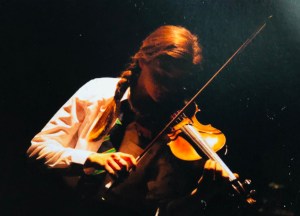
As Simona, Flora Spencer-Longhurst, wearing school uniform and with a long pig tail, overdoes the petulant brat act just a little, but she shows great skills with the violin, playing classical pieces and original compositions by Colin Sell. Melanie Marshall,           playing Mary, Ye’s gospel-singing, persistently interfering landlady, is delightfully comic, bringing welcome relief to what could have been a wearying drama.

Jessica Daniels’ in-the-round production is as highly-strung as any of the dozen or so violins hanging above the stage in Jessica Staton’s simple design. Briton poses intriguing questions regarding the teaching of skills in music (or indeed any other field of the arts), but, when she puts the anti-convention arguments into the mouth of a character who is mentally ill, it is sometimes difficult to decide if the case being made has real validity or is just a dramatic catalyst.

At the beginning, A Pupil looks set to turn into a drama of mutual redemption and, as such, there feels to be a threat that it could be undone by its predictability. However, the more that the play veers away from that well-trodden path, the more engaging it becomes. Perhaps trying too hard to avoid the obvious, Briton reaches an uncertain conclusion, but still this is an accomplished, if not entirely convincing, work of theatre.

Performance date: 5 November 2018

This review was originally written for The Reviews Hub: http://www.thereviewshub.com
Honour (Park Theatre)

Posted: October 31, 2018 in Theatre

Writer: Joanna Murray-Smith      Director: Paul Robinson

⭐️⭐️⭐️⭐️

Honour, Australian writer Joanne Murray-Smith’s incisive study of a marriage break-up, has worn well. Its focus on gender roles perhaps comes through with greater clarity in 2018 than when it received its United Kingdom premiere at the National Theatre in 2003 and casual references in this version to blogs, bitcoins and Love Island, hardly seem needed to stress its modernity.

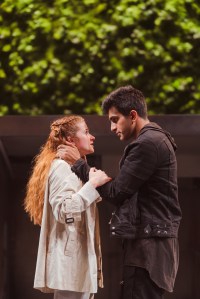
George (Henry Goodman) is an award-winning journalist, still admired and successful even if the decline of print media is threatening him. His wife, Honor (Imogen Stubbs) is also a talented writer, but none of her works has been published for 20 years. The play begins with them appearing to be the perfect middle-aged, middle-class couple, married for 32 years and with a daughter, Sophie (Natalie Simpson) studying at Cambridge.

The arrival of aspiring 29-year-old writer, Claudia (Katie Brayben) changes everything. She inspires George and re-awakens his passion for living, lifting him out of the tired sameness of his routine, conventional existence. He professes that he still loves Honor, but it is love without passion; he loves her as a wife, but, at this stage in his life, he feels that he does not need a wife. Honor’s life is shattered, as she is effectively traded in for a newer model

The play is about Honor and honour. Murray-Smith finds heaps of sympathy for the deserted wife, but, more to the point, she also blames her for choosing to sacrifice her own career in order to take second place behind her husband. If the writer cannot bring it upon herself to exonerate the seemingly dishonourable George, she at least helps us to understand his behaviour. When Claudia challenges him to explain why “the heart” takes precedence over tenderness, justice, loyalty and history, she asks the question which is central to the play.

Goodman’s George is an egotistical unacknowledged misogynist, a silver fox who is circling his prey and prepared to abandon his den for her. However, Brayben’s cleverly-nuanced performance makes Claudia an ambitious and uncannily self-aware modern woman, to the point of being callous, and she quickly overturns perceptions of who is hunter and who is prey. The abandoned Honor is a sad and isolated figure, but Stubbs gives her enough steel to reinforce the writer’s advocacy of female independence.

Paul Robinson’s intelligent, superbly-acted production is staged in-the-round, with a couple of rows of seating positioned at what is normally the rear of the Park 200’s stage. Liz Cooke’s design uses only an arc of overhead lights and several moveable blocks, but emotional performances more than compensate for its sterility.  All the actors seem to know the extent to which their characters are ridiculous and this brings out the acerbic wit in Murray-Smith’s writing strongly. This revival shows Honour to be a very up-to-date 15-year-old play.

Performance date: 30 October 2018

This review was originally written for The Reviews Hub: http://www.thereviewshub.com