Archive for the ‘Theatre’ Category

23.5 Hours (Park Theatre)

Posted: September 13, 2024 in Theatre

Photo: Charles Flint

Writer: Carey Crim

Director: Katharine Farmer

⭐️⭐️

We hear much about criminals and their victims, but little about the collateral damage which crimes cause to families and friends of alleged offenders. Award-winning American playwright Carey Crim enters this sensitive area with 23.5 Hours, an examination of how a small group living in America’s mid-West responds when one of them, allegedly, commits a sex crime.

The play opens with two married couples – Tom and Leigh, Bruce and Jayne – celebrating after a successful school production of Romeo and Juliet, which Tom, a drama teacher, has directed. Bruce is aghast that the show ran for two hours and 48 minutes, but the mood is convivial and we get a picture of a wholesome All-American community in which everyone lives in perfect harmony with everyone else. And then the telephone rings.

The lights dim, followed by loud bangs and bright flashes as, for the first time, we see that understatement will not be a prominent feature of this production. Does the play’s title mean that the characters are half an hour away from the end of the world? Well not exactly. Scene two sees the same four gathered to welcome home Tom upon his release from prison, having served time for, allegedly, behaving inappropriately with his Juliet.

Tom (David Sturzaker) faces a mixed reception. His wife Leigh (Lisa Dwan) believes in his innocence for 23.5 hours every day and defends him resolutely, even though banishing him to sleep on the sofa. Bruce (Jonathan Nyati), a fellow teacher, defends him unreservedly, but Jayne (Allyson Ava-Brown) is convinced of his guilt. Tom’s teenage son Nicholas (Jem Matthews) takes to drugs and staying out all night. His relationships strained, his career and reputation in tatters, Tom soldiers on.

The writer always seems more interested in detailing the problems faving the characters, rather than exploring in-depth their inner emotion and their relationships.The story’s central perspective needs to be that of Leigh, the wife left with just a smidgeon of doubt, but, as played by Dwan, she is volatile and foul-tempered, thereby repelling empathy. More generally, director Katharine Farmer favours hysterics where subtlety may have yielded a stronger impact. Her approach does not serve the play well. Although Crim makes many intelligent points about the dilemmas being faced, the characters and their situations are not made to be wholly convincing and some lines of dialogue become unexpectedly risible.

The play should have been a thoughtful and revealing study of human behaviour under stress, but, in this production, it ends up as just a trite drams, overblown, overwrought and overlong.

Performance date: 9 September 2024

Photo: Flavia Fraser-Cannon

Music: Richard Rodgers

Lyrics: Lorenz Hart

Book: George Abbott

Director: Mark Giesser

⭐️⭐️⭐️

“If it’s good enough for Shakespeare, it’s good enough for you” declares the chorus to the audience in the opening scene of The Boys From Syracuse. But is it good enough? Adapted from The Comedy of Errors, possibly the Bard’s silliest play, this 1938  show is possibly the silliest musical in the history of Broadway.

The boys are the noble Antipholus (John Faal) and his manservant Dromio (played in very camp style by Brendan Matthew). The pair sail from Syracuse to the rival state of Ephesus where they have identical twin brothers from whom they were separated at birth. The brothers are also named Antipholus and Dromio. What follows is a couple of hours of madcap comedy based on mistaken identities.

The chief problem facing any director of this musical or the original play is finding a way to keep the audience aware of which twin is appearing in any given scene. Mark Giesser opts for the same two actors, dressed in the same garish costumes, playing both twins. Also, other actors in the exuberant company of eight double up supporting roles. The result of this is that we are constantly questioning “who’s who?” and, frequently, the confusion drains the comedy of its life.

The songs, with music by Richard Rodgers and lyrics by Lorenz Hart, include several that were established as standards before most of us were born. Falling in Love With Love, etc should have the audience singing along, but even the lesser-known songs prove that Rodgers could certainly knock out a tune. The singing is hit and miss, but the five-piece band, under the direction of Benjamin Levy, is consistently excellent, particularly when bringing out the jazzy elements in the score.

The show belongs to en era when musical theatre on Broadway was still evolving. Judged by modern standards most of the songs seem separate from George Abbott’s book, there to be inserted every 10 minutes or so in the style of a Vaudeville revue and doing little to propel the narrative. Thus the show feels disjointed, book and songs not fully integrated as in later musicals which Rodgers himself was to pioneer in his partnership with Oscar Hammerstein III.

So, many reservations, but, as a jolly nigh out in a pub theatre, this is a gallant effort. Alice McNicholas’ outrageous costume designs fill the space with colour and the actors give it their all. Finally, Giesser finds a splendid solution to the identification problem in a climactic scene which brings the evenings biggest laughs, uplifts the audience and send us away feeling much more generous towards what has gone before.

Performance date: 6 September 2024

The Silver Cord (Finborough Theatre)

Posted: September 9, 2024 in Theatre

Photo: Carla Joy Evans

Writer: Sidney Howard

Director: Joe Harmston

⭐️⭐️⭐️💫

It is almost 100 years since American writer Sidney Howard’s play The Silver Cord was last seen in London, but its themes remain familiar even when its style feels a little dated. Howard, a Pulitzer Prize winner, wrote the screenplay for the epic Gone with the Wind, but here his attention are drawn to a much more intimate subject, the struggles of a possessive mother to keep control over her grown children.

It is Boston in 1925, where Mrs Phelps (Sophie Ward), a widow for 24 years, heads a wealthy family. Her younger son, Robert (George Watkins) still lives with her but he is engaged to marry a lower class local girl, Hester (Jemma Carlton). Her older son, David (Dario Coates) is returning from travelling around Europe, where he has met and married Christina (Alix Dunmore), a highly educated biologist who is set upon building a life in New York in which she will pursue her career goals alongside being a wife and a mother.

Howard sees the huge generational change which brought the rise of now liberated women in the professions and he taps into the inevitable clashes with their foremothers. Mrs Phelps makes much of her belief that motherhood is a profession in itself and bemoans the sacrifices which she has been forced to make. Her conflict with the confident Christina is given wider significance than being simply a tussle for the affections of David.

Dressed in drab colours, Ward gives early warning that Mrs Phelps is an insufferable woman and Dunmore’s Christina is a formidable opponent.  The in-the-round staging suits the drama well and it is enhanced by set designer Alex Marker’s ingenious use of the tiny space; in two scene changes over the play’s three acts, a window transforms into a bed, while glass doors at the entrances let us see the sinister figure of Mrs Phelps hiding as she eavesdrops on private conversations. 

Five strongly focussed performance do much to smooth over the unevenness of the play and of director Joe Harmston’s  production. By modern standards, the drama is far too long and several scenes which needed trimming are allowed to get bogged down. On the other hand, the key clashes are written sharply and stages beautifully as melodrama that is palatable and wholly enjoyable.

Undoubtedly, The Silver Cord shows its age and creaks quite a lot in places, but this solid revival is very welcome for giving us the chance to appreciate its many qualities.

Performance date: 5 September 2024

When It Happens to You (Park Theatre)

Posted: August 10, 2024 in Theatre

Photo: Tristan Kenton

Writer: Tawni O’Dell

Director: Jez Bond

⭐️⭐️⭐️⭐️

So, what is “it”? The title of American writer Tawni O’Dell’s new 90-minute play gives no clues and all the characters appearing skirt around the issue like the elephant in the room, dodging use of the actual word. Even the Park Theatre, in the publicity for the play, talks of “a devastating event”, without specifying what that event is. Well, no spoiler alerts, because it becomes clear in the first few minutes that “it” is rape.

O’Dell shows no interest in the perpetrator of the crime, who, we are told, is caught quickly, tried fairly and sentenced justly. Her focus is firmly on a small family unit comprised of the victim, Esme (Rosie Day) and the secondary victims, her mother Tara (Amanda Abbington), a twice divorced writer, and brother Connor (Miles Molan). Tok Stephen appears as a police officer and several other characters cropping up in the story.

Director Jez Bond keeps all four actors in view throughout, their movement across a bare rectangular stage exaggerated to express urgency at critical points. This simplest possible staging gives the play uncluttered lucidity that contrasts sharply with the evasiveness of the characters when facing up to what has happened to them. 

An extraordinarily powerful performance by Abbington is the drama’s driving force. She brings out Tara’s anger and frustration at her own helplessness in easing her daughter’s pain. Esme is a trainee chef who has moved from the family home in Pennsylvania to live in her own apartment in New York City, with only her cat for company; with great subtlety, Day shows how the confidence of an independent woman can be dented and how the wrong choices can be made easily. Molan’s Connor is a geeky science student who is blown off course by strains in family relationships, but sees the damage caused by failures to face up to the truth. He opts for an uncomfortable Christmas with his estranged father rather than returning to the family home.

Based on true events, the play addresses the social stigmas and prejudices linked to rapes victims. Connor wonders why his sister’s plight cannot be looked at in the same way as a broken leg, which would be discussed openly. The writing walks a fine line between a drama and a lecture and the only strong criticism is that it sometimes veers too far towards the latter, particularly in the closing stages when, in turns, characters speak directly to the audience.

Taken as a whole, this is meaty stuff, raw, riveting and revelatory. The message is let’s talk about the things that hurt and this play itself certainly sets the ball rolling.

Performance date: 6 August 2024

The Years (Almeida Theatre)

Posted: August 5, 2024 in Theatre

Photo: Ali Wright

Writer: Annie Ernaux

Adaptor and director: Eline Arbo

⭐️⭐️⭐️⭐️

For anyone now approaching the end of their life, it may be possible to skim through prints of photographs taken over many decades in just a couple of hours, which is about the length of this play. Future generations, born into the age of digital photography, could find this process taking much more time, but will the memories that the imag evoke be anything like as vivid?

Adapted from Les Années by Annie Ernaux, The Years tells, in autobiographical form, the life story of one unremarkable woman. Each memory triggered by an old photograph. Connecting the play’s framework to Shakespeare, an alternative title could be “The Five Ages of Woman” as it moves from “mewling and puking” to “sans everything”, represented by five women, all sharing in the storytelling and each acting out scenes from specific times in the writer’s life.

Written down, this sounds dull, but adaptor and director Eline Arbo makes sure that her production is anything but that. The five women are Deborah Findlay, Romola Garai, Gina McKee, Anjli Mohindra and Harmony Rose-Bremner. The calibre of these actors should be enough to alert us to the quality of the material and they energise a production that is, throughout, animated and inventive.

The play matches the the trivial with the momentous. Born during World War II in German-occupied France, the writer tells of living through an era of enormous changes for women against the backdrop of distant wars in Algeria, Iraq and the Balkans. She experiences sexual awaking, abortion, marriage, motherhood and divorce. She has many loves, but never finishes her novel, except that this is probably it. An ordinary life lived in extraordinary times.

The play is captivating, funny and harrowing. A scene in which the five women celebrate the arrival of the 1980s by partaking in an aerobics class is pure joy, while the abortion scene, depicted in excruciating detail, is sheer agony. Half-forgotten brand names are mourned and new arrivals such as fridges, vacuum cleaners and hair dryers are welcomed. At the same time, thoughts of the Holocaust lurk in the air and the rise of the French far right sends shivers down the spine.

The Years is a wonderfully literate and totally absorbing piece of storytelling. At its heart lies an account of female emancipation, but those of us who are not women need not be put off by that. These memories can be enjoyed by all.

Performance date: 1 August 2024

hoto: Richard Hubert Smith

Writer: John Steinbeck

Adaptor: Frank Galati

Director: Carrie Cracknell

⭐️⭐️⭐️

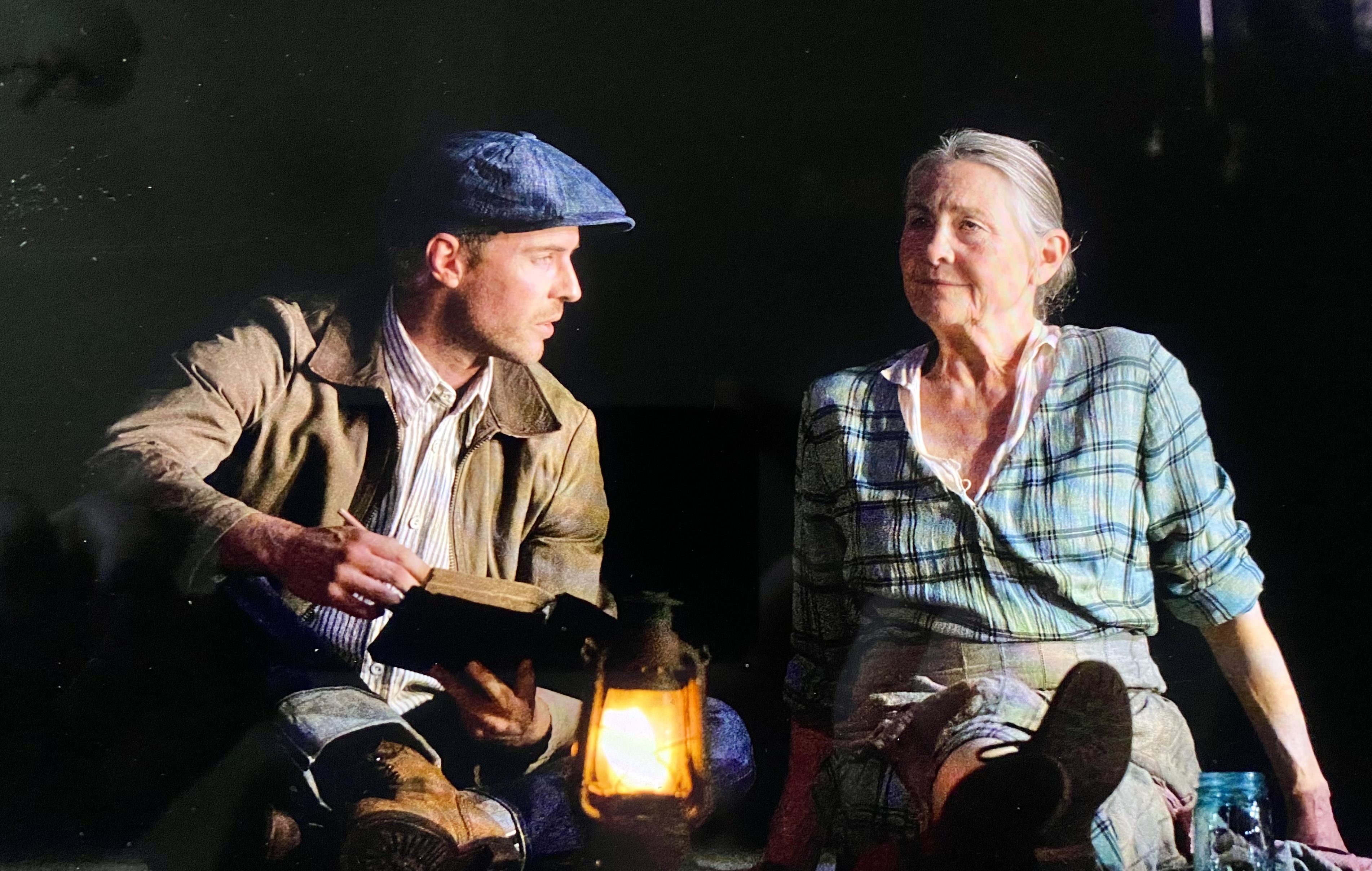
The first thing to say about the Nation; Theatre’s dramatisation of John Steinbeck’s classic 1939 novel, The Grapes of Wrath, is that anyone who is seeking a cheerful offering to add sunshine to their 2024 Summer should be looking elsewhere. Director Carrie Cracknell’s vivid production is relentlessly bleak, lightened only by some startling staging and first class acting.

In Frank Galati’s faithful adaptation, Steibeck’s feel for social injustice survives intact; the novel is set during America’s Great Depression of the 1930s. It follows the fortunes of three generations of the Joad family as they up their roots in the dust bowl of Oklahoma and head for the promised fertile vineyards of Northern California, a trek of motor than 1,000 miles. The penniless family’s trek is epic and, by its nature, the drama is episodic, thereby posing the challenge to both adaptor and director to keep the link to the central narrative thread strong and to bring to the fore the characters’ intimate stories.

Hotheaded young Tom Joad is released on parole after four year in prison and he returns home to find that his tenant farming family is already on the move. Tom is the story’s lynchpin and Harry Treadaway’s strong presence in the role is often the force that holds this production together. Making a rare UK stage appearance, the wonderful Cherry Jones matches him as the formidable Ma Joad, a pillar of strength in the face of adversity. Natey Jones as Jim Casey, a former preacher who joins the trek, and Greg Hicks as Pa Joad are among others giving stand out performances.

Cracknell has assembled a company of 26, all but the principals playing multiple roles, for this large scale production. Using the full width of the Lyttelton Theatre stage, Alex Eales’ set design has a perpetually grey sky overhead, with characters emerging from blacknes; period costumes (designed by Evie Guerney) and atmospheric lighting (designed by Guy Hoare) add to the gloom. The overall visual image often resembles a vast, over-populated, near-monochrome tableau of human suffering.

The main problem with all of this is that, particularly in the first act, the director is piling on the misery just a little too thickly. As a consequence of this excess, too many lines of dialogue come across as trite homespun philosophising and original songs in traditional folk/blues style, written by by Maimuna Memon, begin to sound like dirges. At the interval, many members of the audience could be asking themselves whether they are up to sitting through another hour or so of their own great depression.

The second act brings no more joy and is still episodic, but Cracnell fills it with memorable dramatic set pieces and stirring special effects. A fight, a thunderstorm, etc heighten the human dramas which grow in intensity. Billed as a tribute to the endurance of the human spirit, this stage version of The Grapes of Wrath often becomes a trial of the endurance of the audience’s spirit as it impresses and depresses in more or less equal measures.

Performance date: 31 July 2024

The Box (White Bear Theatre)

Posted: July 28, 2024 in Theatre

Photo: Alex Walton

Writer: Brian Coyle

Director: Jonathan Woolf

⭐️⭐️⭐️⭐️

It may not seem so unusual for an object referred to as “the box” to be the centre of attention in a shared living space, but, for Tom and Kate, the characters in Brian Coyle’s hour-long one-act play, such a box has far more sinister significance than would be normal. 

Wrapped in bright orange paper, the box contrasts with the plain white walls of the couple’s abode, giving an immediate surreal feel to director Jonathan Woolf’s production. That feel is supported by the characters’ movement and initial verbal exchanges, which make little sense to us, the eavesdroppers. Eventually, it becomes clear that Tom (Martin Edwards) and Kate (Sarah Lawrie) have been in a relationship for many years and their aggression towards each other is part of a well-rehearsed ritual to avoid facing up to the truth, which, symbolically, might entail opening the box.

Once its semi-absurdist facade has begun to melt away, the play gains in strength and in emotional depth. Layer by layer, the deceptions are peeled away and the shared grief, guilt and pain are revealed. Perhaps Coyle is hitting on a common trait here – don’t we all divert attention from the elephant in the room, preferring to watch the box in the room? Skilfully, the writer transforms the play from a near-comic sketch into a raw, visceral drama in which two real people tear into each other with verbal and physical ferocity.

Outstanding performances from Edwards and Lawrie add enormously to the sharpness of this strikingly original piece of new writing. Seeking out fresh ideas for exploring the human condition, Coyle is always springing surprises and thinking outside the box.

Performance date: 24 July 2024

Photo: Marc Brenner

Writer: Christopher Hampton

Director: Chelsea Walker

⭐️⭐️⭐️⭐️

Vienna in 1934 was not a welcoming place for a Jewish writer such as Stefan, a central character in Christopher Hampton’s new play. He enjoys the fruits of his success, living the high life to the full and womanising to excess, but, just as he contemplates leaving the city, he meets a woman with a strange allure. She claims to know him well from the past and he has absolutely no idea who she is.

Hampton’s 70-minute drama, adapted from a short story by Stefan Zweig, is a mystery that develops into a tale of unrequited infatuation. The woman, who we later learn is named Marianne, is ushered in as if she is yet another of Stefan’s anonymous one-night stands, but she confesses to having loved him obsessively since childhood, while he has consistently ignored or forgotten her. In modern parlance, Marianne’s behaviour might be classed as that of a stalker, but she acts out of pure, untainted love, without any trace of malice.

James Corrigan plays Stefan with the nonchalant air of a serial seducer of women. Natalie Simpson is spellbinding as Marianne, a woman overwhelmed by her obsession, yet reconciled to repeated rejection. She bares her soul to Stefan, occupying a space in his smart bachelor pad that many other women have passed through, but only briefly. Stefan’s trusted aide, Johann (Nigel Hastings), stands by loyally.

The story is recounted rather than acted out and it falls to director Chelsea Walker to add a visual dimension to what, on paper, looks like a radio play. Dim lighting, designed by Bethany Gupwell, casts long shadows on designer Rosanna Vize’s boxed-in set, while Mariann’s younger self (Jessie Gattward) lurks around the peripheries. If the production is low on movement, it is high on atmosphere.

Brevity enriches the power of the drama. Hampton does not overplay political parallels, but, telling a story of misguided obsession being met by casual indifference, the play can be viewed as both a metaphor for  the time and place of its setting and a warning for the present. This is a dark and haunting romance.

Performance date: 11 July 2024

Photo: Pamela Raith

Music: Andrew Lloyd Webber

Lyrics: Richard Stilgoe

Director: Luke Sheppard

⭐️⭐️⭐️⭐️⭐️

In 1984, when at his creative peak, Andrew Lloyd Webber may have been entitled to feel that he could walk on water or, perhaps even skate on wheels. So, could he craft a hit musical out of a story in which all the characters are trains and their carriages? Well that show, Starlight Express, ran for almost 18 years at London’s Apollo Victoria Theatre, but the logistical problems involved in converting a conventional auditorium into a skating arena could have hindered plans to get it back on track. Until now. 

The Troubadour is a character-less, purely functional structure in the shadow of the InWembley arch. It needs a big splash of starlight to offset its drabness and that is exactly what it gets, together with every other conceivable form of light. At first sight, the set (designer Tim Hatley), which includes “tracks” running through the audience, looks as if it could have cost almost as much as HS2 to construct and a company of 40 fills it with vibrant energy and colour.

The show serves as a reminder that, before being lured into musical theatre, Lloyd Webber’s roots lay in 1970s concept albums. Around 20 entirely separate songs, sometimes in very different styles, are strung together without any linking dialogue, leaving Richard Stilgoe’s delightfully tongue-in-cheek lyrics to do the storytelling work. In a vain attempt to attach some logic to the nonsense that unfolds, the narrative is encased within the dream of a small child.

In an era of transition for the railways, dilapidated old steam locomotive Rusty (Jeevan Braich) is competing with diesel engine Greaseball (Al Knott) and electricity-powered Electra (Tom Pigram) for supremacy and the right to pull (literally) first class carriages Pearl (Kayna Montecillo) and dining car Dinah (Eve Humphrey). Their rivalry culminates in a race at breakneck speed around the stage and auditorium. Guessing that Lloyd Webber and Stilgoe could possibly be sentimentalists, it is not difficult to predict the winner.

Predominantly, the music is loud and proud rock. On press nighy, Green Day were performing at the neighbouring stadium and there were many moment when it might have been possible to wander between the two shows without hearing much difference. However, the writers also thrown in some blues (sung gloriously by Jade Marvin), gospel and, with Uncoupled, a neat parody of Tammy Wynette’s D-I-V-O-R-C-E, a dash of country and western.

Director Luke Sheppard  has assembled not so much a team as an army to put all this together. Original choreographer Arlene Phillips is back on board, credited as creative dramaturg, leaving it to new choreographer Ashley Nottingham to bring order to the hordes of skaters. Gabriella Slade’s imaginative costume designs dazzle when viewed under breathtaking lighting, designed by Howard Hudson,

This extravagant revival should appeal to all ages. It offers a feast for the eye and ear and, if there is less nourishment for the brain, who’s complaining?

Performance date: 29 June 20

Photo: NUX Photography

Writers: Vicki McKellar and Guy Masterson

Director: Guy Masterson

⭐️⭐️

According to Bernie Taupin’s song lyric, Marilyn Monroe “lived her life like a candle in the wind”. If this is so, the new drama co-written by Vicki McKellar and Guy Masterson investigates the intriguing question of what or who was the source of the gust that snuffed her out. She was found dead at her Los Angeles home, supposedly having taken an overdose of sleeping pills, on 4 August 1962 at the age of 36.

The play intercuts scenes from the final days of Marilyn’s life with scenes of gatherings of her friends and associates in the hours after her death. It is a structure that comes close to strangling the drama, leaving it with few places to go as the characters present the patchy evidence to the audience in excessive detail and the survivors conspire to conceal the truth which, they believe, points to wrong doings in very high places.

Genevieve Gaunt’s Marilyn is adept as an impersonation of the Hollywood icon, but there are only small traces of the tarnished innocence which her on-screen persona represented. We see a woman who is in full control of her sexual allure and is beginning to realise the power which she holds over the most powerful – her alleged lovers United States President John F (“Jack”)  Kennedy and his brother, Robert (“Bobby”), the Attorney General.

Conspirator in chief is Peter Lawford (Declan Bennett) a B-list Hollywood actor more famous for being a member of Frank Sinatra’s Rat Pack. Lawford’s wife Patricia (Natasha Colenso) is the sister of Jack and Bobby and his first imperative is to retrieve Marilyn’s diaries which it is believed not only name names, but contain details of very indiscreet pillow talk. His second imperative is to conceal the full truth about the circumstances of Marilyn’s death from the authorities and, most importantly, the press.

Director Guy Masterson’s production, on an open stage that occasionally revolves and is over-cluttered with furniture, sees seven characters arguing it out and trying to find a resolution. This resembles the denouement scene from a whodunnit, sprinkled with flashbacks to the victim herself. Stretched out to two-and-a-half hours, there is not enough wit in the script nor energy in the staging to sustain interest, while the “murder” method that is suggested is so bizarre that even Agatha Christie might have gasped in disbelief.

Little more than a year after the events depicted here, Jack too was dead, sparking a whole new round of never-proven conspiracy theories. For those who revel in such things, there is much in the play to mull over (an over), but, for the rest of us, this over-cooked melodrama has little to say and it takes far too long in saying it.

Performance date: 27 June 2024