Archive for the ‘Theatre’ Category

Writer: Martin McDonagh      Director: Michael Grandage

⭐⭐⭐⭐⭐

Black comedy is becoming an endangered species, threatened by modern forces of political correctness and thin-skinned sensitivity. So thank Heavens for Martin McDonagh. Earlier this year, over-sensitivity to facile accusations of racism could have cost him Oscars for his brilliant film Three Billboards Outside Ebbing, Missouri, but the theatre seems to be a more understanding place for him and this revival of his early work is welcome indeed.

Set at the height of the Irish troubles, the play has none of the lyricism or heart of Jez Butterworth’s The Ferryman. Its sole focus is the sheer brutality that underpins terrorist activities and its triumph is to turn such subject matter into, probably, the most hilarious production seen in London since McDonagh’s Hangmen three years ago. The Lieutenant of Inishmore feels like a prototype for the writer’s film In Bruges, in which he satirised the warped codes of morality of the criminal underworld; here, he gives the same treatment to paramilitary groups, specifically a splinter of the IRA, but the general overtones are clear.

Padraic (a swaggering Aiden Turner) is a renegade terrorist, self-appointed lieutenant in his own splinter army, who thinks the IRA too soft, but admits that they make better bombs than him. We first meet him as he is torturing a drug pusher for supplying children, a carnal sin to him when blowing the same children into oblivion with a home-made bomb would be all in a day’s work. The catalyst for the wanton carnage that is to follow is the death of Padraic’s beloved 15-year-old cat, Wee Tom, who he had left in the care of his un-beloved father Donny (Denis Conway). Donny’s incompetent attempts, along with his gormless gay sidekick Davey (Chris Walley), to cover up the circumstances of the cat’s demise take up the first act and Padraic’s bloody revenge the second.

The success of a comedy such as this depends on pace, tone and performances and Michael Grandage’s production gets them all spot-on. Charlie Murphy is particularly striking as Davey’s 16-year-old sister, Mairead, who is even more threatening than her idol and role model, Padraic. The putative lovers share the dream of a free and united Ireland even if there is no one left to live in it. In the closing scenes, the stage takes on the look of an abattoir, human corpses just outnumbering feline ones, and then an audacious final, ironic twist sends us away purring in delight.

Performance date 11 July 2018
Creator: Jennifer Marsden      Director and choreographer: Racky Plews

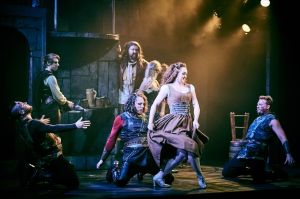
Perhaps it is inevitable that Game of Thrones:The Musical, will hit our stages one day, but, in the meantime, we have to make do with this fusion of classic rock anthems and a tale of heroism, bloodletting and tepid romance, set in a medieval kingdom where knights brandish swords, shields and electric guitars.

The creator of Knights of the Rose, Jennifer Marsden, is, we are told, a barrister, so we have to take it as read that there is no specific law against putting a show like this in front of an audience. Whether or not there should be becomes more debatable as the evening progresses. The House of the Rose (no specified colour) rules over the land, headed by King Aethelstone (Adam Pearce, booming like a miniature Brian Blessed) with his mild-mannered Queen Matilda (Rebecca Bainbridge) at his side. Their son, Prince Gawain (Andy Moss) is absent waging war while their daughter, Princess Hannah (Katie Birtill) loiters at home doing silly things in the company of other maidens, all wearing low-cut dresses, with long, straight hair draped over their shoulders. No cliché is left unused.

The knights return home in glory, hang around taverns waving their tankards and talking bawdily, woo their women and return to war. In short, Marsden’s plot is Much Ado About Nothing without the comedy, crossed with Henry IV pt1 without the weight of history. Sub-Shakespearean verse, much of it ludicrous, goes into the mix. The dramatic temperature rises when Sir Hugo (Oliver Savile) and the shady Sir Palamon (Chris Cowley) compete for Hannah’s hand and the lowly, un-knighted John (Ruben Van keer) acts as a kind of chorus, linking the story together.

There is fun to be had in guessing which familiar lyric daft lines of dialogue are leading into. When the audience guesses correctly, hilarity ensues, but most of the laughs in the show seem to come when Marsden would have least wanted them. The music is loud, amplified just enough to drown out the noise from the overworked air conditioner in this shabby old auditorium. Rock hits such as Holding Out For a Hero, Blaze of Glory, Addicted to Love, Total Eclipse of the Heart, and so on, follow each other in quick succession, but it all becomes too much and, when the company renders REM’s Everybody Hurts, everybody agrees. A dash of Mozart near the end comes as a welcome relief.

Director/choreographer Racky Plews has a decent track record with musicals and she does what she can with the material to hand, using Diego Pitarch’s split-level set imaginatively. Her staging of the fight scenes is exciting, made more so by Tim Deiling’s dramatic lighting effects. The singing is also strong, with Cowley standing out. and Mark Crossland’s seven-piece band does all that could be asked of it. Yes, the show has plusses, but their worth feels diminished when they are placed in a context as inept as this.

This cacophonous calamity is at its best when it wanders into “so bad it’s good” territory, but, sadly, it does not stay there long enough and the show drags out to become a very long evening indeed. At least its creator can find some consolation in having a day job to go back to.

Performance date: 5 July 2018

Photo: Mark Dawson

This review was originally written for The Reviews Hub: http://www.thereviewshub.com

Dusty (Theatre Royal, Bath)

Posted: July 5, 2018 in Theatre

Writer: Jonathan Harvey      Director: Maria F

⭐⭐⭐⭐

A Girl Called Dusty still holds a  special place in my vinyl collection, even though I no longer have anything to play it on, so I can begin with a personal declaration of sentimental interest. This show was always going to bring tears to my eyes and, in the event, it brings plenty. There have been previous attempts to dramatise the life of La Springfield, pioneer for equal rights and LGBTQ icon, on stage, but the names involved here told us well in advance that this was always going to be different class.

Dusty, as seen here, is not very nice to know and she does not seem the ideal subject for a spectacular, feel good juke box musical. The surprise is that writer Jonathan Harvey and director Maria Friedman at first seem intent on making it just that, with big song and dance routines, choreographed by Tim Jackson. They even go as far as incorporating Springfield songs for other characters to sing, but they are only delaying the point as which the show has to reveal what it really is – a full-blown study of a superstar in melt-down, along lines similar to Pam Gems’ Piaf. Once the creators make their minds up that this is a tragic drama in which songs feature, not a musical at all, the show gains in confidence and, at times hits magnificent heights.

Harvey begins in late 1963 when Dusty had split from her brother’s group and was already riding high in the charts with I Only Want to Be With You. This leaves the writer with a back story to tell and he does so with some extremely clunky dialogue, but, once over this hurdle, his brand of camp humour works well to lighten the gloom of much of what follows. Esther Coles and Ella Kenion are hilarious as the star’s loyal right hand women and a sour-faced Roberta Taylor is a grim joy as her gin-swilling Mum. Rufus Hound is rather under-used as her frustrated manager.

At the centre of everything is Katherine Kingsley’s sensational Dusty. Her performance is not just about replicating the singing voice and the look, which she does superbly, it is about finding the heart of a petulant, self-centred, self destructive diva. Harvey offers excuses for her behaviour with passing references to a troubled childhood, but still, sympathy for her is hard to find. Seen as a controlling perfectionist and unreliable performer at the peak of her fame, she foregoes the opportunities offered by British pantos and opts for seedy Los Angeles night clubs, her descent into alcoholism, drug addiction and self-harming accelerating rapidly. She turns down the opportunity to record Killing Me Softly and a frustrated Elton John hands over Don’t Go Breaking My Heart to Kiki Dee (played as rather drab by Alex Bowen). Her love life is represented here by Lois (a moving performance by Joanna Francis), a backing singer who sacrifices her own career for Dusty and receives neglect in return.

Tom Pye’s simple but readily adaptable set designs and his bright period costumes work well. Credit too for Carole Hancock for hair and wigs. The stirring finale comes with You Don’t Have to Say You Love Me, which is presented as the high point of Dusty’s career and it really wasn’t. Nonetheless, Kingsley brings the house down with it. The show goes on a short tour after here, with a West End run not yet announced. Hopefully, Harvey and Friedman will work on fixing the few remaining problems by the time it hits town and help Kingsley to get all the accolades that she deserves.

Performance date: 4 July 2018

Jellyfish (Bush Theatre)

Posted: July 2, 2018 in Theatre

Writer: Ben Weatherill      Director: Tim Hoare

⭐⭐⭐💫

How do perceived misfits find their place in our society? Ben Weatherill’s gentle comedy looks bravely into sensitive issues by challenging preconceptions and prejudices, while serving up a fair number of good laughs in the process.

Sarah Gordy gives a remarkably confident and mature performance as Kelly, a 27-year-old woman who has Down’s Syndrome. Kelly’s life turns around when she befriends Neil, who is a few years older and “normal”. She sees him as a friend and possible lover, but her mother, Agnes, sees him as a predator with sinister intent and wider society sees him as weird. In Tim Hoare’s carefully paced production, the play uses subtle humour to explore how the friendship could develop into co-habitation and parenthood, with relationship ups and down along the way.

Many of the scenes take place on a chilly Skegness beach, Amy Jane Cook’s set design including plentiful sand, a boardwalk and suggestions of amusement arcades and ice cream vendors. Agnes and Kelly have walked this beach every day for 15 years, their bond firmly sealed until the arrival of Neil. As the protective mother, Penny Laden is gritty and down-to-Earth, but she displays the weariness brought on by what feels to her like a lifetime of caring. Agnes speaks movingly of what it means to be a carer, in terms of the everyday practicalities, and she fears with good reason what could happen if she lets Kelly go.

At times when the the writing becomes too earnest and laden with worthiness, the play tends to be a little stodgy, but Weatherill tempers this by tapping into a rich vein of dark comedy, beginning with the arrival of Dominic, a young man with Asperger Syndrome, who is Agnes’ chosen suitor for Kelly. She has found him on Tinder. Nicky Priest’s deadpan style is perfect for Dominic, whose literal interpretations (“I’m not blind” he replies at the suggestion that he is on a blind date) and unintended sarcasm give the play its funniest moments. “We all deserve to be as miserable as each other” he philosophises, before moving on to revise for his forthcoming appearance on Mastermind, with the specialist subject of Kylie Minogue.

If the play has a shortcoming, it is that it does not tell us enough about Neil. Weatherill’s failure to flesh out the character leaves Ian Bonar with little option but to play him as kindly but dull and it becomes very difficult for him and Gordy to make the romance between Neil and Kelly believable. However, we have no problems with believing in the underlying warmth of the adversarial mother/daughter relationship which lies at the heart of the play.

Weatherill poses more questions than he offers answers, but, commendably, he does not go for any soft options. If nothing else, Jellyfish betrays its title by reminding us that people with learning disabilities are not spineless and they don’t sting.

Performance date: 29 June 2018

This review was originally written for The Reviews Hub: http://www.thereviewshub.com

Writer: William Shakespeare      Director: Blanche McIntyre

⭐⭐⭐⭐

It may seem ironic that the Globe should launch its new production of The Winter’s Tale on one of the hottest evenings of the year, but anachronisms are rife in this, Shakespeare’s split personality play.

In temperatures that help the banks of the Thames to pass for Sicily, the tale unfolds. King Leontes suspects his heavily pregnant Queen, Hermione, of infidelity with Polixenes (Oliver Ryan), visiting King of Bohemia, and his uncontrollable jealousy leads him to a path of destruction. The play, believed to be one of Shakespeare’s later works, begins as a tragedy and then, suddenly, it isn’t. There is a sense that the Bard stopped halfway through writing it and told himself that he had done Othello already and needed to move in a different direction, towards reconciliation and forgiveness, in the final two acts.

Finding the range to make the transition from raging tyrant to kindly patriarch, it is the strength of Will Keen’s performance as Leontes that binds Blanche McIntyre’s free-flowing production together. He gives us a study of the loneliness that comes with power, pacing around agitatedly in self-torment.  The large pillars in James Perkins’ palatial stage design give him a place to skulk behind as his irrational fears fester and then they isolate him from the voices of reason in his court once he has embarked on his destructive course. After time has elapsed, Keen reappears, his voice and demeanour now those of a broken man, stripped of all traces of regality and seeking redemption where he once sought revenge.

Priyanga Burford’s Hermione is no whimpering victim. She is unusually forceful, a natural society hostess who suggests that she sees herself as her King’s equal. In this version of the play, Leontes’ jealousy could be caused just as much by her eclipsing him as by the possibility of her betraying him. Sirine Saba makes a fiery, but warm-hearted Paulina, Hermione’s loyal protector.

16 years elapse between the end of Act III and the beginning of Act IV and and the play takes its time to awaken from what could have been a long sleep. McIntyre throws colourful, high-spirited comedy at scenes in rural Bohemia and, aided by excellent work from Annette Badland as the Old Shepherd and Jordan Metcalfe as his/her son, she just about pulls the play through its sticky patch. Not quite a tragedy, not quite a comedy, The Winter’s Tale turns into a sweet romance, when Perdita (Norah Lopez-Holden) the daughter that Leontes has never seen, falls for Florizel (Luke MacGregor), the lost son of Polixenes.

As the play draws to its close, the challenge facing McIntyre is to make the preposterous first plausible and then moving. She shows a delicate touch, sealing a revival which, if not exactly seasonal, is certainly assured.

Performance date: 27 June 2018

This review was originally written for The Reviews Hub: http://www.thereviewshub.com

Kiss Me, Kate (London Coliseum)

Posted: June 21, 2018 in Theatre

Music and lyrics: Cole Porter      Book: Bella and Samuel Spewack      Director: Jo Davies

⭐⭐⭐

Is it possible that what can no longer be spoken can still be sung? The Taming of the Shrew, once one of Shakespeare’s most popular comedies, is now rarely seen in our theatres, seemingly swept away on a tide of political correctness. On the other hand, Kiss Me, Kate, Cole Porter’s 1948 musical based upon the same play, remains a perennial favourite, revived in various forms at regular intervals.

The show made its West End debut in 1951 at this same theatre, now the home of English National Opera. Opera North’s revival first appeared in Leeds in 2015 and, after touring the United Kingdom, it now arrives in London for the first time.

The book by Bella and Samuel Spewick is constructed wittily, following a theatre company as it performs a production of …Shrew in Baltimore prior to Broadway. Actor/manager Fred Graham (Quirijn de Lang) and leading lady Lilli Vanessi (Stephanie Corley) are celebrating the first anniversary of their divorce and their real-life clashes are mirrored by the warfare between their characters in the play, Petruchio and Kate. As long as 70 years ago, the writers could have realised that Shakespeare’s proposition that all it takes to tame a difficult woman is a good spanking needed toning down and, by veiling it in mockery, they just about get away with it.

Even so, the eventual acceptance of subservience by both Kate and Liili draws hisses of disapproval from a 2018 audience, notwithstanding the conclusions being made more palatable by  Dutch baritone de Lang’s lack of real authority as either Petruchio or Fred. Similarly, Corley always seem to struggle to make her characters sufficiently shrewish to need too much taming. Shakespeare’s Bianca is played by flirty starlet Lois Lane (a zestful Zoë Rainey) whose less than super man, Bill Calhoun (a jauntily tap dancing Alan Burkitt) accumulates gambling debts between performances as Lucentio.

Most of Porter’s songs are timeless classics, although not all of them connect with the book as well as perhaps they should. The cheesy Wunderbar feels as if it was thrown in as an afterthought and it is a mystery what Too Darn Hot has to do with this show. However, it gives us a darn good second act opener in which Will Tuckett’s choreography shines. Some songs suit operatic voices better than others. Corley sings So In Love perfectly, but her sweet soprano tones drain all the venom out of I Hate Men.

When an opera company takes on a work created for musical theatre, it can be expected that what is gained in musicality may come at the expense of theatricality. Here the Opera North Orchestra, conducted by James Holmes, and the Opera North Chorus recreate the sounds of Broadway gloriously. Given the luxury of a huge company of singers and dancers, director Jo Davies’ production often looks unusually over-crowded, more typical of a Verdi opera than a Porter musical. She finds flashes of comic invention without aver nearing the consistent sparkle of Trevor Nunn’s 2012 revival at Chichester and then the Old Vic. As was the style in the 1940s, long gaps occur between musical numbers and these sections need many more injections of energy than they get here.

Kiss Me, Kate is a show that nearly always gets “stolen” near the end when the two mobsters chasing Bill’s debts tell us Brush Up Your Shakespeare. This version proves to be no exception as John Savournin and Joseph Shovelton nail the number with aplomb. It rounds off a mixed evening which is musically wunderbar, but slightly under the bar in some other respects. 

Performance date: 20 June 2018

This review was originally written for The Reviews Hub: http://www.thereviewshub.com

Writer: Polly Stenham (after August Strindberg)      Director: Carrie Cracknell

⭐⭐

If nothing else, Swedish playwright August Strindberg’s 1888 work Miss Julie has proved itself to be both durable and malleable. For example, in 2003, Patrick Marber moved the location to rural England and the time to 1945 with his After Miss Julie; more recently, Yaël Farber realised a version of the same play in a steamy modern South Africa with her Mies Julie. Now it is the turn of Polly Stenham, transplanting the drama to the North London suburb of Hampstead in the present day.

The play’s simple premise is that a lady of high birth and wealth becomes entangled with a lowly household servant, leading to (borrowing from another Strindberg title) a dance of death. Different societies behave in different ways and, everywhere, codes of morality, class structures and gender balances shift constantly. On the other hand, it is probable that human nature remains largely unchanged. The recurring fascination with the play comes from examining how Strindberg’s dark vision of the self-destructive side of our nature relates to new settings.

A full five minutes pass in Carrie Cracknell’s production before a word is spoken. Julie’s widowed father is away and she is hosting a wild birthday party, with flashing lights and thumping music. “This is 2018” is being screamed at us at unnecessary length. Gyrating revellers are silhouetted in the background and, below stairs in the basement kitchen, chef Jean and his fiancée Kristina (Thalissa Teixeira) are pilfering the booze and nibbles until Julie eventually descends.

The kitchen, spanning the entire width of the Lyttelton stage, could belong to a house that would occupy a large expanse of Hampstead Heath, but the coldness of Tom Scutt’s minimalist design works against the actors’ efforts to generate fire and passion, as does dialogue that is functional more than lyrical and witty only in flippant asides. Choreographed movement and stage effects catch the eye, but, ultimately, they are just as baffling here as in Cracknell’s recent Macbeth at the Young Vic.

Having been lauded for her performance as the young Princess Margaret in The Crown, Vanessa Kirby could be cornering the market for spoiled rich girls who fly in the face of convention. However, leaving aside suggestions of type-casting, her Julie is also touched by vulnerability and despair at the hollowness of her parasitic existence. She knows that she is a free spirit only because her father’s money allows her to be. Eric Kofi Abrefa’s Jean is a lightweight, a shallow opportunist aiming to open his own restaurant, who looks at first to be easy prey for Julie.

“If anyone conquered anything, I had you” claims Julie in post-coital triumph, but It is surprising that Stenham finds little more room for modern feminist themes and she even allows Jean to claim moral superiority. Her main assertion is that, in the modern age, class is determined by money alone. In Strindberg’s time, birth as well as wealth would have been the determining factors and the concept of servitude would have been clear. Now, Jean is a “servant” who is merely using his position as a stepping stone towards his own riches. 

19th Century audiences may have gasped in horror when Julie and Jean consummate their relationship, but, nowadays, the likely reaction will be shrugged shoulders and the comment “so why wouldn’t they?”. The passing of time has taken its toll on the impact of Strindberg’s messages, but we are still left wondering what new points Stenham wants to make in their place.

To work properly, all versions of Miss Julie need to be delivered as short, sharp shocks. At under 80 minutes straight through, Stenham’s version is certainly short, but its focus is often blurred and, apart from a scene which is wholly unsuitable for pet lovers, the shock waves that it sends out feel buffered. It may have dropped the word “Miss” from the original’s title, but, sadly, this production is still a miss anyway.

Performance date: 7 June 2018

Photo: Richard H Smith

This review was originally written for The Reviews Hub: http://www.thereviewshub.com

Co-author and writer: Simon Stephens      Co-author and composer: Karl Hyde      Co-author and director: Scott Graham

⭐⭐⭐

Masculism has perhaps become unfashionable at a time when, rightly, the movement for gender equality has gained urgent momentum. This new 90-minute piece, presented by Frantic Assembly as part of the London International Festival of Theatre (LIFT), brings the male of the species back into the spotlight, with specific focus on father-son relationships.

The three co-authors put themselves at centre stage. Scott Graham (played by Declan Bennett), Karl Hyde (Mark Arends) and Simon Stephens (Nyasha Hatendi) convene on the pretext of gathering interviews of sons about their fathers in order to create a work of theatre. A potential interviewee, Luke (Craig Stein) turns out to be fatherless and stays around to serve as built-in critic. Seven all-male actors play the interviewees in separate scenes and intercutting with each other and a male voice choir emerges from the audience towards the end

Graham (from Corby), Hyde (from Kidderminster) and Stephens (from Stockport) make Fatherland almost as much about land as about fathers, reflecting on the geographical social mobility of post-World War II generations in England. They all originate from places “on the periphery of somewhere pretty interesting”, but they have moved on, leaving behind immobile fathers and parts of themselves. “What is the first memory of your father?” is always their first question and they hear memories ranging from the humdrum – sons watching Match of the Day and Steven Seagal films with their fathers – to the dramatic – disturbing accounts of final partings.

Accounts of dysfunction and incompatibility abound, with little sign of pride or joy. When Daniel (David Judge) wails aloud “No. We don’t say the word love…” repeatedly, he strikes at the theme that becomes the essence of this poignant work and the inarticulacy that so often blights family life becomes tangible. Hyde’s music (co-composed with Matthew Herbert) lifts scenes from mundanity, particularly in echoing male voice choruses, and imaginative movement brings stories to vivid life. Jon Clark’s superb lighting design merits specific mention.

In his wounding parting shot, Luke cements his position as a potential theatre critic by telling the three co-authors that what they discover is “just stories” and not something truthful. He is exactly right. Fatherland is haunted by disappearing values in a disappearing land, telling stories, but doing so without breaking down stereotypes, nor digging far beneath the surface, nor unearthing any universal truths that would bind the stories together. For all that, the sheer theatricality of the entire experience makes it worth a look and a listen.

Performance date: 31 May 2018

This review was originally written for The Reviews Hub: http://www.thereviewshub.com

Writer: Molière     Adaptor: Christopher Hampton      Director: Gerald Garitti

⭐⭐⭐

Even if Brexit is unstoppable, the Entente Cordiale looks set to live on, exemplified by this production of a Molière play, written in 1664, adapted by an Englishman, directed by a Frenchman, performed by French and British actors and spoken in both French and English in roughly even measures.

The production requires sur, sub and side titles, and all seat positions in this three-tiered theatre appear to be covered. French-to-English translations appear in white text, English-to-French in yellow. It takes time to get used to, but it all works fairly well. As Christopher Hampton’s adaptation tells of a French family that has emigrated to Los Angeles when Dad buys a film studio, it is logical that both languages should be in use, but less so that characters should repeatedly switch between them in mid conversation. Of course, logic is never going to play a big part in a play such as this.

As with most plays in which the plot hinges on a character’s gullibility, suspension of disbelief is essential. Here, the gullible one is family head, Orgon (Sebastian Roché) who takes in the vagrant Tartuffe and is taken in by his piety and perceived wisdom. As the play has alternative titles of The Hypocrite and The Imposter, it quickly becomes obvious that Orgon is heading for a fall, notwithstanding warnings from his son Damis (George Blagden) and others in his family. He insists that Tartuffe will marry his daughter Mariane  (Olivia Ross) against her wishes and remains oblivious to his lusting after his wife Elmire (Audrey Fleurot).

We wonder whether forced marriage is actually legal in California and, in a more general sense, why Hampton has chosen to transplant the play to there. Brief references could be taken to allude to Hollywood’s current woes, but these are passing and a final scene which openly satirises the current American Presidency comes across as clumsy and obvious. For more than half an hour at the beginning of the play, characters stand in clusters to talk about nothing else but Tartuffe and some of their chat is so turgid that it is hardly worth reading the translations. We have a long wait to see if the titular character himself can possibly live down to all this adverse hype and, when he eventually arrives, we are not disappointed.

Our first sight of Paul Anderson’s Tartuffe is with his arms raised sideways in crucifixion pose, a messianic figure, who is, at once, obsequious and dominating. He speaks (only in English) with the pronounced Southern drawl of a Baptist preacher and sings Leonard Cohen’s Hallelujah. Although similarities with a figure seen at a recent royal event are almost certainly unintended, this interpretation of the character begins to show us why Hampton draws parallels between the court of Louis XIV and Donald Trump’s America. Unsurprisingly, all of the production’s most entertaining scenes coincide with Anderson being on stage.

Andrew D Edwards’ striking set design has the look of a chic gallery for modern art, with what could be a multi-medium Turner Prize exhibit as its centrepiece. It forms part of a production, directed by Gérald Garutti, which has enough imaginative flourishes to keep the audience engaged and which marks a bold attempt to breathe fresh life into a creaking 17th Century classic. Nonetheless, much of this Tartuffe is still tough going.

Performance date: 29 May 2018

This review was originally written for The Reviews Hub: http://www.thereviewshub.com

Book: Warner Brown      Lyrics: Warner Brown and David Heneker      Music: David Heneker      Director: Jenny Eastop

⭐⭐

Revived as part of the Finborough Theatre’s British Musicals season, The Biograph Girl, an account of the rise of Hollywood’s silent movie industry in the teens and twenties of the last century, dates only from 1980. This comes as a surprise, because an old-fashioned musical style which owes more to Ivor Novello than to Lionel Bart or Andrew Lloyd Webber, suggests something much earlier.

The show had a modest initial West End run at the Phoenix Theatre, but, shortly thereafter, Torvill and Dean popularised Jerry Herman’s superb score for the erstwhile Broadway flop Mack and Mabel and that became the early Hollywood musical of choice. Mack Sennett appears again here, characterised in Matthew Cavendish’s pratfalling, scene-stealing performance as a man who lived his life in the manner of a Keystone Cop.

The chief problem with Warner Brown’s book is that it charts movie history in sketchy, semi-documentary style without fully developing a central narrative focus to drive the show. Famous names come and go, but Brown’s interest seems not to be in their lives, but in their industry. His lyrics, co-written with composer David Heneker, range from the mildly amusing to the predictable, while lines such as “…your dreams come true on the casting couch” and “every lady needs a master who can guide her through” are pretty well guaranteed to enrage supporters of today’s Me Too movement.

Heneker is no Herman, but his score, played on a single piano by musical director Harry Haden-Brown, is pleasantly hummable. Director Jenny Eastop’s production is zestful, if not over-imaginative and it includes several excellent performances. Sophie Linder-Lee is a bubbly Gladys Smith (aka Mary Pickford, aka America’s Sweetheart, aka The Biograph Girl), the 21-year-old child star that her studio will not allow to grow up; Linder-Lee manages to be endearingly juvenile and, at the same time, steely and avaricious. Emily Langham’s sweet-natured Lilian Gish, a serious stage actor from New York who looks down on the burgeoning film industry, is the closest that the show gives us to a character that we want to root for.

The show’s strongest theme centres on the struggle between art and commerce that has defined Hollywood throughout its history. Jonathan Leinmuller’s DW Griffith is a proud and upright visionary, demanding truth in his films, but denying reality in the real world and believing that audiences would want silent Shakespeare more than talking pictures. His Birth of a Nation stirs up racial tensions in the Deep South and his Intolerance inspires indifference everywhere. In the long-term, both were to gain critical plaudits, but it is Mack Sennett who rakes in the cash.

Some musicals benefit enormously from being miniaturised to fit into tiny venues such as the Finborough, but, performed here with minimal set and props, this is not one of them. The story and songs are too slight to compensate for the absence of big theatre spectacle and this contributes to a feeling that the show is as dated as silent movies themselves must have seemed with the advent of the talkies.

Performance date: 24 May 2018

This review was originally written for The Reviews Hub: http://www.thereviewshub.com