Archive for the ‘Theatre’ Category

What Comes Next for Next to Normal

Posted: June 24, 2024 in Theatre

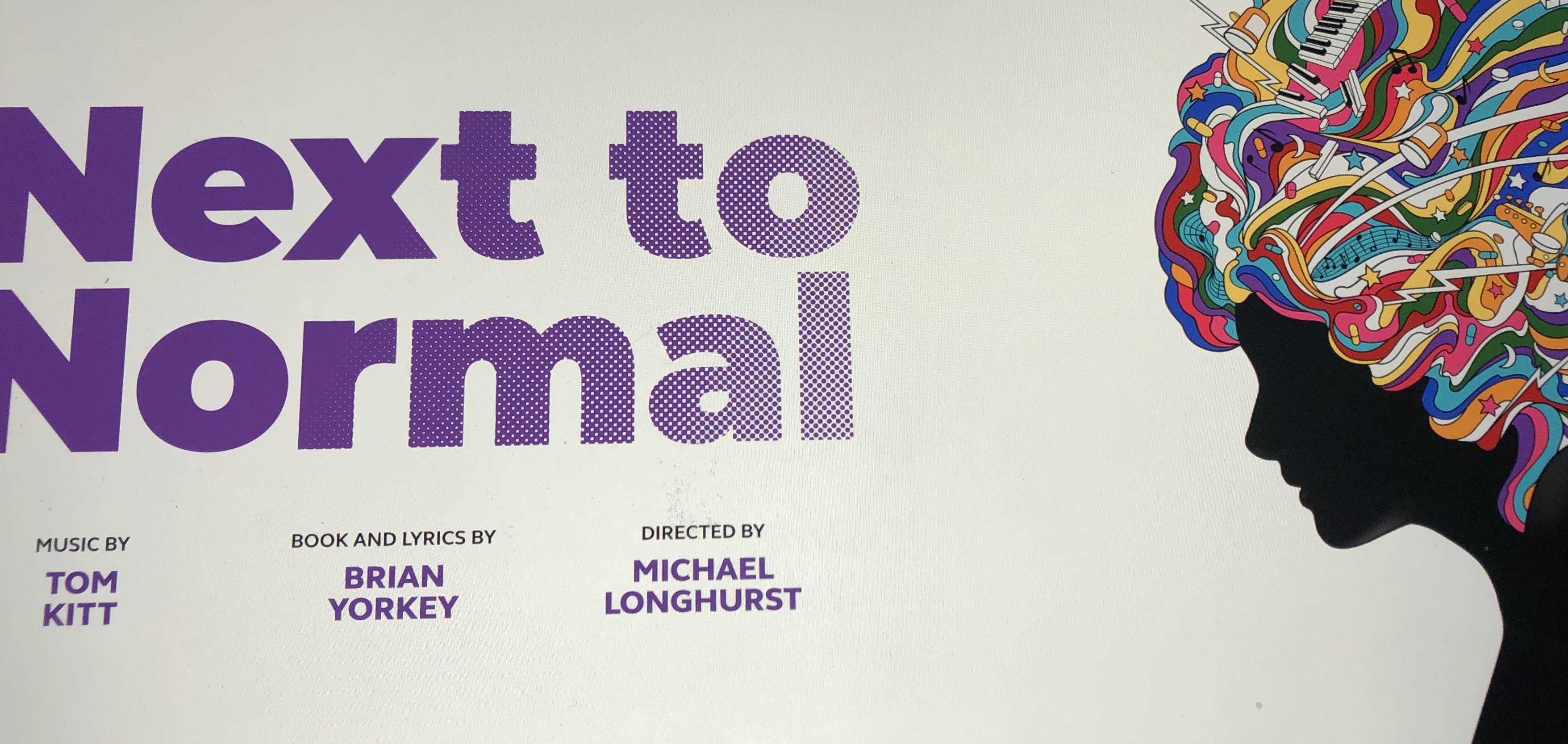
At first sight, a Broadway musical dealing with mental illness and bereavement is far from normal. Yet, as director Michael Longhurst points out, many of the greatest musicals cover very dark themes and a song can be more effective than a paragraph of words in exploring the human condition.

Longhurst was chairing a discussion among cast and creatives on the stage of Wyndham’s Theatre in London’s West End, to where his critically-acclaimed 2023 production of Next to Normal at the Donmar Warehouse is transferring. The group sat scattered around a nondescript family kitchen, being the solitary set on which all the drama unfolds.

The show’s American composer, Tom Kitt, reflected on the 26-year journey that has brought him here. It all started when he and book writer and lyricist, Brian Yorkey, were challenged to write a 10-minute musical. He cites Stephen Sondheim and Kander and Ebb as his main influences, being writers who are not afraid to delve into serious issues nor to venture through previously unexplored territory. The development of Next to Normal led to an off-Broadway premiere in 2008, transferring to Broadway in 2009, picking up a Tony Award for Best Original score and a Pulitzer Prize for Drama. Now, Kitt roams daily around London’s theatre district, looking in wonder as he realises that he is becoming part of it all.

During the 15 years or so that it has taken for the show to cross the Atlantic, it developed something of a cult status here, fuelled by clips on the internet. One avid fan was actor Jack Wolfe, who had bought tickets for the Donmar Warehouse before auditioning for the key role of Gabe. He got the part and, with it, the show-stopping song, I’m Alive. When reading the script, Longhurst recalls that he kept hearing the voice of American actor Caissie Levy as Diana, the troubled wife and mother. He had directed her in the New York production of Caroline, or Change and, happily, she accepted the role, which she is now reprising.

The intimate Donmar Warehouse has around 200 seats and is configured so that the audience is almost sitting in Diana’s kitchen. Longhurst talked about the challenges of transferring his production to a medium-sized, traditional proscenium arch theatre. Olivier Award-winning actor, Jamie Parker, who plays Diane’s husband Dan, has starred in musicals at many West End and London fringe venues and he believes that this transfer gives the show the chance to exercise its muscles. He says that, through rehearsals and previews, the actors have been finding new dimensions for their characters and in the story.

With the costs of staging extravagant new musicals spiralling upward, risk-averse producers on Broadway and in the West End seem to be turning either to safe bets or to smaller scale, more intimate shows. Maybe Next to Normal is confirming a trend towards what is becoming the new normal.

Photo: Steve Gregson

Writer: Noël Coward

Director: Tom Littler

⭐️⭐️⭐️

By 1966, following the emergence of Harold Pinter, John Osborne and other notable British playwrights, Noël Coward’s world of the affluent upper middle classes must have felt anachronistic. Yet it was in that year that Suite  in Three Keys, the writer’s trilogy of plays, premiered in the West End.  Now, over  half a century later, director Tom Littler invites us to immerse ourselves for around five hours among Coward’s people and assess whether the plays continue to stand the test of time.

Littler’s revival is a three for the price of two offer, comprising a double bill of the shorter plays and a single production of the longer one. The plays are linked by the same setting, a lakeside hotel suite in Switzerland. Felix (Steffan Rizzi), a genial room service waiter, is a further link and he also entertains us at intervals with music, including 60s American songs sung in Italian. The Orange Tree’s in-the-round configuration gives a fly-on-the-wall feel, which is perfect for the plays.

The double bill begins with Shadows of the Evening, a melancholic piece in which Coward could well be contemplating his own mortality. When George (Stephen Boxer) is diagnosed as terminally ill, his partner, Linda (Tara Fitzgerald) panics and asks Anne (Emma Fielding), the wife that he had left 20 years earlier, to fly out and join them. Coward passes on opportunities to draw laughter from bitchiness between the two women and, instead, opts for a rambling light drama which repeatedly drives up blind alleys. If nothing else, the playlet reminds us that there were times in the not too distant past when divorce was a social taboo and when dying patients were not told automatically by their doctors of their condition.

After an interval enlivened by Felix, Come into the Garden, Maud follows. Verner (Boxer) is a rich American who is married  to Anna Mary (Fielding), an insufferable social climber. The arrival of Maud (Fitzgerald), a British-born Italian princess, brings disarray as Coward revels in differences between European and American cultures, one obsessed by social status and the other by money. Fielding has enormous fun as the ghastly Anna Mary, her blue-rinsed bouffant hairstyle giving her the look of an early prototype for Marge Simpson. Fitzgerald also excels as the mischievous temptress who sets her sights on driving a wedge between the couple and giving Anna Mary the comeuppance that Coward clearly believes she deserves.

The two-act play, A Song at Twilight, could and arguably should stand alone. Hugo (Boxer) is an eminent writer who lives with his wife of 20 years, the dullish and dutiful Hilda (Fielding). Unexpectedly, he receives a visit from Carlotta (Fitzgerald), a mediocre British actress who had, briefly, been his lover many years earlier. But what does she want? The first act builds slowly, climaxing with the revelation that Hugo had once had a male lover.

Coward is most commonly associated with breezy comedies, but, here, he adopts a style of high drama similar to the works of his contemporary, Terence Rattigan. There are too many coincidences for us not to connect Hugo to Coward himself and, during blazing second act exchanges in which Boxer and Fitzgerald are both magnificent, the writer seems to be challenging himself over a lifetime of deception. Written on the eve of momentous changes in British laws relating to homosexuality, the play feels highly significant and deeply personal.

The sense of daring that flavours much of the writer’s theatre work survives and thrives in these late plays. As a whole, Suite in Three Keys is uneven, but its flaws are by far outweighed by its strengths.

Performance date: 5 June 2024

Photo: Johan Persson

Writer: Stephen Adly Guirgis

Director: Michael Longhurst

⭐️⭐️⭐️💫

Some people seem to enjoy jumping out of the frying pan and into the fire. Take Danny Sapani for example. Having recently completed a run as King Lear at the Almeida Theatre, the actor now makes the short trip across North London to play an old man whose life is descending into chaos in Between Riverside and Crazy, Stephen Adult Guirgis’ Pulitzer Prize-winning drama.

There is something vaguely Shakespearean in how the writer integrates tragedy with comedy and uses symbolic imagery to highlight profound themes. Known as “Pops”, Walter (Sapani) retired from the New York Police Department (NYPD) eight years earlier after being shot by a rookie cop. He lives in a large, rent-controlled apartment on Manhattan’s fashionable Riverside Drive, but his home has become a refuge for petty criminals and drug users and his landlord wants him out.

Walter’s apartment, as seen in Max Jones’ set design, is spacious, but shambolic and unwelcoming. A tall Christmas tree that had long ago lost its needles stands in one corner, still lit up. Walter’s wife had died just before Christmas and it is as if time had stood still for him at that moment. Sapani’s towering performance takes ownership of the stage and of the play. His Walter is stubborn, embittered and bombastic. Being black, the character views every situation through the prism of racism and his generosity of spirit sees him supporting causes that are not always worthy.

Sapani’s Walter dwarfs other characters in director Michael Longhurst’s well crafted and well acted production. Martins Imhangbe is Junior, Walter’s well meaning son, who may (or may not) have made his girlfriend Lulu (Tiffany Gray) pregnant. Sebastian Orozco is a seedy Oswaldo, a desperate drug addict who scrounges off Walter’s charity, and Ayesha Antoine is an eccentric “Church Lady” who advocates strange treatments for his ailments.

In two pivotal scenes, two police officers, Dave (Daniel Lapaine) and Audrey (Judith Roddy), who are engaged to marry each other, appear to attempt to persuade Walter to settle claims against the NYPD. Interestingly, they are the play’s only white characters and the adversarial roles that they assume strengthens the racism subtext of a drama that is not primarily built on that theme.

There are times when it feels that the play is too American, specifically too New York, to resonate fully with United Kingdom audiences. Undoubtedly, some of the drama’s relevance has become lost in the Atlantic crossing. That said, its portrait of a man who is suffering the ravages of ageing and watching is domain crumbling is truly memorable.

Performance date: 13 May 2024

Photo: Alex Brenner

Writer and director: Stephen Unwin

⭐️⭐️⭐️⭐️

In essence, Laughing Boy, Stephen Unwin’s new 100-minute one-act play, is a dramatised documentary. However, the vitality of the writer/director’s production blows away the dryness that can be associated with such a format and elevates it to a level at which information and entertainment are delivered in equal measures.

The play’s source is Justice for Laughing Boy, a book by Sara Ryan, an Oxford academic with a serious grievance to air. Janie Dee plays her with a sense of tempered rage, impassioned but, at most times, rational. Sara’s son, Connor Sparrowhawk, dies at the age of 18 in 2013, drowning in a bath at a National Health Service residential unit. Connor has learning disabilities and he suffers from epilepsy. The play traces Sara’s journey towards uncovering the truth about what happened to Connor and then seeking justice on his behalf. 

Connor, a lover of buses and lorries, is present on stage throughout the play. Alfie Friedman shows remarkable range in playing him, giving us glimpses into the world that he inhabits as he moves from a gentle and vulnerable boy to an unmanageable and occasionally violent teenager. Most importantly, he brings out the “magic” that endears Connor so much to his family and others

A white screen envelops the small stage in Simon Higlett’s set design and images are projected onto it. Forbes Masson plays Rich, Sara’s partner and support through her ordeals. This leaves four actors – Lee Braithwaite, Charlie Ives, Molly Osborne and Daniel Rainford – to play all other characters in the story plus a Jack Russel Terrier. It is their energy that injects life into the production.

This is a story of failures in care by supposed carers and disrespect for the basic human rights of society’s most vulnerable members. Inquests and enquiries follow over a period of years and the writer points the finger of blame at medical malpractice, overstretched resources, underfunding, etc, leaving no room for arguments to be balanced. The play is presented as one woman’s campaign to battle through the excuses and cover-ups to find truth and accountability.

This is gripping and thought-provoking suff. Yes the play’s final sections drag on for far too long. but dragging on for far too long is precisely what much of this distressing story is about.

Performance date: 30 April 2024

Photo: Mark Senior

Writer: Samuel Adamson

Director: Richard Twyman

⭐️⭐️⭐️

Ever since the release of David Lean’s classic 1945 film, Brief Encounter, middle-aged couples, classical piano music and railway stations seem to have been linked inextricably. All three elements figure in the mix for The Ballad of Hattie and James, Samuel Adamson’s new play, which is a complex study of the adversarial platonic friendship between the title characters, spanning almost 50 years.

The play begins in 2019 with Hattie playing the piano at St Pancras International station. This leads to a reunion with James, a professional musician who she had first met in 1976, and we then see how their on-off relationship develops over the years. When they come together, they cannot even agree on who contacted whom to arrange the meeting, but their conflicts lead to a strange form of mutual dependency that, repeatedly, draws them back to each other.

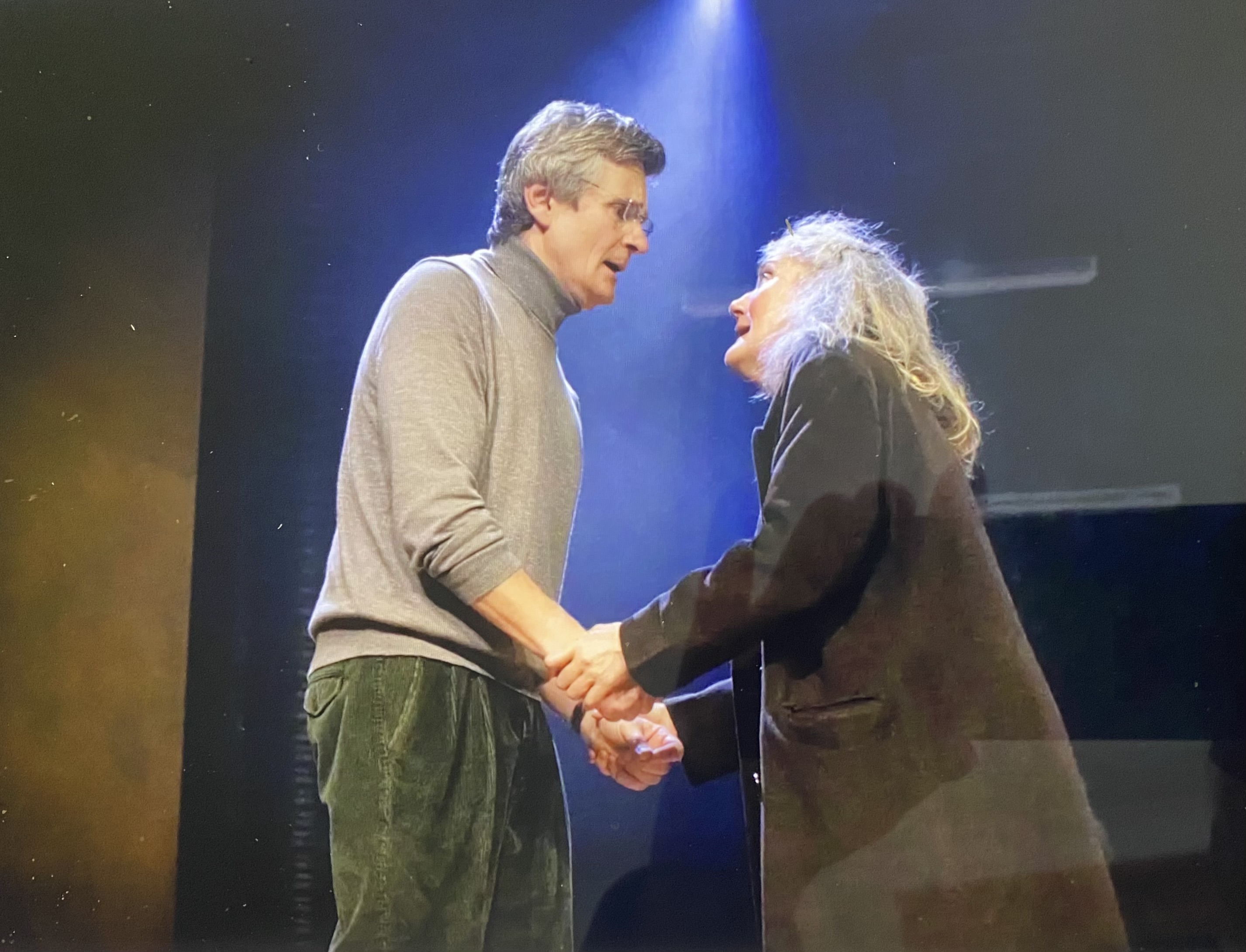
Hattie is eccentric, wears two scarfs and has ambitions to play the piano at the Royal Albert Hall, but she settles for a job in a tax office. James is gay, stuffy, wears old corduroy trousers and is passionate about Benjamin Britten. They could be the proof that opposites attract and music unites them until it tears them apart. 

There are few actors more accomplished at playing eccentric characters than Sophie Thompson and, as Hattie, she is terrific, pushing the comedy as far as she can without going over the top, while finding the pathos in a life of promise unfulfilled. Charles Edwards’ James, an awkward, impassioned academic, is the perfect contrast. Suzette Llewellyn provides solid support to these precisely judged performances, playing multiple roles, and Berrak Dyer plays the piano beautifully.

The product, directed by Richard Twyman, navigates through the play’s crescendos and decrescendos fairly successfully, only getting stuck in some overlong and over-analytical scenes. Adamson packs the script with details of the characters’ back stories which prove to be of little use in helping us to understand their emotions and the strange bond that holds them together. 

There are minor quibbles about what is, overall, an engrossing and unusual drama, but maybe just a little fine tuning could give it a lot more clarity.

Performance date: 18 April 2024

Writer and performer: Tom Walker

⭐️⭐️⭐️

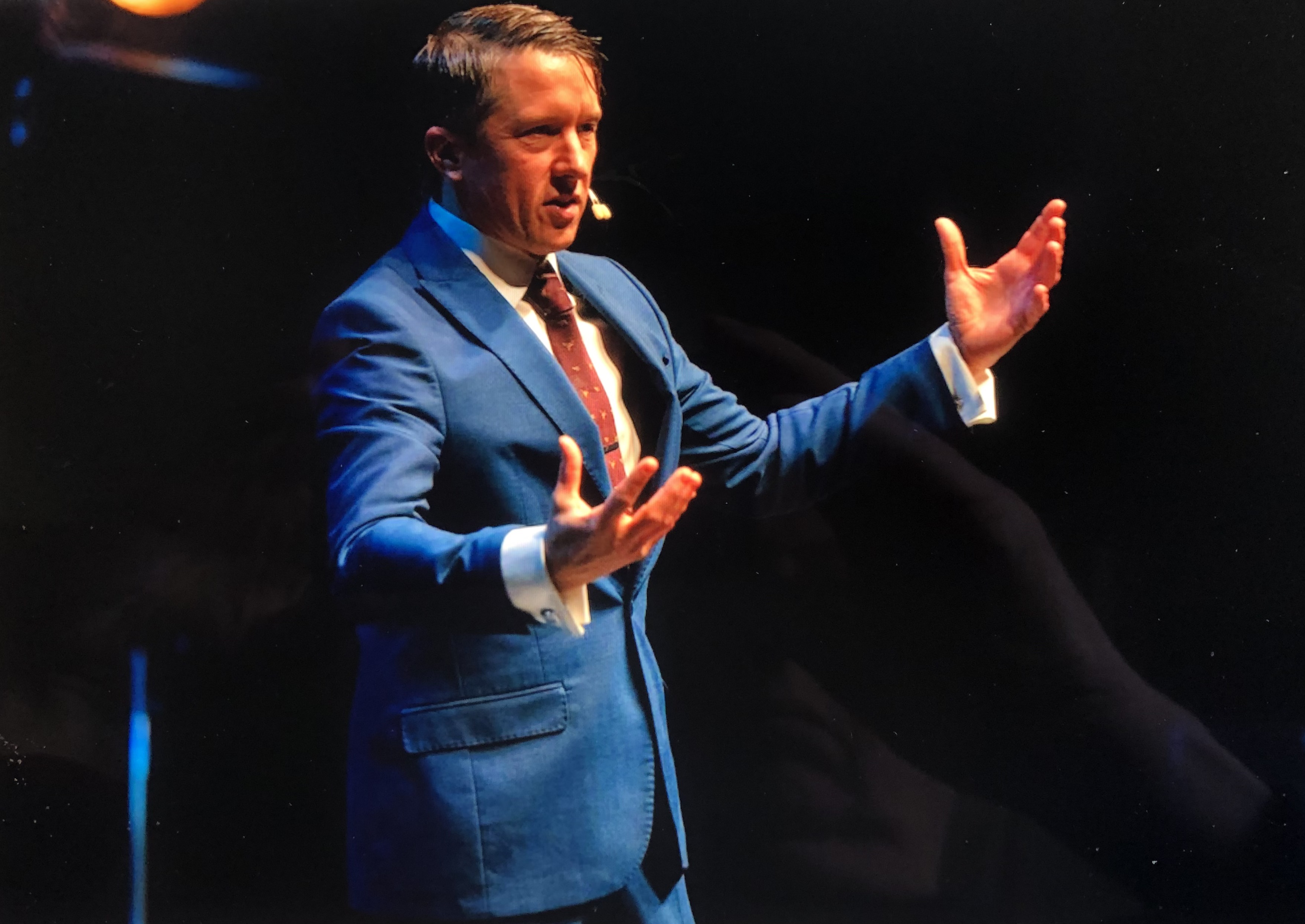
If anyone has ever wondered what BBC News would be like if it lost its balance, Jonathan Pie (alter ego of Tom Walker) could provide the answer. Pie is the BBC’s Westminster correspondent and, having worked previously for Russia Today, he knows all about democracy.

Perhaps realising that preaching Socialism to an audience that has paid West End ticket prices may not be too good an idea, Pie begins by promising that his “lecture” will not be a Party Political Broadcast on behalf of the Labour Party and, instead, he makes it a Party Political Broadcast against the Conservative Party (and others). All Prime Ministers since Thatcher are in the firing line, with Rishi Sunk being named the most evil of all for having once worked as a hedge fund manager. There are many villains, but where are the heroes that the show’s title promises?

The evening begins with a so-so 20-minute set from Egyptian-American comedian Maria Shehata. Presumably, her job is to warm up the audience for Pie, but, having done so, she sends us out for a 20-minute interval and cools us down again. Very odd.

Pie’s style is to launch into ferocious, foul-mouthed tirades, pitched at such a level that they cannot be good for his blood pressure. A Socialist who sends his son to a private school and is a member of BUPA, a conservationist who cannot be bothered to re-cycle waste and regards David Attenborough as overrated, we figure out that Pie’s Achilles heel is hypocrisy long before he owns up to it.

Moving at break neck speed, Pie leaves us little time to dwell on the nonsenses or to figure out the other side of his arguments. Corruption, cronyism, privilege, greed, etc are all sitting targets and, when he hits them, his observations are often very funny. His overlong “lecture” only flounders when he asks us to take him seriously.

Pie rants against every political and social convention that comes, apparently randomly, into his head, reserving special venom for British democratic institutions. However, it is all reminiscent of Basil Fawlty beating up his motionless car and maybe this self-confessed hypocrite’s hopes for real change are just pie in the sky

Performance date: 16 April 2024.

Player Kings (Noël Coward Theatre)

Posted: April 14, 2024 in Theatre

Photo: Manuel Harlan

Writer: William Shakespeare

Director: Robert Icke

⭐️⭐️⭐️⭐️💫

With a title that alludes to a character in Hamlet, Robert Icke’s production of Player Kings is a mash-up of the two parts of  Henry IV, William Shakespeare’s stirring coming-of-age saga, which tracks the progress of the heir to the throne, Prince Henry (Hal), from wastrel to warrior. Its themes are timeless and universal.

King Henry (Richard Coyle) appears with regalia not dissimilar from that seen at the coronation of King Charles III, as Icke gives an immediate signal that no opportunity to link the play to the modern world will be missed. Henry’s grip on the throne is tenuous, with descendants of his deposed predecessor gaining momentum, but how he wishes that he had a son to match the valiant Hotspur (Samuel Edward-Cook), that of his adversary. Instead, his own oldest son is absent, attending the “court” of Sir John Falstaff, a battle-hardened retired soldier, who is set on growing old disgracefully in the bawdy ale houses of East London.

The jewel in Player Kings’ crown is youthful octogenarian Ian McKellen’s marvellous Falstaff. As written, the character is truly ridiculous and McKellen goes flat out to squeeze every drop of pitiable absurdity from him, knowing that, in these plays more than any others, Shakespeare connects comedy to drama with absolute precision.

Toheb Jimoh’s Hal is angry and petulant, as if holding off his inevitable accession. But this is not a gullible kid who simply falls for Falstaff’s boasts, exaggerations and lies. He is fully aware that, while he joins in the boozing, whoring and pranking, his heritage sets him apart. On stage together, McKellen and Jimoh generate magical chemistry, lighting sparks off each other.

Running at well over three hours, including one interval, this could have become a hard slog and, very briefly, Icke’s production gets bogged down in 15th Century politics. However, mostly, it skips lightly over them, leaving scene-setting factual details to appear occasionally as surtutles. Using minimal sets, designer Hildegard Bechtler opts for varies 20th Century costumes and the staging relies on hand-drawn curtains at scene changes. The overriding mood is inflamed much by dim, atmospheric lighting, designed by Lee Curran. The climax to the first half is the Battle of Shrewsbury, staged with long shadows, gun shots and explosions. What is lost in historical accuracy is made up for in dramatic intensity and Icke tops it off with a wonderful coup de théâtre.

The second half is more subdued and reflective, giving it the potential to feel like an anticlimax. However, rich characterisations save this production from that fate and foundations laid down in raucous earlier scenes add power and poignancy to the Bard’s melancholic study of ageing and renewal.

Popularised by star casting, revivals of Shakespeare plays in commercial theatres seem to be going stronger than ever before. Player Kings certainly sets a high bar for those that follow.

Performance date: 12 April 2024

After her stint playing Queen Elizabeth II in the Netflix series The Crown, Imelda Staunton will be returning to her role as the Queen of British musical theatre in a revival of Jerry Herman’s Hello Dolly over the coming Summit at the world famous London Palladium. She joined a small gathering in the venue’s Cinderella Bar to chat about the production with director Dominic Cooke and The Reviews Hub’s Stephen Bates was there to eavesdrop.

The idea for the production fist sprang up when Cooke and Staunton were working together on the 2017 revival of Stephen Sondheim’s Follies at the National Theatre. It began taking shape and was scheduled to open at the Adelphi Theatre in the Spring of 2020. And then came lockdown. However, Staunton sees the delay as being, in some ways, serendipitous, because it means that the show will now be seen at what she regards as the perfect theatre for a spectacular Broadway musical from a golden era (the early 1960s). She recalls fondly that, as a child, she watched all the great stars of the era performing on ITV’s Sunday Night at the London Palladium and then coming here to see live performances by Josephine Baker and Bing Crosby. She says that she will need to banish these memories from her head if she is not going to be too terrified to set foot on the same stage.

Similarly, the star hopes to banish thoughts of the famous names who have played Dolly Levy before her, including Carol Channing and Bette Midler on Broadway and Barbra Streisand, who she acknowledges was 40 years too young for the role in Gene Kelly’s 1969 film version. She says that Dolly has neither the anger and ruthless ambition of Mamma Rose (in Gypsy) nor the inner sadness of Sally (in Follies), Staunton’s two most recent musical triumphs, but she sees a force of positive energy in the character which will strike a chord with audiences in modern times. She believes that it is important to bring back old musicals for young audiences who may never have heard of them. She jokes that she has already been asked if the show is about Dolly Parton.

Cooke is keen to emphasise the musical’s roots. It is adapted from The Matchmaker by the great American playwright, Thornton Wilder. He sees the relationship between the play and the musical as similar to that between George Bernard Shaw’s Pygmalion and My Fair Lady in that many lines are common to both. However, in this new version, additional lines have been taken from Wilder’s play and the director believes that this will make a musical that is already very funny even funnier.

Another change will be the the insertion of the opening number which Herman wrote for the film. Staunton knew the composer/lyricist slightly, having worked with him many years earlier on a production of Mack and Mabel, so she telephoned him to gain permission for the change, which she got. Sadly he is no longer with us, but, hopefully, he will approve from above. When asked how she would like to see theatre grow as it rebounds from the pandemic, Staunton replied that her concern is that the current boom in the West End is not being matched elsewhere. and she would like to see more support for regional theatres. Perhaps a national tour of Hello Dolly could help.

So, after a delay of four years, the sets are being built, the costumes are being sewn, the actors and dancers are in rehearsal. Now we all await now for the curtain to rise.

Attended for The Reviews Hub on 20 March 2024

Foam (Finborough Theatre)

Posted: March 24, 2024 in Theatre

Photo: Craig Fuller

Writer: Harry McDonald

Director: Matthew Iliffe

⭐️⭐️

Could anything be more unpleasant than spending an evening stuck in a public convenience? Well, yes, possibly being in such a place and watching Foam, Harry McDonald’s unflinching one-act account of London’s skinhead scene of the 1970s to 1990s.

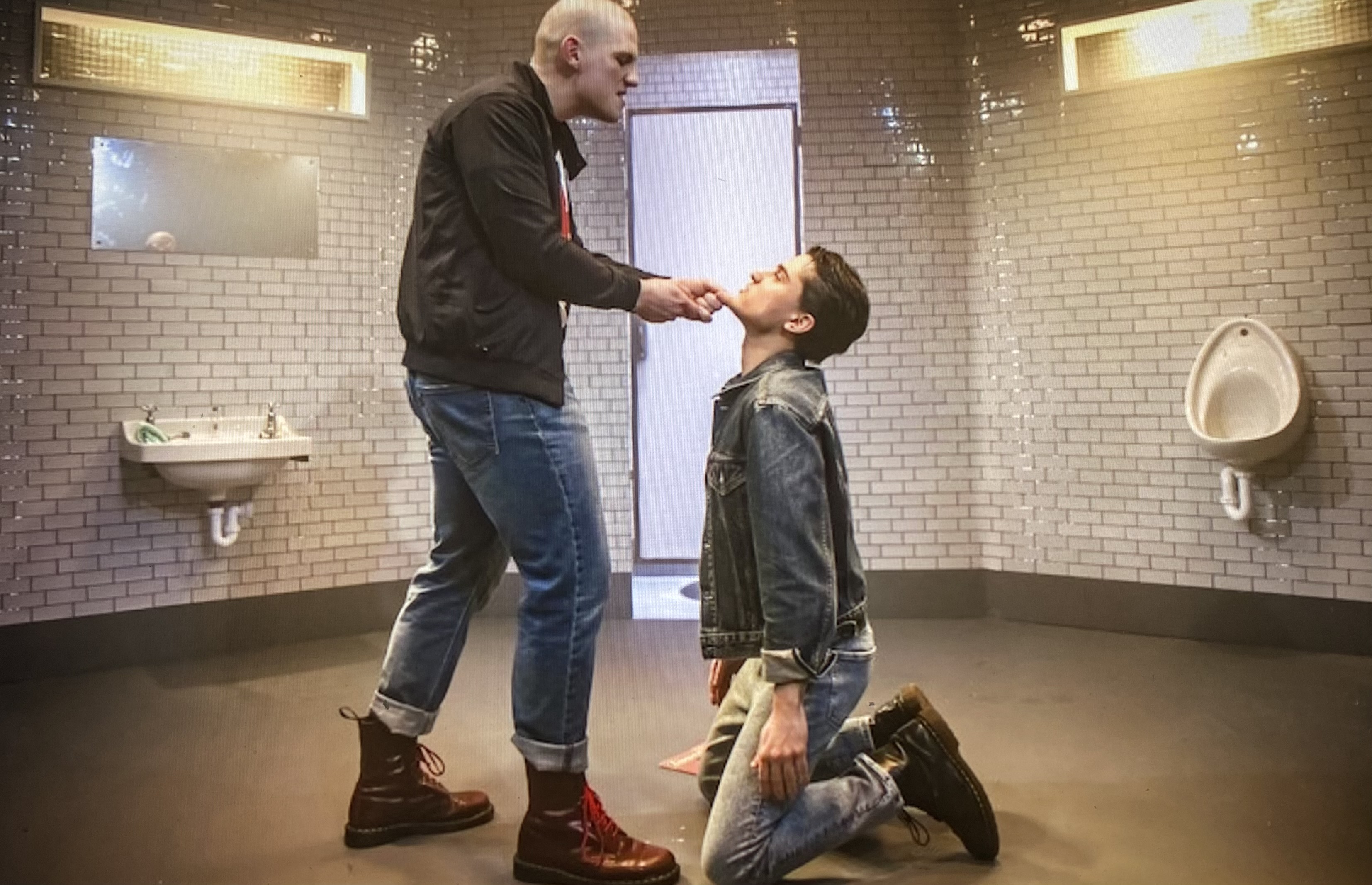
We share the Finborough’s cramped performance space with a urinal, a wash basin and a cubicle that is complete with spy hole. Nitin Parmar’s set design has all the essentials. In 1974, 15-year-old Nicky Crane (Jake Richards) walks in and begins to shave off his hair. He is followed by the vaguely aristocratic Mosley (Matthew Baldwin), dressed all in black, who invites the boy to join his “club” and presents him with a signature pair of boots. This opening scene has a surreal feel, with Mosley as a demonic figure, but the drama reverts quickly to realism.

The play has five scenes, each with confrontation as its main ingredient. Nicky’s journey takes him from night club bouncer to punk rock singer, a prison term and gay porn star. Each scene has a different protagonist, including a gay photographer (Kishore Walker) and a violent defender of black rights (Keanu Adolphus Johnson) as director Matthew Iliffe’s gritty production mounts aggression on aggression.

What McDonald seems most keen to explore are the interactions between the skinhead subculture, fascism and homoeroticism. As Nicky adorns himself with swastika tattoos and chants nationalist slogans, he has numerous sexual encounters with men, while forcefully denouncing the gay world, The connections and the contradictions are laid out clearly by the writer, but maybe they are not adequately explained. Most crucially, McDonald fails to explain Nicky. Does this monster have a heart or a soul? We never know and the omission leaves a gaping hole in the play.

To its credit, Foam does nothing to mask the ugliness of the lifestyle that it depicts, but it is a tough watch, packing into its 90 minutes as much aggression as in a dozen episodes of Eastenders. When it is over, the night air of Chelsea smells sweet.

Performance date: 22 March 2024

Hide and Seek (Park Theatre)

Posted: March 15, 2024 in Theatre

Photo: Mariano Gobbi

Writer: Tobia Rossi

Director and translator: Carlotta Brentan

⭐️⭐️⭐️

Italian playwright Tobia Rossi has found a novel way of exploring the growing pressures placed on teenagers in modern times. His 85-minute two-hander is a dark and sometimes shocking parable for the age of social media,

In Hide and Seek, the hider is Gio (Louis Scarpa), a teenage schoolboy who we assume to be gay, and the seeker is Mirko (Nico Cetrulo), a slightly older boy from the same school in rural Italy. Gio has taken refuge in a remote cave to escape the bullying and torrents of online abuse hurled at someone who happens to be different from their social group. His absence could be construed by the wider world as kidnapping or murder and, when Mirko finds him, he becomes complicit in a growing deceit.

The boys’ conversations centre around Tik Tok, WhatsApp, “hits”, “likes” and so on, They share their admiration of comic book super heroes. When Mirko relays news of the frenzy that Gio’s disappearance is causing in the local community and throughout Italy, Gio shows more delight in his newfound celebrity status than concern about worrying family and friends, thereby highlighting the dehumanising effect of social media.

Rossi’s script requires Gio and Mirko to be both mischievous boys and sexually awakened young men. Occasionally the dialogue jars, feeling not quite right for a situation, but the actors, both excellent, have few problems in bridging the gap between the different sides of each character. The bond between the pair grows and takes on more sinister undertones as Mirko becomes dominant and manipulative and Gio’s ambitions become more irrational. Once more, youngsters who are at ease in the virtual world are seen to struggle when dealing with real emotions.

Having translated to play into English, Carlotta Brentan directs a production that is consistently engrossing and equally disturbing. The entire drams unfolds inside a cave which has no natural light, leaving set designer Constance Comparot to fill the tight studio space with a central representation of a rock and Gio’s essential provisions scattered around. Seemingly more challenging is the job of lighting designer and Alex Forey copes admirably.

In the closing stages, Rossi’s play seems to emulate the plight of the two lads, finding itself in a dark place with no clear escape route. The conclusion which the writer finds is not entirely satisfying, but, at least it gives cause for hard reflection.

Performance date: 15 March 2024