Archive for the ‘Theatre’ Category

damsel

Not content with providing London’s Savoy Theatre with two musicals in straight succession, Chichester could be pitching unashamedly for the hat trick with a show that is set partly in that very theatre. “Things are looking up” chirps Billie Dore (Sally Ann Triplett) performing the closing number of show-within-a-show Kitty in the City on the Savoy stage, before setting off for a weekend in a castle in Gloucestershire, along with the show’s writer George Bevan (Richard Fleeshman). This is a hybrid musical with songs by George and Ira Gershwin transplanted onto a PG Wodehouse story, set in the 1920s, about a couple of Americans enjoying jolly frolics with the English aristocracy. 90 years ago, this sort of thing may have typified musical theatre, but, nowadays, the story looks pretty feeble. The book by Jeremy Sams and Robert Hudson moves towards the very brink of pantomime and then, in a preposterous finale, walks several steps beyond it. This places a heavy burden on the songs and on director/choreographer Rob Ashford’s staging and, thankfully, both prove to be more than up to the challenge. Of course, the presence of names such as Isla blair, Desmond Barrit and Nicholas Farrell in supporting roles gave a pretty strong clue beforehand that the show would be well above the ordinary and they all shine, as do Fleeshman and Summer Strallen as the romantic leads and Richard Dempsey as a goofy toff, whilst Triplett is as much the star of the real show as of the one within it. The Gershwin songs fuse with the book, if not exactly seamlessly, then pretty well. Nice Work If You Can Get ItLove Walked In and A Foggy Day in London Town are probably the best known amongst them, but the real joy comes from hearing and seeing, fully staged, great songs that are much less familiar, all accompanied by Alan Williams’ orchestra, hidden somewhere above the stage. Christopher Cram’s designs give a fairy tale look to a production which bubbles along nicely up to the interval and then comes to life spectacularly from the start of a second half that would, on its own, make a journey to the south coast worthwhile, even from the Outer Hebrides or beyond. It starts with I Can’t Be Bothered Now, a rousing chorus routine led by Triplett. David Roberts and Chloe Hart, as cook and undercook, get the show’s loudest ovation for French Pastry Walk, which incorporates an Argentine Tango good enough to make even Craig Revel Horwood drool and, to round off a blissful half hour or so, the chorus returns to dazzle us with Fidgety Feet, a sparkling tap dance routine. They set the bar high for Anna Jane Casey, who will be showing us how to tap our troubles away on this same stage in just a few weeks’ time. In Chichester, things are definitely looking up.

Performance date: 20 June 2015
TheRedLion_DC_190115.indd

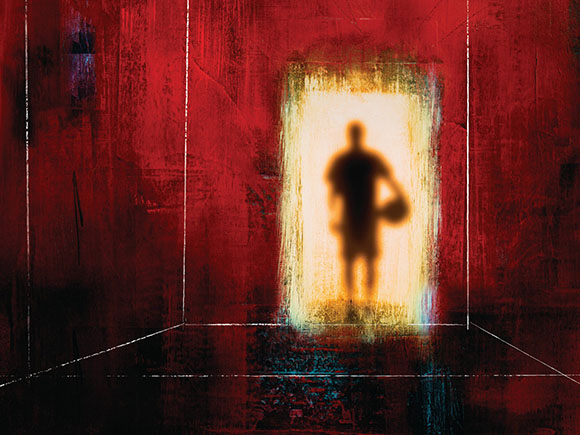
Patrick Marber’s examination of the state of modern football could hardly be more timely. Several rungs down the ladder from corrupt FIFA officials, the clash between the traditional values of the beautiful game and modern day commercialism can be seen at its starkest. Marber’s three-act, three-hander takes place in the home team changing room of a non-league semi-professional club somewhere in the London area, a club that had been formed in 1892 by a group of enthusiastic players in a room above the Red Lion pub. Inspired by love for the game and loyalty to his club is the kit man (Peter Wight), a player and briefly an unsuccessful manager 20 years and more earlier, whose life went on the skids until he got his present job, doing which he regards as “a privilege”. The current manager (Daniel Mays) is a wide boy, broke and with an eye only on taking a bung; when a promising young player (Calvin Demba) joins the club, the manager’s top priority is to get him under contract so that he can get a cut from a huge transfer fee, but he clashes with the kit man who just wants to nurture him to play for his team. The biggest strength of Ian Rickson’s straightforward one-set production is the compelling performances. Wight is overweight, world-weary, playing extra time and almost defeated; Mays suggests a desperate sleaze bag for whom corruption is a way of life; and Demba develops further the cocky youngster persona with which he showed such promise in The Wolf at the Door at the Royal Court recently. All of these characters are, in their own ways, losers and Marber chooses not to show us examples of the game’s winners, of which there are many; the playwright is not quite the British David Mamet, but his dialogue is sharp and realistic. If the play disappoints slightly, it is only because it is a little too low-key, not igniting often enough; also, it leaves a feeling that its scope could have been more expansive and its approach more incisive. Nonetheless, it gives us a good couple of hours of quality drama.

Performance date: 19 June 2015

Chef*** (Soho Theatre)

Posted: June 18, 2015 in Theatre

320x320.fitandcropThis review was originally written for The Public Reviews: http://www.thepublicreviews.com

Food offers up a metaphor for everything in life as viewed by Sabrina Mahfouz in her one- woman play. The chain which sees it move from source to kitchen, its careful preparation and its final consumption are all shown to correspond with twists and turns of fate. The central character, known simply as “Chef” and played here by Jade Anouka, is obsessed with food. She would only accept an invitation to a meal on the condition that she could take her own gravy. We see her firstly in the kitchen of a restaurant, gently mocking chic dining trends and later in a prison preparing meals for her fellow inmates. Her journey is charted in a non-linear narrative and each “chapter” is headed by an appetising dish. For her, food is a constant love in a life filled with hatred and violence, a provider of joy and fulfilment and a route for escaping pain. A gangster boyfriend and a suicidal prison friend feature in Chef’s story, but the overriding presence in her life is that of her bullying, abusive father, absent as a salmon farmer for much of the time, but returning when he is sick and needy. Chef speaks of him with revulsion – “even the fish thought he was a ****, didn’t want to be around him…” – but it is he who provides her with the moral dilemma that would change the course of her life. Mahfouz’s writing is vividly descriptive, sometimes brutal, yet seasoned with humour and irony. The story simmers nicely before coming to the boil in the later stages once the play’s central theme has been revealed. At this point, the playwright tackles difficult issues with considerable sensitivity and insight. Dressed in all white with a chequered headband. Anouka’s animated, often excitable Chef always has the audience rooting for her and makes her passion for food clear for all to see. Anouka looks slightly uncomfortable when affecting street slang in the light opening section, but her performance becomes heartfelt when the scale of the ill fortune and injustice inflicted on her character becomes apparent. The ingredients here are well-mixed and Chef emerges as a 50-minute course of theatre that is tasty and satisfying.

Performance date: 17 June 2015

Photo: Richard Davenport

thepublicreview_hor_web copy

FullSizeRender-71How thoughtful – a show that awards some of its own stars. 2015 Pulitzer Prize winner Stephen Adly Guirgis’ play shows us the messed-up lives of a group of New Yorkers and includes enough raucous comedy to make the recently seen Bad Jews seem placid plus enough ripe language to make The Book of Mormon seem like a vicar’s tea party. Jackie (Ricardo Chavira) is on parole and in rehab, returning to live with his girlfriend since childhood, volatile and crack-addicted Veronica (Flor De Liz Perez). Their relationship begins to fall apart when Jackie discovers that the gentleman of the play’s title has left his headgear and several telling odours in their apartment. Jackie’s rehab sponsor is the self-absorbed and duplicitous Ralph (Alec Newman), who lives comfortably with his neurotic wife Victoria (Nathalie Armin). The entanglements of this four suggest a polarised city where an uneducated, drug/alcohol dependent underclass contrasts with pseudo intellectuals who consume health foods, practice yoga and learn to speak French. We are asked to compare the differences and to recognise the similarities. A series of clashes spark rich comedy, spurred by razor-sharp dialogue and top-notch performances. The icing on the cake is provided by Yul Vazquez as Julio, Jackie’s gay cousin, his droll, mannered delivery being never less than hilarious. Whether there is very much substance behind the laughs is questionable and the play as a whole feels as if it comes to less than the sum total of its many excellent parts. Director Indhu Rubasingham’s production flags only occasionally, when relentless belligerence become monotonous, but a climactic fight scene must rank as one of the least convincing in recent memory. Robert Jones’ sets consist of three nicely detailed apartments, with sections sliding in from all directions at changes and fire escape ladders hovering in mid-air throughout. Maybe this is all too much and, with only around half the width of the Lyttelton stage being used at any one time, it is possible that this is a play that could have been seen to better effect in the smaller Dorfman, with minimal sets. The staging feels not quite right, but then this play that dares not speak its full name may always have been just too American, too New York to ever settle comfortably in this theatre or indeed in this city.

Performance date: 16 June 2015

One Arm**** (Southwark Playhouse)

Posted: June 14, 2015 in Theatre

One-Arm2-e1427377532379-170x130

The discovery of an unperformed script by Tennessee Williams is the theatrical equivalent to finding a Van Gogh in the attic and, for that reason alone, this production is richly intriguing. One Arm, which tells of Ollie, a young Boxing champion who loses a limb in a car accident and then descends into a life of degradation, first appeared as a short story in 1948 when, as it dealt explicitly with prostitution, homosexuality and pornography, dramatisation for stage or screen would have been unthinkable. However, 20 years later, Midnight Cowboy had won the Best Picture Oscar and Williams attempted, sadly in vain, to get his screenplay made into a film. Being a narrative driven piece, Williams probably saw it as more suitable for cinema than theatre and it is a brave move by Moises Kaufman to bring it to the stage. In opening his play with a clear statement that what is to follow was intended to be a film, Kaufman is perhaps acknowledging its unsuitability for theatre, but he does a good job in overcoming the difficulties and director Josh Seymour gives the play a thoroughly modern production – studio space, thrust stage and minimal furnishings with full-length mirrors the only permanent feature. All the Williams trademark images of beauty, brutality and eroticism are in the mix, but here he deals openly with themes that could only be alluded to in his major works, leaving us to wonder what he might have written had he lived in another era. The story is told in flashback with Ollie in a cell on Death Row, recalling how he got there and making the discovery that he meant more as a human being to the “tricks” that he encountered than any of them ever meant to him or he ever meant to himself. Williams’ vision of the values of self respect and respect for humanity is at the play’s heart and Ollie’s belated attempts at reparation become profoundly moving. The biggest flaw is Williams’ failure to make Ollie more sympathetic and thereby explain why he is held in high regard, but the young actor Tom Varey makes valiant efforts to conquer these shortcomings, giving a commanding performance. Peter Hannah, Joe Jameson, Georgia Kerr and James Tucker are also excellent, sharing all the other roles. The initial attraction to this production is its curiosity value, but One Arm is engrossing and haunting and what emerges is a significant work in its own right.

Performance date: 13 June 2015

IMG_5650smallThis review was originally written for The Public Reviews: http://www.thepublicreviews.com

Cab drivers sometimes appear to us as if they are glued inside their vehicles, but this revival of Simon Block’s 1995 one-act comedy serves to remind us that they also have social lives. The play takes place in a Table Tennis club, where a drivers’ team is playing a key relegation match and the King’s Head’s thrust staging means that we get a chance to see the cabbies’ faces as well as the backs of their heads. Team captain Eric (Bobby Davro) and Oscar (Alan Drake) are in their 50s and have been swinging their bats for the club for 30 years. Eric regards relegation as unthinkable, but Oscar realises that the game is now for, if not exactly boys, younger men (and indeed women). Tony (Oliver Joel) is 29 and the team’s star player, but he is so beset with personal problems that his contribution to the vital match becomes doubtful. The sense that an era may be coming to an end had been spurred by the sudden mid- match death a week earlier of “Fat Derek”, a teammate. “The breeze as he went down rustled my Evening Standard” recalls Oscar, who now sees a future of Bridge and Bowls. He is a single man and his acute awareness of the advantages and disadvantages of independence comes through strikingly in Drake’s performance. His policy is never to get involved in the problems of the others just because “it’s policy”, but he always manages to do so anyway. Eric fusses around like a mother hen, using the club to grab time for himself, away from his cab and a family that includes a mother with dementia. Tony is torn between settling down with his girlfriend and sowing more wild oats, dalliances with a lady in the back of his cab in the Aldwych (not in broad daylight surely!) making his choice more difficult. Fine performances bring out the comedy and the pathos in these characters. The three actors play well off each other and get the banter of working class Londoners precisely right in Jason Lawson’s fast paced production. Much of Block’s dialogue is very funny, but it is underpinned with essential truths about the need to escape from the pressures of everyday life, if only to be faced with more pressure. Not A Game For Boys is 75 minutes of lightweight fare, but, in this skilful production, it is always entertaining and occasionally moving.

Performance date: 12 June 2015

thepublicreview_hor_web copy

HERE-BE-LIONS-WEB-BANNERSMALLThis review was originally written for The Public Reviews: http://www.thepublicreviews.com

It is difficult for most of us to imagine what it must be like to live with severe neurological difficulties, disconnected from the rest of the World. Dancer Sandrine Buring created d(ARE) to express her interpretation of the feelings of patients in a French children’s hospital where she worked alongside theatre maker Stephane Olry, who responded with a text which is presented here as a piece of immersive theatre. d(ARE) is performed by Burring in the Print Room’s studio space. She enters to dance playfully with a large, suspended bell jar which is swinging like a pendulum. When she enters the jar, two spotlights pick out her pale, semi-naked body as she writhes, claws at the glass, peers out and then sleeps. She becomes a stark and unsettling embodiment of isolation and despair. There is no sound accompaniment to the 25 minute dance, save for pitiable noises coming from within the jar. For the performance of Here Be Lions, the audience is ushered into the theatre’s main space, being used for the first time since the Print Room moved into what was the Coronet Cinema. We are asked to sit on deck chairs, laid out in a circle, amidst a thick theatre fog, which persists for the entire performance. This is something like sitting on an English beach in the middle of Winter and, although blankets are provided, it is extremely cold. The intent is to replicate the insular existence of patients at the hospital, but, once initial curiosity has passed, what should be an experience that is emotionally disturbing becomes no more than uncomfortable in a physical sense. There is one change in lighting, but, otherwise, we are asked to spend more than an hour staring at almost nothing. Olry’s writing, as translated by Neil Bartlett, is beautifully literate, but it is merely descriptive, telling no continuous story and developing no distinct characters. Repetition of points, also makes the piece longer than it needs to be. Hayley Carmichael, unseen throughout, interprets the text superbly and Phil Minton provides startling sound effects, but, nonetheless, interest wanes several times during the performance. It is questionable whether the fog yields much that could not have been achieved by dimmed lighting, in which case, maybe the effectiveness of both components of this production could have been heightened by combining them together in the same space without a break. As it is, a worthy project which has many strong qualities, suffers from a shortage of dramatic impact.

Performance date: 10 June 2015

thepublicreview_hor_web copy

Teddy*** (Southwark Playhouse)

Posted: June 9, 2015 in Theatre

teddy

It’s rockin’ and rollin’ down at the Elephant and Castle with this trip back to the days of Teds and Judys, Brylcreem and Brillo, times when Camp was just a brand of coffee. Tristan Bernays’ lively piece, more a long poem than a play, takes place in 1950’s London, still blighted by bomb sites and post-War austerity, but with a new dance and a new style of music drifting across the Atlantic, bringing with it a glimmer of light for youngsters longing to escape to a better life. Teddy and Josie are two such youngsters and they narrate the story of their chaotic night on the town directly to the audience, only occasionally interacting with each other. The star attraction for them is the American singer Johnny Valentine (Will Payne), who is appearing at a local club with his band. Bernays captures the feeling from films of the era like Jailhouse Rock that Rock’n’Roll was somehow a forbidden fruit and that teenagers tempted by it could get into serious trouble. It was as if the establishment was using forms of entertainment to warn rebellious youth to conform or else and, sure enough, our couple drift into crime as the evening starts to go wrong and what begins as an ebullient celebration of a bygone era becomes progressively more downbeat. Joseph Prowen and Jennifer Kirby are absolutely terrific in the lead roles, both cocky Cockneys, jiving their way around a derelict church, the “flicks” and finally the music club. They both master the rhymes and metre of Bernays’ intricate verse superbly. Their tentative steps into the world outside their drab and oppressive homes are a joy to behold – a scene in which they have to stop jiving and dance to a slow number is particularly hilarious. Eleanor Rhode’s direction, with choreography by Tom Jackson Greaves, keeps the piece moving at a bouncy pace, but Bernays’ use of narration, rather than having scenes played out fully, results in several points where the production flags just a little. Dougal Irvine’s original songs are a pastiche of Rock’n’Roll, a musical form which may not have worn particularly well, with even Elvis himself now being better remembered for middle-of-the-road material. Teddy is an interesting and unusual work of theatre, most notable for Prowen and Kirby both of whom must be going places.

Performance date: 8 June 2013

Oresteia***** (Almeida Theatre)

Posted: June 5, 2015 in Theatre

IMG_0228

Beginning the Almeida’s Greek Season in just about as ambitious a way as possible, Robert Icke has created a new version, directed by himself, of Aeschylus’ trilogy from c.458BC. Many Greek tragedies are notable for their brevity and intensity. This runs for a bum-numbing 3 hours 40 minutes, but the intensity is there in spades and “new version” means much more than just a new translation – it is modern in language, characters and relevance. Time is one of the most significant themes and digital clocks can be seen on stage, in the auditorium and even the foyer; they stop to highlight the precise time during the performance when each key incident occurs and they even count down the two interval breaks to get us back to our seats promptly for the resumption. We are reminded repeatedly that the time which each of us spends in the universe over the  entire course of its existence is miniscule. At the beginning and the end, the Chorus reads out a roll call of Gods of all main religions from ancient Greece to the present, as if pointing a finger of guilt at them for all the carnage brought about in the name of religion throughout the ages, up to and including the year 2015. The overriding theme is the link from the Gods to family, going through the military. Agamemnon (Angus Wright) receives a sign from the Gods to commit an act which will lead to victory in a war, but will have devastating consequences for his wife Klytemnestra (Lia Williams) and their family. The trilogy follows their son Orestes (Luke Thompson) through from a happy family childhood to the realisation of his own fate. The Almeida stage is widened to its full expanse and left bare, save for a few furnishings, and clouded screens at the back conceal a bathroom in which key events take place as if in distant nightmares. Such is the power of the raw drama in the first three hours that they feel like one, scenes gripping with the ferocity of the eagle’s talons, referred to in a repeated metaphor. Williams is magnificent, reacting like a wounded tigress to her husband’s foul deeds. Wright and Thompson are also superb, as is Jessica Brown Findlay (an impressive stage debut for the former Downton star), making a relatively brief appearance as Elektra. It is only in the final section that the production loosens its grip as it centres on an overlong trial sequence and its key themes become lost. Now the play questions how it can ever be possible to discern between truth and fantasy when the perceptions of two or more people can be so contradictory; unintentionally, the play actually demonstrates its own point by relating the same events as Sophocles’ play Elektra, but with major differences. When the question of gender inequalities is thrown in late on, the point being made is an important one, but it feels like too much of a diversion from the main track. Nonetheless, this brave production is a substantial achievement and it augurs well for what is to come in the Almeida’s Season.

Performance date: 4 June 2015

Bradley-Cooper-John-Merrick-Alessandro-Nivola-Frederick-Treves-Patricia-Clarkson-Mrs-Kendal.-Photo-credit-Joan-Marcus-1024x683

Obvious comparisons can be drawn between the fascination which Victorians had for freak shows and the modern day obsession with Hollywood movie stars. In the 1880s, John Merrick, the title character of Bernard Pomerance’s play, drew the masses to grubby funfair tents to stare disbelievingly at his grotesque deformities and then he moved upwards to become the darling of high society, whose members were equally intrigued, but in a slightly more refined way. Hollywood has turned out few bigger names in the last decade than Bradley Cooper, star of many critically acclaimed and commercially successful films. Huge crowds might gather in Leicester Square to gawp at his appearance for a premiere, but now he can be seen in a more civilised (and probably drier) setting just around the corner by anyone prepared to cough up for a ticket at West End prices and pay £10 for a programme (justify that please!). Defying the suggestion that movie stars are superhuman, Mr Cooper shows that he is in fact made of just flesh, blood and bone and he is actually not at all bad, or rather he is as good as Pomerance’s somewhat creaky play allows him to be. In David Lynch’s 1980 film of this story, John Hurt had to give his performance whilst buried in tons of prosthetics, but, in Pomerance’s stage version, we see Merrick as the human being behind the disfiguration, Cooper distorting his face and body and straining to speak in an affected English upper class accent. He gives Merrick dignity, but Pomerance does not overcome the character’s problem with articulation, not finding a way to express his inner thoughts to the audience. As a result, the surgeon, Frederick Treves becomes the play’s more interesting character, a scientist in the post-Darwin era, struggling to find a moral code to equate with his beliefs. Alessandro Nivola gives a compelling performance as Treves, but this production’s star turn comes from the wonderful Patricia Clarkson as the actress Mrs Kendall who befriends Merrick. This character is the polar opposite of Treves in her certainty that moral conventions are there to be defied and Clarkson, giving her both the classiness of a society lady and the sauciness of a mischievous tart, lights up the stage with her every appearance. London theatre needs to see her again, often. Director Scott Ellis’s production, transferred more or less intact from its Broadway run, is conventional and efficient, the simple set designs by Timothy R Mackabee ensuring that the focus stays where it needs to be – on the actors. However, the play itself still falls well short of classic status.

Performance date: 4 June 2015