Archive for the ‘Theatre’ Category

Obama-ology**** (Finborough Theatre)

Posted: December 2, 2014 in Theatre

obamaology-mainThis review was originally written for The Public Reviews: http://www.thepublicreviews.com

Looked at from the perspective of late 2014, the old adage that all political careers end in failure seems destined to find living proof in the shape of Barrack Obama. Aurin Squire’s biting critique of the state of modern democracy views the seeds of failure as having already been sown in November 2008, as he shows us an Obama campaign consumed by cynicism, compromise and personal ambition. Even so, the play also questions whether, taking a much longer view, failure will in fact be the final verdict of history. Squire looks at events through the eyes of Warren, a college graduate from New York and a newcomer to the campaign team. Being young, educated, black and gay, he seems to tick all the boxes to succeed on the liberal wing of American politics, except that he lacks the ability to connect with the disadvantaged electorate in the deprived area of East Cleveland to which he is assigned. At first, he cannot see beyond his narrow aim to be “part of history”, but the campaign takes him on a journey which leads him to want to make a difference to people’s lives in ways that charismatic politicians cannot directly bring about. As Warren, Edward Dede takes centre stage for much of the play and holds this production together. Ranging from a comic figure of wide-eyed innocence to a passionate advocate for self-improvement, he gives a commanding performance. No less impressive is Pearl Mackie as Cece, an illiterate mother of two whose ambitions do not extend beyond a job in a burger joint. The bond which develops between Warren and Cece forms the emotional core of the play. Mackie shows her versatility by also playing Caits, a feisty street kid and a campaign “instructor”. Peter Caulfield, Katherine Newman and Amanda Wright are all excellent, primarily playing senior members of the campaign team and sharing all the other roles. Campaign posters and urban graffiti around all sides of the stage create a feeling of chaotic energy and Tommo Fowler matches this by giving us a fast flowing production in which comedy, suspense and high emotion are delivered with equal confidence. In all respects, this production is in tune with Squire’s smart and incisive dialogue. On election day, as naive idealists utter platitudes such as “this is post-racial America”, the realists in the campaign team are already busy lining up jobs for themselves in the new administration. Squire’s play understands that momentous changes cannot be brought about on one day nor can they be achieved by one politician, but it also tells us that, If that politician can inspire hope within downtrodden individuals, he will not have failed.

Performance date: 1 December 2014

thepublicreview_hor_web copy

Christmas**** (White Bear Theatre)

Posted: November 29, 2014 in Theatre

Christmas_Poster_PressSmallThis review was originally written for The Public Reviews: http://www.thepublicreviews.com

A natural symmetry occurs when a pub theatre puts on a show about a pub. Simon Stephens’ 10-year old play was first performed above the bar of the old Bush and this revival appears at the back of the White Bear, which would now mirror the front bar were it not that, in the theatre area, it is 2004 and antiquated objects known as cigarettes can be found. If you buy tickets for this production, you need to be prepared for a lot of passive smoking. The actors may speak a little louder, but we always get the sense that the characters and the conversations in the adjacent rooms are a broadly accurate reflection of each other. This early work by Stephens, who has progressed to become one of our foremost playwrights, is rich with sharp insight and natural dialogue, embellished with abundant ripe language. The conversations in the fictional bar may begin as banal and humorous, but Stephens skilfully peels away the outer layers of each of his characters to reveal the poignant truth. The shabby East End bar is decorated with makeshift Christmas lights, an advent calendar and a photograph of Frank Sinatra hang on the wall. Michael, its owner, knows that any boost to takings that the Festive Season may bring will not be enough to clear his mounting debts. He is alienated from his son, facing an uncertain and lonely future and William Ely, looking world weary and near to defeat, captures perfectly his frustration and barely suppressed anger. Billy arrives at the bar to escape his pot-smoking mother and drown thoughts of his beloved West Ham United, who have just suffered another defeat. He is slow-witted and volatile, but aware enough of his own problems and limitations, drawing back from the confrontations that his outward aggression inevitably bring. Ralph Aiken inhabiting the character with fierce intensity, makes Billy a dominant presence throughout the play. Lionel Guyett, slight and looking frail, is Zeppo, an elderly Italian widower who still works as a hairdresser. Drinking may contravene doctors’ advice, but he still orders glasses of Drambuie, only to line them up neatly on a table. He has a strong sense of belonging to a place and of tradition, so, as close as possible, he is continuing his rituals. Like many others, he goes regularly to the same bar, takes part in much the same conversations and observes a religious festival that no longer has any real meaning. Charlie (James Groom) is an interloper who is looked upon with suspicion. A northerner who has given up a career as a musician to become a postman, he carries a cello case which may or may not contain a cello. He provokes confrontations which appear almost like initiation tests, necessary before he can gain acceptance. All of these characters have problems which they may not be able to resolve, but at least the oasis of Christmas is in view and they can put them on hold until it is past. Michael Kingsbury’s carefully measured production is brought to vivid life by this quartet of outstanding performances. Stephens seems to sense that he is writing about a dying world in which many pubs like the one in his play are disappearing. However, others are surviving by branching out into theatre, the response to which has to be “drinks all round”.

Performance date: 28 November 2014

thepublicreview_hor_web copy

Silent Planet***+ (Finborough Theatre)

Posted: November 29, 2014 in Theatre

silent-planet-mainThis review was originally written for The Public Reviews: http://www.thepublicreviews.com

In the days of the totalitarian Communist regime in the Soviet Union, freedom of expression through literature was stamped out, with works being banned and writers such as Alexandr Solzhenitsyn being imprisoned. Eve Leigh sets her play in 1978 when a dissident writer, known simply as Gavriil, is being held in a psychiatric hospital and subjected to treatment (rather interrogation) by a doctor, Yurchak. The story is fictional, but inspired by real incidents. Because they are regarded as already corrupted, patients at this hospital have access to “deviant” books in their library, but doctors, who are still functioning members of society, are denied such access. When Gavriil begins to tell Yurchak stories from the banned books, his doctor’s interest is aroused and their sessions together turn into discussions of novels, poetry and plays. Tom Mansfield achieves an edgy, claustrophobic feel by staging his production on a small elevated platform, furnished with just two chairs and a table. The play, a two-hander until near the end, explores the power of literature to overcome tyranny. It sees written words as beacons that can illuminate even the darkest hours of oppression, give meaning to existence and lift the human spirit. Gavriil is Ukrainian, not from the same country of the USSR as Yurchak and Leigh specifies that he should speak with a strong accent so as to emphasise this. Accordingly, Graeme McKnight’s Gavriil is Scottish, a rebellious street fighter who could have come from an old style Glasgow tenement block. He readily challenges his interrogator’s uncertain grip on authority and, in Matthew Thomas’s performance, we see both Yurchak’s discomfort in his role and his excited curiosity on tasting the forbidden fruits of the patients’ library. Much of the play’s dramatic tension arises from the ambivalence of the relationship between the two protagonists, leaving us unsure as to which of them really has the upper hand at different points and whether their intellectual discourse has sexual undertones. Silent Planet is a relentlessly bleak play and, even at only 70 minutes long, it is sometimes hard going. However, intelligent writing and two outstanding performances ultimately carry it through.

Performance date: 27 November 2014

thepublicreview_hor_web copy

Accolade**** (St James Theatre)

Posted: November 29, 2014 in Theatre

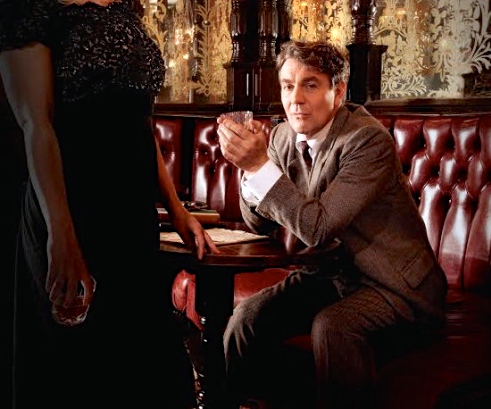
accoladeAt first sight, this production of Emlyn Williams’ rarely performed play from 1950 evokes the feeling of having entered a time warp. Tacky, painted scenery and stilted over-acting suggest a rebirth of weekly rep, a form of theatre which died out more than half a century ago. It takes time to adjust and come to realise that everything in Blanche McIntyre’s production is intended – it is important to be able to place this play in its exact time in order to fully understand its significance and to appreciate how relevant it is to the present day. It is true that the production’s dated style sometimes results in giggles in the wrong places, but, more often, it leads to scenes that are deeply moving. Will Trenting is a newly-knighted novelist, already a Nobel Laureate, known for his risqué works, but it is not publicly known that his writing draws from his own experiences in mingling with people a class or two below him and indulging in what, in 1950, would have been morally unacceptable practices. He offers no excuse that he is researching, rather he insists that his twilight jaunts spring from his personal inclinations which came first, the writing having followed. The point is that, in common with many great writers, he has broken out of the straightjacket of what society considers to be proper, and thereby fuelled his ability to create great works. It is a Jekyll and Hyde existence, but none of it is secret from his wife Rona who condones and supports him in everything. As Will, Alexander Hanson achieves the perfect combination of boyish naiveté and adult sophistication, whilst Abigail Cruttenden makes Rona entirely sympathetic and the rock of a surprisingly solid marriage. Performances are strong in all the the supporting roles, with Bruce Alexander being particularly striking as an embittered blackmailer. Williams is promoting a message very similar to that given by Noel Coward in the earlier Design for Living, which is that society has no right to impose moral codes and that it is no-one’s business how other adults lead their lives, so long as they cause no harm to others; unfortunately, Will inadvertently crosses a line, which is where relevance to celebrity scandals in 2014 arises. However, Rona (and indeed Williams) continue to support him. Elements of this would still shock many today, but, as the programme notes, it is astonishing that such a daring play got past the Lord Chamberlain in 1950. Perhaps he simply did not understand it.

Performance date: 27 November 2014

sara_pascoe_red_dress

Having avoided stand-up comedy at this year’s Edinburgh Fringe Festival, it seemed like a good idea to get a taste of what I’d missed. And a good idea it proved to be. There is nothing fancy about this 1-hour routine – Sara (without the “h”) Pascoe just stands centre stage and chats. This is not the caustic in-your-face female comedy associated with the late Joan Rivers nor does it have the political agenda of the strident feminists. Pascoe does little more than make wry observations about the absurdities of modern life, but her presentation is relaxed and seamless. Most importantly, she is very funny., making this an hour well spent.

Performance date: 26 November 20

Wildefire*** (Hampstead Theatre)

Posted: November 26, 2014 in Theatre

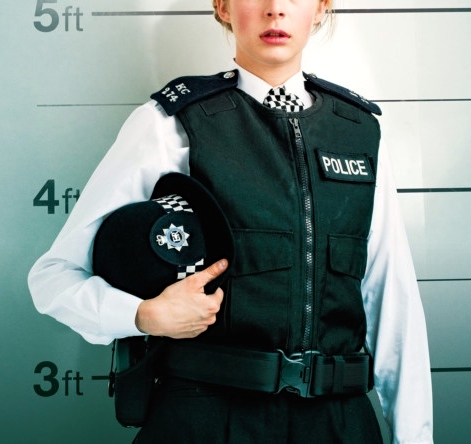
wildefireBoth houses at Hampstead are currently occupied by dramas about the Metropolitan Police. Downstairs, State Red examines the repercussions of institutionalised racism, but Roy Williams’ play shows us a multi-race force that treats women officers on an equal basis with men and, in so doing, he  wisely jettisons the themes of both racism and sexism so that he can focus singularly on the challenges of policing a modern urban community and the corrosive effects upon those charged with carrying out these duties. The play begins with a recitation of the Met’s original charter, making it immediately obvious how far things have moved from what now seems a very naive starting point. WPC Gail Wilde (Lorraine Stanley giving a real powerhouse performance) transfers from Horsham to a deprived London borough, believing that traditional policing methods will be the key to her making a difference in dealing with the area’s problems, chiefly gang crime and domestic violence. The play then charts her journey from wide-eyed optimism to drugged-up disillusionment and despair. This is strong stuff, served well by Williams’ unflinchingly realistic dialogue. However, problems arise when the writing and Maria Aberg’s production fail to match up. Essentially, this is an intimate work, charting one woman’s transformation, but Aberg chooses to enact it on an epic scale. Naomi Dawson’s set of elevated platforms and scaffolding does not seem to represent very much, whilst a couple of scenes with rampaging yobs are not enough to justify this theatre’s cavernous space being left wide open, thus detracting from the real drama and also playing havoc with the acoustics. Solid supporting performances help to drive what remains an interesting and important play, notwithstanding the flaws in the production.

Performance date: 26 November 2014

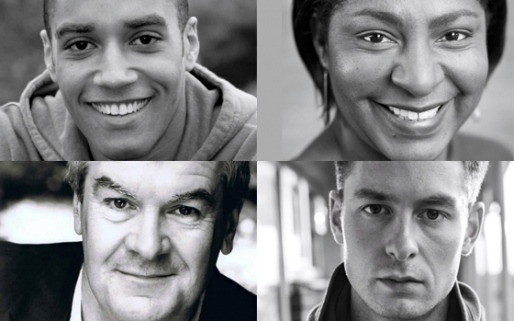
state redWith the London riots of 2011 still fresh in the mind and more recent events in St Louis and Cleveland hitting our headlines, Atiha Sen Gupta’s new play could hardly be more topical in asking the question why the victims of police shootings always seem to be black. Gupta sets her play when Luke (Samuel Anderson) is stricken with guilt having shot a black teenager a year earlier when attending a crime scene with his fellow officer Matthew (Toby Wharton). Luke is the son of the inter-racial marriage of Richard (Geoff Leesley), a pillar of the police establishment, and Joyce (Maxine Finch). This is an issues driven play in which the characters, who are little more than mouthpieces for the writer’s arguments and counter arguments, never really connect in an emotional sense either with each other or with the audience. Gupta goes out of her way (perhaps too far) to demonstrate that the lines between right and wrong are blurred; the mixed race officer who pulled the trigger is from a privileged middle class background, whilst his white colleague grew up in poverty in Tottenham; the senior police officer whose career could be ended if the truth about institutional racism is exposed, could in fact drive for reform if allowed to continue in his job. Yes, it is all just a little bit too contrived and some of Gupta’s arguments lose clarity and potency for that reason, but the four actors perform it with conviction under the taut direction of Douglas Rintoul and it adds up to a gripping 70 minutes.

Performance date: 24 November 2014

Here_Lies_Love_poster_notitleHaving the audacity to turn the hallowed ground that was the Cottesloe into a 1970s-style discotheque, the National has launched its re-named smallest theatre with a spectacular sung-through take on Philippine politics. Well, Argentina has already been covered, so why not? The only major difference between Evita and Imelda Marcos, this show’s subject, is that the former had the good fortune to die young and remain worshipped by her people, whilst the latter lived on in exile, widely loathed. Beginning life as a poor country girl, we see Imelda win a beauty contest and marry Ferdinand Marcos, a rising star of politics who wins the Philippine Presidency on a platform of reform. Accepting her husband’s infidelity, she becomes feted by World leaders and royalty and, when he becomes ill, she effectively takes over control of the country. The show depicts her as becoming a pill-popping, glamour-seeking fashion icon, but, surprisingly, overlooks her fondness for hoarding shoes. As Imelda, Natalie Mendoza handles all the transitions impressively, leading a high energy all singing, all dancing company of 22. The music and lyrics by David Byrne and Fatboy Slim, all in the disco style and mostly up-tempo, fit the occasion well and drive the story, but only the title song lingers in the head afterwards and that could be because it is reprised at the end. If performed in a conventional theatre, this might not be much of a show at all, but it is elevated by a brilliant, technically elaborate and highly original production. Some of the audience is seated on balconies, but most of us are standing on the dance floor, which has a stage at both ends and moveable stages between them. We are ushered around, encouraged to clap and dance (a little), mingling with the performers, shaking the hands of election candidates and forming part of the crowd that forces the peaceful 1986 revolution. Colourful and vibrant, this is a great fun evening.

Performance date: 4 November 2014

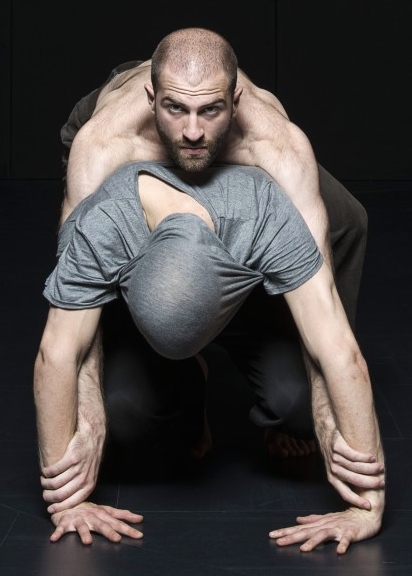
johnConceived and directed by Lloyd Newson for his DV8 Physical Theatre Company, this fusion of spoken word and modern dance creates a truly extraordinary experience. The words are taken verbatim from interviews with real life characters and the dance interprets individual  emotions and the connections between two or more characters. Sometimes smooth flowing, sometimes jerky and edgy, the movement that we see on stage merges seamlessly with the stories that we are being told. Much credit for making this work so effectively must go to Anna Fleischle’s wonderful, adaptable set, which revolves (sometimes constantly) to reveal expansive areas, small rooms, narrow corridors and darkened corners, the flow of the set often heightening the dramatic impact of the movement by the performers. The show runs for 75 minutes without an interval, but it has two very distinct sections: the first is based on interviews with John (performed by Andi Xhuma), telling of his life as part of the social underclass from childhood to early middle age – a life of social housing, state benefits, drug and alcohol abuse, crime, imprisonment, countless women, irresponsible parenthood and many bereavements, but also of success in the form of a University degree gained with honours. For the second section, the primary interviewees are the two owners of a gay sauna who tell, sometimes with considerable humour, of the day-to-day running of their business and of their clients, who include John. Both of the sections work equally well, but they are completely different in tone and content, making it feel for a time that they do not gel with each other; however, when they eventually come together, the emotional impact is shattering. This show is vivid, raw, brutal, life-affirming and totally unique,

Performance date: 3 November 2014

Girlfriends*** (Union Theatre)

Posted: November 1, 2014 in Theatre

girlfriendsThis review was originally written for The Public Reviews: http://www.thepublicreviews.com

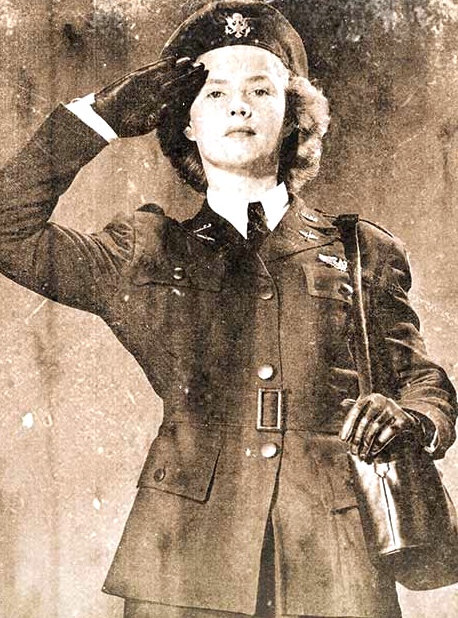
Howard Goodall’s musical first hit the West End in October 1987 with an opening night that coincided with the great hurricane, but it has not kicked up much of a storm since. However, this is the second London revival at a fringe venue in just over three years, perhaps indicating that it is much more suited to small productions than to the big stage. Set in Britain during the early stages of World War II, the show centres on a group of young women from all social backgrounds and all regions of the country who join up to the WAAFs to play their part in the war effort only to find themselves folding parachutes, making tea for their male counterparts in the RAF and waiting anxiously for planes to return safely from their missions. Much of this follows a familiar path, to be exact Terence Rattigan’s Fare Path of which it sometimes feels a pale imitation, but the writers spice things up with a love triangle involving two best friends (Corrine Priest and Perry Lambert, both giving endearing performances) and a bomber pilot (Tom Sterling). Surprisingly in view of the involvement of Richard Curtis with the original book from which Goodall’s current version has evolved, there is very little humour either in the script or the lyrics and it is not for lack of opportunities. When two male officers sing No! in reference to a WAAF’s refusal to to surrender her virtue, we wonder what Sondheim might have made of it, yet the song raises not so much as a smile here. However, there is sincerity in abundance and only very occasionally do the book and Goodall’s lyrics sound trite as they delve into the futility of war and its cost. Catriana Sandison gives a particularly strong dramatic performance as a grieving woman who is veering towards pacifism and desertion. The score is full of simply structured melodies that are instantly catchy, but lacking in variety and unlikely to prove memorable. Sterling’s powerful voice stands out amongst solo singing performances that are somewhat patchy. However, Goodall’s music is suited perfectly to female chorus numbers, of which there are several, including rousing finales to both acts. It is worth the price of a ticket just to hear the harmonies created by the ten ladies in this company. Bronagh Lagan’s production takes place on a blackened stage and is seen frequently either in half light or in the dark with spotlights on individual performers. This robs the show of any sense of time or place and also casts a gloom which makes it more difficult to seek out humour. Choreography by Iona Holland, although limited, works well and the five piece band, under the direction of Freddie Tapner provides an ideal accompaniment for the singers. With musicals flourishing in fringe theatre, Girlfriends is the sort of small scale show that could be up for more regular revivals and, indeed, it provides a very pleasant way of spending a couple of hours or so. In this production, it is the lovely sound of the female chorus that keeps ringing in the ears long after the final bows have been taken.

Performance date: 31 October 2014

thepublicreview_hor_web copy