Archive for the ‘Theatre’ Category

THIS-IS-HOW-WE-DIEChristopher Brett Bailey, the American writer/performer, delvers a relentless assault on the ears, some of which penetrates through to the brain. Pale and gaunt with his hair standing erect, he sits at a desk behind a large microphone and reads from sheets of paper, beginning at a manic speed, barely pausing for breath and slowing up only slightly as the show progresses. The style of presentation has the effect of creating a barrier between Brett Bailey and his audience, thereby forcing concentration on the words being spoken; when occasionally, he pauses and makes eye contact with members of the audience, it is with an icy, threatening stare  – appropriate as a lot of his material is very cold indeed The script mixes neo-existantialist philosophy with stories that show influences as diverse as Jack Kerouac and the Addams Family. Brett Bailey’s writing is at its best when filled with very dark, surreal humour, such as in an account of a visit to his girlfriend’s parents, but at its worst when simply offering a quirky view of the meaning of existence. The evening is rounded off with a rock band making a cacophonous noise whilst four spotlights glare and dim on an otherwise dark and bare stage. In all, this is an unorthodox mixture of forms and ideas which, in a weird sort of way, works.

Performance date: 30 October 2014

Free Fall*** (Pleasance Theatre)

Posted: October 28, 2014 in Theatre

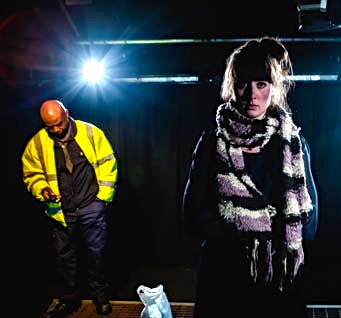
FreeFall_087Vinay Patel sets his play in a soulless wasteland, neither urban nor rural, where transport links scar the landscape and the only signs of humanity are glimpses caught through the windows of passing vehicles. Specifically, this is a high platform on the Dartford Crossing, where Andrea (Molly Roberts) has come to end it all, having decided that she is of more use dead than alive to those close to her. Roland (Maynard Eziashi), a toll booth superintendent, has other ideas; he has spent many shifts watching as distant black dots plunge from on high into the polluted Thames estuary, but, on this occasion, he climbs up to find out more. This is not the first drama to ask the “to be or not to be” question and over-familiarity, particularly in the early stages, is the biggest obstacle in the way of Patel’s play gaining a grip. Once the play settles into a predictable battle of wills between Andrea and Roland to gain the upper hand, it strays into the territory of light comedy, as the banter ranges from old television programmes to brands of supermarket ready meals. This goes on for much too long, but, as it becomes clearer that Roland, in a dead-end job and with a fragmenting family, has problems which mirror Andrea’s, the drama builds to a powerful and distinctive climax.  This production, directed by Bethany Pitts for Polaroid Theatre, is lifted by two exceptionally strong performances, whilst Petra Hjortsberg’s simple stage designs and Ben Jacobs’ atmospheric lighting are effective in suggesting a bleak and hostile environment, in keeping with the writer’s themes.

Performance date: 28 October 2014

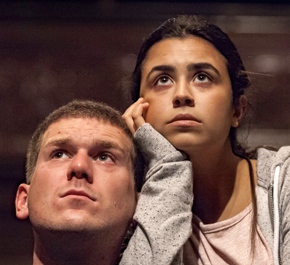
the_distance_1_-_helen_baxendale_-_orange_tree_theatre_-_photo_by_helen_warner_-_webWe are frequently told that the World would be a better place if it was run by women, but Deborah Bruce suggests differently in her sparkling new comedy, which sees three 40-ish mothers descend into total panic, whilst the only voices of sanity are those of the men and a teenage boy. When Bea suffers a crisis of confidence in her abilities as a mother, she abandons her partner and two young sons in Australia to seek comfort and support from her two closest friends in a South London suburb. The friends are Kate, a domineering control freak and Alex, an alcoholic single mother of three (by three different fathers) who is in a frenzy because one of her sons could be caught up in the 2011 London riots, which are taking place at the same time. Helen Baxendale does well as the dazed and confused Bea, having the thankless task of playing straight woman to the comedy characters all around her. Clare Lawrence-Moody makes Kate an unstoppable force of nature, refusing to take “no” for an answer or even to even hear the word spoken in her insistence that everything will be done her way, whilst Emma Beattie’s Alex tows the line obliviously, consumed by her own problems. The appearance of Alex’s son Liam (Bill Milner) is the comic highlight of Act II; fed up with dispensing Ibuprofen to relieve his mother’s hangovers, he gives the perspective of the offspring and, in trying to impose order, he effectively mirrors Kate. Kate’s long-suffering partner (Daniel Hawksford) and his brother (Oliver Ryan) plead for common sense, but are largely unheard. Charlotte Gwinner’s production, performed in the round, moves briskly and Bruce’s writing contains nothing too heavy, but makes many wry observations about the nature of friendship and warns that parenthood is not something to be taken lightly.

Performance date: 24 October 2014

the hunters grimmThis review was originally written for The Public Reviews: http://www.thepublicreviews.com

These are grim times for the Brothers Grimm. They have no more stories to tell and they need our help to scour the streets of Deptford and find new ones. But, to worsen matters, one of them, Wilhelm is suffering from severe depression, making it essential that we find a happy story cheer him up. Teatro Vivo’s theatrical journey, presented in conjunction with the Albany Theatre, is a trek through the streets, shops, bars and back alleys of Deptford, encountering the bizarre and the charming, the pretty and the pretty gruesome, with song, dance and lots of dodgy German accents thrown in along the way. Two parties begin the expedition, taking separate routes and meeting occasionally when two stories connect. Jakob (Mark Stevenson) and Wilhelm (Joel Mellinger), along with their devoted friend Dot (Kas Darley) send us on our way and we soon hear a salutary tale of gambling which leaves us outside the residence of a Mr Paddy Power. We are then ushered to the back of a delicatessen where a wolf (Mellinger again) is sprawled across a sofa, too fat to move; he tells us of his encounter with a young lady in red. Further back, someone’s sister, a not too pretty lady (Sarah Finigan) amputates her big toe in preparation for a shoe fitting and, outside, a rough sleeper named van Winkle is woken from his slumbers as we pass. Yet still no happy stories to tell to Wilhelm. We need a break and head for a bar called The Job Centre, where a lady using a Zimmer frame gives dancing lessons. Then it’s back on the trail and maybe we can help a demented frog (Finigan again and utterly hilarious) to achieve its ambition to be turned back into a prince; sadly, the frog turns out to be into sadomasochism and granting its wish could land us into trouble with the RSPCA. Another unhappy story, but now there is Rapunzel (T’nia Miller) waiting outside Poundland, to offer us a ray of hope. Delightful performances by the five who cover all the roles make this a splendid journey of childish (but not children’s) entertainment which gets better as it progresses. Topical references and quick-witted repartee from them all are a bonus. Of course, clement weather helps too as does the unlikely location of Deptford, quiet in the evenings, but with a few locals around to contribute friendly heckling, particularly as we are walking along the High Street singing a nonsense song in a chorus behind Rapunzel. Inside the Albany, the Brothers eagerly wait for us to report our findings, which hopefully will include that elusive story to lighten Wilhelm’s gloom. And do we all live happily ever after? You bet (well for a couple of hours at least).

Performance date: 23 October 2014

thepublicreview_hor_web copy

Our Town*** (Almeida Theatre)

Posted: October 23, 2014 in Theatre

King Charles IIIThornton Wilder’s 1938 play is performed almost constantly across America, but was rarely seen here until around 18 months ago when it appeared at The King’s Head Theatre, just a few yards away from the Almeida. David Cromer, who has already directed the play in New York with considerable success, now gives us a new version which makes the big statement that, notwithstanding Wilder’s very specific descriptions of place and time, the play speaks just as much to the United Kingdom (and indeed to all regions of it) as to the United States. Of course Wilder’s themes are universal, but Cromer could have assumed that intelligent audiences would figure this out for themselves; instead, he double underlines the point by getting the actors to speak with accents from all parts of these islands, a crass misjudgement which undermines a production with many admirable qualities. Our Town is about families and a community, but, perversely, the characters in this production are not able to gel together as either. Taking the role of Stage Manager (or narrator), Cromer himself brings a strong, nonchalant presence, drawing the audience into the fictional New Hampshire town of Grover’s Corners at the beginning of the 20th Century and introducing us to its inhabitants. Act I (daily routines) and Act II (love and marriage) are played with the house lights on, with actors (in modern dress) and audience mingling and some distant action taking place on a balcony. In accordance with Wilder’s instructions, there is no scenery and this production has only wooden tables and chairs as props. The ambience is just about perfect for the play, but the slow pace and subdued performances, presumably meant to emphasise the mundanity of small town life, work better at some times than at others. In Act II, the nervous proposal scene and the awkward conversation between bride’s father and groom are both funny if read directly from the page, but, here, they are so underplayed that they raise barely a grin. However, with the lights now dimmed, the short and deeply moving Act III (death) is judged beautifully, achieving a sense of stillness that brings out all the writer’s underlying themes relating to the universe, and the place of each individual and community within it. Now Cromer wisely allows Wilder’s fine writing to do most of the work and, even when he defies him by briefly introducing scenery, the effect is memorable. Overlooking things for which the director must take responsibility, the ensemble acting from a company of over 20 is generally excellent. After two viewings, the suspicion remains that, somewhere, a production exists that will reveal this play to be a masterpiece, but maybe there is a better chance of finding it in America than in Islington.

Performance date: 22 October 2014

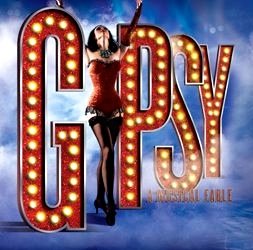
gypsy_media_530e01bac4b8fThis is the first time that I have been to the new theatre here and I wonder if there can be anywhere better for staging a big musical. The audience is seated in a crescent around the traverse stage and, most crucially, the orchestra is where it should be, in a pit front of stage and effectively amongst us. Under the direction of Nicholas Skilbeck, they make a truly glorious sound, transporting us right back to the Great White Way in its golden age. The sound alone makes the journey here worthwhile, but, of course, Jules Styne has given the musicians something pretty marvellous to play, with a score that stands alongside the very best. Gypsy first appeared on Broadway in 1959 with Ethel Merman in the lead and, since then, it has been revived there regularly as a vehicle for almost every leading musical theatre actress who is old enough to have grown-up daughters. However, it has not been seen in London’s West End since the legendary 1973 production starring Angela Lansbury. That omission must be about to be rectified.

Arthur Laurents’ book tells of Momma Rose, a domineering mother of two daughters – the younger, June, is pushed from childhood to become the Vaudeville star that Rose herself always dreamed of being and the older, Louise is constantly put down, used to sew costumes and only allowed to appear on stage as the back end of a cow. When June jumps ship and elopes, Rose turns to Louise to fulfil her showbiz dreams, but, instead of making it big on the fading Vaudeville circuit, she finds tainted success in Burlesque, becoming the stripper Gypsy Rose Lee, whose real life memoir suggested the show.

In Rose, Imelda Staunton, that diminutive giant of the British stage, has found the role that she was born to play. A string of formidable stars have tackled Rose before, all no doubt bringing their own touches of brilliance, but it would be surprising if any of them managed to capture both the hard edge and the soft centre of the character quite so perfectly. In the first half, she makes Everything’s Coming Up Roses a barnstorming hymn of hope and optimism, but when she reprises it towards the end of the show, she stands alone on the vast, bare stage and, with Rose now made a bystander by the very success that she had dedicated her life to achieving, Staunton exposes every line of the lyrics as a delusion, a mere mask for all Rose’s hollow dreams. At the end of the reprise, she steps forward to take her bows in a supposedly empty auditorium, but, inevitably, the illusion is ruined when the real-life audience, many standing, gives her a thunderous ovation. This is a head-dizzying, heart-pumping, eye-watering piece of pure theatre that will be etched in the memory forever.

All that said, this is not a one-woman show. As the girls’ long-suffering agent, Herbie, Kevin Whately is extremely effective. Perhaps due to his familiarity from television, he brings the key quality of likability which is perfect to set against the hurricane force of Rose and his gravelly voice sees him through two great duets. Lara Pulver was the vamp who pierced the supposedly impenetrable heart of Sherlock on television and she assumes a similar guise here as Gypsy, but only for the show’s last quarter. The joy of her performance is seeing Louise’s transformation from a sweet, shy, neglected girl, eventually adding a new layer of confidence for every layer of clothing that she removes. She sings beautifully too in a performance that, in almost any other show, would be the star attraction.

Coming two year’s after West Side Story, this is the last major hit for which Stephen Sondheim wrote only the lyrics and his collaboration with Styne produces one magical song after another throughout the show. Jonathan Kent’s direction and Stephen Mear’s choreography are packed with so many fine details that it feels as if at least one more viewing will be necessary to take them all in and what a chore that will be.

Performance date: 21 October 2014
jacques-brelThis review was originally written for The Public Reviews: http://www.thepublicreviews.com

To avoid confusion, Jacques Brel died in 1978 aged 49, near to Paris and no suggestion is being made of his resurrection. This show is a revue of the Belgian-born singer/ songwriter’s work which first appeared in New York in 1968 and was revived there with great success in 2006. It was last seen in London in 1997. Chris de Wilde’s set resembles a shabby Parisian night club, with a five-piece band on stage and tables at the front of the stalls. The ambience that this creates makes an instant suggestion that the show could be best enjoyed with a full glass of wine to hand, giving encouragement to wallow in the melancholic music. Using Eric Svejcar’s arrangements, Dean Austin’s band, often featuring prominent accordion, gives the evening a distinctive French flavour. Brel’s lyrics reflect lives well-lived and hard-lived, enriched by love and loss, tenderness and pain, passion and despair. In Brussels, he tells of childhood frolics and the company dances like marionettes, dressed in Chaplin outfits. But Brel’s childhood was to be interrupted by war and his music career was to develop in its aftermath. In Statue, a dead soldier comes to life to rebuke those defacing his memorial, a mother laments for her lost boys in Sons Of and, in Next, a young man rails at the indignity of conscription. The spectre of World War II hovers above many of the songs in this revue, yet Brel’s chief preoccupation seems to be with the emotions of ageing. In the bleak Old Folks, he writes of old people in the third person, but in most of his lyrics, he reminisces in a very personal way, showing a remarkable understanding of an age group that he, himself, barely reached. Fittingly, the company is made up of two performers in middle age and two younger, all have their own solo highlights and combine well with each other in duets and company routines. These are four accomplished actors who sing well, but, more importantly, they milk the songs for their dramatic effect, aided by choreography from Sam Spencer-Lane. David Burt, looking dishevelled and world weary, recollects the raucous days of his youth, when he was called Jackie; speaking some lines, finding all the gravel in his voice and varying the tempo, he gives a unique rendition of the song, as different as it could be from the famous Scott Walker version. Later, he offers comedy, rising repeatedly from his own coffin to sing Funeral Tango. Eve Polycarpou brings maternal warmth and, in all her songs, she rises to the crescendos in the style of Piaf. Particularly striking is her delivery of Brel’s best known song, If You Go Away, which she sings in French (Ne Me Quitte Pas), sitting on the edge of the stage strumming an acoustic guitar, whilst back projection shows passengers leaving Charing Cross station. Gina Beck creates an image of tarnished innocence, singing I Loved with resentment towards a man who cheated on her, but finding the resilience to end the song with “I forgot his name” and, later, with My Death, she faces up with resolution to her own mortality. After the passion shown in Statue, and the rage of Next, Daniel Boys gives a memorable, tender interpretation of the beautiful love ballad, Song for Old Lovers, showing clear joy whilst celebrating a relationship that has come through turbulence and survived. There are lighter songs, but, in general, they work less well than the poignant ones and the show ends with an anthem of hope as the company joins together for the slightly corny If We Only Have Love. Jacques Brel is rarely heard these days and Andrew Keates’ confident, well performed production gives us a welcome reminder of a great talent.

Performance date: 18 October 2014

thepublicreview_hor_web copy

TheTrialsOfOscarWilde_EuropeanArtsComapny-EvolutionsPhotoThis review was originally written for The Public Reviews: http://www.thepublicreviews.com

Showcase trials of celebrities are commonplace nowadays, but the Victorians led the way with two 1895 trials involving the writer Oscar Wilde that have continued to fascinate ever since. Writers Merlin Holland (Wilde’s grandson) and John O’Connor have based this play on the original words spoken during the trials, the first of them being the libel action brought by Wilde against the Marquis of Queensbury for accusing him of indecent acts with men and the second being the consequential criminal prosecution of Wilde for committing those acts. The script is laced with the wit of Wilde himself, but the fact-based format restricts the writers’ ability to delve into Wilde’s character in the way that, for example, David Hare did in The Judas Kiss. Therefore, he needs to rely very heavily on actor John Gorick’s excellent interpretation. Arrogant and slightly flamboyant, standing often with one hand on hip, this is a Wilde who is always putting on a performance for the court, exuding wit and intellectual authority. Yet there are moments in Gorick’s performance when the mask slips and Wilde’s underlying terror is revealed; particularly memorable is the frozen smile that appears when it suddenly dawns that the evidence that he is giving is only serving to incriminate him. Rupert Mason and William Kempsell play the opposing barristers in both trials with suitable gravitas. They also double up as all the minor characters, including a disparate string of witnesses in trial 2. Here Peter Craze’s production makes its only wrong move, because these witnesses are inevitably reduced to comic characters, thereby putting their veracity into question and upsetting the balance of the drama. Sitting in this cramped space, it often feels as if the audience is being asked to become the jury. Yet what is there to judge in these more enlightened days when Queensbury’s accusation would be deemed trivial and Wilde would have broken no law? The answer is that we are being asked to assess the motives of both Wilde before and during the trials and of the society that condemned him. Wilde dug a hole for himself in trial 1 and carried on digging in trial 2, but what fascinates is the reason why he ever picked up the spade.  The explanation offered here is that Wilde had become so absorbed in an ethereal world that he had lost touch with reality, unable to distinguish between theoretical concepts and physical acts. Sadly, he was 73 years ahead of his time and he overlooked the fact that his vision, based on the classics and writers such as Shakespeare, was out of step with the laws of the era in which he lived. As to whether or not the juries reached the correct verdicts, Holland’s play is inconclusive. However, it is made clear that Wilde’s superior manner would have alienated those in the court rooms, making it more likely that the juries would have wanted to knock him off the pedestal on which they saw him. It is for this reason that Wilde’s fall from grace reverberates so strongly today when, time after time, the media and the public collude to bring down high profile figures. Humiliated and made to serve a sentence of two years hard labour, Wilde was never to recover and he died at the age of 46 in 1900. His plays and other works live on.

photo: Evolutions Photo

Performance date: 14 October 2014

thepublicreview_hor_web copy

intothewoods29jul2014w200h200This review was originally written for The Public Reviews: http://www.thepublicreviews.com

“Be careful of what you say, children may listen” warns Stephen Sondheim in a show which delves into the grim side of fairy tales and asks us to consider what we are telling our kids and how well we are equipping them to cope with the adult world. Mixing various stories together in the first half and muddying the path to their resolutions, the show then proceeds to tell us that none of the characters live happily ever after, in an often disturbing second half, which issues stark warnings as to how harsh life (and death) can really be. Dating from 1987 when Sondheim was at his peak, Into the Woods will soon gain wider recognition with the release of the long-awaited film version. In advance of that event, this small theatre near to the edge of Waltham Forest, invites us to join an array of well-known characters – Cinderella, searching for her prince; Little Red Riding Hood, visiting her grannie; Jack, climbing his beanstalk; Rapunzel, escaping confinement; and the Baker with his wife, trying to resolve their infertility problem – and share their experiences in woody terrain. The show’s intricate lyrics carry the unmistakable mark of Sondheim and the score must rank amongst his finest, with songs that are comic, romantic, hopeful and despairing linking perfectly together. Cinderella’s Prince (Josh Pugh) and Rapunzel’s Prince (Tim Phelps) both seen here as arrogant toffs, share the wonderful Agony, venting their frustration at their failure to seek out their respective loves; and Helena Raeburn, as the Witch, pleads to her disaffected daughter with a heartfelt rendition of Stay With Me. For all its many treasures, this is not a show without problems. James Lapine’s book always risks falling between two stools, being too dark and, narratively, too complex for small children and too childish for grown-ups. It needs a constant flow of inventive comedy to carry it through the first half and sincere, convincing performance to carry it through the second. Tim McArthur’s well-judged production does well on both counts. With a few exceptions, this is a very young company and, in one instance, a son looks much older than his father. Of course, youth means energy, which is here in abundance. However, Raeburn, heavily disguised as a hunchbacked bag lady and then turning into an embittered, possessive mother upon losing her powers, does not yet have the maturity to be the perfect Witch. Amongst the more seasoned performers, Paul Hutton and Jo Wickham, as the Baker and his wife, are outstanding. Hutton makes a stirring pacifist plea to end the arboreal mayhem, singing No More, and then duets with Annie Kirkham (as Cinderella) for the lovely, soothing lullaby No One Is Alone. Wickham flirts with Cinderella’s Prince as they sing the mischievous Any Moment before dissolving two more of the first half’s happy endings. These examples typify a production which is beautifully sung throughout, accompanied by a five piece band under the direction of Aaron Clingham. Gregor Donnelly’s set, a leafy glade with a stage covered in wood shavings, provides intimacy with the audience as well as plentiful space for the large cast to move around and make their many rapid entrances and exits. Into the Woods is a far from easy show to stage well, so congratulations to all involved with this production. They have just about nailed it.

Performance date: 10 October 2014

thepublicreview_hor_web copy

Damn Yankees**** (Landor Theatre)

Posted: October 8, 2014 in Theatre

Damn Yankees (c) Roy TanThis review was originally written for The Public Reviews: http://www.thepublicreviews.com

The 1950s was a damn good decade for Broadway shows. Their energy and good humour reflect what seem like more innocent times and their enduring popularity indicates that they have become a beacon of light in a more cynical modern world. The Richard Adler and Jerry Ross musical The Pajama Game was revived to acclaim in Chichester and then London recently and now it is the turn of the same team’s Tony award winning follow-up, an unlikely marriage of Baseball and Faust, to reappear. Bringing to life every sports fan’s fantasies, the show sees Joe Boyd (Gary Bland), a Baseball-addicted, overweight couch potato, do a deal with the Devil and transform into the fresh-faced, athletic Joe Hardy (Alex Lodge), joining his beloved Washington Senators team to help depose the all-conquering Yankees. But he ought to have been more careful of what he wished for, because he soon begins to doubt whether all the fame and riches that ensue can equal the worth of plain domesticity and a loving, dutiful, stay-at-home wife. Yes, of course, after toying with immorality, the book by George Abbott and Douglass Wallopp soundly endorses all the values of the middle America of 60 years ago, giving out just the messages that Broadway audiences of that era wanted to hear. The dated nature of the book may have seemed less significant had all of the Adler/Ross songs been top class. However, only two of them, the Coach’s pep talk, (You’ve Gotta Have) Heart and the seduction song, Whatever Lola Wants, have become standards. The rest are somewhat disappointing and the singers here often struggle to give the solo numbers any life. That said, Robert McWhir’s production skips lightly over most of the cracks in the show’s foundations, the 20-strong company giving a terrific ensemble display. The exuberant chorus line sings to raise the celling and dances to rattle the glasses in the bar below. Choreographer Robbie O”Reilly works miracles in cramming so much action into so little space and the accompanying three-piece band, directed by Michael Webborn, fills the room with pulsating rhythms. As the Devil, aka Mr Applegate, Jonathan D Ellis is slimy, malevolent and oh so camp. In displaying over-confidence, Ellis is certainly acting in character, but he sometimes seems too aware that he is potentially the evening’s star comedy turn and, in his showcase number, Those Were The Good Old Days, he goes a little over the top. Playing his accomplice, Lola, Poppy Tierney is more convincing as the lost girl who had sold her soul than as an irresistible temptress. Scaling down a big Broadway musical to fit into this small space above a pub in Clapham must have presented quite a challenge, made more difficult by the show being dated and not really out of the top drawer. However, McWhir and his company have taken a mighty swing at it and, for sheer entertainment value, they have ended up hitting a winning home run.

Performance date: 7 October 2014

thepublicreview_hor_web copy