Archive for the ‘Theatre’ Category

The Lion***** (St James Studio)

Posted: August 22, 2014 in Theatre

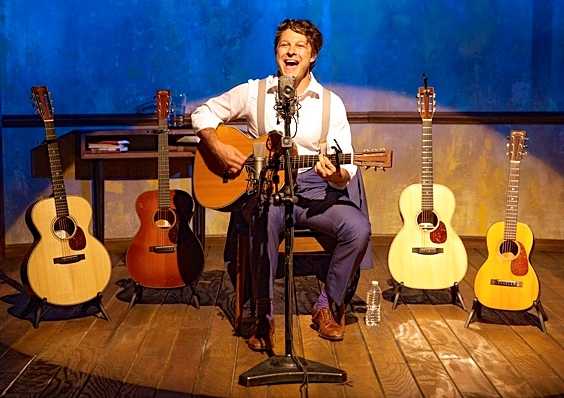
the lionSt James Studio is more like a cocktail lounge than a 1960s-style folk club; gone are the smoke and the seediness, but it is here that the spirit of Guthrie, Seeger and Dylan lives on. Coming from a privileged background, Benjamin Scheuer is perhaps more suited to this air of opulence; financial hardship and political activism do not influence any of his lyrics, yet the songs are heartfelt expressions of the pain and joy of living. This is a 75 minute solo gig in which Scheuer perches on stools and accompanies himself on six guitars (five acoustic, one electric), paying tribute to a father who instilled in him a love of music. “The Lion” is a metaphor for the courage to face life’s challenges head on and, here, Scheuer’s autobiographical lyrics take us through a troubled relationship with his father, an ill-fated romance and a battle with cancer. The storytelling is vivid and deeply moving and the music complements the words perfectly. Scheur’s voice is crystal clear, rich and mellow, with touches of gravel when the lyrics are at their most anguished. There is nothing new or earth-shattering here, but this show is exquisite in its simplicity and very close to perfection.

Performance date: 21 August 2014

Maureen Beattie in The Carousel, in EdinburghThe third of a trilogy of plays by French Canadian writer Jennifer Tremblay, The Carousel relates the stories of three generations of women, all seeking to come to terms with their links to each other and with their places on the carousel of life. A granddaughter speaks to her now departed grandmother who had seemingly cherished her sons, but rejected her only daughter, the girl’s mother; they rake over traumas in the family’s history and and they try to understand how these experiences will help the girl as she moves forward. All three characters in this superbly written but complex piece are played by the same actor, switching frequently from one to another, and this leads to difficulties in connecting with the narrative in the early stages. However, the emotional power increases as the play progresses, thanks largely to wonderful acting by Maureen Beattie. At this performance, Beattie stopped the play early on, because of an unexplained noise, informing the audience that she could not allow anything to interfere with the intense concentration which she needs. Once the play restarted, her reasons quickly became clear. This deeply moving play gets a true powerhouse performance.

Performance date: 15 August 2014

brazoukaIt’s Mardi Gras in August! This carnival of colour, high energy and rhythm is performed by a company of 16 dancers, weaving together lambazouk (lambada dance and zouk music) with other styles, celebrating primarily the culture of Brazil. The show is a collection of spectacular dance sequences, linked very loosely by a script, written by Pamela Stephenson Connolly, which tells of the quest by Braz Dos Santos to bring lambada to Europe. Brazouka does exactly what it says on the tin – it gives solid, undemanding entertainment and there is nothing not to like about it.

Performance date: 15 August 2014

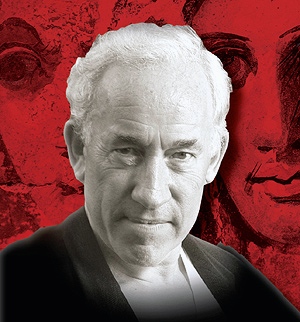
fringe- quarter page template.inddSimon Callow is the master of one-man shows dedicated to cultural icons – Shakespeare, Dickens, Wagner – but who has ever heard of Juvenal? Well, he was a scabrous satirist living in Rome around the 1st Century AD and this show is a collection of his writings, adapted by Richard Quick to give them a modern slant. A vulgar misogynist, he rants against just about everything that comes into his view, but mere rudeness is no substitute for wit and, sadly, the novelty of his outbursts wears thin very quickly. This show could be an uproarious success if performed as an after dinner entertainment for Oxbridge Classics scholars and Callow appears suitably dressed for such an occasion. A few of Juvenal’s observations are relevant to the present day, but the rest are all pretty obscure and there is far too much repetition. Callow’s flamboyant, actorly style is always a joy to behold, but, otherwise, this show has little to recommend it.

Performance date: 15 August 2015

diana riggDame Diana Rigg describes her one-woman show as “an entertainment”, but, for a budding theatre blogger, it is more a tutorial. Developed from her book of the same name, first published 25 years ago, Dame Diana’s talk relates to bad reviews given to herself and to fellow thespians over a period of more than 1,500 years, although she expands it to give a potted history of theatre. Much of the time she reads from a rather dry script (it is very tempting to write something really poisonous at this point in an attempt to get included in volume 2 of the book), enlivened only by occasional delightful anecdotes about “Larry”, “Ralph” and the like in her days as a walk-on – one of these, relating to Vanessa Redgrave, is as cutting as any critic could muster. Eventually, Dame Diana sets the script aside and becomes herself, a delightful, relaxed and witty lady. It is just a pity that she could not have done this earlier.

Performance date: 15 August 2014

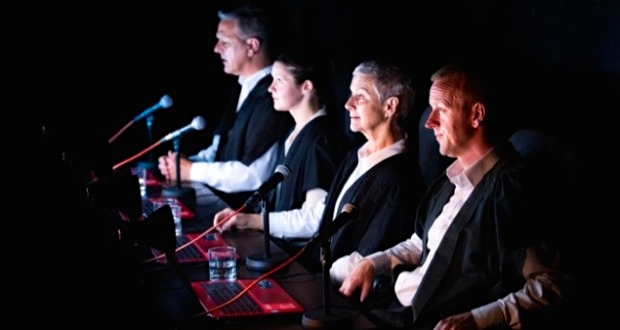
Horizontal-Collaboration-Traverse-Theatre-620x330The technique of getting actors, different for every performance, to read a play “blind” is not new (for example White Rabbit, Red Rabbit which is playing again at this Festival). Horizontal Collaboration, written and directed by David Leddy, requires four actors of either gender, any race or age, to appear in white shirts and judges’ robes, sit behind a long desk and read from computer screens. On this particular occasion, four middle-aged white actors, two men, two women, took the roles. Their characters are presiding over a War Crimes tribunal in The Hague and summarising the testimonies given so far. What follows resembles a suspense thriller of high intrigue, with twists and turns at every corner in a plot which concerns tribal conflicts in an unnamed African country and the less than reputable involvement of United Nations peacekeepers. So, how is this different from listening to an audio book? In reality, not much, except that, with the actors having no prior knowledge of the material, they have little opportunity to dramatise their delivery. Perhaps it is expected that actors will be visibly and audibly taken aback by plot developments, but, at this performance, all four were completely professional and read out their lines in a plain, matter of fact manner. However, all that really matters is that the presentation is effective in getting the story across, because this play is all about that story and it’s a cracker!

Performance date: 15 August 2014

This play is double-billed with a film entitled “City of the Blind”, made exclusively for smart phones or tablets

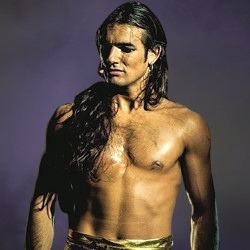
siddhartha-the-musical_2014SIDDHAR_8VInspired by Herman Hesse’s novel, which has something to do with the journey of a prince to discover the meaning of life, this is an Italian musical, written and directed by Isabella Biffi, with music by her and Fabio Codega. It is difficult to think of a successful musical from Italy since Turandot, but, true to its origins, it boasts lush melodies and beautiful singing, particularly by Giorgio Adamo in the title role. With the exception of narration by the older Siddhartha (Michael Nouri), the show is spoken and sung in Italian, but it is only necessary to glance occasionally at the American surtitles, because the book is a load of tosh and all the lyrics seem to be about the same thing – the joy of living. What makes this show special is the full-on staging of the songs, which range from soaring ballads to pounding club anthems and include a novelty number. Yes, this is a live mini version of the Eurovision Song Contest – incomprehensible lyrics, glittery costumes in lurid colours, half naked dancers gyrating all around the singers, flashing lights and lasers, psychedelic back projections and all of it unashamedly camp. Just like Eurovision, occasional suspicions that someone may actually be taking it seriously add to the amusement. The only things missing are (thankfully) the roll call of results and (sadly) Graham Norton’s commentary. Spectacularly entertaining.

Performance date: 14 August 2014

trial-of-jane-fondaIn June 1988, the double Oscar winning Hollywood actress Jane Fonda went to Waterbury, Connecticut to shoot scenes for Stanley and Iris, along with her co-star Robert De Niro. She found herself a pariah in a town which was populated by an unusually high proportion of war veterans, branded a traitor for the stand that she had taken against the Vietnam War in the 1960s and early 70s. This play, written and directed by Terry Jastrow, tells of a confrontation between Fonda and a group of the veterans which was, in effect, a trial. Somewhat ironically, the play takes the shape of Twelve Angry Men, one of the most famous films of Fonda’s father Henry, as we see a single figure seeking to convert dissenters, one by one. Ironically also, Fonda was seen as little more than a nuisance by the US Government and Military who she opposed, but as a demon by the fighting men whose cause was closest to her heart. Here, she admits that she had been hot headed and made mistakes, but she remains passionate in her beliefs that the Vietnam War was wrong and that the actions of US Presidents, particularly Nixon, amounted to genocide. From the perspective of the modern day, it is impossible to argue with her, but, in 1988, the wounds were still open. This is all fascinating and the arguments are generally well presented, with the aid of newsreel footage, except that the same points are repeated too often. Anne Archer is cool and composed as the beleaguered film star, as indeed Fonda may have been in 1988, unlike the fiery image of “Hanoi Jane” of a decade and more earlier. Occasionally, when the verbal interchanges become a little stodgy, dramatic flash points, that look somewhat cooked up, are inserted and the ending is 110% Hollywood. Otherwise, this is an intelligent and intriguing play.

Performance date: 14 August 2014

my-obsession-2014MYOBSES-PH-300Suki Webster’s short play has the feel of a pilot episode for a sit com that was never taken up. The writer herself plays a woman so obsessed with Danny Heywood, a television comedian, that she breaks into his hotel room in the middle of the night. Heywood seems a little like Paul Merton, so, rather conveniently, he is played by Paul Merton, who makes full use of his trademark expression of bewilderment when confronting the intruder. The comedy is inoffensive and light as a feather, steering well clear of the darker side of stalking and it doesn’t go on for a second too long. Indeed, some may reflect that the play lasts for little longer than it takes us to get to and from our seats, but it’s fun while it lasts anyway.

Performance date: 14 August 2014

TheCuringRoom-620x330What better way to spend a lunch hour in Edinburgh than in the company of a group of naked cannibals? In the Spring of 1944 in Southern Poland, a group of seven Soviet soldiers is taken prisoner by the Nazis, thrown naked into a cellar and abandoned with no means to escape. As days become weeks, the seven become hungrier and they realise that there can be only one source of sustenance available to them. A little like Agatha Christies’s Ten Little….., the question now becomes who will be the first and next to fall? In common with all stories of incarceration, David Ian Lee’s play relies upon the development of strong characters and he is served well by excellent performances all round. Stand outs are Marion Solomon as a reluctant leader, Matt Houston as a boastful Georgian ex-farmer and Thomas Holloway as a simpleton. However, this is a grizzly affair that makes us long for a return to the days when suggestions of unpleasant things were enough to trigger an audience’s imagination; the gratuitous offal on display in this production actually works against the drama by distracting our attention from the characters and making us divert our eyes in disgust. Stark realism is a positive feature of this production, but it is taken just a little too far.

Performance date: 14 August 2014