Archive for the ‘Theatre’ Category

17**** (Finborough Theatre)

Posted: July 23, 2014 in Theatre

Photo Booth LibraryThis review was originally written for The Public Reviews – http://www.thepublicreviews.com

Bereaved, homeless and 17, an unenviable triple whammy for Scott, the central character of Dameon Garnett’s play, which is receiving its World Premiere here. Scott’s most treasured possessions are a tank which is home to Dave, his pet snake, and a box containing the ashes of his recently deceased mother by adoption. Clinging to both, he begins to make his home with Lisa, his birth mother, Daniel, her husband and the couple’s 15-year old son Leo. This is a human comedy/drama which charts the integration of a new member into an established family unit. Set in modern day Liverpool, the play also makes astute observations on class and social attitudes. The family is aspiring and middle class, eating mushroom risotto as their evening meal, whilst Scott, who has been raised at least one rung down the social ladder, insists that he will only eat chips. Understandably, Scott needs to establish and retain his own identity; equally understandably, the family can only move so far in order to absorb the newcomer into its midst.! ! Garnett’s writing is rich with everyday humour, funny yet truthful. Very wisely, he realises that verbal expressions of emotions by these characters would sound forced and unnatural, so he places great trust in director Emma Faulkner and the actors to bring out their inner feelings. The trust is repaid, particularly by Ryan Blackburn, who is given very little of real substance to say as Scott, yet manages to project his character’s feelings of abandonment and isolation through physical expression. Similarly, Lisa is not given the words to convey maternal tenderness towards Scott, but Catherine Harvey’s performance makes it implicit. She is domineering and a figure of fun for much of the play, until she is pushed beyond her limits and explodes with rage, fully exposing her frustration and guilt. Paul Regan’s Daniel is tolerant and reasonable, as befits a man who reads The Guardian because he saw it in Starbucks. Greg Fossard’s Leo is a cheeky and confident youngster who firstly sees his newly found half brother as a chav, but one of the play’s most touching features is the development of the relationship between the two teenage boys. The Finborough is already a small space, but setting this play in the round makes it even smaller and the performance area is restricted still further when the centre of the stage is occupied by a large block, doubling as a kitchen unit and the boys’ bunk beds. The play benefits from the claustrophobic atmosphere which this creates, but it loses from the actors having so little room to move. Running for under 90 minutes straight through, the performance here is extended by a seemingly unnecessary interval, which interrupts the flow. However, leaving aside minor gripes, this small scale production is highly impressive and deserving of a wider audience.

Performance date: 21 July 2014)

thepublicreview_hor_web copy

SHAKESPEARE IN LOVE by Norman,This review was originally written for The Public Reviews: http://www.thepublicreviews.com

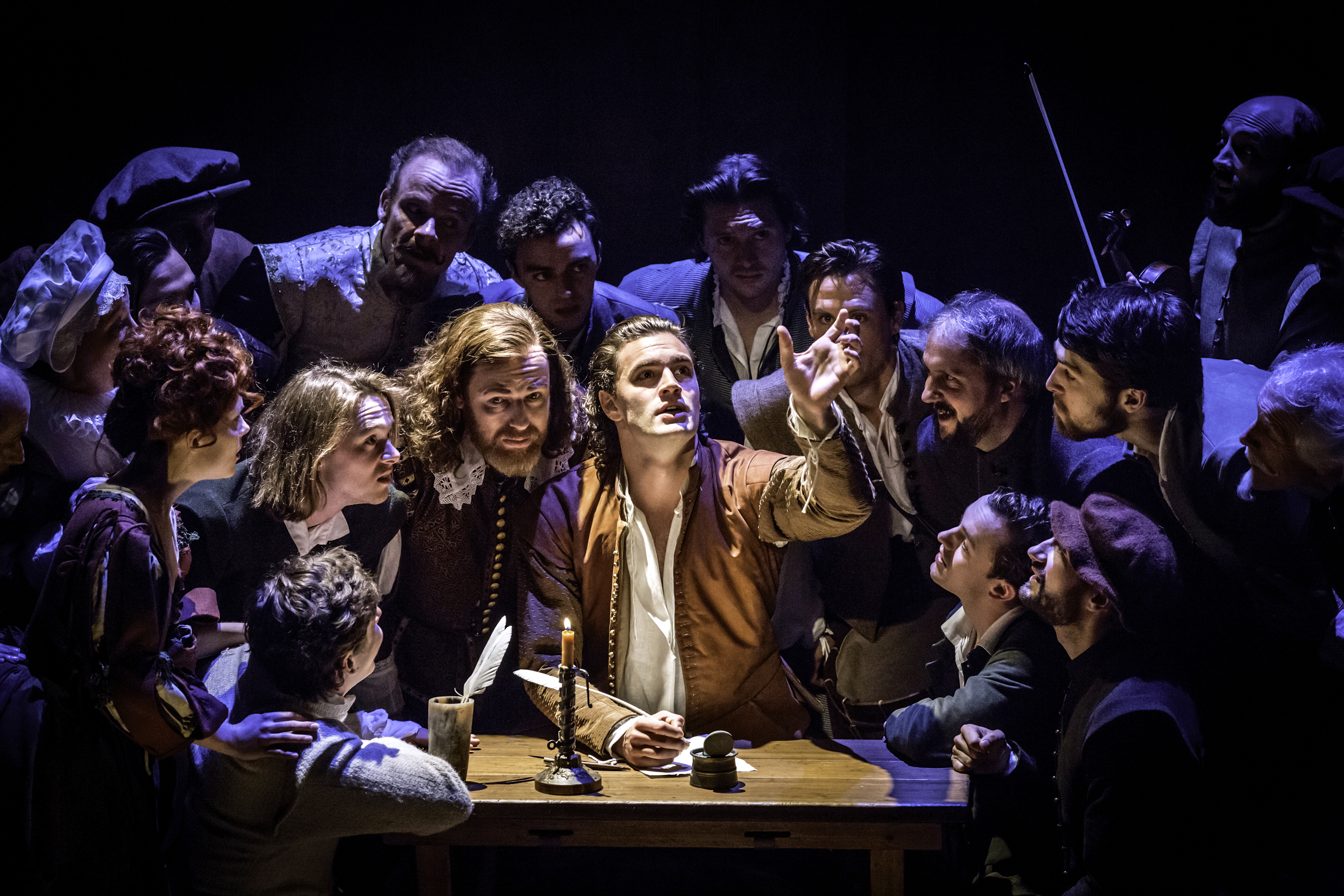
Undeterred by recent flops, the trend for transferring successful films to the London stage goes on. However, in view of its subject, perhaps this one should be regarded as more of a homecoming than a transfer. Lee Hall has adapted the 1998 film, a rollicking romantic comedy, which won seven Oscars, including Best Picture and Best Original Screenplay for its writers, Marc Norman and Tom Stoppard. With a pedigree like this, the quality of the source material could never be in doubt, but the question that still needs to be answered is: what does the experience of live theatre add to it? The story has only a loose connection to documented facts, but this is not a show to please scholars, it is here to entertain us. Will Shakespeare meets Viola when she auditions for a part in his new play and, as women were forbidden to appear on the Elizabethan stage, she is disguised as a man. The couple fall in love and Viola becomes the inspiration for Romeo and Juliet, but their relationship seems doomed, because she is shortly to enter into a forced marriage to the dastardly Wessex.  At a single glance, Nick Ormerod’s magnificent set tells us that this show is going to be a feast for the eye. On three levels and resembling the interior of a Tudor Palace, it features balconies, elevated wooden walkways and a centre section that moves backwards and forwards to suit each scene, whether it be in the Queen’s court, a small bedroom or a theatre. Sumptuous costumes, warmly glowing lighting and a cast of 30 all add to the spectacle. Leaving aside musicals, it is difficult to think of the last time when a commercial production was staged so lavishly. The show has most of the ingredients to make a big musical, it looks like one and it plays like one, so all that is missing is the songs. Fleeting appearances by a troop of minstrels serve only to wet the appetite, but songs could have enlivened several overlong scenes which begin to plod wearily and they could have smoothed out the transitions between frivolity and romance at times when the balance of the two becomes unsteady.! ! Many of the one-line gags from the film, mischievously mocking Shakespeare and his contemporaries, survive in Hall’s adaptation, but his problem is that the people most likely to get theatrical in-jokes are also the people most likely to have heard these particular jokes before. This could explain why the loudest laughs come from topical additions, like Viola blaming her late arrival at rehearsals on a snarl up under Putney Bridge. Declan Donnellan’s slick and confident direction also scores with some neat visual gags, as when Will removes Viola’s false moustache very deliberately and hands it to a servant, before beginning to make love to her. Tom Bateman makes a dashing romantic hero and we have no problem believing that his Will would suffer from writers’ block or rely on Christopher Marlowe’s prompts to find the words to woo Viola. However, he is less successful in convincing us that this is the greatest playwright who ever lived. Viola needs to be both an adventurous tomboy and an alluring seductress and Lucy Briggs-Owen assumes both guises effortlessly. Alistair Petrie is a little too much of a pantomime villain as Wessex, seemingly aiming for hisses every time he makes an entrance, but there are a host of excellent character performances, most notably from Paul Chahidi as Henslowe, David Ganly as Burbage and Abigail McKern as Nurse. Anna Carteret is a knowing and sarcastic Elizabeth I and, by no means least, Barney shows impeccable timing in the pivotal role of Spot the dog. Finally, after the curtain calls, we are allowed a glimpse of the musical that this show is aching to become from the very beginning, as the entire company bursts into song and dances a merry jig. They round off an entertaining evening and send us home happy, but they also direct our minds to thoughts of what might have been.

Performance date: 19 July 2014

thepublicreview_hor_web copy

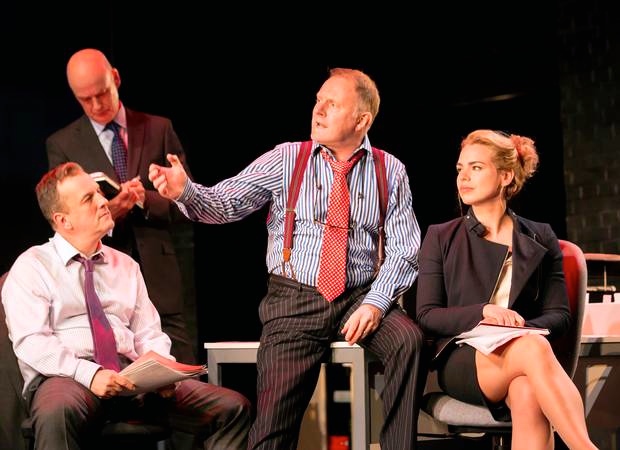
Attachment-1-5At the end of June, the day after a highly publicised phone hacking trial ended, the National made the surprise announcement that this new play, which depicts events not dissimilar to those which led to the trial, would take to the stage almost immediately. Only the National would have the resources to mount such an audacious venture, but, after a so-so year, Nicholas Hytner’s company has, at a stroke, justified its huge subsidy out of public funds. Written by Richard Bean (of One Man, Two Guvnors) and directed by Hytner himself, the play is a savage satire of British journalism, set mainly in the newsroom of a red top (which occasionally adapts to become The Ivy). Paige Britain (Billie Piper) is news editor, ruthlessly ambitious and prepared to use all means at her disposal to achieve her objectives; as to her political leanings, she would not even agree to have her fish and chips wrapped in The Guardian, yet she casually allows a Tory Prime Minister to be left waiting in her outer office when he calls to beg her to sleep with him again. Piper has been a big name for more than a decade, but here she shows herself to be much more than that – she is stylish, sexy and has a natural flair for comedy. Robert Glenister is also excellent as the foul mouthed, quick thinking Cockney wide boy, who is editor of the paper until being “promoted” to a sinecure in television and then to Downing Street. Dermot Crowley plays the owner, an Irish media mogul who rose to prominence in the IRA and, it is now claimed by his lawyers, has suffered from the onset of dementia since the age of six. However, Aaron Neil steals every scene in which he appears as the dimwitted, inept Sully Kassam, who is gay, Asian and, of course, Commissioner of the Metropolitan Police. The plot navigates the narrow straits between fiction and libel, not quite telling it as it actually happened, but getting close enough for us all to know what is being referred to. The characters too do not match exactly with people we might recognise, rather they are composites of familiar figures involved in the real life toxic tryst between the media, politicians and police. The play flounders in the brief moments when it gets serious, but, generally, the jokes, many of them very, very funny, come thick and fast and, if a few fall flat, blame can be laid on the Lyttelton’s wretched acoustics. The production may have been announced in a hurry, but it clearly took much longer than a few days to put it together; it flows slickly, with moving screens dividing the set and showing projected images and filmed sequences. At just under three hours, it is surprisingly long for a satire, but no-one seems to notice whilst having so much fun. After this run, the show is already booked into the Theatre Royal Haymarket where the more compact auditorium could suit it better and there is obvious scope for the addition of new, topical jokes, which could mean that it is even funnier by then.

Performance date: 17 July 2014

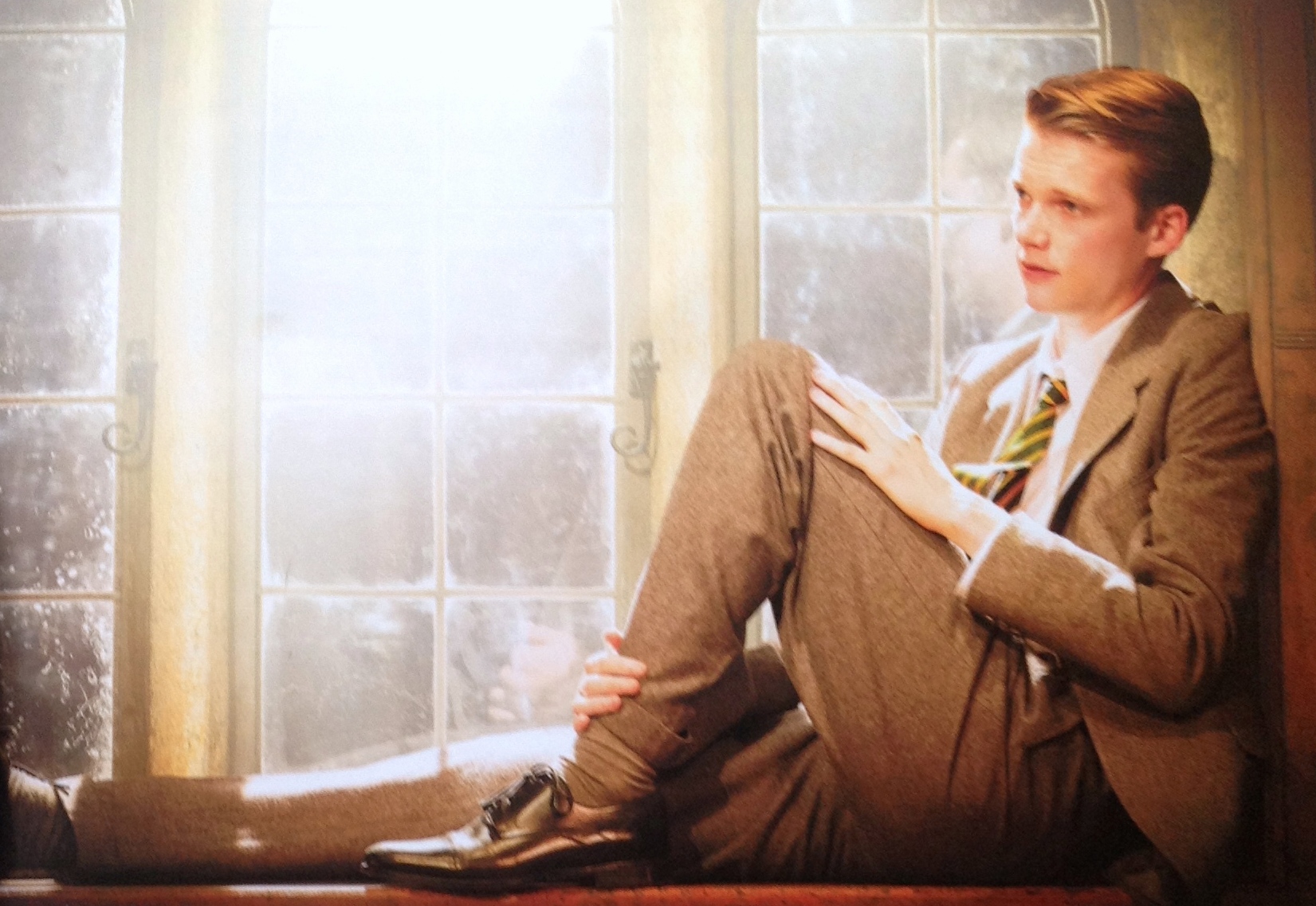
photo-140The original 1982 West End production of Julian Mitchell’s play featured actors who have gone on to win four Oscars, be awarded two knighthoods (so far) and achieve worldwide star status. Therefore, part of the enjoyment in seeing this revival, which originated in Bath and Chichester last year and has already had a West End run, is picking out the stars of tomorrow. There could be several. Directed by Jeremy Herring, the play is a study of life in an English Public School for boys in the 1930s, its bullying, its brutality and its rigid adherence to traditions and the class system. Will Attenborough (newest member of the famous theatre dynasty) dominates the first half as Judd, a studious young man, focussed single-mindedly on gaining his scholarship to Cambridge, but contemptuous of the Upper Class and openly admiring Stalin and the Russian Revolution; Attenborough’s mature and sympathetic performance leaves us in no doubt as to why Judd is so respected by the other boys. This is a play which gains strength as it progresses and it is only in Act II that we realise the significance of Judd’s friendship with Guy Bennett (the name is a thin disguise for who this character is really meant to represent). Rob Callender begins by playing Guy as effete and frivolous, boasting of his sexual encounters with other boys, all of whom brush them off as “just a passing phase”. However, a boy’s suicide makes Guy realise that, for him, homosexuality is not passing, it is for real and forever. Callender’s performance captures this realisation perfectly and shows us Guy’s determination to stand strong against moves to punish him and make him an outcast. Guy may or may not share Judd’s idealistic view of Communism, but he sees it as a vehicle for gaining revenge against his persecutors. He smiles with pleasure at the prospect of both staying inside English society and, at the same time, undermining it through treason. Impressive sets of wood-panelled walls reflect the coldness and rigidity of the school and a strong supporting cast helps to throw fascinating light on one of the most notorious episodes in British post-War history. This production is riveting throughout.

Performance date: 16 July 2014

photo-139Even at this performance, well into the show’s run, the audience seemed unusually full of theatre people (Caroline O’Connor and Lesley Manville the most recognisable), rolling in laughter at the constant flow of not-so-subtle in-jokes at the expense of their profession. For those like me, only half “in”, and for those more”out”, maybe the jokes will come across as a bit hit and miss and also quite repetitive, but still this show, an update of Gerard Alessandrini’s musical revue first seen here in 2009, provides pretty superior entertainment. It is based on the single joke of taking many of the most famous show tunes and changing the lyrics to satirise the shows, their writers, their stars and their producers – Cameron Mackintosh’s take on American Dream from Miss Saigon is a highlight. The first half seems more like “Forbidden West End” with bang up to date references, ending with One Day More from a weary cast of Les Miserables, which becomes 10 Years More (obviously). As the show progresses, it gets more Broadway, stretching from Oklahoma to Book of Mormon. Impersonations of stars such as Julie Andrews, Liza Minnelli, Hugh Jackman and Angela Lansbury strike instant recognition, but Chita Rivera, Rita Moreno, Idina Menzel and Mandy Patinkin are less well known on this side of the pond; Menier audiences may not appreciate being reminded of Patinkin who appeared in a catastrophic flop here in 2010, before returning shame-faced to his home land, but his inclusion may correct impressions somewhat by demonstrating his stature in New York. Of course the show is self-indulgent, which is a big part of its appeal, but it can hardly be described as “gentle” or wholly “affectionate”; children’s musicals (Lion King, Charlie… etc) are lampooned with bile and, with Into the Words, there is even mockery of Stephen Sondheim’s lyrics (do these people ever want to work again?). The show ends fittingly with a stinging attack on the takeover of Broadway by big corporations to the tune of Tomorrow Belongs To Me from Cabaret. Equating Disney etc to the Nazis in pre-war Germany is a bit strong, but we all recognise the sentiments. The four performers – Anna-Jane Casey, Sophie-Louise Dann, Damian Humbley and Ben Lewis are all excellent and show remarkable skill in quick changes of costume and make-up. Great fun.

Performance date: 15 July 2014

Mr Burns** (Almeida Theatre)

Posted: July 12, 2014 in Theatre

photo-137Never having seen an episode of The Simpsons from beginning to end, I approached this with some trepidation. Anne Washburn’s play, which turns into a musical in its later stages, is set in a world in which, following a nuclear catastrophe, there is no electricity and all that is left for the survivors to do is to mull over and recreate old episodes of the television cartoon series. Act I, set in the immediate aftermath of the disaster, sees a group huddled around a camp fire discussing a specific episode in minute detail. Not helped by the performance being in half light, it is difficult to engage with the characters on stage and impossible to imagine that even the most fanatical of Simpsons devotees would not find this discussion excruciatingly boring. Act II, set seven years later, is not much better; now, in this post-electric society, the only form of entertainment is performing episodes of the cartoon, pieced together from memory, with rival groups competing with each other and trading lines from the scripts as a form of currency. Everything that is of interest in this show comes in the completely bonkers, musical Act III, set 75 years later and consisting of a re-enactment of the episode under discussion in Act I, wildly distorted by the passage of time. Here we see the Simpson family facing up to its nemesis, the satanic Mr Burns, in a battle of good versus evil. All this seems to add up to a satire on the pervasive influence of American popular culture, yet, in the final act which is filled with pious moralising and ceremonial rituals, there are hints that Washburn could be aiming at a bigger target – that of all organised religion. However, what she seems to forget is that any successful satire needs to be sharp and incisive; by stretching this one out to 2 hours 45 minutes (including two intervals) and allowing two thirds of it to become mired in longueurs, she has effectively extracted its teeth. On the plus side, the show is highly original and performed with gusto – who would have thought that Jenna Russell, a wonderful leading lady in Sondheim musicals, might progress to playing Bart Simpson? Washburn deserves credit for attempting something ambitious and different, but, sadly, she fails to pull it off.

Performance date: 11 July 2014

Attachment-1-2This review was originally written for The Public Reviews: http://www.thepublicreviews.com

The tragedy of Lucrece is mentioned by William Shakespeare in several of his plays, but his narrative poem which recounts the full story is known to most of us only from the page. This bold and imaginative production by the Royal Shakespeare Company, which was first staged at the Swan Theatre in Stratford-upon-Avon in 2011, brings the poem to vivid life. Part spoken and part sung, the poem is performed by the Irish singer and actor Camille O’Sullivan, accompanied on piano by Feargal Murray. Together, they have written the haunting music, which is in the rock ballad style, ranging from soothingly melodic when matching Shakespeare’s lyrical descriptions of Lucrece’s beauty, to loud and discordant in harrowing scenes of violence and anger. O’Sullivan’s clear and powerful voice do full justice to both the words and the music throughout. O’Sullivan’s style as a concert performer is always intensely dramatic, but here, not content to just stand in front of a microphone, she deploys her considerable acting skills, playing at first the abuser, Tarquin, and then the victim. She begins wearing a full-length black coat and, with her hair pinned back tightly, she has the severe appearance of a prison warder. Once the foul deed has been committed, she discards the coat and becomes Lucrece. Wearing just a pure white night dress, her hair now dishevelled and falling forward, she writhes on her bed in pain and disgust. Lily Arnold’s simple designs represent a grand, unfurnished room, with large windows at the back and littered with manuscripts piled high. The production is marked throughout by exceptionally effective lighting by Vince Herbert. A square block of light represents Lucrece’s bedroom and, inside it, a smaller white square is her bed. At the end of the performance, a thin shaft of light across the stage links a heavy pair of men’s black boots at one end to a pair of white ladies’ slippers at the other, leaving us with an indelible summarising image. This 80 minute interpretation of Shakespeare’s work is a unique and memorable fusion of of poetry, drama and music. It is also a personal triumph for the extraordinary Camille O’Sullivan, providing a showcase for the full range of her talents.

Performance date: 9 July 2014

thepublicreview_hor_web copy

p.txtMartyn Hesford’s writing credits include a television bio-pic of Kenneth Williams and, although no-one actually talks in Polari in this new comedy, he extends a line of gay humour which stretches from Julian and Sandy in the 1960s through Larry Grayson to Julian Clary. In other words, Hesford extracts most of his laughs from mocking exaggerated stereotypes, but, sadly, the comedy is shallow and lacking in the kind of insight found in, for example, Kevin Elyot’s soon to be revived My Night With Reg, which features similar characters and situations. Marcus (Michael Begley) is boring, fussy about stains on his John Lewis carpet and touchy about his expanding paunch; understandably, his partner of 20 years, Colin (Owen Sharpe) has turned to drugs. They have moved recently to a cottage in Hampshire and their solitude is interrupted by the unexpected arrival of a gruff businessman, Steven (Michael Feast) with his promiscuous and very camp 18 year old toy boy, Jamie (Alex Lawther). The two couples had met on a cruise a year earlier and enjoyed each other’s company in every sense. The visitors also bring in tow Steven’s slutty and coarse ex-wife, Wendy, played with relish by Michelle Collins, who looks as if she could well build a fruitful post-soap career in theatre. Hesford offers a flimsy explanation for Wendy’s presence, but, in effect, she is little more than a catalytic device for getting the comedy moving. It would be dishonest to deny that a lot of what follows is very funny, particularly when Collins is in full drunken flow during the raucous second act, but the absence of any real depth leads to a guilty feeling whilst laughing, like when watching an old episode ‘Allo, ‘Allo. Intermittently entertaining this play is for sure, but, if there were to be any suggestion that these irksome characters represent 21st Century gay lifestyles accurately, it could be enough to nudge even the most liberal minded of Hampstead audiences in the direction of homophobia.

Performance date: 8 July 2014

Attachment-1-3Ivan Turgenev’s novel Fathers and Sons first appeared in 1862, preceding Chekhov’s greatest plays by more than 30 years, yet Brian Friel’s adaptation is marked by the same feelings of wistfulness and melancholy as those plays. The setting is rural Russia on the estates of aristocratic landowners, but, whereas Chekhov used similar settings to depict a social order in terminal decline and on the cusp of being overturned, Turgenev sees the emergence of revolutionary forces which will make waves, but ultimately leave the status quo intact. There is much talk of disturbing “the natural order of things”, but not displacing it and, taking a longer view of history from a modern day perspective, perhaps Turgenev got it right and even the 1917 Revolution was no more than a temporary blip. Arkady and Bazarov are close friends who return together from university in St Petersburgh to their family homes, both claiming to be nihilists, without agreeing with each other on the word’s definition. Arkady cannot entirely detach himself from his heritage and bonds of affection, but Bazarov, a brilliant student and radical thinker, is dispassionate towards his family and lovers, until he meets the lovely widow Anna and finds it impossible to rein in his emotions. There are flaws in the narrative which emanate from the novel itself and from condensing it, but Friel’s script is rich with insight and wit. There can be no complaints about Lindsey Turner’s production – she strikes the perfect balance between pathos and humour, paying great attention to detail and her casting choices are impeccable. Tim McMullan shines as Arkady’s Uncle Pavel, debonair, droll, waspish and the staunchest defender of the established order. Seth Numrich, the American actor who was so good in Sweet Bird of Youth at the Old Vic last year, impresses again with his commanding stage presence as Bazarov, showing us the inner turmoil beneath the character’s outward fervour. Joshua James is a naive and impressionable Arkady, devoted and loyal, but rueful that he lacks both the intellect and dynamism of his friend. As the two fathers, Anthony Calf and Karl Johnson are loveable eccentrics, both touching us as they face their families’ ordeals. The set, built almost entirely from planks of wood, is magnificent, rounding off what is a highly accomplished work of theatre.

Performance date: 4 July 2014

This review was originally written for The Public Reviews: http://www.thepublicreviews.com

In a world where shoals of cod can sing in a 17,000 point harmony and whales can communicate with each other across thousands of undersea miles, the human race struggles to make itself heard, blocked by censorship and inarticulacy. Fine Chisel has devised this musical entertainment, building upon these themes in a loosely linked story which moves between a marine biology station off the Alaskan coast to a pirate radio ship in the North Sea. Set very vaguely in the early 1960s, the story concerns Ted (Robin McLoughlin), an academic who is researching marine mammal bioacoustics, living a solitary life and obsessed with tracking singing whales across the Bering Sea. He is able to distinguish between the accents of individual whales, but, impaired by a brain tumour, he has difficulty in finding words to pass on his knowledge to his student, Fiona (Holly Beasley).  Fiona is more obsessed with human communication and, springing from an aversion to the BBC’s Light Programme (something like the modern Radio 2), she establishes an illegal radio station to broadcast whatever she chooses. However, when she airs provocative views and reads extracts from the then banned Lady Chatterley’s Lover, Ted tries to persuade her that she would be more suited to a sedate job in Belgium. This bizarre narrative provides a framework and ambience to showcase some lively music, which is themed on the life aquatic, ranging from emulating whale noises to rocking a pirate boat. George Williams plays guitar and provides vocals, Tom Spencer plays banjo and percussion and Carolyn Goodwin also vocalises and plays woodwind, contributing some outstanding jazz saxophone segments. Beasley adds a couple of dances to add to the entertainment, showing little regard for the lecture room setting, surrounded by blackboards and charts. Dumbstruck is, in essence, about connectivity, yet, itself, it does not quite connect to make a coherent whole. Nonetheless, if not taken too seriously, it provides an unusual and pleasantly entertaining evening.

Performance date: 3 July 2014

thepublicreview_hor_web copy