Archive for the ‘Theatre’ Category

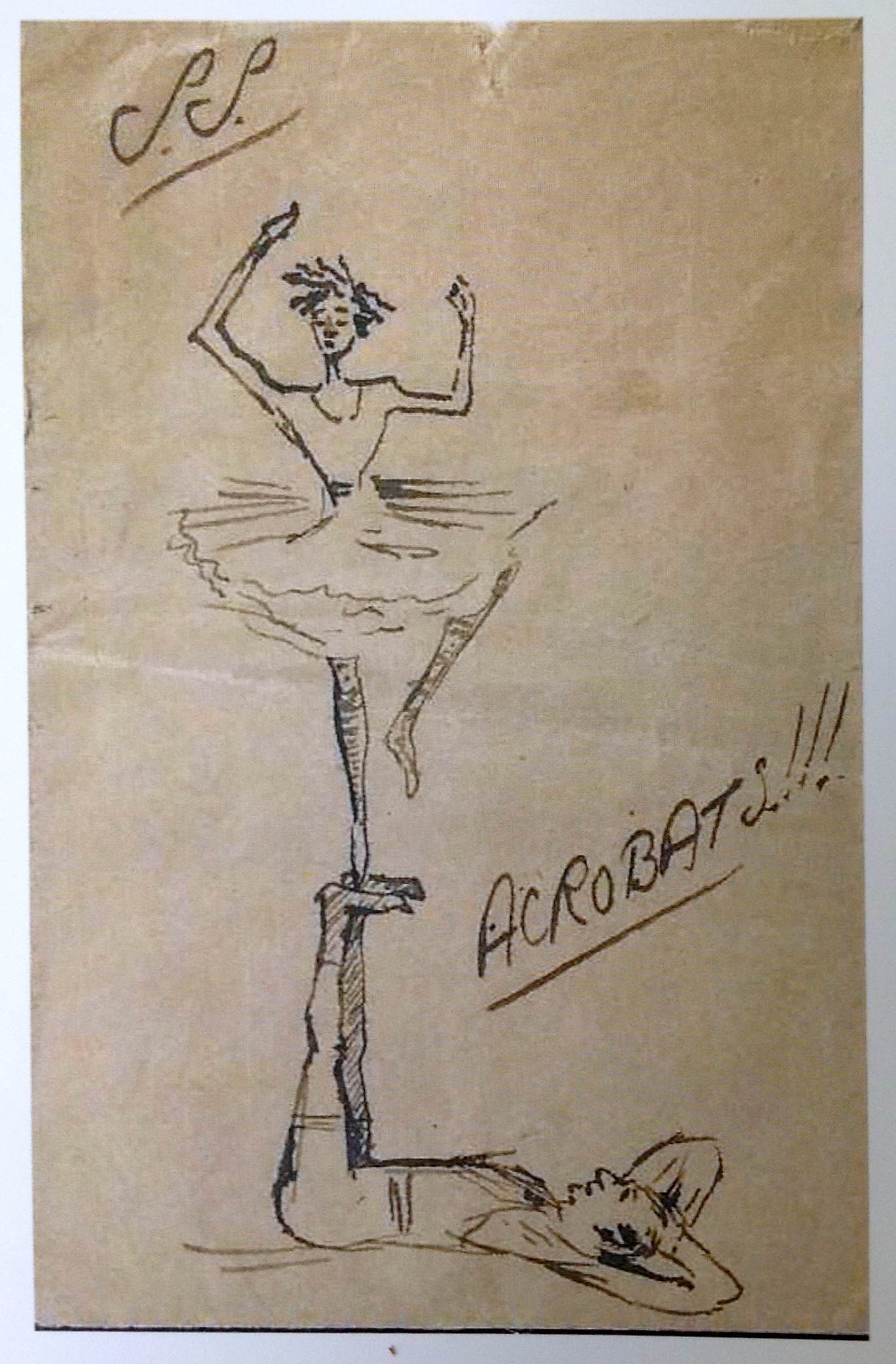
photo-132This show begins very badly, with its writer/presenter, Danny Braverman, handing round  cold fish balls to the audience and, with the unpleasant taste still lingering in the mouth, he embarks on a rather unpromising anecdote about a bowel operation. His style is relaxed and amiable but not witty and he seems to be rambling, which makes it all the more surprising when I realised, after about 15 minutes, that I had become totally enthralled. The true story concerns his great aunt, Celie and her husband Ab Solomons, an employed Jewish shoemaker living in London’s East End. They married in 1926 and, from that time for over half a century, Ab received his weekly pay in a small, brown, dated envelope and, on the reverse side, he drew sketches depicting the couple’s life together. Having found these envelopes in shoeboxes, Braverman projects them onto a screen and relates the couple’s story, in some cases illuminating the sketches with supposition, in others leaving them to explain themselves. As Ab grows in confidence, the sketches become bolder and more explicit; they tell of young lovers, proud parents, wartime hardship, heartache and illness. Ab and Celie’s younger son was afflicted by severe autism and epilepsy and, as was normal in those times, he was incarcerated in a “loony bin”. Ab was a “schlump”, but Celie had style and aspirations, always wanting to move from the squalid East End to the middle class Golders Green. Overwhelmingly, this is a story of undying love, constantly tugging at the heartstrings, but never resorting to excessive sentimentality. It is also a story of fortitude, endurance and of overcoming life’s trials and it is told by Braverman with great affection and family pride, as shown when he finds himself as a child amongst the figures in the sketches. The story also has symmetry and irony – Ab and Celie’s older son was (and still is) an art dealer who owned a Rothko and lunched with the likes of Francis Bacon, yet he never realised the value of the treasures lying in shoe boxes beneath his own bed. In all, this is the most beautiful and moving piece of story telling that I can remember experiencing.

Performance date: 3 July 2014

Attachment-1-4It could be argued that the Miners’ Strike of 1984/85 was the closest thing to a civil war seen in these islands since 1651 and, fittingly, Beth Steel’s compassionate new play views the Strike as a conflict in which, as in all wars, the greatest losers were the fighters and their families. The chief protagonists, Margaret Thatcher and Arthur Scargill are never seen, although some insight into the political background is given in discussions between the “wet” Energy Secretary Peter Walker (Andrew Havill), Transport Secretary Nicholas Ridley (Paul Cawley) and the Chairman of the National Coal Board Ian MacGregor (Michael Cochrane), who is seen as a man with a genuine mission to rebuild the mining industry, not to destroy it. It is refreshing that Steel does not promote the simplistic view favoured by delusional socialists that the Strike was only about the evil witch Thatcher crushing the noble workers; she is clear that Britain at that time was on the brink of economic ruin as a result of two decades of Trade Union domination and that mining and most other industries were in need of urgent and drastic reform to make them viable; she sees the miners as being led blindly by politically motivated Union leaders who called the illegal Strike at a time when conditions were least favourable to them and then prolonged the agony of their members by remaining intransigent well after the point when defeat had become a certainty. However, the play’s political content is only there to provide background, because Steel’s chief focus is always on the miners who were caught in the middle, bound by tradition and by their loyalty to each other. The first half is a vivid and detailed account of working in a coal mine, arduous, hazardous and unhealthy; the staging is starkly realistic, with metal cages descending from above the stage to well below it and, under Edward Hall’s superb direction, the miners moving around constantly as they perform their daily labours. Songs (composed by Simon Slater who also plays the Pit Manager), help to illustrate life in this hellish underworld. In the second half, the stage is cleared and we are taken through key points in the Strike itself, with pitched battles, extreme hardship and indignity, family members set against each other and, inevitably, the bitter pill of defeat. We see dirty tricks played by both sides, most notably those involving David Hart (Dugald Bruce-Lockhart), a wealthy eccentric residing in Claridge’s, who is sent to infiltrate Nottinghamshire miners. The acting in the roles of the miners is exceptionally strong, but, strangely, all Steel’s characters are male and we see no signs of the women who suffered alongside their men. This production is theatre on an epic scale, thrilling, enthralling and often deeply moving.

Performance date: 2 July 2014

photo-127This review was originally written for The Public Reviews – http://www.thepublicreviews.com

Traditional folk songs, passed down from one generation to the next through decades and centuries, form part of out cultural heritage, but, until relatively recent times, they were never written down nor recorded. Kevin Mandry’s new play is set in 1916 when recording techniques were in their infancy and he sees the onset of an age when the songs could be taken away to be heard by wider audiences, whilst the people to whom they belong would remain rooted in their own place and time. Mary (Hilary Burns) is selling her small Sussex farm to George (Ian Mairs), who is unable to do military service due to disability. It is accepted that, as part of the deal, George will marry Mary’s foster daughter, Sarah (Isabella Marshall), who is seen by herself and everyone else as plain.Their world is disturbed by the arrival from London of Archie (Josh Taylor), a young army captain who is taking leave to research folk songs. He turns up on foot, towing a cart containing recording equipment, cylindrical discs and a Fortnums’ hamper. Much of the first half of the play is taken up with discussions over what is or is not an authentic folk song. Archie is a condescending toff who uses long words to emphasise that he has had an education; he is the sort of man that everyone has nightmares about being stuck with on a long train journey – when talking folk music, he can bore at international level. We are told that he has had an inglorious military career, has a drink problem and dislikes the Irish, but, otherwise, we know very little about him and the failure to flesh out this character may be the play’s biggest flaw. Inevitably Sarah sees Archie as her way to escape, but the story does not turn in this direction until after a first act which tends to ramble aimlessly. It is not clear why it is deemed necessary to have an interval in a play which would otherwise run for under 100 minutes and has no scene changes, but, when we return to our seats, the first 20 minutes of the second act is played in semi-darkness, making it rather like an episode of The Archers. In fact, Marshall’s performance becomes more credible during this period, because she is actually nothing like as plain as her character is described. The drama ignites briefly in the later stages, but mostly it remains laboured and clumsy. The four actors, plus Mac Elsey as an elderly farm hand, and director David Cottis do all they can to bring the production to life, but Mandry’s dialogue, for the most part prosaic and humourless, ultimately defeats them. Sadly, Flowers of the Field fails to blossom.

Performance date: 25 June 2014

thepublicreview_hor_web copy

photo-126Having developed an aversion to Sean O’Casey’s three most famous plays during schooldays, I initially decided to give this a miss. However, generally positive reviews led to a change of heart and a decision to catch Howard Davies’ production of this rarely performed O’Casey play late in its run. There has been no shortage of Irish drama on the London stage in the last couple of years and, when the long and unmemorable first scene of this play settles into the familiar pattern of a group of jocular Irish eccentrics bantering aimlessly, it induces a deep sigh of “here we go again”. And then, before we realise that the scene has ended, a series of loud and blinding explosions shatters the serenity abruptly. When the smoke clears, we see the ruins of an old abbey and we are now in the middle of a World War I battle zone for an extraordinary and surreal second scene which depicts the horrors of war, mostly through verse, song and stark visual images. After the interval, it is back to Ireland to see lives that have been changed irrevocably or wrecked. No complaints here about the use of the wide Lyttelton stage – the sets and the staging are magnificent. There are strong performances too, most notably from Aidan McArdle and Stephen Kennedy as a sort of Irish Laurel and Hardy, Ronan Raftery as a star footballer who becomes paralysed in battle and Judith Roddy as a religious zealot who blossoms out. Looked at as a drama, there is an uneasy mix of comedy and tragedy and the play is too episodic, lacking a strong enough central narrative thread. However, judged as a work of literature, much of it is simply superb, written more like an epic poem than a play, it is a moving elegy on the ravages of war and its cost to humanity.

Performance date: 24 June 2014

Carousel**** (Arcola Theatre)

Posted: June 24, 2014 in Theatre

photo-125

This review was originally written for The Public Reviews: http://www.thepublicreviews.com

June is bustin’ out all over London’s East End right now and Morphic Graffiti’s scaled down revival of this familiar Rodgers and Hammerstein hit deserves to draw in lovers of musicals from far and wide. It is a show that relies heavily on dance and it is famed for its big orchestral music, so the decision to perform it on the Arcola’s small stage, backed by just a five-piece band, is a big gamble. Thankfully it is one that pays off with director Luke Fredericks realising that what is lost on the swings can be gained on the carousels – less spectacle for the eye and ear, but more intense drama and character development. Carousel is both blessed and cursed by its songs – blessed because of their matchless quality, but cursed because they are so absurdly good that they make everything that comes between them feel anticlimactic. Oscar Hammerstein’s book is adapted from Liliom, a 1909 Hungarian play by Ferenc Molnar, and the action is transplanted to a New England coastal town during the Depression era. Moving into the realms of the supernatural in its final third, the show has an awkward narrative structure, but the downsizing process does not magnify the difficulty, rather this production seems to transcend it better than some larger ones. Gemma Sutton makes a charming Julie Jordan, stubborn and loyal, falling instantly for the feckless and philandering fairground barker, Billy Bigelow, not out of naivety, but out of certainty that this is the man for her regardless of his faults. What’s the Use of Wond’rin? she sings resignedly, knowing that she can only play the cards that fate has dealt her. Tim Rogers is the perfect Billy, headstrong and fiery, but with low self-esteem and easily led. He holds the stage solo for over five minutes with his passionate interpretation of Billy’s Soliloquy, bursting with pride and optimism.  A sub-plot involving the courtship between Julie’s friend Carrie (Vicki Lee Taylor) and an ambitious fisherman, Enoch Snow (Joel Montague), provides light relief; he returns from work, stinking of fish and they duet When the Children Are Asleep, planning their future family from either side of a shower curtain. There are other strong performances, most notably from Valerie Cutko as the Carousel owner, Richard Kent as a small-time criminal and Amanda Minihan as Julie’s Aunt Nettie. Minihan’s voice may not have the power to belt out You’ll Never Walk Alone in the traditional style, but her alternative version, almost whispering it into Julie’s ear, is just as effective.  After their success with Oklahoma, the writers came to this show with the confidence to incorporate dark themes of death and brutality into it. Amongst such themes is marital violence and modern audiences may be disappointed that this is not condemned more robustly by the script, particularly in the overly sentimental closing scenes, during which the tone is one of acceptance and forgiveness. Such a failing could possibly be glossed over in a big production, but, in this intimate setting in which the drama is more sharply focussed, it is laid bare. With the audience seated on three sides of this steeply raked auditorium, Lee Proud’s choreography is thrilling throughout, making imaginative use of the small space, and it hardly matters that the dancers are not always step perfect. Circus performers ascend ladders to the upper levels of Stewart Charlesworth’s simple sets and Susie Porter leads the company to dance the long second act ballet beautifully. It is a rare treat these days to hear a musical performed without electronic amplification and Richard Rodgers’ lovely melodies lose very little from being played by a small acoustic band. The singing, mostly excellent, has a crispness that allows Hammerstein’s lyrics to be appreciated fully. Fredericks’ lively production runs for a full three hours, indicating that he has not shied away from any of the challenges that scaling down this show presents. Like the fairground attraction of the title, revivals of Carousel come around at regular intervals, but here we have one that is fresh and distinctive, breathing new life into a timeless classic.

Performance date 23 June 2014

thepublicreview_hor_web copy

photo-124This review was originally written for The Public Reviews: http://www.thepublicreviews.com

Sleep,“’tis a consummation devoutly to be wished” according to the Bard and so ’tis here, as we see an elderly couple edging inexorably towards eternal sleep and their insomniac son tortured by his past. American writer Kevin Kautzman’s 90 minute one act play, a reflection on mortality and inter-generational tensions, is getting its World Premier at the Finborough and it is nothing like as downbeat as a summary of its storyline might suggest. Mary and Gene are septuagenarians, a devoted couple who have been married for over 40 years, but she now suffers from dementia and he has been diagnosed with cancer, knowing that he has little time left. It is not December, but they have invited home their son Robert and adopted daughter Melissa to celebrate a “random” Christmas, rekindling family traditions and, effectively, giving everyone the opportunity to say their goodbyes. Touchingly played by Susan Tracy, Mary drifts in and out of the real world, rejecting her medication and scouring the room to find the remote to control an imaginary television. At one moment she is alert and vital, at the next she stares vacantly into space and imagines herself to be Queen of the Underworld. As Gene, Martin Wimbush dons a Santa hat and shows us a man who remains outwardly strong, but is beset by growing frailty and fearful of his inevitable fate. The couple’s last wish is to complete their lives with dignity. The family is already fractured, with the two children having lived apart from their parents for many years, rarely communicating with them and never with each other. Robert (Cory English) is boorish, argumentative and absorbed with the failures in his own life; Melissa (Lisa Caruccio Came) is a shallow, pot-smoking new-ager. They are an irritating and unsympathetic pair, which poses problems for the middle section of the play, when it is difficult to accept that they are genuinely concerned about their parents’ dilemma. However, when the story moves towards family reconciliation and the healing of old wounds, we warm to them much more. Kautzman’s writing is stronger on mystical imagery than on the natural language of everyday life, but he tackles serious themes without ever being heavy-handed or too earnest. Holly Seager’s set is an old fashioned oblong living room with a Christmas tree hanging upside down in one corner. The audience forms each of the two long walls of the room, giving the production a feeling of intimacy that it perfect for this moving and truthful little play.

Performance date: 19 June 2014

thepublicreview_hor_web copy

PX*4185958Janet Adler and Margaret Gibb were (fictional) American conceptual artists working during the last three decades of the Twentieth Century. They were collaborators and lovers, their work was innovatory, their appearance eccentric and their lifestyle unconventional. Tim Crouch’s new play (which he also co-directs) follows two modern film makers (Brian Ferguson and Denise Gough) as they try to demythologise the artists’ lives and works in order to uncover the truth about them. Giving the play an over-elaborate structure, we also hear from a young student presenting a paper on the artists and this proves to be an unnecessary distraction. Furthermore, the production’s style, which seems to assume that, if the play is about conceptual artists, it needs to be presented as if it were itself a piece of conceptual art, baffles more than it informs. Early parts of the play consist of absurdist conversations and surreal images, with children used as non-speaking extras, and there seems to be a lack of purpose, as we get only occasional glimpses of the very strong themes that are struggling to rise to the surface. Fortunately, the second act is altogether more focussed and Crouch now delivers his messages with clarity and force. He shows us that all the love, pain, ecstasy and suffering that form part of living are integral to art in all its forms and that they are themselves art. Gibb’s revelatory speech is superbly written and enhanced by Amelda Brown’s understated performance. A filmed sequence which is sheer perfection could and should have given the production a memorable conclusion, but, perversely, Crouch then chooses to remind us of the misjudgements that have dogged Act I, by tagging on a jokey postscript which misfires completely and comes close to destroying the reflective mood that everyone had worked so hard to create. In all, flawed but still intriguing.

Performance date: 17 June 2014

Incognito*** (Bush Theatre)

Posted: June 16, 2014 in Theatre

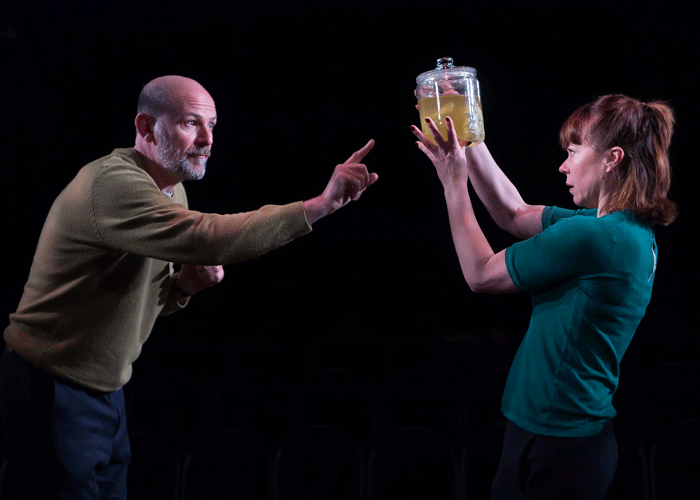
incognitoThroughout Nick Payne’s play, we can see what purports to be Einstein’s brain in a large jar of formaldehyde, so that it is almost as if the audience is being taunted by being told that this is what we would need in order to understand what is going on. “Incomprehensible” could have been a more appropriate title for this theatrical equivalent to the Rubik’s cube. In fact, we are told that Einstein’s brain, when dissected and examined under a microscope, looked like any other and that is as far as Payne goes in considering anatomical questions. His play is about the brain in a metaphysical sense, its functions and malfunctions. Several connected stories, spanning different decades and different continents, are intertwined in a complex structure, with four actors taking all the roles, switching rapidly from one to another, sometimes whilst on stage, with only changes in accents to help us to identify them. The play’s text is on sale at the Bush and it needs to be read before seeing the play performed, or maybe before seeing it performed for a second time. Not having read it, I often needed to glance at surtitles for the hearing impaired to get help with character identification. All that said, the feelings of bewilderment and disorientation which the play generates could well add to enjoyment of it by heightening dramatic tension. Maybe we are just meant to savour the individual components and not attempt to piece them together to make a cohesive whole. The actors, Paul Hickey, Amelia Lowdell, Alison O’Donnell and Sargon Yelda are all superb and Joe Murphy’s production moves at a lightning pace to give a constant bombardment on the senses. An entertaining and accomplished 90 minutes, so who cares if the brain hurts a little at the end of it?

Performance date: 13 June 2014

This review was originally written for The Public Reviews – http://www.thepublicreviews.com

Our first sight of Judith comes as she sips a glass of red wine (one of many) and staggers around her cramped London bedsit which is cluttered with cardboard boxes surrounding her unmade bed (an IKEA futon to be precise). Roger Glossop’s very realistic set design, which may owe a little to Tracey Emin, is a reflection of a life in chaos. Judith has been dumped by her longstanding boyfriend and, under the influence of the wine, she calls him and gets through to his answering machine to leave a message informing him that she has bought a packet of henna and some razor blades and will decide in the morning whether to dye her hair or slash her wrists. The plan misfires when Judith’s message is received by her ex’s new partner, Ros, and it is she who arrives at the bedsit to sort things out. Amy Rosenthal’s one act play, first staged in 1999, examines the tensions between the two women, victor and vanquished. In the opening stages, Rosenthal’s crisp and observant dialogue consists almost entirely of gentle sarcasm, but, as the balance of the women’s interaction changes, the emotions felt by both are brought out touchingly. Can it be that sisterly bonds may form notwithstanding the rivalry between the pair? Hatty Preston’s Judith is a ditzy extrovert, and we are never quite sure if she is genuinely heartbroken or if her pride has merely received a superficial wound. She acknowledges that she may have lost her man because she tried too hard to keep him, never realising that all he truly wanted was a steadier relationship. Ros is a less exciting school teacher, charitable in that she buys The Big Issue and exudes sympathy for Judith, but, as played by Nicola Daley, she shows a steely determination to hold on to what she has gained. This is not a play to set off fireworks. It is low-key throughout, lacking in dramatic high points and real bite. However the development of the two characters through sharp writing and well rounded performances is ultimately satisfying and, running for just 50 minutes, it never threatens to outstay its welcome.

Performance date: 12 June 2014

thepublicreview_hor_web copy

Attachment-1When seeing Putting it Together, the recent revue of Sondheim songs, the problem was disassociating the songs from the shows from which they originated. With this revue of musical theatre songs by Andrew Lippa, the opposite problem arises – not being able to associate them with their source material – and the problem is an acute one because some of them are so completely brilliant that they spur a desperate need to see the shows without delay. Lippa, Leeds born and American raised, has been a victim of the difficulties that have arisen in recent years in transferring original works of American musical theatre across the Atlantic, but, hopefully, that could be about to change. The Menier’s own David Babani conceived this review jointly with Lippa and he also directs, so could that mean that he has an eye on bringing one of the shows here to this small venue which has already done so much to further the cause of musical theatre in London? Maybe, but, in the meantime, the ball is already rolling as Lippa’s The Addams Family is being staged at the Assembly Hall throughout the Edinburgh Fringe Festival in August. This show is performed by three of the most accomplished stars of musicals – Damian Humbley, Caroline O’Connor and Summer Strallen – joined by Andrew Lippa himself, who anchors the show, shares piano duties and performs several of the numbers. He proves to be a ready-made cabaret act with smart anecdotes, quick wit and the gift for forming a natural repartee with the audience. He begins by telling us how, in the early 1980s, he had a date which included listening to the cast recording of Sweeney Todd and how this led to him falling in love, not with his amorous companion but with Stephen Sondheim. Clearly the love affair continues, because the prime influences in Lippa’s work both as a composer and a lyricist are Sondheim and everything that influenced Sondheim. There can hardly be a higher compliment and what a cause for celebration it is to suddenly discover that the great man has an heir who is 35 years younger and probably has his best years still to come. Delights here include, from The Addams Family, Humbley plastered in white make-up as Fester chanting The Moon and Me and the company performing the gloriously optimistic (Death is) Just Around the Corner. The song that gives this review its title is performed by Strallen as a drunk struggling to stay upright and, also from The Wild Party, the utterly hilarious lesbian lament An Old Fashioned Love Story  gives O’Connor the opportunity to stop the show for five minutes. The songs range from the outright comic to the heartbreaking and Lippa ends with extracts from his new choral work I Am Harvey Milk. This is an evening of marvellous melodies and magical rhymes that tickle the funny bone one second and pierce the heart the next and, throughout, there is a synchronicity between music and words that seems extra special because both come from the same writer. On its own, this sampler box merits a long run, but what makes it more exciting is that it could be only a foretaste of goodies to come in the shape of productions of the full shows. A terrific appetiser.

Performance date: 8 june 2014