Archive for the ‘Uncategorized’ Category

Photo: Alastair Muir

Writer: Noel Streatfeild

New version: Kendall Feaver

Director: Katy Rudd

⭐️⭐️⭐️💫

At a time when theatres everywhere are filled by pantos, Scrooge, Petr Pan, etc, the National Theatre again chooses to take a different route for the festive season. Katy Rudd’s version of Noel Streatfeild’s 1936 novel, Ballet Shoes, adapted by Kendall Feaver, dances back into the Olivier Theatre for the second successive year,  hoping to charm and delight kids of all ages.

Streatfeild makes her story a celebration of English middle class values in the first half of the 20th Century, thereby establishing it in territory that is enduringly fertile for popular children’s fiction. Three orphaned baby girls – Pauline (Nina Cassells), Petrova (Sienna Arif-Knights) and Posy (Scarlett Monahan) – are taken in by Great Uncle Matthew (Justin Salinger), an absent-minded palaeontologist who quickly becomes simply absent, having installed them in his rambling South Kensington mansion, where they are surrounded by bones and fossils.  The three “sisters” are left in the care of teenage Sylvia (Anoushka Lucas) and her childhood nanny (Lesley Nicol).

Posy has inherited a pair of of ballet shoes from her birth mother and she develops a passion for dancing. Pauline aspires to become an actor at the dawn of the motion picture era, while Petrova becomes obsessed with aviation. The story follows the girls through their formative years and on towards achieving their aspirations, encountering many stumbling blocks and financial hardship en route. The mix of of cutesy kids and eccentric adults is fairly standard, but the messages are all positive, emphasising that anything is possible if you pursue your passions, particularly at a time when new opportunities are opening up for young women.

Frankie Bradshaw’s set design favours an open stage over recreating the creepy atmosphere of a house full of skeletons, but there is plenty of room for several appearances by a glorious vintage car, the property of lodger Jai (Rai Baiaj). Faced with a story that is largely grounded, Rudd is left with few opportunities to create the eye-popping spectacles that can draw youngsters in. There are several longish passages of just dialogue during which the attention of younger children could wander and the director attempts to counter this with dance routines, performed mainly to jazz age music and choreographed by Ellen Kane. There is even a flight scene, but these additions feel like diversions that do not connect fully with the main narrative.

Maybe Ballet Shoes is not destined to join the ranks of festive classics that will turn up year after year in the future, but this National Theatre production is staged handsomely and performed strongly by a company of 25, making it a cheery treat. 

Performance date: 25 November 2025

Photo: Danny Kaan

Writer: Michael McKeever

Director: Christopher Renshaw

⭐️⭐️⭐️⭐️

Charlie Chaplin and Alfred Hitchcock have established link between south-east London and Hollywood, so perhaps Elephant & Castle is as good a place as any to stage The Code, Michael McKeever’s new one-act play exposing the dark side of the American film industry. 

It is 1950. We are in what many describe as the “golden age“ of movies, during which the big studios and the executives who run them reign supreme. The “Hollywoodlamd” sign towers above Ethan Cheek’s smart set design, representing  a cocktail lounge where Tallulah Bankhead (Tracie Bennett) is already slightly tipsy. She had been one of the biggest names in the early days of movies, but her star is now fading rapidly. She still works both in Hollywood and on Broadway, but she is overlooked repeatedly for the plum roles and she remains bitter over having missed out on Scarlett O’Hara more than a decade earlier. The difficulty, she tells us, is that studio bosses regard her as too risky, because of her known promiscuity with both men and women and her willingness to talk openly about sex. The studios demand that their stars adhere to a strict moral “code” which dictates how they behave in private as well as in public.

Tallulah is joined by Billy Haines, possibly the biggest male movie star on the planet during the 1920s and early 1930s until his career had been wrecked by his refusal to comply with his studio boss’s demands for him to get married and end his long-term homosexual relationship. Billy had risen like a phoenix from the ashes of his film career to establish himself as a prominent interior designer with a long list of A-lust clients. He believes that he now stands as living proof that there are more important things in life than film stardom.

Happily, Bennett herself is nowhere near to becoming a fading star. She gives Tallulah similar swagger to that of her West End performance as Judy Garland in End of the Rainbow, inebriated and fragile, yet unashamedly flamboyant and gleefully vulgar. It is great credit to Partridge that he is never overshadowed by this tor de force; his proud, dignified Billy gives the play emotional depth and heart. Together, these actors make a glittering pair of code breakers.

In its opening stages, director Christopher Renshaw;s production feels sluggish in places; it is merely a conversation piece, all back stories and no front story. This all changes with the arrival of sleazy agent Henry Willson (Nick Blakeley) and his latest protege, naive young actor Chad Manford (Solomon Davy). Pressure is mounting on Chad to sacrifice his gay relationship in pursuit of fame and fortune, but will he succumb or will he follow Billy’s example and be true to himself? The play now finds the dramatic tension that it had needed from the beginning.

Written crisply and performed with flair, The Code trades heavily in showbiz gossip, most of which should by now be well known. However, there may be some who still buy into Hollywood myths and this is certainly a play to open their eyes.

Performance date: 17 September 2005

Photo: Helen Murray

Writer: Shaan Sahota

Director: Daniel Raggett

⭐️⭐️⭐️⭐️⭐️

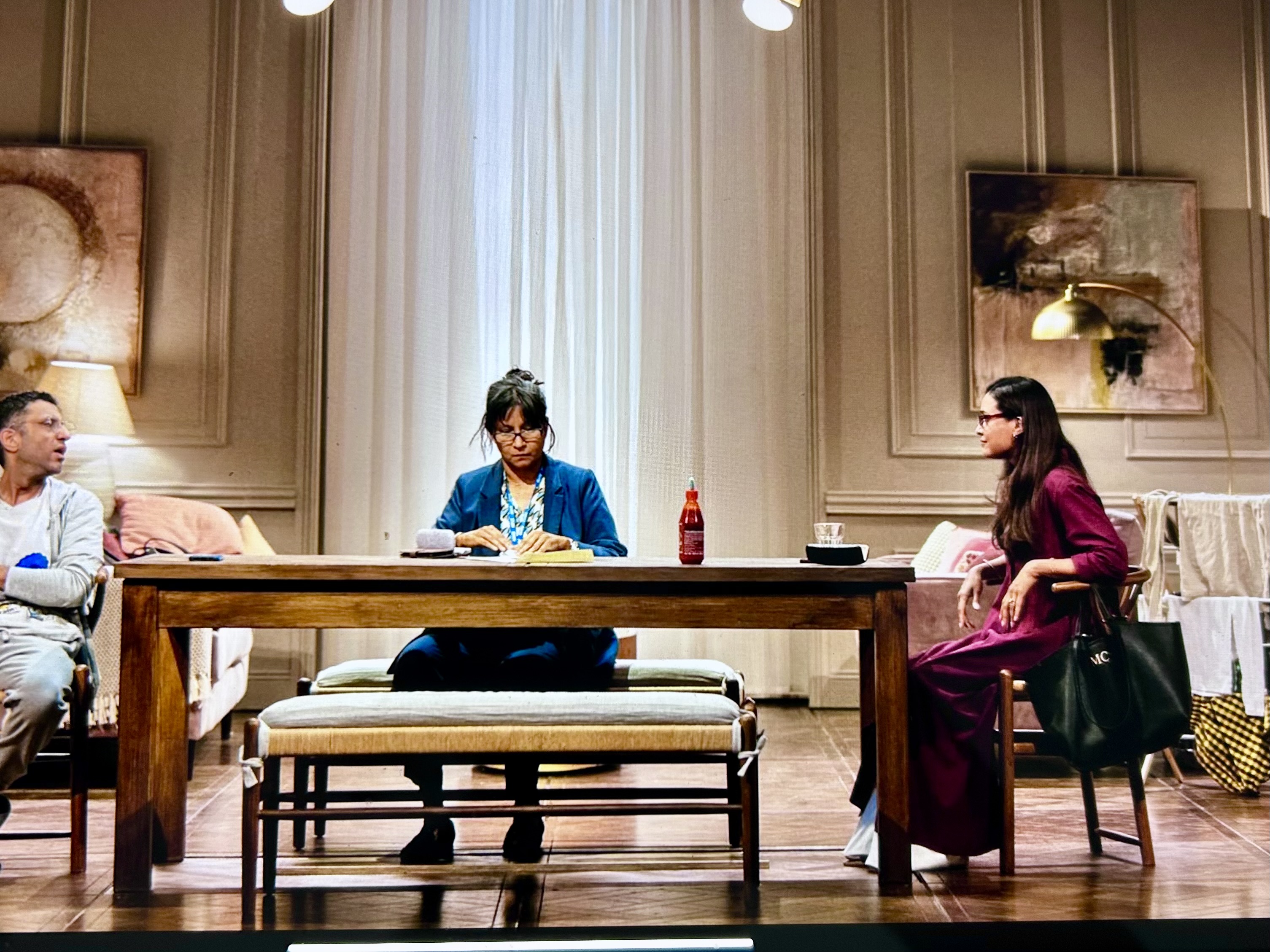
Shaan Sahota’s debut play, The Estate. a comedy, dips into dangerous waters as it centres around a Member of Parliament of Sikh heritage who is aspiring to climb to the top of the Westminster ladder. Added to politics, race, religion, gender inequality, cultural tradition and family loyalties are all thrown into the mix in a venture that, at first glance, looks foolhardy, But is it?

The play is marked by the freshness and fearlessness of a first time playwright. Sahota, a British Asian herself, has much to say about merging deeply contrasting cultures and she does so with great sensitivity and rich humour. The play begins as a political satire in the style of The Thick of It. It is one year before a General Election and the Leader of the Opposition has resigned. Angad Singh (Adeel Akhtar) sees himself as a contender for the vacancy, encouraged waveringly by his assistants, Petra (Helen Wilson) and Isaac (Fode Simbo), but discouraged by the pompous party whip, Ralph Hughes (Humphrey Ker).

The set, designed by Chloe Lanford, at first an austere Westminster office, opens out to begin a new story centring around Angad’s private life. He has a wife, Sangeeta (Dinita Gohil) and a baby daughter, but his father, who had arrived in Britain in the 1970s to work as a baggage handler, has just died. Angad’s older sisters. Malicka (Shelley Conn) and Gyan (Thusitha Jayasundera) arrive in town for the funeral and the reading of a will in which they find themselves cut out in favour of the only son, as would have been normal in the patriarchal society to which their father had belonged. The sisters are incensed and, unless Angad agrees to give them what they believe to be their fair shares, they threaten to sabotage his career with revelations of trivial misdeeds from the past.

There is enough material here to feed a meaty drama, so how does the play manage to fill the Dorfman Theatre with laughter throughout its 140-minute (including interval) running time? Aside from the writer’s wit, much credit goes to director Daniel Raggett’s beutifully balanced production and to Akhtar’s astonishing lead performance. His Angad is an underdog and a leader, surreal and human. Raggett gives free rein to Akhtar’s clowning and the introduction of physical comedy feels inspired, throwing a bright light on the lunacy of what is going on in Angel’s world.

The many serious themes are never totally overwhelmed by the production’s comic content and there is much to discuss afterwards. However, it is the lighter that will linger longest in the memory. The Estate is frantic and its focus sometimes gets fuzzy, but, when all its pieces fall into place, it is poignant and absolutely hilarious.

Performance date: 17 July 2025

Photo contributed

Writer: James Inverne

Director: Daniel Slater

⭐️⭐️⭐️

Peter Shaffer’sAmadeus set a high bar for plays about rival composers and writer James Inverne enters similar territory with That Bastard Puccini, a drama about the competition between Giacomo Puccini and Ruggero Leoncavallo to produce the most successful version of La bohème. One of them would bask in the warmth of public acclaim while the other would feel more frozen than heroine Mimi’s tiny hand.

In Milan, 1893, Leoncavallo is being labelled a one hit wonder, seemingly incapable of following up the enormous success of his opera Pagliacci. He mentions to his friend Puccini that his next project will be to adap works by French writer Henri Murger, to which Puccini replies “me too”. Leoncavallo bursts into barely controlled rage, accusing his friend of stealing his idea and various other acts of plagiarism, while Puccini remains placid, seemingly not concerned that there will be two operas, both entitled La bohème, being staged concurrently and, eventually, both will appear at different theatres on the same street in Venice on the same night.

Sebastien  Torkia’s arrogant, sneering Puccini certainly merits the unflattering description of him in the play’s title, contrasting sharply with the frenzied rage of Alasdair Bucham’s Leoncavallo. Lisa-Anne Wood intervenes in the dispute as Berthe, Leoncavallo’s supportive wife and she also contributes impressively singing short extracts from the operas. The enthusiasm of this trio of actors gives director Daniel Slater’s production all its energy.

Lacking the scale and ambition of Amadeus, Inverne’s play takes a long time to develop a sense of direction. Foreknowledge of the outcome of the composers’ battle robs the drama of its tension and gaps are filled with hit-or-miss comedy, often involving the actors taking on subsidiary roles such as that of Gustav Mahler. 

A pedestrian first act meanders aimlessly, frequently laden with stilted scene-setting dialogue, but there is a distinct improvement after the interval when the writer finally reveals the play’s purpose, which is to discuss the processes for creating great art.

Overall, That Bastard Puccini is lightweight and patchy, mildly entertaining even though slightly off key. However, Puccini’s version of La bohème was itself received poorly by Italian critics when it premiered in Turin; taking this as a precedent, Inverne’s play could yet have a bright future.

Performance date:15 July 2025

Photo: Amanda Searle

Creator and performer: Dickie Beau

Director: Jan-Willem Van Den Bosch

⭐️⭐️⭐️⭐️

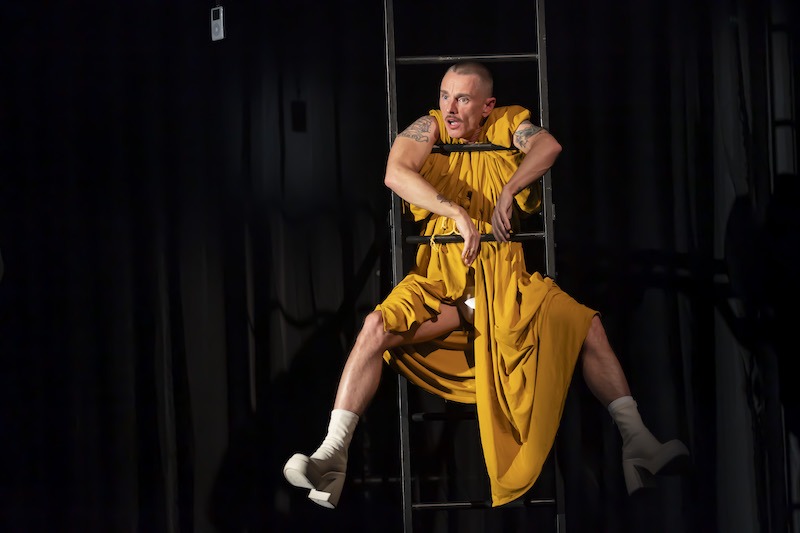
Early arrivals for performances of Showmanism can look up towards the high ceiling of Hampstead Theatre’s main house to see the show’s creator and star clambering around precariously on scaffolding while reciting familiar tongue twisters. He is actor, impersonator, drag artist and flamboyant showman Dickie Beau. It is a startling prelude and when, eventually, the show comes down to earth, it does so only in the most literal sense.

First seen at the Theatre Royal Bath in 2022, Showmanism is a discussion of all things theatre, looked at from a perspective that is wildly eccentric and mildly queer. Beau is self-analytical when considering the psyche of actors, going on to assert that audiences are themselves key parts of performances. His illustrations range from Ancient Greece, through the Shakespearean era and the Oberammergau Passion plat to the present day. As Beau’s last appearance here was in Tom Stoppard’s The Invention of Love, he may feel that Hampstead audiences have been well prepared for a certain level of intellecyia;ism, particularly with regard to the classics.

So, in essence, is this a lecture best suited for scholars or RADA students? Well, maybe, but Beau livens it up with voices ranging from David Cameron to Cilla Black. Most notably, it is the comforting tones of Sir Ian McKellen that guide us through, almost as if the actor himself had lived through all the ages of civilisation. Also, director Jan-Willem Van Den Bosch makes sure that Showmanism is a real show for the whole of  its running time of 95 minutes straight through.

Justin Nardella’s elaborate set and dazzling costume designs would be fit for a West End musical, while Marty Langthorne’s lighting designs create striking images. However, none of these fireworks  can eclipse the astonishing fire of Beau himself, which is fuelled by insight, honesty and mischievous humour. The lasting effect is weirdly mesmerising, funny, profound and even spiritual. 

Beau finds time for an excoriating assessment of the contributions of critics, so, in retaliation, it feels necessary to point out that his show is uneven, often losing focus and cohesion. Showmanism is a very long way from being perfect, but its star has a magnetic presence which makes it extraordinary.

Performance date: 23 June 2025

Photo: Marc Brenner

Writer: David Adjmi

Original songs: Will Butler

Director: Daniel Aukin

⭐️⭐️⭐️⭐️

By the mid-1970s, the Beatles-led invasion of British pop had faded in America, being replaced in part by country influenced soft rock bands such as The Eagles and Fleetwood Mac, who sold millions of vinyl albums to be heard by avid fans on their stereo music centres. David Adjmi’s multiple Tony Award-winning play with songs focuses on a fictional band in this mould. It proposes that out of chaos magic emerges, a theory that is advanced further by the play itself.

In style, director David Aukin’s production could be seen as a cross between an Annie Baker play and a juke box musical. Baker is an American dramatist whose work, seen several times during the last decade at the National Theatre, is noted for its slow progression and long silences. Here, the lethargic feel purports to imitate real life, but, at the same time, it gives a surreal air to the production which, over time, becomes mesmerising.  Undoubtedly, the pace and pauses are factors contributing to a perhaps excessive running time of three and a quarter hours (including interval).

Baker located one of her plays in a near empty art house cinema and Adjmi consigns his characters to being dwarfed equally in a Los Angeles recording studio, which is realised beautifully in David Zinn’s imposing two-level set design. Remarkable work by lighting designer Jiyoun Chang further heightens the production’ visual impact.

Adjmi does not use a central narrative to drive the play, instead examining the behaviour of the seven individuals gathered together to record their new album. These are people for whom the pressure of fame is equalled only by the fear of anonymity. We witness their egos in full flow, their neuroses, their make-ups and break-ups, their drug taking and we get to glimpse their musical talent. Lucy Karczewski is particularly striking as the unstable singer/songwriter Diana, Zachary Hart impresses as the addicted Brit bass player Reg. However, it feels unfair to single them out from the other outstanding actor/musicians who are: Andrew R Butler, Eli Gelb, Jack Riddiford, Chris Stack and Nia Towle.

When the drama gets sluggish, as it often does by design, Will Butler’s excellent 1970s-style rock songs act as an instant pick-me-up. They are so authentic that it is tempting to check that they were not genuine smash his of that era. They were not, but they should have been.

Stereophonic, already a huge hit with New York critic, could present challenges for West End audiences who are unaccustomed to this style of theatre. It is long and slow, but it is also bold and rewarding. The best advice is to go to see it and stick with it. 70s rockers and many others should find it a blast.

Performance Date: 14 June 2025

Photo: Johan Persson

Writer: Bernard Shaw

Director: Dominic Coole

⭐️⭐️⭐️⭐️

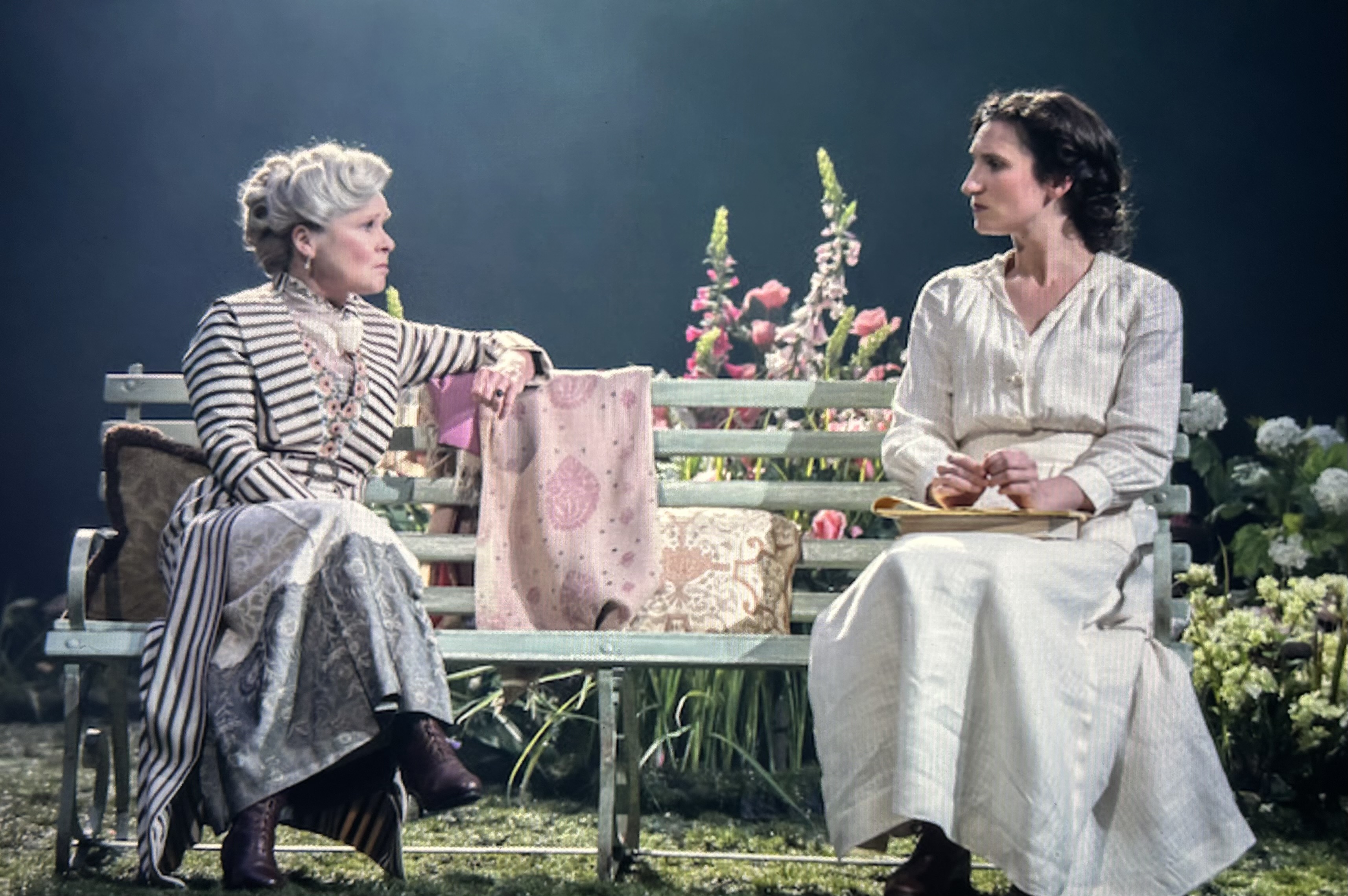
Ignoring the advice offered in Noël Coward’s famous song, Dame Imelda Staunton has gone ahead and put her daughter, Bessie Carter, on the stage. Indeed, she now goes one stage further by sharing a stage with her in director Dominic Cooke’s classy revival of George Bernard Shaw’s 1902 play Mrs Warren’s Profession; perhaps inevitably, the pair play mother and daughter.

Not for the only time, Shaw sets out to puncture the facade of refinement and gentility surrounding the English upper middle classes of his age and he expose the hypocrisy  that hides behind it. The profession of the play’s title is that which is often referred to as “the oldest” one and, accordingly, it was only performed in private members’ clubs for many years after it was written. Nowadays, it should be regarded as, in more ways than one, family friendly, notwithstanding the theatre’s somewhat surprising 14+ age recommendation. Could it be that traces of Edwardian prudishness still linger on?

Writing at the dawn of female emancipation, Shaw uses the play to examine the changing roles of women in society. Vivie Warren has been raised and tutored in rural England and she is now ready to make her own way in the world, not as a dutiful wife, but as an independent professional woman. Carter is splendid in the role. instantly dispelling thoughts of nepotism. Vivie awaits the arrival of her mother, Kitty, breaking into her business travels around Europe to make a rare visit. Staunton slightly underplays the role, surprisingly not fully exploiting the comic potential of Kitty, although, very occasionally, she allows glimpses of vulgarity to appear through the character’s air of refinement.

The balance between the two key performances could reflect a view by Coole that Shaw wanted the play’s primary focus to be on Vivie. Kitty had financed her daughter’s upbringing, expecting her to grow into the role of a lady of her own generation, only to see the emergence of a very modern woman. Vivie has suitors in the earnest Mr Praed (Sid Sagar) and the naive Frank Gardner (Reuben Joseph), son of a clergyman (Kevin Doyle) who had known Kitty in the past, but she rejects them in favour of keeping control over her own life. Kitty is accompanied by her friend and, it transpires, business partner Sir George Crofts (Robert Glenister in villainous mode), who also has his eyes on Vivie, but his offers of status and financial security are swiftly turned down.

Essentially, Shaw sees Kitty and Vivie as the same woman born into different generations and now divided by the circumstances into which society has forced them.  Cooke counters the writer’s reputation for being wordy and worthy with a streamlined staging in which even Chloe Lanford’s elegant set designs are notable for their simplicity. Scenes change quickly and speeches are delivered briskly, all fitting into 105 minutes with no interval. Strangely, the company is augmented by the occasional appearances of a non-speaking chorus in the style of ancient Greek drama. It is not entirely clear what purpose this serves, but if it keeps decent actors away from having to wait tables, it is to be welcomed,

Leaving aside the play’s slightly scandalous subject matter, Coole’s revival gives us a flavour of what a night out in the West End may have been like a century or more ago. The Garrick Theatre has probably not changed very much and the production is utterly conventional without ever being dull.

Performance date: 28 May 2025

Photo: Pamela Raith

Music and lyrics: Stephen Sondheim

Writer: Aristophanes

Adaptors: Burt Shelvelove and Nathan Lane

Director: Georgie Rankcom 

⭐️⭐️💫

Let’s face it, even William Shakespeare had a few bad days at the office, so it should come as no surprise that, among the masterpieces of Stephen Sondheim, there lie some green slimy things. Maybe it is a little uncharitable to remind enthusiasts for the late God of musical theatre of this, but director Georgie Rankcom’s off-West End revival does so and makes a valiant attempt to turn The Frogsinto a prince among musicals.

A big surprise is that The Frogs premiered after Sondheim’s sophisticated hit A Little Night Music; a surprise because it has all the feel of a year-end college revue by a bunch of Classics undergrads. This could be down to the fact that, in its early form, with a book by Burt Shevelove, the show did the rounds of universities, opening at Yale gymnasium in 1974, with Meryl Streep and Sigourney Weaver in the chorus. The version seen here has a new book by Nathan Lane, who starred in the first Broadway production in 2004. The United Kingdom  premiere came at London’s tiny Jermyn Street Theatre in 2017.

We are told at the outset that the time is the present and the place is Ancient Greece. Freely adapted from a BC405 Greek comedy by Aristophanes, the story tells how the ranidaphobic God of Drama, Dionysos (Dan Buckley) and his upstart slave, Xanthias (Kevin McHale) set off for Hades on a mission to retrieve George Bernard Shaw (Martha Pothen), eventually opting for William Shakespeare (Bart Lambert) in preference. The journey is plodding, but Buckley and McHale make up a pleasing double act in the Laurel and Hardy style.

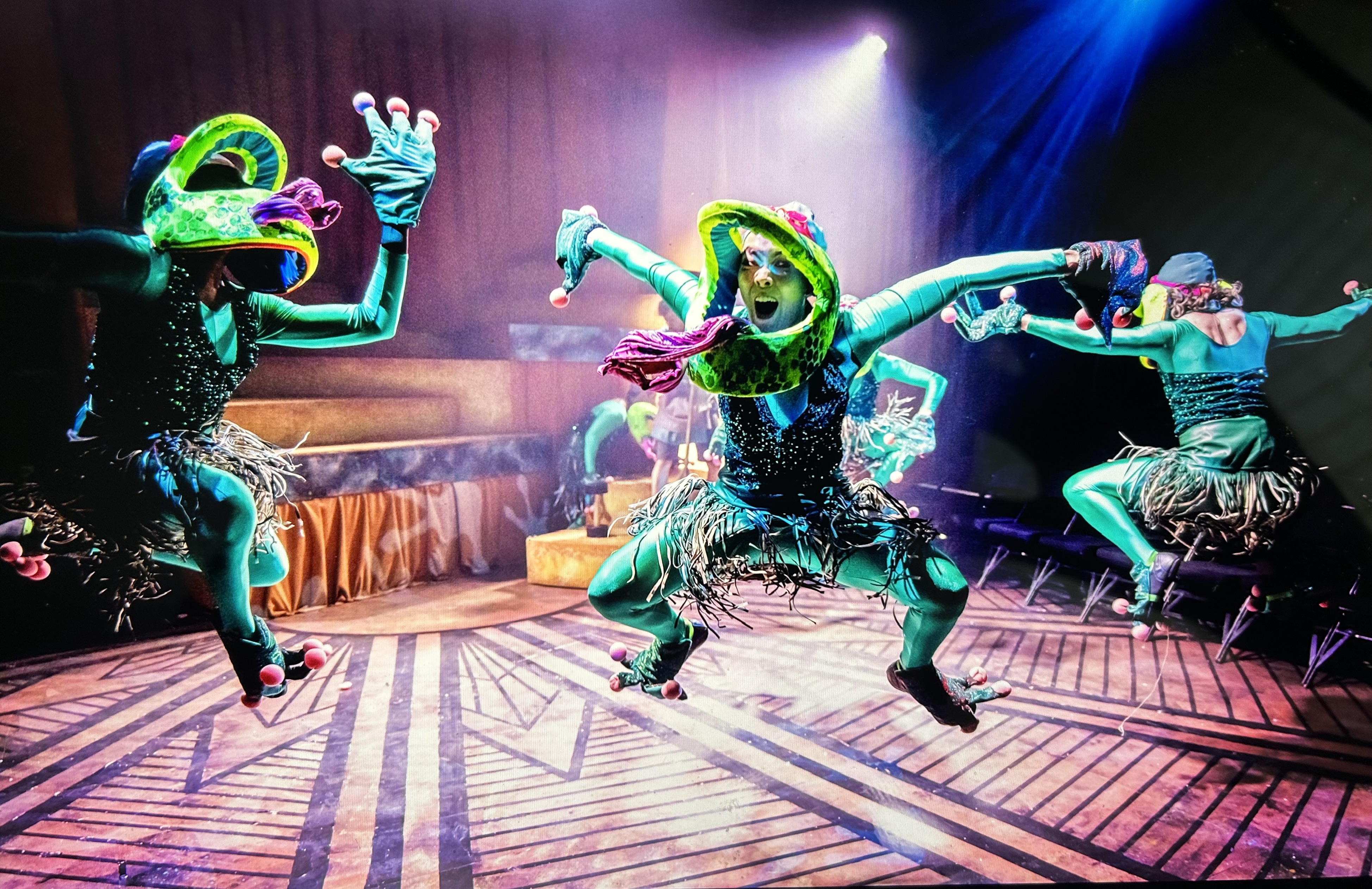
On the road, the pair meet up with Dionysos’ brother, Heracles (Joaquin Pedro Valdes), taking a break from his labours to give guidance on fashion, and an aggressive ferryman, Charon (Carl Patrick overacting towards the point of stealing the show). Things go wrong when Dionysos is kidnapped by frogs and the second act, set in Hades, is much like Hell for the audience, culminating in a seemingly interminable battle of words between the two playwrights.

The show has none of Sondheim’s most instantly recognisable songs, but the ones that are here have much merit and, generally, the lyrics are stronger than the music. The problem with the show is not the songs, they are the highlights as progress creaks and croaks between them. The book is ridiculously self-indulgent, mixing high brow arguments with low-brow topical gags while, at the same time, submerging itself in a sea of silliness where even the hardiest of amphibians would struggle to stay afloat.

Rankcom’s production often feels lifeless between the songs, but it redeems itself when the six-member chorus bursts into action, particularly for The Frogs and Hymn to Dionysos on either side of the interval and It’s Only a Play, later. Here, the work of choreographer Matt Nicholson is outstanding and it stretches to high camp with the appearance of glamour queen Pluto (Victoria Scone), inserted as if a cabaret act, to perform Hades.

In the early 1970s, perhaps Sondheim was still learning how to expand the boundaries of musical theatre and it is interesting to discover some seeds of later successes being sown here. Even so, the highlights of The Frogs are all musical ones and they come as oases in a fairly arid desert.

Performance date: 27 May 2025

Photo: Mark Senior

Writer: Alice Childress

Director: Monique Touko

⭐️⭐️⭐️⭐️

American writer Alice Childress wrote during turbulent times about other turbulent times. Her play, Wedding Band… was first performed in 1966, when Civil Rights protests were at their height and war was raging in Vietnam, and it is set in the Deep South in 1918, when racial tensions were at boiling point, Spanish Flu was beginning to spread across the world and war was raging in Europe. There is more than enough drama here to warm up a cool Summer evening in Hammersmith.

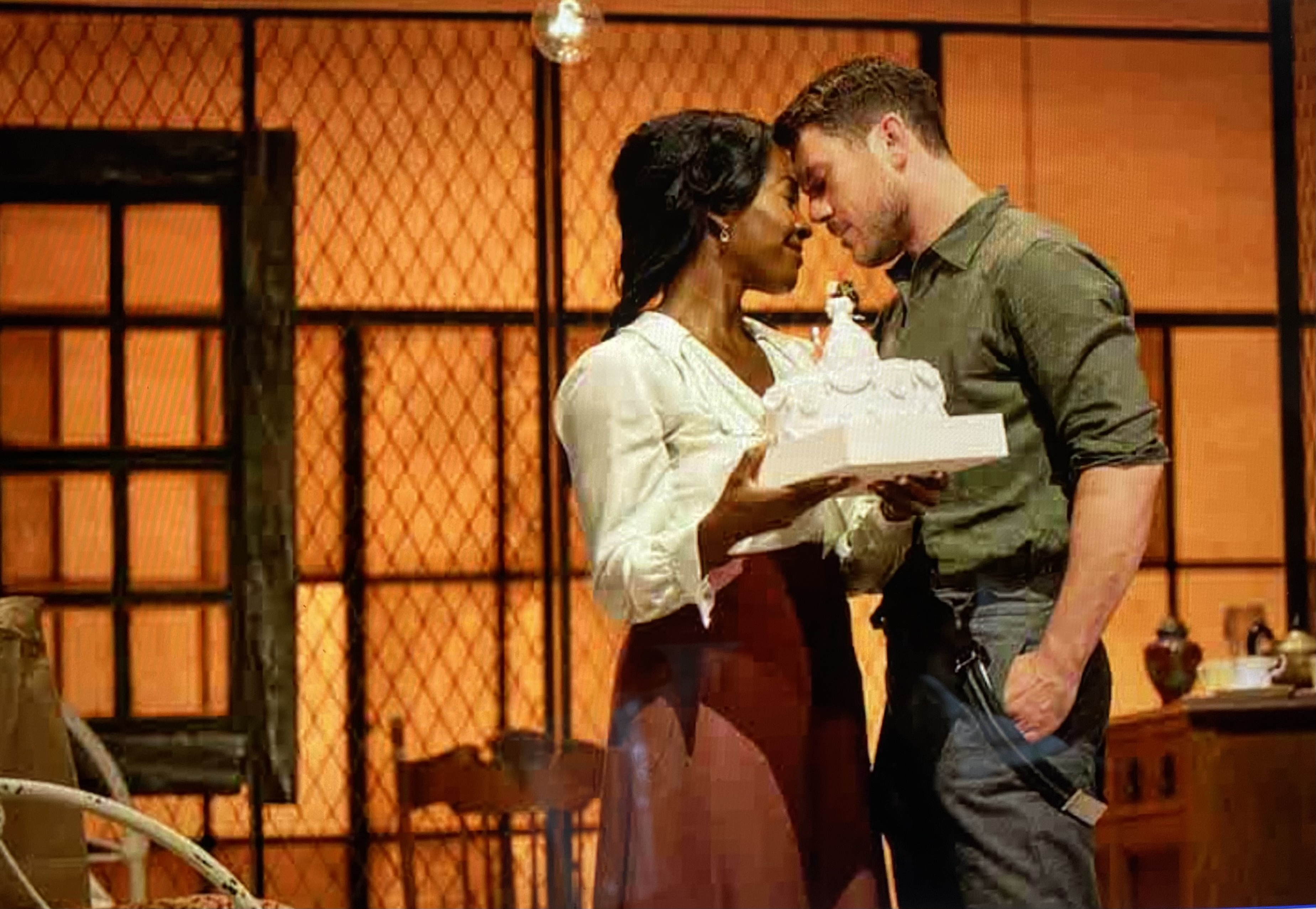
Childress tells a Romeo and Juliet-type story of two lovers coming from opposite sides of a community that is torn apart. Julia (Deborah Ayorinde) is a black seamstress and Herman (David Walmsley) is a white baker. They have been together for 10 years in a covert relationship, but interracial marriage is still illegal in their State, South Carolina and they know that they must move north to formalise their union. However, once their relationship becomes known, the law is a lesser problem than the deep-rooted prejudices of their friends and families.

With a strong company of 11, director Monique Touko’s lively production paints a vivid picture of the divided community. Buildings are represented in skeletal form in Paul Wills’ set design, enriched by changing colours in lighting designed by Matt Haskins. The atmospheric staging is enhanced further by the playing of gospel music in the background.

The trigger for the drama comes when Herman comes down with Spanish Flu. Julia pleads for a doctor to be called, but she meets resistance all round as Herman’s domineering sister and his spiteful, foul-mouthed mother seek to take control. Herman in his sick bed lies centre stage while competing forces circle like vultures around him. Throughout, Touko provides the imagery to match the poetry in the writing.

An astonishingly powerful performance by Ayorinde lies at the heart of this production’s success. Defiantly wearing a white wedding dress, she exudes love and anger in equal measures. This play could easily have lunged towards romantic melodrama, yet it stops well short of that partly due to skilful playing, but mainly due to the writer’s clarity in making her central characters common people with simple aspirations and not heroes.

Wedding Band…is written to shock, but it would be interesting to know if the audiences’ gasps of horror in the London of 2024 come at the same points as those in the play’s home country in 1966. Much has changed, but Childress asks questions of the modern world as much as she interrogates history.

Performance date: 6 June 2024

Photo: Isha Shah

Writer: Sarah Gordon

Director: Natalie Ibu

⭐️⭐️⭐️⭐️

In the 1840s, when the nights were cold and blustery on the Yorkshire Moors, if there were no good books to read, it seems that the best thing to do would have been to write them. Such was the case with the legendary Brontë sisters who provide the inspiration for Sarah Gordon’s new play, a compelling tale of sisterly rivalries blended in with 19th Century gender politics an 21st Century celebrity culture.

The Dorfman Theatre is introduced to re-wilding in set designer Grace Smart’s representation of the drama’s primary location and, even though the vegetation disappears from view, it leaves behind a sense of the characters’ earthiness, their language being peppered generously with fruity modern-day expletives. As Gordon examines the dynamics of female relationships, her hypothesis is that the “other other” sister is Anne, the youngest, who is overshadowed unjustly by the domineering Charlotte, the oldest, and by Emily, whose novel Withering Heights is already acknowledged to be a great work.

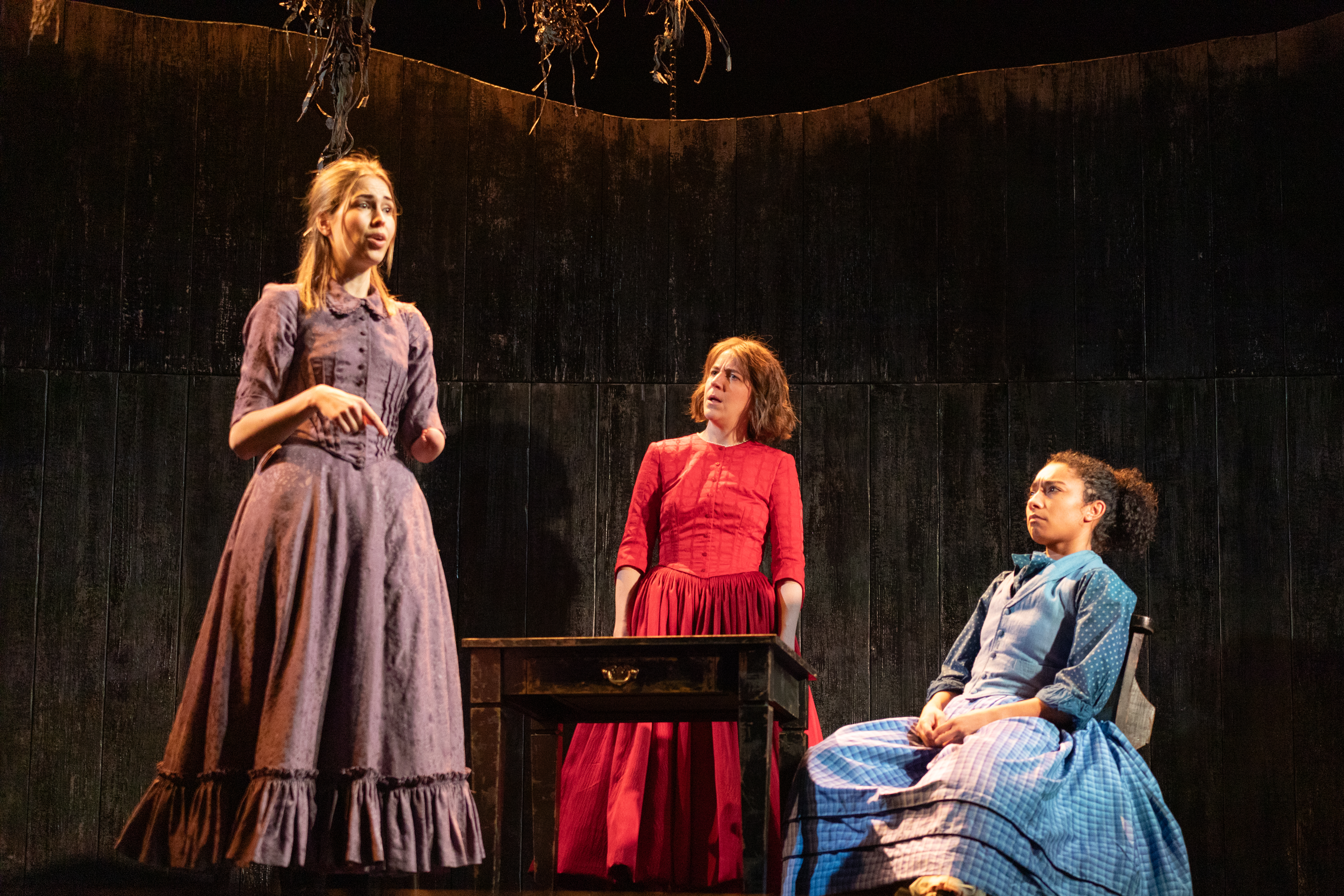
Gemma Whelan’s Charlotte, dressed all in bright red,  is ambitious and surprisingly cold-hearted. It is she who advocates the sisters working together, encouraging and supporting each other as they strive to succeed as writers. In fact, collaboration turns into competition and jealousy. Gordon shows us Charlotte shamelessly plagiarising Anne’s debut novel, Agnes Grey, when writing Jane Eyre and, later, going on to suppress The Tenant of Wildfell Hall, Anne’s hard-hitting account of early Victorian society.

Anne (Rhiannon Clements) fights in vain to resist Charlotte’s dominance, while Emily (Adele James) stands between them. With the sisters being forced to publish their works under male pseudonyms, Gordon turns a strong spotlight on the subservience of women in Victorian society, adding sly references to modern-day gender inequalities. She also shows sympathy for the fourth sibling, rarely sober brother Branwell (James Phoon), who finds himself incapable of living up to the expectations for a man in that era.

Written with strong hints of sarcasm, the play is a sometimes uneven mix of drama and broad comedy, held together by an overriding tone of irreverence. Director Natalie Ibu’s snappy production, making good use of a revolving stage, captures the tensions of the sisters’ clashes and then switches seamlessly to something like pantomime, with Nick Blakeley making a couple of appearances as “dames”.

The story of these three women who left an indelible mark on English literature has been told many times before and, in factual terms, Gordon adds little that is new. However, she uses the story as a vehicle for expressing many intriguing ideas and, seen in a production that is acted with conviction and impressively staged, her play is richly entertaining. The National Theatre is on a high at the moment and the clumsily titled Underdog: The Other Other Brontë looks likely to become another another success.

Performance date: 4 April 2024