NO I.D. (Royal Court Theatre)

Posted: April 20, 2023 in Theatre

photo: Marc Brenner

Writer: Tatenda Shamiso

Director: Sean Ting-Hsuan Wang

⭐️⭐️⭐️

Tatenda Shamiso is a female-to-male transgender entertainer. His story is specific, but it has elements which should resonate with any of us who has wasted hours trying to fit square pegs into round holes or hanging on in a long queue, waiting to hear a real live human being speak at the other end of a telephone helpline.

Shamiso performs his short monologue, speaking in tones of sarcasm and frustration rather than indignation. He was born in California of a Belgian father and a Zimbabwean mother and he now resides in the United Kingdom. He refers to his former self, Thandie, as if she is a girl that he once knew or a friend with whom he has lost touch. She was a shy but precocious child, the apple of her father’s eye.

Thandie’s discomfort at being moulded to conform with conventional society’s ideas of what a girl should be is described wittily and the absurd criteria applied to reach a formal diagnosis of gender dysphoria are passed over with scorn. However, the process of Thandie’s transition to become Tatenda is not the main target for attack in Shamiso’s play. Rather it is the obstacles standing in the way of establishing a new identity once the transition is complete.

Passport and driving licence details must be amended, National Health Service records need changing, His (formerly Her) Majesty’s Revenue and Customs has to be told and so on. The one-size-fits-all mentality of officialdom overwhelms Tatenda as he strives to establish an identity to open the door to the basic essentials of modern life.

Director Sean Ting-Hsuan Wang gives Shamiso the freedom of the stage to dance, sing and play keyboards. He demonstrates the stifling impact of excessive bureaucracy by showering the stage with reams of paper in anarchic style. A mildly amusing hour passes quickly and the play is never less than enlightening. 

Performance date: 19 April 2023

Snowflake (Park Theatre)

Posted: April 20, 2023 in Theatre

Photo: Jenifer Evans

Writer: Robert Boulton

Director: Michael Cottrell

⭐️⭐️⭐️

With Spring well underway, snowflakes should be a rarity in London, as rare perhaps as the arrival  of a taut new thriller in modern theatre. Robert Boulton’s play takes classic elements of the genre and updates them for the internet age.

The writer himself plays Marcus, who we take to be an assassin. He is violently aggressive and boastful of his complete mastery of his trade. He barges into a hotel room accompanied by rookie Sarah, who is on her first mission. Louse Hoare makes Sarah an ambitious career woman, eager to learn from an expert, but wary of what lies ahead.The pair bring with them crates full of DIY tools, giving rise to gruesome thoughts about their intended use. The room’s occupant, Anthony, a famous writer is laid flat by Marcus before the intruders have even announced themselves.

While Anthony lies unconscious on the bed, assassin and apprentice assassin joust with each other, dancing gingerly around the purpose of their mission, but not  fully revealing it. At this stage, the characters feel one-dimensional and, rather than wondering what is going on, it seems more relevant to question whether all this has been seen before. In The Dumb Waiter perhaps? Similar layers of menace prevail, but Pinter’s piercing observations and subversive wit are notably absent.

When Anthony comes round, the play itself wakes up. Henry Davis makes the character a fallible human being, filled with real terror, his face caught in close-up and projected onto a large screen. Through his protracted agony, the play appears to be turning into a parable about trial by Twitter, but then it veers off to sprout other less clear philosophical views. In all, there are too many ideas for them all to gel together successfully. As plot twists are unveiled, the play itself risks twisting itself into knots, but it is saved by a gripping, if excessively violent finale.

Director Michael Cottrell’s compact production suits the Park Theatre’s studio space well and designer Alys Whitehead fills the space with a comfortable modern hotel room, which contrasts perfectly with the discomforting goings on inside it. Overall a high level of suspense is sustained for much of the two-hour (including interval) running time.

Snowflakes marks a promising writing debut for Boulton, but his modern thriller is a patchy affair. At times, it grips like a vice and, at other times, it melts away like a snowflake in April. However, there can be no disputing the power of its climax. Hitchcock could not have staged it better.

Performance date: 17 April 2023

Photo: Pamela Raith

Adapter: Liv Hennessy

Director: Lisa Spirling

⭐️⭐️⭐️💫

Many young boys dream of growing up to become top footballers, so maybe the recent surge in the popularity of the women’s game could lead to young girls having the same dreams. Arguably, such goals would be far more admirable than targeting the seemingly vacuous lifestyles of many WAGs (wives and girlfriends of footballers) which were exposed brutally in the 2022 court case Vardy v Rooney, labelled by the media “The Wagatha Christies Trial”.

Liv Hennessy adapts the proceedings verbatim, compressing them into 90 minutes plus injury time, with a half-time break. In a nutshell, Coleen Rooney (wife of former England captain Wayne Rooney) began suspecting that posts on her private Instagram account were being leaked to the tabloid press and turned sleuth to uncover the culprit. When the finger pointed at Rebekah Vardy (wife of Leicester City striker Jamie Vardy), Mrs Rooney revealed her findings on social media and Mrs Vardy sued for libel.

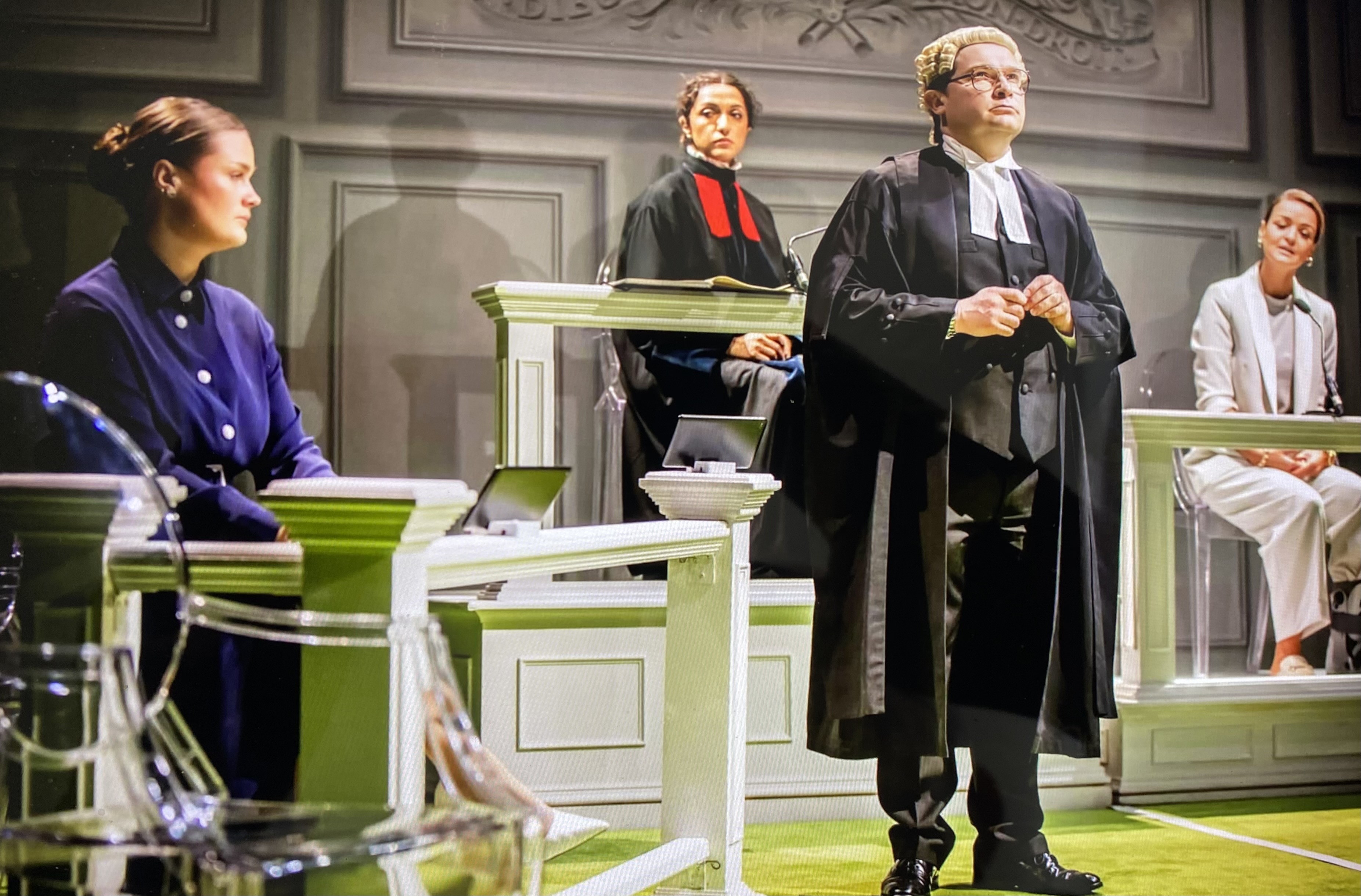
The play offers a running commentary from two “pundits” (Halema Hussain and Nathan McMullen), but, otherwise, the words spoken are taken from the trial itself. Jonnie Broadbent and Tom Turner struggle to keep straight faces as the opposing barristers and Verna Vyas presides over proceedings solemnly as the judge, Mrs Justice Steyn. Director Lisa Spirling realises that the transcript of the trial contains enough comedy to fill an evening and, rather than overplaying the absurdity of it all, settles for an overriding lightness of tone. Fittingly, designer Polly Sullivan’s courtroom set does not look like a place where the death sentence would ever have been handed down.

So, as the two ladies parade before us in their neat designer outfits, we ask (if we care) which of them is in the right and which is in the wrong. This production is hardly neutral, highlighting how difficult it is to avoid taking sides when the characters of real life protagonists are interpreted by actors. There is not much to like about Lucy May Barker’s waspish version of Mrs Vardy, sitting in the witness box with the demeanour of a stony faced reform school headmistress. Barker is great, but her every utterance seems to be encouraging the audience to hiss and boo as they would for the away side in a fierce cup tie.

In total contrast, Laura Dos Santos presents Mrs Rooney as smart, warm, maternal and a long suffering victim of the antics of her allegedly errant husband. If the play’s audiences were asked to vote, it is very likely that they would arrive at the same verdict as that of Mrs Justice Steyn.

The media frenzy surrounding the trial speaks loudly about a modern culture driven by social media and worthless celebrity status. Ironically, a West End play about the trial adds to the frenzy as much as it criticises it. No fiction writer could invent this; it is all so utterly ridiculous that it could only possibly be true.

Performance date: 12 April 2023

Photo: Nick Rutter

Writers: Ricky Simmonds and Simon Vaughan

Director: James Grieve

⭐️⭐️⭐️⭐️

After Thatcher, Blair, Trump and others, former Italian leader Silvio Berlusconi becomes the latest larger-than-life political figure to receive the dubious accolade of having a satirical musical devoted to him. The self proclaimed “Jesus Christ of politicians” proves to be a rich source for mockery.

Berlusconi’s vision of himself as a modern day Emperor Tiberius is endorsed by Lucy Osborne’s set design, which resembles a section of an ancient Roman amphitheatre. The “Friends, Romans and countrymen…” speech could have been delivered to the masses from steps such as these. Adversely, the set occasionally restricts movement in director James Grieve’s otherwise rousing production, ably performed by a company of ten and accompanied by a band of five.

The show is entirely sung through, with writers Ricky Simmonds and Simon Vaughan adopting a musical style that could possibly be influenced by Andrew Lloyd Webber’s Evita. As a whole, the songs are remarkably strong and several are near-showstoppers. The wit in the lyrics matches the catchiness of the tunes. However, the songs appear as a succession of stand alone numbers, thereby giving the show the feel of a series of revue sketches, rather than that of a flowing piece of storytelling.

Sebastien Torkia storms the stage as the title character, exuding all the charisma, ruthlessness and arrogance which led to his success and then his downfall. The narrative is framed by Berlusconi’s 2012 trial for tax fraud. He decides to devise an opera (he insists that it is not a musical) to tell his life story and use in his defence. 

Moulded by a strong mother (Susan Fay), the young Berlusconi sets sail as a cruise ship entertainer, before turning to property development and then becoming a media tycoon. He enters politics and eventually becomes Prime Minister of Italy, Throughout, he is mired in controversy and scandal, mostly surrounding his shady business dealings and his serial womanising. Emma Hatton gives a moving performance as Veronica, his long-suffering second wife.

As a satire, the show really takes off at the beginning of the second act. A night club dancing scene demonstrates the thin line between politics and show business and then Berlusconi joins a bare chested Vladimir Putin (Gavin Wilkinson) in a chilling, but hilarious duet which resembles a bizarre courting ritual. This is followed by an equally hilarious sequence in which Berlusconi strides the world stage with the heads of G7 leaders popping up from below him. It all leads to a finale in which, the chorus faces the audience and sings “Be Careful Who You Vote For”. The audience response could well be “Si”.

If Berlusconi… brings little in the way of enlightenment, it compensates in the form of entertainment, offering more than enough highlights to fill an evening. However, the show needs tightening up in many places. It goes on for far too long, in common perhaps with the political career of the man himself.

Performance date: 29 March 2023

Killing the Cat (Riverside Studios)

Posted: March 24, 2023 in Theatre

Photo: Danny Kaan

Book and lyrics: Warner Brown

Music: Joshua Schmidt

Director: Jenny Easton

⭐️⭐️⭐️

The theory that opposites attract is put to the test rigorously in Killing the Cat, a new chamber musical that is receiving its world premiere at Riverside Studios prior to a planned Off-Broadway run. 

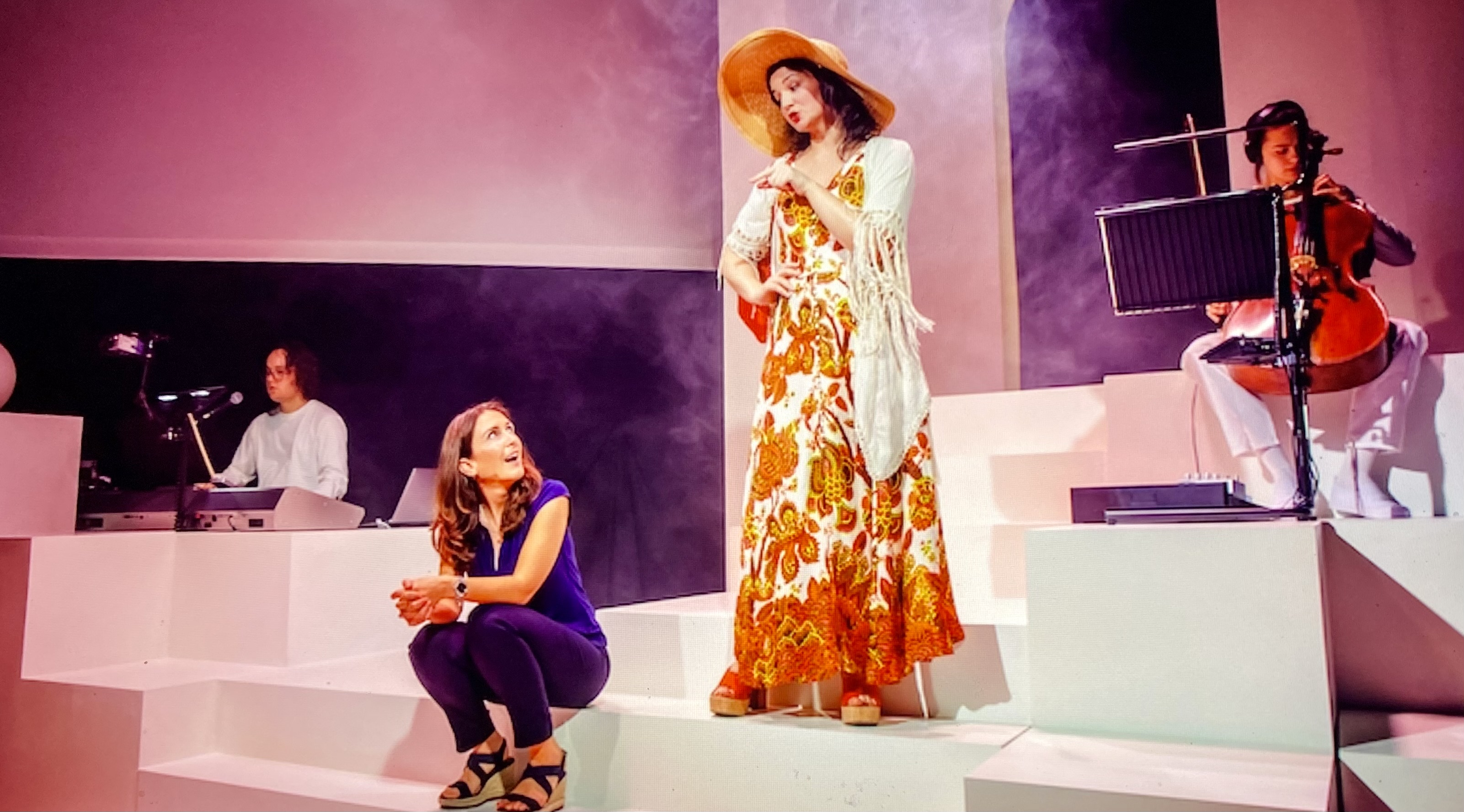
Madalena Alberto plays Maggie, an American scientist and author who has written a best seller which offers scientific explanations for all life’s mysteries. In order to escape from the widespread recognition that her newly found fame has brought, her friend Sheila (Kluana Saunders) invites her to join her on a holiday to Livorno. There she meets and falls for Luke (Tim Rogers), a man whose devout religious beliefs contradict everything that Maggie advocates.

This central relationship is mirrored by that of another holidaying couple, Heather (Molly Lynch), who is passionate about the romantic poets and all forms of art and the culturally sceptical Connor (Joaquin Pedro Valdes). Amid Italian sunshine and beauty, the scene is set for profound debates which set reason against religion, rationality against romance and cold logic against instinctive emotions.

Throughout a first act of flirtations and deceptions, it seems that the plot of a routine romcom could be hiding beneath the blanket of the show’s highbrow pretensions, struggling to come out. Lee Newby’s all white set design represents stone steps leading up to Roman arches and the three hard-working band members are also dressed all in white, as if it is camouflage. All this gives a sterile look to director Jenny Easton’s production, which always errs in the direction of taking itself too seriously.

The supremacy of discord over harmony in the narrative is reflected in Joshua Schmidt’s score, which is sung and played with great confidence. Generally, the music is easy on the ears, but stand-out moments of the type on which hit musicals thrive do not materialise.

It is brave and ambitious to attempt to incorporate philosophical arguments into the book and lyrics of a musical, but Warns Brown rises to the challenge admirably. It is deep into the second act before the quest to find the meaning of life becomes too weighty and we stop caring about the characters and their relationships. Eventually, there is a temptation to shout to everyone on stage: “lighten up a bit”.

Killing the Cat is a curiosity. At this stage, it feels like a work in progress and more time should help it to blend together its elements more smoothly. Eight more lives remain.

Performance date: 22 March 2023

Writer: Enda Walsh

Director: Nicky Allpress

⭐️⭐️

Irish writer Enda Walsh’s 2006 play, The Walworth Farce, seems like an ideal choice to open Southwark Playhouse’s brand new venue, which is located near to where Walworth Road meets the Elephant and Castle roundabout. So, is this revival well worth seeing or is it just a white elephant?

The new venue is just a few hundred metres from the existing Southwark Playhouse (Borough) which continues to operate. It is tucked in neatly at the foot of a modern tower block. Its two-level interior could be a model for freshly-painted industrial chic, sending a loud and clear message that thrills on the stage will always take precedence over frills in the foyer.

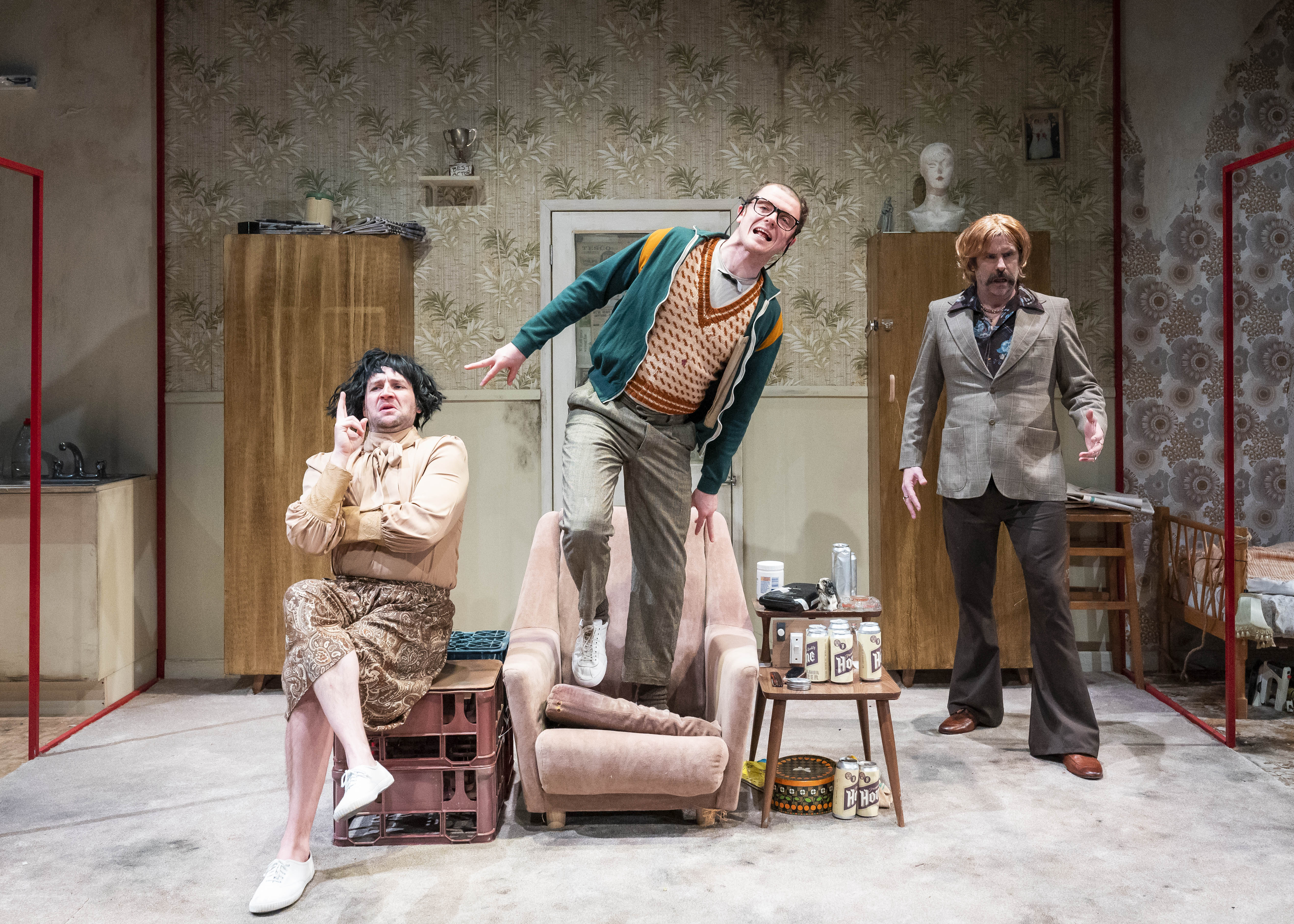
The play is set inside an upper level flat in a Walworth Road high rise, occupied by Dinny (Dan Skinner), an expatriate Irishman who has switched careers from painter and decorator to brain surgeon. Designed by Anisha Fields, the shabby flat has three adjacent doors, giving rise to the promise of a farce in the Feydeau mould, but this never materialises and, instead, we get a nonsensical romp in the Ionesco mould, with a few uniquely Irish twists.

Dinny shares the flat with his two sons, Sean (Emmet Byrne) and Blake (Killian Coyle), both distraught after the funeral of “Mammy” who had been killed by a dead horse. Dinny goes into a rage when it becomes apparent that the wrong shopping bag has been brought back from Tesco’s, ruining his expectations for an evening meal after a long day of brain surgery and setting off a train of fierce family conflicts.

As the three men re-enact scenes from their past in Cork, they assume different characters, switch in and out of drag. At this point, the production is something like an episode of Mrs Brown’s Boys on speed and the skills of the actors in ploughing through it is admirable, but the one feat that they are not able to pull off is to make any of their antics funny. It takes the arrival, with the correct shopping bag, of Tesco checkout agent, Hayley (Rachelle Diedericks), to raise some laughs and that is largely because the character is recognisable and believable.

Underlying the mayhem, the writer is exploring the pull of roots and family ties in shaping characters’ lives, familiar territory for many forms of comedy. It would be ridiculous to complain that an absurdist comedy makes no sense, but there are many occasions when Walsh takes too much licence in the name of absurdism and director Nicky Allpress’s frenzied production fails to rein him in. When things quieten down and the pace slows, signs of a decent play start to emerge and the savage beauty in Walsh’s almost poetic writing becomes, fleetingly, beguiling.

The addition of this new venue to London’s off-West End theatre scene is warmly welcomed. Inevitably, future productions will be less site-specific than this inaugural one and, hopefully, they will also be more appealing.

Performance date: 24 February 2023

Windfall (Southwark Playhouse Borough)

Posted: February 15, 2023 in Theatre

Photo: Pamela Raith Photography

Writer: Scooter Pietsch

Director: Mark Bell

⭐️⭐️⭐️

After a day at the office, what could be better than an evening at the office? American writer Scooter Pietsch’s comic morality fable, Windfall, takes a broad swipe at office life – its backstabbing, secret affairs, jealousies, frustrations, and so on. The most notable thing that the group in the play are not seen to do is work.

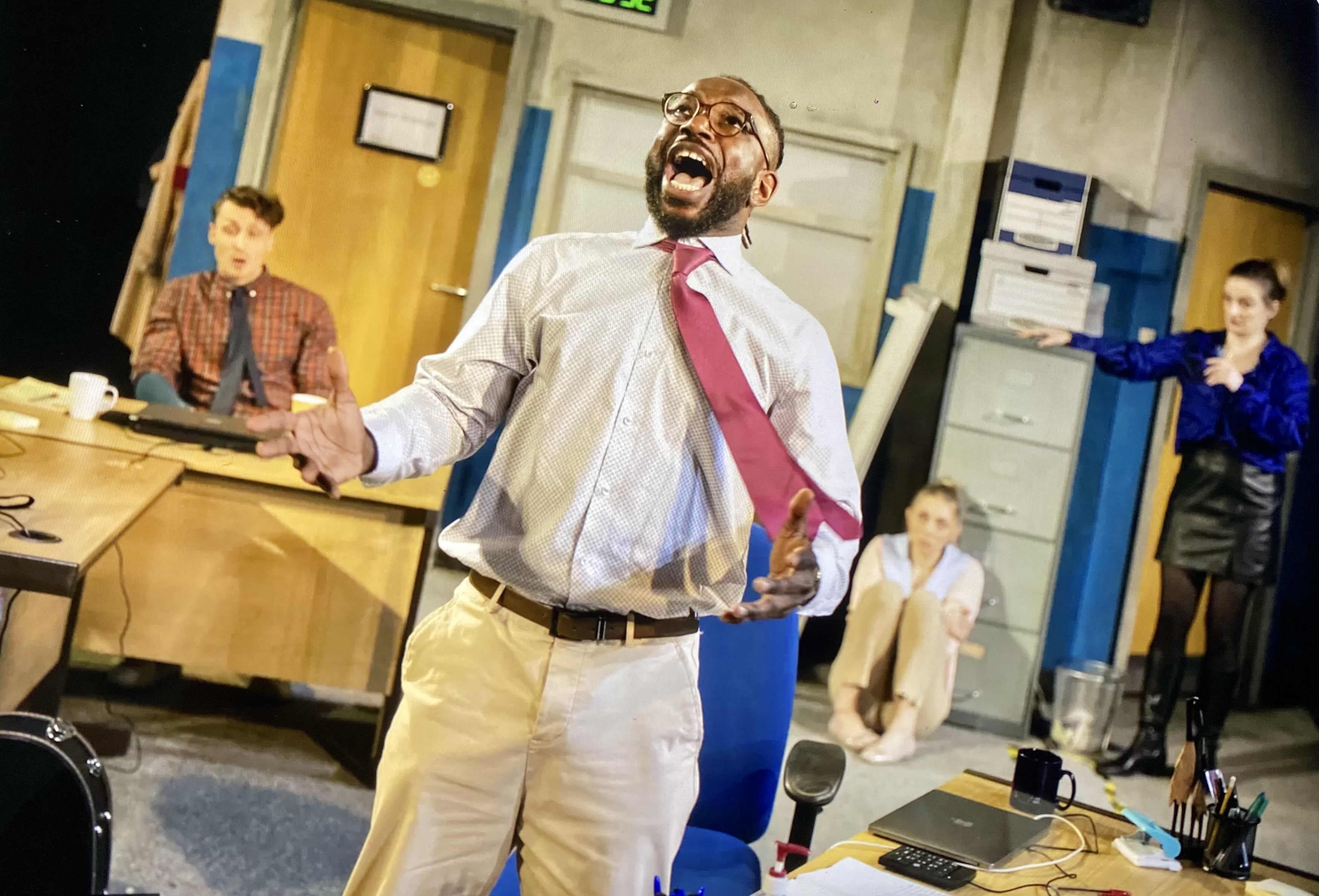
Office manager, Kate (Judith Amsenga), unmarried and senior in years, is a quietly efficient leader. In contrast, Hannah (Audrey Anderson) is separated and prone to bouts of hysteria, seeing herself as Sally Field in Norma Rae. Chris (Wesley Griffith) clings to the guitar belonging to his recently deceased father and drowns his sorrows in booze. Galvan (Gabriel Paul) is a put-upon religious zealot who believes that he is God’s messenger. The lives of these four are humdrum and the only escape could be a winning lottery ticket.

The comedy is slow to gain momentum, but the arrival of boss Glenn (Jack Bennett) brings some fizz. He enters with a tube inserted down his throat to combat a digestive problem, but that does not impede his merciless bullying. The play was first staged in America in 2016 and is meant to be contemporary, but the level of bullying suggests much earlier and this is endorsed by some cultural references and the low-tech office set, designed by Rachel Stone.

Glenn’s surprise is the introduction to the team of Jacqueline (Joanne Clifton) as a sort of spy. Her surname is Vanderbilt and she is taken to be a cut above the rest, but she is actually a single mother who is struggling to pay the bills. She becomes a member of the team’s lottery syndicate and, lured by Galvan’s vision that a $500 million prize will become theirs, all five invest $911 and await their windfall. Needless to say, all does not go to plan.

The first act of director Mark Bell’s production struggles to find the level of buoyancy needed for a screwball comedy and it sometimes plods. However, the investment in character development pays good dividends in a raucous second act in which all standards of decency are gone with the windfall. Bell previously directed the hugely successful The Play That Goes Wrong and he appears well inside his comfort zone when this comedy turns into unrestrained slapstick, performed with admirable precision.

Eventually, Windfall produces a steady flow of laughs, if not quite enough to live up to its title and Pietsch tends to stretch the central joke too far. Running at two hours, including a 20-minute interval (why?), this production suggests strongly that shorter could have meant sharper.

Performance date: 14 February 2023

Phaedra (National Theatre, Lyttelton)

Posted: February 10, 2023 in Theatre
Photo: Johan Persson

Writer and director: Simon Stone

⭐️⭐️⭐️⭐️

There is nothing like a Greek tragedy to add misery to a dark February evening, but not to worry, because Simon Stone’s modern reimagining of The Phaedra myth is nothing like a Greek tragedy, at least not for more than three-quarters of its duration.

in this version, the Phaedra figure is Helen, a high-flying politician, who juggles a shadow ministerial job with tending for her constituents and jointly heading a bickering dysfunctional family. Power-dressed to the hilt, Janet McTeer’s Helen has the air of a woman who is in complete control, at least until a new arrival exposes her vulnerability, leading to her downfall. Paul Chahidi makes excellent use of the comic potential in Hugo, Helen’s unexciting husband, who is used to playing second fiddle, but finds himself increasingly exasperated. 

Stone directs the opening scene, a family gathering, as if he is telling the audience that the chit-chat and the sub-plots are inconsequential, as indeed they turn out to be. The dialogue is rushed through at breakneck speed, making some of it inaudible, but at least it compresses the production’s running time to a bearable 160 minutes (including interval). The play’s real substance emerges in scene two with the arrival of Sofiane, the son of Helen’s now dead Moroccan lover from the 1980s. Assaad Bouab gives him a mysterious, magnetic appeal, which helps to explain why, instantly, Helen becomes infatuated with him. He seduces her (or vice versa) and he then turns his attention to Helen’s unhappily married daughter, Isolde (Mackenzie Davis), making her pregnant.

McTeer and Bouab shine brightly, but neither can eclipse the star quality of Chloe Lamford’s extraordinary set designs, which scream out “people in glass houses…”. The characters, encased in a Lyttelton stage-filling revolving glass box, then throw proverbial stones at each other and at society’s codes of morality. Inside the box, Scandinavian style interiors suggest cold habitats in which lust outranks love and power is all. Irritatingly, the designs reinforce the “fourth wall”, but it constantly intrigues and grabs the imagination.

Throughout the first act, Stone adds deft comic touches to the drama, as if to highlight the ridiculousness of the characters’ behaviour. The second act begins with a hilarious scene of family disintegration in a chic restaurant and this is more reminiscent of early Ayckbourn than of any tragedy, Greek or otherwise. It is a bold move to insert a comedy segment as the prelude to a dramatic climax and, even though the scenes do not blend together seamlessly, the effect is disarming. Bold too is the climax itself in which, lit from the rear, the actors appear only as enlarged silhouettes on the glass.

In all of this, Stone is exploring playfully the clashes between modern sophisticated lifestyles and primitive human urges. Opportunities to expand on the pressures placed specifically on women in modern professional life and on the different attitudes towards them and their male counterparts are largely passed over. The writer seems less concerned with making serious social points than with creating a piece of stimulating and original entertainment.

This Phaedra is inconsistent, over-gimmicky and occasionally baffling. However, its plus points outnumber its flaws and it achieves a strange and seductive quality that imprints itself on the mind.

Performance date: 9 February 2023

Kissed by a Flame (Pleasance Theatre)

Posted: February 4, 2023 in Theatre

Photo: Liam Fraser Richardson

Writer: Simon Perrott

Director: James Callàs Ball

⭐️⭐️⭐️

Condensing 11 years of grieving into 70 minutes of catharsis, Simon Perrott’s one-act play Kissed by a Flame is a deeply personal account of the pain of losing a loved one and the process of healing afterwards. The writer describes the play as autobiographical, paying tribute in the programme to his partner, who died in 2007.

Director James Callàs Ball’s production is performed, somewhat inappropriately, in a cabaret room; “death is a cabaret old chum” could spring to mind in an attempt to detract from the gloom on stage. Jamie (Ian Leer) and Teddy (Andrew Lancel) were in a relationship for as long as they have been parted when the play begins. Jamie is the type who is always burying his head in the sand, Teddy had been the one to yank it out, so, when Jamie needs to reconcile himself with the past in order to move on with his life, it is the imagined appearance of Teddy that forces him to read an old diary.

The diary covers the final months of the couple’s life together, from Teddy’s diagnosis of oesophagus cancer to his passing. Perrott tells us almost nothing about the characters’ wider lives together or separately, keeping the play focussed narrowly on Jamie’s ongoing trauma and his times with Teddy during illness. Impeccably acted, the partnership, tactile and affectionate, has a moving romantic quality, always overshadowed by the knowledge of tragedy.

The set, designed by Jack Valentine, is a white circular revolving stage with a double bed, draped in white linen at its centre. This gives an ethereal feel to what had been the couple’s living space, suiting the unworldly presence of Teddy. Perrott articulates Jamie’s feelings of loss, helplessness and guilt with admirable clarity, having revealed that he is drawing from personal experience and seeing writing the play as part of his journey to recovery.

When Teddy’s ghost thanks Jamie for all the shared laughter during his final days, it feels as if the writer is inviting himself to introduce some comedy, much needed to relieve the play’s relentlessly mournful tone. Regrettably, the invitation is declined, but, nonetheless, this morbid romance leaves its mark for being heartfelt and truthful.

Performance date: 3 February 2023

Photo: Mathew Tsang

Writer and director:  Michel Laprise

Creative director: Chantal Tremblay

⭐️⭐️⭐️⭐️

High-flying. Death-defying. Jaw dropping. The clichés abound when describing the work of Cirque du Soleil, the French-Canadian entertainment group that was founded in 1984. This “circus of the sun” resumes its regular Winter visits to London with the European premiere of the new show, Kurios: Cabinet of Curiosities.

The Royal Albert Hall is celebrating its 150th Birthday and it seems likely that many of the basic stunts seen in this show pre-date it. However, Cirque du Soleil is not about the basics, it is about presentation and packaging. As expected, the show is a visual extravaganza that revels in the enormous space (most specifically the height) made available. The show and the venue are matched perfectly to each other.

In Kurios… the flimsy premise is that a seeker opens their large curio cupboard to release the world’s hidden marvels and bring them to vibrant life. The curiosities that emerge stretch our imaginations to the limits, as directors Michel Laprise and Chantal Tremblay fill the stage and above it with dazzling colour and non-stop action. Original music complements the surreal images and the whole spectacle is seasoned with generous sprinklings of visual wit

So send in the clowns, the jugglers, the acrobats, the trapeze artists, the high wire walkers, the brave and the foolish. The invitation is to sit back in amazement, but don’t try any of it at home. Even PT Barnum might have conceded that this is the greatest show were it not for the absence of elephants, tigers, etc, none of which would be acceptable to modern audiences. Compensation is offered in an invisible circus comedy sequence, during which the deafening roar of an unseen lion echoes around the Hall.

On arrival, the audience is greeted by Stéphane Roy’s labyrinthine set and even given the opportunity to walk through it. There are enough zany, garish costumes, designed by Philippe Guillotel, to inspire several series of The Masked Singer. Performers are seen clambering up a tree of precariously balanced chairs towards the old building’s dome, falling as if from the sky and swinging out above the heads of the gaping audience. Arms and legs are in positions that they really have no right to be as precisely timed acrobatic choreography provides thrills galore.

The show has its climaxes, soaring (literally and otherwise) to the heights and is seldom grounded. Served up withe customary panache.  Kurios… may not have many surprises, but it is hard to think of any disappointments.

Performancece date: 18 January 2023