Adapted from a novel by the Japanese writer Abe Kobo, Micha Colombo’s play tells of an amateur entomologist who, in pursuit if his research into sand insects, becomes lured into a dune-dwelling community and entrapped to live as the partner of the title character. The logistics of this bizarre community’s existence do not stand up to close scrutiny, but, letting that pass, this is a story loaded with Orwellian political and social metaphors. It plays like a long (at least 30 minutes too long) episode of The Prisoner in which outrage at imprisonment is followed by thwarted escape attempts and then gradual acceptance. The predictability of the plot, plodding pace and dreary, humourless dialogue mean that this production possibly induces more yawns per minute than anything seen in London in recent times. Sandy coloured curtains and sandy tinted lighting provide a set that looks tacky, maybe appropriately so. Felix O’Brien plays the entomologist as a bumbling geek, Roslyn Paterson is the woman who has long since given up resistance and Niall Kerrigan is a villager who represents their rather benevolent captors. Sadly absent is any sexual chemistry between the central pair and, when the woman appears heavily pregnant towards the end of the play, the only possible explanation seems to be immaculate conception. Yet, despite all this fairly damming criticism, there remains something about the production that is quite endearing. Partly this is due to a trio of likeable actors who all seem to believe in what they are doing, accepting that at least one of the performances could have been mis-judged. Partly it is due to an affinity with quirky theatre which, even if it misfires, at least tries to do something different.
This review was originally written for The Public Reviews: http://www.thepublicreviews.com
The Irish War of Independence, fought between 1919 and 1921, led to the formation of an independent Ireland and fundamental change for the Irish people, but the stories of English residents in the country at that time have been little told. Ann Henning Jocelyn’s new drama centres on the descendants of English aristocratic landowners, displaced by the War and examines the social and religious divisions continuing in Ireland up to the present day. Christopher Faulds’ impressionist design of a lakeside Irish fishing lodge looks curious at first sight, but it works rather well when warmly lit. The lodge is the refuge that the family found in Connemara after the burning of their ancestral Tipperary home and it is the setting for the entire play. Played in nine shortish scenes, the story spans the period from 1989 to 2013 and shows how succeeding generations of the family struggle to preserve their own identity whilst integrating into an Irish Catholic community which remains passively hostile towards Protestants of English descent. Lady Eliza is the family’s last survivor of the War and she recounts, in the play’s best written passages, the horrors that she witnessed. Her mission is to ensure that her granddaughter, Titania, is able to appreciate her heritage and pass her knowledge on to her own children. These are Chekhovian characters, except seen after their revolution rather than before. Elaine Montgomerie makes a stately Lady Eliza, movingly reflecting on her childhood traumas. Alex Gilbert has the difficult task of portraying Titania both as a frumpy, rebellious teenager and then as a sophisticated career woman and wife. She is not entirely convincing as either and it does not serve the play well that her character remains so thoroughly unlikeable throughout. The intervening generation is represented by Lady Eliza’s daughter Meg and her husband Andrew, parents of Titania. Much of the play consists of one of these characters informing the other of events from the distant or recent past of which both must be already aware. The information is being recited solely for the benefit of the audience, which contributes to making some of their dialogue sound very stilted, thereby bringing occasional ripples of laughter to an evening which contains little intended humour. It is unfortunate that so much of this story is told rather than enacted and that several potentially interesting characters are only talked about and never seen. Meg and Andrew hold the stage for large chunks of the play, but, as their function is made to be primarily that of narrators, their characters remain under-developed. Despite the valiant efforts of Maev Alexander and Cornelius Garrett to bring them to life, they remain a desperately uninteresting couple and it becomes very difficult to empathise with them. Often the play seems to wander some distance from its central themes of heritage and progression and when, in the final scene, it reconnects strongly with them, it produces an ending which feels contrived, almost as if it had been tagged on as an afterthought. In many ways the links which Only Our Own makes between historical events and the modern world are fascinating, but the play and this production of it do not do full justice to the writer’s core ideas.


This is probably the closest that I, or several others of similar age in the audience, will ever get to attending a “rave”. Originating from Argentina and going the rounds for a decade or so now, this show is a non-stop assault on the senses, with vibrant colour, breathtaking visual spectacle and deafening techno music. The promenading audience fills the space beneath the Roundhouse dome, whilst the action takes place around, amongst and, most often, above us. A man runs at breakneck speed on a conveyer belt, bursting though walls; human spiders crawl around a giant web; swimming pools, descend upon us to a level which enables us to touch their translucent bottoms and gaze directly into the eyes of the swimmers. At one point the arena is encircled by what looks like aluminium foil, the space is darkened and then illuminated by strobe lighting, blurred by emissions from smoke machines, and then drizzle is showered over us (as if London needs more rain right now). It is like a film packed with special effects, say Inception, except that there is no CGI, this is all live action, real flesh and tomato ketchup. Technically, the show is dazzling, the continuity is faultless and the 80 minutes literally flies by, leaving us with nothing to do except to go along for the ride. It is only afterwards that it dawns that it is all rather pointless, the evening being devoid of anything to engage the intellect or stimulate the brain. Maybe one day the creators of this show will collaborate with theatre makers who have a wider vision and are able to put this style of imaginative spectacle into a more meaningful context. That would definitely be something to look forward to.
This review was originally written for The Public Reviews: http://www.thepublicreviews.com
Staging a lively mix of well chosen revivals and interesting new work, the small theatre above the Old Red Lion pub is establishing a reputation as one of London’s brightest fringe venues. The trend continues with the World Premiere of this family drama by the American writer Gregory Beam. The location is Massachusetts and the setting is the kitchen of a home in which the father of the family has recently committed suicide. The impending funeral brings back together two step sisters. Abra has never moved far from the local area and Samara, an alcoholic, is returning from California. The family’s parents were immigrants to the United States and Moslem. The story is told in a series of confrontations between the two women, gradually revealing to the audience the history of their relationship. Whilst at the beginning Abra appears staid and sensible and Samara a reckless free spirit, perceptions of them change radically as the play progresses. The kitchen set, designed by Katie Bellman, is meticulously detailed down to the tiled floor and defines the apparent ordinariness of a working family’s life. It’s authenticity is matched by the writing and performances. Beam’s dialogue is carefully nuanced to bring out his characters’ inner feelings and laced with subtle humour. Dilek Rose (as Abra) and Lou Broadbent (as Samara) both give searing performances as two damaged and vulnerable women at loggerheads with each other, yet inextricably bound together. In flashback sequences, Rose doubles as her character’s mother and Allon Sylvain plays the father. He and James Corscadden (as Samara’s brother) make brief but effective appearances. Beam’s play embraces many, perhaps too many, sub-themes – mental health, taking responsibility for elderly relatives, culture clashes and more; as a result it occasionally gets sidetracked when we really want it to keep its focus on the two protagonists. It then builds to a slightly melodramatic climax which does not sit too well with the realistic drama that has preceded it. Nonetheless, as a study of a dysfunctional family, the play is, on the whole, sensitive and thoughtful, showing how such a family can both inflict wounds on its members and heal them. This is a small production that punches well above its weight.
 Seeing VCRs and Sony Walkmans paraded as treasured possessions in Rupert Goold’s musical version of Brett Easton Ellis’s modern classic tale of 1980s New York reminds us how fleeting such fads can be. A quarter of a century later, they are replaced by smart phones, streaming, social media, etc, but nothing that really matters seems to have changed at all and none of the lessons seem to have been learned. The lyrics of one of the songs protests that the story is not an allegory, but it is exactly that, satirising city lifestyles and weaving in existentialist themes. The main characters’ working lives are driven by greed, status and materialism; their social lives are fuelled by lust, drugs and alcohol. The first half of the show devotes itself to demonstrating the emptiness of all this and, although it is generally entertaining, it eventually runs out of different ways to hammer home the same point. However, the central character, Patrick Bateman, has long been obsessed with grizzly serial murderers and, once he begins to emulate his heroes, things really get moving. The first half ends with the first splattering of blood and what follows after the interval is infinitely better. Robert Aguirre-Sacasa’s book serves the story, but lacks consistent wit. Similarly, Duncan Sheik’s pop/rock score and lyrics are functional but unmemorable, their shortcomings being highlighted by half a dozen 80s classics which are imported. Therefore, this show needs outstanding staging and performances to lift it above the ordinary and it gets both. The minimalist set design allows for freedom of movement and rapidly changing projections, whilst two revolves help to provide slick progress throughout. The show’s best scene is a dazzling song and dance routine in which Bateman goes on a murderous rampage, slaughtering the entire chorus line. As Bateman, Matt Smith is star casting, obviously, but he is absolutely terrific, showing an awesome stage presence and he can almost sing. He manages to convince equally as a cold, ruthless killer and as a lost and lonely man who has never been able to make anyone happy, not even himself. He believes that he is not really alive, but shows that he is struggling to become so when reaching out to his loyal and besotted PA (beautifully played by Cassandra Compton). This relationship is genuinely touching and it gives the show its emotional heart. All the other performances are top class and it matters little that there are few real singers. This show is packed with original ideas, it plays around with conventions of musical theatre and kicks out many of the tired cliches. Refreshingly different.
As of midnight on 31 December, my visits to live performance plays and shows in 2013 total a record 179, not quite averaging one every other day, but pretty close. The total includes 67 on behalf of The Public Reviews and 23 at the Edinburgh Fringe Festival, but does not include classical concerts and opera. It was a year of high quality theatre, but, setting an average of one truly great show a month, my Top 12 list for 2013, in alphabetical order, is:
Bracken Moor (Tricycle)
Ghosts (Almeida)
Let the Right One In (Royal Court)
Old Times (Harold Pinter)
Othello (National)
Peter and Alice (Noel Coward)
Sweet Bird of Youth (Old Vic)
The Audience (Gielgud)
The Color Purple (Menier)
The Pride (Trafalgar Studios)
The Scottsboro Boys (Young Vic)
Titanic (Southwark Playhouse)
Lines between “West End” and “Fringe” can get blurred, but my favourite theatres continue be those that are not quite one nor the other: The National, apart from Nicholas Hytner’s brilliant Othello, had a rather disappointing year, showing how much the now closed Cottesloe had become its powerhouse; after a pedestrian start to Josie Rourke’s tenure, The Donmar Warehouse seems to be picking up momentum again and The Almeida, with Headlong’s Rupert Goold now in charge, is on a roll of hits. The Royal Court continues to nurture new writing and The Menier Chocolate Factory stages comedies and musicals of outstanding quality. Find of the year has been St James Theatre, an excellent venue with a knack for seeking out first rate productions. Commendations also for The Young Vic and the re-housed Southwark Playhouse.
Looking at productions that were undoubtedly “Fringe”, my favourite six were: Grounded (Edinburgh), Halbwelt Kultur (Jermyn Street), Jumpers for Goalposts (Bush), Quietly (Edinburgh), Skin Tight (Park) and The Herd (Bush).
Inevitably, the year included a few absolute stinkers; my dirty half dozen are: Much Ado About Nothing (Old Vic), Our Town (King’s Head), Port (National), Socrates and His Clouds (Jermyn Street), Steptoe and Son (Lyric Hammersmith) and WAG: The Musical (Charing Cross).
Turning to performances, my choices are: best in a play – Rory Kinnear (Othello) and Lesley Manville (Ghosts); worst in a play – James Earl Jones and Vanessa Redgrave (both Much Ado About Nothing); best in a musical – Killian Donnelly (The Commitments) and Cynthia Erivo (The Color Purple); worst in a musical – Tim Flavin and Lizzie Cundy (both WAG! The Musical).
Roll on 2014.
A curious excursion to the fringes of London’s East End leads to a trilogy of one-act Eugene O’Neill plays which, individually, may be of little interest to anyone other than drama degree students, but, collectively, paint a vivid and disturbing picture of Chicago during the Depression era. The building, an antiquated meeting hall with ornate decor, looks as if it belongs in the 1920s and the audience is greeted on arrival with a band playing original jazz/blues music composed by Alex Baranowski. Music is also played between the plays, with vocals by Nicola Hughes. All three plays are set in squalid urban accommodation with the train of the collective title rumbling overhead. The first is Before Breakfast, a monologue performed by Ruth Wilson as a dutiful wife lecturing her husband, who is in the next room, about his laziness and infidelity. It is directed by Sam Yates, as is The Web, in which an alcoholic, consumptive prostitute (Wilson again) struggles to care for her baby in the face of aggression from her pimp (Zubin Varla); she finds brief hope in the form of a bank robber who is on the run (Simon Coombs). The final play, The Dreamy Kid, is directed by Wilson and involves a dying mother (Hughes) who presents her son (Coombs again), a killer on the run, with the dilemma of either staying by her bedside and facing certain arrest or escaping to possible freedom. The plays are intense, atmospheric and superbly acted, the cumulative effect of them being nightmarish. Cramped, wooden seats (at West End prices) do not provide the most comfortable way to spend 90 minutes, but, nonetheless, the venue enhances the experience. 2013’s theatregoing ends on a high note.
Fascinating Aida: Charm Offensive***** (Southbank Centre, 23 December 2013)
Posted: December 24, 2013 in Theatre This review was originally written for The Public Reviews: http://www.thepublicreviews.com
If anyone ever wondered what the St Trinians schoolgirls could have turned into in later life, Fascinating Aida may provide the answer. These three ladies are elegant, mischievous and, in the nicest possible way, extremely rude. Now into their 31st year, they have aged like the finest wine, honing their writing and performing skills to the point of near perfection. Founder member Dillie Keane is still going strong, together with Adele Anderson, who joined a year later, and relative newcomer Liza Pulman, who has been with the trio for just under ten years. Charm Offensive is a show that is certainly charming, but it is only likely to be offensive to the most diehard amongst prudes. Somehow language that might be shunned even on a building site becomes perfectly acceptable when uttered by sophisticated ladies in evening dresses who have reached their prime years. The show is a mixture of old and new. Greatest hits such as Dogging and Cheap Flights are almost obligatory, as is the Bulgarian song cycle, except that the lyrics of each of the short songs have been updated to make cutting references to the very latest news headlines. To prove themselves bang up to date, the ladies chant Facebook Blues and then Keane, who is now beginning to look like a very young Margaret Rutherford, re- brands herself as “Keane Dillie” to perform an energetic rap number. Later, she adopts the guise of a French chanteuse to ask Where Is Your Johnny Now, Johnny, which is very risqué but completely hilarious. Topicality is high on the agenda, as the ladies become bankers’ wives pondering the dilemma of how to spend “his” bonus, they reflect on how their generation of baby boomers has ruined everything for succeeding generations and they lament the Eurozone crisis to the accompaniment of traditional Greek music. The centrepiece of this show lands a hefty swipe on the face of the British Education system and informs us that OFSTED is an acronym for “”Overpaid F***ers Shafting Teachers Every Day”. The evening is not just a collection of comic numbers and crude jokes. Several wistful and poignant songs are blended skilfully into the mix to vary the mood. Look Mummy, No Hands is a lovely celebration of mother/daughter relationships and Old Home reflects nostalgically on places we have lived in but left behind. Pulman, who possesses a crystal clear soprano voice, sings of a first date between two divorcees and Anderson gives a deeply personal account of gender change. There are times during these more serious moments when the lyrics are so delicate and the rhymes so precise that it is possible to wonder whether the songs are really original or taken perhaps from a Sondheim musical. Sending the audience home for the festive season, the ladies warn Try Not To Be A **** At Christmas, but, sadly, lack of BBC airplay may ruin it’s chances of ever being a contender for Christmas number one. As a couple of hours of cabaret, this is about as good as it can get, at least until Fascinating Aida come up with their next show.
 This review was originally written for The Public Reviews: http://www.thepublicreviews.com
In 1963, when the Kennedy assassination rocked the world, Britain was still shaking from the seismic effects of the Profumo Scandal. John Profumo, Minister of War, had been sharing a mistress, Christine Keeler, with a naval attache at the Soviet Embassy, causing justifiable security concerns when Cold War paranoia was at its height. The MacMillan Government was destabilised, but, perhaps more significantly, the prurient and frenzied media coverage of the affair challenged the British Establishment and triggered a fundamental reappraisal of the values in our society. These events form the backdrop to this new musical which reunites composer Andrew Lloyd Webber with writers Christopher Hampton and Don Black, the team responsible for Sunset Boulevard. Stephen Ward, an osteopath with a long list of celebrity clients, got caught in the maelstrom by introducing Profumo to Keeler, but he was no more than a facilitator, an organiser of social occasions, albeit ones that flouted moral conventions of the day. Despite only playing a peripheral role, it was Ward who became the chief victim of the Establishment backlash, the scapegoat or, as described in the title of the show’s keynote song, Human Sacrifice. The story is told drily, rather like a dramatised documentary, feeding us much factual detail but rarely drawing us in emotionally. It is not entirely sung through, but substantially so. Richard Eyre’s imaginative direction brings a brisk pace to the first half, well assisted by Rob Howell’s set designs which use simple scenery and projections, changing rapidly behind swishing curtains. The second half is more static but includes an impressive courtroom scene in which the Judge towers above the accused Ward, now belittled by the Establishment that he has crossed. In the title role, Alexander Hanson is on stage for almost the entire first half and much of the second. His Ward is a suave libertine, not comprehending the significance of what is happening around him; he makes him aloof and largely unsympathetic, rather as Ward himself appeared in newsreel footage. Charlotte Spencer gives us a feisty Keeler, transforming from an innocent girl, dragged from her home in a converted railway carriage, to a much less innocent woman mingling with the high and mighty. Keeler’s friend, Mandy Rice-Davies, is played by Charlotte Blackledge as a mouthy tart, completely at ease with her promiscuous lifestyle. These events coincided with a momentous period for British music, as the Beatles made their breakthrough. Tribute is paid to the Fab Four’s early style with the delightful 1963, on which Christine and Mandy duet, and there are other dashes of 60s pop, even some reggae. However, the overall musical style is still very distinctively Lloyd Webber and, even if over-familiarity with that style dampens enthusiasm, there can never be any doubting the composer’s gift for conjuring up lovely melodies, which are plentiful here. Evita showed that Lloyd Webber’s music, even in its most romantic form, could fuse with a cynical, political storyline and the same trick is pulled off again. The lyrics merge seamlessly with the book, advancing the story, developing the characters and throwing in fascinating background information. Diners in a high class restaurant, including Lord Boothby, the Kray twins and Peter Rachman, burst into You’ve Never Had It So Good, echoing Harold MacMillan’s famous boast, but turning it into a celebration of their own hedonism. We then move to Lord Astor’s country estate where Ward sings Manipulation, at first explaining osteopathy, but the lyrics turn quickly to refer to nefarious dealings and widespread corruption; during this song, a sedate dinner party transforms into a bizarre orgy, which is beautifully choreographed by Stephen Mear. These scenes are gems, displaying the decadence of a fetid social elite that was soon to enter its dying days. The second half charts Ward’s downfall and it is then that the pace slackens and Lloyd Webber’s recurring musical themes begin to grate. Nonetheless, there are some outstanding sequences. It comes as a surprise to see a name as big as Joanna Riding cast in the tiny role of Valerie Hobson (Mrs Profumo) but the reason becomes clear when, late on, I’m Hopeless When It Comes To You falls to her and she does it full justice. It is one of the show’s two great songs, the other being the climactic Too Close To The Flame which Hanson delivers with tremendous power, bringing a lump to the throat, if not quite a tear to the eye. Stephen Ward is a production with little humour, no likeable characters, little visual spectacle and no obvious wow factor, yet it has degrees of intelligence and ambition that set it apart from most other musicals. Certainly the show has its flaws, but it still stands as a very considerable achievement.
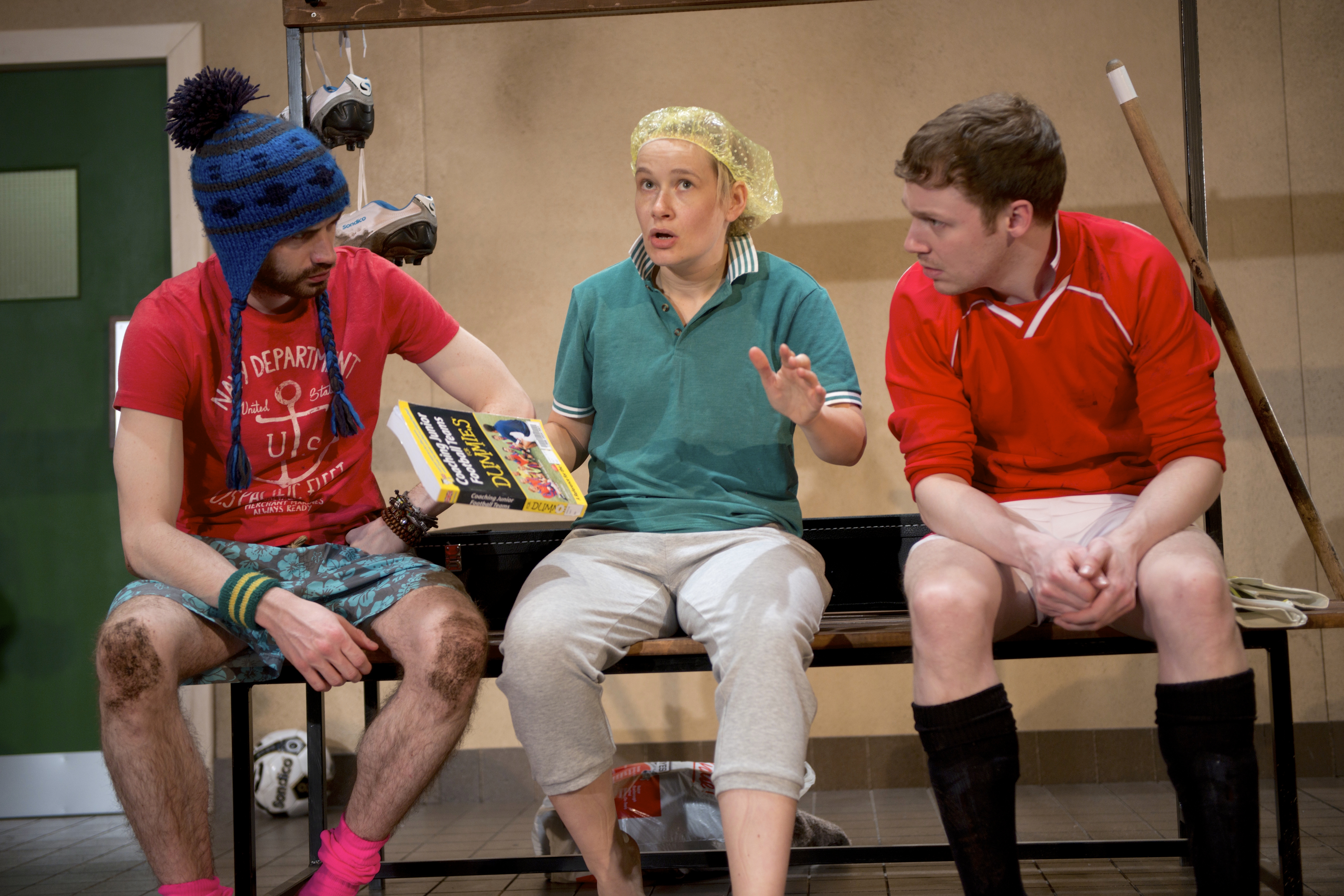 Tom Wells’ little romantic comedy seems to have been gaining momentum as it has toured over the last few months and it has now found the perfect home here. The Bush has the look and feel of a sports changing room, except that the tiled walls have been replaced on three sides by tiered seating. This gives a realistic touch to a play in which authenticity does not figure prominently. Barely United is one of four teams in the Hull Gay and Lesbian 5-a-side football league; the team includes a token straight and a woman, rejected by the lesbian team and acting as coach. The one act play simply features the interplay between five quirky characters over their six-match season; Viv (Vivienne Gibbs), the coach, is drawn towards Joe (Matt Sutton), an overweight widower; “Beardy” Geoff (Andy Rush) is a weak-willed busker; the two youngsters, assistant coach Danny (Jamie Samuel) and newcomer Luke (Philip Duguid-McQuillan) struggle awkwardly to overcome obstacles that stand in the way of them forming a relationship. All of the performances are generally well judged, striking the correct balance between comedy and pathos. The innocent and romantic tone is very reminiscent of Jonathan Harvey’s Beautiful Thing and, just as in that play, there are many times when the sugary cuteness is laid on too thickly. Although the harsh reality of life occasionally intrudes it is always in a “bottle half full” manner. The options are either to cringe for 90 minutes or to go along with it, laughing and crying at each unlikely turn and, once the latter decision has been made (who wants to be a Scrooge at Christmas anyway?) the whole evening becomes an absolute delight. Judging by the cheering at the end, 99% or more of the audience made the same decision and quite right too.
 The Beast's Pen