photo-80This review was originally written for The Public Reviews: http://www.thepublicreviews.com

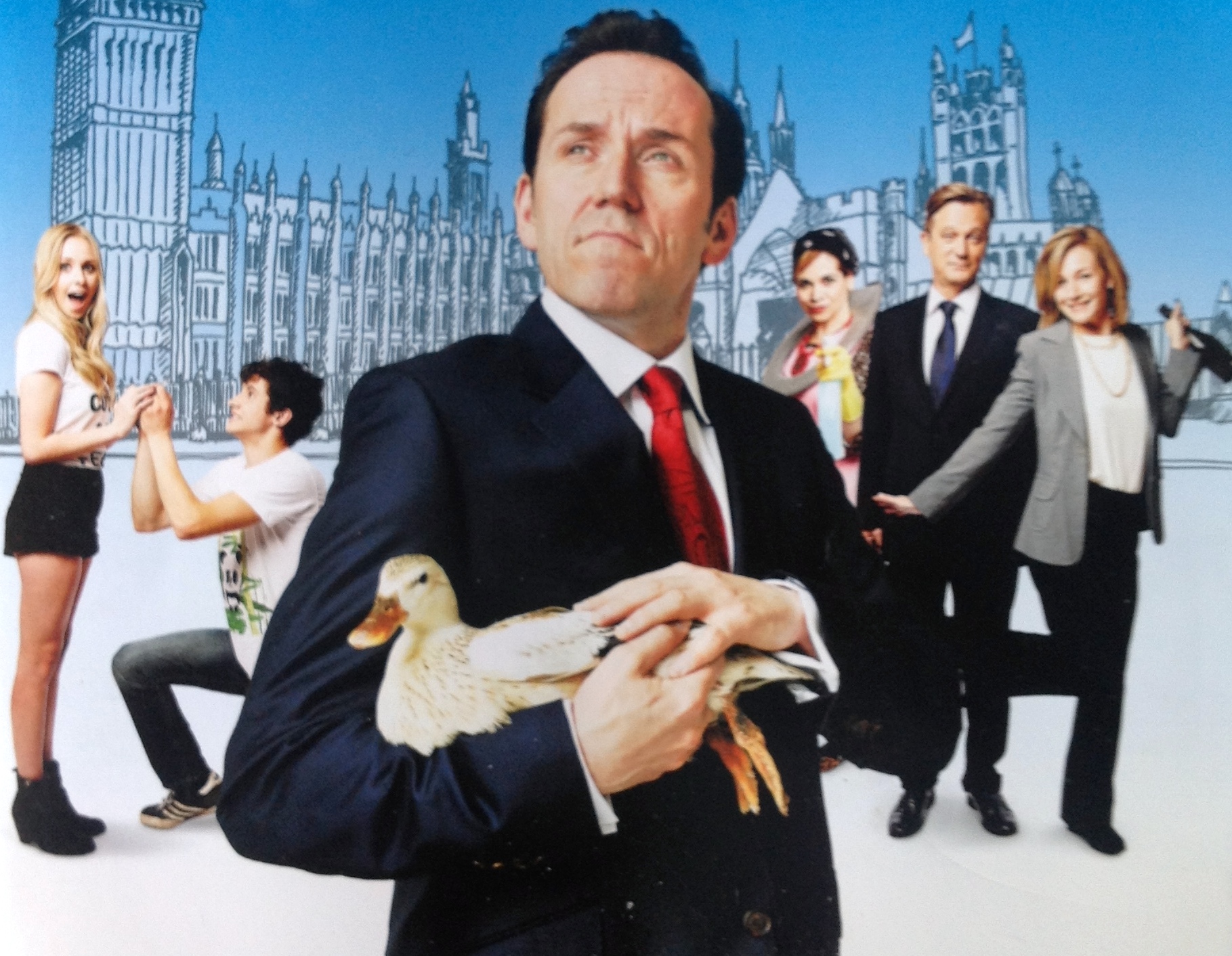
The biggest challenge facing the writers of The Duck House must have been to create a comedy that would be funnier than the real life farce that it draws from. In 2009, the nation was enthralled and appalled as, day by day, more details were revealed of expenses claims by Members of Parliament, some of whom seemed to think that it was more important to shelter ducks from weather that is, proverbially, nice for them than to make sure that taxpayers’ money was spent correctly. The curtain rises to reveal Robert Houston MP and his wife guzzling expensive Champagne to the sound of quacking outside their French window. He is on the verge of defecting from Labour, lured by the offer of a ministerial post in a future Government, she is dreaming of the luxurious lifestyle of a Tory wife, no longer having to feign enjoyment of scampi and chips. To seal the deal, they need to impress a Tory party grandee who is about to visit, but the expenses scandal is breaking and all evidence of unjustifiable claims needs to be hidden. Needless to say, the evidence is substantial. At the beginning, the play is styled as political satire of the mildest kind, bringing a torrent of rapid-fire jokes, most of them very funny. There is a recurring gag in which someone in the 2013 headlines – Andy Coulson, Nigella Lawson, Andrew Mitchell, etc – is referred to as seen in 2009. Of course, one line gags cannot sustain a full-length play alone and this play moves on to develop into a Feydeau-like farce with rapid entrances and exits, outrageous costumes and general mayhem. The greed, hypocrisy and deceitfulness of the characters are exposed whilst they are put rightly to ridicule. Political satire and broad farce are styles of comedy that do not aways sit comfortably together in this play and reactions at this performance could suggest that each of the two styles appeals to different audiences. The production has weak moments, particularly during slapstick routines, which occasionally feel laboured, predictable and incongruous to the context of the play. Nonetheless, accepting that there are a few points when the production misfires, the laugh-out-loud moments outnumber them by far. Leading a top-notch cast, Ben Miller is perfect as the hapless MP, growing increasingly frenzied as the extent of his involvement in the scandal becomes ever clearer; he consoles himself that at least he does not have a moat, until he is told that there is one surrounding his duck house. Nancy Allen shines as a socialite who loathes socialism, as does Simon Shepherd as a top Tory who is arrogant and pompous until a secret involving how he makes use of the Treaty of Lisbon is revealed. Also excellent are James Musgrave as the MP’s wayward son and Diana Vickers as his girlfriend from Burnley, who has paid off her student loan with earnings from a novel form of acupuncture. A maid is obligatory in most farces, so here we have a Russian one with ultra right wing political views, splendidly played by Debbie Chazen. Terry Johnson is a director with vast experience in comedy and he keeps things moving with flair and precision. Lez Brotherston has designed two sets, both striking but in different ways; Act I takes place in the opulent living room of the MP’s house in the London stockbroker belt; Act II moves to the MP’s “second home”, a London flat which he has never previously visited, now daubed with graffiti and stripped of the furniture paid for by taxpayers, then sold to pay off his son’s gambling debts. From the Palace of Westminster, politicians need only take a short walk along Whitehall and then right into the Strand to find the Vaudeville Theatre. En route they could cast a glance or two sideways to see the homeless huddled in spaces barely wider than a typical duck house and ponder on the irony. Maybe a few of them will feel chastened by this play, but, whilst, leaving the real world behind for a couple of hours, the rest of us can enjoy a jolly good laugh.

thepublicreview_hor_web copy


This review was originally written for The Public Reviews: http://www.thepublicreviews.com

Titles can be misleading, so it needs to be stated that this is not a stage adaptation of the Disney cartoon nor is it a Christmas pantomime version of the famous fairy tale. It is in fact a thoughtful study of the links between the story of The Little Mermaid and events in the life of its creator, Hans Christian Andersen. Coming from the Blind Tiger Theatre Company, the production which is performed by actor/musicians, uses music inspired by Danish folk songs and draws from journals, letters and diaries written by Andersen himself. In the fairy tale, The Little Mermaid is cast out from her home in the sea and, alone onshore, she craves love from the prince who can never be hers. In real life, Andersen is parted from his family in rural Denmark to live in Copenhagen, where he forms fraternal bonds with Edvard, the son of his patron, but has to accept that his love for Edvard can never be fully reciprocated. The two stories are related as reflections by an elderly Andersen (James Earl Adair) and their progress is deliberate and unhurried, making the production extremely slow to get into its stride. In the early stages, there is hardly any humour, a little music but not enough of it and the staging is rather static. However, when the play begins to grip, it is the real life story that takes the strongest hold and this is largely due to an endearing performance by Anthony Pinnick as the young Andersen; he captures perfectly the spirit of a creative idealist, confused by his emotions and unable to put down roots in the real world. Stu Mansell, playing both Edvard and the Prince in the fairy tale creates two characters that are more grounded but always sympathetic. Claire Francis makes a delightful Little Mermaid, contrasting with Erla Brynjarsdottir’s splendidly spiteful Sea Witch, whilst Jennifer Johnson sings sweetly as the Swedish opera diva Jenny Lind and provides some brief comedy as an insolent maid. The writing, which uses Andersen’s material verbatim in many instances, has a lovely lyrical quality. Being slow, wordy and without spectacle, this is not a show that is likely to appeal to younger children. However, taken as an antidote to the traditional feasts of family fun on offer at this time of year, the production has got a lot to offer. The Little Mermaid is always an enchanting tale, but, with the additional dimension that it is given here, it becomes a wistful hymn to the pain of unrequited love. A Christmas show with a difference.

thepublicreview_hor_web copy

photo-87Adapted from Patricia Highsmith’s dark psychological thriller, Craig Warner’s play concerns the meeting of Guy, a promising architect and Bruno, a feckless rich playboy, on a journey through Texas. Guy’s life is being hampered by a troublesome wife and Bruno needs rid of his millionaire father, so the latter develops the idea that the two will swap murders meaning that, with no connection between killers and victims, detection would be impossible. Guy is always reluctant, but inevitably, the two become more and more entangled together, with increasingly sinister consequences. It needs to be stated that Robert Allan Ackerman’s’s production is quite brilliantly staged, with sets rapidly revolving to ensure a swift pace, lighting which picks out what we need to see but leaves the rest of the stage in creepy darkness and a spectacular, technically accomplished climax. At this performance, Antony Jardine, an understudy, played Bruno and was very effective in bringing out the menace in an immature and weak man in the grips of a doting, drunken mother. Sadly, Lawrence Fox, not an understudy, is feeble as Guy, capturing none of the magnetism that draws the other characters to him and failing to convince as a man tormented by guilt. The always reliable Imogen Stubbs relishes the role of the mother and the other performances are generally adequate, allowing for some dodgy American accents. Translating a plot-driven piece to theatre can often be tricky, but this production’s big failure is in showing us any reason why this story needed to be put on the stage at all. Alfred Hitchcock’s classic film varied much in detail from Highsmith’s original novel, but it was able to bring out the complex Freudian themes and even allude to the gay subtext, albeit restrained by the conventions of the 1950s. No longer subject to such constraints, this version fails abjectly to delve any deeper into the psychology or to develop most of the characters into much more than stereotypes. Therefore, we are left with plot, visual spectacle and little else, resulting in an experience that moves at lightning speed but is, at the same time, tedious and empty.

Described as “a theatre adventure with food and music”, this 100 minute entertainment explores our dietary customs at the present time and in the future. We begin in a waiting area where we are served aperitifs which look like neat spirits but are in fact fruit/vegetable juices, misleadingly coloured. We are then seated around tables in the dining room, where a musician (Alasdair Macrae) and four waiters/performers begin to entertain us with amusing songs, comedy sketches and food, peppered with pertinent facts about how and what we eat. Delights that are put before us include savoury profiteroles and sweet egg sandwiches, also baked locusts and crickets (both bland, but perfectly edible), serving to demonstrate how our choices of foods are influenced by appearances and irrational prejudices. The songs and comedy segments satirise the diet industry, supermarkets, dealings in foodstuff commodities, etc, etc. If anything, the show’s themes are too scattered, when a sharper focus on fewer, very specific topics could have made a greater impact and left a more lasting impression. Nonetheless, this is an enjoyable piece of lightweight fun.

Not booking for the National’s Christmas extravaganza means risking missing out on the next War Horse; booking for it risks having to sit through a mindless kids’ show. Sadly, although not entirely without merit, this falls more into the latter category. Written by Erich Kastner and set in Germany (mostly Berlin) in 1929, it is a simple story of a boy, Emil, who has his money stolen by a banker (very topical) and enlists the help of a horde of other children to reclaim it. The plot has no mystery, no twists or turns and, at about two hours with interval, it is stretched just about as far as it can go. Despite deploying much of the technical wizardry that the Olivier stage can offer, the first half of Bijan Sheibani’s production falls very flat. The second half starts well with music evoking Berlin nightlife of the era and includes an excellent chase through a sewer, but, overall,  it is not much livelier until the last 10 minutes when elements of pantomime are introduced to bring about a rousing finale. The leading junior roles are alternated nightly in a company that includes over 30 children, all on stage together at times. At this performance, Emil, a precocious lad, was played with confidence, but the characters of some of the other children were not brought out as strongly as they might have been, more due to writing and direction than to weak performances. Amongst the adults, Stuart McQuarrie stands out as a dastardly villain. Okay, maybe I am 60 years too old for it, but I found this show a real disappointment. As a postscript, it is interesting to note that the National has just opened two new shows playing in repertory in its main auditoriums – this and From Morning to Midnight in the Lyttelton; both are set in Germany in the early part of the 20th Century, both have a similar look, both have key scenes in a bank, a hotel room, a small house and a street. Perhaps thrift does not come high on Mr Hytner’s agenda, but would it not have been possible for them to alternate on the same stage, using the same sets?

This review was originally written for The Public Reviews:  www.thepublicreviews.com

The grand master of Theatre of the Absurd, Eugene Ionesco, has become rather out of fashion in Britain in recent times. Yet this one-act play, written in 1948 and Ionesco’s first, is the French equivalent to The Mousetrap, having run in Paris since 1957. Romanian by birth, Ionesco spent most of his adult life in France and, at the time of writing this play, he was learning English, apparently fascinated by English words and phrases. He sets the play in London, but his knowledge would have been too rudimentary for him to have written a meaningful satire of English ways, rather it seems to be a nonsensical flight of fancy developed from ideas arising during his studies of the language. If the play’s popularity in France is because the French really see the English as depicted here, it is rather worrying, but perhaps it could explain a few things. The setting of this production is a fancy dress party taking place in a vault, with sounds from outside of some sort of apocalyptic event audible over Wham’s Last Christmas. Hosting are Mr and Mrs Smith (Patrick Lenney and Helena Payne), who are dressed as a convict and a hornet. They will be serving cold ham and warm beer to their guests, Mr and Mrs Martin (Darren Beaumont and Cheska Moon), dressed as a clown and Cinderella. Their maid (Judy Tcherniak) appears as Queen Victoria and they are later joined by a fireman (Rupert Baldwin). Unshackled from responsibilities for characterisation and exploration of hidden meanings, the performers can overact with impunity and they all do so with great glee. This play is about as grounded as a helium balloon and trying to find the point of it would be missing the point of it. The only way to approach it is to go along for the ride, but those of us used to grappling with the complexities of, say, Pinter or Stoppard can enjoy sitting back and relaxing in the knowledge that what seems a load of nonsense is, in fact, a load of nonsense. Occasionally absurdist comedy here comes to mean sequences of an absurd length, with endless repetition, or jokes that are only funny because they are so absurdly unfunny. But normal rules of dramatic structuring have been thrown out of the window and what we see is a play that has no logic, goes round in a circle and ends with its beginning. The titular character never appears and, when someone asks “what about The Bald Prima Donna?” towards the end of the play, the fireman replies “she always wears her hair the same way”. So at least the title is explained, but, as for everything else, it is anyone’s guess.

thepublicreview_hor_web copy


photo-93John Ajvide Lindqvist’s 2004 novel of the supernatural has already been turned into a highly successful Swedish film and an American one. However, this stage adaptation by Jack Thorne, produced by the National Theatre of Scotland, gives stunning proof, if more is needed, that, when its forces are properly harnessed, live theatre has a power that can be equalled by no other medium. It is a relatively simple story of a young adolescent boy, brutally bullied at school, and his friendship with a “vampire” who appears as a girl of similar age. This is not the soppy romance of the Twilight series; the characters being much younger, the relationship is chaste and there is a sense throughout of childhood innocence coming face to face with the harshness of adulthood. Underlying themes of self-empowerment and the merging of clashing cultures also give the play depth and texture, making it much more than just a feast of shocks and gore, although there are plenty of both during the course of the evening. The set is beautiful to behold – snow on the ground, bare Winter trees towering high, lit in amber and then in blue – and director John Tiffany’s staging is rich with imagination, incorporating several sequences of balletic movement to the accompaniment of a haunting, atmospheric score by Olafur Arnalds. The two leads give performances that belie their tender years; Martin Quinn makes the boy diffident and awkward, gaining fresh confidence through the friendship; Rebecca Benson transforms convincingly from sweet little girl to ferocious predatory animal in an instant. This is an evening of beauty and terror in equal measure and, immediately, it can be ranked amongst the theatre highlights of 2013. If Bill Kenwright’s involvement with the production can be taken to mean that a West End transfer is already assured, it could also become one of the big commercial successes of 2014.

This review was originally written for The Public Reviews: http://www.thepublicreviews.com

The news that a co-founder of the Reduced Shakespeare Company would be turning his attentions towards another of Britain’s literary giants has created great curiosity and high expectations. If Adam Long could whisk us through the Bard’s complete works in a couple of hours, the canon of Charles Dickens should present no problems at all, but does it leave us, like Oliver Twist, begging for more? The show’s opening song informs us that “Shakespeare was good but Charlie was better” and a group of five American hicks proceed to explain their reasoning, looking at the author and his works with American eyes throughout. Maybe Long decided that we British take our national institutions too seriously to poke irreverent fun at them as American may do, or maybe he simply sought consistency with the show’s musical style (rockabilly with touches of Southern blues) which is itself inconsistent with the subject matter. However, such analysis hardly matters when things get into full flow. During the show’s high points all of the ingredients, however odd, mix together perfectly. The plot of Oliver Twist takes barely a minute to recount in an an original song that makes several nods towards Lionel Bart; the sprawling Little Dorrit is condensed into a five-line limerick; Bleak House, The Old Curiosity Shop and Great Expectations fly by at breakneck speed and it is mostly splendid fun. No mention is made of Dickens the social reformer or Dickens the biting satirist of the institutions of the Victorian age, but these things would not bring laughs. The only changes in tone come when scenes from Dickens’ own life are depicted. David Copperfield is seen as autobiographical and too much of the first half of the show is devoted to it, with parallels to Dickens’ life being interwoven with the novel. Heap and Micawber appear in order to berate the author for representing them so unsympathetically, very cleverly merging fact and fiction, but, otherwise, Long finds it difficult to draw any humour from the true story. It seems that Dickens had marital difficulties and an unhealthy fondness for a violent scene in Twist, but there is little else to interest us or to make us laugh and these scenes, which continue intermittently throughout, prove to be something of a millstone around the show’s neck. The second half begins well with an amusing Nicholas Nickleby, followed by a hilarious A Tale of Two Cities (“I’m very nervous as this will be my first decapitation”), leaving the biggest crowd-pleaser until last with an uproarious spoof of A Christmas Carol, sending everyone home full of seasonal spirit. Damian Humbley, is excellent as the “American” Dickens and several other characters, very ably supported by Gerard Carey, Matthew Hendrickson, Kit Orton and Jon Robyns, who share all the roles between them. Having an all-male cast, the show is never shy about getting cheep laughs from bringing on bearded men in drag whenever more original jokes run dry. There is a great deal more to like about Dickens Abridged than there is to dislike. Sometimes it hits sticky patches, occasionally it is repetitive, but, when it is funny, which is for much of the time, it is very funny indeed. Overall, this is up there with the best entertainments on offer this Christmas.

thepublicreview_hor_web copy

This review was originally written for The Public Reviews:: http://www.thepublicreviews.com

No, the BBC is not reviving its property makeover show for a live tour, but all doubts as to what to expect here are removed as soon as the set for this production comes into sight. Three large doors at the back of the stage can mean only one thing – a farce. Marc Camoletti never quite achieved the same status as his fellow countryman Georges Feydeau, but two of his farces, Boeing Boeing and Don’t Dress for Dinner, were sizeable West End hits. The former was revived in 2007 and, largely thanks to a star turn by Mark Rylance, triumphed in London and then in New York. Rylance at his most formidable would have struggled to resuscitate this creaking museum piece, yet Anna Ostergren has managed to breathe enough life in it to provide a pleasant enough couple of hours. In essence the plots of all farces are usually the same, but the best of them are given novel twists, different characters, locations, etc to flesh them out and make them more interesting. However, there is hardly any fleshing out here. This is skeletal farce, the basics and little more. A middle-aged husband and wife each contrives for the other and their housekeeper to be away from their Parisian apartment for the weekend so that they can bring back their respective lovers; of course, all five end up in the apartment in different rooms and mayhem ensues. Kevin Marchant is suitably slimy as the lascivious husband, a high ranking Government official, and Maria de Lima makes the wife a vampish predator, impatient to devour her nervous toy boy (Milan Alexander). Anna Lukis amuses as the bimbo girlfriend, begging for a wedding ring whilst sucking on a lollipop, but the evening’s biggest delight is Jill Stanford as the housekeeper. Her every utterance is laced with sarcasm as she strives valiantly to direct traffic through the apartment whilst milking her employers of every franc (this is set in the 1960s) she can extort in bribes. The venue, a small pub theatre is a plus, so long as the performers remember not to overact, which is not always the case. When the audience is so close to the action, events in the play somehow come to seem less preposterous than they obviously are. Ostergren keeps things moving at a decent pace throughout, possibly helped by the characters having such a short distance to move as they chase around the room from one door to another. Vacuous and predictable it may be, but this production of Changing Rooms has enough charm to bring smiles to our faces and warm up a cold December evening.

thepublicreview_hor_web copy


This review was originally written for The Public Reviews: http://www.thepublicreviews.com

Broadly defined as a prominent group of people who follow hedonistic lifestyles, perhaps known as Bohemian in English or Demimonde in French, Habwelt is used here to describe a group of seven women living in Berlin during the Weimar Republic of the 1920s to early 30s and, as a postscript, during the Third Reich through to the outbreak of World War II. They are performers, writers and political activists. This piece of musical entertainment, running for around 80 minutes, is divided into seven sections, each showcasing one of these extraordinary characters. Of course, as the show makes clear, these women and other similar groups were already heading for a full-on collision with Hitler’s Nazis, who would regard them as depraved and seek their destruction. Berlin during this period is very familiar from the writings of Christopher Isherwood, adapted for the musical Cabaret. The influence of the director/choreographer of the film version of that show, Bob Fosse, is clear in the look of this show and in the style of the dance routines. We enter the theatre with the seven ladies already on stage, wearing only short petticoats and black stockings, as they will do for most of the evening. They include the Communist revolutionary Rosa Luxemburg (Alma Fournier-Carballo), dancer Anita Berber (Samantha Clark) and cabaret performer Blandine Ebinger (Stephanie Hampton). The most internationally famous of the seven, Marlene Dietrich (Sarah Bradnum) sings the familiar Honeysuckle Rose and Falling in Love Again, but most of the other songs, all from the 20s and 30s are rarely heard in this country. Their music and lyrics are of a very high quality, beginning with the chorus number Kick Out All the Men (from the Reichstag etc), written by Friedrich Hollaender, which establishes the bold political and feminist tone. Hollaender also contributes the stunning Liar Liar, heard later in the show. A strong lesbian theme runs throughout, which is exemplified by the anthemic Lavender Song (we’re not afraid to be queer and different…”) written by Mischa Spoliansky, as is When the Special Girlfriend, beautifully sung by Gabriella Schmidt, playing the cross- dresser Claire Waldoff. Other songs, varying widely in styles and moods, come from Hanns Eisler/Bertolt Brecht and Kurt Weill. There is serious quality here and lovers of musical theatre may find it worth more than double the ticket price just to hear these rarities performed live and performed so well. Making up the performers are Alyssa Noble (also the show’s choreographer) and Julia Cugini. Here we have seven exceptionally talented young singers/dancers/actresses, performing superbly both as individuals and as a company. A five piece band accompanies the singers, with Peter Mitchell as musical director. Several excellent dance sequences include a chorus line tap routine and director Patrick Kennedy along with his choreographer work a small miracle in achieving so much in this tiny space. The links between the musical numbers are intelligent, informative and, occasionally, extremely moving, evoking the feel of the era perfectly and the sense of helplessness in the face of the on-rushing storm. The show ends leaving us wanting more and there is obvious scope for developing it further, incorporating a fully-formed book. In the meantime, it is already a small gem.

thepublicreview_hor_web copy