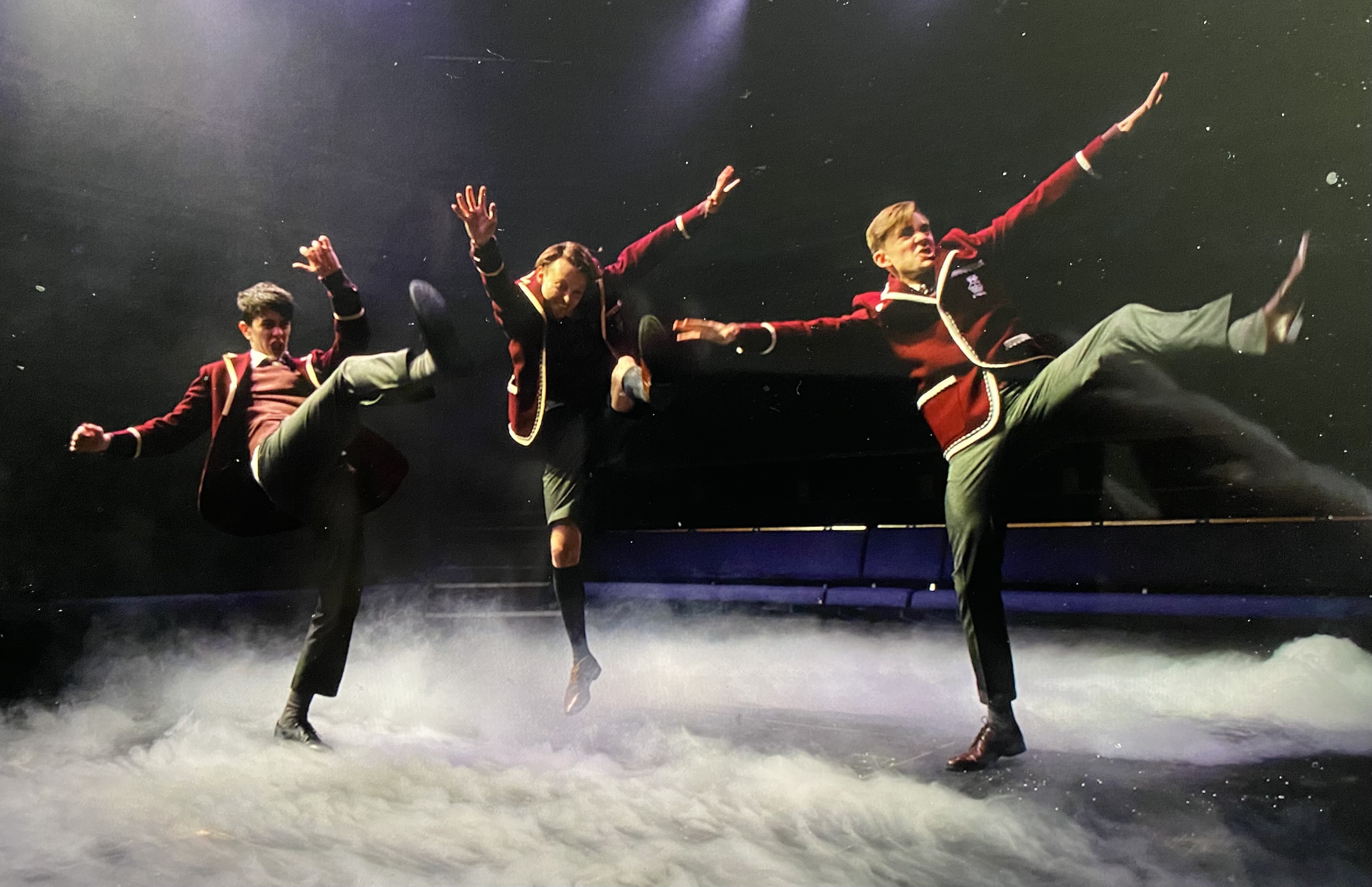
Photo: Rjjie Kurttz

Writer: Pamela Carter:

Director: Oscar Toeman

⭐️⭐️⭐️

In the Spring of 1936, King Edward VIII sat on the British throne, Nazis were on the ascendancy in Germany and a group of 27 English schoolboys set out on an ill-fated trek through the Black Forest. Inspired by true events, Pamela Carter’s 95-minute drama recounts the boys’ misfortunes and interrogates the peculiar condition of being English.

The boys, from The Strand School in London, describe themselves as “lower middle class”. Class remains the key to everything in their homeland. Their story is told from the perspective of just three of them, all in their early teens and appearing in their maroon school blazers: Harrison (Hubert Burton) embodies the bulldog spirit; Lyons (Matthew Tennyson) strives to not be the outsider, guiltily denying his Jewish heritage; and Eaton (Vinnie Heaven) comments irreverently on all around him, his every word dripping with irony.

After spending a night at the Adolf Hitler Youth Hostel, the party begins its journey on foot to the next destination, led by a novice teacher (not seen). A late Winter blizzard is on its way. There is an easy route and a difficult route crossing a mountain, so, unanimously, they choose the latter. Being English, the writer asks, would they have any other option? Carter chips away at the quirks and foibles that join together to make a nation’s psyche and makes us wonder whether they add up to insanity or the attributes that win wars.

Director Oscar Toeman’s highly animated in-the-round production is played out on a bare stage, with the house lights up for much of the time. The three boys, always trying to maintain stiff upper lips, play tapes of familiar voices on a machine that would be invented decades later and huddle together to sing I’ll Stand By You in a moving scene that is also remarkable, considering that none of the song’s writers had been born in 1936. Period detail is not the production’s strength and Carter occasionally has a tendency to wander off course as easily as the schoolboys, seeming to overlook that her play’s suspenseful main narrative is more involving than her underlying thesis. Fortunately, three lively and captivating performances provide compensation for other shortcomings.

Towards the end, when the play is already walking on tires legs, a German tour guide (Eva Magyar) emerges to deliver a sort of epilogue, which has all the subtlety of a school History lecture. It provides an untidy climax to an intriguing, if not entirely satisfying, piece of theatre.

Performance date: 28 April 2022

Photo: PBGstudios

Writer and director: Glenn Chandler

⭐️⭐️⭐️

There are countless examples of injustices against homosexual men in the years up to the 1960s. Many have been officially acknowledged and rectified in small part with posthumous pardons, but others lie buried more deeply in the annals of legal history. Writer/director Glenn Chandler sets out to throw light on one such case with his gripping, but slightly ambiguous 70-minute drama.

In the 1920s, Sidney Fox travels around South-East England with his mother, staying either in hotels without paying the bills or, in his case, in prison. The story begins with the young man standing accused of matricide by setting fire to Mum’s Margate hotel room a few hours before an insurance policy on her life is due to expire. The play asks whether he can possibly get a fair trial when prejudice against his class and sexual orientation are stacking the odds so heavily against him.

Sidney Fox is a prostitute, an habitual thief and a compulsive liar, so what’s not to like about him? Sebastian Calver counters the facts by making the character a loveable rogue, exuding boyish charm; this is all fine, except that there are few signs of the steel that Sidney would have needed to come through in his tough lifestyle. His close relationship with his mother, Rosaline (his “pal”), is touching and amusing, Amanda Bailey giving her maternal warmth and, crucially, a twinkle of mischief in the eye.

Mark Curry plays Cassels, a barrister who is not quite a fully paid-up member of the establishment, but who plays their game anyway, rounding off Chandler’s solid production. The audience is being asked to act as a jury, judging not guilt or innocence, but whether or not the trial process is fair. The whole point of the drama is to demonstrate the existence of prejudice, but does Chandler make his case beyond reasonable doubt? In Scotland, where this play premiered in 2021, the verdict would be “not proven”.

Performance date: 21 April 2022

Photo: Marc Brenner

Writer: Mike Bartlett

Director: Rachel O’Riordan

⭐️⭐️⭐️💫

Mike Bartlett is known as a prolific writer for theatre and television and this, his second play to open in London within a week and his third currently running in the city, only adds to that reputation. Of course, Scandaltown refers to London and it asserts that nothing of much significance has changed since the the post-pandemic second half of the 17th Century. The play is a mash-up of modern social/political satire and traditional Restoration Comedy.

Pinpricking hypocrisy and pomposity, the writer takes plot lines and character names that are no less ludicrous than those featured in the original comedies and places them into a post-pandemic 21st Century setting in which corruption, substance abuse and infidelity are rife. The jokes are, in some ways, scattershot and many miss the mark, but it feels genuinely scandalous that there are still so many targets in the modern world to be aimed at.

Northerner Phoebe Virtue (Cecilia Appiah) heads south, cross dresses and embarks on a mission to find her missing brother Jack Virtue (Matthew Broome) and rescue him from a life of debauchery. She arrives in time to attend the social event of the season, the Netflix Masked Ball. This extravaganza results in a cascade of mistaken identities and it provides an opportunity for th 12-strong cast to parade in flamboyant costumes, designed by Kinnetia Isidore. 

The London elite appears before us. Lady Susan Climber (Rachel Stirling), came third in the 2015 series of The Apprentice, but suffered a fall from grace following some ill-advised comments on social media. She hires as her consultant Hannah Tweetwell (Aysha Kala), who guides her into a liaison with Matt Eton (Richard Goulding), the randy and duplicitous Secretary of State for Procurement. Bartlett does not try too hard to conceal similarities between many characters and real life counterparts.

The humour is risqué, but also risk-free, not threatening to give real offence to anyone. The play flounders when Bartlett wades too deep in the swamp of party politics and when he takes it all much too seriously and lectures the audience. Otherwise, his joke-a-minute style keeps the ridiculous comedy bubbling and director Rachel O’Riordan’s nimble production maintains the flavour of Restoration Comedy throughout. The actors all seem to have a whale of a time, given complete freedom to go over the top.

Bartlett stitches the second act together with a potentially glorious running gag and then, unforgivably, fails to deliver the punchline. It is an up and down ride, but, overall, the laughs far outnumber the yawns and, in these grim days, that is a cause for gratitude.

Performance date: 14 April 2022

Another America (Park Theatre)

Posted: April 8, 2022 in Theatre
Photo: Piers Foley

Writer: Bill Rosenfield

Director: Joseph Winters

⭐️⭐️⭐️⭐️

Television channels are awash with travelogues documenting American life. Typically, the host will take a car/train, stop at a small town, take in the views, interview a few locals (usually weirdos) and move on to the next location. So do we really need another similarly formatted American documentary, this time adapted for the theatre? Clearly playwright Bill Rosenfield believes that we do.

Simon and Garfunkel looked for America in their 1960s song, so maybe Rosenfield has, at long last, found it. His play is inspired by True Fans, a documentary film by Dan Austin, and the mode of transport used is the bicycle. Dan Austin (Marco Young), his younger brother Jared (Rosanna Suppa) and his best friend Clint (Jacob Lovick) set off to ride from Venice, California to Springfield, Massachusetts. They are Basketball fanatics, supporters of Utah Jazz, and their destination is the Basketball Hall of Fame. They cross the Rockies and the Rust Belt, meeting the disillusioned and the dreamers on their way, all three actors taking turns to play different characters in the places visited.

Modern America can be seen as a nation dominated by affluent East and West coasts, home to a liberal elite, with a vast, often ignored expanse in the middle. Nothing in this play is overtly political, but the notion that the forgotten have the potential to kick back always lies beneath the surface. The characters narrate the story, often stopping to correct themselves and take out exaggeration; the writer is reminding us that this country with a short history is founded on legends, many of which could be baseless.

The first half of the road trip is tricky. Every time that a new character appears, one of the actors is taken out, thereby hindering the development of their main role and leaving the audience little to connect with. The story has no high drama, little comedy, no mystery and no romance; it is a celebration of small lives, mundane and often boring. However, a dip in the Mississippi in the middle of the play refreshes it. The three cyclists emerge as fully rounded characters and Rosenfield’s themes begin to coalesce with clarity.

Director Joseph Winters keeps it all very simple, leaving an almost blank canvas on which to paint a picture of a vast country. Apart from three chairs, a basketball signed as a memento by those encountered by the cyclists along the way, is the only prop. The production relies on vivid writing and remarkably strong performance and, perhaps against all the odds, it succeeds.

The idea of an American travelogue appearing in a North London studio theatre seems crazy, but everything about Another America is eye opening. When the play trips over its own over ambition, wonderful acting comes along to pick it up and get it back on the road.

Performance date: 7 April 2022

Photo: Danny With a Camera

Music and lyrics: Stephen Sondheim

Book> Arthur Laurents

Director: Georgie Rankcom

⭐️⭐️⭐️

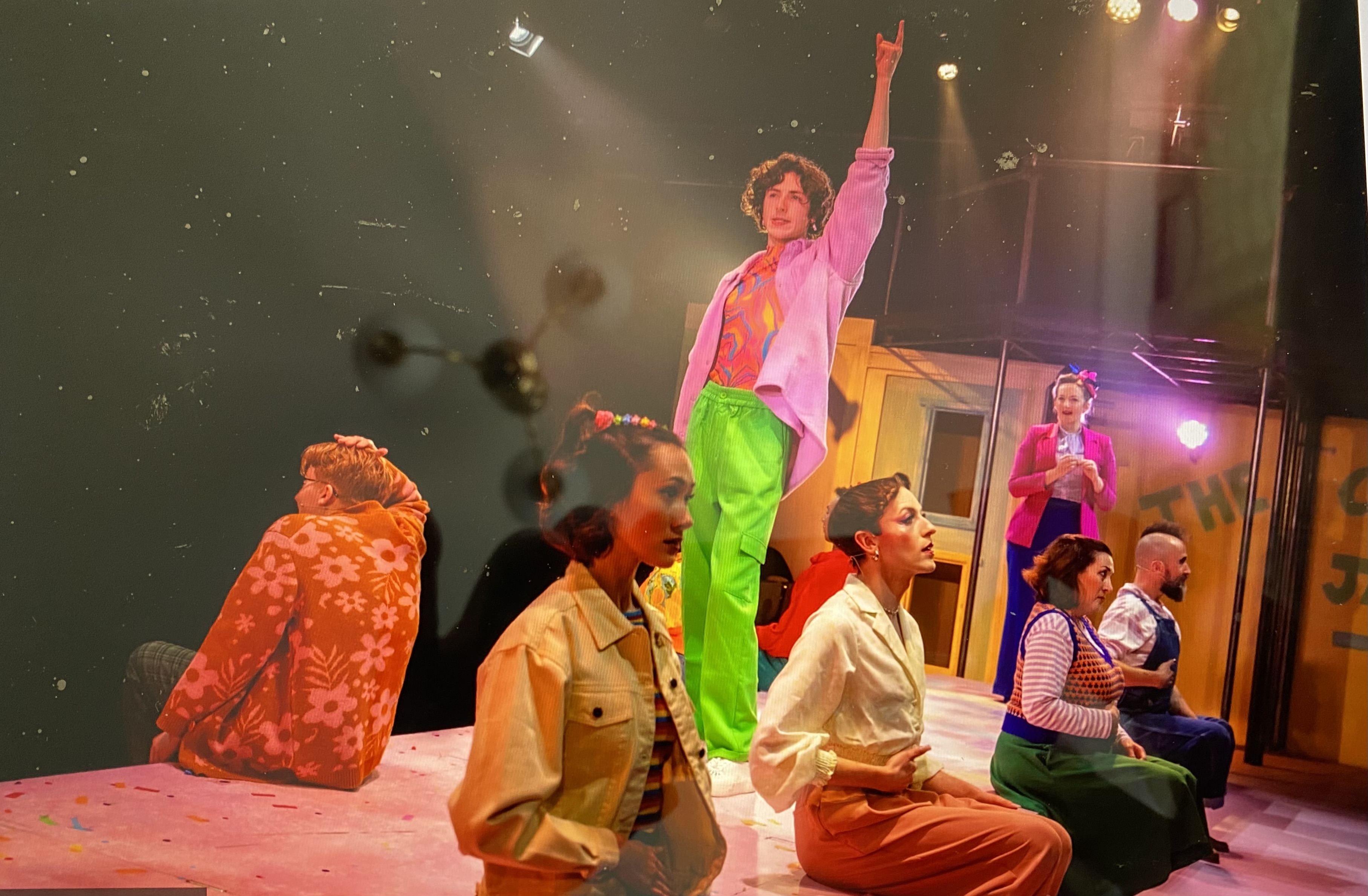
When Anyone Can Whistle landed with a thud on Broadway in 1964, Stephen Sondheim already had three hits under his belt: West Side Story and Gypsy as lyricist and A Funny Thing Happened on the Way to the Forum as composer/lyricist. Therefore, it is hard to put the show’s failure down to beginner’s bad luck and, in the intervening years, there have been few attempts to revive it. It is more likely that the best songs will be heard in concert performances.

The small town setting is typical of many early musicals, but, in this case, it is not used as a showcase for wholesome all American values. Sondheim posts a warning with the song There Won’t Be Trumpets, which could have been a deliberate counter to the euphoric 76 Trombones from the near contemporary Broadway hit, The Music Man. This town is bankrupt and rife with political corruption and social repression. It seems that only a miracle will save it, so one is duly manufactured.

The town’s mayor is Cora Hoover Hooper, played originally, albeit for only a handful of performances, by Angela Lansbury. Here, Alex Young simply devours the role and spits it back at the audience with venom. Her avaricious power crazy vamp is the big success at the heart of director Georgie Rankcom’s revival. Otherwise, the show is not particularly well sung and Lisa Stevens’ choreography, constrained by the narrow traverse stage, shows little invention; however, boundless youthful exuberance carries the production along its bumpy road.

Central to community life is an institution known as “The Cookie Jar”, a home for 49 townsfolk who have mental health difficulties, or, perhaps, for general misfits. There is no reason to believe that this concept would have been any more palatable in 1964 than it is now, but Rankcom does a good job in trying to connect the narrative to modern day sensitivities. Members of the 49 merge with the audience when the show poses the key question as to who is “normal” and who is not. Chrystine Symone as Fay Apple, nurse in charge of the “Jar” and Jordan Broatch as J Bowden Hapgood, the psychedelically attired new psychiatrist in town, make a likeable couple, even if their romance feels as if it has been pasted on as an afterthought.

Although Sondheim is not without fault, it is easier to blame Arthur Laurents’ book for the show’s failure. A social and political satire it may be, but it never feels like a slice of real American life, while it is far too heavy handed to work as a fantasy fable. Sondheim’s songs range from the downright ordinary to the sort that are mosts commonly associated with the recently departed great man. At least three of them are far bigger than the show, including the brilliant tongue twister Everybody Says Don’t and the lovely title number, which is essentially a simple lament for low self esteem, but it brings in intricate phrasing and a matching bitter-sweet melody which typify what was to become so treasured over the years.

Rankcom’s lively revival provides a rare opportunity to catch up with an almost lost curiosity, but it comes nowhere near to resolving all of the show’s multitude of problems. At least, its energy, colour and good-heartedness just about pass the whistle test.

Performance date: 5 April 2022

Photo: Brittain Photography

Writer: John Lahr

Director: Nico Rao Pimparé

⭐️⭐️⭐️

Primarily noted for a meagre three hits, playwright Joe Orton was a leading figure in 1960’s “Swinging” London, rebelling against the establishment with wit and vigour, until, suddenly in August 1967, it all came to a stop. John Lahr’s play uses Orton’s personal diaries, quoting some extracts verbatim, to paint a picture of the final years of the writer’s life,

 When the play’s main action starts,  Entertaining Mr Sloane and Loot are already successes, having caused outrage among more traditional theatregoers, but their writer remains resident in a small Islington flat shared with his long-term partner Kenneth Halliwell, who is seven years older. Toby Osmond’s Halliwell, dressed in a business suit and with an ill-fitting wig to hide his baldness, is brittle and humourless, resentful that his one-time prodigy has now eclipsed him. The deterioration of Halliwell’s mental health, leading to his brutal murder of Orton and suicide, is extremely well played.

in covering ground gone over in many dramatisations and documentaries, director Nico Rao Pimparé’s production challenges George Kemp, playing Orton, not only to match up to previous performances (most notably by Gary Oldman), but also to fit in with appearances by Orton himself in several surviving television interviews. Kemp is certainly convincing as the cocky East Midlands upstart gatecrashing the London scene, but he does not quite find the rough edges and air of danger of a still rebellious celebrity in his 30s. Four actors share supporting roles, which include Kenneth Williams and Paul McCartney.

The problems with all diaries are that they give just a single perspective on their subjects and they tend to focus on intimate personal details. Here, Orton’s obsession with casual homosexual encounters is so prominent that we feel entitled to ask: “how did he ever find time to write plays?” Whether at home in London or on holidays in North Africa, it is all much the same and explicit details, having lost their power to shock decades ago, do nothing to arouse interest. As a result of repetition, the play feels far too long.

One of the greatest ironies surrounding Orton is that two of the pillars of the establishment against which he rebelled began to be dismantled within a year of his death. In 1968, homosexuality was partially decriminalised in England and Wales and the role of the Lord Chamberlain’s office in censoring theatre was abolished. Whether or not Orton played any part in forcing these changes is not considered in Lahr’s play, which begs for more context than can be drawn from a personal diary.

By the time that What the Butler Saw opened in London’s West End in 1969, with a distinguished cast led by Sir Ralph Richardson, Joe Orton had become part of the establishment that he had so despised and the adjective “Ortonesque” had entered the English language. Without a doubt, the playwright was a somebody, but Lahr’s play seems prompted by the title of that final hit by taking a prurient peep at Orton’s personal life, while offering little to explain the nature of his genius.

Performance date: 30 March 2022

Photo: Ali Wright

Writer and director: Edward Einhorn


⭐️⭐️

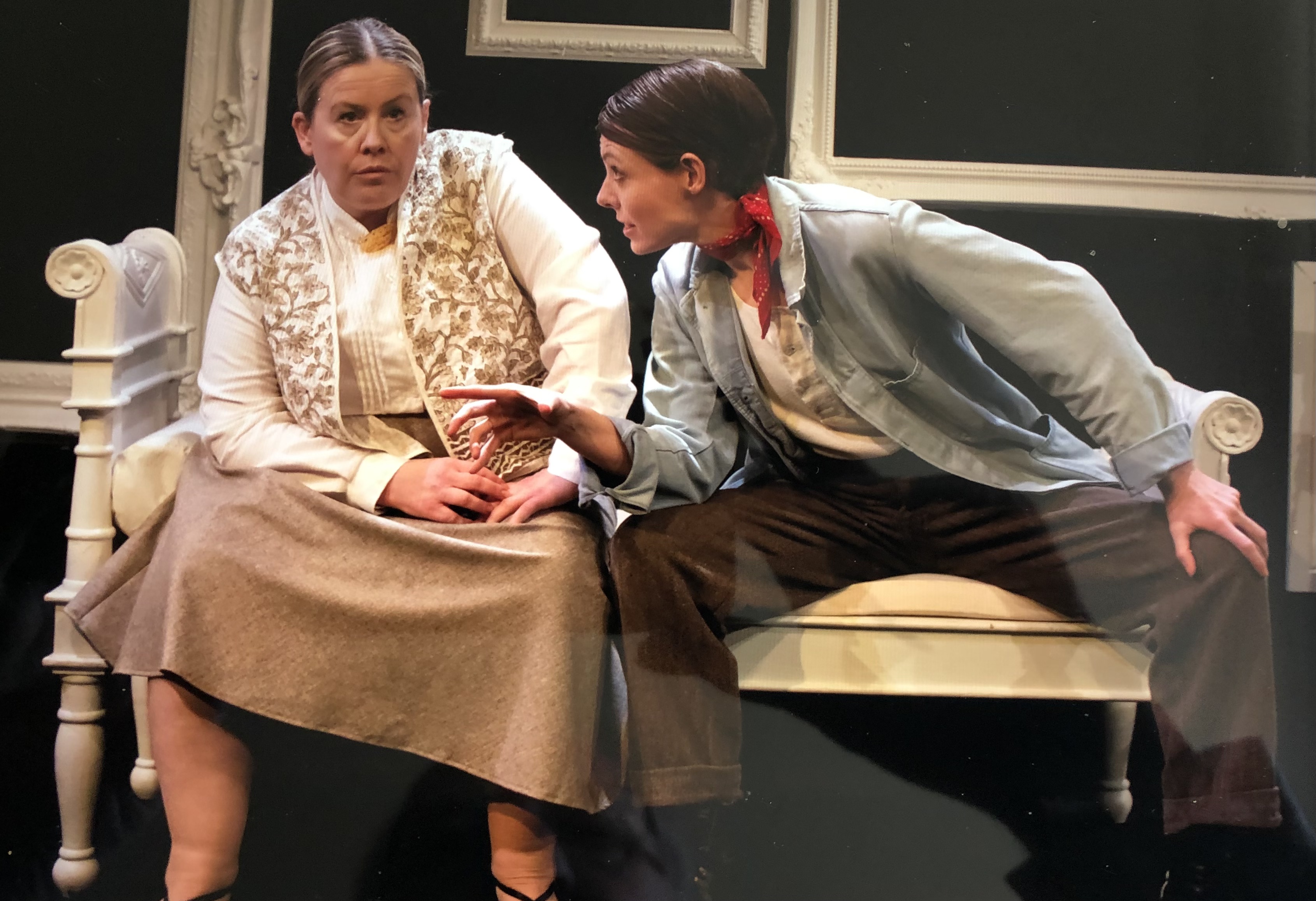
The celebrated writer Gertrude Stein and her lover/wife Alice B Toklas were Americans in Paris long before Gene Kelly went there to dance. According to US writer Edward Einhorn’s play, receiving its European premiere, they were part of an artsy set that populated the French capital in the early part of the 20th Century, flouting society’s conventions and getting away with it the name of “genius”.

As the title states, the story centres entirely around the wedding of the two women. This is the sort of play, packed with intellectual pretentiousness, that frequently wows New York audiences a long way off Broadway and it seems to have found an equivalent London home in a basement near to Piccadilly Circus. The characters mill around and discuss art and death, love and sex, just as we imagine artistic folk always do, but none of the conversations go anywhere.

Rarely can a play have made such a big deal out of actors doubling up on roles, presenting it in the text as a joke in the opening scene and then repeating the joke over and over again until it becomes exceedingly tiresome. Everyone on stage, at some point, is a character “pretending” to be another character.

On the rare occasions when the real people are allowed to come through, Natasha Byrne (Gertrude) and Alyssa Simon (Alice) are a touching, mildly eccentric couple. They whet the appetite for the story to be retold in a more cohesive, less gimmicky form. Mark Huckett is a boorish, hard drinking Ernest Hemingway and Kelly Burke is a flamboyant Pablo Picasso. The four actors share the wedding guests, who include TS Eliot, James Joyce and Thornton Wilder.

Machiko Weston’s set design, an array of empty white picture frames, unintentionally reflects a play that is showy, but short on real substance.  Einhorn’s production of his own work is billed as a comedy, but most of the laughs come in the form of embarrassed sniggers when actors are being particularly silly. A prevailing air of flippancy makes the evening palatable, but it persistently undermines efforts to get scenes taken seriously.

Running for just 90 minutes, this bizarre play has two acts but no proper interval, just a short break in which the whole audience is served “Champagne” to toast the happy couple. The show finds a way to bring some welcome cheer after all.

Performance date: 22 March 2022

Tom Fool (Orange Tree Theatre)

Posted: March 20, 2022 in Theatre
Photo: The Other Richard

Writer: Franz Xaver Kroetz

Director: Diyan Zora

⭐️⭐️⭐️

By 1978, when Mensch Meir (Tom Fool) premiered, Franz Xaver Koetz had become Germany’s most performed living playwright. The play suggests that, in chronicling family dysfunction, he could be the German equivalent to his United Kingdom contemporary, Alan Ayckbourn, but his characters are perhaps one step further down the social ladder and his themes are more overtly laden with left wing sentiments.

Director Diyan  Zora’s revival of the play, performed from a translation by Estella Schmid and Anthony Vivis, remains rooted very firmly in 1970’s Germany. As such, it struggles to find contexts in time or place.  that could connect it strongly to modern Britain, its social attitudes and politics looking conspicuously dated and, of course, foreign. However, it still fascinates as a curiosity akin to a museum exhibit and the comic drama which edges towards tragedy still grips.

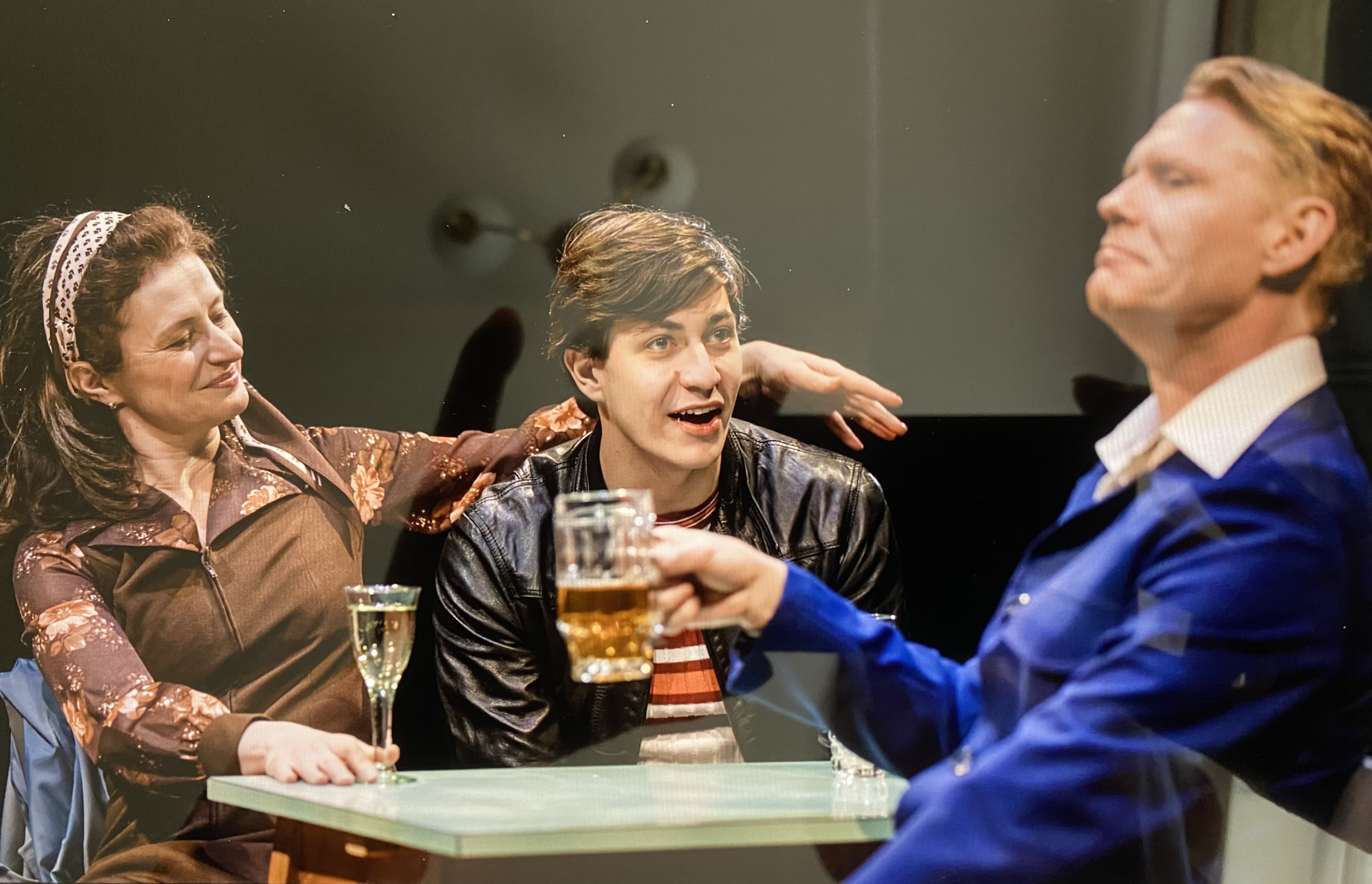
41-year-old Otto (Michael Shaeffer) describes himself as “a human screwdriver” in his mind-numbing low skilled job at a car factory. His wife Martha (Anna Francolini) does not question her role as home maker, spending her 850 DM per week housekeeping allowance frugally. Their teenage son Ludwig (Jonah Rzeskiewicz) sleeps on a sofa bed in the living room of the family’s small flat; he has finished school and has no job, so he does nothing, rejecting parental pleas to take up the law or dentistry by stating a preference for starting a bricklaying apprenticeship. It seems that the entrapment of the oppressed working classes in lives without hope is to be passed down from one generation to the next.

There are touches of Willy Loman from Arthur Miller’s Death of a Salesman in Otto as he crumbles in the face of his own failures. He is a slave at work who attempts to be a slave master at home, obsessing over trivia. Shaeffer’s deadpan style finds comedy in the character’s absurd pedantry without losing sight of the tragedy in his plight; his escape to a fantasy world as the pilot of a model glider is strangely touching. Francolini suggests that Martha could be made of sterner stuff, but she is just as downtrodden as Otto when she performs her household and conjugal duties, without questioning; her fawning over a Swedish royal wedding on television allows Kroetz to illustrate the power of the social hierarchy which underpins capitalism.

Zora’s production navigates the play’s many awkward turns confidently, its boldest sequence coming towards the end of the first act. Otto’s pent up frustration explodes in a fit of rage which sees him smashing everything in the flat across the floor; then, slowly and methodically, he and Martha clear up the mess. The anger simmering beneath their calmness and total silence is almost deafening.

The short second act feels anticlimactic and adds little to a drama that had already run its course. In 2022, the human screwdriver would have been replaced by a machine, Martha would be a joint breadwinner and the bored Ludwig would be preoccupied with computer games and social media. Beyond such details, Tom Fool prompts the question as to whether working class lives have much changed.

Performance date: 16 March 2022

Bacon (Finborough Theatre)

Posted: March 5, 2022 in Theatre
Photo: Ali Wright

Writer: Sophie Swithinbank

Director: Matthew Iliffe

⭐️⭐️⭐️⭐️

Stories of sickening violence among adolescent boys attending inner city schools frequently fill local news reports, but we get few insights into the details of their lives and the causes of their behaviour. Sophie Swithinbank’s new 75-minute one-act play interrogates teenage macho culture with the vision of an outsider looking in and uncovers its soft centre.

Mark and Darren are 15-year-olds, both from single parent families, but seemingly polar opposites. Mark is geeky, smartly dressed, conformist and proud of the waistcoat that he made for his dog. Darren is an unruly, aggressive bully, lying as conspicuously about his sexual exploits as about a three-day holiday to Barbados; his idea of defying convention is walking through a drive-through McDonald’s, but his love for his three pet mice (Mac, Cheese and Salad) points to some redeeming features. For entirely different reasons, both boys are friendless. The story of their odd relationship is told by Mark, after an unexpected reunion four years later.

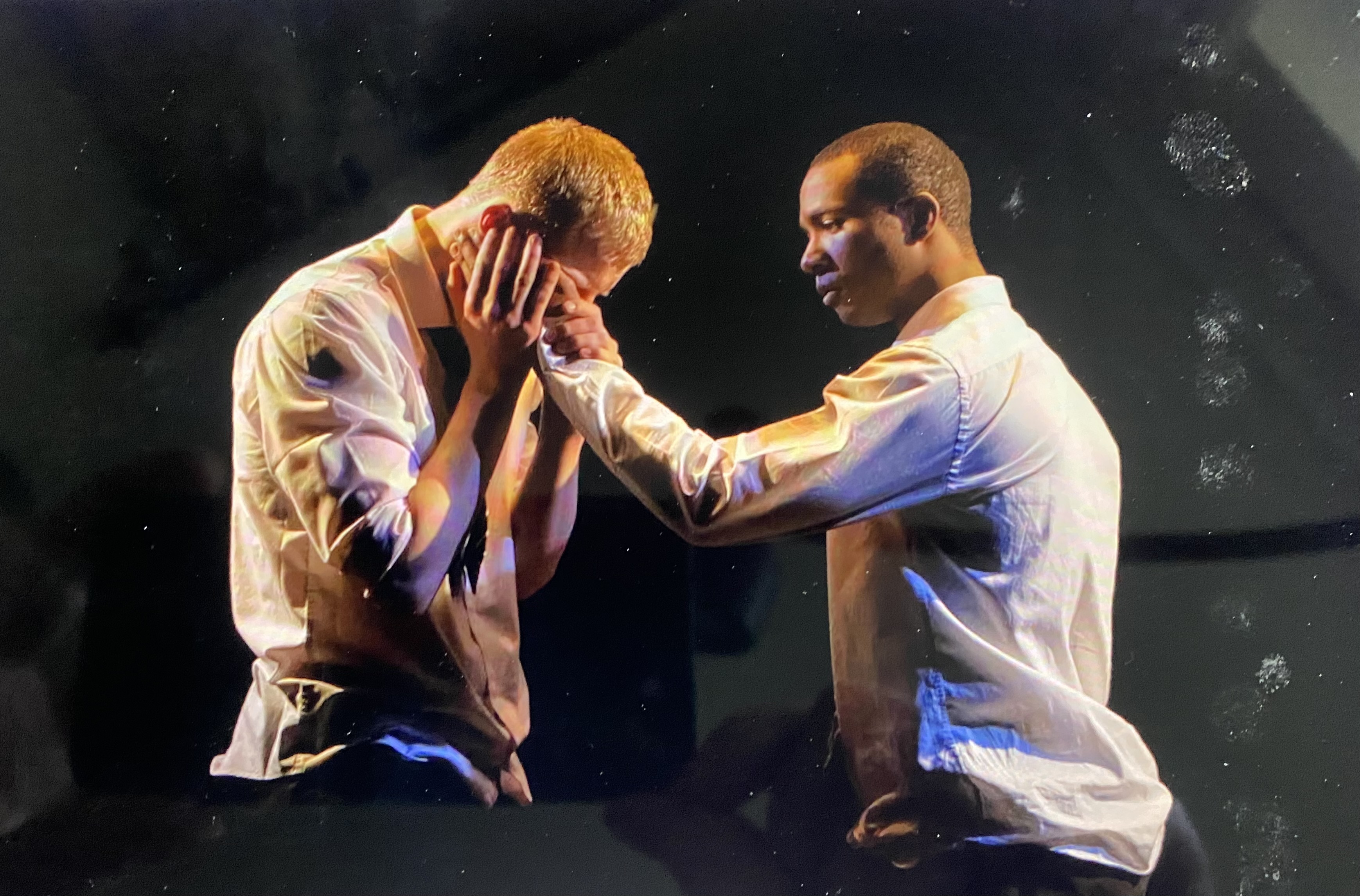
The see-saw which spans the width of the traverse stage in Natalie Johnson’s simple set design could be a metaphor for the progression of the play, as laddish comedy and visceral drama vie for supremacy. Bacon begins as a bitter-sweet bromance, but becomes a riveting emotional journey as both Mark and Darren struggle to come to terms with their sexuality. The constant throughout the play is Swithinbank’s razor-sharp writing.

Corey Montague-Sholay reveals the inner turmoil beneath Mark’s calm and orderly exterior. There is genuine astonishment on his face when it occurs to him that Darren had simply acknowledged his existence. Mark realises that he is gay, but cannot make sense of his feelings towards Darren and, in his confusion, resorts to self harming.

The vulnerability masked by Darren’s swagger is brought out beautifully by William Robinson, who demonstrates clearly that all the character’s rule breaking is motivated by his need to get noticed by a neglectful father. Working together, the two actors generate an explosive force, sparked by physical energy and precision timing.

Using the tight performance space to maximum advantage, director Matthew Iliffe’s sizzling production moves at breakneck speed, slowing down only for the tenderest of exchanges. Like a gourmet fry-up, this Bacon is to be savoured. 

Performance date: 4 March 2022

Writer: Ruby Thomas

Director: Lucy Morrison

⭐️⭐️⭐️⭐️

What is it that separates the human animal from all other species? Ruby Thomas’ play, The Animal Kingdom, receiving its world premiere here, asks that question and seems to toy with the answer that there is not very much. The stage is set out like an animal sanctuary with the audience seated around an enclosure, wildlife noises are heard in the background and the only thing that could be missing to complete the picture is a commentary from David Attenborough.

The play’s “menagerie” is a dysfunctional family of four, shepherded by Daniel (Paul Keating), a calm and compassionate counsellor. His mission is to chair six therapy sessions which have been convened to help in the recovery of family member Sam, an in-patient at a psychiatric clinic. Sam is a 21-year-old university student, played with nervy intensity by Ragevan Vasan; he has been self-harming and the play charts the cathartic process over the six sessions, exposing previously hidden emotions and breaking through barriers.

Martina Laird excels as Sam’s mother, Rita, a woman who, unwittingly, makes everything about herself; she takes the blame for her son’s troubles, including the fact that he is “queer”, thereby arguing that nurture overcomes nature even in this purportedly natural world. She is divorced from Sam’s father, Tim, a man of few words and still fewer outward expressions of feelings, who believes that he can compensate for these shortcomings by splashing out money. Jonathan McGuinness has little to do as Tim sits on the sidelines, but he rises to the occasion when the character finally opens out, giving the play its most touching scene.

Ashna Rabheru gives a spirited performance as Sofia, Sam’s 18-year-old sister, who is worn down by constantly worrying about her unstable brother. Thomas seems less concerned with the specific details of the characters’ lives than with showing their relationships as being representative of family dynamics in a general sense and, to this limited extent, they occasionally come across as stereotypes. However, her approach works in asking the audience to identify with the family’s turmoil and thereby drawing us in. Maybe the overriding animal metaphor gets a little lost, but the writer creates an absorbing and moving piece that is laced generously with deft touches of humour.

Director Lucy Morrison leads us around this emotional rollercoaster with a carefully measured production which is more effective for being unshowy and allowing lucid writing and strong performances to carry it through. It is often claimed that brainpower is the only feature that distinguishes homo sapiens from the wider animal kingdom, but, after 80 minutes of sharing the emotions of the family in this play, we may wonder whether intelligence gives us any advantage at all.

Performance date: 24 February 2022