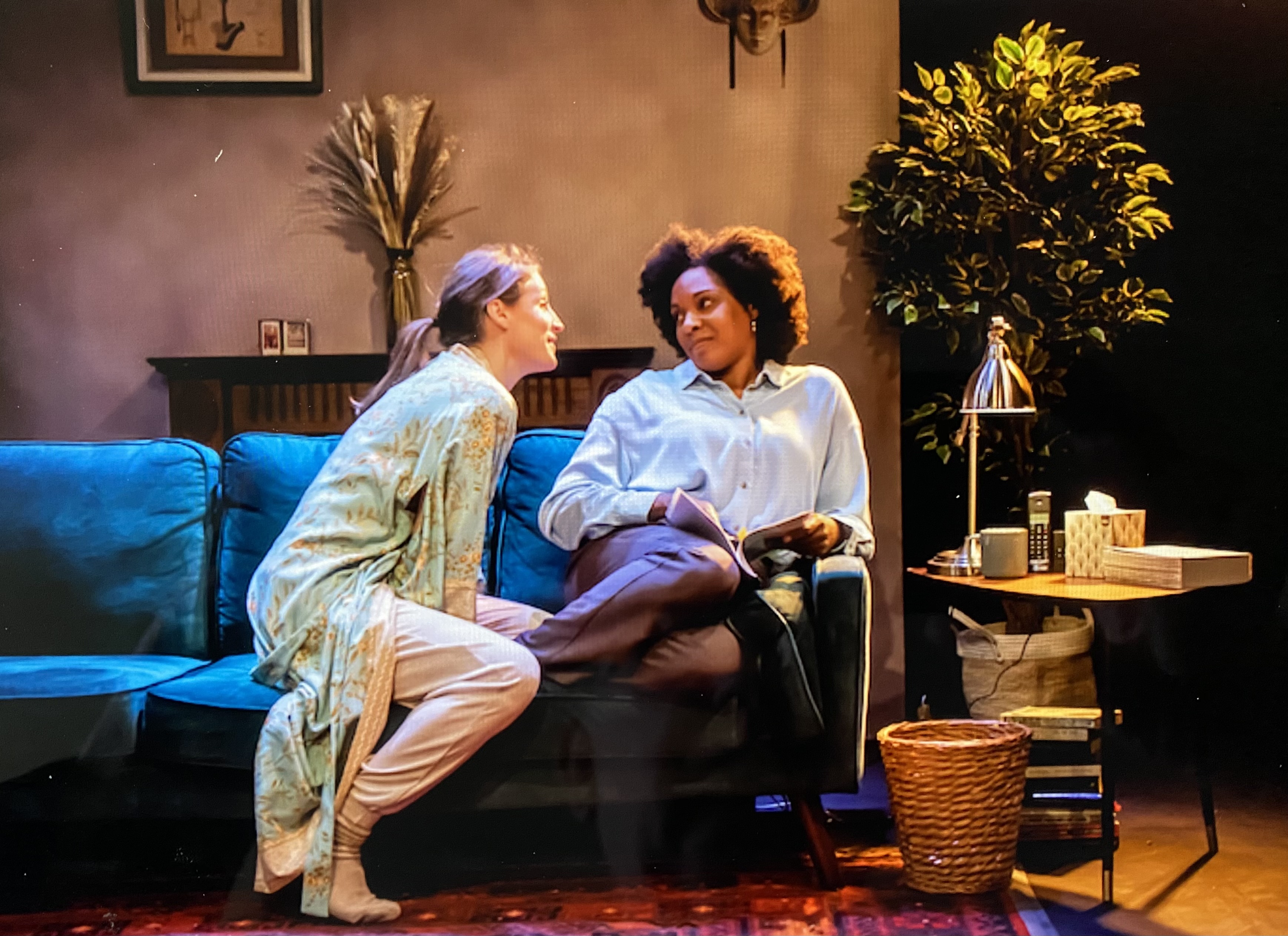
Never Not Once (Park Theatre)

Posted: February 12, 2022 in Theatre
Photo: Lidia Crisiafulli

Writer: Carey Crim

Director: Katharine Farmer

⭐️⭐️💫

Seated around three sides of an elegant and cosy room, audiences for American writer Carey Crim’s play Never Not Once may feel transported back in time. A Persian carpet is spread across the floor and framed prints are arranged tidily on the far wall, hanging above an invitingly comfortable sofa. Yet the traditional flavour of Roisin Martindale’s set design belies the very modern nature of the relationships seen in the play.

Eleanor (Meaghan Martin) is the teenage daughter of same sex parents who is about to become engaged to a fellow student, steady and dependable Rob (Gilbert Kyem). Her birth mother, Allison (Flora Montgomery), a former dancer, is reserved and slightly distant, unlike her partner, Nadine (Amanda Bright), a successful scientist, who is emotionally closer to Eleanor. Their home in Eastern USA is a picture of domestic bliss until Eleanor becomes obsessed with finding her father and hires a private detective to help her in achieving that goal.

Crim’s play starts out being about heritage and identity, but, once a can of worms has been opened, it moves in different, darker directions. Investigations point to Doug (Adrian Grove) as the likely father and disturbing revelations rock Eleanor’s world. The play crams a great deal of plot into barely 80 minutes of running time, but it has a storyline which could have been taken from a television soap opera and the challenge presented to director Katharine Farmer is to raise it above that level.

For three quarters of the drams, Farmer’s production is calm and absorbing, helped by commendably restrained performances, particularly from Montgomery and Bright. Even occasional dollops of American-style sentimentality prove to be only mildly irritating. Unfortunately, the final quarter comes close to risible melodrama, as Crim’s sole objective seems to become to show Doug squirming in repentance for past misdemeanours. The expected examination of the psychological effect on Eleanor of her discoveries fails to materialise; instead, she has an unconvincing panic attack, in response to which Nadine offers the useful advice: “keep breathing”.

Possibly Crim tries too hard to tie things up neatly, but it is disappointing that a drama which begins as a thoughtful account of the dilemmas thrown up by 21st Century relationships ultimately falls apart. The play deserves better.

Performance date: 11 February 2022

Photo: Marc Brenner

Writer: Elizabeth McGovern

Director: Gaby Dellal

⭐️⭐️

The name of Ava Gardner may mean little to many 21st Century film lovers. She won no Oscars and left behind few of the sort of enduring classics that still appear regularly on television and streaming services. Perhaps she would have been remembered differently if she had not turned down an offer to play Mrs Robinson in The Graduate. Yet, in her prime, during the 1940s and 50s, she was a huge name in Hollywood, whose private life led to her featuring as prominently in the gossip column headlines as on the posters for her films.

Elizabeth McGovern’s 90-minute one-act play, looking into Ava’s life, is an adaptation of the book The Secret Conversations, written by journalist Peter Evans and Ava herself. Born in 1922 in North Carolina, she had three high profile marriages: to the juvenile star Mickey Rooney, the jazz musician Artie Shaw and the legendary singer/actor Frank Sinatra. She also had a 20-year relationship with the eccentric tycoon, Howard Hughes. Her final years were spent living in a central London flat, where she died in 1990.

In her mid-60s and suffering the after affects of a stroke, Ava needs the cash that an autobiography could generate. McGovern slips comfortably into the role of the brittle fading star, chain smoking and sipping spirits. Anatol Yusef looks beleaguered as Evans, caught between a demanding publisher and an often uncooperative Ava. Yusef also takes on the roles of all three husbands in short flashback scenes. As the play’s title indicates, all the interactions are conversations, but they are only at a superficial level and neither Ava nor the other characters are given enough depth to become really interesting or to create believable dramatic tension. 

Director Gaby Dellal’s production is elaborate, possibly more so than the simply constructed play requires. The set, designed by 59 Productions, has the London flat at its heart and is framed as if it is a cinema screen which expands or contracts for different scenes. The suggestion that we could be watching a film documentary, intercut with real life footage, is not helpful. The production needs to be an insightful and involving drama rather than a recital of easily researched facts.

The play foretells its own biggest problem – that rags-to-riches stories set in Hollywood’s Golden Age are already over familiar. Evans’ publishers recognised this, urging him to spice things up and, similarly,  the stage version needs more sparks to ignite the drams. The conversations hold back their juiciest secrets and this life story of a once shining star seems distinctly lacklustre.

Performance date: 25 January 2022

Conundrum (Young Vic Theatre)

Posted: January 20, 2022 in Theatre
Photo: Marc Brenner

Writer and director: Paul Anthony Morris

⭐️⭐️⭐️

As children, we believe that anything is possible, that we can become whatever we choose and that no obstacles will stand in our way. Looking back at those aspirations in middle age, how many of us will feel disappointed? Conundrum is a new 75-minute one-act play, written and directed by Paul Anthony Morris, which explores the gulf between childhood dreams and adult reality.

Fidel (Anthony Ofoegbu, articulating the character’s thoughts as in a monologue) was a child of the 1970s. Now, in lockdown, he sifts through old diary entries, exam results and letters of rejection for jobs which all give as their reason that he is “over-qualified”. The papers are put through the shredder. He strains to recall the sort of facts learned at school that prove to be useless in later life, adding them to a jumble of words laid across the stage floor in Sean Cavanagh’s design. 

Confidently, Fidel boasts that he was ten times brighter than any other kid, but he offers little corroboration and Morris never reveals whether he had been just a cocky brat or a genuine talent who had gone on to under-achieve. Further, we are not told precisely how Fidel has been a disappointment as an adult, but we see him driven by his perceived failures to a mental breakdown, needing to be injected with sedatives by a psychiatrist (Filip Krenus). He perceives his fate as having been pre-ordained by the circumstances into which he was born and which would always remain outside his control.

Ofoegbu grabs this rather depressing piece by the throat and delivers a performance of intense visceral power, heightened by balletic movement directed by Shane Shambhu. So remarkable is the actor that he produces the presumably unwanted effect of making this production of a play, which is built on a thin and somewhat obvious premise, seem overblown. When Fidel states that he has been a victim of racism (so indoctrinated with it that he had contributed to his own failures), it feels as if Morris is throwing in a weighty theme almost as an afterthought and the ideas which could arise from it are never properly developed.

“I know who I am” exclaims Fidel repeatedly, as if reaching this point is equal to unearthing the meaning of life, but Morris does not invite the audience to share in his discovery. Posing unanswered (and perhaps unanswerable) questions, the play is profoundly puzzling. It is a tough watch, but, nonetheless, Ofoegbu is spellbinding.

Performance date: 19 January 2022

Folk (Hampstead Theatre Downstairs)

Posted: January 5, 2022 in Theatre
Photo: Robert Day

Writer: Nell Leyshon

Director: Roxana Silbert

⭐️⭐️⭐️💫

In the age of streaming, music can become everyone’s property within seconds of it being made available, but, in the not too distant past, songs were not written down or recorded. They belonged to individuals, families and communities, passed down from generation to generation. Nell Leyshon’s new two-act play, receiving its world premiere here, explores the place of traditional folk songs in rapidly changing times.

It is 1903 in rural Somerset and sisters Lucy and Louie occupy a small squatters’ cottage from which they work as glove makers. Their mother has died recently, leaving her songs implanted firmly in Louie’s head. While Lucy flirts with local boy John and plots an escape into the wider world, Louie mourns and she eventually meets a visiting academic, Sharp. He claims that Scotland, Wales and Ireland all have traditional folk songs, but not England, so he makes it his mission to discover the songs that define the English nation, put them onto paper and rearrange them.

In this studio theatre, Rose Revitt’s design has a strong Autumnal feel, suggesting the end of an era and director Roxana Silbert’s gently paced, un-melodramatic production underlines the sense of loss. A glove making factory is moving in to take the sisters’ work and popular entertainment is threatening to claim their mother’s songs. Their traditional ways of life are being swept away in a tidal wave of industrial and commercial forces..

Mariam Haque is outstanding as Louie, sorrowful, withdrawn and seemingly of low intellect, but finding steely resolve to defend what she believes to be her heritage. She also sings the songs sweetly, although, sadly, we hear too few of them. Simon Robson gives Sharp an air of educated arrogance, which is countered by the character’s admission of his own lack of musical talent. Sasha Frost as Lucy and Ben Allen as John make a zestful couple, hoping to improve their lives and become a spur for inevitable change.

At the heart of the play lie conflicting arguments between Sharp and Louie for progress and preservation, both presented by Leyshon in articulate form (perhaps more articulate than would be consistent with the character of a “simple” country girl). However the family drama in which the debates are encased feels too flimsy and contrived to be gripping and the play ends up as quietly charming, but short of dramatic substance.

Performance date: 4 January 2022

Photo: Johan Persson

Writer: Alice Childress

Director: Nancy Medina

⭐️⭐️⭐️⭐️

Any idea that Trouble in Mind, Alice Childress’s angry comedy from 1955, is outdated has been countered as recently as 2019 when the Best Picture Oscar winner, Green Book, was criticised widely for representing a white person’s view of America’s racial divisions. Childress, an actress herself, lambasts the dramatic arts for misrepresenting her race and adhering to cosy conventions in an era when the Civil Rights movement was only in its infancy.

The writer voices her rage mainly through the character of Wiletta Mayer (a storming performance from Tanya Moodie), an experienced black actress who is fed up with playing maids. She is cast in a leading role in a new play to be directed for Broadway by eminent film director Al Manners, given tyrannical authority by Rory Keenan. Manners brandishes liberal credentials, but orders white cast and crew members that they should not eat with their black counterparts and refuses to listen to Wiletta’s pleas to make aspects of the play and her performance more true to life. 

Childress presents her earnest arguments encased in a light comedy of backstage bitchery and theatrical in jokes. Perhaps she needed to give a sugar coating to her bitter pill in order to get it to the Broadway stage in 1955. Director Nancy Medina’s production on the Dorfman Theatre’s thrust stage needs to negotiate some tricky changes of tone in getting the play to work. The awfulness of the drama being rehearsed is exaggerated to the point that we could be watching The Play That Goes Wrong and this may be followed swiftly by an impassioned speech about racial injustice; however, the transitions between broad comedy and high drama are always handled deftly.

The company in the rehearsal room includes three other black members. Cyril Nri’s Sheldon Forester is a hardened veteran, inclined to agree with Wiletta, but more inclined to make sure that he can pay his bills. Millie Davis (Naana Agyei-Ampadu) is a sassy younger actress always armed with a smart quip and the enthusiastic juvenile lead is John Nevins (Daniel Adeosun), whose most notable prior experience has been as one of the children in Porgy and Bess; nonetheless, Manners promises him Hollywood stardom and thereby secures compliance on his production.

Arguably, all Childress’s characters in this play are stereotypes, but that rather strengthens the points which she is making. Joe Bannister is the harassed assistant director wandering around with his clipboard, John Hollingworth has fun hamming it up as the company’s ham actor and Emma Canning is charming as the ingénue being touched inappropriately by her director and pursued ill-advisedly by her leading man. Rounding things off, Gary Lilburn contributes a delightful cameo as the septuagenarian theatre caretaker who has seen it all before.

In staging this highly accomplished and thoroughly enjoyable revival, the National is asking itself and the wider theatre world some intriguing questions. While laughing, audiences should be pondering over how much of 1950s Broadway lingers on this side of the Atlantic today.

Performance date: 9 December 2021

Yes So I Said Yes (Finborough Theatre)

Posted: November 27, 2021 in Theatre
Photo: Lidia Crispafulli

Writer: David Ireland

Director: Max Elton

⭐️⭐️

Judged from his most recent works, perhaps the one word that can best describe the style of Belfast-born playwright, David Ireland is “confrontational”. In both Cyprus Avenue, which enjoyed two successful runs at London’s Royal Court Theatre, and Ulster American, a big hit at the 2018 Edinburgh Fringe Festival, characters challenge each other and audiences ferociously and follow through with shocking acts of violence. If the title of this, his latest play which is here receiving its premiere on this side of the Irish Sea, suggests a milder approach, it is misleading. There is no mellowing of tone and, in fact, the writer could be said to have progressed from risking offending many to being near certain of offending all.

Ireland’s writing bears an acute awareness of the divisions, both political and social, on the island of his birth. He writes from the perspective of belonging to a province that seeks an identity and a relevance in the modern world, perpetually viewing itself as either British or Irish or neither or both. Now (the play is set in 2011), following on from the peace process, even traditional sectarian killing is out of fashion. The writer’s themes are as before, but he now presents them in the form of an absurdist satire that is even starker in a horror tale about mental torment, rape, bestiality and Eamonn Holmes.

The central figure, Alan “Snuffy” Black, a Protestant Unionist, is played with a doleful look of bewilderment by Daragh O’Malley; he is diagnosed by his jocular doctor (Kevin Trainor) as suffering from depression after he complains that the barking dog owned by his neighbour, McCorrick (Owen O’Neill) is preventing him from sleeping every night. The dog (symbolic of irrational prejudices?) may or may not exist. Snuffy gets help from an unconventional therapist (Laura Dos Santos) who orders an outrageous remedy for his ills.

Director Max Elton’s production has pace and anger, magnifying the play’s darkest humour. The right note is hit with the arrival of two Unionist paramilitaries, a hilarious double act comprising the relentlessly aggressive Craig (Kevin Murphy) and his over-eager sidekick, Carson (Declan Rodgers). Sadly, their appearance is too brief and, without them, Elton struggles to keep the excesses of Ireland’s black comic writing in check.

in the course of the production’s 80-minutes (straight through) running time, jokes work sporadically, but they tend to be dragged out for too long and, while all the ingredients for a successful black comedy are here, they feel wrongly balanced. Resulting from this, the play eventually strays so far beyond the boundaries of good taste that it ends up being neither funny nor meaningful.

Performance date: 25 November 2021

Little Women The Musical (Park Theatre)

Posted: November 18, 2021 in Theatre
Photo: Pamela Raith

Book: Allan Knee

Music: Jason Howland

Lyrics: Mindi Dickstein

Director: Bronagh Lagan

⭐️⭐️⭐️💫

Interest in Louisa May Alcott’s 1868/9 two volume semi-autobiographical novels, Little Women, was revived by a highly acclaimed 2019 film adaptation. Its mix of comedy, tragedy, romance and nostalgia clearly remains potent today and it would seem that these could be the perfect ingredients for it to follow the paths of other 19th Century literary works to become a successful musical. 

Set in New England at a time when the American Civil War is raging far to the south, Alcott’s books tell the coming of age stories of the four March sisters who live with their impoverished mother while their father is away serving in the Union army.There is a lot for writer Allan Knee to condense into 260 minutes (including interval), but he does a fine job in jettisoning subsidiary characters and scenes, while retaining the full flavour of the original.

The most striking feature of director Bronagh Lagan’s heartwarming production is the impeccable casting. Anyone familiar with the novels is likely to recognise all of the characters as soon as they appear on stage, dressed in splendid period costumes, designed by Nik Corrall. Lydia White gives a thrilling star performance as second oldest sister Jo, a strong-willed aspiring writer, assumed to be based on Alcott herself. Jo resolves never to marry and rejects the advances of the awkward, over-eager neighbour Laurie (Sev Keoshgerian showing deft comic touches), while her older sister, Meg (Hana Ichijo), sets herself on a course towards marital bliss with Laurie’s tutor, John (Lejaun Sheppard).

The quartet is completed by musically talented Beth (Anastasia Martin) and the precocious, spiteful Amy (a deliciously nasty Mary Moore). Savannah Stevenson, with the sweetest soprano voice in the company, is the girls’ loving “Marmee” and, in memorable cameo roles, Bernadine Pritchett is the domineering Aunt March, Brian Protheroe is the kindly rich neighbour, Mr Lawrence and Ryan Bennett is the timid New York Professor who could have a chance of winning Jo’s hand.

Sadly, the songs with music by Jason Howland and lyrics by Mindi Dickstein, are a big disappointment, most of them distinguished only by their consistent mediocrity. It feels as if all the work in developing the characters and propelling the story is done by the book writer and the performers, with the songs contributing very little. There is some improvement in the later stages and the final duet between Jo and the Professor, Small Umbrella in the Rain, is actually rather charming, but still there is nothing likely to linger in the head even for as long as it takes to reach the theatre’s exit door.

The production succeeds well as a dramatisation of Alcott’s novels and the transformation into a musical takes little away from that success; however, neither does it add very much. If the producers aim to take the show beyond this 200-seat venue and expand it, they will need to find some songs that are capable of making a stronger impact.

Performance date: 17 November 2021

Photo: Robert Day

Writer: Rebecca Watson

Adaptor: Miriam Battye

Director: Katie Mitchell

⭐️⭐️⭐️⭐️

On the face of it, Rebecca Watson’s extraordinary modern novel little scratch would seem impossible to dramatise. Written in short sentences, often random, often disconnected, it expresses the thoughts of a troubled young woman as she ploughs through a single, unremarkable working day. She commutes to her office, executes her mundane tasks, masks her internal pain and itches while remaining determined never to scratch.

Perhaps the novel could have been made to work as a monologue, but adaptor Miriam Battye and director Katie Mitchell do not look for easy options. Their play is performed by four superb actors, not bringing to life other characters in the unnamed woman’s story, but illustrating the conflicts and confusions inside her mind. This bold and original technique works to stunning effect.

Mitchell preempts the criticism that this is nothing more than a radio play by making it seem as if we are watching the recording of a radio play. Three women (Morónké Akinolá, Eleanor Henderson and Eve Ponsonby) and one man (Ragevan Vasan) appear statuesque behind standing microphones on a semi-lit stage throughout the production’s 95 minutes. They improvise sound effects and take turns to articulate the woman’s thoughts. Curiously, they become a non-singing choral quartet, the varying timbres of their voices, the precise rhythms and timing of their speech collectively representing a mind in turmoil.

The play dwells on the minutiae of daily life – waking up, eating breakfast, performing bodily functions, facing social media and so on – before finding the epicentre of the woman’s trauma. She is a rape victim. She sets herself the challenge of carrying on as if nothing had happened, working in the office where the assault had taken place, continuing her happy relationship with her boyfriend, but she is unable to bring herself to tell anyone what had happened. Crucially, the adaptor and director never allow the play to feel as if it is a cathartic outpouring; everything remains internalised as the woman searches for her own ways to come to terms with events and to begin the healing process.

Unflinching in its approach, sometimes unavoidably shocking and sickeningly topical, Watson’s book has been transformed into a uniquely disturbing theatre experience.

Performance date: 12 November 2021

Old Bridge (Bush Theatre)

Posted: October 28, 2021 in Uncategorized

Writer: Igor Memic

Director: Selma Dimitrijevic

⭐️⭐️⭐️⭐️

It is possible to think of wartime atrocities either as part of distant history or, in a modern context, as taking place on far away continents. However, we must not forget how recent and how close to our own doorstep were the conflicts that followed the break-up of the former Yugoslavia in the 1990s. British writer Igor Memic’s 2020 Papatango Prize-winning drama serves as a chilling jolt to the memory.

The story begins in 1988, when the city of Mostar, located in modern day Bosnia and Herzegovina, is still part of Yugoslavia. The historic landmark Old Bridge spans the river which divides the city, vaguely on ethnic lines. It brings communities together, never more so than on one day each Summer when it becomes the scene of a diving competition. Mili (Dino Kelly), a young man from another city, joins the competition and jumps from the bridge, catching the eye of local girl, Mina (Saffron Coomber). She is watching with her friends Leila (Rosie Gray) and Sasha (Emilio Iannucci), the joker in the pack until the jokes turn sour.

Mostar’s people identify as Bosnian, Croatian, Serbian, Albanian and so on; they may be Catholic, or Moslem, or Jewish. Their lives are inter-connected but shifting in ways that Mili likens to a Rubik’s Cube. Mina and Mili fall in love, but the play does not turn into an updating of Romeo and Juliet; the couple’s dreams are shattered not by their own family or ethnic divisions, but by the horrors of the warfare that begins to rage all around them. 

Memic does not concern himself with politics and he teaches us few specific details of the wars taking place in the Balkans region at that time. His focus is solely on the play’s characters, assessing the impact of epic events on their lives. Director Selma Dimitrijevic’s production, on a wide stage, unadorned by formal sets and with few props, conveys a sense of small people caught up in a vast tide of uncontrollable events, but this sometimes comes at the expense of projecting the intimacy of close friendships.

The writer gives the play a historical perspective through the eyes of Emina, who serves as a form of narrator, looking back from around 30 years later. Occasionally, it feels as if this character is being over used; we want the four young people to speak more for themselves and the actors playing them to expand the characters and perform all of their stories. However, much of Memic’s most lyrical and graphic writing falls to Emina and Susan Lawson-Reynolds is a commanding presence, speaking it with great clarity and emotional intensity.

Throughout the play, Old Bridge is seen as a symbol of division and unification, destruction and renewal. Memic gives us a powerful and moving reminder of the fragility of the peace that we take too easily for granted,

Performance date: 27 October 2021

Photo: Steve Gregson

Writer: Ben Brown

Directors: Alan Strachan and Alastair Whatley

⭐️⭐️⭐️⭐️

In 1987, Kim Philby, member of the infamous Cambridge Five spy ring, was living in exile in Moscow, nearing the end of his life. His Communist dream, embodied in the Soviet Union, was crumbling and the Capitalist era of Reagan and Thatcher was on the ascendancy. Against this backdrop, Ben Brown’s play imagines the conversation in a meeting in that year between Philby and the great British novelist, Graham Greene, who had once been his junior in MI6.

The unmistakeable zither music from The Third Man opens the play and provides an immediate link between the two men. Greene scripted the film and, after Guy Burgess and Donald Maclean, Philby is often referred to as “the third man” to be uncovered as a Soviet agent working inside British intelligence. Philby confesses his suspicions that Greene had based the film’s villain, Harry Lime, on him and the hero, Holly Martins, is  the writer himself, then realising that lime is in fact a shade of green. In their world, nothing is what it seems and Brown exploits the many ironies in the stories playfully throughout the play.

The meeting takes place in the living room of Philby’s Moscow apartment, cosy and comfortable in Michael Pavelka’s design. The fourth Mrs Philby, Rufa (Karen Ascoe), a Russian woman, appears from time to time, but mostly the two old friends who had not met for 25 years are left to reminisce, catch up and probe. They are alone, except for a KGB “minder” probably listening in the next room. Teasingly, his name is Vladimir.

Stephen Boxer’s Philby is an urbane womaniser who shows no outward signs of remorse, even when confronted with the lives lost due to his treachery. Oliver Ford Davies’ Greene has a sardonic air, but his anti British establishment views are much milder. He matches his friend’s duplicity by spinning different sorts of fiction and killing off his creations readily. The vodka flows and, in the play’s first act, the two men tell their stories and rake over widely known facts, but the drama becomes much more intriguing in the second act, when Brown explores the personal cost of actions taken in the past.

To some extent, Brown is touching on the same themes as Alan Bennett in An Englishman Abroad, a play which finds Burgess in Moscow exile and questions the nature of loyalty, betrayal and being forever English. However, these themes are given a fresh perspective and, in a production directed by Alan Strachan and Alastair Whatley, they are presented with style and wit.

Cleverly, Brown plants doubts over the veracity of the two men’s words almost as soon as they are spoken. The truth that prevails is that two hours spent in the company of two of our finest senior actors, seen sparring with each other cagily, is pure joy.

Performance date: 16 October 2021