Writer: Tom Wells

Director: Tessa Walker

⭐️⭐️⭐️⭐️

For anyone who has not yet booked their 2021 staycation, it could be useful to note that Kilnsea is a small town on the East Yorkshire coast, near Hull. It is the home town of writer Tom Wells and the setting for his new play Big Big Sky which paints a picture of it as a place of tranquility, in harmony with the natural world. Even rare birds think it worthwhile to stop by here twice a year as they migrate north or south.

The 90-minute one-act play is the antithesis of an action thriller. It is almost entirely character-driven and it contradicts its title by being about small small things. This is exemplified in director Tessa Walker’s carefully detailed production by characters fussily repositioning furniture and moving signage on and off set, over and over again. Little things mean a lot in Kilnsea, small cogs make the bigger wheels turn.

The action (or perhaps inaction) unfolds in a seaside café, represented by designer Bob Bailey’s beautifully observed pale blue set. It is run by Angie and the much younger Lauren, whose dad, Dennis hangs around at the end of each day in the hope of picking up free meals from leftovers. It is end of season and the café will soon close for Winter, maybe never to reopen in the face of competition from a new development in the town centre.

The arrival of Ed, a geeky ornithologist and conservationist from the Black Country, shakes things up a little. He settles in to enjoy vegan brownies with mint tea, takes a job as “Tern Warden” and quickly forms a romantic relationship with Lauren. All four characters are grieving: Dennis for his wife, Lauren and Ed for their mothers and Angie for a lost child. Continuity of life in all its forms is a strong theme running through Wells’ writing.

The play’s men are clumsy, tactless beasts and its women pull the strings that make things work. Sam Newton grasps at every opportunity to exploit the comic potential of Ed’s nervous awkwardness, while Matt Sutton gives Dennis the air of a lost soul, always striving to do well, but invariably putting his foot in it. In contrast, Jennifer Daley’s Angie is a rock, overcoming personal loss to spread warmth to others, and Jessica Jolleys’ vibrant and youthfully optimistic Lauren is a pillar of common sense.

Lovingly written and performed, Wells’ heartwarming play brings an oasis of calm to the bustle of North London. It reminds us that simple things matter most, where there is loss there is renewal and where there is life there is hope.

Performance date: 5 September 2021

Swimming (White Bear Theatre)

Posted: August 5, 2021 in Theatre

Writer: Alex Bower

Director: Kayla Feldman

⭐️⭐️⭐️

Alex Bower’s one-act play Swimming made its first appearance at the White Bear Theatre in 2019 and now, after our enforced break, the producers have judged that it’s safe for us to go back in the water, socially distanced of course.

Dan (George Jones) is in a seemingly stable relationship with Marianne (Rose Dickson), but his eye is caught by Sam (Dominic Rawson), a student and amateur swimming instructor, while he is lounging at the local lido. Soon, the boys are practicing their strokes together, both in the pool and in the privacy of Sam’s flat, and Dan abruptly dumps Marianne over the telephone. Meanwhile, Dan’s best mate Ant (Andy Sellers), a bed maker who would like to lie in one of them with Marianne, reminds Dan of the joys of laddish sexist banter and stag nights in Ibiza.

Director Kayla Feldman’s in-the-round production, performed on a bare stage, wavers between light comedy and anguished drama. In summary, Dan wants Sam (or maybe Marianne or maybe both), Sam just wants to know, Marianne wants to heal her wounded pride and Ant wants Dan back in the hetero fold but out of the way so that he can move in on Marianne. The characters congregate to discuss Dan’s bisexuality coyly, attempting to sort out the mess that it has made of their tranquil, ordinary lives.

In looking at things from four different perspectives Bowers seems to be taking on too much to cram into a mere 70 minutes, leading to all the characters feeling underwritten. A quartet of capable young actors struggles to flesh them out and to make the chemistry between them believable. This is a particular problem in the case of Dan, the central figure. He is unable to open out to others, or probably to himself and the writer can find no way to reveal his inner emotions to the audience. As a result, we neither understand him nor empathise with him.

Swimming skims over the surface of a large pool of complex human problems without diving down to find their heart. The play is amiable enough, but it never really moves far from the shallow end.

Performance date: 4 August 2021

John & Jen (Southwark Playhouse)

Posted: August 3, 2021 in Theatre

Writers: Andrew Lippa and Tom Greenwald

Director: Guy Retallack

⭐️⭐️⭐️⭐️

Broadway writer composer and lyricist Andrew Lippa has for long been undervalues in this, his country of birth. Recent UK productions of Big Fish and The Addams Family have gone some way towards rectifying this, but here we have an opportunity to appraise his first show from 1993, written in collaboration with Tom Greenwald. This updated version is receiving its world premiere and has fresh orchestrations by Lippa and Jason Robert Brown.

The revised version spans a period of around 35 years, from the mid-1980s to the present day. It begins with seven-year-old Jen picking up her new-born baby brother John, promising to care for and protect him throughout his life. Together, they embark on a journey from childhood playfulness and teenage rebellion through to the harsh realities of responsible adulthood. The show is a two-hander, a chamber musical, performed here with a four-piece band under the direction of Chris Ma.

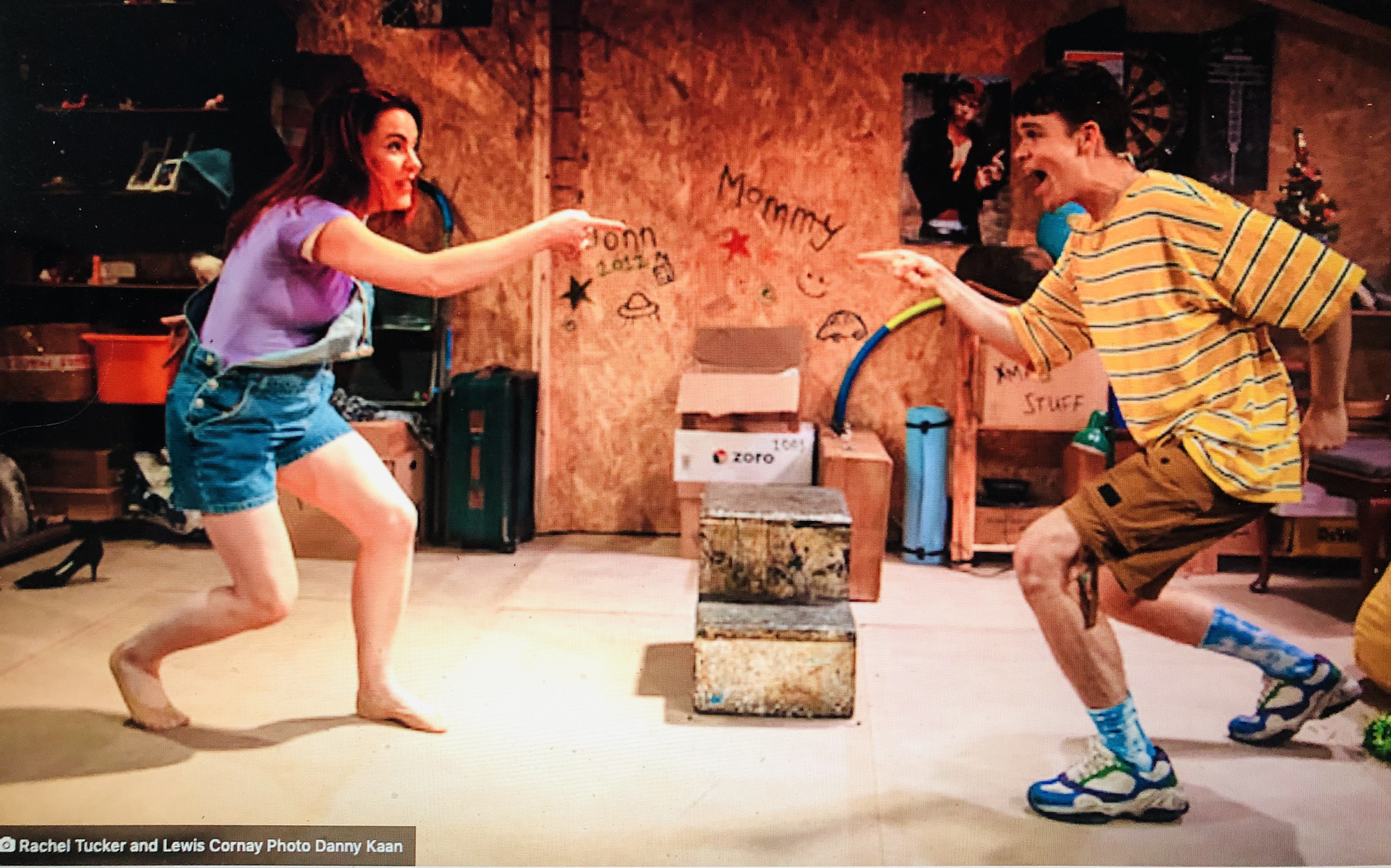
Designer Natalie Johnson sets the show in a shed (or perhaps an attic) filled with boxes of toys and other children’s paraphernalia. The siblings belong to an all-American family, perhaps typical in our perceptions, but the writers make clear that there are cracks in this idyllic structure. Lurking in the background is a controlling, violent father, despised by Jen, but eventually worshiped and treated as a role model by John. The father’s presence never comes to the fore, but is suggested subtly as, for example, when Santa Claus fails to leave presents on Christmas Eve.

Director Guy Retallack’s production blends frivolous humour with powerful emotional clout. However strong the material, an intimate show like this can only succeed if the performances are good and here they are superb.  Rachel Tucker, recently triumphant in the West End production of Come from Away, takes Jen’s girlish playfulness, teenage angst and doting motherhood all comfortably in her stride and belts out the show’s finale in a style that almost literally brings the small house down. Lewis Cornay, youthful in appearance, but always playing John as still younger, commands the stage with impressive authority.

The story is about love and loss, standing still and moving forwards, holding on and letting go. In examining American family life, the show touches on themes that Lippa was to return to in Big Fish, but the story is also told against the backdrop of turbulent history, incorporating political debates in song between the hawkish John and pacifist Jen. 

Almost sung through, the show includes several songs of stand alone quality, all done full justice by Tucker and Cornay. However, the factor that ultimately makes John & Jen so special is the skill with which it tells a multi-layered human story in musical form. In so doing, it frequently brings tears to the eyes.  

Performance date: 2 August 2021

Writer: Tennessee Williams

Director Sam Yates

⭐️⭐️⭐️💫

Tennessee Williams was a dramatist who had a gift for finding intriguing titles to entice audiences into his plays, but it would seem that inspiration eventually deserted him. The title of this play, which received its World Premiere at Hampstead Theatre in 1967, at very least gives a factually accurate description of what to expect, but, once the action gets underway, basic expectations are defied over and over again.

Director Sam Yates’ revival continues Hampstead’s season of looking back at its landmark productions and it is being performed to socially distanced audiences throughout its run. The Two Character Play is, in fact, a play within a play, being staged when an audience is waiting and only two actors have turned up “due to the eccentricities of the time”. Disruption of theatre for such a reason is something that we can easily relate to right now.

The actors are siblings, Clare (Kate O’Flynn) and Felice (Zubin Varla). Hampstead’s large stage is opened out to its full expanse as the pair arrives, designer Rosanna Vize having littered it with an upright piano, props, part-built scenery and all the inanimate ingredients that go to make theatre. Playfully, Felice dons a wig and, through the characters, Williams begins to explore parallels between life and art, reality and fantasy. The writer seems to be bringing to theatre the mysterious and introspective style associated with Federico Fellini in 1960s cinema; this is emphasised further in Yates’ production, when songs from Italy and other European countries are scattered throughout.

O’Flynn and Varla, thespians playing thespians, throw themselves full-heartedly into their roles, knowing that the structure of the piece gives them licence to overact at will. The fictional actors’ relationship is fragile but mutually dependant, mirroring the relationship between the characters in the play which they perform. For that play, they assume distinct Louisiana accents, playing two people trapped inside a house and incapable of leaving it.

The play within a play is an undisguised parody of Williams’ own greatest successes, building in themes of dysfunctional family ties, confinement and social taboos. Much of the playwright’s early work is thought to reflect his personal frustrations and turmoil, so it is enlightening to learn that, by the mid-60s, he could have been looking back in amusement. However, a thin line separates self-mockery from self-indulgence and Williams crosses it often, allowing scenes to drift off at tangents or drag on for far too long.

Yates’ production is suitably shambolic, but inventive, using tricks of modern theatre to enhance the writer’s themes. For all its many flaws and its often irritating quirkiness, the work possesses a magnetic pull that keeps drawing us back to it and our enduring fascination with Williams himself is the obvious explanation for this. The play is undoubtedly an oddity, but it is an engaging one.

Performance date: 26 July 2021

Writer: Bryony Lavery

Director: Tinuke Craig

⭐️⭐️⭐️💫

Theatre is always a collaborative effort. To some, it is also a matter of life and death. Bryony Lavery’s comedy Last Easter embraces these ideas and more in a story about a group of theatre folk who join forces as one of them becomes stricken by serious illness and embark on a sort of pilgrimage to Lourdes.

When June, a lighting designer, is diagnosed with stage two cancer, her friends gather round and panic: Leah is a props maker whose alter ego is a garish glove puppet; Gash, is a drag performer with an unsuitable joke for every occasion; and Joy is an actor who over-dramatises everything, particularly after a tipple or two. Their road trip to Southwest France does not come from religious conviction, but more from their desperation to try anything, with the bonus of enjoying a pleasant Easter break.

Naana Agyei-Ampadu’s June is the calm at the eye of a storm, stoically facing mortality, but willing to go along with her friends’ whims on the way. She endorses the writer’s point that those surrounding victims of illness can often be hit harder than the sufferers themselves. Leah (Jodie Jacobs) and Joy (Ellie Piercy) are panicky, while also preoccupied with their own developing relationship.

The main joy of this production is Peter Caulfield’s flamboyant and irrepressibly slutty Gash. With an armoury of dreadful jokes and classic songs from the 1940s, he brightens up scene after scene and keeps the play on course whenever it threatens to hit the rocks.

Just as Gash spits out one-line gags as a defence against hard realities, Lavery uses comedy to sweeten the bitter pills of the weighty themes of terminal illness, faith and euthanasia. Sometimes it feels as if she is buying cheap laughs to prevent the play from sinking and sometimes it feels as if the constant barrage of wisecracks is working contrary to the writer’s wish to draw us in emotionally. However, overall, the tricky balancing act is tackled with confidence.

Director Tinuke Craig gives her simply-stages in-the-round production pace and energy. The performance space at the Orange Tree is condensed even further by socially distanced seating and, for most of the 90-minute (plus interval) running time, the actors have just four swivelling chairs to work with, but Craig puts this to advantage in emphasising the closeness of the characters to each other. The outcome is only mildly challenging and thought-provoking, but consistently entertaining.

Performance date: 7 July 2021

Staircase (Southwark Playhouse)

Posted: June 26, 2021 in Theatre

Writer: Charles Dyer

Director: Tricia Thorns

⭐️⭐️⭐️

In 1966, London was swinging like a pendulum, England’s men’s football team was winning the World Cup and, amid all the celebrations and gaiety, homosexual relationships continued to be illegal. Charles Dyer’s comedy Staircase, depicting the lives of a middle-aged gay male couple, was premiered by the Royal Shakespeare Company in that year and, by the time that a 1969 film version appeared, starring Rex Harrison and Richard Burton, our repressive laws had already begun to change. If for no other reason, director Tricia Thorns’ revival of the play is worthwhile for giving us a snapshot of a significant period in LGBTQ+ history.

Dyer, who died in January 2021, treads carefully, seemingly not wanting to offend the sensitivities of the age, nor incur the wrath of the Lord Chamberlain, with anything too explicit. The loud and clear message, perhaps novel in the ‘60s, is that these two guys are just like everyone else, doing no harm to anyone, and the writer asks us to laugh at their dilemmas without sniggering at them. Curiously, Dyer gives one of the characters his own name and he calls the other Harry C Leeds, an anagram thereof. The couple, both hairdressers, have lived together for 20 years, but both now have problems. Charlie is awaiting a court appearance for donning drag and sitting on a man’s knee in a pub and Harry is losing his hair.

John Sackville’s Charlie is preening and theatrical, bordering on hysterical. He taunts Paul Rider’s Harry cruelly as he fusses around like a mother hen, his head swathed in bandages to hide his increasing baldness. They bitch, they bicker and there is little more to the play than that. Occasionally the writing steers the characters too close to camp stereotypes like Julian and Sandy, popular in the ‘60s from the Round the Horne radio show, but Sackville and Rider give them more depth, always reassuring us that their relationship is built on mutual affection. Of course, there are no verbal or physical demonstrations of such affection and what may go on after the pair climb the staircase together we are left to guess.

All the action takes place in the South London Barber’s shop where the couple work, which is realised sharply in Alex Marker’s set design. The play carries a deep sense of lives unfulfilled because of unjust laws and social hostility. Charlie and Harry both talk of pretending to be married (to women), both are, to some extent, in denial of the truth to each other and, more poignantly, to themselves.

Seen outside the context in which it was written and first performed, Staircase is not much of a play. It is rooted firmly in a specific time and place and Thorns can do little to give it modern relevance. However, her production boasts two first rate performances which at least breathe some fresh life into it.

Performance date: 25 June 2021

Happy Days (Riverside Studios)

Posted: June 18, 2021 in Theatre

Writer: Samuel Beckett

Director: Trevor Nunn

⭐️⭐️⭐️⭐️

Poor old Winnie doesn’t have much of a life. Samuel Beckett’s Happy Days is here again and we find her stuck deeper and deeper in a mound of earth, but this time at the Riverside Studios, perilously close to a stretch of the Thames that is tidal.

Director Trevor Nunn’s revival marks the 60th anniversary of Beckett’s absurdist comedy of frightfully cheerful despair. The play is a near monologue, interrupted only by a few words and grunts from Willie (Simon Wolfe), Winnie’s henpecked husband who is entrenched in another hole nearby. He sleeps through most of his wife’s ramblings as she recounts the mundanities of life and reflects on the unstoppable passage of time. Every day, it seems, replicates the one that preceded it, all of them, in the end, “happy”.

Lisa Dwan’s Winnie is often a comic delight, shielding herself from the sun with a flimsy parasol and worrying that she could “put on flesh” and make her home too tight. However, overall, Dwan seems less concerned with milking the comedy than with mining the tragedy, her every syllable dripping with a sense of rage at her character’s hopelessness. Her performance makes Nunn’s interpretation of the play much darker than many that have gone before, but, blessed with a rich Irish accent, she could well have found the voice that was in the playwright’s head when he wrote Winnie’s words.

Robert Jones’ set design, beautifully lit by Tim Mitchell, makes a stunning impact. Extending to the width of two wide cinema screens, it resembles the view from an aeroplane window, Winnie’s mound looking like a fluffy cloud in the foreground. Thanks too to sound designer Johnny Edwards for ringing bells loud enough to rouse the whole of West London.

Trying to make too much sense of this play can ruin it, but it seems reasonable to assume that the mound of earth is a metaphor for constraints placed around everyday existences. Certainly the ravages of ageing are inescapable, but we can think of other constraints in terms of, for example, political oppression, social immobility or, given a topical slant, lockdown. Beckett is not specific and Nunn offers few pointers. The writer is not telling us, individually or collectively, to acquiesce like Winnie nor to put on a happy face and shrug our shoulders, rather he is gently mocking our tendency to do so.

At 90 minutes plus interval, the play’s central premise is stretched about as far as it could go. It will not be to everyone’s taste, maybe not even to Winnie’s, although she would take the glass half full approach to it. In fairness, we should see it in at least the same light.

Performance date: 17 June 2021

Book: Craig Lucas

Music: Daniel Messé

Lyrics: Nathan Tysen and Daniel Messé

Director: Michael Fentiman

⭐️⭐️⭐️⭐️💫

The statue of Eros guards over the entrance to London’s Criterion Theatre and gives a fitting clue to the air of the show that has now taken up residence inside. Based on Jean-Pierre Jeunet’s hit 2001 film Amélie, this musical is set in a romanticised version of modern Paris which bears only a passing resemblance to the reality lying little more than a couple of hours away on Eurostar.

French-themed musicals do not have a bad track record and this one was seen briefly in London before the pandemic. The show is now making its West End debut at a theatre in which alternate rows of seating have been removed, such a blessing for those of us who are slightly long of leg. Drinks can also be delivered to seats, perhaps giving us a preview of luxury theatregoing in the future. 

There are no Eiffel Towers to be seen in Madeleine Girling’s split-level set design which eschews the obvious, but, when lit dimly, looks more like a crypt at Notre Dame than a vibrant cityscape and seems somewhat at odds with the feel good mood of the show.

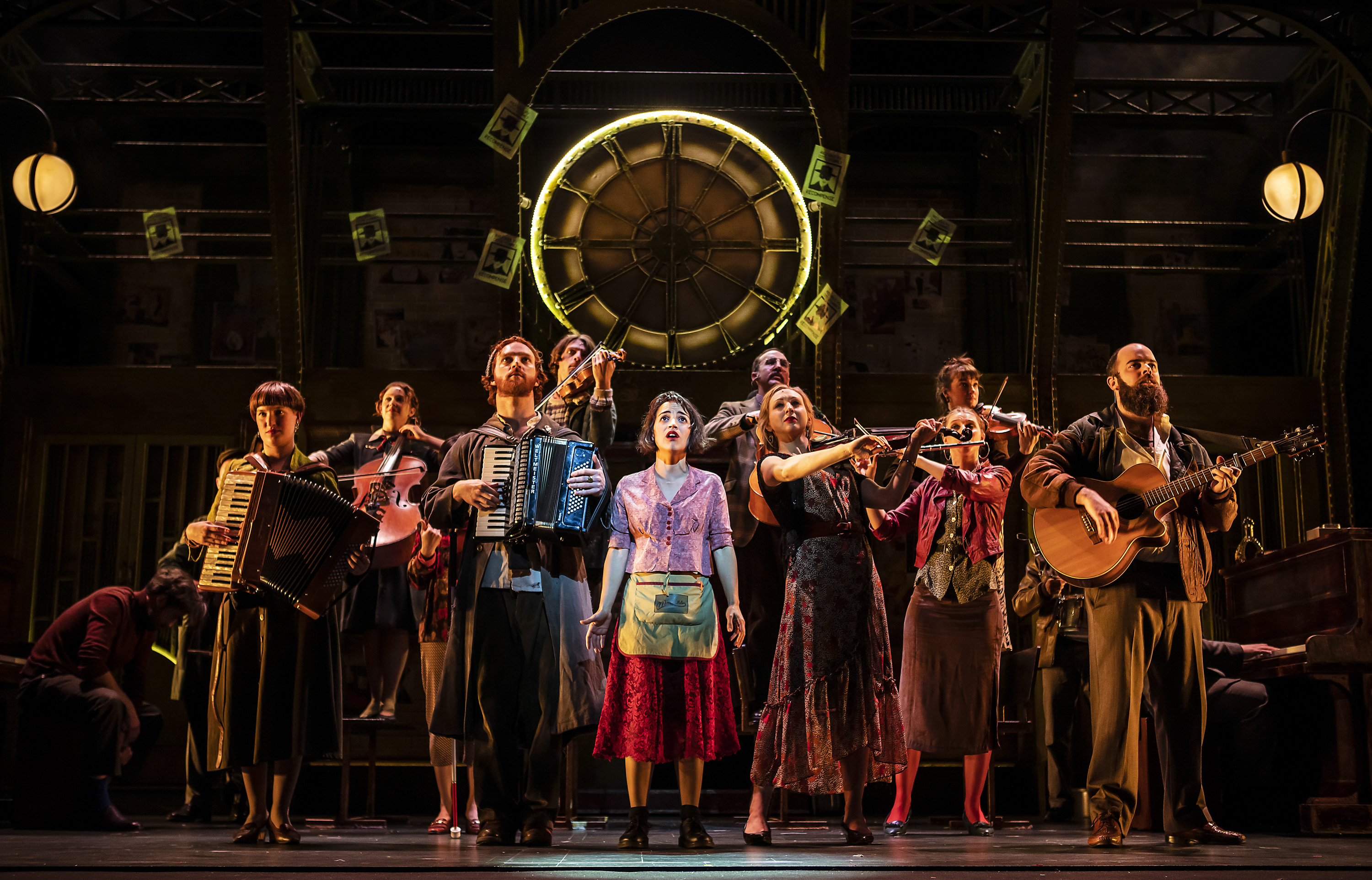
Amélie Poulain (Audrey Bisson) is a shy young lady from a dysfunctional family. Her father has more time for a garden gnome than for her. After being whisked quickly through her backstory, we find Amélie in 1997, a waitress in a Parisian restaurant. She is a naive fantasist who embarks on a plan to perform extraordinary acts of kindness to others. Various stories intertwine, leading to multiple redemptions and Amélie herself moves along a path towards romance with Nino (Chris Jared).

Leading the company, Bisson and Jared are excellent, but this is an ensemble piece for 16 multi-tasking actors/singers/musicians. Under Michael Fentiman’s direction, they harmonise in every sense and generate a compelling sense of community. Fentiman’s witty and inventive production flows, seemingly effortlessly and thrives on group energy.

The original film was most notable for its quirky humour, which is captured well in Craig Lucas’ book and the song lyrics by Nathan Tysen and composer Daniel Messé. There is a folksy feel to Messé’s lovely music, but there is also much variety, ranging from lilting love ballads to comic parodies. A surprise appearance by Elton John (Caolan McCarthy) brings the first half to a rousing climax.

Thick French accents assumed by the entire company seem unnecessary and they impair the clarity of the storytelling. However, it becomes impossible to dwell long on minor flaws while being swept away by the endearing performances and ravishing melodies to be seen and heard here. This is one enchanted evening which make

Performance date: 2 June 2021

Writer: Alfred Fagon

Director: Dawn Walton

⭐️⭐️⭐️

Continuing its much interrupted season of revivals of plays which premiered here, Hampstead Theatre looks back to 1975. At first glance, the chilling title of Alfred Fagon’s The Death of a Black Man suggests that the play’s themes could have been echoed in recent events. As it transpires, the title is misleading, but it still leads to the key questions for a modern audience: how much in society has changed in almost half a century and how much of what is depicted in the drama is still relevant today?

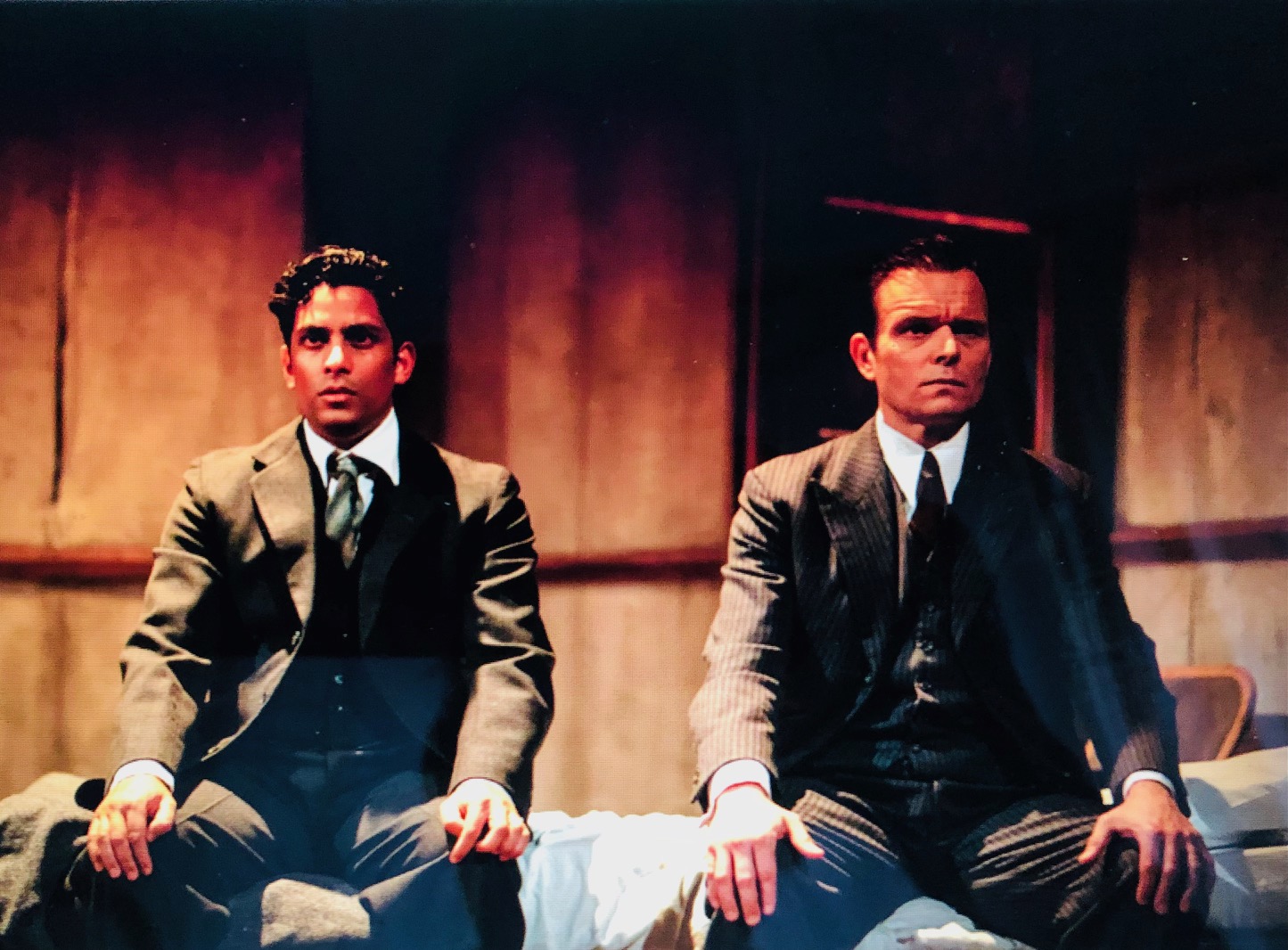
The time is 1973, the place is a smart flat in Chelsea’s Kings Road, owned by Shakie, a confident entrepreneur who struts around proudly in his flowery shirt and bell-bottom trousers. His age is 18. He is visited by ex-girlfriend Jackie, who comes from a comfortable middle class background and is the mother of a child fathered by Shakie when he was 15. She is 30. Third to arrive is Stumpie, Shakie’s friend who has plans to make it big in the music business and favours a revolutionary approach to righting historical injustices. He is 21. All three characters are British and black.

The ages and other character details are emphasised, but they play little part in the play’s slight narrative and it is unclear why Fagon thinks them so important. It seems illogical that Shakie could have achieved his status in life so young, but Nickcolia King-N’da gives him refreshing youthfulness even when his dialogue belies his demeanour. Natalie Simpson struggles to find depth in the underwritten role of Jackie, but there is a real sense of danger in Toyin Omari-Kinch’s Stumpie as he paces around the stage smouldering with aggression..

The first half of the play resembles early John Osborne, with characters debating the crumbling British nation and empire while taking the drama nowhere. Like Osborne, Fagon gives little prominence to feminist causes. We gather that racism is at the root of all the characters’ grievances and we observe that even the victims of racism are themselves driven into becoming racists. 

The second half is altogether more dark and surreal. Shakie, having been let down in a business deal, turns to Stumpie’s radical ideas and the two men imprison the hapless Jackie with a view to selling her into slavery. Director Dawn Walton’s production is impassioned, but it does not unravel all the play’s mysteries and, when the three characters stand in a line and address the audience directly, it looks as if Walton is signalling defeat. 

As to modern relevance, perhaps racism is like the coronavirus in that it mutates repeatedly over time. If so, the 1973 variant is different from the 2021 one and there may not be too much point in putting it under a microscope for further study. The only certainties are that both variants are equally destructive and equally difficult to conquer.

Fagon’s writing is confrontational, confusing and often contradictory. If he gave 1975 audiences a severe jolt, the shock factor today, when at least the issues that he raises are discussed more openly, could be diminished. Still this remains a challenging play and, because it points to no prospect of resolution, it is also a deeply depressing one.

Performance date: 3 June 2021

Writer: Harold Pinter Director: Alice Hamilton

⭐️⭐️⭐️⭐️

It has been a long wait. Celebrating its 60th birthday, Hampstead Theatre announced a “greatest hits” season early in 2020, starting with a revival of Harold Pinter’s one-act classic The Dumb Waiter, which received its world premiere here in 1960. When the play was staged in the West End only last year, it formed half of a double bill and eyebrows were raised at the prospect of paying normal ticket prices for a mere 55 minutes of theatre (with no interval, but plenty of Pinter pauses). Now, many months later, the production finally hits the stage in a socially distanced environment and such reservations feel irrelevant. All that theatre-starved audiences should want to do is rejoice at its arrival.

The play could be viewed as a sinister comedy or an absurdist thriller and even its title has alternative interpretations. Ben and Gus are hit men despatched by an unseen Mr Big to a derelict building in Birmingham to await the arrival of their mysterious next victim. It is a Friday and Aston Villa may or may not be playing at home to Spurs that weekend. In James Perkins’ bleak design, single beds stand on opposite sides of their undecorated room. They taunt each other with inconsequential small talk and then, with a rumble and thud, a dumb waiter appears from what is, apparently, a cafeteria above. It contains orders for meals and drinks, but the gas supply to the kitchen has been cut off and the ingredients needed to fulfil the orders are not available. They respond by sending up what little they can find – a packet of crisps, a stale Eccles cake, a half-pint of sour milk, etc.

An air of foreboding hangs over Alice Hamilton’s production from the outset. Tempo is key, as the famous pauses are followed by rat-a-tat exchanges and then more silence. Questions are asked and left unanswered and clues are placed alluding to the play’s ultimate twist, which, itself, asks yet more questions. The writer is teasing the audience continuously; nothing is what it seems, nor as, in a real world, it could possibly be. The uncertainty keeps us as much on edge as it does Ben and Gus.

Alec Newman’s Ben has the marks of seniority, but his assertiveness is undermined by suggestions of deep unease; we suspect that he knows more than he is letting on either to Gus or to us. Shane Zaza’s Gus is, at times, a gormless junior, but his failure to obtain answers to the most obvious questions drives him into an anguished frenzy. Together, the actors master the tones and rhythms of Pinter’s multi-layered dialogue to near perfection..

Inevitably, this play has been likened to Samuel Beckett’s Waiting for Godot, but Hamilton’s meticulously detailed revival shows us that Pinter’s early work has a clear identity of its own. This short, sharp theatrical treat has been well worth waiting for.

Performance date: 8 December 2020