Photo: Amanda Searle

Creator and performer: Dickie Beau

Director: Jan-Willem Van Den Bosch

⭐️⭐️⭐️⭐️

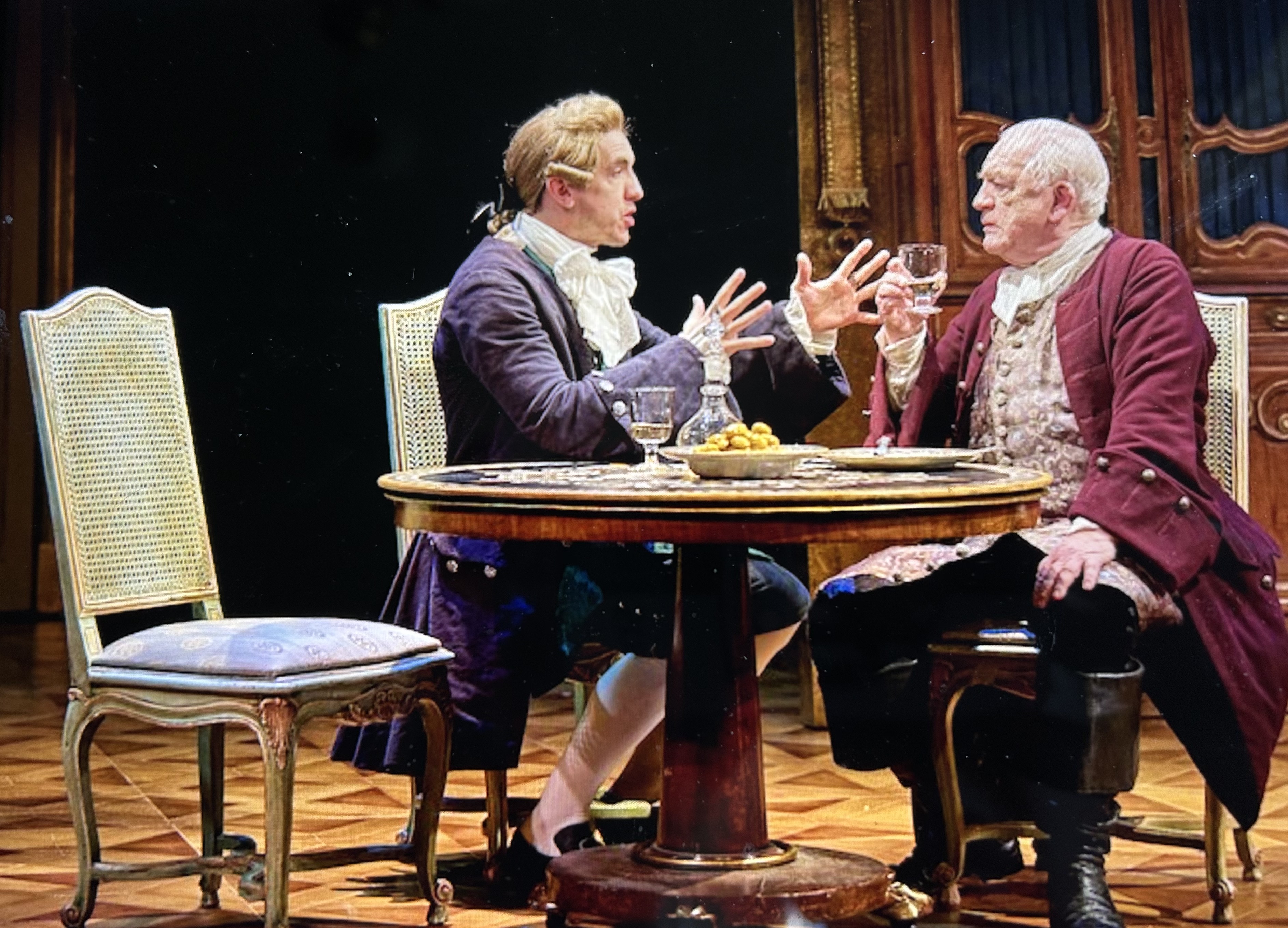
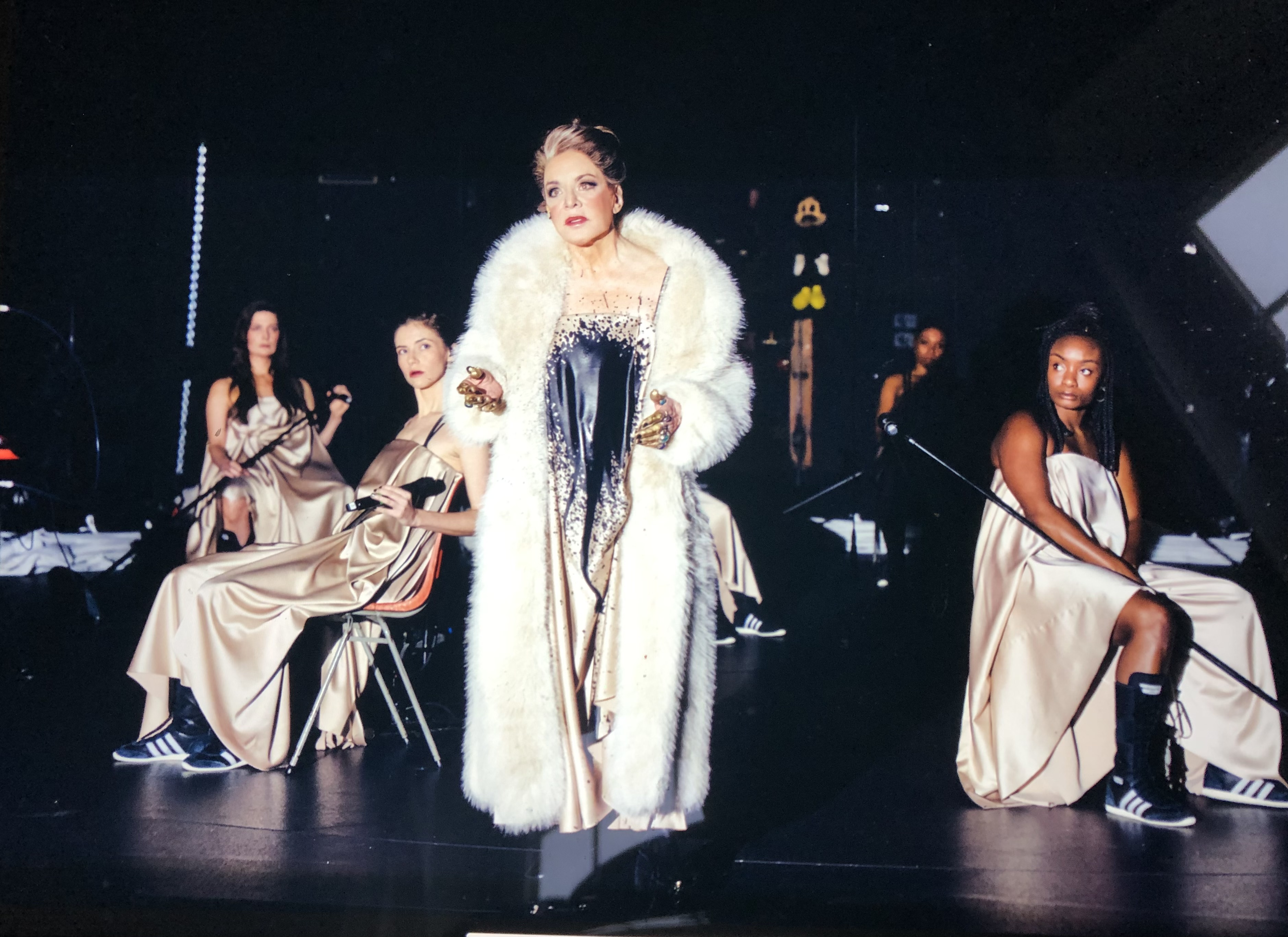
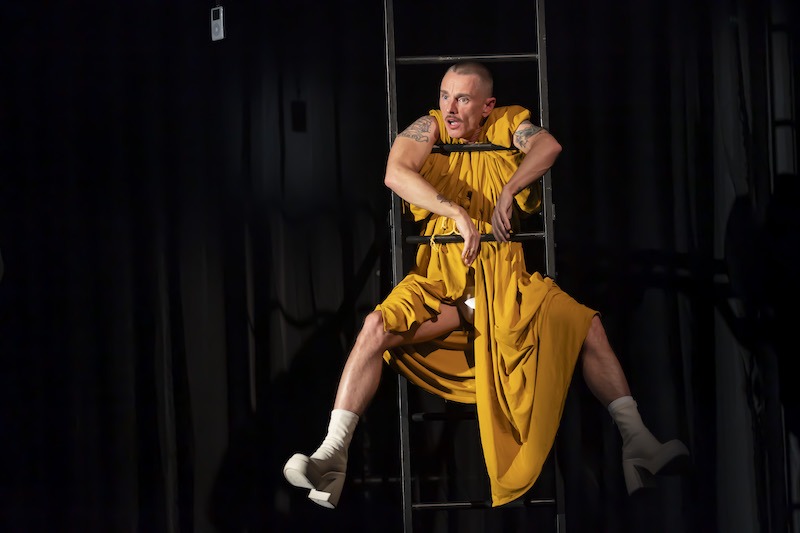
Early arrivals for performances of Showmanism can look up towards the high ceiling of Hampstead Theatre’s main house to see the show’s creator and star clambering around precariously on scaffolding while reciting familiar tongue twisters. He is actor, impersonator, drag artist and flamboyant showman Dickie Beau. It is a startling prelude and when, eventually, the show comes down to earth, it does so only in the most literal sense.

First seen at the Theatre Royal Bath in 2022, Showmanism is a discussion of all things theatre, looked at from a perspective that is wildly eccentric and mildly queer. Beau is self-analytical when considering the psyche of actors, going on to assert that audiences are themselves key parts of performances. His illustrations range from Ancient Greece, through the Shakespearean era and the Oberammergau Passion plat to the present day. As Beau’s last appearance here was in Tom Stoppard’s The Invention of Love, he may feel that Hampstead audiences have been well prepared for a certain level of intellecyia;ism, particularly with regard to the classics.

So, in essence, is this a lecture best suited for scholars or RADA students? Well, maybe, but Beau livens it up with voices ranging from David Cameron to Cilla Black. Most notably, it is the comforting tones of Sir Ian McKellen that guide us through, almost as if the actor himself had lived through all the ages of civilisation. Also, director Jan-Willem Van Den Bosch makes sure that Showmanism is a real show for the whole of  its running time of 95 minutes straight through.

Justin Nardella’s elaborate set and dazzling costume designs would be fit for a West End musical, while Marty Langthorne’s lighting designs create striking images. However, none of these fireworks  can eclipse the astonishing fire of Beau himself, which is fuelled by insight, honesty and mischievous humour. The lasting effect is weirdly mesmerising, funny, profound and even spiritual. 

Beau finds time for an excoriating assessment of the contributions of critics, so, in retaliation, it feels necessary to point out that his show is uneven, often losing focus and cohesion. Showmanism is a very long way from being perfect, but its star has a magnetic presence which makes it extraordinary.

Performance date: 23 June 2025

Photo: Marc Brenner

Writer: David Adjmi

Original songs: Will Butler

Director: Daniel Aukin

⭐️⭐️⭐️⭐️

By the mid-1970s, the Beatles-led invasion of British pop had faded in America, being replaced in part by country influenced soft rock bands such as The Eagles and Fleetwood Mac, who sold millions of vinyl albums to be heard by avid fans on their stereo music centres. David Adjmi’s multiple Tony Award-winning play with songs focuses on a fictional band in this mould. It proposes that out of chaos magic emerges, a theory that is advanced further by the play itself.

In style, director David Aukin’s production could be seen as a cross between an Annie Baker play and a juke box musical. Baker is an American dramatist whose work, seen several times during the last decade at the National Theatre, is noted for its slow progression and long silences. Here, the lethargic feel purports to imitate real life, but, at the same time, it gives a surreal air to the production which, over time, becomes mesmerising.  Undoubtedly, the pace and pauses are factors contributing to a perhaps excessive running time of three and a quarter hours (including interval).

Baker located one of her plays in a near empty art house cinema and Adjmi consigns his characters to being dwarfed equally in a Los Angeles recording studio, which is realised beautifully in David Zinn’s imposing two-level set design. Remarkable work by lighting designer Jiyoun Chang further heightens the production’ visual impact.

Adjmi does not use a central narrative to drive the play, instead examining the behaviour of the seven individuals gathered together to record their new album. These are people for whom the pressure of fame is equalled only by the fear of anonymity. We witness their egos in full flow, their neuroses, their make-ups and break-ups, their drug taking and we get to glimpse their musical talent. Lucy Karczewski is particularly striking as the unstable singer/songwriter Diana, Zachary Hart impresses as the addicted Brit bass player Reg. However, it feels unfair to single them out from the other outstanding actor/musicians who are: Andrew R Butler, Eli Gelb, Jack Riddiford, Chris Stack and Nia Towle.

When the drama gets sluggish, as it often does by design, Will Butler’s excellent 1970s-style rock songs act as an instant pick-me-up. They are so authentic that it is tempting to check that they were not genuine smash his of that era. They were not, but they should have been.

Stereophonic, already a huge hit with New York critic, could present challenges for West End audiences who are unaccustomed to this style of theatre. It is long and slow, but it is also bold and rewarding. The best advice is to go to see it and stick with it. 70s rockers and many others should find it a blast.

Performance Date: 14 June 2025

Photo: Johan Persson

Writer: Bernard Shaw

Director: Dominic Coole

⭐️⭐️⭐️⭐️

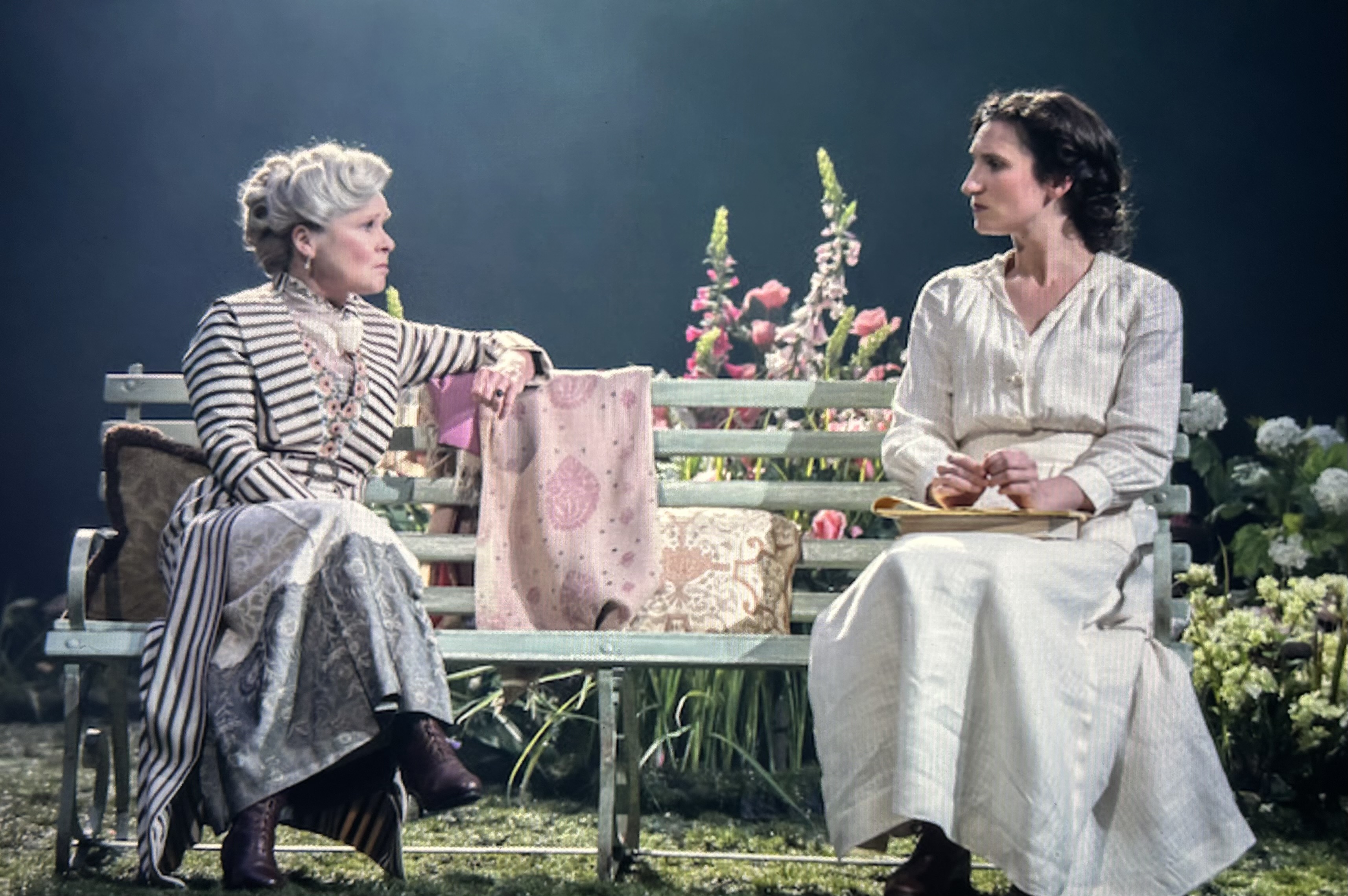
Ignoring the advice offered in Noël Coward’s famous song, Dame Imelda Staunton has gone ahead and put her daughter, Bessie Carter, on the stage. Indeed, she now goes one stage further by sharing a stage with her in director Dominic Cooke’s classy revival of George Bernard Shaw’s 1902 play Mrs Warren’s Profession; perhaps inevitably, the pair play mother and daughter.

Not for the only time, Shaw sets out to puncture the facade of refinement and gentility surrounding the English upper middle classes of his age and he expose the hypocrisy  that hides behind it. The profession of the play’s title is that which is often referred to as “the oldest” one and, accordingly, it was only performed in private members’ clubs for many years after it was written. Nowadays, it should be regarded as, in more ways than one, family friendly, notwithstanding the theatre’s somewhat surprising 14+ age recommendation. Could it be that traces of Edwardian prudishness still linger on?

Writing at the dawn of female emancipation, Shaw uses the play to examine the changing roles of women in society. Vivie Warren has been raised and tutored in rural England and she is now ready to make her own way in the world, not as a dutiful wife, but as an independent professional woman. Carter is splendid in the role. instantly dispelling thoughts of nepotism. Vivie awaits the arrival of her mother, Kitty, breaking into her business travels around Europe to make a rare visit. Staunton slightly underplays the role, surprisingly not fully exploiting the comic potential of Kitty, although, very occasionally, she allows glimpses of vulgarity to appear through the character’s air of refinement.

The balance between the two key performances could reflect a view by Coole that Shaw wanted the play’s primary focus to be on Vivie. Kitty had financed her daughter’s upbringing, expecting her to grow into the role of a lady of her own generation, only to see the emergence of a very modern woman. Vivie has suitors in the earnest Mr Praed (Sid Sagar) and the naive Frank Gardner (Reuben Joseph), son of a clergyman (Kevin Doyle) who had known Kitty in the past, but she rejects them in favour of keeping control over her own life. Kitty is accompanied by her friend and, it transpires, business partner Sir George Crofts (Robert Glenister in villainous mode), who also has his eyes on Vivie, but his offers of status and financial security are swiftly turned down.

Essentially, Shaw sees Kitty and Vivie as the same woman born into different generations and now divided by the circumstances into which society has forced them.  Cooke counters the writer’s reputation for being wordy and worthy with a streamlined staging in which even Chloe Lanford’s elegant set designs are notable for their simplicity. Scenes change quickly and speeches are delivered briskly, all fitting into 105 minutes with no interval. Strangely, the company is augmented by the occasional appearances of a non-speaking chorus in the style of ancient Greek drama. It is not entirely clear what purpose this serves, but if it keeps decent actors away from having to wait tables, it is to be welcomed,

Leaving aside the play’s slightly scandalous subject matter, Coole’s revival gives us a flavour of what a night out in the West End may have been like a century or more ago. The Garrick Theatre has probably not changed very much and the production is utterly conventional without ever being dull.

Performance date: 28 May 2025

Photo: Pamela Raith

Music and lyrics: Stephen Sondheim

Writer: Aristophanes

Adaptors: Burt Shelvelove and Nathan Lane

Director: Georgie Rankcom 

⭐️⭐️💫

Let’s face it, even William Shakespeare had a few bad days at the office, so it should come as no surprise that, among the masterpieces of Stephen Sondheim, there lie some green slimy things. Maybe it is a little uncharitable to remind enthusiasts for the late God of musical theatre of this, but director Georgie Rankcom’s off-West End revival does so and makes a valiant attempt to turn The Frogsinto a prince among musicals.

A big surprise is that The Frogs premiered after Sondheim’s sophisticated hit A Little Night Music; a surprise because it has all the feel of a year-end college revue by a bunch of Classics undergrads. This could be down to the fact that, in its early form, with a book by Burt Shevelove, the show did the rounds of universities, opening at Yale gymnasium in 1974, with Meryl Streep and Sigourney Weaver in the chorus. The version seen here has a new book by Nathan Lane, who starred in the first Broadway production in 2004. The United Kingdom  premiere came at London’s tiny Jermyn Street Theatre in 2017.

We are told at the outset that the time is the present and the place is Ancient Greece. Freely adapted from a BC405 Greek comedy by Aristophanes, the story tells how the ranidaphobic God of Drama, Dionysos (Dan Buckley) and his upstart slave, Xanthias (Kevin McHale) set off for Hades on a mission to retrieve George Bernard Shaw (Martha Pothen), eventually opting for William Shakespeare (Bart Lambert) in preference. The journey is plodding, but Buckley and McHale make up a pleasing double act in the Laurel and Hardy style.

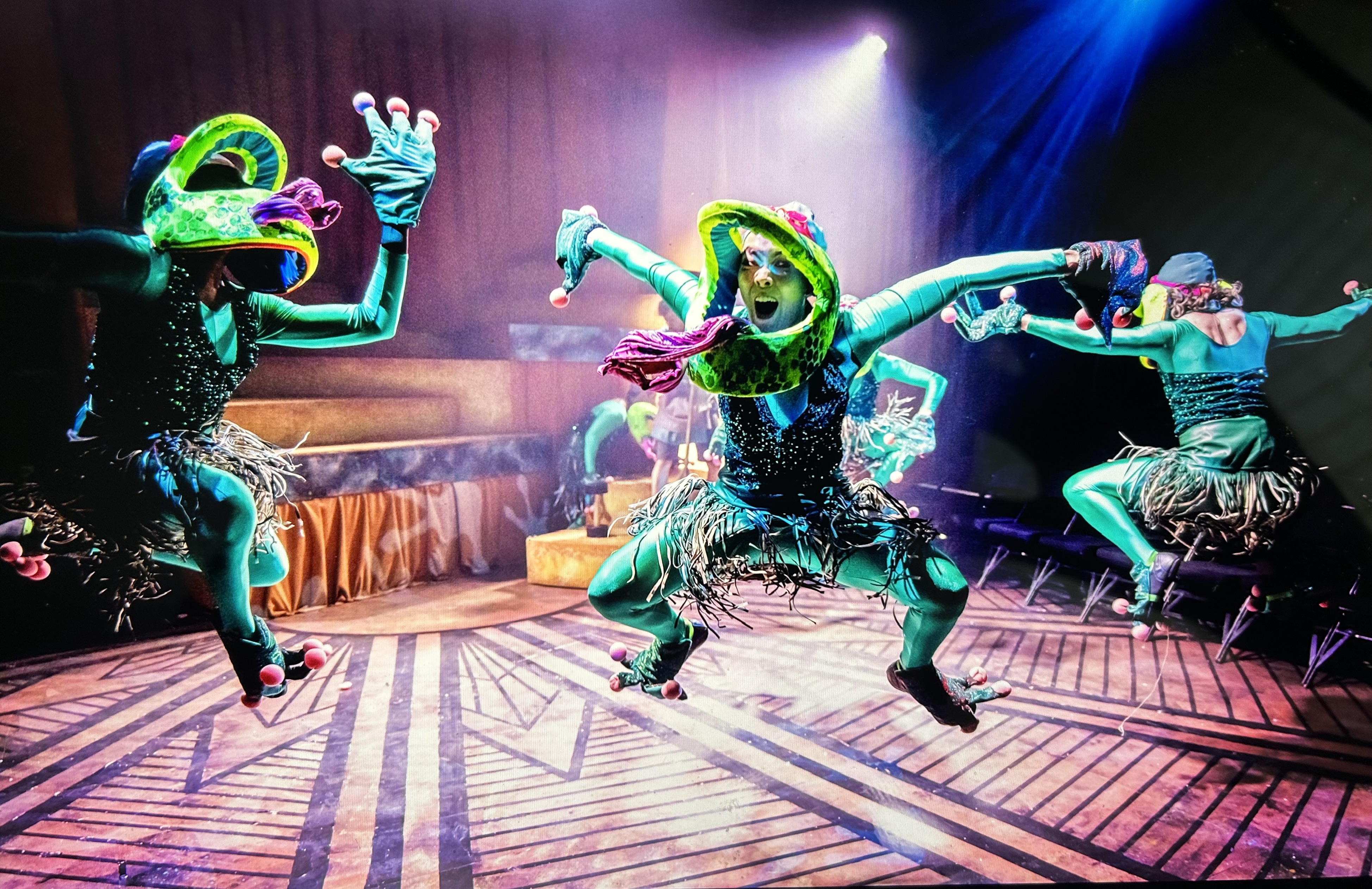
On the road, the pair meet up with Dionysos’ brother, Heracles (Joaquin Pedro Valdes), taking a break from his labours to give guidance on fashion, and an aggressive ferryman, Charon (Carl Patrick overacting towards the point of stealing the show). Things go wrong when Dionysos is kidnapped by frogs and the second act, set in Hades, is much like Hell for the audience, culminating in a seemingly interminable battle of words between the two playwrights.

The show has none of Sondheim’s most instantly recognisable songs, but the ones that are here have much merit and, generally, the lyrics are stronger than the music. The problem with the show is not the songs, they are the highlights as progress creaks and croaks between them. The book is ridiculously self-indulgent, mixing high brow arguments with low-brow topical gags while, at the same time, submerging itself in a sea of silliness where even the hardiest of amphibians would struggle to stay afloat.

Rankcom’s production often feels lifeless between the songs, but it redeems itself when the six-member chorus bursts into action, particularly for The Frogs and Hymn to Dionysos on either side of the interval and It’s Only a Play, later. Here, the work of choreographer Matt Nicholson is outstanding and it stretches to high camp with the appearance of glamour queen Pluto (Victoria Scone), inserted as if a cabaret act, to perform Hades.

In the early 1970s, perhaps Sondheim was still learning how to expand the boundaries of musical theatre and it is interesting to discover some seeds of later successes being sown here. Even so, the highlights of The Frogs are all musical ones and they come as oases in a fairly arid desert.

Performance date: 27 May 2025

1536 (Almeida Theatre)

Posted: May 18, 2025 in Theatre

Photo: Helen Murray

Writer: Ava Pickett

Director: Lindsey Turner

⭐️⭐️😂⭐️

From the drama and intrigue of the Wolf Hall trilogy and A Man for All Seasons to the musical frivolities of Six, the reign of King Henry VIII continues to grip theatregoers. Playwright Ava Pickett follows this trend with 1536, the title referring to the year in which Anne Boleyn was executed. The play looks at historic events from a very different perspective; it is new writing, tackling age-old issues.

The place is a field in rural Essex, which, in Max Jones’ set design, is overgrown and dominated by the remains of a dead tree. This gives the production a bleak and unforgiving look. Before social media, television, radio and even newspapers, gossip spread far and wide and lowly folk were fascinated by the private affairs of the rich and famous, relating news to their own simper lives. Perhaps little has changed in almost 500 years. As word of Anne Boleyn’s imprisonment in the the Tower of London filters through, women talk of Henry’s Queen as a hapless victim, while men speak of “the great whore”, thereby highlighting the gender divide which Pickett sets out to explore thoroughly and thoughtfully.

Siena Kelly excels as the free-spirited and unapologetically promiscuous Anna. She is unable to resist the sexual advances of the duplicitous Richard (Adam Hugill), even though he is about to marry her best friend, the much more sedate Jane (Liv Hill). These two women meet in the field, along with community midwife Mariella (Tanya Reynolds), who is bitter after being  spurned by William (Angus Cooper). The women gossip and catch up on the latest news from London, all of it grim for Queen Anne.

From here, Pickett allows a soap-style plot to drive the play to its dramatic conclusion, leaving herself ample room to expose the cruel injustices of a male dominated society. Her focus is entirely on the three women and her writing includes no sympathy for the men whose actions are inspired by the behaviour of their role model, the King.

Kelly, Hill and Reynolds all give passionate performances, bringing out the individual plights of three very different personalities. They style themselves as modern day Essex girl stereotypes, encouraged by dialogue that is embellished by over-generpus sprinklings of the “f” word. In the play’s early stages, some of their banter is very funny on the level of a sitcom such as Blackadder, but, overall, this proves to be a minor distraction from the writer’s main purpose.

There is more than enough meat to sustain the drama for its 110-minute running time and performing it without an interval helps greatly in building up intensity. Under the assured direction of Lindsey Turner, 1536 moves effortlessly from inconsequential comedy to high drama, leading up to a climax that is memorably powerful.

Performance date: 13 May 2025

Photo: Manuel Harlan

Writer and director: Conor McPherson

⭐️⭐️⭐️

Taking its title from a poem by WB Yeats, Conor McPherson’s new play is here receiving its world premiere in a production directed by the writer himself. The Brightening Air fills the Old Vic with a distinct scent of Ireland and it feels something like becoming re-acquainted with old friends.

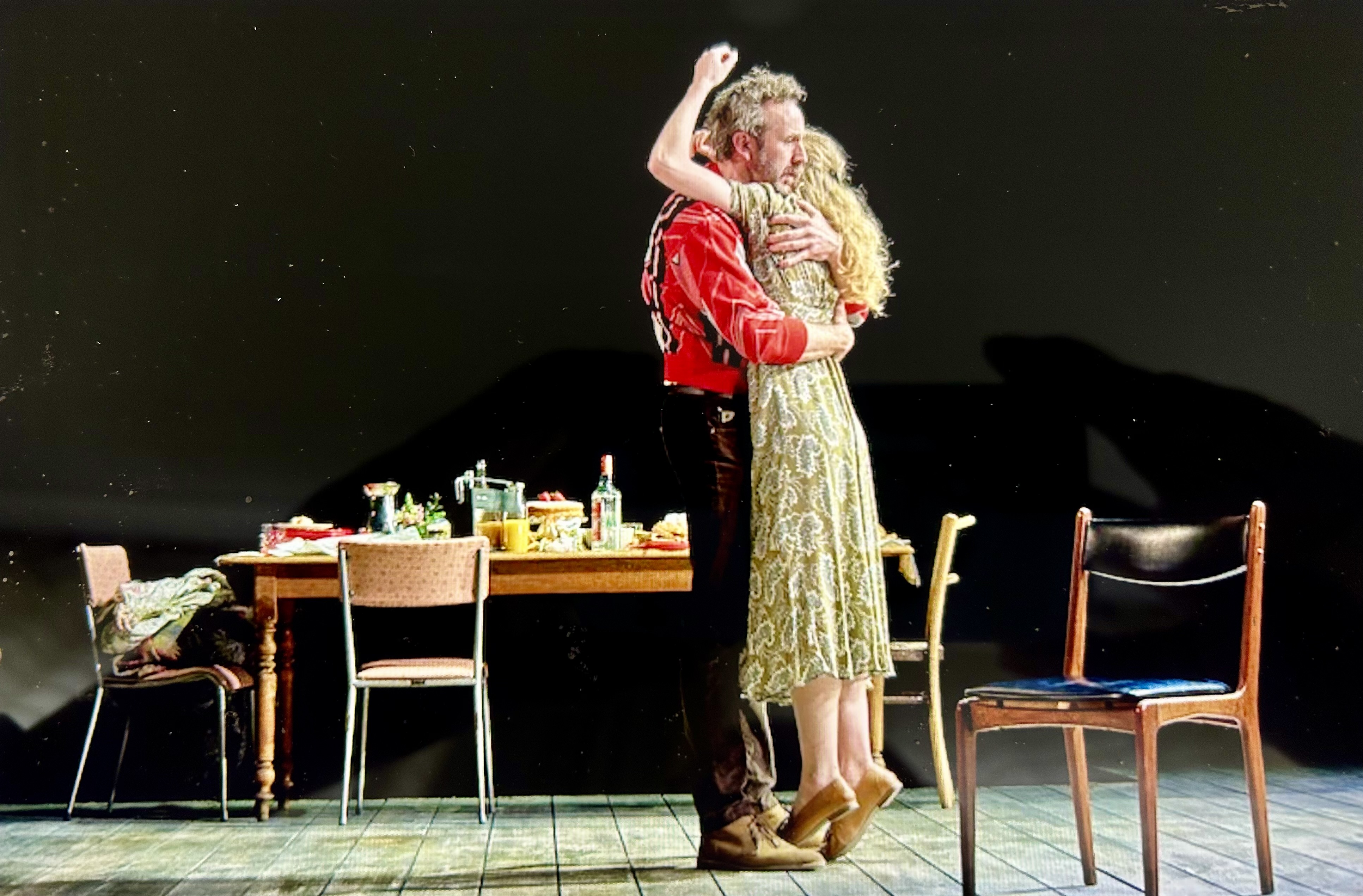
The setting is Sligo on the north-western Irish coast, the time is the 1980s. Stephen (Brian Gleeson) and his sister Billie (Rosie Sheehy) live together in what has always been their family home, a run-down farmhouse. Their wayward, dissolute brother Dermot (Chris O’Dowd) has long since flown the nest and is scornful of his siblings’ inertia. He turns up displaying his new 19-year-old girlfriend Freya (Aisling Kearns) in front of his still doting estranged wife Lydia (Hannah Morrish) and their children. 

Into the mix is thrown Uncle Pierre (a show-stealing turn by Seàn McGinley), a former priest who has big ideas for the house of which he claims part ownership by inheritance. From then on, there is minimal  plot in an inaction-packed piece that becomes almost entirely character driven. Drawing humour from the characters’ quirkiness, the writer explores how home means different things to different people and how the pursuit of personal goals can impact on others.

The absence of a formal set robs the drams of some of its flavour. Furniture is scattered around an often crowded open stage, against a darkened background, with characters wandering on and off, unhindered by doors. There is no sense of this being a family home and sometimes the action looks static, actors lined up like in a doctor’s waiting room. It is as if McPherson is trying too hard to dodge visual clichés that could have added  to the unavoidable ones in his play; his approach has created a production that may have been much better suited to an in-the-round staging.

McPherson and some other contemporary dramatists seem to see Chekhovian themes as linked inexorably to Irish life.  Here again we have unrequited passion, unfulfilled potential, yearning to break free and the unstoppable force of change. Characters loathe each other and resent their mutual dependence, filling the comedy-drama with rancour that is fuelled by the writer’s brittle humour. However, is any of this new, particularly in a rural Irish setting? McPherson’s play may promise breaths of fresh air, but it delivers too many gusts of déjà vu. 

Notwithstanding these reservations, there is much to savour. McPherson’s writing blends spiky wit with lyrical reflections and the characters are brought to life vividly by uniformly superb performances. We may have seen it all before, but we can feel content to experience it again.

Performance date: 24 April 2025

Rhinoceros (Almeida Theatre)

Posted: April 5, 2025 in Theatre
Tags: , , , ,

Photo: Marc Brenner

Writer: Eugène Ionesco

Translator and director: Omar Elerian

⭐️⭐️⭐️⭐️

Top marks for timing must be given to the Almeisa Theatre’s decision to hold the press performance of its revival of Rhinoceros on April Fools’ Day. Eugène Ionesco’s 1959 satire remains a classic piece of absurdism and, potentially, offers a feast for the fools in all of us. However, this is a play that parades itself as a folly and then asks to be taken seriously.

Romanian-born Ionesco thrived in a France that was still recovering from Nazi occupation, in which the literati of Paris had become infatuated with existentialism and absurdism. Breathing fresh life into a piece which, at first glance, seems horribly dated in style and content, presents a double challenge to Omar Elerian, who acts as both translator and director. By presenting his production as a play within a play, he invites modern viewers to see it with even more mocking eyes, assisted by a narrator (Paul Hunter), who also conducts audience participation.

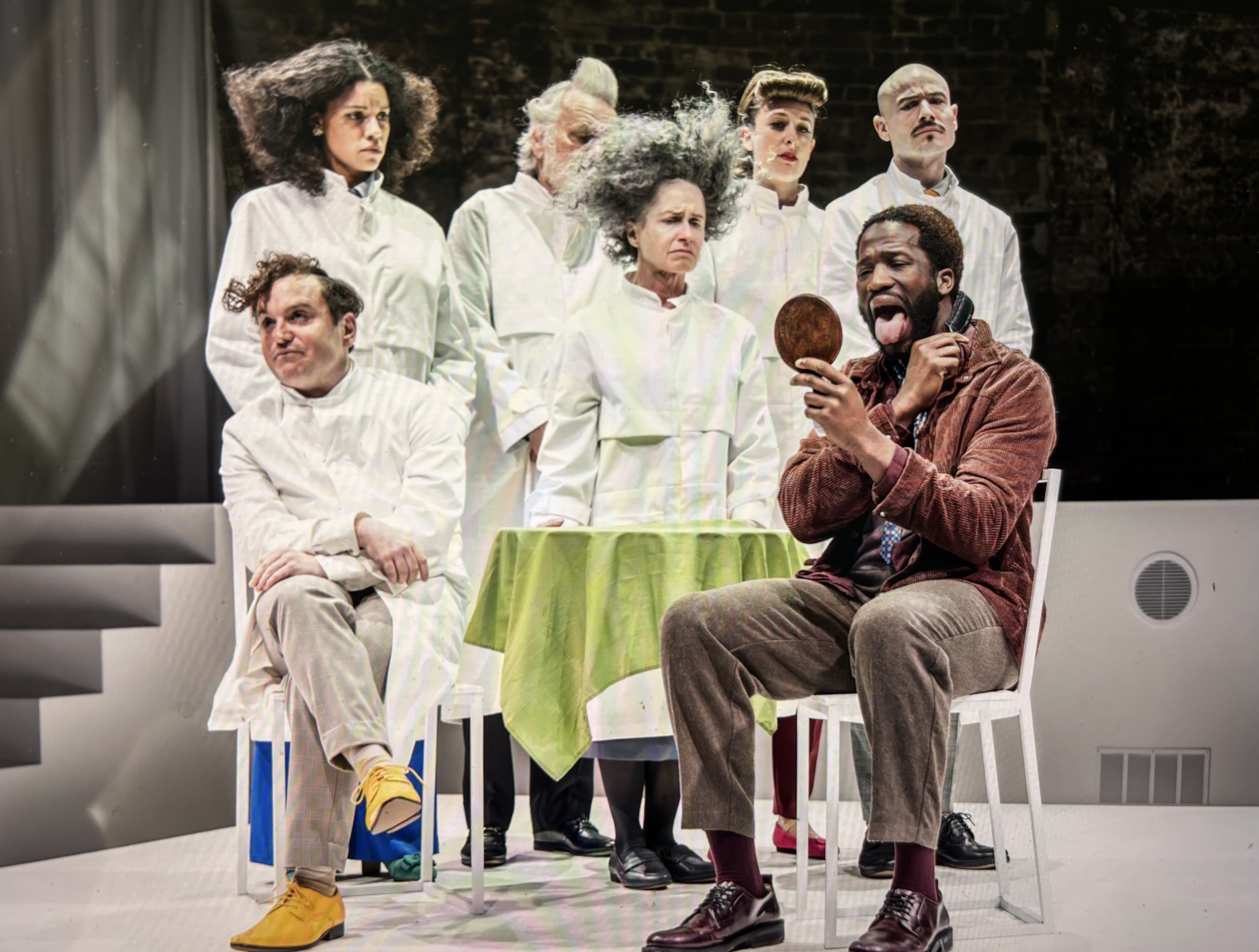
The play’s central character is Berenger, played with an air of puzzlement and growing conviction by Sopé Dìrísù. He is a depressed alcoholic who drinks as a way to find reality. In a French provincial town, he sits at a roadside café, chatting idly with his friend Jean (Josh McGuire), when a rhinoceros charges past them. Did it have one horn or two and would that mean it was African or Asiatic? They decide that it would be racist to speculate. Berenger’s prospective girlfriend Daisy (Anoushka Lucas) appears, carrying a dead cat, trampled on by a herd of rampaging rhinos. What is happening?

The action shifts to Berenger’s workplace, an office bossed by a fluttering M Papillion (Alan Williams) and a dithering M Dudard (John Biddle). Workers are ‘phoning in sick and confusion begins to reign as it seems that all the townsfolk are growing horns and turning into rhinoceroses. But Berenger stands firm, vowing that he will never join them.

The production is given a surreal look by Ana Inės Jabares-Pita’s all white set and (except for Berenger) costume designs, which become progressively darker as the play moves on. Ionesco’s depiction of one individual standing resolutely against an overwhelming majority represents a them common in 1950s drams, reflecting the politics of that era, but, here, it is made to be taken as a warning against present day trends in which populist movements appear to be gaining ground across Europe and elsewhere. Maybe the messages are put across crudely, but they are, nonetheless, effective.

Elerian takes as much licence as is needed to bring Ionesco’s preposterous pachyderm parable up to date and keeps his production fizzing with consistently inventive staging and impeccably timed ensemble playing. Yes, the translator/director succeeds in making this old play feel relevant to the modern world, but, far more importantly, he succeeds in making it fun.

Performance date: 1 April 2025

Photo: Manuel Harlan

Writer: Oliver Cotton

Director: Trevor Nunn

⭐️⭐️⭐️💫

Prepare to be transported back to the 18th Century. Having begun life in the Regency splendour of Bath’s Theatre Royal, Oliver Cotton’s 1747-set play, The Score, now finds a seemingly natural new home at the London equivalent, the Theatre Royal Haymarket. The question is whether or not the production, with veteran director Trevor Nunn at the helm, is destined to feel more than a couple of hundred years past its sell-by dare.

Contrasting the Earthly with the Heavenly, Cotton’s play revisits many of the themes of Peter Shaffer’s Amadeus. On this occasion, the composer is Johann Sebastian Bach, a 62-year-old with failing eyesight. He lives in Leipzig, a city recently overrun by Prussia, whose KIng, Frederick II, summons him to his court. Bach is devoutly religious and loathes warfare, while Frederick is an atheist  who, instinctively, leads armies into battle. They are opposites drawn together by a common love of music.

Brian Cox’s Bach barks loudly and often. The Scottish actor who  once played Hannibal Lecter seems born for this role and his commanding performance, inevitably, fights off all comers to grab centre stage and hold onto it. Stephen Hagan’s slightly effete Frederick is not the warrior King that the early dialogue leads us to expect, but his nonchalant air makes him a fascinating foil for Cox’s bellowing Bach.

Bach leaves behind his doting wife Anna (Nicole Ansari-Cox) in Leipzig and answers the KIng’s call to his court in Potsdam. There he is greeted by his young son Carl (Jamie Wilkes), who holds a position there, and by the friendly maid Emilia (Juliet Garricks), who recounts stories from Frederick’s past. The King’s constant companion is the French philosopher Voltaire, played in flamboyant style by Peter De Jersey. Nunn’s production is mounted handsomely, with Robert Jones’ unfussy set designs transitioning effortlessly between Bach’s humble home and the Royal Palace.

The play’s big flaw is a slow-paced first act in which it takes the two main protagonists four scenes and almost an hour to come face-to-face. The result is all talk and hardly any dramatic tension. Happily, things improve immeasurably after the interval when the writing becomes more eloquent and focussed and the acting more powerful. Frederick and his sycophantic courtiers bet against Carl that “old” Bach will not be able to improvise on a theme composed by the King; this brings a refreshing dash of fun to scenes that could have, otherwise, become too dry.

Bach argues that music emerges from divine intervention, even when it comes into the head of a non-believer such as Frederick. This belief provides the play with one of its central theses, the other being the morality of war and oppression. In this, Frederick can be seen as an arrogant autocrat who compares with certain modern day figures, but, otherwise, the play is little more than a dip into history, imperfect yet nonetheless entertaining.

Performance date: 28 February 2025

Photo: Tristan Kenton

Writer: Howard Brenton

Director: Tom Littler

⭐️⭐️⭐️⭐️⭐️

There has been no shortage of dramas recounting the activities of Winston Churchill during World War II, but, until now, little has been known about the British Prime Minister’s trip to Moscow to meet Soviet leader Joseph Stalin. Howard Brenton puts that right with a new play that starts out as a factual account of the visit and then develops into a biting and frequently hilarious satire of all international diplomacy.

It is the Summer of 1942. The planned invasion of Northern France has been delayed, the shipment of arms to the Soviet Union has stopped and Churchill’s priority has become attacking Southern Europe from North Africa. It has become rather useful to the British tat Hitler is deploying troops on the Eastern front, but Stalingrad is about to fall and Stalin is desperate for help. The background to the leaders’ meeting could hardly be more awkward.

Director Tom Littler’s in-the-round production is blessed with glorious performances from Roger Allam as Churchill and Peter Forbes as Stalin. They enter into a gladiatorial combat that shakes the roots and branches of the Orange Tree, bringing out the vast differences between a son of the English aristocracy and a Georgian peasant. Churchill sees Stalin as “a yokel” and, amusingly, Forbes plays him with an English West Country accent.

Churchill is backed up by the sturdy British Ambassador, Archie Clark Kerr (Alan Cox) and Stalin by the hawkish General Molotov (Julius D’Silva), who had previously led a collaboration with the Nazis. Much of the humour in the play arises from mistaken translations, some deliberate and the action focuses on the roles of two translators (Jo Herbert and Elizabeth Snegir), both officers in their respective armies. A fascinating figure hovering in the background is Stalin’s young daughter, Svetlana, played endearingly by Tamara Greatrex. She is doted on by her father who gives her the job of being hostess at a dinner party for their guest, taking over from her late mother.

Churchill is accommodated in Stalin’s private marble-built dacha, bugged throughout. Doubts and suspicions abound as each man challenges the other over past misdeeds. “We don’t murder our enemies, we send them to the House of Lords” asserts Britain’s leader, while his Soviet counterpart retaliates with  accusations about atrocities committed under British Imperial rule. Ultimately, the men meet face-to-face, alone and without translators, for a late night vodka-fuelled summit, They yell at each other, neither understanding a single word of what the other is saying and they reach an accord. The playwright has made his point emphatically.

Brenton does not allow us to forget that, along with the Americans, these two guys would go on to carve up Europe and lay the foundations for 45 years of cold war. A sobering epilogue by Svetlana sums up what happened after the joke diplomacy and brings us back to reality, but it is the riotous satire that has gone before that will linger long in the memory.

Performance date: 11 February 2025

Elektra (Duke of York’s Theatre)

Posted: February 9, 2025 in Theatre

Photo: Helen Murray

Writer: Sophokles

Translator: Anne Carson

Director: Daniel Fish

⭐️⭐️

Ancient Greek tragedies with Oscar-winning Hollywood stars taking title roles seem to be flavour of the week in London. Elektra, a bloody tale of revenge, follows the trend. The play was written in c400 BC by Sophokles and it arrives in the West End in a prosaic translation by Anne Carson, with Daniel Fish, a Broadway director who has earned a reputation for reimagining classics, at the helm, So , what could go wrong?

Stripped of Captain Marvel’s super powers, Brie Larson is impressive  in conveying the tortured anguish of Elektra, a woman obsessed with avenging the murder of her father, Agamemnon.  She wails and moans impeccably and conducts her exchanges with the Chorus as if she is addressing a Trump rally, but she finds little else in the character to absorb us.

Larson is supported by a big name cast. Stockard Channing is Clytemnestra, Elektra’s mother and unrepentant murderer of her father alongside her new lover, Aegisthus (Greg Hicks). Marième Die is Chrysothemis, Elektra’s sister and Patrick Vaill is Orestes, their brother who is expected to return home to commit the vengeful act. All are strong, but Fish’s production does not leave room for their characters to become more than one-dimensional. Often, the lead actors are upstaged by the six members of the Chorus, choreographed by Annie-B Parson, singing all their lines a cappella and creating soothing harmonies to contrast with the mayhem around them,

This is a spartan production with plain costumes, designed by Doey Lüthi and a minimalist, often revolving, set designed by Jeremy Herbert. A glaring spotlight which blinds sections of the audience on every revolve is an irritant, as is uneven sound projection caused by some actors speaking into microphones and others not.

Fish seems uncertain about what he wants to achieve. Is he looking to recreate the form of the original staging? Or does he want the play to speaks with relevance to modern audiences? The outcome is a production that occupies a no man’s land somewhere between Ancient Greece and 21st Century America. A running time of little more than 70 minutes (no interval) is achieved partly by racing through some pages of dialogue at breakneck speed. Audience members sitting in top-price seats may flinch at the thought of having paid around two pounds per minute for the privilege of watching this.

When focussing firmly on the characters and the storytelling, this is a play that can defy its age and still be a riveting watch, The 2014 production at London’s Old Vic Theatre lingers in the memory. Unfortunately, Fish’s revival is overladen with misfiring gimmicks, while it neglects key elements of the drama. This Elektra is low voltage and its chief asset is its brevity.

PERFORMANCE DATE: 5 FEBRUARY 2025