Hansard (National Theatre, Lyttelton)

Posted: September 6, 2019 in Theatre

Writer: Simon Woods      Director: Simon Godwin

⭐️⭐️⭐️⭐️⭐️

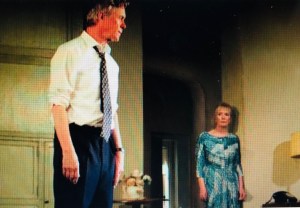
Most of us may feel that we have had enough of politics in our lives right now, but actor turned playwright Simon Woods seems to think otherwise. His play is a forensic examination of the murky territory where the public and private lives of a politician and his wife intersect. It is quite something for a debut play to be premiered at this hallowed venue, taken on by in-form director Simon Godwin and blessed with the dream casting of Lindsay Duncan and Alex Jennings, but this is quite some play.

Robin Hesketh (Jennings) is a minister in the Margaret Thatcher Government of 1988. Every weekend, he negotiates the Hanger Lane gyratory and the Oxford by-pass to reach his constituency home in the Cotswolds and be greeted by his bored, heavy drinking wife Diana (Duncan). Hildegard Bechtler’s design for the Hesketh living space is expansive, stretching to the entire width of the Lyttelton stage, and elegant, but it is entirely soulless, not personalised in any way, and we know before a word is spoken that there is emptiness in the lives of the occupants.

Acted out over just under 90 minutes in real time, the play begins as a battle of wills in which both combatants denounce each other with excoriating wit, sharpened over many years of marriage. Left-leaning Diana despises the old school tie brigade represented by her husband, while Robin scoffs at Diana’s favoured artsy set, citing theatregoers and readers of Ian “McKellen” novels in particular.. Woods’ style has the feel of Oscar Wilde, who delved into similar political territory in The Ideal Husband. Under Godwin’s unobtrusive direction, the fun flows freely, but we are always aware of more serious themes lying beneath the surface.

The pompous, upstanding, possibly promiscuous Tory politician and his obedient wife could easily have been seen as stereotypes, but Woods resists temptations for caricature, giving Duncan and Jennings every opportunity (which both seize with relish) to make the characters three-dimensional. We sense from the beginning that something more than duty binds the pair together and the gradual discovery of what that factor is becomes one of the play’s great pleasures.

Woods is even-handed in political debates, allowing both sides of each argument to be heard. A recurring theme is spurred by Diana’s objections to Robin’s advocacy of the infamous Section 28, which prohibited the teaching of LGBT+ lifestyles in schools. He claims to be fearful that white heterosexual men could become extinct within 20 years, but we see him as conforming to the role for which he was born by upholding the traditional values of his times and not as a monster. That said, the play is not just a history lesson, making us aware that the Section 28 arguments have re-emerged in 2019 and that elitist politicians have never gone away.

There are times when Hansard feels like an enjoyable ride without a clear destination, but, when we arrive at the play’s dénouement, it hits with the force of a sledgehammer. Showing consummate skill, Duncan and Jennings move from splitting sides to breaking hearts at the blink of an eyelid. Woods has set the bar high for his second play.

Performance date: 3 September 2019

Photo: Catherine Ashmore

This review was originally written for The Reviews Hub: http://www.thereviewshub.com

World’s End (King’s Head Theatre)

Posted: August 30, 2019 in Theatre

Writer: James Corley.     Director: Harry Mackrill

⭐️⭐️⭐️

It hardly seems like two decades since the war in Kosovo was raging and video games were in their infancy. James Corley takes us back to this era in his debut play, which skilfully blends comedy and tragedy into a teenage gay love story.

World’s End is an estate on the least fashionable part of Chelsea’s King’s Road. Divorcée Viv and her son Ben move into flat 13 in a block, next door to Kosovan refugee Ylli, a widower, and his son Besnik. The two boys strike up a friendship over games of Super Mario and Zelda and the friendship grows. Anyone who remembers the premise of Jonathan Harvey’s groundbreaking comedy Beautiful Thing will know where this is going, but predictability is offset by quirky character details, which keep the play afloat and Corley is eventually bold enough to overturn some of the Harvey feel good factor.

Patricia Potter’s Viv shows the frustration of a woman who is often between jobs and between men, but who retains a hankering for life’s finer things. Tom Milligan’s Ben is a stammering, housebound nervous wreck who can find no place for himself in the world. He contrasts with Mirlind Bega’s confident Besnik, who is more like his late mother than his father, a struggling artist, played fierily by Nikolaos Brahimllari. Ylli is a patriot who yearns to fight for his home country, but the play brings a stark reminder that sickening violence can also occur less distantly.

Director Harry Mackrill’s well-balanced production is at its best when scenes of domestic conflict are played over each other. The characters take turns to have bouts of hysteria and over-playing works well when it is generating comedy. However, it works less well when it nudges more serious scenes in the direction of melodrama. Disappointingly, Mackrill and designer Rachel Stone add little to give the production a period feel; for example, we hear no contemporary pop tracks. Also, a pedantic note to the writer for including a mention of The Sixth Sense in the dialogue: the film was first released several months after the very specific time when the play is set.

The play runs for 90 minutes without an interval and it says much for Corley’s writing that it ends with a feeling that there is plenty of scope for developing the characters further and expanding their storylines. World’s End is no world beater, but it is quietly touching.

Performance date: 29 August 2019

Photo: Bettina Adela

This review was originally written for The Reviews Hub: http://www.thereviewshub.com

The Weatherman (Park Theatre)

Posted: August 23, 2019 in Uncategorized

Writer: Eugene O’Hare      Director: Alice Hamilton

⭐️⭐️⭐️⭐️

In the first of his two plays receiving their world premieres at the Park Theatre this year, Eugene O’Hare turns to a retro style of black comedy in order to explore deeply disturbing modern themes.

At first glance, The Weatherman appears to be an undisguised homage to Harold Pinter’s 1960 play, The Caretaker. Two middle-aged, down-and-out East London men share a dilapidated one-bedroomed flat, owned by a ruthless gangster. The early dialogue is infused with Pinteresque absurdism – “it creeps up on you when you least expect it you see – Christmas; the bastard” – and brings reminders of ‘60s television sitcoms centring on bickering, dysfunctional London families, such as Steptoe and Son. 

Director Alice Hamilton seems happy for the opening scenes to be played for comedy, while ensuring that, also in the style of Pinter, a sense of hidden menace is ever present. This is a flat where every arrival (bar one) is preceded by loud thumping on the stairs. Designer James Perkins’ set is a cheaply-furnished kitchen diner, with only murk discernible beyond its windows.

O’Rourke (Alec Newman) is the dominant flatmate, but a man of few words. We know that he is angry, but, for a long time, we have no idea why. Beezer (Mark Hadfield) is a shambolic drunkard who claims that he could have been a meteorologist if he had put his mind to it. He still forecasts the weather every day. Their landlord is Dollar, played by David Schaal with a veneer of benevolence masking deep-rooted evil. Dollar is an East End villain who exploits his victims without mercy, but also possesses a warped vision of family and loyalty. “She was a crook and a womaniser, but she was still my mother” he boasts, tearfully.

The play moves into even darker territory when Dollar brings to the flat Mara (Niamh James), a 12-year-old Romanian girl. The offer that O’Rourke and Beezer can’t refuse is six months free of rent and some extra cash. The terms are that they look after the girl and only allow her out of the flat when Dollar’s heavy, Turkey (Cyril Nri) accompanies her for a “job”. Fortunately, both writer and director realise that there is nothing remotely funny about child trafficking for prostitution and the delicate balance between comedy and drama is carefully maintained.

The most memorable and moving scene comes at the beginning of the second act when O’Rourke sits with Mara, folding old clothes for despatch to a charity shop and he sets about offloading all his problems, knowing fully that the girl has no understanding of English. Newman finds all the pathos in his character and in the desperate situation. O’Hare is writing about the terrors of exploitation and he offers the bleak prognosis that the dice will always be loaded against the exploited. Mara, lying on a camp bed at the front of the stage while the nastiness unfolds behind her, creates a profoundly unsettling image.

For all its humour, The Weatherman has a gloomy outlook on human nature. However, bold, if derivative, writing and outstanding acting make the production genuinely suspenseful and absorbing.

Performance date: 21 August 2019

This review was originally written for The Reviews Hub: http://www.thereviewshub.com

Book and lyrics: Lynn Ahrens      Music: Stephen Flaherty      Director and choreographer: Lee Proud

⭐️⭐️⭐️⭐️

Continuing The British Theatre Academy’s 2019 Summer Season, Once On This Island is a revival of a short musical which was seen on Broadway in 1990 and in the West End in 1994, the latter production winning the Olivier Award for Best New Musical.

The show is based on My Love, My Love; or, The Peasant Girl, a 1985 novel by Rosa Guy, telling a mystical tale that has strong echoes of Hans Christian Andersen’s The Little Mermaid. The story is infused with the flavour of its Caribbean island setting, with local superstitions and folklore intervening along the way.

A little girl, Ti Moune (Kassidy Taylor at this performance), is orphaned in a storm and adopted by the peasants Euralie (Marie-Anna Caufour) and Tonton (Andre Beswick).

Having grown up, Ti Moune is played by Chrissie Bhima, who gives a terrific star performance. It is now her turn to become a rescuer and, when she finds the young upper class Frenchman, Daniel (Sam Tutty), injured in a car crash, she nurses him back to health. After his family has reclaimed Daniel, Ti Moune pursues him across mountains to the far side of the island only to find man-made barriers standing in her way. The social divisions in the story are about class and director Lee Proud takes care to make sure that they are not seen to be about race.

Proud, a vastly experienced choreographer, packs the traverse stage with movement and colour, sometimes using the entire company of 19. Atmospheric lighting, designed by Andrew Exeter, and Simon Wells’ flamboyant costumes help to transport us to a tropical paradise and the overflowing exuberance of the performers does the rest. The show is virtually sung through, Lynn Ahrens’ lyrics telling the story concisely and clearly. Stephen Flaherty’s easy listening, melodic score combines calypso influenced numbers with power ballads, all sung and played beautifully under the musical direction of Chris Ma.

Running at around 85 minutes without an interval, the show is just short enough to ensure that it runs out of neither story not musical variety, not to mention energy. It brings a brief splash of tropical sunshine into our lives.

Performance date: 14 August 2019

This review was originally written for The Reviews Hub: http://www.thereviewshub.com

River in the Sky (Hope Theatre)

Posted: August 12, 2019 in Theatre

Writer and director: Peter Taylor

⭐️⭐️⭐️⭐️

Peter Taylor’s riveting 70-minute one-act play, River in the Sky, was seen briefly at the Lion and Unicorn Theatre in London just a few months ago. Its quick return for a longer run here is richly deserved.

Taylor explores how a couple, both devastated by the loss of their child, find ways to come to terms with their grief by creating worlds of wild fantasy. We first meet Ellie (Lindsey Cross) and Jack (Howard Horner) when they are planning the size of their family, settling on the number one. We then learn that, after an earlier miscarriage, their one child has died in infancy. Immediately after the funeral, Ellie disappears to a dilapidated caravan on a rugged coast, seeing no one, apart from visits by Jack to bring her supplies of Earl Grey tea and custard creams.

We know that Ellie is a writer, but, otherwise, Taylor gives us only scant back stories for the couple, leaving it to his capable actors to flesh out the characters. There is little to distract from the assured writing and the acting in Taylor’s in-the-round staging and deliberately understated performances from Cross and Horner convey the depth of individual and joint suffering. Ellie and Jack find their own way of coping, embarking on flights of Game of Thrones style fantasy to divert their minds from reality and give themselves time to heal. 

Ferocious monsters, flying cars, roaring winds and turbulent seas feature in the stories which Ellie and Jack relate to themselves, each other and their dead child. They become the heroes, saving their limbs from the jaws of hungry carnivores and slaying dragons, as they act out their brave deeds. The tales feel less like metaphors for the cruelty of real life than examples of the wild fantasy worlds in which we all may seek refuge when life becomes too hard to bear.

The play has progression, taking the couple on a journey from deep depression, alienation and attribution of blame to a common understanding which shines a beacon of hope. The journey is marked out by subtle changes in writing style and performances which suggest the potency of fantasy as a cathartic force. The couple’s method of dealing with grief may not necessarily find approval from psychologists, but we feel that it gives them the strength to move on.

Performance date: 8 August 2019

This review was originally written for The Reviews Hub: http://www.thereviewshub.com

Writer: JM Barrie      Director: Sally Cookson

⭐️⭐️⭐️⭐️

Say it quietly but London theatre seems to be booming. 2019 has seen a string of brand new venues announced, which include two Troubadours – this one at White City houses separate 1,200-seat and 800-seat spaces, while a sister theatre at Wembley Park is a single 2,000-seater. These are ambitious projects, but, to launch them, tried and tested family shows that bear the brand of the National Theatre (War Horse will be at Wembley Park) look like solid choices.

Sally Cookson’s revival of Peter Pan, a co-production with Bristol Old Vic, was seen at the National’s Olivier Theatre over the 2016/17 Christmas season. The larger space here is purely functional, with none of the ornate decor associated with the West End, but the awfully big adventures of the boy who refuses to grow up bring all the glitter that is needed.

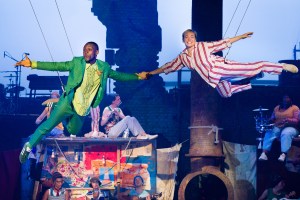
It is often forgotten that, before the pantos, the ice shows, the films and the book, Peter Pan was a play, written by JM Barrie in 1904 for the theatre. Cookson takes extravagant  licence with the original and in twisting common interpretations. Until quite recently, the eponymous hero would have been played by an actor who is female and petite, but John Pfumojena’s hyperactive Peter is neither. Similarly, Captain Hook would have been male and bewhiskered, but, clearly, Kelly Price, attired in a frilly purple skirt, is also neither. And then there is Shiv Rabheru’s craggy, crabby Tinkerbell, an anti-fairy if ever one existed. 

It takes time for the show to take flight. The opening scene is made even duller than usual, played out in front of a dark curtain. Mr and Mrs Darling head off for a night on the town and, dismissing worries about what might fly in (or out of) the bedroom window, they tuck in their offspring. Would the pre-teen children of an affluent Edwardian household really have slept three in a double bed? Daisy Maywood is a delightful tomboyish Wendy who leads her younger brothers (Ammar Duffus and Alistair Toovey) through the window and on to Neverland in pursuit of Peter.

Once the curtain drops to reveal Michael Vale’s bright, open design, the new theatre also shows its colours, facilitating Peter’s flight to the very back of the expansive auditorium. Neverland appears like a cross between a ‘60s hippy commune and a scene from The Rocky Horror Show. Amid all the frolics, Cookson makes no attempt to suppress the darker themes that swim beneath the surface of Barrie’s writing like the huge crocodile that is realised here by Toby Olié’s puppetry. Price makes Hook a truly tormented soul and she doubles as the warm matriarch of the Darling family, adding a fresh layer to the Freudian subtexts.

One drawback with Cookson’s non-stop avalanche of inventiveness is that it tends to create diversions that obscure the main thrust of the narrative. Most adults know the story inside out, but some children at the press performance seemed to have problems figuring out what was going on. However, thrilling action, swashbuckling fights and breathtaking flights prove irresistible and Benji Bower’s excellent score, played by a rock band, turns the second half into a near-musical.

The ageless appeal of Peter Pan relies not only on fantasy and spectacle, which this production delivers in abundance, but also on the manner in which the story connects with common experience. Cookson’s eccentric revival never loses sight of Barrie’s affirmation that real life, even though it includes growing old, must be better than Neverland.

Performance date: 27 July 2019

Photo: Steve Tanner

This review was originally written for The Reviews Hub: http://www.thereviewshub.com
Devisor: Phil Young      Director: PJ Stanley

⭐️⭐️

Phil Young, a one-time associate of Mike Leigh, devised the short play Crystal Clear in 1982 using improvisation techniques. It is hard to see why White Deer Theatre has opted to to revive such a stilted piece now, although not seeing is what it is all about.

The Old Red Lion Theatre has a cosier than usual feel, carpeted and with cushioned seating along all four walls. The whole play takes place in the cluttered flat of Richard (Gareth Kennerley), a picture dealer who is blind in one eye and suffers from type one diabetes. However, Richard’s luck at the beginning of the play is not all bad, as he has not one, but two girlfriends. 

The first to appear is Thomasina (Gillian Dean, whose own sight is severely impaired), a blind woman who needs to be guided around the flat to avoid tripping over the futon and various items, such as a tool box and Richard’s underpants, lying around on the floor. Voices of actors are heard describing movement on behalf of the visually impaired and this gives PJ Stanley’s production an air of worthiness, drawing good will from an audience which roots for the play to become better. It never does so.

Girlfriend number two is the belligerent Jane (Rakhee Sharma) who demands more of Richard’s time and gets furious when she finds an open copy of Penthouse lying around the flat. Suddenly, Richard is struck completely blind while bidding for a painting, causing his life and both relationships to go on a downward spiral. How will he remember where in his flat he has left his cigarettes or how much Scotch is left in the bottle?

In telling us what it is like to lose one’s sight, the play goes no further than stating the obvious and its conclusions are desperately depressing. The production has the forethought to provide an audio commentary for the benefit of the visually impaired, but maybe they would have appreciated notes of optimism and positivity in the play far more.

The actors, most notably Kennerley, perform their roles with intensity, but, repeatedly, they are defeated by some truly dreadful dialogue. Ultimately, it has to be acknowledged that it is not enough for a production to have worthy intentions if the play that it showcases is as dull and lacking credibility as this.

Performance date: 25 July 2019

This review was originally written for The Reviews Hub: http://www.thereviewshub.com

Blues in the Night (Kiln Theatre)

Posted: July 27, 2019 in Theatre

Creator and original director: Sheldon Epps      Director: Susie McKenna

⭐️⭐️⭐️⭐️

Not seen in London for 30 years, Sheldon Epps’ anthology of a couple of dozen or so blues songs, some very familiar, many not, gets a sizzling makeover that should lead to someone penning “The Why So Long? Blues”. Denied any running narrative and given only vaguely drawn characters, this revival relies for its success on its sense of time and place, four stellar leading performances and the enduring appeal of songs by Bessie Smith, Duke Ellington, Johnny Mercer and others.

The setting is a run-down New Orleans hotel, the rooms of which inspire Four Walls (and One Dirty Window) Blues. The Lady (Sharon D Clarke) runs the joint, showing maternal devotion to guests, The Woman (Debbie Kurup) and The Girl (Gemma Sutton), but disdain towards The Man (Clive Rowe). The Lady sits in her square room, puffing on cigarettes, while the two females sit in their rooms, also marked as squares, on the opposite side of the stage. There is a feeling of isolation, but also of community.

Robert Jones’ set design makes full use of the Kiln’s deep stage, scattering it with art deco lamps, and Neil Austin’s wonderfully evocative lighting transports us to a place where free-flowing Bourbon can drown an abundance of sorrows. In the hotel lobby, musical director Mark Dickman’s five piece band, plays virtually non-stop. There is no time for spoken words when there are blues to be sung.

“I ain’t gettin’ older, I’m gettin’ better” Clarke declares, hearing no dissent from the audience. The 2019 Olivier Award winner for Caroline, or Change is fitting in this production between Death of a Salesman at the Young Vic and its West End Transfer. Does this phenomenally talented performer ever take a holiday? Hopefully not!

The great skill in Epps’ creation, realised beautifully in Susie McKenna’s revival, is seen in how a compilation of songs about heartbreak, abandonment, loneliness, despair and so on is turned into a feel good entertainment. As performed here, the songs are laments only in part; more importantly, they become celebrations of the resilience of the human spirit. Injections of comedy also contribute greatly, as typified by the lighthearted bickering between The Lady and The Man. As one of Rowe’s ovations is dying down, Clarke growls “I can’t stand it!” adding resentfully “but he sure can sing”.

Running through August, Blues in the Night guarantees a scorching Summer for this part of north west London. The word “blues” has something to do with depression, a condition for which this joyous show is the perfect antidote.

Performance date: 24 July 2019

Photo: Matt Humphrey

This review was originally written for The Reviews Hub: http://www.thereviewshub.com

Games for Lovers (The Vaults)

Posted: July 19, 2019 in Theatre

Writer: Ryan Craig       Director: Anthony Banks

⭐️⭐️💫

Poking fun at the mating rituals of the British is an age old pursuit, picked up on by Ryan Craig in this new comedy, which, if nothing else, demonstrates that very little changes over the years. The play devotes itself more to re-working familiar situations than to finding modern perspectives and, coming from a writer who has an impressive record of recent successes, it proves to be a disappointment.

Designer Simon Scullion decorates the traverse stage with geometric shapes in garish colours, giving Anthony Banks’ production a jazzy feel, but not altogether a modern one. We enter a world where twenty somethings make passing references to Tinder and the like, but where snappy chat-up lines at the bar are a great deal more prevalent than anything on Snapchat. Could this be this be 2019 or, perhaps, 1979?

The self-proclaimed master of chat-up techniques is inept Lothario, Darren (aka “Juan”), played with a jaunty swagger by Billy Postlethwaite. He is a dating dinosaur, the sort of man who, 40 years ago, would have been wearing medallions on chains around his neck. Darren sublets a room in his flat to the timid Martha (Evanna Lynch), who is infatuated with a doctor at the hospital where she works. Only rating her a six-and-a-half, Darren takes her in, calculating that her presence in his home will prove less tempting to him than an eight or a nine.

Martha’s friend from school days is PE teacher Logan (Calum Callaghan), who also happens to be friends with Darren and a student of his in the art of chat-up. Logan’s new girlfriend, Jenny (Tessie Orange-Turner) is a website designer with a tendency to get too close to her clients. She is the most modern of the four characters. Her relationship with Logan is threatened by an unsatisfactory love life, which leads to role-playing in which she becomes a Belarusian whore.

At its best, Banks’ production has energy and a dash of wit and, at its worst, it has neither. There is a very slight narrative thread running through, but the show plays out like a series of independent, short comedy sketches of varying quality and what emerges is a quartet of thinly-drawn characters who are going through the motions of coupling for no better reason than it is what they believe they are supposed to do. Romance and emotional connections play virtually no part.

Predictable though it is, much of what goes on is mildly amusing, but the play’s overriding problem is that too little of what is has to say is new.

Performance date: 17 July 2019

This review was originally written for The Reviews Hub: http://www.thereviewshub.com

Fiver (Southwark Playhouse)

Posted: July 7, 2019 in Theatre

Book, music and lyrics: Alex James Ellison and Tom Lees

⭐️⭐️⭐️⭐️

The Little space at Southwark Playhouse is turning into fertile territory for new British musicals. Just a few weeks after The Curious Case of Benjamin Button emerged as, arguably, the fringe hit of 2019, here comes a refreshing offering from a young team that can already stake a credible claim to becoming the next Rice/Lloyd Webber.

A street busker sings Change Is Bringing Me Down and gets the eponymous note in his jar as a reward. The note is passed on to a homeless person who spends it at a newsagent on scratch cards, before it goes in change to a young man who has just bought a birthday card. The passing of the fiver around its many owners links together a cycle of humorous, romantic and melancholic songs.

The busker is co-writer (along with director and music director Tom Lees), Alex James Ellison, who reappears through the show with his acoustic guitar, like a wandering minstrel. Four highly talented actor/singers – Luke Bayer, Dan Buckley, Aoife Clesham and Hiba Elchikhe – play all the characters in the linked stories, showing remarkable versatility. A four-piece band accompanies the songs.

There are times when the fiver gets forgotten, but, being of the modern plastic variety, it proves durable. The show also takes a long detour with what amounts to a songless revue sketch about a surprise party. What emerges overall is that the real linking theme is about the problems of young people making the transition from childhood to adulthood more than about any form of money. Love, loss, depression, exams, bullying, stalking, the generation gap and becoming parents all feature in a show that often feels like part of a cathartic process to counter the pain of adolescence.

If musicals stand or fall on the quality of their songs, this one definitely stands. Encompassing a variety of musical styles, intelligent lyrics combine with catchy rhythms and lovely melodies throughout the show. The writers’ work, switching effortlessly from light to shade, shows no traces of the kind of bland and predictable pop that has dragged down so many British musicals over the years.

The title invites a five-star review and it is tempting, but the show needs further work to knit all its elements together more tightly. That said, at this stage, lack of polish matters less than freshness and conviction. When creators and performers seem to believe in their material as much as this, audiences have to believe in it too.

Performance date: 5 July 2019

This review was originally written for The Reviews Hub: http://www.thereviewshub.com