The Gift (Park Theatre)

Posted: February 1, 2025 in Theatre

Photo: Rich Southgate

Writer: Dave Florez

Director: Adam Meggido

⭐️

We all know that friendships and family relationships can be fragile things, capable of being disrupted by even the slightest  of upsets. Dave Florez’s new play, a one-joke comedy, puts this to the test when the arrival of an unexpected gift shocks three characters who are gathered in a flat in Crouch End, just along the road from the Park Theatre. Perhaps the play’s producers imagined that local interest could draw in audiences when all else fails. Sadly, all else does fail.

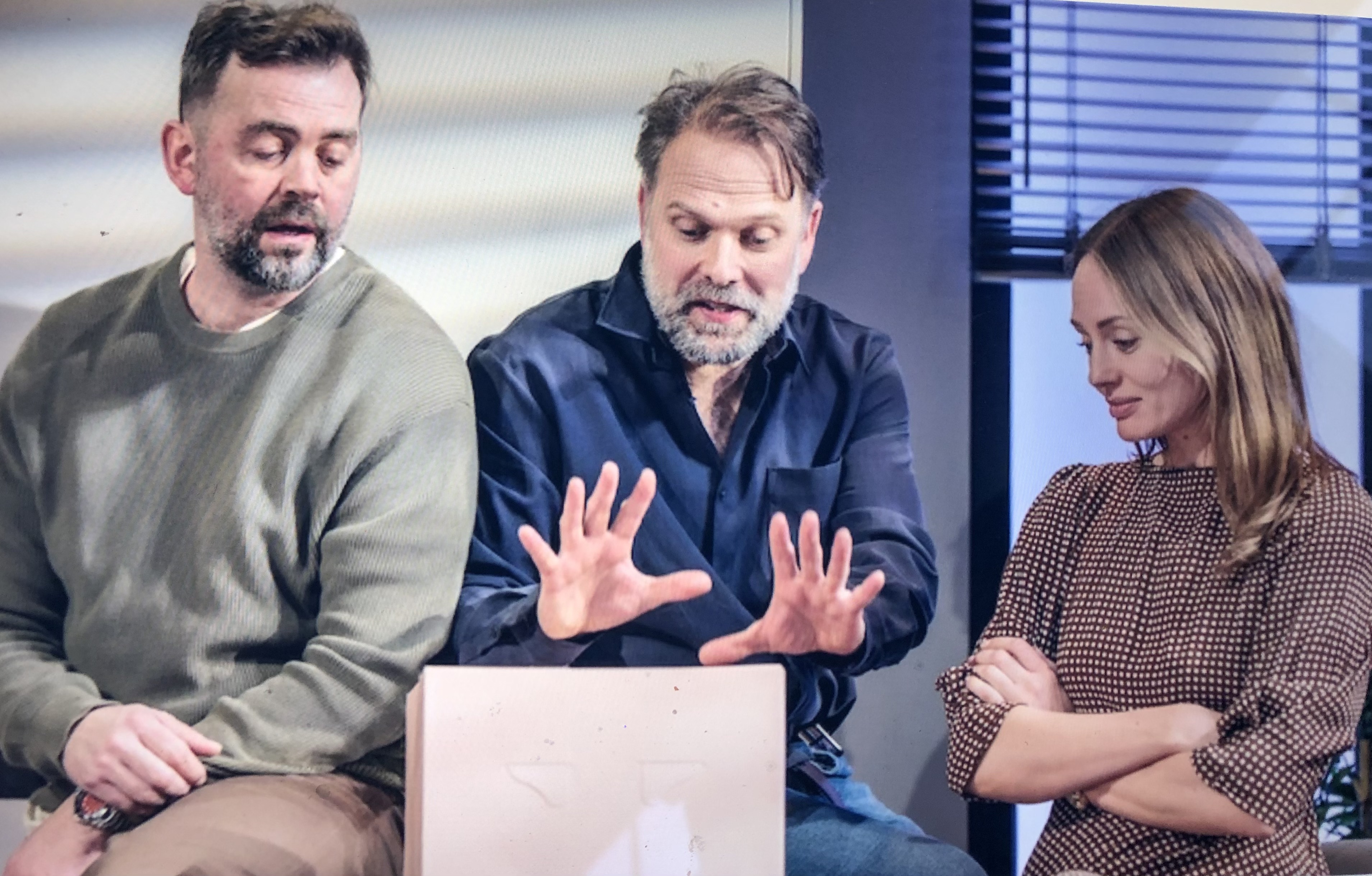
The occupant of the flat and recipient of the gift is Colin (Nicholas Burns), a 43-year-old single man. Calling round to view the gift are his sister Lisa (Laura Haddock) and her partner Brian (Alex Price). It had arrived that morning by Royal Mail Special Delivery from a nearby patisserie. The object is a cake box, but what is in it? At first the trio speculates that it could be a chocolate éclair, but further examination reveals that it is in fact a deposit of human excrement.

The discovery prompts Colin to develop a spreadsheet of his potential enemies. Briefly, an unfunny comedy promises to turn into an enthralling whodunnit. For reasons that are not altogether clear, all three  characters become obsessed by the gift and they begin to re-evaluate their lives. Flores scratches away at the surface, looking for deeper meanings, but genuine emotions need to be filtered through believable character in credible situations. In this play, neither the people nor their dilemmas are ever made to feel real.

The play starts out as if it has parked in a cul-de-sac. It has nowhere to go and, over a tedious journey of just over two hours (including interval), nowhere is precisely where Florez takes it. The trip is padded out with juvenile lavatorial humour and, in seeming desperation, some crude slapstick is thrown in, but it feels as if there is nothing that director Adam Meggido can come up with to make the comedy work.

For brief spells, the three actors make their characters amiable and the play becomes bearable, but, repeatedly, The Gift invites comparisons with the contents of the cake box, an unwelcome gift indeed.

Performance date: 28 January 2025

Kyoto (@sohoplace)

Posted: January 21, 2025 in Theatre

Photo: Manuel Harlan

Writers: Joe Murphy and Joe Robertson

Directors: Stephen Daldry and Justin Martin

⭐️⭐️⭐️⭐️

Looking back nostalgically, the 1990s seem like an era of tranquility. The Cold War and the major conflicts of the 20th Century had by then passed into history, while the horrors, real and potential, that were to engulf the fist quarter of the 21st Century were still invisible on the horizon, with one exception: that of global warming. Kyoto, a new play by Joe Murphy and Joe Robertson, begins by reminding us that this was the context for the ground-breaking climate change conference that took place in Japan’s second city in December.1997.

This Royal Shakespeare Company production. directed by Stephen Daldry and Justin Martin is transferring from Stratford-upn-Avon to @sohoplace, the West End’s newish in-the-round theatre, which set designer Miriam Buether turns into a realistic representation of a conference venue. Delegate badges are handed to the audience and the debating begins. The play’s first half tells the back story, with conferences in Geneva and Rio de Janeiro setting out dividing lines between nations, ranging from Kiribati to China. Perhaps the play gets slightly too bogged down in detail during this half, but it takes flight once the shores of Japan have been reached.

Acting as narrators, United Nations observer Don Pearlman (Stephen Kunken) and his wife Shirley (Jenna Augen) describe events with an appropriate air of cynicism which brings out the many ironies in the narrative. Pearlman is an American Republican who clashes inevitably with the USA delegate (Nancy Crane), representing the Clinton/Gore administration.  

The Rio conference is presided over by the German Environment Minister, a strict Angela Merkel (Kristin Atherton) suggesting that a bright future could be lying in wait for her. Showing a flair for understatement, she begins a discussion with the United Kingdom delegate: “I know that our countries have not always seen eye to eye, but…”, The UK delegate at Kyoto is a bellicose John Prescott (Ferdy Roberts), lecturing other delegates on more unsubtle negotiating tactics. Could it be that the newly-installed Blair Government is not taking the threat of global warming too seriously?

Seemingly aware that most of the arguments and counter arguments put forward by countries are still being heard regularly on news bulletins today, the writers know that the plain facts about climate change will not be enough to hold the interest of audiences and, accordingly, they spice up their script with generous measures of humour. Marshalling a company of 20, the directors achieve a degree of vitality that translates into urgency. At times the coordination of the ensemble is breathtaking, geneating an ordered chaos that we imagine to be an accurate  depiction of real events.

Unfortunately, all the events depicted in the play remain blazingly topical more than 27 years later. Kyoto represented a breakthrough, but it found no permanent solutions to the dilemmas that still haunt us. The play offers no new revelations, but it gives fresh insights into the knots that still have to be untangled.

Performance date: 17 January 2025

Photo: Tanya Pabaru

Writer: John Nicholson

Director: Kirstie Davis

⭐️⭐️

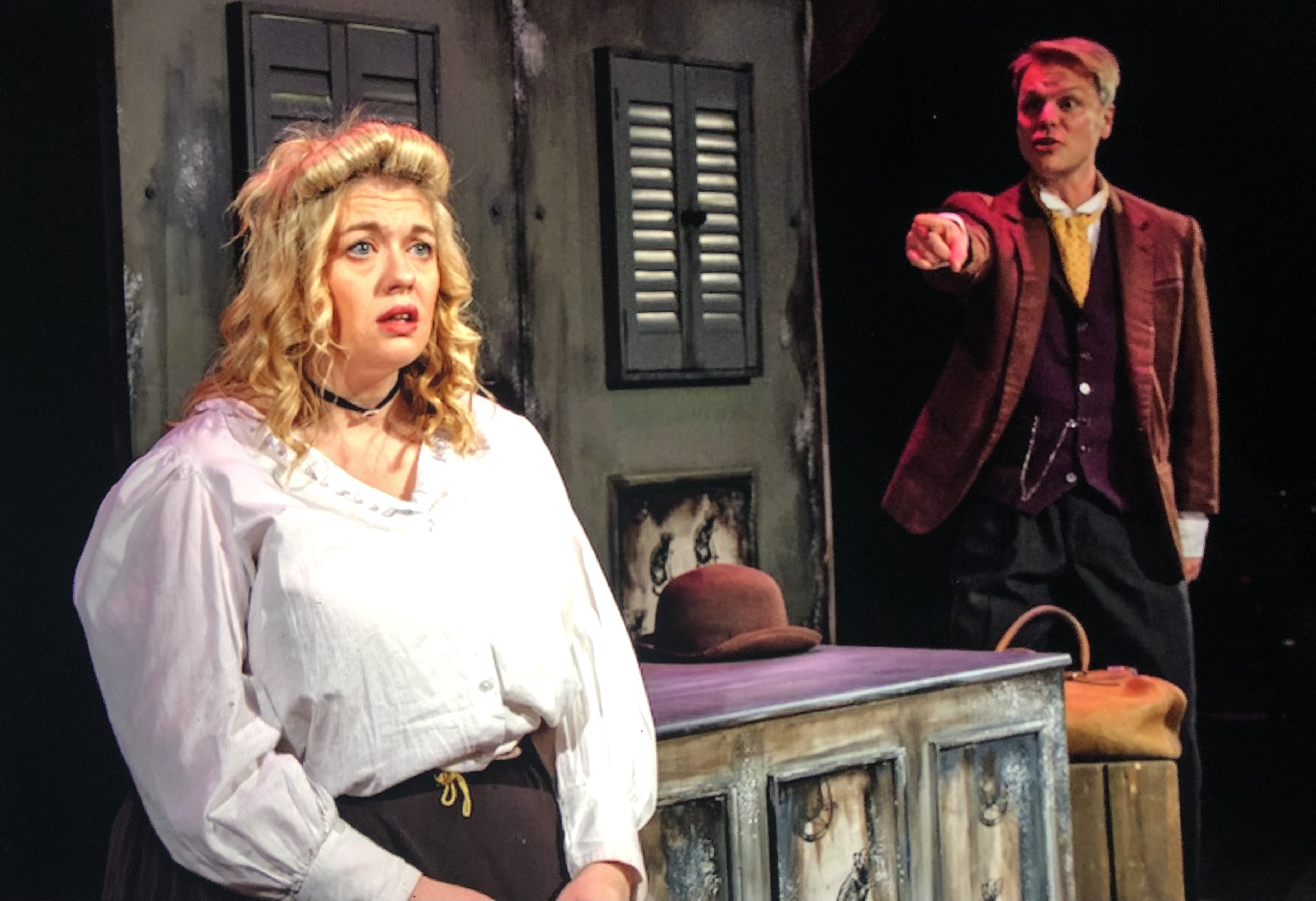
“Has anyone ever read Madame Bovary?” an actor asks the audience at the start of the show. Seeing very few hands go up, the actor responds “that’s more than I thought”. In that case, what is the point of mocking something when it is acknowledged that very few people will have the foggiest idea about what is being mocked?

“What is the point?” becomes a recurring question in this adaptation of Gustave Flaubert’s 1856 novel which turns a French tragedy into a French melodrama and then pushes it one stage further into the realms of French farce. Bearing in mind the season, perhaps it is meant to be seen as an adult pantomime, albeit one with a madame instead of a dame and no songs. In style, the show resembles a manic, absurdist Monty Python sketch, stretched out for an almost unbearable two hours (plus interval).

For the benefit of the assumed majority who are unfamiliar with the novel, Emma Bovary is the wife of a doctor in provincial France, bored with her drab life and her dreary husband. She embarks on a journey of serial adultery and extravagance, piling up debts and leading to eventual ruin. We are warned at the beginning of the show that the tragic ending will be cut in order to preserve the feel-good factor, but, as it stands, writer John Nicholson’s adaptation is hardly ideal for a kids’ Christmas show.

it is pointed out that Emma joins the likes of Anna Karenina and Cathy Earnshaw as one of the tragic heroines of 19th Century literature. However, there is little in Georgia Nicholson’s portrayal of her that draws sympathy for her as a symbol of female oppression. Instead, Nicholson turns her into a ridiculous figure, selfish and petulant. All the other roles are shared between Stephen Cavanagh, Ben Kernow and Darren Seed, leading to frantic entrances and exits and lightning-quick costume changes. The four actors earn ten out of ten for efforts, but it feels as if they try too hard to be funny and, eventually, their material defeats them.

When played straight, 19th Century melodrama can be entertaining, even funny, but playing it for laughs, as here, is simply taking the joke too far. In the season of good will to all, it would be too unkind to describe the mayhem of director Kirstie Davis’ production as a “massive tragedy”, better to sum up by returning to asking what is the point?

Performance date: 9 December 2024

Photo: Marc Brenner

Writer: Oscar Wilde

Director: Max Webster

⭐️⭐️⭐️⭐️💫

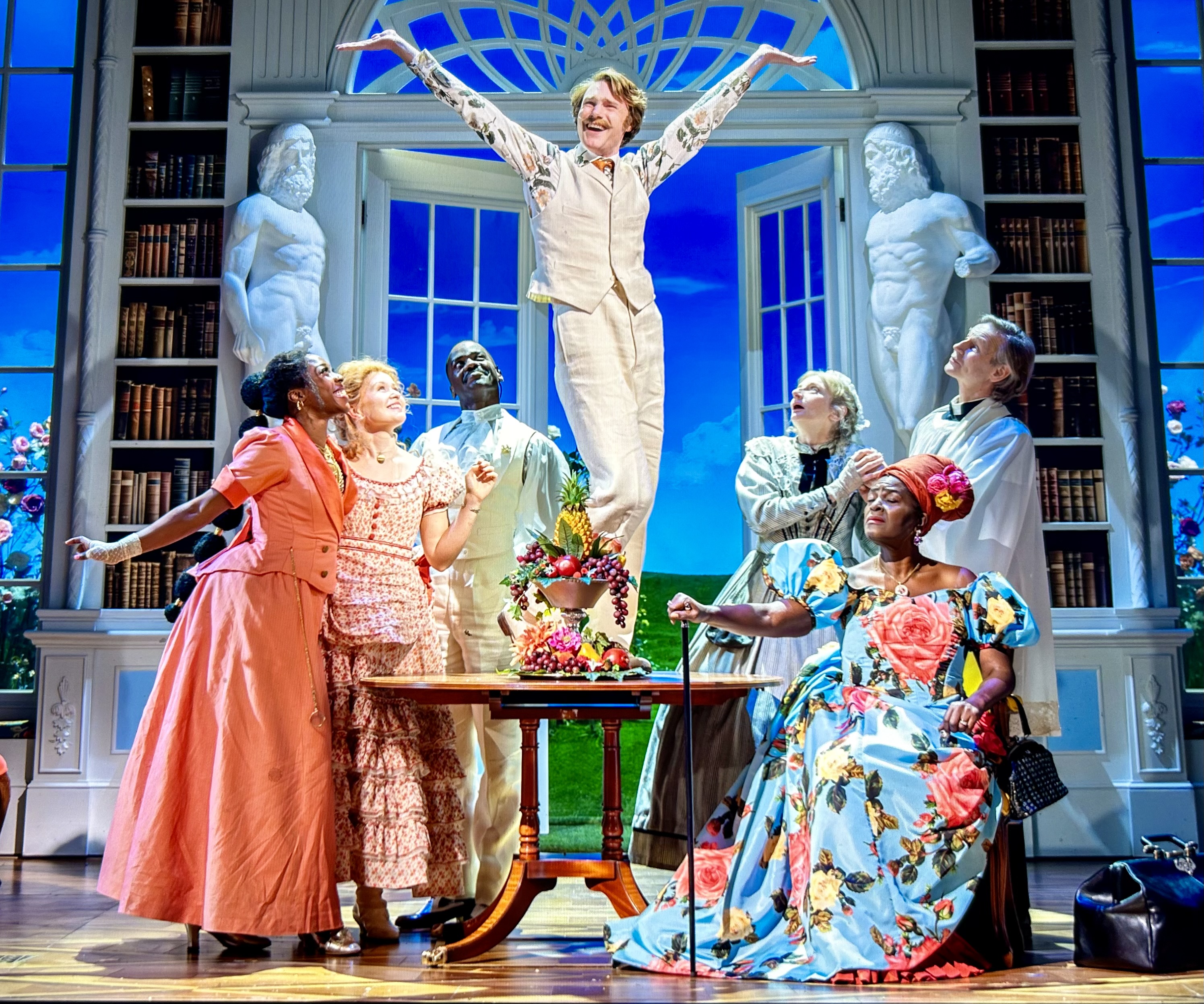
St Valentine’s Day 1895 was both a happy and a sad day in the history of our theatre. Happy because it saw the opening of the irrepressible comedy The Importance of Being Earnest and sad because its writer, Oscar Wilde, was arrested after the first performance, his career being effectively ended. Wilde’s perceived crime was partaking in “the love that dares not speak its name”. Therefore, there is a satisfying irony in welcoming a revival in which the name, if not exactly spoken, is suggested very loudly indeed. It is all about as camp as it is possible to get away with while staying faithful to a plot that respects the social conventions of the Victorian age.

Apart from bizarre sequences at the beginning and the end, this revival strives to be traditional, as emphasised by a set that has a proscenium arch stage, complete with red velvet curtain, within the Lyttelton Theatre stage. Rae Smith’s set designs, not over-elaborate but dazzling, and her glorious period costumes provide a feast for the eye, while the ear is treated to a bombardment of Wilde wit, spoken with great clarity by all the actors. Much credit goes to sound designer Nicola T Chang for achieving this in a venue where acoustics can be a problem.

Television’s current Doctor Who, Nouti Gatwa, travels back in time to the late 19th Century, playing the upstart Algernon Moncrieff, who lives a double life, using his own name when in London and that of Bunberry when in the country. Gatwa does nothing to dowse the camp fire in director Max Webster’s jaunty production and his presence tests whether or not avid Whovians will become wild about Oscar. He possesses a natural air of impudence that is perfect for this role and he is equalled by Hugh Skinner as Jack (known in the country as Earnest) Worthing. who had been discovered as a baby in a handbag at Victoria Station.

Algernon has an eye for Jack’s ward, Cecily (Eliza Scanlen) and Jack for Algernon’s cousin Gwendolyn (Ronke Adékoluéjó), both ladies insisting that they could only become romantically attached to a man whose name is Earnest. Perhaps the play is best known for a two-word line spoken by Algernon’s aunt, Lady Bracknell, played here by the prodigiously talented Sharon D Clarke, an unforgettable Ma Rainey on this same stage. Sadly, she does not sing the line, but she drops it in with relish. Her regal appearances in the first and last scenes support this predominantly youthful production like sturdy bookends.

Revivals of this play in London and elsewhere are not exactly rare, but Webster’s sparkling version brings out all the cutting observations of an Irish outsider looking in on the absurdities of English society. It not so much revives a classic comedy as it refreshes it.

Performance date: 28 November 2024

King James (Hampstead Theatre)

Posted: November 28, 2024 in Theatre

Photo: Mark Douet

Writer: Rajiv Joseph

Director: Alice Hamilton

⭐️⭐️⭐️⭐️

Supporting a sports team can be a precarious business, made up of soaring highs and dismal lows. Very much like most of our lives in and relationships perhaps. American writer Rajiv Joseph’s short four-scene play matches up the fluctuations in the fortunes of an American professional Basketball team with the ups and downs in a friendship between two young men, both supporters, over a period of several years.

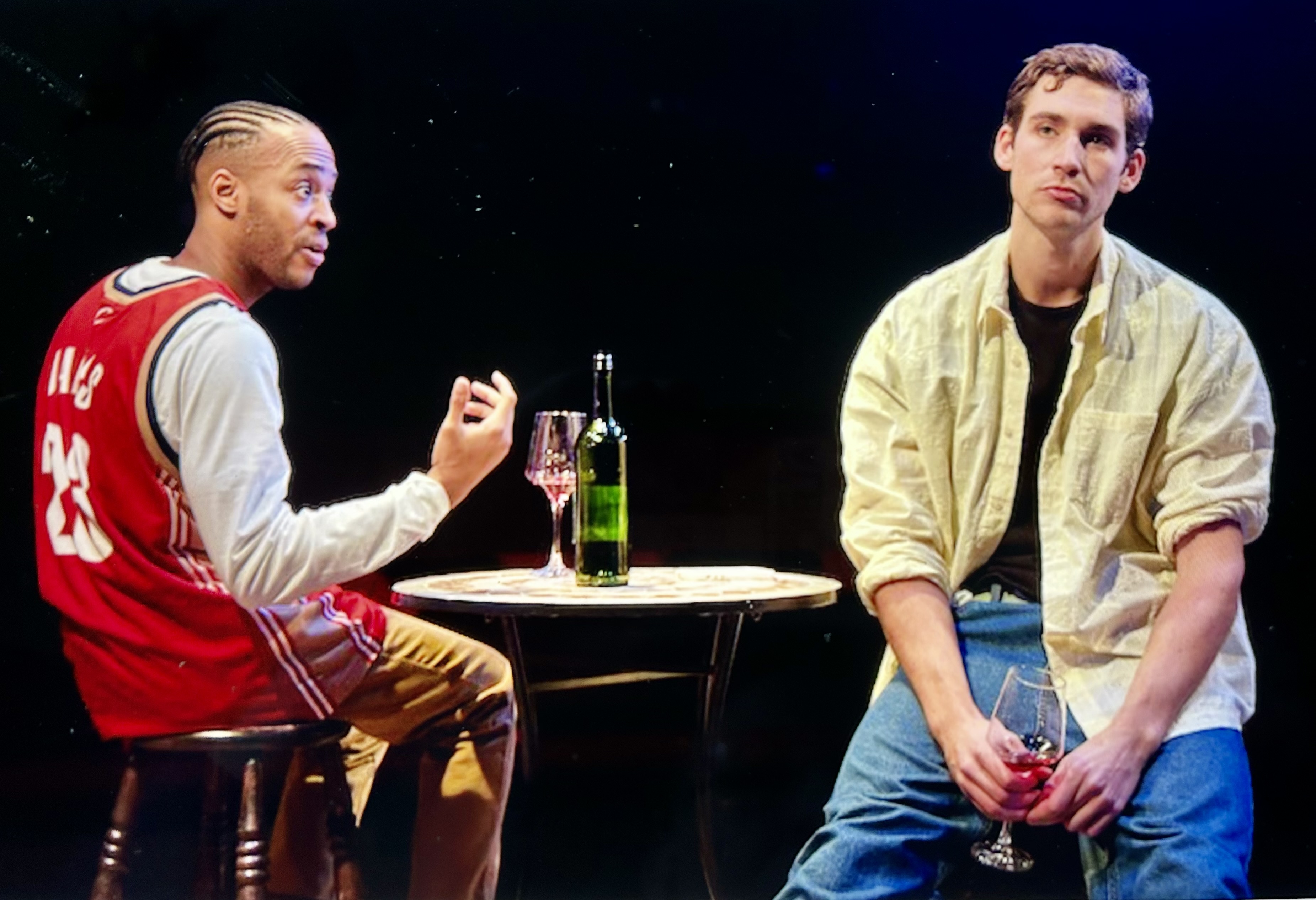
In his earlier play, Guards at the Taj, Joseph explored the intricacies of male bonding. Here the time and the setting are very different, but the essential themes remain the same. In Cleveland, Ohio, Matt (Sam Mitchell) and Shawn (Enyi Okoronkwo) are brought together by their shared love for the Cavaliers (“Cavs”). Matt is raising quick cash by selling his ailing father’s pair of season tickets, Shawn has a windfall from selling a short story and is the potential buyer. But who will he take with him to the matches?

The lads’ “King” is star player LeBron James. They feel the pain of his treachery when he leaves the Cavs for Miami and they embrace the ecstasy of his triumphant return. His success becomes a symbol of how great things can emerge from humble beginnings and he inspires them as they strive to win through in their own lives. Shawn moves to New York and them Los Angeles, while Matt remains rooted in Cleveland, the pair fall out and make up, but, for both, the draw of friendship and the Cavs remains constant.

The quick fire exchanges give director Alice Hamilton’s perfectly pitched production the feel of a David Mamet piece. It seems remarkable that these young British actors are able to master the pace and rhythm of Joseph’s dialogue with such consummate skill, but their sensitive performances also delve deep into the hearts of their characters. A minor gripe – a play that runs briskly for around 80 minutes is extended to 100 minutes by the intrusion of an interval; a set change explains this, but it does not justify the disruption to the play’s flow.

The finer points of American Basketball may fox many in audiences at Hampstead, bu what should be crystal clear to all are the razor-sharp quality of Joseph’s writing and the absolute precision of the two performances

Performance date: 21 November 2024

Burnt-Up Love (Finboroigh Theatre)

Posted: November 4, 2024 in Theatre

Photo: Rio Redwood-Sawyer

Writer and director: Ché Walker

⭐️⭐️⭐️⭐️

Be warned! Ché Walker’s new 70-minute play, Burnt-Up Love, receiving its world premiere here, takes us to very dark places. It explores how love and violence can co-exist side-by-side and feed off each other. It is a harrowing, yet strangely rewarding experience.

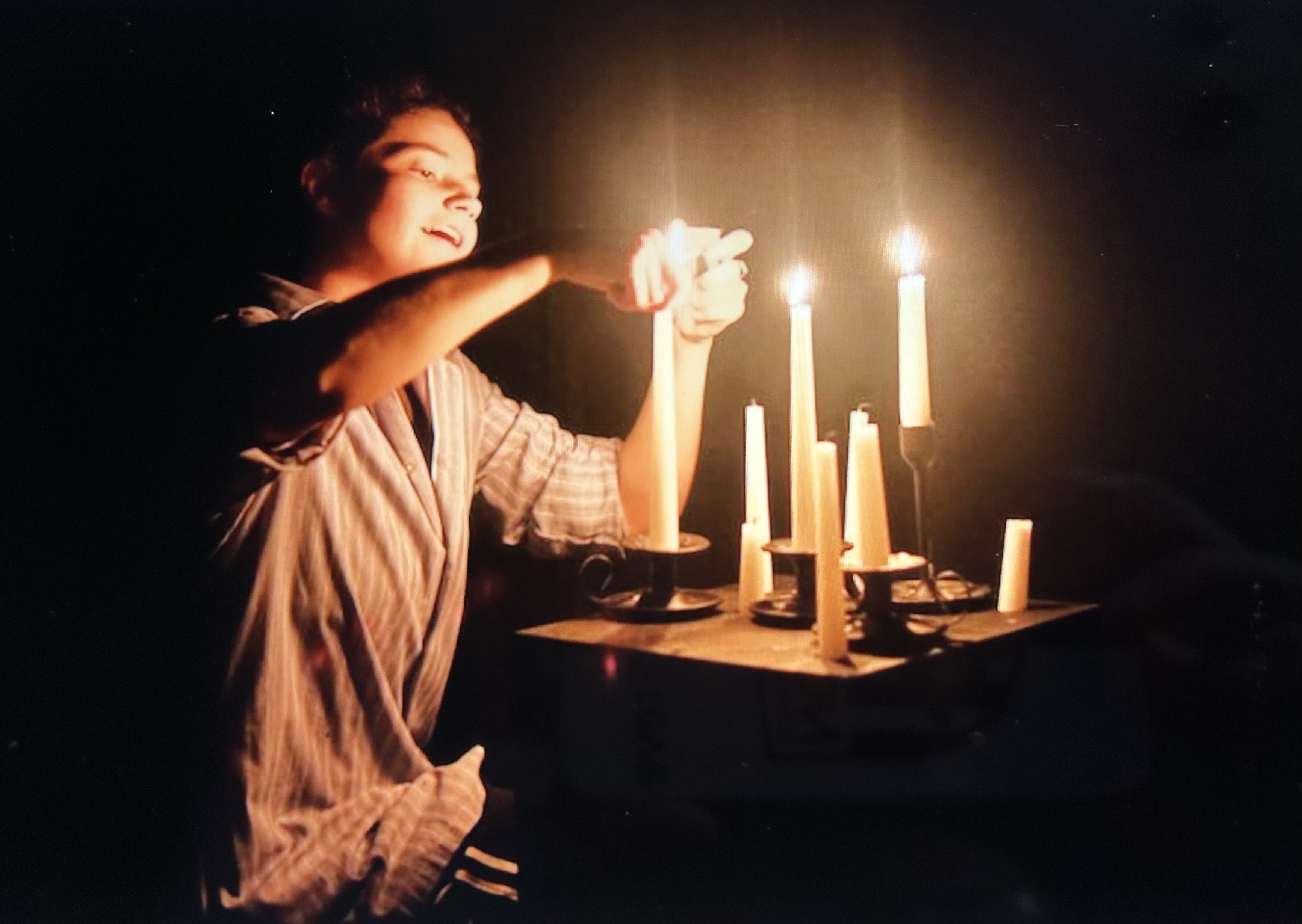
As writer, director and leading actor, Walker spreads darkness all around the Finborough Theatre. Five candelabras and, occasionally, a torch are the only sources of light. Seen through the gloom, the three characters vaguely resemble Dickensian villains. Sharing a room with them feels dangerous.

Mac (Walker) is serving a 20-year prison sentence for murder. He combats the harsh realities of prison life with only a small photograph of his smiling, then three-year-old daughter keeping him going. He imagines that she is on her way to achieving one of the lofty goals which he has set for her and, on his release, his sole ambition is to find her.

Joanne Marie Mason is superb as Scratch, the daughter. She is a wild spirit, bright and street-wise, dragged to the fringes of the criminal underworld as if it is her birthright. She forms an edgy romantic relationship with another petty criminal, JayJayJay (Alice Walker), but, as if it his in her genes, gruesome deeds from her past return to haunt  her and the chain of violence in her family remains unbroken.

Stark and often shocking, Burnt-Up Love hits with the force of a short, sharp shock. Written in the style of an epic love poem, it takes us into an underworld in which normal civilised behaviour is readily set aside, but one in which deep human emotions still thrive.

Performance date: 31 October 2024

Coriolanus (National Theatre, Olivier)

Posted: September 28, 2024 in Theatre

Photo: Misan Harriman

Writer: William Shakespeare

Director: Lyndsey Turner

⭐️⭐️⭐️

At a time when populist movements are gaining ground in many western democracies, the topical relevance of Coriolanus could not be clearer. William Shakespeare’s political thriller, set in Ancient Rom, follows the progress of the titular character from victorious warrior to popular hero and then to enemy of the State, advocating radical reforms which infuriate the ruling elite.

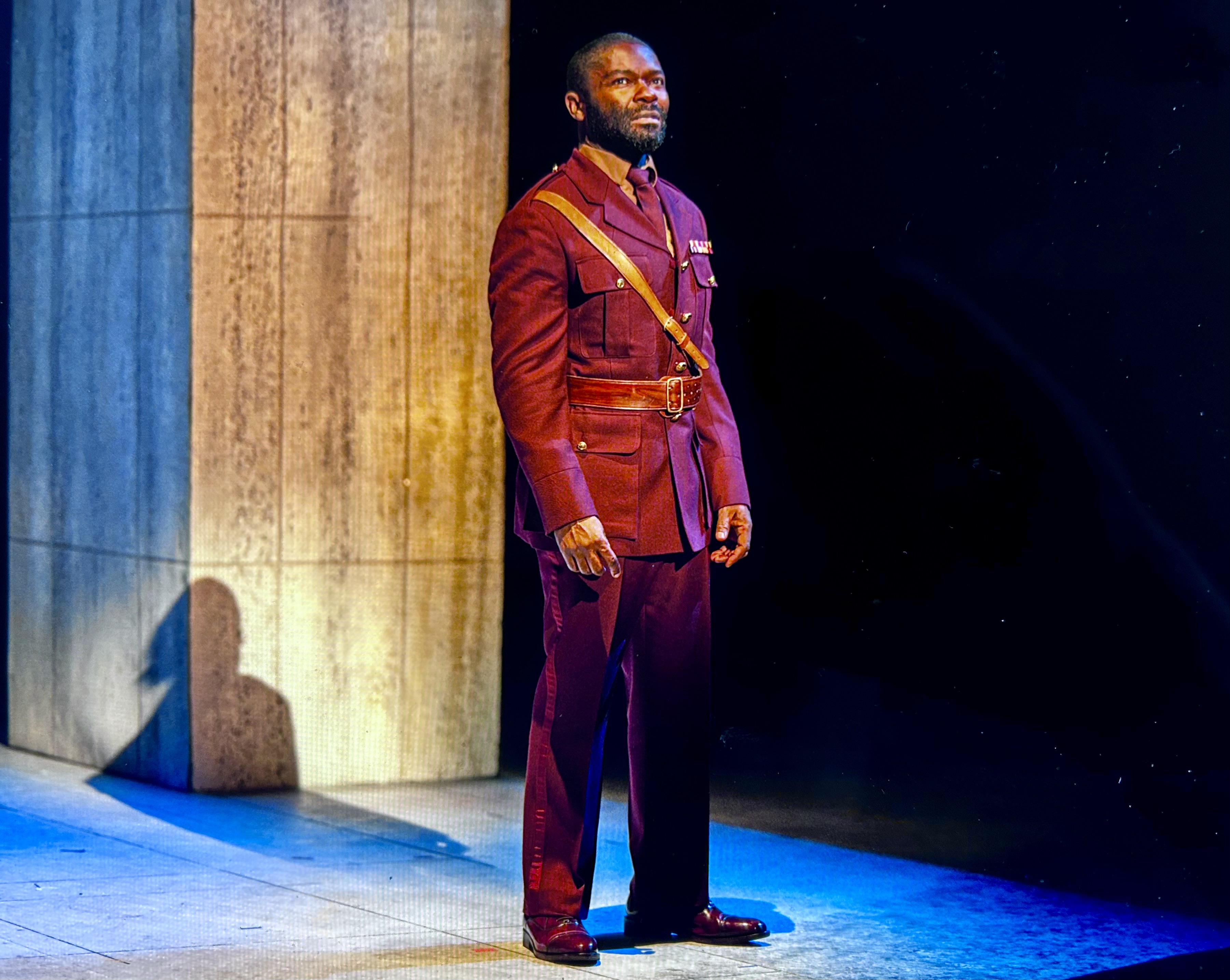
Director Lindsey Turner’s revival forsakes togas for modern dress, with video images and Zoom meetings emphasising the connection to the 21st Century. Es Devlin’s set designs are timeless, serving mainly to expand and contract the vast Olivier Theatre stage, which opens out fully for the early battle scene. The thrilling staging of the combat owes much to the lighting, designed by Tim Lutkin. However, after the ectio, words replace warfare to capture our imagination, 

When first appearing, David Oyelowo’s Coriolanus falls short on displaying the powerful presence of a triumphant conqueror, but the actor grows into the role and comes close to exuding the charisma and inner strength that explain the character’s actions. The visceral performance for which we had sought is not completely there yet, but, hopefully, it will develop.

The trajectory of the narrative is established firmly in the first half of the play and does not change in a second half which feels like an anticlimax as it moves predictably towards its inevitable conclusion.  The chief highlights in these later stages are impassioned speeches by Coriolanus\ mother, Volumnia (Pamela Nomvete) and the arbiter between him and the ruling Tribune, Menenius (Peter Forbes). Both are delivered with fire.

Supprting roles are shared among the relatively small company, doubling-up to an extent that is perhaps unusual for the National Theatre. The effect of this is to diminish the minor characters and sharpen the focus on the principals. However, Shakespeare gives little help in getting inside the head of Coriolanus and understanding his emotional drive. Turner keeps him at a distance from his mother, wife and son, revealing nothing of his connection to them and his inner feelings.

Turner’s production has many flourishes and creates striking, if occasionally puzzling images, but nothing quite as spectacular as the physical destruction of Elsinore in her 2015 production of Hamlet. After its stirring start, the production rarely achieves an epic feel, but, in many ways, this is commendable in that it places the emphasis on the political manoeuvring which forms the heart of the story.

This is a flawed revival of a flawed play, but, nonetheless, much of it remains intriguing.

Performance date: 24 September 2024

Two of Us (Watford Palace Theatre)

Posted: September 21, 2024 in Theatre

Photo: Ross Kernahan

Writers: Mark Stanfield, Richard Short and Barry Sloane

Director: Scott Williams

It will have escaped the notice of very few that the Gallagher brothers recently patched up their differences to re-form the pop band Oasis. Yet, with much less publicity, almost half a century ago, an even more momentous reunion seemed, briefly, on the cards. Two of Us is an account of a real-life meeting that took place between Jon Lennon and Paul McCartney in New York City in 1976, six years after the Beatles had split up.

Mark Stanfield’s screenplay has been adapted for the stage by himself, Richard Short and Barry Sloane. Sloane also plays the reclusive John Lennon, first seen pacing restlessly around his Manhattan penthouse apartment. He is isolated and bored, while the apartment, as envisioned in Amy Jane Cook’s set design, is neat, stylish and sterile. A ring on the entrance bell augers the arrival of an unexpected visitor.

Paul McCartney (Jay Johnson) is in town for gigs at Madison Square Garden with his new band, Wings. He is tired of journalists asking him if the Beatles will ever get back together and being unable to give an answer. So he goes in search of that answer. At first, the atmosphere is frosty as creative and personal differences surface. John insists that music should be born out of pain and mocks Paul’s lightweight style, as typified by Wings’ current hit, Silly Love Songs. There are also hints that, as in one of his solo songs, John is a jealous guy, resentful of Paul’s commercial success and the fact that Paul’s Yesterday had been names the Beatles’ most popular song.

A two-hander on a large stage, director Scott Williams does well to keep the production consistently engaging, assisted by the script’s liberal scatterings of name-dropping and frivolous jokes (John: “Yoko’s away”; Paul: “Oh! No”). Once the ice between the pair melts, with a little help from “friends”, what is revealed is two old buddies who had been best mates since the age of nine, going back over good and bad times and re-kindling a flame. Two working class Liverpudlians, they had reached a pinnacle of fame, probably unequalled before or since, and their different ways of dealing with the massive pressures are revealing.

The writers seem to reach the conclusion that John’s wife Yoko and, to a lesser extent, Paul’s wife Linda  were the wedges that came between the music legends, but they are less interested in the divisions than in the bonds. The play’s biggest success comes in cutting through the well-publicised friction and finding a simple bromance that yielded, arguably, the most significant pairing in the history of popular music, In this, Two of Us feels truthful and very touching.

Performance date: 17 September 2024

23.5 Hours (Park Theatre)

Posted: September 13, 2024 in Theatre

Photo: Charles Flint

Writer: Carey Crim

Director: Katharine Farmer

⭐️⭐️

We hear much about criminals and their victims, but little about the collateral damage which crimes cause to families and friends of alleged offenders. Award-winning American playwright Carey Crim enters this sensitive area with 23.5 Hours, an examination of how a small group living in America’s mid-West responds when one of them, allegedly, commits a sex crime.

The play opens with two married couples – Tom and Leigh, Bruce and Jayne – celebrating after a successful school production of Romeo and Juliet, which Tom, a drama teacher, has directed. Bruce is aghast that the show ran for two hours and 48 minutes, but the mood is convivial and we get a picture of a wholesome All-American community in which everyone lives in perfect harmony with everyone else. And then the telephone rings.

The lights dim, followed by loud bangs and bright flashes as, for the first time, we see that understatement will not be a prominent feature of this production. Does the play’s title mean that the characters are half an hour away from the end of the world? Well not exactly. Scene two sees the same four gathered to welcome home Tom upon his release from prison, having served time for, allegedly, behaving inappropriately with his Juliet.

Tom (David Sturzaker) faces a mixed reception. His wife Leigh (Lisa Dwan) believes in his innocence for 23.5 hours every day and defends him resolutely, even though banishing him to sleep on the sofa. Bruce (Jonathan Nyati), a fellow teacher, defends him unreservedly, but Jayne (Allyson Ava-Brown) is convinced of his guilt. Tom’s teenage son Nicholas (Jem Matthews) takes to drugs and staying out all night. His relationships strained, his career and reputation in tatters, Tom soldiers on.

The writer always seems more interested in detailing the problems faving the characters, rather than exploring in-depth their inner emotion and their relationships.The story’s central perspective needs to be that of Leigh, the wife left with just a smidgeon of doubt, but, as played by Dwan, she is volatile and foul-tempered, thereby repelling empathy. More generally, director Katharine Farmer favours hysterics where subtlety may have yielded a stronger impact. Her approach does not serve the play well. Although Crim makes many intelligent points about the dilemmas being faced, the characters and their situations are not made to be wholly convincing and some lines of dialogue become unexpectedly risible.

The play should have been a thoughtful and revealing study of human behaviour under stress, but, in this production, it ends up as just a trite drams, overblown, overwrought and overlong.

Performance date: 9 September 2024

Photo: Flavia Fraser-Cannon

Music: Richard Rodgers

Lyrics: Lorenz Hart

Book: George Abbott

Director: Mark Giesser

⭐️⭐️⭐️

“If it’s good enough for Shakespeare, it’s good enough for you” declares the chorus to the audience in the opening scene of The Boys From Syracuse. But is it good enough? Adapted from The Comedy of Errors, possibly the Bard’s silliest play, this 1938  show is possibly the silliest musical in the history of Broadway.

The boys are the noble Antipholus (John Faal) and his manservant Dromio (played in very camp style by Brendan Matthew). The pair sail from Syracuse to the rival state of Ephesus where they have identical twin brothers from whom they were separated at birth. The brothers are also named Antipholus and Dromio. What follows is a couple of hours of madcap comedy based on mistaken identities.

The chief problem facing any director of this musical or the original play is finding a way to keep the audience aware of which twin is appearing in any given scene. Mark Giesser opts for the same two actors, dressed in the same garish costumes, playing both twins. Also, other actors in the exuberant company of eight double up supporting roles. The result of this is that we are constantly questioning “who’s who?” and, frequently, the confusion drains the comedy of its life.

The songs, with music by Richard Rodgers and lyrics by Lorenz Hart, include several that were established as standards before most of us were born. Falling in Love With Love, etc should have the audience singing along, but even the lesser-known songs prove that Rodgers could certainly knock out a tune. The singing is hit and miss, but the five-piece band, under the direction of Benjamin Levy, is consistently excellent, particularly when bringing out the jazzy elements in the score.

The show belongs to en era when musical theatre on Broadway was still evolving. Judged by modern standards most of the songs seem separate from George Abbott’s book, there to be inserted every 10 minutes or so in the style of a Vaudeville revue and doing little to propel the narrative. Thus the show feels disjointed, book and songs not fully integrated as in later musicals which Rodgers himself was to pioneer in his partnership with Oscar Hammerstein III.

So, many reservations, but, as a jolly nigh out in a pub theatre, this is a gallant effort. Alice McNicholas’ outrageous costume designs fill the space with colour and the actors give it their all. Finally, Giesser finds a splendid solution to the identification problem in a climactic scene which brings the evenings biggest laughs, uplifts the audience and send us away feeling much more generous towards what has gone before.

Performance date: 6 September 2024