Writer: Martin Zimmerman       Director: Christopher Haydon

⭐️⭐️⭐️⭐️

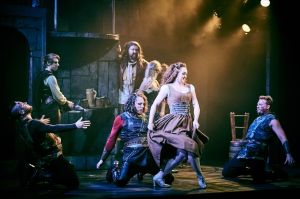
Take a deep breath. Martin Zimmerman’s 70-minute monologue takes us on a suspenseful ride through modern urban paranoias that we hope belong to a distant land and then realise maybe not.

Director Christopher Haydon had a big hit in this same studio space at the 2013 Festival with Grounded, the story of a female drone pilot who who saw faraway violence drawing closer. On that occasion, the lone character was confined to a glass cage and here she is trapped in a maze of threatening metal rods, Haydon’s taut, gripping style evident from the very beginning.

The character is a teacher at an America High School, a single mother by choice who scoffs at attempts by friends to pair her up. She interviews an aggressive male student, fearful that he may be carrying a gun, feels embarrassed when offloading her anxieties to her therapist and questions why it should ever be necessary for anyone to display a sign indicating that guns are not welcome. What follows is dark, stark and disturbing.

Polly Frame shows us a woman who is rational, efficient and in complete control until, suddenly, she isn’t. She never speaks of herself in the first person, as if distancing herself from her own actions and emotions, thereby also distancing herself also from the audience. It is difficult to connect with this woman emotionally, but Zimmerman’s spare writing does not require us to do so, only to listen to her story and to understand her reactions when gun violence strikes at her own community. Contemplating retaliation, she is taught, chillingly, to breathe deeply and, on the exhale, pull the trigger.

Much of Zimmerman’s play is targeted at American law makers and the NRA, but, performed in a country that still feels the pain of Dunblane, no comfort gan be gained from thinking that its concerns are only distant ones.

Performance date: 5 August 2018

This review was originally written for The Reviews Hub: http://www.thereviewshub.com


Entropy
Edinburgh Fringe 2018
©The Other Richard

Writer: Jennifer Roslyn Wingate      Director: Laura Clifford

⭐️⭐️⭐️

However far we roam, most of us can take with us the comfort of knowing that we have a home to return to. Not so 19-year-old Sam, the central character in this short debut play by Jennifer Roslyn Wingate, which is receiving its premiere here. Sam arrives at the door of his childhood home and all that he can hear from inside is a voice telling him to go away.

Entropy is a taut and visceral suspense thriller which plays on our fears of not belonging anywhere. The sole occupant of the house at which Sam arrives is his widowed stepmother, Barbara. When she finally opens the door to Sam, she alludes to his disgusting behaviour as a teenager; he retaliates by claiming horrific abuse as a seven-year-old to which Barbara turned a blind eye. She still disbelieves him. Their alienation seems total, but we sense that they have a need for each other and, beneath the surface, suggestions of sexual attraction are strong.

The quality of the acting transcends implausibilities in the plotting. Lewis Bruniges’ agitated, unpredictable Sam could be damaged or simply dangerous. Katharine Drury’s nervous Barbara could be guilty or simply terrified. Their relationship could be avenger/victim, son/mother, or they could be past or future lovers. Roslyn Wingate’s writing thrives on ambiguities to build and sustain tension and she only goes off track with an ending which does not seem to fit with the play’s key themes.

Laura Clifford directs an edgy production, which showcases the work of an interesting young writer who seems to have a promising future.

Performance date: 9 August 2018

This review was originally written for The Reviews Hub: http://www.thereviewshub.com

Writer: Henry Filloux-Bennett      Director and choreographer: Jonnie Riordan

⭐️⭐️⭐️⭐️

Back in the days when Michelin stars were a thing of the future for the UK and Fanny Craddock was teaching the nation to cook, a 12-year-old Nigel Slater was learning his craft by helping his Mum to make jam tarts and mince pies in her Wolverhampton kitchen. Now a famed food writer, Slater’s autobiography of his adolescent years has already been adapted for television, but, if the ingredients here are familiar, the art comes in mixing them afresh to serve up a tasty treat that is distinctively theatrical.

Sam Newton is a marvel as Nigel, holding centre stage for almost 90 minutes, as his character finds that the end of childhood is a time of fun and discovery, but also of pain and loss, his experiences all linked to the aromas and tastes of the kitchen. Nigel would have been a near contemporary of Adrian Mole and he shows similar traits to that fictional character, possessing both innocence and youthful wisdom as he makes casual observations directly to the audience while he goes about his daily life. 

“It’s impossible not to love someone who makes good toast” declares Nigel and his doting Mum (Lizzie Muncie) makes good toast. However, at Christmas, she dies shortly after incurring Nigel’s wrath by leaving the mincemeat off her shopping list and Nigel is left with his bad-tempered Telegraph-reading Dad (Mark Fleischmann), whose only contribution to the culinary arts is a disastrous attempt at spaghetti Bolognese.

Things get worse for Nigel when Dad takes up with the cleaner, Joan, played by Marie Lawrence as a vulgar woman with a thick Black Country accent. War breaks out, but Joan has the advantage of being an ace cook. Writer Henry Filloux-Bennett throws a fair amount of sharp wit into the mixing bowl and Newton’s excellent comic timing does the rest. The production credits include a Food Director (James Thompson), presumably responsible for the nibbles that are handed around the audience in addition to Walnut Whips, which, we are instructed, can only be consumed on the command of Slater senior.

Director Jonnie Riordan strikes a good balance between comedy, sadness and 1970s nostalgia. He adds zest with several choreographed routines, performed to pop tracks of the era. There are darker elements in Slater’s story, but Riordan wraps them in a glow of warmth and rarely lets his production be anything other than good fun.

Performance date: 8 August 2018

This review was originally written for The Reviews Hub: http://www.thereviewshub.com

Writer: Nick Cassenbaum

⭐️⭐️⭐️⭐️

Nick Cassenbaum charmed the 2016 Edinburgh Festival with Bubble Schmeisis his love letter to a traditional Jewish bath house in the East End of London, not too far from the Bermondsey birthplace of Michael Barrymore, the subject of this new hour-long show.

Cassenbaum’s blend of affection, sentimentality and humorous storytelling are as distinctive as before and just as irresistible. His memory for trivial detail enriches his stories and, when this extends to remembering the names of audience members, his shows become intimate group conversations. This show is as much a tribute to his late Nana Sylvie as to the TV star whose rise and fall has been reported to excess in the tabloid press. It was Nana Sylvie who gave 6-year-old Nick a VHS compilation of Barrymore clips as a Christmas gift and it was she who mentored the promising young entertainer of the family, encouraging him to tell risqué jokes to a group of aunts.

The show understands that childhood heroes remain heroes forever. Eric Morecambe topped an audience poll at this performance, but, for Cassenbaum, the presenter of ITV shows such as Strike It Lucky and My Kind of People has no competition. Using audience participation extensively, Barrymore’s career is charted largely through his appearance on This Is Your Life and we get the picture of a man who was as much a showman in his private life as in public, a purveyor of anarchy, mayhem and chaos in both.

Revelations about Barrymore’s sexuality did not seems to dent his popularity with the British public, but the tragedy which occurred at his home in 2001 triggered what Cassenbaum describes as “homophobia in the media” and toppled him from his pinnacle.

 The entertainer, whose catchphrase was “awight” (ie “all right”) is alive and, according to reports, well following addiction problems. Apparently, he has not yet seen this tribute, which is a pity, as it is very likely that he would find it his kind of show.

Performance date: 6 August 2018

This review was originally written for The Reviews Hub: http://www.thereviewshub.com

Book: Fiona English      Music and lyrics: David Eaton      Director: Benji Sperring

⭐️⭐️

Lin Manuel Miranda’s smash hit Broadway musical Hamilton has already been followed across the Atlantic by the off-Broadway parody Spamilton and now, within a matter of weeks, comes this new variation, based loosely on the life and career of Britain’s World Formula 1 champion. What next we wonder, Hamilton (Neil and Christine)?

Standing behind a row of toy cars, boy and girl racers (two of each) begin with a string of disclaimers, presumably to dodge writs from Miranda, Hamilton and others, but the most significant one is to prime the audience not to expect too much rap (“it took years to write Hamilton”). This is a disappointment, because Miranda demonstrated how rap can advance story-telling and give a musical an unstoppable rhythm. With so little rap, the show often stalls and all that we get are David Eaton’s very ordinary songs linked together by tired jokes and too much talk.

What Fiona English’s book tells us is that, in common with so many sporting superstars before him, Lewis is not very interesting. He is portrayed here by Letitia Hector as a naive young man who has zero personality, mentored by his team boss (Jamie Barwood). He contrasts with a red-cloaked, pantomime villain  Fernando Alonso (Louis Mackrodt). “You can’t be a winner just by driving fast” Alonso advises the novice, pointing him in the direction of branding and high profile girlfriends. Enter Pussycat Dolls singer Nicole Scherzinger (Liberty Buckland), whose involvement with Lewis is seen here as more of a publicity stunt than a romance.

Director Benji Sperring harnesses the energy of the four performers well, but he is hampered by a stage that is too big and the whole feel is of a show being poorly thought-through and quickly thrown together. There is clear scope for improvement and it should all become slicker during its run. In the meantime, good humour is not enough to carry it and it is good only in patches, as chequered as the flag that our hero wants so much to pass first.

Performance date: 4 August 2018

This review was originally written for The Reviews Hub: http://www.thereviewshub.com

Pity (Royal Court Theatre)

Posted: July 20, 2018 in Theatre

Writer: Rory Mullarkey      Director: Sam Pritchard

⭐⭐⭐⭐

In 1960, Orson Welles’ production of Eugene Ionesco’s Rhinoceros appeared at the Royal Court. In the 58 years of innovative theatre that have followed, apart from a 2007 revival of the same play, it is doubtful if the famous venue has seen anything quite so utterly bonkers as Rory Mullarkey’s absurdist, anarchic, apocalyptic new comedy.  Yes, Caryl Churchill’s 2016 play, Escaped Alone, works on similar themes, contrasting the calm of traditional England with the chaotic, disintegrating world outside it, but even that does not come close.

The setting is an English market town that has no coffee bar, but boasts a multitude of ice-cream sellers. The audience walks in across the green-carpeted stage, greeted by a brass band playing the likes of Colonel Bogey and Floral Dance. A professor arrives with his daughter, complains about the awful town and is promptly struck dead by fork lightning. Daughter survives, she and a stranger assure each other, for the first of many times, “I’m alright” and the pair marry. All goes well for a few minutes until the department store in which daughter works is flattened in an explosion. Disaster then follows disaster, all in a single day.

“The plan is to keep bombing until it gets better” a warlord informs us. Characters drop like flies, but the actors, all of equal merit, get re-cycled to play other roles. They are: Paul Bentall, Sandy Grierson, Helena Lymbery, Sophia Di Martino, Siobhán McSweenet, Francesca Mills, Abraham Popoola, Paul G Raymond and Dorian Simpson. A female Prime Minister arrives at the disaster scene to dispense familiar platitudes, a famous actor drops by, only to be devoured by cannibals (“It’s true what they say, famous people really do taste better”) and hungry refugees from elsewhere seek help before being sent on their way.

Much of this is played in the form of trivial nonsense, but the effort (and seeming expense) that goes into Sam Pritchard’s astonishing production guides us towards realising that it is a lot more than just that. Literally, Pritchard throws everything into it from all directions – bombs, bullets, debris, armoured tanks (of the Hamleys variety) and an earthquake all strike. A graphic sequence, performed comically to throbbing club music with a neon-lit red “Atrocities!” sign hovering above the stage, gives a haunting vision of the catastrophes that always follow catastrophes.

Goon-like comedy can inevitably flag if it is not supported by a sturdier structure than Miullarkey builds here and, although the production’s pyrotechnics paper over many weaknesses, the loss of a few of the play’s 100 minutes could perhaps have made it all a little sharper. Amid the almost constant bombardment of verbal and visual gags, there is a risk that the writer’s serious messages, exposing the fragility of our cosy lifestyles and telling us to be less blinkered when viewing our wide world, could melt from the mind like one of the play’s many ice creams. If this were to happen, it would be the real pity.

Performance date: 19 July 2018

Photo: Helen Murray

This review was originally written for The Reviews Hub: http://www.thereviewshub.com
Mamma Mia! Here We Go Again

Posted: July 17, 2018 in Cinema

Writer and director: Ol Parker      Songs: Benny Andersson and Björn Ulvaeus

⭐⭐⭐⭐

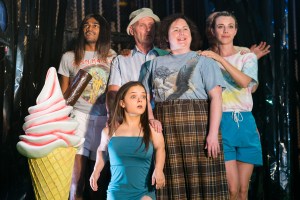
Our wonderful Summer has just got even sunnier. It’s time to forget about high art and think about guilty pleasures, time to take another trip back musically to an era of dancing queens and disco kings, time to take in the warm sea breezes and bask under the cloudless skies of the idyllic Greek islands, time for unashamed escapism.

The 2008 film version of the long-running stage show Mamma Mia!, which celebrates the songs of ABBA, broke UK box office records. More recently, The Greatest Showman, which transcended poor reviews, has been a huge hit, suggesting that the appetite of British cinema goers for film musicals has not diminished. With these facts in mind, the creators of this new film, which is part-sequel and part prequel, did not really need to work too hard to make it a hit, so the pleasant surprise is that they have done such a good job in making it as least as enjoyable as its predecessor. Largely, this is due to a screenplay by writer/director Ol Parker which bristles with witty lines and a clever storyline, developed by Parker with original writer Catherine Johnson and the master of romantic comedy, Richard Curtis.

Precise casting matches familiar character with their younger selves and makes the jumps backwards and forwards in time feel effortless. We join the story with Sophie (Amanda Seyfried) planning to re-launch the Hotel Bella Donna, with her mother Donna (Meryl Streep) now gone and her husband Sky (Dominic Cooper) planning to further his career in New York. As no one seems to have suggested DNA testing during the course of the last decade, she remains the girl with three fathers – Sam (Pierce Brosnan/Jeremy Irvine), Harry (Colin Firth/Hugh Skinner) and Bill (Stellan Skarsgård/Josh Dylan).

The film takes us back to when the young Donna (Lily James) receives her degree from her Vice Chancellor (Celia Imrie) and heads straight for Greece, stopping only to be bedded by three strangers en route and arriving pregnant. The word “slut” would not be suitable for a film like this, not even if spoken by Donna’s best friends Tanya (Christine Baranski/Jessica Keenan Wynn) and Rosie (Julie Walters/Alexa Davies), who give us two memorable comedy double acts for the price of one. Watch out for the Abba men Benny Andersson and Björn Ulvaeus doing a Hitchcock with non-speaking cameo appearances and Omid Djalili as a ticket seller (he makes it worthwhile hanging on until after the end credits).

If you always wanted to experience Will from BBC’s W1A (Skinner) singing Waterloo, this is the place to come. Brosnan exercises his vocal chords a little less than last time, managing only to whisper a single verse of, appropriately, SOS. Some of the songs reprise those in the last film, others are lesser-known Abba album tracks, but all are sung and choreographed with verve, some in Busby Berkeley style, including a bobbing armada of pleasure boats for Dancing Queen.

The big name addition is Cher, an Oscar winner who has done a bit of singing in her life. Resplendent in a platinum blonde wig, she is Ruby, Sophie’s long-lost grandmother, who steps down from her helicopter and dispenses the uplifting advice “being a grudge holder makes you fat”. Glancing sideways, she spots an old flame, the hotel manager who happens to be named Fernando (Andy Garcia). Cue a duet. If we take the lyrics of Fernando completely seriously, this pair fought side-by-side in a mid-19th Century North American war, but the sequence is so deliciously kitsch that taking anything seriously is the last thing on our minds.

Reviving a formula that pulls off the seemingly impossible trick of being both sincere and tongue-in-cheek throughout, Mamma Mia! Here We Go Again mixes an intoxicating cocktail of sun, sea, songs and super troopers. How can we resist it?

Screening date: 17 July 2018

This review was originally written for The Reviews Hub: http://www.thereviewshub.com

Alkaline (Park Theatre)

Posted: July 14, 2018 in Theatre

Writer: Stephanie Martin      Director: Sarah Meadows

⭐⭐

There are some parties where it is preferable to be a fly on the wall rather than an invited guest. Such is the case in Stephanie Martin’s new one-act play, in which Sophie throws a drinks party in an attempt to rekindle her fading friendship with Sarah. However, there is an elephant in the room in that Sarah is wearing a hijab. following her recent conversion to Islam.

Martin sets up an intriguing and potentially provocative scenario for examining modern inter-faith tensions. She sets it up and then does hardly anything with it, opting instead for a routine comedy of embarrassment. EJ Martin’s Sophie is highly-strung, bossy and has a  talent for finding a faux pas to fit every situation; she is the hostess from Hell, who could be modelling herself on Beverley in Mike Leigh’s Abigail’s Party. Her ineffectual fiancé Nick (Alan Mahon) snorts coke and cowers on the open staircase when he has performed what seems to be his sole duty – riling his partner – too well.

A beaming Sarah (Claire Cartwright) arrives with her new fiancé in tow, Ali (Nitin Kundra), a Geordie Moslem who is separated from his wife and three children. Ali swigs from beer bottles and indulges in locker room banter with Nick as Martin seems at pains to show that he is just an ordinary bloke notwithstanding his faith. However, there are more than a few hints of gender stereotyping in her grouping of angst-ridden women and laid back men.

Sarah explains her decision to convert in vague and dreamy terms, announcing that it makes her feel “alkaline”. Her reasons for wearing the hijab are even less clear, but we have to assume that it is not at the insistence of Ali, when his estranged wife Aleesha (Reena Lalbihari) appears, not similarly attired. Sophie finds reassurance from knowing that Christianity and Islam are both “Abramovich” religions (a malapropism that followers of Chelsea FC may appreciate). “You look nice in it (the hijab)” she whimpers sheepishly with a faint smile, following up with the useful information that M&S now stocks burkinis.

By using the lightweight character of Sophie to give voice to the prejudices and misconceptions that she seeks to highlight. the writer adds a comic touch to the play’s most serious moments. Ali’s long rebuttal of Sophie’s biggest gaffe is the most searching speech in her script, but its fire is also eventually doused by flippancy. Sadly, such focussed exchanges are rare and Martin, seemingly having run out of things to say on her core theme, allows the play to drift off at two tangents and become about relationship troubles and family break-up.

Director Sarah Meadows’ production brings out the brittle humour well, exploiting the claustrophobic feel of Georgia de Grey’s cramped orange and green set. After 75 minutes, the party fizzles out and the play with it. This little comedy is amiable enough, but it is entirely toothless and the opportunities which Martin gives herself to say something meaningful are mostly wasted.

Performance date: 13 July 2018

This review was originally written for The Reviews Hub: http://www.thereviewshub.com

Writer: Martin McDonagh      Director: Michael Grandage

⭐⭐⭐⭐⭐

Black comedy is becoming an endangered species, threatened by modern forces of political correctness and thin-skinned sensitivity. So thank Heavens for Martin McDonagh. Earlier this year, over-sensitivity to facile accusations of racism could have cost him Oscars for his brilliant film Three Billboards Outside Ebbing, Missouri, but the theatre seems to be a more understanding place for him and this revival of his early work is welcome indeed.

Set at the height of the Irish troubles, the play has none of the lyricism or heart of Jez Butterworth’s The Ferryman. Its sole focus is the sheer brutality that underpins terrorist activities and its triumph is to turn such subject matter into, probably, the most hilarious production seen in London since McDonagh’s Hangmen three years ago. The Lieutenant of Inishmore feels like a prototype for the writer’s film In Bruges, in which he satirised the warped codes of morality of the criminal underworld; here, he gives the same treatment to paramilitary groups, specifically a splinter of the IRA, but the general overtones are clear.

Padraic (a swaggering Aiden Turner) is a renegade terrorist, self-appointed lieutenant in his own splinter army, who thinks the IRA too soft, but admits that they make better bombs than him. We first meet him as he is torturing a drug pusher for supplying children, a carnal sin to him when blowing the same children into oblivion with a home-made bomb would be all in a day’s work. The catalyst for the wanton carnage that is to follow is the death of Padraic’s beloved 15-year-old cat, Wee Tom, who he had left in the care of his un-beloved father Donny (Denis Conway). Donny’s incompetent attempts, along with his gormless gay sidekick Davey (Chris Walley), to cover up the circumstances of the cat’s demise take up the first act and Padraic’s bloody revenge the second.

The success of a comedy such as this depends on pace, tone and performances and Michael Grandage’s production gets them all spot-on. Charlie Murphy is particularly striking as Davey’s 16-year-old sister, Mairead, who is even more threatening than her idol and role model, Padraic. The putative lovers share the dream of a free and united Ireland even if there is no one left to live in it. In the closing scenes, the stage takes on the look of an abattoir, human corpses just outnumbering feline ones, and then an audacious final, ironic twist sends us away purring in delight.

Performance date 11 July 2018

Creator: Jennifer Marsden      Director and choreographer: Racky Plews

Perhaps it is inevitable that Game of Thrones:The Musical, will hit our stages one day, but, in the meantime, we have to make do with this fusion of classic rock anthems and a tale of heroism, bloodletting and tepid romance, set in a medieval kingdom where knights brandish swords, shields and electric guitars.

The creator of Knights of the Rose, Jennifer Marsden, is, we are told, a barrister, so we have to take it as read that there is no specific law against putting a show like this in front of an audience. Whether or not there should be becomes more debatable as the evening progresses. The House of the Rose (no specified colour) rules over the land, headed by King Aethelstone (Adam Pearce, booming like a miniature Brian Blessed) with his mild-mannered Queen Matilda (Rebecca Bainbridge) at his side. Their son, Prince Gawain (Andy Moss) is absent waging war while their daughter, Princess Hannah (Katie Birtill) loiters at home doing silly things in the company of other maidens, all wearing low-cut dresses, with long, straight hair draped over their shoulders. No cliché is left unused.

The knights return home in glory, hang around taverns waving their tankards and talking bawdily, woo their women and return to war. In short, Marsden’s plot is Much Ado About Nothing without the comedy, crossed with Henry IV pt1 without the weight of history. Sub-Shakespearean verse, much of it ludicrous, goes into the mix. The dramatic temperature rises when Sir Hugo (Oliver Savile) and the shady Sir Palamon (Chris Cowley) compete for Hannah’s hand and the lowly, un-knighted John (Ruben Van keer) acts as a kind of chorus, linking the story together.

There is fun to be had in guessing which familiar lyric daft lines of dialogue are leading into. When the audience guesses correctly, hilarity ensues, but most of the laughs in the show seem to come when Marsden would have least wanted them. The music is loud, amplified just enough to drown out the noise from the overworked air conditioner in this shabby old auditorium. Rock hits such as Holding Out For a Hero, Blaze of Glory, Addicted to Love, Total Eclipse of the Heart, and so on, follow each other in quick succession, but it all becomes too much and, when the company renders REM’s Everybody Hurts, everybody agrees. A dash of Mozart near the end comes as a welcome relief.

Director/choreographer Racky Plews has a decent track record with musicals and she does what she can with the material to hand, using Diego Pitarch’s split-level set imaginatively. Her staging of the fight scenes is exciting, made more so by Tim Deiling’s dramatic lighting effects. The singing is also strong, with Cowley standing out. and Mark Crossland’s seven-piece band does all that could be asked of it. Yes, the show has plusses, but their worth feels diminished when they are placed in a context as inept as this.

This cacophonous calamity is at its best when it wanders into “so bad it’s good” territory, but, sadly, it does not stay there long enough and the show drags out to become a very long evening indeed. At least its creator can find some consolation in having a day job to go back to.

Performance date: 5 July 2018

Photo: Mark Dawson

This review was originally written for The Reviews Hub: http://www.thereviewshub.com