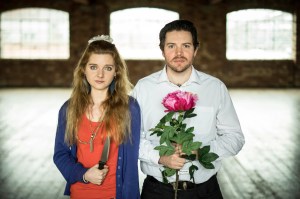
Writer: Felicity Huxley-Miners      Director: Richard Elson

⭐⭐⭐

Girl meets boy, girl Rugby-tackles boy and so begins an imperfect relationship. Felicity Huxley-Miners’ short (70 minutes), bitter-sweet new play introduces us to Ellie and Rob, a couple who we come to feel need a lot of things in life, but not each other.

The opening scenes feel like an old-fashioned screwball romcom in which, say, Goldie Hawn could have been Ellie and the writer, taking on the role herself, certainly plays it that way. However, we already know that Ellie’s dramatic first entrance had been to intervene when Rob was about to jump under a train, which leads us to expect that the play will take us to much darker places.

David Shears gets Rob, the ordinary Geordie bloke who has just lost his girlfriend to his best mate, precisely right, but the chemistry between him and Huxley-Miners’ Ellie always feels completely wrong. If this is a deliberate ploy to show a dysfunctional relationship, it is very clever acting indeed. Having rescued Rob, Ellie goes several stages further than a typical Samaritan and invites him to share her bed. “Too much too soon” we think and we are right.

The needy stare in Huxley-Miners’ eyes, her frail demeanour and the desperation in her gestures make it clear that Ellie is by far the more troubled of the two. Having lured Rob into her web, she uses all her guile to keep him there, but this central section of the play is its least convincing. Rob’s inability to walk out is irritating, as are Ellie’s semi-comic attempts to keep him. We are told that Rob is close to his mother, but not his father and that Ellie is estranged from both her parents, but deeper knowledge of their past emotional lives would have helped us to understand them better and to care more for them.

At a time when the mental health issues affecting young people, facing the intense pressures of modern life, are being brought into sharper focus, the play has much to say. Rob, coming out of a failed relationship and discontented with a job that he hates, struggles to see the point of carrying on. Ellie is told pointedly that she needs to like herself, but she persists with the misguided mission to make Rob, a man too wrapped up in his own problems, to like her instead.

Director Richard Elson’s production tunes in well to the shifting tones of the play. In the Shadow of the Mountain needs more depth and it needs more polish, but it makes a brave stab at probing the turbulence inside so many young minds today.

Performance date: 17 May 2018

This review was originally written for The Reviews Hub: http://www.thereviewshub.com

Director: Ellen McDougall

⭐⭐💫

News that Chinese television did not broadcast the 2018 Eurovision Song Contest, because the authorities there objected to two seemingly gay dancers and a few tattoos, reminds us that state censorship has never gone away completely and gives weight to this revue made up of songs banned in Germany by the Nazis.

The 85-minute show is a collaboration between the Gate Theatre and English National Opera, bringing together performers from diverse backgrounds. Baritone Peter Brathwaite and mezzo-soprano Katie Bray join forces with cabaret entertainers Lucy McCormick and Le Gateau Chocolat, a bearded, deep-voiced drag artist. It is a mix that sets a bizarre tone which sometimes suggests Gilbert and Sullivan being staged in a sleazy night club. The quartet is supported by three musicians – Geri Allen, Cassie Kinoshi and Fra Rustumji – and musical director Phil Cornwell.

Beginning with Lavender Song, the performers introduce themselves as “the buds that grow a little different”, dressing in exotic costumes to emphasise their point. The songs date from 1920 to 1939, sung in broadly chronological order. We are warned to expect nudity and lyrics of a sexual nature, but we get very little of either. The opening segments spring from the famously licentious Berlin of the pre-Third Reich era, yet most of the lyrics are innocent more than provocative. Bray and McCormick have to work hard to add lesbian touches to the flippant Best Girlfriends and it takes a long time for anything even mildly shocking to a modern British audience to come along.

Ellen McDougall’s uneven production is held together loosely by factual information and clowning, but some of the links feel amateurish and they drain the show of any energy that it has built up. As the audience gets showered in flowers and confetti and the stage becomes impossibly cluttered with props, we hear extracts from the Nazis’ encyclopaedia of banned songs and writers and we learn that entry therein could have been earned not only because of content deemed salacious or subversive, but through any connection whatsoever with black or Jewish people.

McCormick gives a star turn with Sex Appeal, a pastiche of Greta Garbo, but this marks the end of frivolity and things start to get better. Songs dealing with abortion and propaganda (should we call it fake news?) feature, before the performers take early (and lengthy) bows. The show’s real meat comes as an encore, when we hear expressions of outrage at racist persecution and the banning of inter-race marriages, sung with power and passion. It comes as a relief that, at last, the show has given us something to really savour.

Performance date: 14 May 2018

This review was originally written for The Reviews Hub: http://www.thereviewshub.com

Writer: Terence Rattigan      Director:Rachel Kavanaugh

⭐⭐⭐

Like British theatre’s equivalent of a hardy perennial, Terence Rattigan’s 1946 play The Winslow Boy is never long away from our stages. This sturdy touring revival shows again why the story of a 13-year-old boy who is accused falsely of stealing a five shilling postal order continues to intrigue us.

It is mark of the play, based on real events, that Rattigan accepts neither that the sum stolen is trivial nor that the boy’s upper middle class family’s quest for justice is insignificant. The moral certainty which, seemingly, belongs to a bygone age, feels like a safe haven from the confused turmoil of the modern day and this could explain the play’s enduring popularity. Rattigan’s supreme craftsmanship as a dramatist could also have something to do with it.

The problem for director Rachel Kavanaugh is how to stamp her own mark on such a beloved classic, when audience expectations are pretty well set in stone. Wisely she does not try too hard to be innovative and settles for a production that, we suspect, has the same look and feel as most others over the last 72 years. Michael Taylor’s turquoise-walled set of the Winslows’ Kensington home and his period costumes endorse this view, as does the venue – the ornate late-Victorian Richmond Theatre.

Aden Gillett gives a fine portrayal of English stoicism as Arthur Winslow, the father who defends Ronnie, the son who has been kicked out of Osborne Naval College for the alleged theft. In his defiance, he takes on the Admiralty, not only risking bankruptcy and jeopardising his own health, but also requiring his older son Dickie (Theo Bamber) to sacrifice his studies at Oxford and making it necessary for his daughter Catherine to break off her engagement. Timothy Watson as Sir Robert Morton, the eminent and expensive barrister hired to represent Ronnie is exactly as haughty and aggressive in interrogating his client as he needs to be to carry off the great coup de théâtre which ends Act I.

Rattigan observes the patriarchal society of the period immediately preceding the First World War with wry humour and dwells on the rise of feminism. Ronnie’s mother Grace (Tessa Peake-Jones) is a dutiful wife to Arthur who has little say on how things develop. However Dorothea Myer-Bennett’s zestful and clear-minded Catherine, a member of the burgeoning Suffragette movement, is laying down a different path for herself and her generation. It could be seen as progressive that the journalist who arrives to interview the family is female, but she shows more interest in the sitting room curtains than in the court case. Wittily, Rattigan could be foreseeing that the journey towards gender equality would not be without its setbacks.

The real life Archer-Shee case on which the play is based was a cause célèbre in its day and set a lasting precedent in British law. The Winslows stir up the sort of media frenzy that, nowadays, would be reserved for the antics of a reality TV star and we ask whether this could really happen just for the sake if 25p. However, it is not about cash, it is about honour and Rattigan’s eloquent explanation of the place of honour in our nations’s psyche makes his play worth revisiting, if not too often, then from time to time.

Performance date: 8 May 2018

This review was originally written for The Reviews Hub: http://www.thereviewshub.com
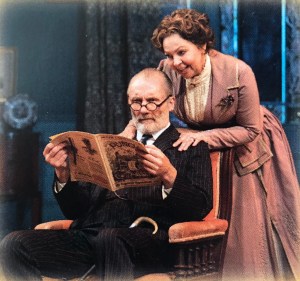
Writer: Oscar Wilde      Director: Jonathan Church

⭐⭐⭐⭐

Glancing at the names of the main characters in Oscar Wilde’s An Ideal Husband, all bar one of them titled, a natural reaction is to ask how on Earth can the problems of this cross section of the Victorian aristocracy be relevant to modern life? It is only when their problems turn out to relate to raging hypocrisy, corruption in high places and “historical” misdemeanours that we realise that not too much has really changed.

This revival of the 1895 play is presented as part of Dominic Dromgoole’s year-long Wilde season at the Vaudeville Theatre. The too virtuous to be true Lady Chiltern (Sally Bretton) thinks that she has found the ideal husband and the nation thinks that it has found the ideal politician in him. However, the seemingly upright and incorruptible Sir Robert Chiltern (Nathaniel Parker) has a dark secret in his past which comes back to haunt him and threatens to bring him down. The play asks whether he can be forgiven and allowed to carry on with his private and public lives. 

Wilde could be warning us that, if we demand standards of our politicians that we cannot live up to ourselves, we get the leaders that we deserve. Parallels between Sir Robert’s plight and the writer’s own precarious position in the 1890s are clear to be seen, but director Jonathan Church’s production allows the play’s serious themes only to give depth to its comedy and never to dampen it.

In his earlier play, Lady Windermere’s Fan, Wilde gives a nod to feminist causes by introducing as the catalyst for the action Mrs Erlynne, a fiercely independent woman who is prepared to be ruthless in order to succeed in a male-dominated world. Here, Mrs Cheveley, a blackmailer and a thief, has similar traits, although she is much more vicious. Frances Barber makes her deliciously venomous, in one scene appearing resplendent in all scarlet against the pastel shades of the set.

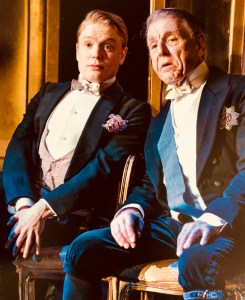
In this form, Barber is not easy to eclipse, but Freddie Fox does just that with a superb comic performance as the nonchalant and amoral Viscount Goring, friend and confidante of both Chilterns and “the idlest man in London”. Promiscuous and vain (“to love oneself is the beginning of a lifetime romance”), Goring gets the lion’s share of the play’s Wildean witticisms and Fox cashes them in for the lion’s share of the laughs. His disapproving father, the Earl of Caversham, is played in typically pompous style by Edward Fox; yes, father and son play father and son, a touch which adds considerably to the humour of a dad’s constant put-downs of his errant offspring.

Susan Hampshire as the sharp-tongued Lady Markby and Faith Omole as Sir Robert’s sister Mabel, a possible match for Goring, are both splendid. Simon Higlett’s elegant sets and lavish costumes help to give the production a solid and conventional feel, although there are times in the first two acts when Church could have livened things up by taking risks and thinking more outside the box. That said, there are no such reservations about a hilarious third act, which has hints of Feydeau, when Wilde’s writing, Barber and the two Foxes join forces to terrific effect.

When the laughter in this delightful revival dies down, Wilde’s pleas for forgiveness of past indiscretions linger in the mind, tinged with the sad irony that the playwright’s own fall from grace was to begin with his arrest on indecency charges even before this play had completed its initial run at the Theatre Royal, Haymarket.

Performance date: 3 May 2018

This review was originally written for The Reviews Hub: http://www.thereviewshub.com
Chess (London Coliseum)

Posted: May 2, 2018 in Theatre

Music: Benny Andersson and Björn Ulvaeus      Lyrics: Tim Rice       Director: Laurence Connor

⭐⭐⭐⭐💫

This new “semi”-staged production of Chess, a musical that can be seen as a metaphor for the Cold War, is a great deal more welcome than the 2018 revival of the Cold War itself. 

The show was developed as a concept album and it then toured in concert form before premiering as a fully staged musical at the Prince Edward Theatre in 1986. By this time, composers Benny Andersson and Björn Ulvaeus had already turned Europop into an art form with Abba and lyricist Tim Rice had established himself as a grand master of musical theatre. Their collaboration produced a collection of songs with enduring appeal, but the show has not been seen in the West End since the end of its initial three-year run.

Inspired by real events, the story tells of the battle for the World Chess crown between challenger, Russian nice guy Anatoly (Michael Ball) and reigning champion, American nasty guy Freddie (Tim Howar). With both the USSR and the USA regarding success at sports and games as symbols of national virility, the stakes are high. When Freddie’s aide, the Hungarian girl Florence (Cassidy Janson) defects to start an affair with Anatoly, the Russian defects to the West, leaving behind a wife, Svetlana (Alexandra Burke) and son.

It is becoming a tradition for popular musicals to be staged at the home of English National Opera every Spring and producers appear to have learned from past mistakes. There is no room here for great singers who can’t act, only for seasoned musical theatre performers. Cedric Neal as the match Arbiter and Phillip Browne as Anatoly’s second both impact strongly and Howar’s thunderous rock style contrasts beautifully with the soulful tones of Janson and Burke, who take complete ownership of the famous duet I Know Him So Well. 

Ball’s big moment comes with the now stateless Anatoly’s passionate Anthem. He steps to the front of stage and delivers the song with the confidence and power of a man who has sung it hundreds of times before, as indeed he has. It is a showstopper that can only be followed by the interval.

Stylistically, the music at the beginning of the show is all over the place. A Wagnerian overture is followed in quick succession by echoes of a Lehár operetta, Bon Jovi and a Sousa march. However, midway through the first act, Andersson and Ulvaeus begin to stamp a brand that is distinctively their own, with the result that uncertainty is left behind and the show moves from strength to strength. Rice’s sharp and intelligent lyrics tell the story and enrich the music, but there are also strong instrumental sections, played magnificently by the 60-piece orchestra, conducted by John Rigby.

The description “semi-staged” is made more or less redundant by Laurence Connor’s spectacular production, which makes all the right moves. The orchestra is on stage, but often obscured in Matt Kinley’s set design which begins with squares outlined in white across the entire pitch black stage. Projected images then show performers in close-up, flash up news footage to establish the story’s historical context and create colourful effects, such as engulfing the stage in flames for One Night in Bangkok. Slick dance routines, choreographed by Stephen Mear, contribute further towards making the show as thrilling for the eye as the ENO orchestra/choir and wonderful solo singing make it for the ear.

Quoting Rice’s lyric, “Nothing is so good it lasts eternally…”, but there are times during this production when we wish that it could be otherwise. Andersson and Ulvaeus may have found bigger commercial success from recycling old Abba hits for Mamma Mia!, but, on the evidence seen here, Chess must surely stand as by far their greatest achievement.

Performance date: 1 May 2018

This review was originally written for The Reviews Hub: http://www.thereviewshub.com

Music and lyrics: Sting       Director and book writer: Lorne Campbell

⭐⭐⭐⭐

Who would ever think of launching a show about Geordie shipyard redundancies in New York? Maybe the producers of this new musical believed that the name of Sting as composer/lyricist (and briefly performer) would be enough to guarantee ticket sales. It wasn’t. As a result, this large and very British vessel is tarnished with the label “Broadway flop”, but it is not holed below the water line and the job now is to get it back afloat with the help of glowing reviews and strong word of mouth, ready to sail (hopefully) into the West End. The re-floating process has started well with a sold-out run in its spiritual home, Newcastle, followed by this national tour.

The show is seen here directed by Lorne Campbell, who has also written a new book, based on the original by John Logan and Brian Yorkey. The story has two strands – the closure of the Newlands shipyard on Tyneside, leading to a token act of defiance by its workers, and a love story between Gideon, returning home after 15 years seeking greener pastures, and Meg, the girl left behind carrying their daughter. The love story always feels like an add-on and Campbell does not knit the two stands together completely, but Richard Fleeshman and Frances McNamee play and sing the roles so beautifully that all resistance is swept away.

The main narrative thread tells of a proud community being threatened with obliteration in the tsunami of de-industrialisation that swept across the United Kingdom from the 1980s onwards. Jackie (Joe McGann) and his supportive wife Peggy (Charlie Hardwick) lead the opposition to the yard’s closure. The Government’s case is stated by Baroness Tynedale, who, in a crass misjudgement by Campbell, is played by Penelope Woodman doing a crude Margaret Thatcher impersonation. This is reminiscent of Richard Bean’s abysmal satire of the Wilson Government in Made in Dagenham, a flop musical with many similarities, although The Last Ship is vastly superior to that show in almost every respect. This show would be improved if Campbell were to adhere fully to the principle of telling the human stories and allowing audiences to work out the politics for themselves and Sting, of all people, should know that Socialist drum-beating by multi-millionaire entertainers inevitably becomes tainted by suggestions of hypocrisy.

As director, Campbell needs to do more to enliven several leaden spoken scenes which threaten to sink his ship; as things are, this production demonstrates exactly why so many modern musicals tend to be sung (or rapped) through. So yes, the show still needs more work, but that cannot detract from the songs which are truly glorious, better musically and lyrically than in any new British musical that I can remember. The score is distinctively Sting/Police, but influences ranging from traditional folk to Rodgers and Hammerstein can be detected in passionate anthems and gentle love songs. The singing here, in solos, duets and choruses does full justice to the songs, which often become emotionally overwhelming. As Ellen, the wilful daughter of Gideon and Meg, Katie Moore is just beguiling, but she is only one of a faultless company.

The staging is on a grand scale, with the whole show being performed in front of the shipyard’s high scaffolding. I wish The Last Ship Bon Voyage and hope to see it cruising to the success that it richly deserves.

Performance date: 18 April 2018

Writer: Thomas Eccleshare      Director: Hamish Pirie

⭐⭐⭐⭐

What we want for our children is rarely what they want for themselves, but would it result in what we really want either? Thomas Eccleshare poses the question in this new absurdist satire that scythes through the jungle of modern parenting and gives a glimpse into what genetic engineering could be holding in store for the future.

Max and Harry are not happy with their errant teenage son Nick, so they decide to replace him with a new model who will conform to their idea of perfection, becoming something like a clone of themselves. They acquire their new “son” in much the same way as they would buy a bed from a Swedish furniture store, getting the pieces in a flat pack and assembling them at home. The result is Jân. If his behaviour ever falls short of desired standards, he comes with a remote control which has a rewind button so that he can be made to try again until he gets it right. As a last resort, there is a money back guarantee.

The first quarter of Hamish Pirie’s surreal production is performed inside a small rectangle, surrounded by darkness, halfway back on the stage. This gives a curious effect, like watching a television monitor in an IMAX cinema, but Cai Dyfan’s set opens out to coincide with the point when the play itself begins to take a hold. Eventually, a mass of foliage appears at the very back and, together with a line of sunflowers which separates the audience from the actors, the suggestion is that the characters whom we are watching are in sight of nature but not responding to it in their actions.

Jane Horrocks is terrific as the bemused, caring/non-caring Max and, occasionally, when she slips into her “Bubbles” mode, she lends the play a delicious flavour of AbFab meets Frankenstein. Mark Bonnar also hits the nail on the head as the DIY-obsessed Harry and Brian Vernel, casually rebellious as Nick and straight-faced but never robotic as Jân, is the source of the production’s biggest laughs.

Eccleshare takes us into the world of urban middle classes and tears it to pieces. Here, families jog together, eat whole foods together and aspire for their offspring to become human rights lawyers. Parents parade their children’s academic prowess like prize trophies, as with Laurie and Paul (Michele Austin and Jason Barnett) and their Oxford-bound daughter Amy (Shaniqua Okwok). The hypocrisy of these lifestyles is exposed to the full in two hilarious dinner parties when Jân’s gaffes puncture the illusions of accord and harmony completely.

The sterility of the satire diminishes the impact of the pathos that creeps in late on in the 100-minute play. However, after an uncertain start, in warning us to be careful what we wish for and in stirring up howls of laughter, it all holds together perfectly.

Performance date: 14 April 2018

This review was originally written for The reviews Hub: http://www.thereviewshub.com

Palmyra (Battersea Arts Centre)

Posted: April 13, 2018 in Theatre

Creators and performers: Bertrand Lesca and Nasi Voutsas

⭐⭐⭐⭐

It is good news that Palmyra, one of the big hits of the 2017 Edinburgh Fringe Festival, is seeking out a wider UK audience. The bad news is that the conflict in Syria to which it relates continues to rage no less fiercely.

Palmyra, an ancient Syrian city, was home to monuments of incomparable beauty and historical interest. No more. The theme of this show, created and performed by Bertrand Lesca and Nasi Voutsas, is destruction. The pair revive their comic personas of Bert and Nasi, first seen in Eurohouse, still amusing us with their brand of absurdist physical comedy, but the mood is much darker and childlike squabbling is displaced by raw aggression.

A white plate is broken. Nasi is aghast and Bert taunts him, dropping another plate from high on a step ladder. Nasi explodes with rage, running amok with a hammer, more plates are broken and the value of all plates is diminished to zero. The visual metaphor is obvious, its presentation is visceral, darkly funny and deeply shocking.

The title of the 55-minute show is the only direct reference made to Syria and no explanations are offered for the violence and destruction seen on stage. Pointlessness is the point of the show, or, at least, one of its points. Lesca and Voutsas do not concern themselves with politics nor, specifically, with human carnage; rather, they focus on the irreversible damage to the human spirit that comes from the obliteration of history, culture and beauty. Through comedy, they also dig down to the roots of anger, hatred and revenge and ask us to find our own explanations for things that we might readily pass off as inexplicable.

Palmyra has already picked up several Fringe Theatre awards, well merited for its inventiveness and unnerving power. It leaves its audiences feeling as shattered as the fragmented crockery that remains lying on the floor when the performers take their bows..

Performance date: 12 April 2018

This review was originally written for The Reviews Hub: http://www.thereviewshub.com

Eurohouse (Battersea Arts Centre)

Posted: April 13, 2018 in Theatre

Creators and performers: Bertrand Lesca and Nasi Voutsas

⭐⭐⭐⭐

In the almost two years since Britain’s European Union referendum, the pro-Brexit case has felt off-message in theatre. Seemingly theatre makers and theatregoers have joined hands in expressing horror at the outcome and there is initial surprise at finding a fluffy piece of light entertainment that bucks the trend.

Bertrand Lesca and Nasi Voutsas first presented Eurohouse at the 2016 Edinburgh Fringe Festival and they are reviving it here for a single performance as part of a double bill with their current show Palmyra. It is a lament for a dying nation, a Greek tragicomedy appearing in the disguise of an hour-long Music Hall comedy double act routine. “Bert and Nasi” could be Laurel and Hardy or Morecambe and Wise – Bert the tall dark one (without glasses) and Nasi the short, skinny bearded one. Both are instinctive comics.

We watch Bert and Nasi, skipping in circles, dad dancing, sharing a pack of M&Ms, performing very basic acrobatics, and soliciting applause with beaming smiles on their faces. The physical comedy is often sublimely funny and there is no hint of any political subtext until more than halfway through. They dance and singalong to My Way (in French), but Nasi tires of the song and asks for it to be changed to Fleetwood Mac’s Go Your Own Way. Now the rift appears and their joint dreams of everyone wearing white, standing hand-in-hand around a placid blue lake begin to evaporate.

By the time that Bert demands the return of his M&Ms even after Nasi has eaten them, the dream has already become a nightmare and the show’s metaphor has become clear. Statistics seen on a screen as an epilogue spell it out; this is the story of a proud country being bled to death for the profit of German and French banks. Why would anyone choose to depart from a union that leads to this?

Performance date: 12 April 2018

This review was originally written for The Reviews Hub: http://www.thereviewshub.com
Chicago (Phoenix Theatre)

Posted: April 12, 2018 in Travel

Book: Bob Fosse and Fred Ebb      Music: John Kander      Lyrics: Fred Ebb      Director: Walter Robbie

⭐⭐⭐💫

You can’t keep a good show down! Chicago, with music and lyrics by John Kander and Fred Ebb, was a moderate success in New York and London in the late 1970s, but it is the 1996 revival, directed by Walter Robbie, that defines it. That production has run continuously on Broadway for over 20 years and it also ran in the West End, in three theatres, from 1997 until it seemed to have run out of steam in 2012. Now Robbie’s production rises again, appropriately at the Phoenix Theatre and the air is once more filled with toe-tapping tunes and raging amorality.

This is a prime example of a Kander and Ebb trademark, that of framing a musical with a specific entertainment style. They gave us a Berlin nightclub for Cabaret, a minstrel show for The Scottsboro Boys and, in this case, we find ourselves landed in Vaudeville at the height of the Jazz Age. One of the explanations for the show’s longevity could be the simplicity of it’s staging – a single set, with orchestra in the middle, serves all needs – and another could be the ease with which star names can be slotted into any of the leading roles to reinvigorate it repeatedly. Yes, Chicago, is a show that can sometimes fall victim to flawed stunt casting.

The biggest name blazoned across the posters here is that of Oscar winner Cuba Gooding Jr, a larger-than-life personality who turns out to be unexpectedly subdued as the dodgy lawyer Billy Flynn. A singing voice with a limited range does not necessarily spell disaster for an actor in a musical, but the Hollywood star’s two big numbers, All I Care About and Razzle Dazzle make little impression and, overall, we really want him to harness the natural ebullience for which he is famed a lot more and burst out of his role.

Elsewhere, the show is still razzle dazzling in most of the right places, with too many great songs packed in to leave room for any boring bits. Sarah Soetaert’s bubbly peroxide blonde Roxie Hart and Josefina Gabrielle’s sultry brunette Velma Kelly are spot-on. Both murderers awaiting trial, they quickly realise that, when the justice system and showbiz go head-to-head, showbiz will win and they scheme to use their notoriety to advance their careers on stage. Incredibly, the book by Bob Fosse and Fred Ebb is based on real-life events in 1920s Chicago.

Ruthie Henshall has played both Roxie and Velma in the West End and she now completes a personal hat trick by taking on the role of the prison matron Mama Morton, lending her strong presence to the lady that can fix anything, at a price. Paul Rider gives comic pathos to “Mr Cellophane”, Roxie’s cuckolded husband Amos and AD Richardson threatens to shatter glass as the goody-goody Mary Sunshine.

Stacey Haynes is the Resident Director, charged with bringing back to life Robbie’s production and Ann Reinking’s choreography (in the style of Fosse). Combining Kander’s musical mastery and Ebb’s witty, cynical lyrics with glitzy glamour and high-kicking dancing, Chicago remains hard to resist, however often it reappears on stage or screen and it looks set for another successful run here.

Performance date: 11 April 2018

This review was originally written for The Reviews Hub: http://www.thereviewshub.com