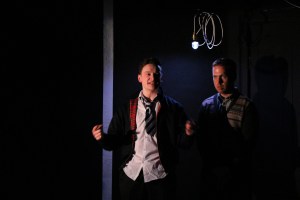
Plastic (Old Red Lion Theatre)

Posted: April 8, 2018 in Theatre

Writer: Kenneth Emson      Director: Josh Roche

⭐⭐⭐⭐⭐

With news stories again dominated by sickening violence on London’s streets, the arrival in the city of Essex playwright Kenneth Emson’s Plastic is about as timely as it could get. The 70-minute verse play, a dark thriller first seen at the 2015 Latitude Festival, gives a devastating account of how peer pressure tears into the lives of young people and wrecks them.

Kev (played by Mark Weinman with cocky assurance touched by vulnerability), once captain of the school football team, has experienced a rapid fall from hero to zero. His post-school life has been one of menial work and queues at the Job Centre, but now he waits at the school gates for Lisa, who has signalled that she will surrender her virginity to him on that evening. Madison Clare is remarkably strong as the girl torn between old loyalties and the lure of the in-crowd that hangs around her school’s football team.

In stark terms, Emson’s play shows how the inevitable by-product of an in-crowd is an out crowd. Ben, played by Thomas Coombes as if he is a pressure cooker filled with boiling anger, is an outsider, not one of the popular people, not a member of the football team. Even a friendly voice taunts him with “what are you, gay or something?” when he declines to go with the flow and he looks increasingly disturbed as he repeatedly murmurs a list of American school massacres and takes bloody revenge on a dead creature in his Biology class.

Emson fills the play with images of the futility felt in working class communities where young lives can be seen to be as readily disposable as single-use plastic. Where is the escape for these characters? Jack, seems the most grounded of the four, but, helped largely by the thoughtful performance of Louis Greatorex, he becomes the most interesting. He forsakes the popular people to befriend the isolated Ben, taking the taunts of “faggot” himself and jeopardising his friendship (and possible romance) with Lisa. It takes time for us to realise how much the divisions within the school are taking their toll on Jack.

Josh Roche’s taut production grips like a vice. We feel from the beginning that the ingredients are in place for something dreadful to happen, but it is not knowing exactly what that gives the play its unrelenting air of suspense. Sophie Thomas’ all black set is decorated only by hanging multi-coloured light bulbs and Peter Small’s carefully judged lighting design heightens the tension. 

When the denouement arrives, it is as unexpected as it is shocking. Plastic is a short play, but not a small one. It is topical, universally relevant and it hits home with the force of a sledgehammer.

Photo: Matthew Foster

This review was originally written for The Reviews Hub: http://www.thereviewshub.com

Performance date: 6 April 2018

Writer: Rolf Hochhuth      Adaptor: Peter Thiers      Translator: Peter Sutton,      Director: Anthony Shrubsall

⭐⭐

On 2 July 1961, the bell tolled for Ernest Hemingway, literary icon of the mid 20th Century. His tempestuous life had encompassed four marriages, the lively bars of Havana and the deadly battlegrounds of three wars in Europe, but, in the early hours of that day in his Ketchum, Idaho home, he picked up his favourite hunting rifle and shot himself through the head.

German playwright Rolf Hochhuth has imagined the final hour of Hemingway’s life for this monologue, performed in real time and here receiving its English language premiere. In Holly Maples’ set design, the thickly carpeted study of the journalist and novelist has a small desk at one end a telephone table at the other, flanked on either side by the audience. The 61-years-old Hemingway that enters is ravaged by prolonged mental illness – he is paranoid, delusional and severely depressed – compounded by electric shock treatment that would be considered barbaric in the modern age. His memory, “a writer’s only asset”, is gone.

The chief problem with Hochhuth’s play is that it conflicts with itself. We are informed that its only character suffers from memory loss and an inability to express himself, but we then hear from him recollections from the past that are clear and articulate. If the playwright’s aim is to contrast the dying Hemingway with the man in his prime, we need two points of focus and it seems very curious that Hochhuth has chosen to write the play as a monologue.

As Hemingway resolves to write a suicide letter to his sons, actor Edmund Dehn’s fingers hover trembling over a typewriter, incapable of touching the keys. This is the one moment in Anthony Shrubsall’s production when Hemingway’s debilitated condition is evident. Otherwise, Dehn strides around assertively, confronting members of the audience individually. He resembles a caged bull, or, more pertinently, Hemingway at the peak of his powers. When, we hear, in graphic detail, of a deer that the author had shot, staring into his eyes as he fumbles to put it out of its misery, we think that the anecdote could be alluding to Hemingway’s own dying condition, but we see or hear nothing to endorse such a metaphor.

Hochhuth writes of the nobility of nature and the savagery of mankind in terms that are true to Hemingway, but, for the rest, the play does little more than recap widely known facts, without adding fresh insights into a man who continues to fascinate us. Most disappointing of all is that a play that chronicles the sad demise of a cultural giant simply fails to be moving.

Performance date: 2 April 2018

This review was originally written for The Reviews Hub: http://www.thereviewshub.com

Love Me Now (Tristan Bates Theatre)

Posted: March 30, 2018 in Theatre


Writer: Michelle Barnette      Director: Jamie Armitage

⭐⭐⭐💫

When the woman at the centre of Michelle Barnette’s play asks her new casual sex partner what their relationship can be, he replies: “it can be anything you want it to be”. She (known simply as “B”), the modern, liberated woman, is in control, but using what freedom that she has been given to gain what she really wants is not as simple as it may have seemed.

“Now” is the key word in the title of this excoriating new comedy, which rips apart 21st Century courting rituals and asks what, if anything, have women truly gained? As B, Helena Wilson resembles a learner driver stuck behind the wheel of a fast-moving juggernaut; she is assertive, but dithering and confused. She conforms to contemporary stereotypes, having a successful career, treating sex as a recreational activity and practicing yoga just for the sake of photographs on Instagram. Her nemesis comes in the form of a man known as “A”.

In naming (or, rather, not naming) her primary characters, perhaps Barnette is telling us that A still comes before B. Alistair Toovey’s A exudes boyish masculinity, boasting that B is just one of six current sex partners. The new order gives him a rather good deal of no-strings sex on tap until he is ready to find himself a homemaker. His misogyny is implied more than stated, but it is made clear that his brute force could always overpower a woman such as B.

When B starts to wonder how she rates alongside A’s next Tinder date, sparks start to fly. She talks of “reclaiming” her virginity and reflects that what she wants most of all is someone to cuddle up next to in bed at night. Perhaps, we think, the prim and proper Victorians had got it right after all.

The 75 minute one-act play is at its strongest in its middle section, when A and B, confined together because of a jammed door, tear into each other in a fierce battle of the sexes. Here Jamie Armitage’s production crackles, driven by short, sharp lines of dialogue which are delivered with precision by the two actors. However, the play falters with the introduction of C (Gianbruno Spena), a humourless nerd, who smothers B with false flattery and then dumps her on voicemail. Barnette’s ploy to show an alternative to A is too obvious and serves no real purpose.

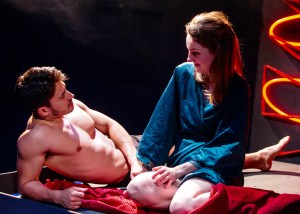
Fin Redshaw’s set design, a double bed surrounded by pitch black and fluorescent tubing, resembles the boudoir of a Soho madam, perhaps too strong if meant to be a reflection of B’s lifestyle. There are occasions when the play feels as if it is going round in circles, a problem compounded by a closing scene in which snippets from earlier scenes are re-enacted. In not finding destinations for her characters, the writer is consistent with her themes, but, in terms of drama, we feel disappointed. Nonetheless, Love Me Now offers a perceptive and incisive look at modern relationships.

Performance date: 29 March 2018

Photo: Helen Murray

This review was originally written for The reviews Hun: http://www.thereviewshub.com

Writer: José Rivera and Allan Baker (from Manuel Puig’s novel)      Director: Laurie Sansom

⭐⭐💫

Already an Oscar winning film and a Broadway musical, it would have seemed that nothing could go wrong with adapting Manuel Puig’s 1976 novel into a stage play. Unfortunately not so. It all starts really well, with Jon Bausor, like many designers at the Menier before him, having created not merely a set but a transformation of the entire space. We enter an ugly, unwelcoming underground Argentinian dungeon and two prisoners are already prowling around their cell as we prepare to share in an immersive experience. The prisoners are Molina (Samuel Barnett), a camp homosexual who is there for acts of “gross indecency” and Valentin (Declan Bennett), an opponent of the ruling military junta.

Even if we are unfamiliar with other versions, we can guess at the outset that this is going to be a story of extreme opposites converging and indeed it is, but only in the second half of the play. Before that, Molina attempts to alleviate Valentin’s boredom by recounting the stories of Hollywood fantasy films to him. In the Kander and Ebb musical, these stories could be turned into lively and lavish production routines, but, here, all we get is shadowy projections onto the side walls and the whole thing becomes very turgid very quickly and then drags on for at least another half an hour. Valentin’s boredom is no longer the problem, it is ours. The play turns at about half way when we see a prison guard (Grace Cookey-Gam) embroiling Molina in an implausible plot to extract information from Valentin, but it is too late to fully repair the damage.

The great pity is that History Boys alumnus Barnett is wonderful as the resilient, but vulnerable Molina, not overdoing the campness at any point. Bennett too impresses as the noble freedom fighter Valentin and the closing scenes, when the bond between the two characters has been sealed, are genuinely moving. After three successive productions at the Menier that have been, at very least, disappointing, it had been hoped that this would have been the one to get the tiny venue that has always punched above its weight back on the right track, but we shall have to wait a little longer for that to happen.

Performance date: 22March 2018

Writer: Francis Turnly      Director: Indhu Rubasingham

🌟🌟🌟🌟

It is ironic that the latest in a long line of successes for the Dorfman Theatre should be unveiled in a week when the National Theatre’s Artistic Director Rufus Norris has been under increasing pressure over the use of his largest space, the Olivier. Let’s face it, four turkeys out of five new productions is not going to impress anyone, but it is hardly the fault of the Olivier that the wrong shows are being put into it. Perhaps part of the problem is that the current crop of playwrights, many of them just brilliant, are writing for intimate spaces like the Almeida, Royal Court, Hampstead and, yes, the Dorfman. Last year, Michael Billington in The Guardian criticised Norris for neglecting the classics and (ignoring the fact that Macbeth is a classic) perhaps he should take heed when programming for the Olivier in future rather than looking for new work that is either not good enough or does not suit the space.

The Great Wave could have been performed on a grander scale in the Olivier, but its essence would have been lost. Francis Turnly’s play, getting its world premiere, is a rare example of theatre being used as a medium for story-telling. The previous play in the Dorfman, John, was all about characters and underlying themes, but this is the exact opposite; the characters are not explored in depth, some are even stereotypes and there is no discernible sub-text, but these things hardly matter, because we are being told a fascinating little-known story based on fact, presented in chronological order with the precision and clarity of a film documentary.

The story begins in 1979 in coastal Japan. 17-year-old Hanako (Kirsty Rider) lives an ordinary (and very American-looking) quiet life with her mother and year-older sister. One night, after a row with said sister, she is walking along the beach and she disappears. We next see her in a North Korean prison, being forced to show allegiance to that country’s “dear leader” and preparing to become involved in an espionage plot. Back in Japan, her family begins to suspect that she may not have been swept away by a great wave as first thought and they join forces with other families who have lost members in similar circumstances to try to persuade the erstwhile indifferent Japanese government to take action. This play needs to be viewed as a suspense thriller, so plot revelations must end there.

In the the climate of 2018, there is little that we do not know about the authoritarianism of North Korea’s Kim dynasty and the extent of citizens’ brainwashing shown here is shocking but hardly surprising. However, the play’s most chilling moment comes when Hanako admits complete ignorance of Japanese atrocities in World War II, making us realise how brainwashing can also occur in supposed democracies. Indhu Rubasingham’s fluid production is helped along greatly by Tom Piper’s ingenious, three-sided revolving set, which ensures that not a second of the play’s 150 minutes is wasted (apart from the interval). If you want theatre that offers impeccable acting and a profound examination of the human condition, then it is a shame if you missed John. This is another kind of theatre and it is just as thrilling.

Performance date: 20 March 2018

Vincent River (Park Theatre)

Posted: March 24, 2018 in Theatre

Writer: Philip Ridley      Director: Robert Chevara

⭐⭐⭐⭐

Vincent River, Philip Ridley’s account of the devastating repercussions from a homophobic hate killing, was first performed at Hampstead Theatre in 2001. In the intervening years, society has changed (albeit not yet enough) and some of the specific details in the 80-minute one-act play feel dated, but, more generally, the persistence of sickening, senseless inner city violence means that this revival still resonates strongly in 2018.

Anita is being forced to move out of her home because of neighbours’ taunts about the sexuality of her son Vincent, murdered by a gang of thugs 18 weeks earlier. Her new flat, as seen in Nicolai Hart Hansen’s set design, still has bare walls, a sofa covered by a sheet and several cardboard boxes, from which only a bottle of gin has been unpacked. Louise Jameson makes her a proud and defiant figure whose tears of grief must be suppressed. This is a woman for whom attack is always the first line of self-defence, a product of the old working class East End of London, from a breed that is now becoming a rarity in Shoreditch, the area in which she and her son had lived.

Over the weeks since the murder, Anita has felt the presence of a young stalker and now she invites him into her new flat to confront him. He is 17-year-old Davey, who enters wearing a hoody claiming that he was present when the body was discovered. He explains that the only way in which he can erase images of Vincent from his head is to make him a real person again by learning everything about him from his mother. By making Davey’s pretext so implausible, Ridley signals too early where the play is really going, but his skilful writing makes the journey to get there consistently gripping.

At first, Thomas Mahy looks uncomfortable as the Cockney Jack-the-lad Davey, but, as more is revealed, he grows into the character and climaxes with a performance of commanding visceral intensity. Fuelled by a cocktail of gin, strong pain killers and marijuana, the inhibitions of both Anita and Davey melt away and they bare their souls in a combative, cathartic process that is often painful to watch.

When everything comes together in Robert Chevara’s taut production, it is scorching. If there are occasions when the high drama feels slightly over-cooked, they are countered by unexpected moments of high comedy and the balance works to good effect. It all leaves us wishing for a kinder, gentler world and regretting that, 17 years after the play was written, we still seem no closer to finding it.

Performance date: 23 March 2018

This review was originally written for The Reviews Hub: http://www.thereviewshub.com

Old Fools (Southwark Playhouse)

Posted: March 22, 2018 in Theatre

Writer: Tristan Bernays      Director: Sharon Burrell

⭐⭐⭐⭐

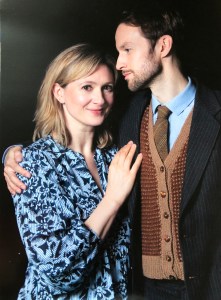
“Some day, when I’m awfully low, when the world is cold, I will feel a glow just thinking of you….” Tom and Viv dance to The Way You Look tonight during their tentative courtship and the song recurs during their lifelong relationship, through their ups and downs, parenthood and the parting in mind, if not in body. Writer Tristan Bernays has admitted that this play is filled with the “mythology” of his own family and it feels that way, deeply personal and affectionate.

Running for only an hour, the play, hardly that at all, is a random dip, in jumbled order, into memories, spanning two lifetimes, through until the time when the memories begin to blur and fade. It does not give us a detailed examination of the effects of Alzheimer’s Disease, it merely reflects on what that dreadful disease takes away. Sharon Burrell’s gentle in-the-round production makes the memories sharp; beautifully tender performances by Mark Arends and Frances Grey give them poignancy. An hour spent swimming through the Bernays family heritage is an hour well spent.

Performance date: 20 March 2018

Writer: Leo Butler      Director: Law Ballard

⭐⭐⭐⭐

“It’s bigger than it looks from the outside” observes Joanne; “We call it Tardis” responds Dave. They are talking about the studio flat on the fringes of London’s East End of which Dave is sub-tenant, but they could just as well be talking about the pub theatre that is staging this revival of Leo Butler’s 2008 play, first seen at the Royal Court Theatre in London. If director Law Ballard’s new production is not exactly site-specific, it feels as near such as makes little difference.

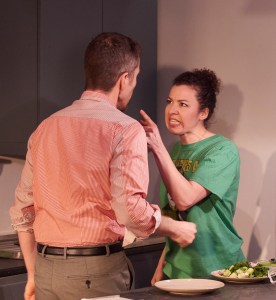
Joanne and Dave have lived apart for ten years, but remain married. He had walked out of their heavily-mortgaged Sheffield home to reclaim his freedom and live a life of easy money, free-flowing sex and casual drug-taking. He is now a 44-year-old recruitment consultant who reads The Guardian and looks forward to Question Time on television. After struggling to pay off debts, 39-year-old Joanne has established a small business as a florist. The reasons for her visit to see her husband are left unclear until well into the play, but the differences that separate the pair are abundantly obvious from the outset.

Butler’s harsh, unsentimental examination of the north-south divide and gender inequality feels as biting and relevant now as it would have been when first performed. The Sheffield-born writer spreads his cynicism even-handedly, pouring scorn on both the shallow hypocrisy of London’s middle classes and the small-mindedness of their northern counterparts. Played over 75 minutes in real time, Ballard’s carefully paced production is slow to get going, but it builds to a powerful crescendo with a raw and bruising confrontation between the two protagonists.

The acting could hardly be bettered. Bonnie Adair’s sharp-tongued, direct Joanne, displays her emotional scars openly and refuses to be impressed by the landmarks, glamour and excitement of our capital city. Outwardly, she is strong and proud, allowing only the audience to see her tears. Adam Bone’s Dave is nervous and evasive in his wife’s presence, seemingly hiding feelings of deep-rooted guilt. He brushes off Joanne’s jibes until pushed into a corner and then unleashes a ferocious tirade against the northern lifestyle that had stifled all his ambitions in life. For Joanne, geography is not the only constraint. As a woman, she sees that the options that Dave took to break free were not available to her, even less so now that she is an ageing woman.

Michael Leopold’s precisely detailed set design crams everything into the small cube that Dave inhabits, including a kitchen sink. Noise from neighbours in the converted building is forever intruding and the set will be a familiar place for many locals who enter the White Bear Theatre during this production’s run. Indeed, the play’s themes should also resonate strongly. The divisions, north-south and male female, persist at the end of Butler’s play and, if the writer offers a distant hope of reconciliation with his final line, it is only a very faint one.

Performance date: 16 March 2018

This review was originally written for The Reviews Hub: http://www.thereviewshub.com

Interview: Tristan Bernays

Posted: March 17, 2018 in Theatre

This article was originally written for The Reviews Hub: http://www.thereviewshub.com

After the success of his play Boudica at the Globe Theatre last year, 2018 is getting off to a good start for Tristan Bernays. His musical Teddy, which premiered at Southwark Playhouse in 2016 is soon to return to London for a 10 week run at the Vaults and his new play Old Fools is about to open at Southwark Playhouse. The writer took time off from his busy schedule to chat with The Reviews Hub’s Stephen Bates.

At first glance, a play that deals with Alzheimer’s Disease would seem to have limited appeal, but Bernays insists “the play is not ABOUT Alzheimer’s, it is about relationships and how difficult it is to keep a relationship going over several years, especially when it is eventually affected by illness”. He adds “it spans 40 or so years, playing around with memory and time jumping…it is an incredibly human experience and it is only an hour, leaving time for a drink in the bar afterwards”.

The play’s central characters are named Tom and Viv, so was this an intended reference to TS Eliot? Bernays laughs and protests “no, absolutely not, it was a complete coincidence. I was halfway through the play when it was pointed out to me, but, when you’ve named characters, it’s difficult to go back. They were in my head with those monosyllabic names and I stuck with them”.

The play is a two-hander, but, bearing in mind its title and the theme of dementia, it comes as a surprise to discover that two relatively young actors, Mark Arends and Frances Grey, have been cast in the premier production. Bernays explains that casting decisions were not his: “my script gives the director (in this case Sharon Burrell) a blank sheet, with no stage directions or anything like that. The play spans many years and the actors play eight characters in all, so it is perfectly possible that a future production could be acted by 70-somethings”.

The writer is drawing from personal experience, his grandfather having suffered from Alzheimer’s. “I understand what it means when someone you know and love is, gradually, not there any more” he says. “The play includes some of my own family’s mythology, like stared jokes. I wrote it some time ago and then set it aside, as happens in this business, and, one day, Sharon contacted me and said ‘let’s do it’, so here we are”.

With his playwriting career blossoming, where does Bernays see himself going from here? “I trained as an actor, but tried everything in theatre and quickly realised that I was more interested in other areas (including) lighting….and, of course writing” he explains. “I still perform my one-man shows, such as Testament, which was at the Vault Festival recently, but I have another project in hand and I am focussing mainly on writing”. We all wait with interest to see what this promising young talent comes up with next.

Adaptor: Tim Luscombe      Director: Daniel Buckroyd

⭐⭐⭐💫

A great deal of mileage has been found in Henry James’ 1898 novella Turn of the Screw. It has spawned a Benjamin Britten opera, Jack Clayton’s 1961 film (The Innocents), not to mention television versions, and now Tim Luscombe has adapted it into a stage play for this handsomely-mounted touring production.

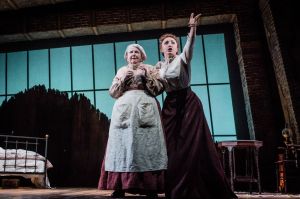
The plot is simple. A young governess (Carli Norris) is hired by the distant guardian (Michael Hanratty) of two young children, Flora and Miles, to take care of them in his country house, giving explicit instructions that he is never to be troubled regarding any matters affecting them. With only the doughty housekeeper, Mrs Grose (Maggie McCarthy) to help her, the governess soon discovers that the children are deeply troubled. Miles has been expelled from school for unexplained reasons and both appear to be obsessed with, or perhaps possessed by the ghosts of a former valet and the previous governess, who had each died in mysterious circumstances.

By framing his play inside the recollections of the governess some 30 years later, Luscombe distinguishes his version from some others, but reverts to a structure that is similar to James’ original work. Here the governess is challenged by the adult Flora (Annabel Smith) to explain what had happened and the audience is invited to question the veracity of her account. Thus, a story that is always enigmatic becomes more so. Are the malign forces at work paranormal or of human making? Is it the children who are possessed by ghosts or is it actually the governess?

Sara Perks’ set design and Matt Leventhall’s lighting give the production its vital creepiness. A single child’s bed and a large rocking horse occupy centre stage and, behind them, projected images occasionally emerge through the darkness. What we need to see is illuminated brightly, but the rest of the stage is a pitch black expanse in which we fear evil could be lurking. For the most part, director Daniel Buckroyd seems to take the point that suggestion is far more powerful than overstatement in the telling of ghost stories, but, occasionally, he betrays this principle with sudden flashes and loud bangs that are designed more to make us jump than to really scare us, thereby taking his production dangerously close to Victorian melodrama.

The roles of Flora and Miles are played by adult actors (Smith and Hanratty), assuming children’s speech, movement and mannerisms. This diminishes the impact of essential ingredients in James’ original – childhood innocence and the corruption thereof. The problem manifests itself most strikingly in a disappointingly limp staging of the climactic scene which fails to generate the sense of horror that it undoubtedly should. That aside, Luscombe’s play is a worthy addition to the list of theatrical ghost stories and it should have lovers of the hugely successful Woman in Black queuing for tickets.

Performance date: 15 March 2018

Photo: Robert Workman

This review was originally written for The Reviews Hub: http://www.thereviewshub.com