Then Again (King’s Head Theatre)

Posted: March 14, 2018 in Theatre

Creators: Tremolo Theatre      Directors: Helena Middleton and Jack Drewry

⭐⭐💫

There was a time when a stereotypical inventor and time traveller would have been a grey-haired, dishevelled old crank, but no more. Here we find Millie, a geeky, bespectacled university science student who is, if not exactly Doctor Who, probably very much like her.

Tremolo Theatre’s 55-minute comedy show is made by and for the social media generation, which, although growing in numbers, does not include all of us and there is a sense that its humour might be better received on a campus than in a fringe theatre. Millie (Hanora Kamen) is a thoroughly modern young lady whose inventions include a noodle dryer, a talking toothbrush, a hover broom and a singing hair dryer. Intent on self-promotion, she and her friend Anna (Lily London), a struggling musician, launch an assault on YouTube.

When Millie invents a machine that allows her to travel backwards and forwards in time, which also has the side effect of cloning her several times over, things start to turn sour. “Milly Makes” becomes s fleeting internet hit, topping one million views, but her censorious tutor (Alice Ritchie) disapproves and she gets sent down.

If the comedy could have matched Millie’s inventiveness or, if the show could have found the wit to equal the charm and enthusiasm of its performers, this would have been a surefire winner. However, things have not quite fallen into place yet. Of course, it is all completely bonkers (and there is nothing wrong with that) but the script needs a lot more bite to turn it into an effective satire of modern lifestyles.

The familiar message that real friends are better than virtual ones comes through fleetingly, but, otherwise there seems to be no serious purpose underlying the humour. Ultimately, this cheerful, inoffensive show is not really funny enough to make a big impact, but, then again, looked at as a work in progress, it could have a future.

Performance date: 12 March 2018

This review was originally written for The Reviews Hub: http://www.thereviewshub.com

Summer and Smoke (Almeida Theatre)

Posted: March 13, 2018 in Theatre

Writer: Tennessee Williams      Director: Rebecca Frecknall

⭐⭐⭐⭐⭐

Tennessee Williams is known as one of the great playwrights of the 20th Century primarily because of half a dozen or so major works that are performed regularly in London and elsewhere, but he also wrote a lot of other stuff that tends to get neglected, often for good reasons. The exhumation of this 1948 Broadway flop always seemed likely to be interesting, but few could have anticipated anything quite like what we see here. Rebecca Frecknall’s smouldering, sensual production unveils in its full glory a poetic masterpiece fit to stand alongside the writer’s greatest plays and, in Alma Winemiller, we find a delicate, bruised and proud female character who is as complex and intriguing as Blanche DuBois in A Streetcar Names Desire.

We first see Alma as a young girl with a crush on John, the boy in the house next door. They live in the small town of Glorious Hill, Mississippi, she the daughter of a minister, he the son of a doctor. As the years pass, their fascination with each other turns into obsession and then into a form of love that is fully reciprocated but never consummated. “I am as much afraid of your soul as you are afraid of my body” John tells Alma. He has become a gambler, heavy drinker and womaniser and, as he inherits his father’s medical practice, he longs to contain his wild streak and assume Alma’s purity and dignity, while she longs to throw off the shackles of a strict church upbringing and release the doppelgänger, her opposite self, that is smoking inside her.

I have vague memories of the so-so 1961 film version of this play, with Geraldine Page and Laurence Harvey in the lead roles, and this recollection highlights the first of many inspired moves by director Rebecca Frecknall – the casting of two much younger-looking actors. This brings to the fore a sense of Alma and John not being able to escape the people who they were when young, thereby reinforcing all Williams’ themes. Patsy Ferran is truly phenomenal as Alma, holding the stage for almost the entire 150 minutes, mesmerising us and breaking our hearts. Matthew Needham matches her as John, looking like an overgrown schoolboy and making us understand and care for what could have been such an unsympathetic character. If anyone is looking for a dehfinition of on-stage chemistry, it is here.

There are quirks in Frecknall’s production. The significance of the entire cast being barefoot or of nine upright pianos lined up in a crescent at the back of the stage remain a mystery, but such details matter little when they contribute to evoking the combustible, stifling atmosphere of America’s Deep South so perfectly. Tom Scutt’s set design, exposing the theatre’s brick rear wall, Lee Curran’s lighting and Angus MacRae’s music all make big contributions. Finding fault, actors doubling up in important roles is overdone. Alma’s and John’s fathers are both Forbes Masson, Alma’s mother and a townswoman are both Nancy Crane and all John’s girlfriends are Anjana Vasan. We want to concentrate on this wonderful play without having to figure out which characters are on stage at the beginning of every scene. That said, great theatre productions can always transcend their flaws and this is such a production.

Performance date 6 March 2018

Writer: Ian Grant      Director: Nadia Papachronopoulou

As with the old music hall song, many a heart is aching in After the Ball. Ian Grant’s new play is a London working class family saga spanning more than 60 years in the 20th Century, but, sadly, it buckles under the weight of its own over-ambition.

With World War I looming, young socialist William Randall (Stuart Fox) marries naive, simpering Blanche (Julia Watson) and tells her that “the poison is in the wind”. Ignoring his wife’s protests, he decides that the only antidote to the poison that he can offer is to join up, which he does, along with his friend Albert (Jack Bennett). Much is spoken about the horrors of the trenches, but William survives with only a leg wound and, while he is on leave in London for Blanche to nurse him, a baby is conceived.

After the War, William stays on in Belgium to help out with the reconstruction process and begins a torrid affair with sweet local mademoiselle, Marguerite (Elizabeth Healey), before returning home to his now hectoring wife and their daughter, Joyce (played from her teenage years by Emily Tucker). Through the London Blitz we go and then the Attlee and Wilson governments and then membership of what has since become the European Union. Joyce, a flighty girl, marries badly and later emulates her father by committing to left wing causes.

The story is told in non-linear form, leading to frequent confusion and, when characters are all played by single actors over a wide span of ages, making them consistently believable becomes virtually impossible. In Nadia Papachronopoulou’s plodding production, nothing is as moving as we feel it should be and, instead of tears, there are frequent giggles, prompted by stilted dialogue.

Meaty themes, including socialism, pacifism and women’s suffrage float over the play like clouds without ever getting properly grounded and integrated into the unfolding drama. Near the end, it seems that Grant wants to use the Randall family’s story as a metaphor for Britain’s relationship with continental Europe (or, specifically, Brussels) through to the modern era, but whatever messages he intends to convey emerge feeling as hopelessly muddled as so much else in his play. In trying too hard to say too much, the writer ends up saying nothing at all.

Performance date: 8 March 2018

Photo: Mitzi de Margary

This review was originally written for The Reviews Hub: http://www.thereviewshub.com

Writer: Stephen Bill      Director: Lindsay Posner

⭐⭐⭐⭐

A 2012 survey revealed that there is a much higher probability that people over 60 will die on their own birthdays than on any other day of the year. In Stephen Bill’s play, things are not looking good for Ida, whose family are gathering round to celebrate her 86th, bearing greetings cards, gifts and wishes for a still longer life.

Ida (Sandra Voe) sits in her wheelchair, swathed in blankets, her vacant expression betraying the weariness of having had indignity after indignity piled upon her through illness and misfortune. Family members talk to her as they might talk to a baby in a crib and talk of her as if she was not in the room. “I’ve had enough, I have” Ida cries out and we believe her.

Daughter Katherine has baked her a cake, daughter Margaret has made her a trifle. Katherine’s husband, Geoffrey, sits dutifully watching on; Margaret’s husband, Douglas, goes off to mow the lawn; Ida’s grandson and lodger, Michael, fusses over her, while next door neighbour, Mrs Jackson, is ready to spring in and give a helping hand on hearing the faintest knock on the wall. The arrival of the family’s black sheep, youngest daughter, Susan, kicked out by Ida 25 years earlier, sets the first cat among the pigeons.

The elephant in the room is, of course, death or. more specifically, euthanasia. Bill’s character-driven play is more light drama than dark comedy and Lindsay Posner’s production skips nimbly between its pathos and humour. The set, designed by Peter McIntosh, realises perfectly the old-fashioned cosiness of a living room that has been occupied by the same person for, perhaps, too long.

Saskia Reeves’ matronly Katherine paints a perfect picture of suppressed anguish, contrasting with the self-obsessed hypocrisy of Wendy Nottingham’s Margaret. Tim Dutton’s Douglas calmly cuts through family nonsense with common sense reasoning, while still finding time to flirt with Caroline Catz’s Susan, who readily flouts convention. Jonathan Coy’s Geoffrey makes everything worse as he tries to pour oil over troubled waters; he is as instinctively a pragmatist as is his son, Michael (Leo Bill) instinctively angry, without knowing exactly why. Completing the list of spot-on performances, Marjorie Yates’ redoubtable Mrs Jackson is a touching tribute to a sadly dying breed of devoted neighbours.

As Benjamin Franklin pointed out, death (along with taxes) is a certainty (and Bill’s well observed play explores how and why that certainty remains a taboo subject in family life. Some of the moral dilemmas raised in the play are complex and potentially dry, but the writer presents them with a human touch that makes them engaging, chiefly because he invites us to recognise its characters as exaggerated versions of members of our own families.

Performance date: 5 March 2018

This review was originally written for The Reviews Hub: http://www.thereviewshub.com
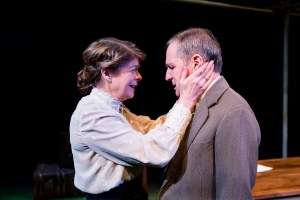
A Princess Undone (Park Theatre)

Posted: February 27, 2018 in Theatre

Writer: Richard Stirling       Director: Jonny Kelly

⭐⭐⭐

When she died in 2002, Princess Margaret looked to have completed her slow journey towards becoming a footnote on the pages of British history. However, interest in the Queen’s younger sister has been rekindled by the Netflix series The Crown and now Richard Stirling’s new play takes a further look at what many remember as a sad and unfulfilled figure.

The time is 1993 and the Princess is divorced from “the campest man in Britain”. She has left a long list of alleged lovers in her wake, but the press has now turned its attention to the younger royals and she is yesterday’s news. She occupies her Kensington Palace apartment (sumptuously furnished in Norman Coates’ set design) with other royals as her near neighbours, comforted by a favourite cushion embroidered with the words “it’s not easy being a princess”, sipping Red Grouse and chain-smoking (“down to 10 a day”). She looks out onto the Palace courtyard waiting to see which boyfriend the “Golden Girl” (Diana) will be bringing home tonight.

With her mother and sister out of town, HRH has charged the Queen Mother’s dutiful but sarcastic aide, William (played by the writer himself), to raid his mistress’s drawers and bring to Margaret piles of papers that she believes relate to her personal scandals. The object is to burn them, which it seems actually happened. Perhaps less likely to be true is the arrival of a young interloper (Alexander Knox) seeking to get his hands on the papers, but his appearance lets us see that the Princess’s flirtatious disposition is still active even in her 60’s.

The insatiable appetite of the British public for tittle-tattle about royalty should ensure that Stirling’s gossipy play finds an audience. There is much name-dropping – the Kents complaining about the noise, Diana being ostracised for allowing her boys to dive-bomb Margaret in the Kensington Palace swimming pool and so on. A further reminder of Margaret’s show business links comes when John Bindon (Patrick Toomey) turns up. The press had reported that Bindon, an actor with underworld connections, had been a guest on the Princess’s Caribbean hideaway of Mustique several years earlier and he is now intent on blackmail.

Much of this would be very flimsy stuff indeed were it not for a superb central performance by Felicity Dean, regal and slutty almost in the same instant. This is a woman who remains defiantly arrogant, using bitchiness as a defence mechanism, so caught up in the role that she was born to play that she does not know who she truly is. The daughter of a King, she had been second in line for the throne for over a decade, but now the long downward spiral to insignificance is nearing its end and Dean’s Princess looks lonely and forlorn.

Jonny Kelly’s steady direction keeps us interested for 80 minutes (extended by a 20 minute interval), but the creakiness of Stirling’s plotting cannot be disguised and it feels likely that the play could have worked a great deal better if it had been structured as a monologue for the magnificent Dean to perform.

Performance date: 26 February 2018

This review was originally written for The Reviews Hub: http://www.thereviewshub.com
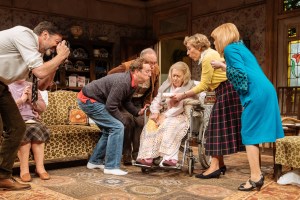
The Lady With a Dog (White Bear Theatre)

Posted: February 24, 2018 in Theatre

Original Story: Anton Chekhov      Adaptor and director: Mark Giesser

⭐⭐⭐

Starting with a short story written by Anton Chekhov in 1899, writer and director Mark Giesser has devised a play about marital infidelity in the mid-1920s that has the feel of Noël Coward. It hovers between the casual frivolity of Private Lives and the fraught, guilt-ridden romance of Still Life (filmed as Brief Encounter).

Oscar Selfridge’s art deco set design dazzles and then baffles. Deck chairs lie around a sunlit balcony, looking out towards a cloudless sky and a calm, dark blue sea. Yes, this is coastal Scotland. If the production’s sense of location falls short, Giulia Scrimieri’s keenly observed costumes at least give it a far more accurate sense of period.

Holidaying North of the Border, separate from their respective spouses, are the prim Anne (Beth Burrows), accompanied by her playful Pomeranian, and debonair ex-army officer Damian (Alan Turkington), a serial seducer. These characters come from the affluent upper middle classes of their era that populated much of Coward’s writing, perhaps passing their time solving cryptic crosswords, playing Golf in the afternoon and Bridge in the evening. Can anyone blame them for spicing things up with a spot of adultery?

Back home in Wiltshire, Anne’s dull, humourless husband Carl (Duncan MacInnes), a bespectacled, pipe smoking soon-to-be Tory MP, is nursing his war wound. In London, Damian’s stern, frumpy wife Elaine (Laura Glover) is looking after the couple’s three children, aware of her husband’s probable antics whenever he is away from home. Neatly, Giesser merges in imaginary conversations between all four characters with actual conversations, allowing them all to reveal more of themselves and their self-obsessiveness.

Essentially, this is a tale about what boring people do when they get bored and Giesser does well to stop his production from itself becoming boring too often. Anne confesses to having “taken a liking to making love beside a moonlit rock pool” but, as with all holiday romances, the question is what will happen when the pair return to their homes. Act II sees Anne and Damian torn between love and duty, but, if we are meant to believe that they are having a torrid affair rather than just a holiday fling, it feels remiss that hardly any passion can be felt on stage.

We may wonder what the agonising in this play has to do with the world almost a century later when social behaviour has changed so radically. Anne could provide an answer when she talks of public expectations of politicians and their wives and we may reflect that news reports almost every day demonstrate the extent to which hypocrisy still abounds. Relevance proves to be less of a problem for the play than length, the short story that provides Geisser’s source material feeling too thin to be stretched out to two hours (including interval). Pleasurable as a great deal of this production is, it is also much too long.

Performance date: 23 February 2018

Photo: Andrew Grieger

This review was originally written for The Reviews Hub: http://www.thereviewshub.com

Foul Pages (Hope Theatre)

Posted: February 24, 2018 in Theatre

Writer: Robin Hooper      Director: Matthew Parker

⭐⭐⭐

All the World’s a stage in Robin Hooper’s new play, a bawdy romp set in 1603 when a production of As You Like It is being staged to please the newly-crowned King James I/VI. The theatre, it seems, is the centre of everything in this tale of backstage backstabbing, political intrigue and thwarted love, all taking place under the watchful eye of a cuddly canine.

The Countess of Pembroke (Clare Bloomer) is desperate to save her former lover Sir Walter Raleigh from the axe and invites the new King (Tom Vanson) to her country pile, where she keeps dissident French Protestants hidden in the attic. She hopes that a performance of AYLI, which she has “improved” herself, will help her to encourage his leniency. The actors arrive, all of them gay, but it is explained that there were no women around in theatre companies in those days. The Countess’s lusty maid, Peg (Olivia Onyehara), has little chance of getting satisfaction from any of them.

Trouble starts when the King takes a fancy to bit part player Rob (Thomas Bird) and insists that he must play Rosalind instead of the talented and ambitious Alex (Lewis Chandler). The writer, Will (Ian Hallard), succumbs to the King’s request, much to the consternation of his actor brother Ed (Greg Baxter with a broad West Midlands accent) who has rejected Peg’s advances in favour of his pursuit of Rob. Meanwhile, the King’s kilted henchman (Jack Harding) takes a shine to Alex and could prove to be his saviour.

Matthew Parker directs these shenanigans on an often cramped stage with a light touch, throwing in some neat comedy and some oddities. Techno music and strobe lighting during scene changes feel particularly incongruous. It is very unlikely that the vain actors of 1603 would ever have been as generous as the company here by allowing scene after scene to be stolen by a dog. Chop, the Countess’s put-upon mutt, woofing, canoodling and throwing in sarcastic asides in the style of Lily Savage, is a delight and James King’s performance certainly earns at least a biscuit.

When it comes to Elizabethan (or immediately post-Elizabethan) theatre comedies, Tom Stoppard set the bar fairly high with his screenplay for Shakespeare in Love, exploring the links between theatre and life with wit and insight. It is no surprise that Hooper’s play falls short in comparison, but still it could have shown more purpose. The writer seems to have little interest in Will himself, who becomes a rather anonymous, incidental figure. Focussing primarily on the thespians’ antics, the play is mildly amusing for its 90 minutes, but, at the end, we are left thinking it to have been much ado about very little at all.

Performance date: 22 February 2018

This review was originally written for The Reviews Hub: http://www.thereviewshub.com

The York Realist (Donmar Warehouse)

Posted: February 17, 2018 in Theatre

Writer: Peter Gill      Director: Robert Hastie

⭐⭐⭐⭐⭐

Josie Rourke has recently announced an intention to leave her position as Artistic Director at the Donmar Warehouse and, when the time comes to assess the high points of her tenure, Peter Gill could feature strongly. His play Versailles, which premiered here in 2014, may have shown the strains of over-ambition, but its searing final act lingers on in the memory. Now this revival of  The York Realist, first seen at the Royal Court in 2002, proves to be the perfect marriage of play and venue.  The Donmar, better than any other theatre in London, can accentuate subtlety and give power to the understated in intimate human dramas and Robert Hastie’s exquisite production takes full advantage.

Gill writes about irreconcilables – town and country lifestyles. middle class and working class values. The time is the mid-1960s and John (Jonathan Bailey) is up in Yorkshire from London to work as Assistant Director on York’s Mystery Plays. He comments that the countryside is everything that he expected and still nothing at all like what he had expected, probably meaning that most unexpected is George (Ben Batt), a farmer who shows promise as an amateur actor (in the days when actors from working class backgrounds were welcomed into theatre). George is plain-speaking and plain-thinking, finding no time to question or show reticence about his homosexuality, contrasting sharply with townie John’s coy nervousness when being seduced. Interestingly, George has been mirrored recently by the central character in Francis Lee’s wonderful film God’s Own Country, which has a similar setting. Perhaps there is something in the Yorkshire air.

Batt is simply superb. When he realises that what he yearns for most in life is the thing least attainable to him, he turns to the audience, failing to hold back tears and we are all heartbroken. Bailey too shows true passion as the uncomprehending John. Lesley Nicol is touchingly real as George’s dutiful but ailing mother and Katie West gives poignancy to the role of neighbour Doreen, who is prepared to carry out household duties for George, quietly biding her time until the time is right for her. In Peter MacIntosh’s warm farm cottage set the back door is always unlocked for family and friends to wander in, a custom somehow abandoned in cities and there is a sense throughout that everyone knows and accepts the truth about George, but never speaks about it. Beautifully written and impeccably observed, Rourke’s successor in the Donmar hot seat will do well to keep up the standards achieved by this production.

Performance date: 16 February 2018

Hamilton (Victoria Palace)

Posted: February 17, 2018 in Theatre

Book, music and lyrics: Lin-Manuel Miranda      Director: Thomas Kail

⭐⭐⭐⭐⭐

Hype raises expectations and high expectations frequently result in disappointment. For example, I saw Jez Butterworth’s The Ferryman with no expectations on press night at the Royal Court, recommended it to everyone I spoke to when it transferred to the West End and have invariably received the reaction “it wasn’t THAT good”. Hamilton is the most hyped show of the modern era, garlanded with accolades and awards, and, having failed to get tickets on two visits to New York, I am finally crossing paths with it a couple of months into a London run that was greeted with almost unanimous five star reviews. So, can it possibly be THAT good?

I try hard not to be one of those irritating people who knocks anything successful just for the sake of being different, so let me start by emphasising that this is a rock solid five star show, brilliant in concept and execution, informative and hilariously funny. By thinking outside the box, creator Lin-Manuel Miranda has taken the art of musical theatre to another level and there was not a second of it’s 165 minutes that I was not enthralled by his show. It was only when leaving the theatre, as a friend said to me “that is a musical for today”, that I began asking questions. Yes, being a musical for today is a big positive, but will it be a musical for tomorrow? Could suggestions that the Victoria Palace (spectacularly renovated at a cost of around £60million) may never have to look for another show be a little premature?

Alexander Hamilton (c1755-1804) was born out of wedlock on the Caribbean island of Nevis, emigrated to the United States as a young man, became a senior officer fighting for American Independence, was appointed Treasury Secretary in George Washington’s first administration and played a key role in establishing the US Constitution and financial systems. The show’s running theme is that it is throwing light on a prominent figure that history tends to overlook and the pleas by his wife Eliza (Rachelle Ann Go) to put right that wrong are stirring. However, when elements in the show remind us of  Les Miserables, they also expose the fact that Hamilton, a flawed, fallible politician and bureaucrat, is not an iconic hero as was Jean Valjean. Thus, the show’s emotional hook is much weaker and, as a result, I am left wondering how quickly it will fade from the memory.

There are many reasons why I wish that I had seen Miranda’s own performance as Hamilton, among them now being that it would have helped me to make up my mind about the performance of the much younger Jamael Westman in the role. There is no doubt that he is technically excellent, but does he have the maturity and charisma to be fully convincing as the character ages? I have niggling doubts, particularly in scenes when he is onstage alongside Giles Terera, brilliant as Hamilton’s some time rival, some time ally, Aaron Burr. Obioma Ugoala is a commanding Washington, Jason Pennycooke a childlike Thomas Jefferson and, singing the tune that I cannot get out of my head, Michael Jibson’s King George III is bonkers (as indeed was the case).

Finally, a mention for Miranda’s use of rap, a word that I had previously thought needed to be preceded by the letter “c”. Miranda integrated hip-hop into his Tony award winning show In The Heights, which I loved and which was a long running hit on the London fringe, so its reappearance here was not entirely unexpected. However, in the event, it proves to be a revelation. Using rapping as a tool for storytelling, the awkward transitions between spoken word and song that blight many musicals are gone and the pace, rhythm and energy of Thomas Kail’s production never falter. An added bonus is that the cheekiness that comes naturally to rap gives licence for the show to be both respectful to American history and completely irreverent at one and the same time. Hamilton is one helluva ride, but will we still love it tomorrow? Only time can tell.

Performance date: 14 February 2018

Photo:Matthew Murphy

Cyril’s Success (Finborough Theatre)

Posted: February 6, 2018 in Theatre

Writer: Henry J Byron      Director: Hannah Boland Moore

⭐⭐⭐

Marking the 150th Anniversary of the building which is now home to the Finborough Theatre, there is a nice feeling of symmetry to this revival of a play also originating from 1868, placing a Victorian drawing room comedy in what could once have been a Victorian drawing room.

Henry J Byron’s Cyril’s Success has not been performed in London since 1890 and such time lapses usually have good reasons. In this instance, one such reason could be that 1890 was around about the time that Oscar Wilde began delivering a similar brand of social comedy, but with considerably larger helpings of wit.

Cyril Cuthbert (Tim Gibson) is a successful playwright who takes for granted and neglects his devoted wife (Isabella Marshall). On their wedding anniversary, he opts for a night out with the boys and asks the cad Major Treherne (Will Kelly) to escort Mrs C to the opera. Encouraged by her man-hating former school teacher, Miss Grannet (a deliciously sour Susan Tracy), Mrs C begins to suspect her husband of infidelity with a divorcee, Mrs Bliss (Allegra Marland). She walks out and, without her support, Cyril’s success rapidly turns to failure.

The plot is as featherlight as that of a comic opera, much of the dialogue is stilted and, for long spells, the play is short on any form of humour. The wonder is that director Hannah Boland Moore polishes it up so well in her handsome production, designed by Daisy Blower. Drawing first rate performances that are only slightly tongue-in-cheek, she does what she can to bring out the gender issues, contrasting the strutting Victorian-era males with the so-called “soft sex”.

As is often the case with Wilde, much of the fun comes from subsidiary characters. Cyril’s friend, the over-eager, lovelorn (and curiously named) Titeboy is played with relish by Lewis Hart and, as his other friend, hardened misogynist Mr Pincher, Stephen Rashbrook has a delightful glint of mischief in his eyes; he is a literary critic who promises Titeboy: “I shall not only review (your book) favourably, I shall read it”. As we know that Pincher and Miss Grannet are polar opposites, we wonder if they can be anything other than a match made in Heaven. In this sort of play, of course not.

When the going gets tedious, consolation comes from knowing that the play will only last for 90 minutes (extended by an unnecessary interval) before we can call for our carriages home. For sure, Cyril’s Success is a dusty old museum piece, but credit is due to Boland Moore and her company for presenting it to us as a rather jolly one.

Performance date: 5 February 2018

Photo: Scott Rylander

This review was originally written for The Reviews Hub: http://www.thereviewshub.com