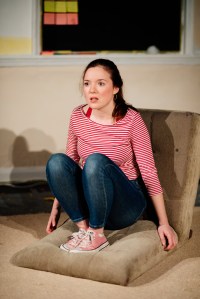
Bunny (White Bear Theatre)

Posted: March 10, 2017 in Theatre

This review was originally written for The Reviews Hub: http://www.thereviewshub.com

⭐️⭐️⭐️

Writer Jack Thorne is riding on the crest of a wave right now with Harry Potter… in the running for multiple awards and heading for Broadway, but it is a big leap from a West End extravaganza to a small pub theatre production of a gritty hour-long monologue such as Bunny, first seen in 2010. It is also a long way from Hogwarts to Luton, the setting for this play.

As with the later Let the Right One In, Thorne concerns himself with an adolescent straying into dark territory. Katie is in her last year at school, casually promiscuous, showing tendencies towards kleptomania and playful, but with a spiteful streak. Jumping randomly between inconsequential ramblings and pointed storytelling she describes her family, her boyfriend Abe who, to her parents’ consternation, is black and his two mates from the Vauxhall factory – mysterious Asif and stuttering Jake. She tells us that she prefers surprise to suspense, because “I feel suspense all the time”, a trait that perhaps typifies an age group dogged by insecurity.

Catherine Lamb’s Katie is hyperactive in body and mind, inquisitive but knowing too much at the same time as knowing too little. A petty tiff over a ruined ice cream becomes a matter of honour and revenge as she and the three men enter into a chase across a town that is multicultural but divided along ethnic lines. The location is as confused about its identity as is Katie about hers. Thorne’s colourful writing and Lamb’s lively delivery take us effortlessly with the quartet on its journey.

Lucy Curtis directs a taut production, hinting at hidden danger even when there is none there. Flickering lights and sudden noises keep us on edge and, until we actually arrive, it is never obvious where the journey will end. Dramatically, Thorne’s narrative is low-key and he delivers no hefty punches. Instead, he turns his play into a methodical, probing exploration of the uncertain and dangerous place that exists between childhood and adulthood.

Performance date: 9 March 2017

Photo: Dashti Jahfar

The Monkey (Theatre 503)

Posted: March 9, 2017 in Theatre

⭐️⭐️⭐️⭐️

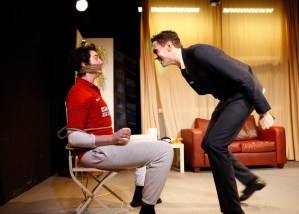
If Quentin Tarantino had ever directed an episode of Only Fools and Horses, the result could have been something like John Stanley’s new 90-minute play The Monkey.  The production is mounted by Synergy Theatre Project as part of their Homecoming season, featuring plays by prisoners and ex-prisoners. If Stanley is drawing from personal experience in his account of drug-abusing petty criminals,  it is to be hoped that he has “exapperated” (malapropisms occur regularly) the psychopathic tendencies of his central character, Tel.

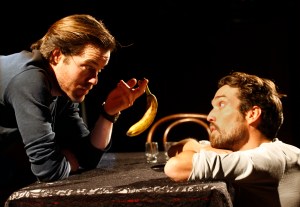
Morgan Watkins’ Tel is volatile and threatening, the character modelling himself on Michael Madsen in Reservoir Dogs. He is so offended by the gormless “Thick-Al” (George Whitehead), who owes him a monkey (a glossary of Cockney rhyming slang provided with the text comes in handy), that he interrupts his breakfast of a single Jaffa Cake and Coke (the drink) and offers him a makeover to give him the Vincent Van Gogh look. Following another bout of violence, he asks his dim-witted buddy Dal (Daniel Kendrick) whether he still has a chance with his on/off girlfriend Becks (Danielle Flett), having just tried to strangle her and he reflects fondly on the transformative moment in his life when, at the age of eight, he saw Harvey Keitel in Bad Lieutenant. Tel is not a nice man, but liking him is the play’s guilty pleasure and Watkins is towering in the role.

Cleverly, Stanley taps into a vein of British humour that associates itself with “Sarf” London rogues and runs through the Ealing comedies, PorridgeOnly Fools…etc and his dialogue is as sharp as the knife that Tel wields with menace.  The play is about people who are trapped in a spiral of criminality, but Stanley finds no time to expand on their hopelessness or to introduce pathos and the play tails off disappointingly without the touch of irony that it needs. However, the laughs come thick and fast, director Russell Bolam keeping the production bubbling so that we hardly care that the characters and situations have little depth. Good black comedies have been a rarity of late. but, on the the evidence of this ferocious and ferociously funny play, Stanley has the flair to reinvigorate the genre.

Performance date: 8 March 2017

Photo: Simon Annand

This review was originally written for The Reviews Hub: http://www.thereviewshub.com

⭐️⭐️⭐️💫

We think of EM Forster and we think of stories about the English upper classes at home and abroad in the early part of the 20th Century. Science fiction we regard as the territory of his contemporary, HG Wells, so it comes as a surprise to discover that Neil Duffield’s 85 minute play is an adaptation of a 12,300-word short story by Forster, The Machine Stops, originally published in 1909. Even more surprisingly, Duffield suggests to us that Forster could have inspired the invention of Skype.

Forster imagines a future in which Earth’s human population has been driven underground to live in isolation, discouraged from direct contact with others and from travelling. There is no need for people to go to see things when those things can come to them in their own subterranean cells. It is an Orwellian nightmare in which the Machine, a sort of forerunner to Big Brother, controls everyone’s lives. The story has two protagonists: Yoshti is a lecturer on “the Australian Period”, communicating remotely with the outside world and conforming strictly to the rules of the Machine; her rebellious son Kuno lives on the far side of the planet and is eager to break free from the Machine to explore life on the surface.

Using a prototype of video chatting, Kuno persuades Yoshti to board an air ship and visit him so that he can relay to her the joys of seeing the sun and making direct contact with real life. Essentially, the original novella centres on a conflict of ideologies and Duffield’s difficulty in translating this to the stage comes with generating dramatic tension. The adventurous youthful optimism of Rohan Nedd’s Kuno is endearing, but Ricky Butt’s Yoshti is an icy figure indeed, drained of all signs of maternal affection. This interpretation of the character takes literally the Machine’s rule that parental responsibilities end with giving birth and the absence until near the very end of an emotional connection between mother and son leaves a hole at the heart of this adaptation.

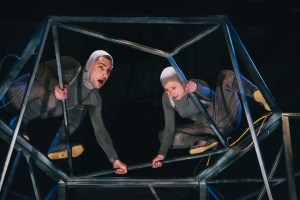
Fortunately, Juliet Foster’s vivid and imaginative production offers more than a little compensation for weaknesses in the drama. Rhys Jarman’s set design resembles a large climbing frame constructed around a small cell for a single occupant. Two performers (Maria Gray and Adam Slynn) clamber acrobatically around the frame and they, aided by Tom Smith’s superb lighting design and eerie music composed by John Foxx and Benge, create striking impressions of the Machine in motion.

The details of the future foreseen by Forster may not have been as specific as shown in this production, but still his prescience is astonishing. Effectively, he predicted an age when our lives would be run by a machine, encompassing instant messaging, telecommunications, virtual reality and commercial air travel, over a century ago and then he went on to ask what would happen if the machine was to malfunction and stop. Chillingly, that is something that remains to be figured out.

Performance date: 7 March 2017

Photo: Ben Bentley

diaryThis review was originally written for The Reviews Hub: http://www.thereviewshub.com

⭐️⭐️⭐️

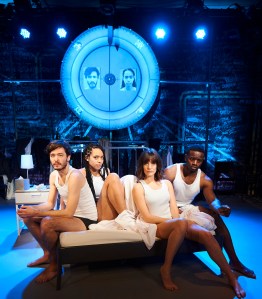
Flower power and hippies may have deserted San Francisco by 1976, but Marielle Heller’s play, adapted from Phoebe Gloeckner’s 2002 graphic novel, tells us that they left behind traditions of free love. Diary of a Teenage Girl is based around the daily tape-recorded ramblings of 15-year-old Minnie as she trips tentatively into the world of adults. dabbling in promiscuity and hallucinatory drugs.

Rona Morison’s Minnie is lively, naive, inquisitive and mischievous. She aspires to being older than her years, living with a divorced mother, Charlotte (Rebecca Trehearn), who tries desperately to be younger than hers. Charlotte’s current boyfriend, Monroe (Jamie Wilkes) is a weak-willed waster and her straight-laced distant step dad, Pascal (Mark Carrol) feigns concern while sleeping with her slutty best friend, Kimmie (Saskia Strallen). And so, Minnie seduces Monroe and things start to get hot.

As coming of age tales go, the play is not particularly remarkable. It is mildly amusing rather than hilarious and it relies very heavily on the likability that Morison gives to Minnie to carry it through some soggy patches. Most telling is the central character’s growing feeling of empowerment. “I’m better than you” she tells Monroe with conviction and her determination to exploit new opportunities opening up for women gives the play meaning and raises it above the level of broad comedy.

Heller sprinkles the “f” word liberally over her dialogue in a work that, by modern standards, tries too hard to be bold. This may be explained by reminders everywhere in this production, directed with pace by Alexander Parker and Amy Ewbank, that we are back in the less enlightened era of flared trousers, sideburns and glam rock. Andrew Riley’s set and costume designs are sharply evocative. An attic bedroom with patterned wallpaper and a huge skylight is Minnie’s base and projected graphics link to the play’s origins, as does Minnie’s likely future profession, a cartoonist. To top everything, David Bowie, T Rex and Neil Sedaka provide the soundtrack.

All this may have considerable nostalgic appeal for fifty somethings, but it will speak less loudly to a modern generation used to mobile phones, Facebook and internet dating. Therein lies the problem that this production fails to overcome. Although the play does not belong to the era in which it is set and some of its themes are timeless, modern relevance becomes obscured by period detail and candid treatment of sexual activities, which may have been daring in the 1970s, now seems merely quaint.

Morison is pure joy, heading a spirited cast, and there is evidence throughout that a great deal of loving care has been put in by all involved in the production. However, the question that lingers is whether this play, which is quite modern but feels badly dated, is really deserving of their efforts.

Performance date: 6 March 2017

trh-2

titleThis review was originally written for The Reviews Hub: http://www.thereviewshub.com

⭐️⭐️⭐️⭐️

The absurdist works of Eugène Ionesco are so unconventional that they could feel out of place on a regular stage in front of an audience seated in rows. Perhaps with this in mind, Marianne Badrichani comes up with the not-so-absurd idea of performing them at an elegant dinner party with the audience becoming diners sitting around a long table, sipping glasses of French wine.

The Romanian-born French writer had his hey days in the middle of the 20th century, but his plays are seen less often today. Adapting extracts from the plays, along with Edith Vernes, Badrichani fuses Ionesco’s writing with a peculiarly English strain of upper class eccentricity and it proves to be a match made in Heaven. We are ushered in by a camp butler (Jorge Lagardia) and a saucy maid (Sharlit Deyzac), both looking as if straight out of a Feydeau farce and our hosts, the Smiths, take their places at opposite ends of the table. Mr Smith (Sean Rees) displays his “typically English” thin moustache, exudes smoke and reads the Daily Mail; his refined and graceful wife (Lucy Russell) argues with him from a considerable distance. The main guests, the Martins (David Mildon and Vernes) are late.

The evening plays like a mash-up of Ionesco’s greatest hits: the family whose members are all named Bobby Watson; the strangers who meet and discover that they are married to each other; the Spanish fire chief (Lagardia) who has a problem with the letter “f”. Each segment seems like a sketch in a revue and perhaps we have seen them all before and know the punchlines well, but this is definitely a case of familiarity breeding contentment. The six actors tune in perfectly to the ridiculousness of their characters and give us an absurdly enjoyable evening.

The surreal nature of the event is heightened in a sequence during which diners are blindfolded and Ionesco himself (Rees) appears in two brief sequences, answering questions (in French) about his works. However, this show is overwhelmingly about comedy and Badrichani’s concept spotlights how absurdism is prominent in British humour, seen in The Goon Show, Monty Python’s Flying Circus and so on. The big surprise comes at the end when we remind ourselves that Ionesco was, in fact, French.

Performance date: 4 March 2017

trh-2

im-gonna-pray-so-hard-for-you-finborough-theatre-c-scott-rylanderThis review was originally written for The Reviews Hub: http://www.thereviewshub.com

⭐️⭐️⭐️

It is tricky to review a play that begins with a savage diatribe against theatre critics. Halley Feiffer’s forensic study of the darker side of theatre sees successful playwright David convening with his daughter Ella, an actor, to await the first reviews of an off-Broadway production of The Seagull, in which she has played second female lead. Preparing her for the worst, he tells her not to resent the critics, but to pity them and pray hard for them.

If Feiffer sees critics as a malign force in theatre, she tempers her argument with the admission that her characters’ professions feed off the adulation that only they can give. Little mention is made of audiences. She sets up the play to become a cosy, heartwarming little drama in which father gives loving consolation and daughter gains strength from it, but then she delivers quite the opposite. This late night chat, fuelled by white wine and cocaine, turns into a brutal conflict in which David sets about destroying Ella with all the subtlety of a wrecking ball. He tells her that she is “interesting” rather than beautiful, handing out the back-handed compliment that actors crave least, before he shatters her confidence to little pieces.

Feiffer’s writing occasionally has the ferocity of Albee, spotlighting the venom that runs in this family’s bloodline and through theatre itself. Love may be offered, but is never reciprocated. There are suggestions of black comedy, but wit and irony never surface strongly and director Jake Smith opts to play it as raw drama, allowing two forceful and loud performances to dominate his production, set mainly in Anna Reid’s compact design of a modern Manhattan apartment.

Adrian Lukis plays David as a bullying, egotistical tyrant, eager to exploit his daughter’s vulnerabilities in order to control and manipulate her. He wants her to be a writer, not an actor. He tears into critics, actors, directors and his fellow writers without mercy. Is Arthur Miller really as bad as he describes him? Jill Winternitz’s Ella moves between shy nervousness and near-hysteria, hanging on every word of her father’s oft-told anecdotes as she struggles to avoid confronting her own demons.

90 minutes of theatre navel-gazing ends with a short second act, more an epilogue, in which Feiffer suggests that David may have helped Ella’s career by toughening her up, but at the expense of her inheriting his streak of cruelty. This is the bleak final vision of a play that is high on rancour. but low on heart.

Performance date: 2 March 2017

Photo: Scott Rylander

trh-2

The Understudy (Canal Café Theatre)

Posted: February 24, 2017 in Theatre

the-understudy

⭐️⭐️⭐️

As we were reminded with the recent West End revival of Ronald Harwood’s The Dresser, there are many important contributors to theatre who take in the smell of the greasepaint but not the roar of the crowd. American writer Theresa Rebeck’s play celebrates those men and women who carry out the thankless task for which all theatregoers should be thankful, that of being an understudy. They wait in the wings night after night, hoping to step into the spotlight, knowing that, if it ever happens, they will have to face an audience disappointed that an adored star is off with flu.

Rebeck’s play shows us a hierarchical acting profession. At the top is Bruce (not seen), a Broadway and Hollywood star who has the leading role. On the second tier is Jake (Leonard Sillevis), a star of terrible action movies, who is second lead. Bottom of the pile comes Harry (Samuel John), a method actor who takes his art seriously and works as an understudy just to get Equity minimum pay. In the unlikely event of Bruce being off, Jake would step up to take the leading role and Harry would replace Jake.

Beleaguered stage manager Roxanne (Emma Taylor) takes charge of the understudies’ rehearsal in which the two actors’ differing perspectives on their profession puts them at odds. Jake never misses an opportunity to mention that the movie that Harry thinks dire had a $67million opening weekend and Harry makes no secret of the fact that he feels bitter. To make things worse, Jake and Roxanne have a thing going on, but Harry is the ex who jilted her almost at the altar. Coping with technical failures and actors who hide and eat the props, Roxanne leads a catastrophic run-through.

The play within the play is a Broadway production of a newly-found work by Franz Kafka, infused with jokes and a dance routine. Happily, it is easier to get laughs from Rebeck’s writing than from most of Kafka and her exercise in theatre introspection has wit and relevance. Roxanne’s plea that more of the 15 male characters in the play need to be played by women resonates particularly strongly. However the playwright occasionally loses her way and, although Russell Lucas’s in-the-round staging fizzes more often than it falls flat, there are times when the comedy needs to be sharper.

Slight and uneven, The Understudy wears thin over 90 minutes and ultimately underwhelms, but well judged tongue-in-cheek performances lift it and there is always considerable amusement in seeing theatre people mocking those that they know and love best.

Performance date: 23 February 2017

Photo: Simon Annand

trh-2

good dog (Watford Palace Theatre)

Posted: February 18, 2017 in Theatre

good-dog-anton-cross-watford-palace-theatre-photo-by-wasi-daniju-30This review was originally written for The Reviews Hub: http://www.thereviewshub.com

⭐️⭐️⭐️⭐️⭐️

A 13-year-old boy looks out from the balcony of his tower block flat and surveys the community below him, making wry and cutting observations a little like the narrator in Under Milk Wood. He sees wrong doing, but vows that he will, himself, stay on the straight and narrow, hoping that his Mum will reward him with a bike at Christmas. Still he sighs “no one ever said being good is easy” and he is proven to be right.

good dog is theatre at its most simple and its most striking. The key contributors are Arinzé Kene, whose animated writing brings unseen characters to vivid life, and the lone actor, Anton Cross, who takes to the stage and owns it completely for well over two hours. Of course, it helps that director Natalie Ibu’s production is tuned to perfection, Amelia Jane Hankin’s set design is stark and uncluttered and Zoe Spurr’s lighting complements changes in tone with complete subtlety.

The boy is bullied at school by “Desmon” and “Massive Martin” and he belongs to an inner City community in which bullying prevails over compassion. A peaceful father and son are harassed by the “smoking” boys, a proud corner shopkeeper is tormented by the “what what” girls, a small dog cowers in fear of the big dog next door and even the bullies are themselves bullied. The boy’s coming of age sees his commitment to goodness challenged repeatedly as his community begins to disintegrate and descend into anarchy.

Cross, hilariously funny at times, then heroic and then heartbreakingly sad, is astonishing, maturing with his character every step of the way. He conveys Kene’s accounts of other characters so effectively that it becomes hard to believe that we have not actually seen them.

Kene balances humour and tragedy with enormous skill, but, when he unites his story with real-life events, his play bites like a Rottweiler. If the argument that the way forward may not always be the good way is morally ambiguous, the play’s central messages, advocating self-empowerment and positivity, are uplifting and encourage a vision of hope emerging from tragedy and despair.

Performance date: 17 February 2017

Photo: Wasi Daniju

trh-2

La Ronde (Bunker Theatre)

Posted: February 14, 2017 in Theatre

la-rondeThis review was originally written for The Reviews Hub: http://www.thereviewshub.com

⭐️⭐️⭐️

Arthur Schnitzler’s 1897 play Reigen (or La Ronde) keeps reappearing in varying forms, itself like a car on a merry-go-round. David Hare and Peter Morgan are among the writers who have produced versions in recent years and here writer/director Max Gill comes up with yet another take on the classic.

The essence of Schnitzler remains intact with a series of lovers seen in pairs in ten scenes like a tag team. One character disappears at the end of each scene to be replaced by another for the next, with the first character returning at the end. The characters span professions and social classes, but they all have in common a need to make emotional connections which is confounded by an unerring capacity to make only carnal ones. Gill’s adaptation sets the play in modern London and, between scenes, he inserts recorded verbatim testimonies from the city’s residents. However, he does not overcome the key problem with the original piece – that the short scenes are little more than sketches which have no room for depth.

These unromantic couplings are a perfect antidote to the sentiments of St Valentine’s Day, as lust outranks all other human instincts time and again. Frankie Bradshaw’s set design is dominated by a large spinning wheel and a king-size bed that looks as if it has come from the window of The White Shop. The sheets soon become ruffled. The purpose of the wheel is to select randomly which of four actors – Leemore Marrett Jr, Lauren Samuels, Alexander Vlahos and Amanda Wilkin – will play the character new to each scene. We are told that there are more than 3,000 different possible realisations of the play in this production, so women tangle with men, men with men and women with women, just as the world is 120 years on from Schnitzler.

Gill directs with a light touch that ensures consistency whoever plays the roles, but, at this particular performance, a flaw in his concept was exposed. By around scene four, the audience began to realise the it would be possible for one of the four actors to sit on the bench throughout and so it proved (almost), with the loss of a quarter of the company robbing the performance of some impact. The four bring diverse characteristics to the production and it seemed a pity that the writer/director’s essential point, displaying the randomness of human encounters, became diluted.

Unwittingly or otherwise, the production also makes an interesting contribution to ongoing debates in theatre surrounding gender and type casting. Some scenes at this performance left little room for improvement, but others, although acted superbly, misfired and the question hovered as to whether more considered casting could have changed the dynamics of those scenes and improved them. At the end, the niggling thought persists that tomorrow, with different spins of the wheel, the entire show could be perfection. Tonight, probably in common with most other nights, it was a bit hit and miss.

Performance date: 13 February 2017

Photo: Ray Burmiston

trh-2

Killing Time (Park Theatre)

Posted: February 9, 2017 in Theatre

killingtime_940x420This review was originally written for The Reviews Hub: http://www.thereviewshub.com

⭐️⭐️⭐️

“No husband, no family, no religion” Hester moans as she faces up to dying alone in her small flat. In contrast, the play in which she appears is very much a family affair, being a collaboration between writer and actor Zoe Mills and her mother, composer, cellist and actor Brigit Forsyth. With such a variety of talents, perhaps these ladies are entitled to show off a little.

Hester (Forsyth) is 69 and has been diagnosed with terminal cancer. She had played the cello with some of the world’s great orchestras, but is now fearful that her obituaries will refer mainly to a youthful affair with a celebrated musician. In her own words, she has become “a cantankerous old tart”, waiting to take her final bows, but the performance cannot end soon enough for her. Never mind, bottles of the finest Rioja (many of them) provide constant comfort. Sara (Mills) is Hester’s social worker, an ambiguous young woman who could be either a saviour or an angel of death.

Forsyth has stockpiled audience affection during decades in television sitcoms and this asset is applied to good effect to give the very unloveable Hester some warmth. However, the first act of Antony Eden’s production is badly in need of an injection of life. Paul Colwell’s untidy sitting room set on a circular revolving stage has a cosy feel, but the play itself is cold and both the characters take time to become plausible. Strangely in the circumstances, the two performances are also slow to gel together, hampered by dialogue that is inconsequential when it could be sharper and more direct.

Things pick up considerably after the interval, when the writer gets fully to grips with the strain of black humour that is essential to making the play work. The thorny subject of euthanasia is skimmed over lightly as Hester argues for the right to choose to die, but confesses to being incapable of doing the deed on her own. Sara’s breezy optimism is brought out well in Mills’ performance as she encourages Hester to look for positives, but she needs to give the character more darkness to convey her sinister side convincingly.

The mournful sound of the cello (played live by Forsyth and on recordings) is the perfect match for the play’s themes and tone, bringing a mellow overall feel to the production. Extracts from Elgar, Brahms and Forsyth enrich the evening, the latter’s piece HeartTime having inspired the play. A cd included with the programme is a pleasing memento of an amusing little comedy that may not otherwise linger long in the mind.

Performance date: 8 February 2017

trh-2