Saint Joan (Donmar Warehouse)

Posted: January 10, 2017 in Theatre

saint-joan

⭐️⭐️

Howard Brenton’s play Lawrence After Arabia, seen at Hampstead Theatre last year, was set during a period in the 1920s when TE Lawrence was a house guest of his friend George Bernard Shaw, who was preoccupied with writing Saint Joan. It is plain to see how Shaw found similarities between the Maid of Orleans, the 15th Century peasant girl who led an army against an occupying power, and Lawrence. It is also plain to see how the playwright linked Joan’s story to events of the early 20th Century. The first half of Shaw’s work, as seen here, plays like a satire of international politics and diplomacy that is timeless, so much so that director Josie Rourke’s approach of bringing the play bang up to date seems almost like overstating the obvious. Television screens show Bloomberg News and BBC2’s Newsnight and the cast (with one obvious exception) is all male, dressed in natty suits as if commodity traders. The exception, in the form of Gemma Arterton, looks rather anachronous in a full-length red gown and, later, battle dress.

Shaw is out to show how the establishment, in this case church, state and crown, inevitably conspires to overpower the outsider, but Rourke’s production is cold, her relentless and unnecessary quest for modernity robbing the play of its essential passion. Arterton is given little chance to delve into the central character, who comes across as little more than a religious crank. Competence abounds throughout, but what this Saint Joan needs is, dare I say, more fire.

Performance date: 6 January 2017

2016 Theatre Round-up

Posted: December 31, 2016 in Theatre

2016 was a year for Brexiteers and Trumpeters, and, with an unreasonable number of losses among showbiz greats, it is something of a relief that it has come to a close. On a personal level, the year was blighted by a sight problem that made it difficult to write reviews and led to an even higher than usual number of typos, for which I apologise. The problem should be fixed in the first week of 2017, so I am looking forward to a New Year of tasty theatre delicacies.

I managed to see (if not too well) over 160 productions, 83 of them reviewed for The Reviews Hub. As usual, the following are my personal favourites of 2016 and, this year, I am making no distinction between mainstream and fringe (I don’t know where the line is drawn anyway).

FAVOURITE PRODUCTIONS (alphabetical order)

An Intelligent Homosexual’s Guide to Capitalism and Socialism with a Key to the Scriptures (iHo) (Hampstead Theatre)

The Flick (National Theatre)

Grey Gardens (Southwark Playhouse)

Groundhog Day (Old Vic)

Jess and Joe Forever (Orange Tree Theatre)

Kenny Morgan (Arcola Theatre)

The Mother (Tricycle Theatre)

Mouse – The Persistence of an Unlikely Thought (Traverse Theatre, Edinburgh)

The Nap (Crucible Theatre, Sheffield)

Ragtime (Charing Cross Theatre)

The Rolling Stone (Orange Tree Theatre)

 Wild (Hampstead Theatre)

Honourable Mentions: Amadeus (National Theatre)The Brink (Orange Tree Theatre)The Burnt Part Boys (Park Theatre), The Caretaker (Old Vic)The Deep Blue Sea (National Theatre), Faith Healer (Donmar Ware house),  Funny Girl (Menier Chocolate Factory/Savoy Theatre)The Go-Between (Apollo Theatre),  Good Canary (Rose Theatre, Kingston), The Great Divide (Finborough Theatre), Guys and Dolls (Savoy Theatre), Love (National Theatre), Milk (Traverse Theatre, Edinburgh)Orphans (Southwark Playhouse)Plastic Figurines (New Diorama Theatre), The Red Barn (National Theatre)Road Show (Union Theatre), Uncle Vanya (Almeida Theatre),  Welcome Home Captain Fox (Donmar Warehouse)

FAVOURITE PERFORMANCES

Male in a play: (jointly) Daniel Mays and Timothy Spall (The Caretaker). Honourable mentions: David Calder (iHo)Paul Keating (Kenny Morgan)

Female in a play: Gina McKee (The Mother and Faith Healer). Honourable mentions: Tamsin Greig (iHo)Glenda Jackson (King Lear)Maureen Lipman (My Mother Said I Never Should)Freya Mavor (Good Canary), Helen McCrory (The Deep Blue Sea)

Ensemble in a play: iHo

Male in a musical: Andy Karl (Groundhog Day). Honourable mentions: David Haig and Jamie Parker (Guys and Dolls), Michael Xavier (Sunset Boulevard)

Female in a musical: Sheridan Smith (Funny Girl). Honourable mentions: Glenn Close (Sunset Boulevard)Sheila Hancock and Jenna Russell (Grey Gardens), Sophie Thompson (Guys and Dolls)

Ensemble in a musical: Ragtime

OTHER FAVOURITES

New (to the UK) play: The Flick by Annie Baker

New (to the UK) musical: Groundhog Day by Tim Minchin and Danny Rubin

Director (play): Robert Icke (The Red Barn and Uncle vanya)

Director (musical): Thom Southerland (Allegro, Grey Gardens, Ragtime and Titanic – revival)

LAST AND VERY MUCH LEAST…This year’s dirty dozen: The American Wife (Park Theatre)Cleansed (National Theatre)4,000 Days (Park Theatre)Hand to God (Vaudeville Theatre)The Mirror Never Lies (Cockpit Theatre)Miss Atomic Bomb (St James Theatre)Norma Jeane: The Musical (LOST Theatre)Off the King;s Road (Jermyn Street Theatre)The Past is a Tattooed Sailor (Old Red Lion Theatre)The Red Shed (Traverse Theatre, Edinburgh)Something Something Lazarus (King’s Head Theatre)Two Kittens and a Kid (The Space, Edinburgh)

Quick Catch-up

Posted: December 31, 2016 in Theatre

She Loves Me**** (Menier Chocolate Factory)

she-loves-meThe show is set over the Christmas period and the Menier is staging it over the Christmas period, a guaranteed hit for sure. London does not really need another revival of this musical by Joe Masteroff (book), Jerry Bock (music) and Sheldon Harnick (lyrics), but director Matthew Whie gives us one anyway and it is simply a case of leaving reservations out on Southwark Street and sitting back to swallow the sugar. A re-working of the 1940 Hollywood film, The Shop Around the Corner, the improbable plot is sold to us with panache by a tip-top company. Scarlett Strallen, she of the glass-shattering voice, hits all the right notes, the divine Katherine Kingsley steals scene after scene, good old Les Dennis is splendid and a beaming newcomer, Callum Howells lights up the stage. Stalwarts such as Mark Umbers, Dominic Tighe and Alastair Brookshaw do not disappoint either. This is far from being the greatest of Broadway musicals, but it will probably never get a better production than this.

Performance date: 21 December 2016


wild-honeyWild Honey*** (Hampstead Theatre)

We are often told that Anton Chekhov’s plays are comedies, although it is sometimes difficult to believe. However, adaptor Michael Frayn takes this early work, also known as Platanov, one stage further into the realms of farce. Jonathan Kent has picked up the director’s reins, following the recent sad death of Howard Davies and gives us a first act in which very familiar Chekovian characters line up before us, followed by a second of almost pure Feydeau, The plot centres on four women all besotted with Geoffrey Streatfield’s shambolic, drunken Platanov, his allure being that he dares to be different, breaking the tedium of rural Russian life. The comedy often feels forced, but the ensemble playing is generally good and, with lavish sets and costumes, the production is always gorgeous to look at.

Performance date: 15 December 2016


oilOil*** (Almeida Theatre)

Ella Hickson’s ambitious new play, directed by Carrie Cracknell, attempts to chart both the changing roles of women and the consumption of oil over a period of approximately 150 years from the end of the 19th Century to the near future. The story it tells is continuous, with episodes dropped into different eras during the play’s time span. Anne-Marie Duff and Yolanda Kettle (both superb) play May and Amy, either mother and daughter or two faces of the same woman however the play is interpreted. The drama is absorbing, but Hickson’s multi-faceted approach is often baffling and the end result is a play that does not quite gel.

Performance date: 22 November 2016

Love (National Theatre, Dorfman)

Posted: December 15, 2016 in Theatre

nt-loveThis review was originally written for The Reviews Hub: http://www.thereviewshub.com

⭐️⭐️⭐️⭐️💫

As Tina Turner once asked “what’s love got to do with it?”, and it takes a long time for it to dawn why Alexander Zeldin chose to give the title Love to his play about a loveless society. When we hear of homelessness at Christmas, we may think of people sleeping rough who we risk falling over in the street and we may consider those who are given shelter, however basic, to be the lucky ones. So, why should we bother further about the latter category? Zeldin’s vivid, heartfelt play tells us why.

With the Dorfman stage dismantled, the audience merges into and intrudes upon the characters. The house lights remain full on throughout the production and a high wall painted in glaring white and dull grey is decorated with a single framed print in Natasha Jenkins’ bleak set design. This is the interior of a building used as temporary accommodation for homeless families. A shared kitchen space is on one side of a shared living room and a door leading to a shared bathroom is on the other. Two more doors lead to the cramped rooms in which two families get their only limited privacy.

Colin (Nick Holder) is a middle-aged unemployed man living with his elderly, incontinent mother Barbara (Anna Calder-Marshall), making do by washing her hair in the kitchen sink with Fairy Liquid. Dean (Luke Clarke) and the pregnant Emma (Janet Etuk) are a couple with two playful children who have been evicted from their home because they could not afford the landlord’s rent increase and they are facing a cut to their Jobseekers’ Allowance. Both families battle with the Council and the Job Centre, but are frustrated by intolerable delays and a Kafk-esque maze of bureaucracy.

A Sudanese woman (Hind Swareldahab) and a Syrian man (Ammar Haj Ahmad), both refugees living in upstairs rooms, wander slowly in and out of the shared space. They and the two families keep their distances from each other, rejecting hands of friendship as if fearing that they could result in connections which they would forever associate with this place. All six adult actors find the inner desolation of being at the bottom of the social pile, their voices sound tired, their demeanours suggest defeat, but their characters’ human dignity, although challenged, survives

Taking subject matter that could have suited Ken Loach and developing it using methods associated with Mike Leigh, Zeldin and his actors have devised a play that reminds us that social, economic and political forces can conspire against an unfortunate few to leave them in a world such as this, almost void of privacy and purpose, one in which burning a fried egg is the first new catastrophe of a day that will not improve. The children rehearse a school Nativity play and decorate the sterile room with tinsel, but what we see is still an antidote to any form of Christmas cheer.
In the end, love has quite a lot to do with it, the inextinguishable love within both families that sustains hope and fights off despair. Zeldin’s play neither points the finger of blame nor offers solutions, but, slowly and calmly, it sears itself onto our collective conscience.

Performance date: 14 December 2016

Photo: Sarah Lee

trh-2

Muted***+ (The Bunker)

Posted: December 10, 2016 in Theatre

mutedThis review was originally written for The Reviews Hub: http://www.thereviewshub.com

Lovers of musicals should have no trouble finding the Bunker, as it is right next to the Menier Chocolate Factory and they may well consider it worth their while heading there to catch this brand new show, similar in style to Willy Russell’s Blood Brothers.

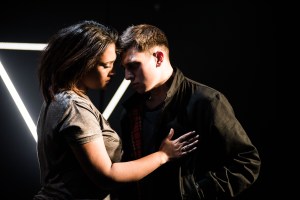
Michael had been the lead singer in a rock band until the trauma of his mother’s death in a road accident left him mute. In his absence, his girlfriend Lauren has paired up with fellow band member Jake, but, when Michael returns, she becomes pressured to help him to speak again, both by Jake, who wants to re-form the band and by Michael’s young uncle/guardian Will, who wants to get on with his own life. An illuminated triangle dominates the back of the stage, Sarah Henley’s book telling of triangular relationships and struggles to break free from the shackles of the past.

Co-songwriter Tori Allen-Martin impresses as Lauren, tormented by her torn allegiances and a guilty secret and Jos Slovick makes Jake a forlorn figure when he realises the consequences of the mission upon which he has sent his lover. Mark Hawkins brings out the frustration of Will and, in flashback sequences, Helen Hobson’s Amanda, the mother, is at first almost angelic but is later exposed as over-possessive and emotionally fragile.

David Leopold’s damaged Michael contrasts beautifully with Edd Campbell Bird’s portrayal of his younger self, brimming over with teenage optimism and ambition. The centrepiece of Sarah Beaton’s memorable set design, which reflects psychological undertones in the story, is an island surrounded by a moat in which both Michaels paddle tentatively. A garden swing hangs from above, as childhood memories intrude upon current dilemmas and the silent, isolated Michael reaches out and searches for his voice.

The show starts slowly and the pacing of the first half is uneven, but, as tension builds, book and songs combine to give brooding intensity to the drama until an unsatisfactory conclusion, which suggests that Henley’s plotting could have taken a wrong turn or two. Jamie Jackson’s inventive direction uses the confined space to striking effect and, although there is no room for dancing, choreographed movement gives visual form to emotions contained in the songs and creates vivid images.

Music and lyrics in the soft rock style by Tim Prottey-Jones and Allen-Martin, accompanied by a band consisting of guitar, bass and drums, generally work well, but the team falls short of delivering the knockout song that could have defined the show and more work is needed to integrate the songs with the book. The lyrics express characters’ inner feelings, but they rarely advance the story and, too often, pivotal dramatic scenes are spoken when they need to be acted out in song.

Although still some way short of realising its full potential, Muted speaks loudly for emerging talent in British musical theatre.

Performance date: 9 December 2016

Photo: Savannah Photographic

trh-2

Benighted*** (Old Red Lion Theatre)

Posted: December 9, 2016 in Theatre

michael-sadlerThis review was originally written for The Reviews Hub:: http://www.thereviewshub.com

“The ultimate creepy Christmas treat” boasts the publicity for this adaptation of JB Priestley’s 1927 novel, Benighted. Perhaps the association between creepiness and the Festive Season has something to do with Dickens, but, otherwise, the only things remotely Christmassy in this production are a quick snatch of Ding Dong Merrily on High, seemingly inserted as an afterthought, and a good old punch-up that brings the party to a halt.

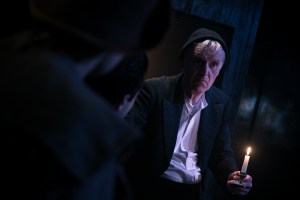
There is not even snow in the remote part of Wales where the action takes place, just rain in what could be the longest continuous spell of thunder and lightening in the history of the Principality. A tetchy Philip Waverton (Tom Machell) and his assertive wife Margaret (Harrie Hayes) are stranded a long way from their Hampstead pad when their car breaks down in the middle of the storm. Out of the boot pops jolly Roger Penderel (Matt Maltby) and the three head off to find shelter in the nearest house – The Old Dark House as it became known when the novel was adapted into the film of that name in 1932. This is not the sort of place that would rate highly on Trip Adviser.

Later, they are joined by another stranded couple, tycoon William Porterhouse (Ross Forder) and showgirl Gladys Du Cane (Jessica Bay), to share their experiences of things that go bump in the night. Michael Sadler looks suitably demented as both the householder and the servant guarding mad cousin Saul, who is locked in the attic, and doubling up of roles by other actors allows for plenty of unexpected entrances. The doors, the floorboards and the plot all creak loudly and one of the actors actually has to speak the line “is there anybody there?” without bursting into laughter.

Happily, what could have been an evening more ghastly than ghostly becomes one of morbid merriment, largely due to director Stephen Whitson successfully navigating a course between parody and gravity. There are many inventive touches in the staging and the company of six all score by playing (or, to be more exact, over-playing) their roles straight. Credit too to Gregor Donnelly, whose set in dark wood makes clever use of a space here that can sometimes be awkward and whose 1920s costume designs look perfect. Lighting by Zia Bergin-Holly completes the spine-tingling effects.

Adaptor Duncan Gates finds traces of the writer with a social conscience that Priestley was to become, with attacks on heartless capitalism and the damage inflicted by the Great War. However, it would be quite a feat to delve into the hidden depths of characters as shallow as these, so that the serious passages in the play feel out of place and do not really work. The production is at its best when it is not taking itself too seriously.

80 minutes (without an interval) is just about the right running time to relate this thin story briskly without the jokes and the shocks becoming tired. Towards the end, the storm abates and we are told that water levels outside are subsiding, which is good news indeed for both the marooned characters and the audience heading out into an Islington still mopping up from its burst water main.

Performance date: 8 December 2016

Photo: Chris Gardner

trh-2

Thebes Land**** (Arcola Theatre)

Posted: December 6, 2016 in Theatre

thebes-landThis review was originally written for The Reviews Hub:: http://www.thereviewshub.com

Crouched inside a three-metre high metal cage is, we are told, a very dangerous creature, a young man convicted of patricide who is on temporary release from HMP Belmarsh with strict security conditions to protect the public. He is, of course, an actor and the deceit is so obvious that we question why Franco-Uruguayan playwright Sergio Blanco would have bothered with it and why he thought it worth the impairment to audience sight lines that the cage causes. However, these turn out to be passing concerns.

The play, getting its UK premier here, translated and adapted by director Daniel Goldman, seems to take pleasure in misleading its audience, almost as if Blanco is trying to divert from the suspicion that its core element, a confrontation between a troubled young man and his interrogator, is a reworking of the formula devised by Peter Shaffer for Equus. Yet, as the drama progresses, it becomes clearer that the diversions themselves have purpose, the themes evolving from a study of the psychology of patricide into a fascinating analysis of the processes involved in creating a piece of theatre. It transpires that Blanco’s real concern is how a writer connects with both his subject and his interpreter (the actor) to bring his work to the stage.

The title refers to the Oedipus legend, yet Blanco dwells on the point that Oedipus himself, being unaware of his parents’ identities, did not possess an “Oedipus Complex” in the strict sense defined by Freud. On the other hand, the killer here, Martin, was fully aware of who his victim was, but his father had been a cruel bully and violent abuser and we do not need to go into the depths of the mind to find the justification for the murder. Mercifully, this opt out allows Blanco to keep his writing relatively free of cod psychology.

The writer, known as just “T”, is played with calm authority by Trevor White, lecturing the audience as if presenting a case study, from outside the cage and interacting with Martin and Freddie, the actor who will be playing Martin, when inside. The house lights remain up for most of the performance, underlining a deliberate clinical feel, but the drama moves subtly into emotional territory in the second act. Somewhat predictably, Martin, afflicted by epilepsy, becomes more victim than monster and equally predictably, bonds are formed between the characters. T is visibly taken aback when confronted with the homoerotic undertones touching both of his relationships, but this emphasises Blanco’s essential argument that real life and theatre are inseparable.

Martin’s cage doubles as a Basketball court and he occupies it like a zoo animal as the audience enters and takes his shots at the net throughout the interval. Alex Austin may not be the best Basketball player, but he gives remarkable performances both as Martin and Freddie, switching between the two effortlessly. His Martin is deeply disturbed and inarticulate, but reaching out for human contact and his Freddie is conscientious, about to graduate from RADA, and almost imperceptibly becoming entwined in Martin’s fate.

Spiced up with with cultural references including Seneca, Mozart, Whitney Houston and the rules of Basketball, Blanco’s intriguing play is structured elaborately, sometimes overly so, but its themes are not as unduly complex as references to Greek legend and Freud may suggest and Goldman’s superbly acted production offers many pleasures, even though some of them are blocked out by the cage.

Performance date: 5 December 2016

Photo: Alex Brenner

trh-2

pride-and-prejudice-nick-underwood-and-joannah-tincey-courtesy-of-carrie-johnson_2This review was originally written for The Reviews Hub: http://www.thereviewshub.com

It is a truth universally acknowledged that very little time will ever elapse between someone coming up with a new take on Jane Austen’s 1813 novel, Pride and Prejudice. Detailing the courting rituals of the well-to-do and the aspirers in an England as yet untouched by the Industrial Revolution, Austen created a timeless classic and chiselled out a template for romantic comedy that is still being put to new uses more than two centuries on.

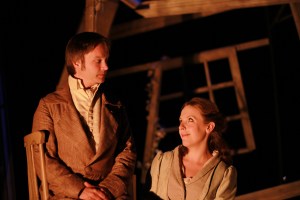
The twist in Joannah Tincey’s adaptation is that the novel is interpreted to be performed by just two actors – Tincey herself and Nick Underwood, who is not hampered by bearing a passing resemblance to Colin Firth. Dora Schweitzer’s set, warmly lit by Simon Wilkinson, has impressions in light wood of a window frame, fireplace and beams, suggesting a welcoming rustic residence. This is a show that would fit into a large living room and delight the extended family at Christmas.

More an acted-out reading direct from the novel than a full dramatisation, Abigail Anderson’s sprightly production sees Tincey and Underwood cast perfectly as the headstrong Elizabeth Bennet and the haughty Mr Darcy. Scenes between these two main characters are realised impeccably. The pair then keeps us on our toes,switching between characters of either gender at the blink of an eye. They become the languid Mr Bennet and his social climbing wife, Elizabeth’s four twittering sisters, the amiable Bingley, the dastardly Wickham, the stern Lady Catherine (each taking a turn to play her) and so on.

Familiarity with the story works both for and against this adaptation. It results in character recognition being much easier when the actors make their quick switches, having few props to help them, but, when the production hits a stodgy patch, the mind is tempted to wander in the safe knowledge that the threads can be picked up later. Austen’s sub-plots come across less successfully in this version than the main Elizabeth/Darcy storyline and, running at over 150 minutes (including interval), the production could well benefit from a little trimming.

There is nothing ground-breaking on display here, but, as a showcase for versatile acting talents and for the wit and perception of Austen, there is not much that can go wrong and this warm, cosy production fits comfortably into its Jermyn Street home.

Performance date: 1 December 2016

Photos: Carrie Johnson

trh-2

The Mirror Never Lies* (Cockpit Theatre)

Posted: November 16, 2016 in Theatre

woman-at-dressing-tableThis review was originally written for The Reviews Hub: http://www.thereviewshub.com

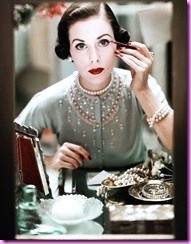
Based on the novel The Sweet Dove Died by Barbara Pym, first published in 1978, this new 90-minute chamber musical is set among people who “go to auctions and expensive lunches”, beautiful people for whom appearance is everything and ageing is a matter for self denial.

Leonora (Francesca Ellis) is a lost soul, leaving her best years behind her and, as it is the 1960s, unable to turn to Botox for help. She becomes besotted with young James (Ryan Frank) whose Uncle Humphrey (Jon Osbaldeston) is besotted with her. Unfortunately, James has a girlfriend nearer his own age, Phoebe (Jennifer Harraghy who sings beautifully) and, even more unfortunately, he also has an eye for his own gender. Such material could provide the foundations for a very camp musical, but one of this production’s problems is that it is nowhere near camp enough.

Ellis does well, given not too much to work with, and she grabs at her big moment singing the title song at the very end. However, Frank’s James looks as if he is convalescing from a recent charisma by-pass and the fact that he becomes such a magnet for other characters is the show’s big mystery. Crossing the Atlantic, James shares a cabin with Ned, a very butch American Professor of “British” Literature who seduces him with little effort. Spencer O’Brien gives Ned real swagger and attacks his two numbers with the sort of gusto that we expect to see in a musical.

Otherwise, Joe Giuffre’s production is stuttering and flat-footed, cast adrift on a bare stage that is much too big for it. Giuffre/s lyrics are often bland and predictable, while his book needs more wit. Juan Iglesias’ score shows a fondness for strong counter melodies, but there is little to evoke a period feel. The songs, performed with the accompaniment of a five-piece band led by Musical Director Joseph Finlay, sound as if they are less than half way towards where they need to be to lift the show.

The mirror never lies and neither should the reviewer, This production always feels like a workshop for a musical that is not yet ready to be seen by the paying public. Viewed as “in progress”, there are glimmers of hope that cracks in the show can be repaired, but it is going ro take a great deal more time and effort.

Performance date: 15 November 2016

trh-2

I Call My Brothers**** (Gate Theatre)

Posted: November 15, 2016 in Theatre

i-call-my-brothersThis review was originally written for The Reviews Hub: http://www.thereviewshub.com

A car bomb explodes in a city centre, chaos descends and fingers of suspicion start to be pointed. Jonas Hassen Khemiri’s 80-minute one-act play looks at the aftermath of such an outrage not from the perspective of the terrorists or the dead and injured, but from that of another sort of victim.

The place is Sweden, but it could be anywhere in Europe or North America. Amor (Richard Sumitro) is a student, dark-skinned and a not very devout Muslim. After a night out clubbing, he heads home to sleep it off and wakes the following morning to hear of what has happened. He calls his “brothers” (meaning those sharing his ethnicity) and is warned to keep a low profile. “Walk like a person who isn’t thinking about walking” he is advised. The play follows Amor through a day in which he encounters many challenges, always thinking that he is being watched.

Designer Sadeysa Greenaway-Bailey configures the studio space cleverly, with the audience placed along what seems like a long passageway, its wall painted in sterile white. Thus we become embroiled in what Amor sees as a conspiracy of suspicion, the majority set against a small minority. The writer drip feeds information, generating suspense and sometimes making our suspicions feel well founded.

Amor roams the city and, against the advice of his “brothers”, he carries a back pack which contains nothing more threatening than a broken hand drill. He tells his story to the audience and talks with other characters on his mobile phone. Director Tinuke Craig uses the full width of the stage to keep characters apart and emphasise Amor’s sense of isolation. His best friend, Shavi (Jonas Khan) pesters him constantly with trivial news about his new-born daughter, a charity worker presses him to donate, his opinionated cousin and deluded grandmother (both Lanna Jeffrey) call to show their concern. Life goes on as normal when nothing is really normal at all and everyday irritants become greatly exaggerated.

Sumitro holds the stage throughout, treading the fine line between comedy and serious drama with natural skill. Amor is not the type who could hide in plain sight easily, his eccentric sense of humour marking him out. His childhood sweetheart (Nadia Albina) no longer reciprocates his feelings, but his behaviour towards her comes close to stalking and Sumitro plays on the suggestion that there could be something sinister about Amor very effectively.

The writer’s style is cryptic, yet still sharp and spiked with playful humour. When he charts a path along which isolation can turn into alienation, his play assumes its most urgent relevance. We know that terrorism is a modern nightmare that has many dimensions, but this thought-provoking production shines a different light on it.

Performance date: 14 November 2016

trh-2