partial nudity

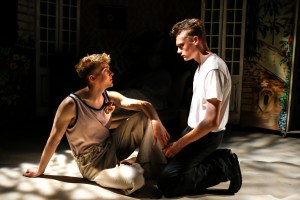
Set in the dressing room of a Northern club, Emily Layton’s 45-minute one act play explores the role of striptease artists in modern culture. Darren (Joe Layton), a lad’s lad from Bolton is here to perform for a hen party, but his outer swagger hides his inexperience and lack of confidence. He is forced to share the dressing room with Nina (Kate Franz), an American student, who is an old hand at the game and self-assured as she prepares to entertain a stag party.

The writer, who also directs, lays the foundations for an amusing rom com, but does not really take the play anywhere and the sparring between the two protagonists is too predictable. Critically, the play takes far too long to get going and, for a piece as short as this, that is a pretty big problem. Towards the end, as Nina educates the naive Darren, there are some astute observations about the hypocrisy of attitudes to sex and gender, but, overall, the play does not bare enough about the world of strippers to be seen as anything more than a lightweight diversion.

Performance date: 7 August 2016

milk

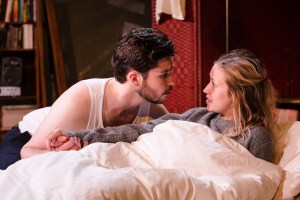
Ross Dunsmore’s debut full length play is a remarkably confident mix of comedy and tragedy, directed with almost dreamlike fluency by Orla O’Loughlin. The narrative has three strands – a war veteran tends for his dying wife, a teacher and his wife nurture their new-born baby and two 14-year-olds fumble their way into the adult world.

The linking theme is sustenance. Baguettes, junk food Mars bars and milk feature in stories that deal with birth, coupling and death. They overlap each other, criss-cross and eventually connect. The three stories are simple in themselves, but, collectively, they say something profound. Funny and heartbreaking in turns, the play builds to a climax that will reduce all but the most hard-hearted to tears.

Performance date: 7 August 2016

in-fidelity-LST207871No sooner than Cilla is cold in her grave, Blind Date is back with a vengeanc. First a nude version on Channel 4 and now a variation for the stage in which, thankfully, the clothes stay on.

As the title suggests, the show is about fidelity or, at least the very start of it, with genial host Rob Drummond pulling volunteers out of the audience, whittling them down to two and taking them to a set that looks very much like a posh dentist’s waiting and setting them off on on a very awkward and very public first date.

At this performance, six volunteers were reduced to five with the quick departue of the solitary gay guy and, eventually, 18-year-old Jordan from New York and 28-year-old local girl Kim were chosen. Was it a coincidence that they were the most “photogenic” of the six? Both were also actors, but the percentage chances of that happening at the Festival are pretty high.

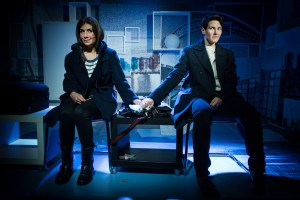
Drummond, also the writer, throws in tit-bits of scientific data about the heart and the brain from the likes of Darwin and several amusing aphorisms, but the show works primarily due to his quick-witted ability to keep it afloat when the audience is not helping him. No-one knows if Jordan and Kim will live happily ever after or even make it to a second date, but they contributed to a mildly amusing 80 minutes anyway

Performance date: 7 August 2016

The Past is a Tattooed Sailor (c) Pamela Raith Photography (3)This review was originally written for The Reviews Hub: http://www.thereviewshub.com

Informing his lover that the rich have it hard too, the hero of Simon Blow’s new play refers to Evelyn Waugh’s A Handful of Dust to prove his point. Blow himself seems more taken with Brideshead Revisited in crafting a tale of two young men who go exploring in the weird and wonderful world of the English upper classes. The play is based on experiences in the writer’s own life and his relationship with his great uncle, Stephen Tennant.

Joshua (Jojo Macari), an aspiring writer who had a troubled childhood, pairs up with his new boyfriend, builders’ labourer Damien (Denholm Spurr) and decides that it is time to learn more about his family heritage. So posh Josh and rough Damien head off into the country to meet the former’s great uncle Napier, who, it transpires is also partial to gents from the working classes, specifically tattooed sailors.

Screens open out to reveal a bellowing Napier (Bernard O’Sullivan) reclining on a chaise longue in his country house and they close again for all other scenes to be enacted in the small space in front of them. Rosie Mayhew’s set design does little to help director Jeffrey Mayhew’s consistently awkward production.

Napier’s house has two ghosts – his younger self (Nick Finegan) and his mother (Elizabeth George) – and we learn how he is an unpublished poet and a painter whose works have never been exhibited. In his youth, he had a Bohemian lifestyle of privilege and excess and names such as Bacon, Beaton, Cocteau, Garbo, Sassoon and Woolf, are dropped casually into his anecdotes.

Blow emphasises Napier’s eccentricity by contrasting him with the tiresomely boring Joshua. The young Napier had gone globetrotting to mingle with icons of the arts worlds and to make lusty assignations with multi-patterned matelots in Marseilles. Joshua stays at home and feels sorry for himself. The eccentric Napier ought to be a source of great mirth, but eccentricity is most fun when served up with generous helpings of wit and, sadly, Blow gives us eccentricity on its own.

Here we have a look into a bygone age that is neither nostalgic nor sentimental nor informative nor meaningful. Perhaps this disappointing little play would be best consigned to the past without undue delay.

Performance date: 5 August 2016

Photo: Pamela Raith Photography

trh-2


The Collector***+ (The Vaults)

Posted: August 5, 2016 in Theatre

Daniel Portman and Lily Loveless in The Collector (c) Scott Rylander (3)This review was originally written for The Reviews Hub: http://www.thereviewshub.com

John Fowles’ debut novel about a butterfly collector who kidnaps the girl of his dreams and keeps her in his basement was first published in 1963 and turned into a successful film shortly thereafter. With only two characters and a single set, it is hardly surprising that stage adaptations followed, the version by Mark Healy seen here being the latest.

Audiences are asked to wind their way through a maze of darkened tunnels under Waterloo Station to find the over-furnished cellar, designed by Max Dorey, that is home for the captive Miranda. The journey sets the mood perfectly. The room has been filled lovingly with everything that it’s occupant may need to make her happy. She has been captured by Frederick not for ransom, not for sex but because he genuinely believes that he loves her and that she will come to reciprocate his feelings.

Inevitably, real-life cases of stalking, abduction and incarceration hang over the play and sour the tone, but what is most extraordinary about Fowles’ story is how it overturns perceptions and expectations. Small details in the play suggest that it is set much later than the novel, but the social issues that it raises still have a feel of the 1960s. Miranda is comfortably off and middle class, but Frederick is uncultured, sexually repressed and beset by a sense of inferiority. A lottery win instils in him the belief that money can get him everything that he yearns for, including Miranda.

Chatting amiably directly to the audience, Daniel Portman’s Frederick is more an ardent suitor than a malicious abductor. He strips the character of menace to the point that the audience starts rooting for him, wanting him to get the girl, while still knowing that what he is doing is very wrong. This inversion of type is what makes the play so interesting, as it asks us to reflect on how relationships develop in natural circumstances and on how gender and social factors impact upon them.

Lilly Loveless makes Miranda a Miss Bossy Boots, continually manoeuvring and testing Frederick’s limits while struggling to gain the upper hand and achieve her liberty. Healy’s version of the story is more a battle of wills between the two protagonists than a suspense thriller and it only becomes truly sinister towards the end.

There is one small criticism of Joe Hufton’s taut and lucid production, which is that his staging needs to give more consideration to the poor sight lines at this venue. In all, The Collector is an intriguing piece that feeds off its own moral ambiguity and translates almost perfectly from page to stage.

Performance date 4 August 2016

Photo: Scott Rylander

trh-2


1_sunset-38

Set on on the idyllic Greek island of Skiathos, Alexi Kaye Campbell’s new play is actually concerned with America, a country that. as the writer sees it, tramples all over ancient civilisations in order to achieve its own narrow objectives. In 1967, Theo (Sam Crane) and Charlotte (Pippa Nixon) are bullied into buying the villa that they have been renting from an impoverished Greek family by a brash American, Harvey (Ben Miles), who is something with the US Government in Athens. Nine years later, Harvey and his wife return to the villa after a spell in Chile, where there has been another American backed coup.

Theo is a playwright, working on something that sounds remarkably similar to Kaye Campbell’s own The Pride and Charlotte is an actress whose strong principles lead her to resist displacing Greeks from the island and breaking local traditions. They make a convincing couple and Miles attacks the role of the irresistible Theo forcefully. Harvey’s wife June is mostly wasted (meaning drunk), but, playing her, Elizabeth McGovern is wasted in the other sense, unable to find anything interesting in a weakly-drawn character.

As always, Kaye Campbell’s writing has a simple fluency that captivates, but, on this occasion, there are patches of laziness, particularly in long, dull speeches, firstly by June and then by Harvey, describing events in far off lands. More importantly, the connections between the story being told on stage and the underlying themes are not always clear and improbabilities in the plotting, small individually, add up to eat away at the play’s credibility.

With the Dorfman in a thrust stage configuration, Hildegard Bechtler’s unfussy design takes us effectively to a Greek island and Simon Godwin’s low key production offers many pleasures. However, the playwright’s previous works, The Pride and Bracken Moor, raised expectations high and this play is slightly disappointing.

Performance date: 30 July 2016

Rotterdam*** (Trafalgar Studios)

Posted: August 1, 2016 in Theatre

Rotterdam - Alice McCarthy and Anna Martine-2This review was originally written for The Reviews Hub: http://www.thereviewshub.com

“Rotterdam is anywhere. Anywhere alone…” goes the Beautiful South song. To the three British expats in Jon Brittain’s play, first seen at Theatre 503 in 2015, the Dutch port city is a place where things are moved in and out and now they are all looking for the exit. Alice came to be alone, believing Rotterdam to be a location to which her boyfriend Josh would never follow her. He did, bringing with him his little sister Fiona who promptly paired up with Alice.

Seven years on, it is 31st December in the flat that the three share and Alice has at last decided to come out to her parents by e-mail, her finger hovering over the “send” button as if she could be about to launch a nuclear missile, but Fiona has a bombshell of her own. She reveals that she is really a man living in a woman’s body and plans to change her gender. It is time for the fireworks and the beginning of a not so happy New Year for all.

Fiona sets out on the journey that will transform her into Adrian and Alice, who has only ever found women attractive, has to adjust to her long-term partner becoming a man and one who gets mistaken for his sibling, her former boyfriend. Brittain juggles dilemmas of sexual and gender identity deftly and Donnacadh O’Briain’s brisk production is well-suited to the intimate setting here.

Brittain has a real feel for comedy, poking fun at the uptight, dithering Alice (Alice McCarthy) and the transitional Fiona/Adrian (Anna Martine). Jessica Clark is engaging as the carefree office girl who tries to lure Alice away, but the best one-liners are reserved for the jocular Josh and Ed Eales-White makes great use of them. However, all this comedy comes from scratching the surface of the issues raised and Brittain is far less successful when attempting to dig deeper into the emotional turmoil faced by his characters.

The play is made up of a succession of shortish scenes, punctuated by bursts of Euro-pop, Ellan Parry’s modern, predominantly white set design giving the production a cold feel. Most of the scenes could be better described as arguments – the characters convene, usually in pairs, they have a row and they part. This repetitive pattern eventually gets wearying and it also contributes to robbing the play of much of the warmth and tenderness that it would need to become genuinely moving.

At least 75% of Rotterdam is breezy comedy, which provides just about enough entertainment to gloss over disappointment that it does not quite arrive at anything more profound.

Performance date: 28 July 2016

Photo:Piers Foley Photography

trh-2


into the woods

“Be careful what you wish for” is the message of Stephen Sondheim’s  show and how true it is. A couple of years ago, a revival would have been high on the wish list, but, since then, several fringe productions and a major Hollywood film version have relegated it way down and this imported production from the American company Fiasco Theater really suffers from poor timing.

If there is anyone left who does not know, James Lapine’s book knots together several classic fairy stories and turns them upside down as they are untangled. A first viewing of the show delivers the shock of all the characters living unhappily after the interval, a second viewing is needed to marvel at the intricacy of it all, but, once it has become familiar, it starts to feel a little stale. Even so, the show provides a home for some of Sondheim’s most sublime songs – AgonyStay With Me, Children Will Listen, Last MidnightNo More, No One is Alone, etc.

A pre-show announcement that the Baker’s Wife, whose storyline revolves around her inability to have children, is to be played by Jessie Austrian, who is in the later stages of pregnancy, sets the tone, by telling us that this is a production in which the audience’s imagination  will play a huge part. There is nothing too imaginative about the staging, it is all about improvisation, ensemble timing and boundless energy. The accompaniments come from an upright piano (played by Evan Rees) that is moved around the stage at dangerous speeds and members of the company picking up various instruments.

Vanessa Reseland is a youngish Witch, wearing a Phantom-like mask until she transforms into a chic, modern vamp. Her Last Midnight is a stunner. Claire Karpen is a sweet Cinderella, Patrick Mulryan a dopey Jack and Noah Brody and Andy Grotelueschen are less than charming princes (the latter doubling as the cow). The entire show is sung beautifully, most memorable being Ben Steinfeld (as the Baker) stepping down into the audience for a heartbreaking No More. But the title of that song says it all and, for me, it feels like a good idea to stay out of the woods for a while.

Performance date: 27 July 2016

titanic-the-musical

“…it is only the ship that sinks, because this is a musical that floats blissfully on air and soars” I gushed when reviewing Thom Sutherland’s production at Southwark Playhouse almost exactly three years ago. Returning to it here, I have not changed my mind one tiny bit. The configuration of the theatre is different – conventional proscenium stage – but the ensemble performances are as good and Maury Yeston’s music and lyrics set scenes and tell stories with just as much clarity as before. It is as if Yeston uses the audience’s foreknowledge of the ship’s fate to add poignancy to every song and some of them scale heights of musical theatre that only Stephen Sondheim and a few others have ever reached. Gushing again!

My original review is filed under August 2013, so no need to repeat it. The added pleasure on this occasion was that I sat directly in front of Maury Yeston himself, who appeared on stage for a 30-minute Q&A session afterwards. Aged 70 and a professor of Musicology at Yale University, Yeston seemed completely at home and treated the session as if a masterclass. His words of encouragement to a budding Danish writer who is currently working on a musical tragedy (not that tragedy surely!) were worth noting – “if at first you don’t succeed…” etc, but Yeston himself should know all about that, having completed a musical version of Phantom of the Opera in the 1980s only to be beaten to the gun by someone else. He was not the only one working on a Titanic project in the late 1990s, but he managed to get in a few months before James Cameron.

Yeston did not forget to mention (several times) that Titanic won every Tony for which it was nominated. His two other big Broadway successes have been Grand Hotel and Nine, but he is in London to promote the UK premiere of Death Takes a Holiday, a smaller chamber musical, at this theatre in December. It is an adaptation of an often dramatised supernatural story, first filmed in 1934 and seen most recently as the Brad Pitt film Meet Joe Black. It was good to “meet” Mr Yeston.

Performance date: 26 July 2016

The Soul of Wittgenstein Press Photo 4This review was originally written for The Reviews Hub: http://www.thereviewshub.com

At first glance, Ludwig Wittgenstein (1889-1951), an Austrian-born philosopher, would not seem to be an obvious subject for a comedy, albeit one tinged with tragedy. However, this remarkably accomplished new 70-minute play by established Australian playwright Ron Elisha dispels doubts very quickly.

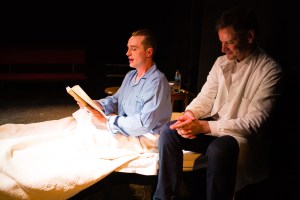
Of Jewish descent and, for three of his childhood years, a classmate of Adolf Hitler, Wittgenstein taught at Cambridge University from 1927 onwards, but, during World War II, he worked as a porter at a London hospital. Elisha gives a fictional account of the academic’s relationship with John Smith, a young terminally ill patient in the hospital at the time of the Blitz.

The play is a variation on the familiar odd couple formula, spiced with enough wit and originality to make it fresh. Wittgenstein teaches the illiterate John to read, introducing him to Tolstoy and Dickens; John reciprocates with lessons in Cockney rhyming slang. Gifted and able-bodied, Wittgenstein suffers from fits of depression, while the stricken John is irrepressibly cheerful.

John condenses Wittgenstein’s 75-page thesis into just eight words as Elisha makes the point that the experiences of living are simple and do not need deep analysis. He shows us icy philosophical theory being moderated by real life and melted gown by human warmth.

Comedy and pathos are blended perfectly in Dave Spencer’s impeccably acted production. Richard Stemp’s Wittgenstein begins with the air of TV’s Frasier, an arrogant intellectual whose pomposity is set to be pinpricked regularly, but then the actor conveys the gradual softening of the character brought about by compassion and friendship. Ben Woodhall’s bedridden John is a joy, uneducated and cheeky, but uncannily perceptive. The pair bounce Elisha’s sharp lines off each other with precision timing.

It can be argued that the ending is slightly misjudged, but, otherwise, the play is consistently sure-footed when tackling tricky themes and this production merits a longer run than the four performances that it is getting here as part of the King’s Head Theatre’s Festival46 new writing season. Rarely can the dry subject of Philosophy have been made so funny and moving.

Performance date: 22 July 2016

Photo: Chris Tribble

trh-2