Hide and Seek (Park Theatre)

Posted: March 15, 2024 in Theatre

Photo: Mariano Gobbi

Writer: Tobia Rossi

Director and translator: Carlotta Brentan

⭐️⭐️⭐️

Italian playwright Tobia Rossi has found a novel way of exploring the growing pressures placed on teenagers in modern times. His 85-minute two-hander is a dark and sometimes shocking parable for the age of social media,

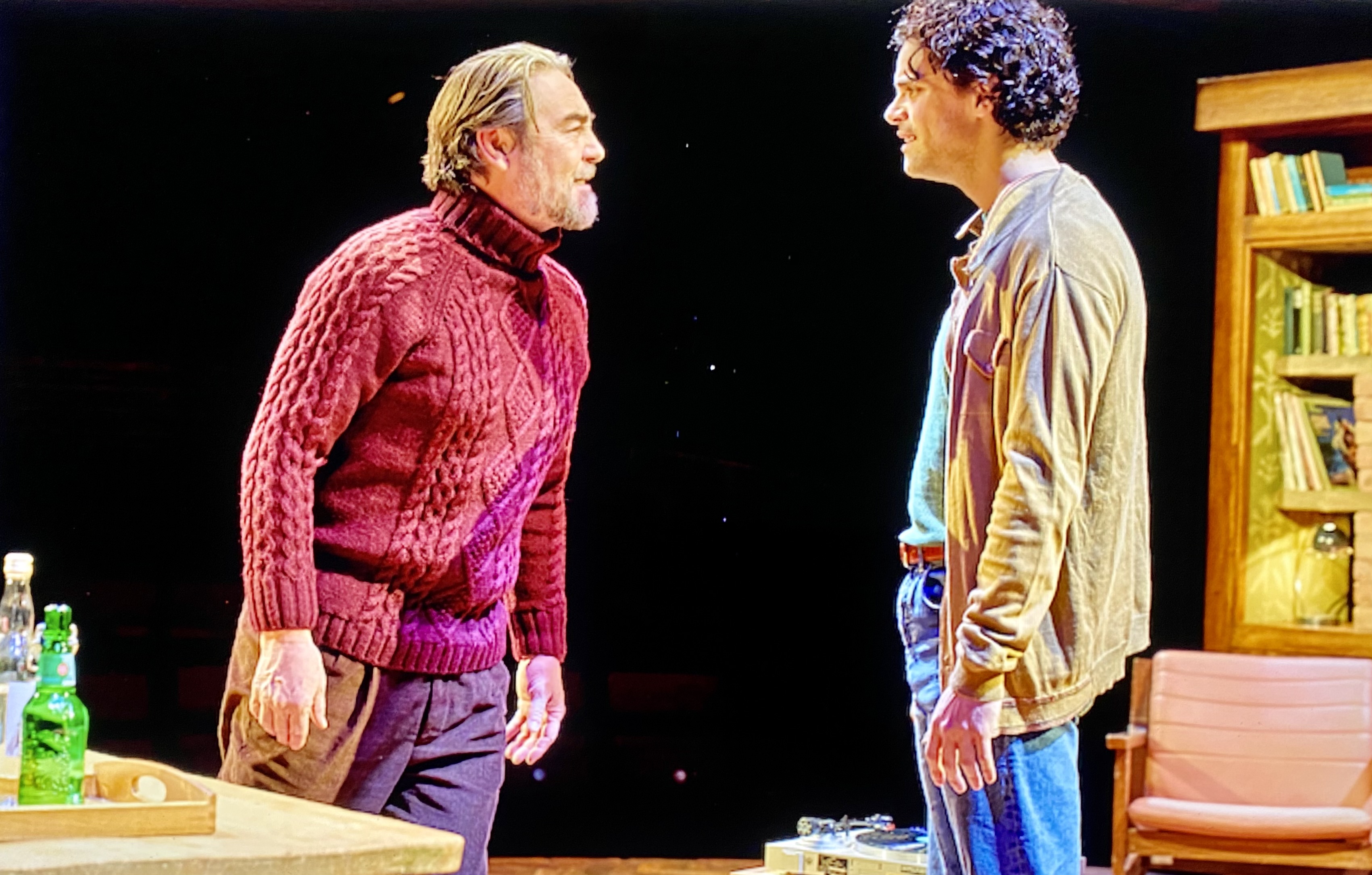
In Hide and Seek, the hider is Gio (Louis Scarpa), a teenage schoolboy who we assume to be gay, and the seeker is Mirko (Nico Cetrulo), a slightly older boy from the same school in rural Italy. Gio has taken refuge in a remote cave to escape the bullying and torrents of online abuse hurled at someone who happens to be different from their social group. His absence could be construed by the wider world as kidnapping or murder and, when Mirko finds him, he becomes complicit in a growing deceit.

The boys’ conversations centre around Tik Tok, WhatsApp, “hits”, “likes” and so on, They share their admiration of comic book super heroes. When Mirko relays news of the frenzy that Gio’s disappearance is causing in the local community and throughout Italy, Gio shows more delight in his newfound celebrity status than concern about worrying family and friends, thereby highlighting the dehumanising effect of social media.

Rossi’s script requires Gio and Mirko to be both mischievous boys and sexually awakened young men. Occasionally the dialogue jars, feeling not quite right for a situation, but the actors, both excellent, have few problems in bridging the gap between the different sides of each character. The bond between the pair grows and takes on more sinister undertones as Mirko becomes dominant and manipulative and Gio’s ambitions become more irrational. Once more, youngsters who are at ease in the virtual world are seen to struggle when dealing with real emotions.

Having translated to play into English, Carlotta Brentan directs a production that is consistently engrossing and equally disturbing. The entire drams unfolds inside a cave which has no natural light, leaving set designer Constance Comparot to fill the tight studio space with a central representation of a rock and Gio’s essential provisions scattered around. Seemingly more challenging is the job of lighting designer and Alex Forey copes admirably.

In the closing stages, Rossi’s play seems to emulate the plight of the two lads, finding itself in a dark place with no clear escape route. The conclusion which the writer finds is not entirely satisfying, but, at least it gives cause for hard reflection.

Performance date: 15 March 2024

Photo: Marc Brenner

Writer: William Shakespeare

Director: Brigid Larmour

⭐️⭐️⭐️⭐️

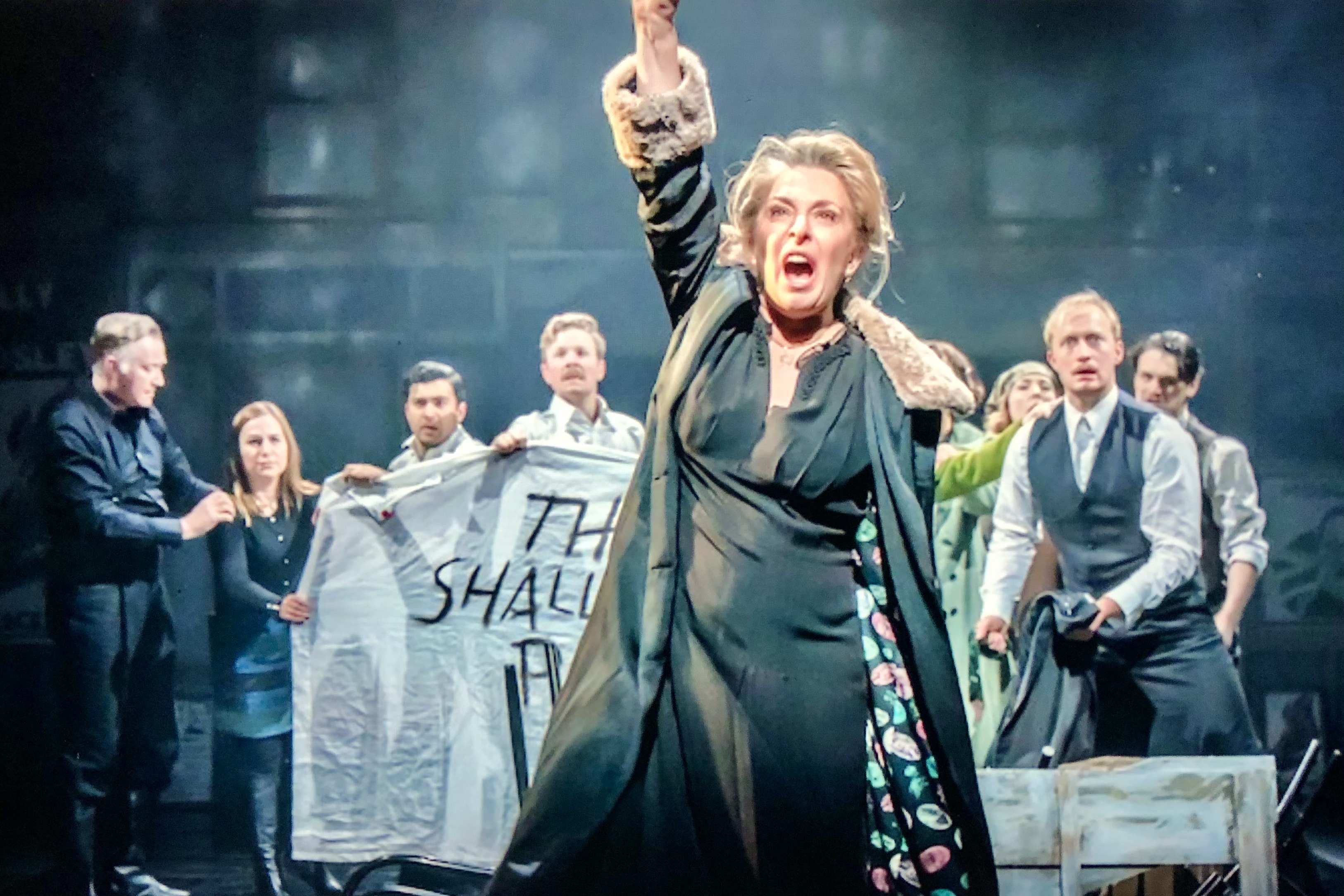
Increasingly in recent years, The Merchant of Venice has come to be regarded as one of William Shakespeare’s problem plays, due to the perceived antisemitism in its treatment of the vengeful Jewish moneylender, Shylock. Perhaps cutting the most offensive lines could sweep some of the difficulties under the carpet, but, courageously, director Brigid Larmour’s revival takes exactly the opposite approach by tackling the problem head on.

The production lands in the West End for a limited run almost a year after it began touring. Therefore, it was conceived well before the sequence of events triggered on 7 October 2023 added new urgency to its anti-antisemitic sentiments. This version of the play is set in the East End of London in 1936, when mobs of black-shirted demonstrators, led by former Labour Member of Parliament Oswald Mosley, were swarming the streets in ugly protests against the Jewish community, aligning themselves with activities of Adolf Hitler’s Nazis in Germany. Real life newsreel footage from the time and newspaper cuttings are projected onto the set, accompanied by British nationalist images and patriotic songs.

The change of setting does not explain the change in Shylock’s gender, but making the character a woman takes nothing away from the power of the messaging. In fact Tracy-Ann Oberman’s compelling performance in the role provides more than adequate justification. Abandoned by the elopement of her daughter Jessica (Gráinne Dromgoole) with the gentile Lorenzo (Priyank Morjaria), she becomes an isolated figure and it is made abundantly clear why the racist abuse which she receives, particularly at the hands of the arrogant merchant Antonio (Raymond Coulthard), is unbearable and why she is driven to claim her pound of his flesh.

The lack of colour in Liz Cooke’s set and costume designs establishes a sombre tone which runs throughout. This makes the rather silly romcom  that takes up a large part of the play’s first half seem even more ill-fitting than usual. Portia, played as a very modern professional woman by Hannah Morrish, has inherited great wealth from her late father and now has to choose between suitors by getting them to open caskets. There is much more potential for comedy here than Armour chooses to squeeze out, but perhaps it is wise to understate these scenes rather than risk undermine the gravity of the production’s overriding themes.

Portia’s chosen suitor is Bassanio (Gavin Fowler), Antonio’s close friend, and thus she is drawn into the merchant’s conflict with Shylock. The stage is now set for a searing, all-female courtroom battle of breathtaking intensity. Very lucidly, the question is asked as to who is in the right – the persecuted and abused Shylock, fighting for her honour, her heritage and her faith or Antonio, defending his flesh and his life.

in this adaptation by Armour and Oberman, the play runs for a manageable 130 minutes and, even if the brief sermonising which rounds it off feels unnecessary, it underlines the deep passion of all involved in the project. When the quality of mercy prevails here, we are left hoping that the same will soon happen universally,

Performance date: 21 February 2024

Photo: The Other Richard

Writer: Neil D’Souza

Director: Alice Hamilton

⭐️⭐️⭐️💫

Have you ever wondered what goes on in a holiday resort such as Ibiza after the young revellers have departed? Have you ever wondered what becomes of fun-seeking lads when they are not lads any longer? Neil D’Soiza’s bitter-sweet new coming of middle age comedy sets out to answer these questions and to peel back layers of male friendships.

Chris. a small-time guitarist and singer is about to celebrate his 50th birthday. It is October and he arrives in Ibiza with his slightly older friend Dev, 30 years after they first holidayed at the same hotel in the same room 547. Dev is a somewhat geeky music teacher who has “I love Dvorak” tattooed  in a privates place and brings along a Thomas Mann novel for bedtime reading. Neither has maintained a successful relationship.

This is a character driven play that relies on strong performances. Peter Bramhill’s Chris is a likeable extrovert who occasionally lets slip a feeling of low self-esteem and regret for missed opportunities. The writer himself gives a beautifully understated performance as Dev, a British Asian who is withdrawn and has allowed himself to play the role of an underling. The two men’s inner characters start to be revealed when they meet two women, also holidaying from England – Holly (Kerry Bennett) and Amy (Catrin Aaron).

The play meanders rather aimlessly through an amusing but insubstantial first act, but it then springs to life with the appearance of Michael, the third member of the lads’ holiday of 30 years earlier, who immediately orders five magnums of Champagne. James Hillier gives Michael the unpleasant swagger of a man who has achieved success as a music agent but has shown a callous disregard for others, particularly women, encountered along the way.

Director Alice Hamilton’s breezy production allows all five actors to shine in a compact studio space. A lot is crammed into Janet Bird’s set design, representing a standard Spanish tourist class hotel room, dominated by a large double bed, which, we are assured, can be split into two singles.

D’Souza’s writing reveals a subconscious hierarchy in the structure of male friendship groups. Here, Michael is clearly the alpha and the other two fall in line behind him. Patterns of behaviour that are established at the start of their friendship prevail over decades and are repeated, with seemingly harmless banter turning into bullying which can leave permanent scars. 

Out of Season is a gentle comedy with subtle insights. The writer leaves his characters with faint hints that, even in their Autumnal years, brighter futures can still be found.

Performance date: 22 February 2024

Photo: Mark Douet

Writer: Jez Butterworth

Director: Sam Mendes

⭐️⭐️⭐️⭐️⭐️

It is now almost seven years since The Ferryman hit the London stage, making it a long wait for Jez Butterworth to stake another claim to be dubbed our greatest living playwright. That 2017 Ireland-set drama went on to pick up both the Olivier and Tony awards for Best New Play, so, whatever the fate of The Hills of California, its arrival must rank as a major event in theatre.

Belying the play’s title, its setting is the Northern English seaside resort, Blackpool. It begins in the long hot Summer of 1976. The Sea View guest house lacks air conditioning and it has seen better days, but it has never viewed the sea. The set, designed by Rob Howell and reaching up to the theatre’s ceiling, is a labyrinth of steep staircases, brown furniture and bric-à-brac. A non-functioning juke box sits centre stage.

The owners are the Webb family and three sisters belonging thereto – Jill (Helena Wilson), Ruby (Ophelia Lovibond) and Gloria (Leanne Best) – gather in the guest house while their mother, Veronica, lies dying upstairs. They await the arrival of a fourth sister, Joan, who had left to pursue a show business career in California 20 years earlier. It will be for the four to decide whether to authorise a final dose of morphine to end their mother’s pain.

The writer sees this dysfunctional family as a microcosm of a wider world that was caught in a vice-like grip by American culture in the early years of movies, radio and television. Flashback scenes transport us to the mid-1950s when Veronica (Laura Donnelly in blazing form) is seen moulding her young daughters to become the next Andrews Sisters, targeting the London Palladium, Carnegie Hall and beyond. This pushy showbiz mum is a Mamma Rose from Gypsy for whom nothing is coming up roses.The Andrews Sisters themselves are already yesterday’s news, having been replaced in popularity by the likes of Nat King Cole, and Elvis Presley lies on the horizon.

An understanding that the Hollywood dream is actually a mirage runs through the play like the lettering in a stick of Blackpool rock. Butterworth’s dialogue merges the lyrical and the earthy, threaded together by strong, dark humour. He writes as if he has spent half a lifetime surrounded by Northern matriarchs.

The play reunites Butterworth with director Sam Mendes, who showed with  The Ferryman a flair for marshalling enormous casts. Here 22 actors have speaking parts and they come up with several delightful cameos in support of the four wonderful principals. This production’s greatest strength lies in the loving care devoted to giving every character depth and meaning.

From the ashes of shattered dreams, the play seeks reconciliation. Arguably the third act is a little overlong and brings in unnecessary plot asides, but a climax in which truths and falsehoods become inseparable brings the drama to a wistful and wise conclusion. Yes, at three hours including an interval, it is a long play, but sometimes it is impossible to have too much of a good thing.

Performance date: 8 February 2024

Photo: Manuel Harlan

Writer: Beth Steel

Director: Bijan Sheibani

⭐️⭐️⭐️⭐️

As we leave January behind us, we can embrace the warming prospect that we shall soon see the arrival of Spring, traditionally the season when wedding bells fill the air. Beth Steel’s new comedy/drama adds a dash of trepidation to this thought as she sets out the routines  attaching themselves to a working class wedding in Northern England and then tears them apart.

Sylvia (Sinéad Matthews) is getting married to Marek (Marc Wootten), a self-made businessman of Polish origin. She panics as she fails to zip up her wedding dress while her father, Tony (Alan Williams), a widower, is waiting to give her away. Hazel (Lucy Black) and Maggie (Lisa McGrillis) are her sisters, the former married to unemployed John (Derek Riddell) and with two mischievous young daughters, the latter  having moved away from the area a year earlier for mysterious reasons.

Steel reserves her most acerbic lines for the forthright Aunty Carol (a stand-out performance from Lorraine Ashbourne), who is married to Tony’s estranged brother Pete (Philip Whitchurch). Carol takes control on arrival and suffers the indignity of having her flamboyant hat attacked by the cat. The perceptive comedy rolls along briskly during the first act, but appears to be going nowhere until everything starts to unravel.

The writer’s proposition is that the rituals in place at weddings, partly designed to paper over cracks in family life, in fact serve to magnify them and bring them to the surface. She harks back to themes in her 2014 play, Wonderland, to find lingering resentments resulting from the 1984/85 Miners Strike and she exposes the racism that underlies the family’s reluctant acceptance of Malek. Most telling are the long suppressed passions that are unleashed by an excess of Polish vodka, seen when John and Maggie are caught in an embrace and when Tony becomes Tarzan and, hilariously, wrestles with a crocodile before carrying Jane (Aunty Carol) over his shoulder to safety.

Director Bijan Sheibani’s slick production thrives on magnificent ensemble acting that brings the many characters to vivid life. Designer Samal Blak takes full advantage of the staging that is in-the-round, literally, marked out like the centre circle on a football pitch, perhaps symbolising a wedding band, or, more likely, a circus ring. The reception, for which the family convenes around a giant revolving top table is a first act highlight.

Steel’s play lulls the audience into a false sense of security by starting out as a cosy comedy and then turns itself into a raw and real family drama, building to an explosive climax which rattles the foundations of the Dorfman Theatre.

Performance date: 31 January 2024

Plaza Suite (Savoy Theatre)

Posted: January 29, 2024 in Theatre

Photo: Marc Brenner

Writer: Neil Simon

Director: John Benjamin Hickey

⭐️⭐️⭐️

With breathtaking view across Central Park, the Plaza Hotel has come to symbolise the height of Manhattan luxury and elegance. Therefore, it seems fitting that this revival of Neil Simon’s 1968 play set there should be staged at a theatre annexed to the Savoy, one of London’s equivalent locations. The production arrives with ticket that could just be affordable for paying guests at these hotels and the big question is whether or not the show matches their five-star ratings.

Simon was the unchallenged King of Broadway comedy in the 1960s and 1970s, but his success in the West End has been less consistent. Presumably hoping to transform the late writer’s fortunes on this side of the Atlantic, director John Benjamin Hickey’s production boasts the star casting of real-life married couple Matthew Broderick and Sarah Jessica Parker and, playing three roles each, they are certainly made to work their shifts.

Set designer John Lee Beatty’s gleaming representation of Suite 719 at the Plaza draws gasps from the audience as the curtain rises and it also sends out an early message that this will be an utterly conventional staging of the play, or rather the three separate plays that have only the setting in common.

Visitor from Mamaroneck is the first and longest of the segments. Sam and Karen Nash, having moved into the hotel temporarily while their home is being redecorated, are celebrating their 23rd or 24th wedding anniversary in the same suite where they spent their honeymoon, or maybe in the one below it. Parker excels here as the scatterbrain, attention-seeking wife and mother who is losing her grip on both roles, fumbling around to find ways to respond to her husband’s supposed infidelity with his secretary. Broderick has little to do but return the volleys fired at Sam and look as glum as if this is Ferris Bueller’s off day. The jousting runs out of steam midway, needing Hickey to inject more pace and energy to enliven the comic interplay and compensate for the absence of topicality in the social and cultural references..

Visitor from Hollywood is an odd little snack, sandwiched between two main courses. Broderick is Jesse Kiplinger, a lecherous three-times divorced film producer who invites a married woman, Muriel Tate (Parker) to the suite, hoping to re-light a flame from 17 years earlier. Muriel knows why she is there, but puts up token resistance before becoming intoxicated by Jesse’s name-dropping and the thought that she is one degree of separation from Humphrey Bogart, Frank Sinatra, etc. This is a lightweight, only mildly amusing seduction comedy from the pre-Harvey Weinstein age and, looked at from a modern perspective, it makes rather discomforting viewing.

In true Broadway tradition, Simon leaves the best till last. The Visitor from Forest Hills sees Roy and Norma Hubley checking in for the wedding of their daughter. Their problem is that, with the ceremony ready to start, daughter has locked herself in the bathroom. Simon now switches to a broader style of comedy, including slapstick, which suits Broderick perfectly. He milks the laughs as the beleaguered Roy, frantically counting the mounting cost of the reception downstairs. Parker is also hilarious as the mother fussing over the details of her own wedding outfit while overlooking the fact that there could be no wedding at which she can display it.

Overall, this revival is a mixed bag with a glittering exterior. It is lavish, starry and it oozes class, but it also carries several reminders that all that glitters is not gold.

Performance date: 25 January 2024

Kim’s Convenience (Park Theatre)

Posted: January 14, 2024 in Theatre

Photo: Mark Douet

Writer: Ins Choi

Director: Esther Jun

⭐️⭐️⭐️💫

Ins Choi’s one-act play, Kim’s Convenience, first seem in Toronto in 2011, has already spawned a Netflix series and it now arrives in North London trailed by high expectations. In a narrow sense, this is a routine family comedy centred around a bullying patriarch, but, judged in its wider context, the play can be seen as an affectionate tribute to the positive contribution made by Asian immigrants to Canadian society.

Director Esther Jun’s spirited revival sees the writer himself taking on the role of Mr Kim (known as “Appa”), the owner of a small community store in a rapidly changing area of Toronto. Walmart is threatening to move in and Kim receives an offer to sell up, but he is set on keeping the store in his family and continuing Korean traditions. Choi writes amusingly but powerfully about struggles to preserve heritage and identity in a world of continuous change.

Kim is obsessed with Korean history and harbours long-standing  resentments, particularly against the Japanese. He is bombastic and intransigent, prepared even to use violent coercion to get his own way.

This bigoted monster at times looks like a modern-day Alf Garnet and, as it should, the role fits Choi like a glove. It could come as a surprise to some that we are still allowed to laugh at such an outrageous character in these days of political correctness. Yet laugh most of us will.

The family consists of Kim’s wife, Umma (Namju Go), his daughter, Janet (Jennifer Kim) and an estranged son, Jung (Brian Law). Kim is determined that Janet will take over the store, but she refuses, being more interested in pursuing a local policeman, Alex (Miles Mitchell). Set designer Mona Camille makes sure that the shelves are fully stocked and, although the play is far from being a world beater, there is absolutely nothing to dislike in its entire 80-minute running time.

Choi’s comedy sticks to its predictable formula right through, unsubtle and occasionally raucous, but, when the resolution arrives, it is underplayed so delicately that it becomes genuinely touching.

Performance date: 12 January 2024

Photo: Douglas Armoir

Composers: Joel Goodman and Jan Osborne

Bool: Joan Greening

Director: Jane Miles

⭐️⭐️⭐️⭐️

Anyone fortunate enough to be in possession of a £50 note could look at the proud face that adorns it, that of Alan Turing, and ponder over the many ironies of an extraordinary life that journeyed from hero to zero and then, posthumously, back to hero. This 80-minute show delivers exactly what the title promises and charts the rise and fall of the man who contributed massively to his country’s victory in World War II and, along the way, invented the computer.

Played by Joe Bishop, Turing is seen as a man whose intellectual capacity and obsession with mathematics sets him apart from all those around him. He regards himself as occupying a separate parallel universe and, in the unenlightened era of the 1930s-50s, he is a homosexual in a world of heterosexuals. The death of a boyhood friend, Christopher Morcom, possibly an intellectual equal, scars him and the savage injustices inflicted on him in later years leave him mortally wounded.  Bishop’s sensitive portrayal lays bare his deep loneliness.

Zara Cooke plays all other significant characters in Turing’s life: his mother, his tutors, an aggressive police officer included. Most movingly, she becomes Joan Clarke, the woman alongside whom he graduates from Cambridge and with whom he reunites for wartime codebreaking work at Bletchley Park. Very briefly, they become engaged to be married.

In essence, Turing is as much of an enigma as the German code that he strives to crack and Joan Greening’s book can only skim over the surface of his life and achievements. Instead, the focus is placed firmly on Turing’s lifelong emotional turmoil and the music, composed by Joel Goodman and Jan Osborne, heightens the impact of this approach. Director Jane Miles’ simple but intense production further emphasises this central focus.

Turing died in 1954, aged only 41, and his subsequent elevation to iconic status reflects important changes in society, but it can hardly be recompense for the degradation that he suffered at the hands of the country which he served with such brilliance. A £50 note would be enough to buy a pair of tickets for this revealing little show, with change to spare. It would be money well spent.

Performance date: 9 January 2024

Rock ‘n’ Roll (Hampstead Theatre)

Posted: December 13, 2023 in Theatre

Photo: Manuel Harlan

Writer: Tom Stoppard

Director: Nina Raine

⭐️⭐️⭐️💫

Any play that begins as the Russian army invades a neighbouring country is sure to strike a chord with modern audiences, even if they are too young to remember the events of 1968. This revival of Czech-born writer Tom Stoppard’s 2006 play Rock ’n’ Roll serves as a timely reminder of the impact of the foreign occupation of Czechoslovakia on the country’s people, their freedoms and their culture, including, of course, their music.

Unlike the present day, 20th Century divisions in Europe were founded, at least in part, on ideological differences, the West upholding the principals of capitalism and democracy and the Eastern Soviet bloc following the principals of communism and authoritarian rule. These opposing ideologies form the basis for Stoppard’s play.

Max (Nathaniel Parker) is a university professor, living in Cambridge with his dying wife, Eleanor (Nancy Carroll). He is a prominent Marxist, believing unswervingly in egalitarianism and the iron-fist methods needed to enforce it. Jan (Jacob Fortune-Lloyd), studying for a doctorate, is his pupil and supposed disciple. The 1968 Russian invasion of Czechoslovakia inspires Jan to move back to his home country and he packs up his precious vinyl collection of rock music and leaves for Prague.

On arrival, Jan experiences the realities of the occupation. The country’s  leader, Alexander Dubček is perceived as weak (“basically Cliff Richard”) and its leading rock band, The Plastic People, is driven underground. Working as a writer, Jan becomes a dissident and he pays the price. For large chunks of the play, Stoppard is, in effect, playing Devil’s advocate with himself as he lays down the arguments to support the viewpoints of both Max and Jan, but the problem is that good arguments do not necessarily make good drams. Perhaps realising this, the writer brings in human stories of friendship and romance, but they come across as afterthoughts and the two distinct elements of the play never connect properly with each other. 

The second act leaps forward 19 years. Margaret Thatcher has just been re-elected as the United Kingdom’s Prime Minister, Max is showing signs of dementia and U2 have replaced The Rolling Stones at the top of playlists. Most significantly, there are signs that The Cold War is beginning to thaw. Jan returns to Cambridge to find that the obdurate Max has not moderated his views and the drama becomes cluttered with secondary characters as the writer seems to struggle to find an apposite ending.

The unevenness of the play takes us on a rocky ride, but director Nina Raine’s classy in-the-round production makes it much smoother. The acting is impeccably and Anna Reid’s set designs with Peter Mumford’s atmospheric lighting supports the actors admirably.

The writer’s sharp wit shines through the fog that the play sometimes walk into. Overall,Stoppard’s clearest message could be that political regimes come and go, but rock ’n’ roll lives forever.

Performance date: 12 December 2023

Photo: Marc Brenner

Writer: Annie Baker

Director: James Macdonald

⭐️⭐️⭐️⭐️

Annie Baker seems to have taken up a forms of residency at the National’s Dorfman Theatre, Infinite Life being the award-winning American writer’s fourth play to be staged at the venue since 2016. In style, this new work has much in common with the first of these plays, The Flick in which a group of lonely strangers gather in a near-empty cinema. Here, five women patients in a California hospital chatter mundanely while reflecting on mortality and the even worse alternative, infinity.

The middle to old aged women bask on sun loungers, always fully clothed, as day turns to twilight, to night and then back to day. Baker does not burden the play with a narrative nor detailed back stories for the characters. There can be no spoilers because nothing of note happens. As in The Flick, the writer is never afraid to empty the stage, nor to plunge it into darkness. Pauses in sound and vision are as potent as her words in conveying a sense of the unstoppable progress of time, which is the play’s hidden charter.

The play begins with Sofi (Christina Kirk) ploughing through a copy of George Eliot’s Daniel Deronda before her reading is interrupted by the arrival, one by one, on the sun deck of Eileen (Marylouise Burke),  Yvette (Mia Katigbak), Ginnie (Kristine Nielsen) and Elaine (Brenda Pressley). They exchange pleasantries, discuss their ailments and display all the awkwardness of strangers being thrown together by circumstance. Baker extracts the play’s humour, and there is plenty of it, not from jokes, but from quirkiness and recognisable human traits.

As the drama moves slowly along on a straight track, the only twist comes with the unexpected arrival of a partly-dressed man, Nelson (Peter Simpson), who is being treated for colon cancer. Sofi, who has already declared that bad health results from bad sex, shows an interest in him which leads, hilariously, to a weird flirtation in near total darkness apart from the glow from Nelson’s mobile ‘phone as he shares his explicit selfies.

The acting in director James Macdonald’s deliberately pedestrian production is tuned to perfection. The combined work of set designer dots and lighting designer Isobella Byrd creates a sort of purgatory where normal life is temporarily suspended, part sun-drenched paradise and part nightmarish darkness. It is inhabited by six people who are together but alone, reaching out for something that may never be attainable.

Poignantly, Infinite Life sets up a mirror in front of the audience and what we see in it is slightly ridiculous, but, ultimately, touching. Is itworthwhile setting aside 105 minutes of our non-infinite lives to spend them in the company of these dull and uninteresting people? Actually, it is.

Performance date: 30 November 3023