Beacons***+ (Park Theatre)

Posted: March 25, 2016 in Theatre

beaconsThis review was originally written for The Reviews Hub: http://www.thereviewshub.com

“Fresh to you daily” boasts the sign on Julie’s ice cream van as it stands proudly at the top of Beachy Head, looking out to a stormy sea and a flashing lighthouse. The van is the centre point of Tabitha Mortiboy’s new one-act play in which three lonely and very different characters come together to form a makeshift family. Julie (Tessa Peake-Jones) is middle-aged and facing challenges to her business from reduced visitor numbers, an aggressive competitor and coastal erosion; her part-time occupation is talking down from the cliffs potential jumpers. Bernard (Paul Kemp) is of similar age and smitten with Julie, but lacking in the confidence needed to tell her. Skye (Emily Burnett) is new to the area, a bouncy teenager living in a youth hostel with a fondness for gazing across the water and dreaming of becoming a lighthouse keeper. Tom Rogers’ set design places the van on a miniature white cliff, a large patch of lush green grass contrasting with a pale blue late Summer sky. The setting reminds us of half forgotten seaside holidays where brief glimpses of the sun would alternate with long spells sheltering under an umbrella and Mortiboys captures the peculiarly English quaintness of it all in her writing. Much of the early part of the play resembles a coastal version of Last of the Summer Wine. The first hour meanders rather aimlessly, sustained only by quietly amusing and occasionally lyrical dialogue, but with little plot. Bernard moves into a new flat, Skye gets a job in a dog grooming parlour and Julie dabbles in internet dating, but nothing else happens and director Philip Wilson finds little to light up his production. Then Mortiboys makes surprise revelations and what follows is a dramatic and moving final third that is written and played quite beautifully. Beacons is defiantly old-fashioned, but warm-heartedness runs through it like the lettering through a stick of seaside rock, making it a welcome and timely antidote to news of cruel events in the world outside the theatre.

Performance date: 26 March 2016

trh-2


reasons to be happyComing to the second play in a trilogy without having seen the first can present problems. Neil LaBute’s quartet of American 20/30-somethings first appeared in Reasons to be Pretty and, in this continuation of their mildly comic games of relationship musical chairs, the first challenge is not how to get to know them, but finding a reason to want to get to know them. Tom Burke’s dithering bookworm Greg is torn between his ex, volatile and selfish Steph (Lauren O’Neil) and Carly (Robyn Addison) who revels in martyrdom in her role as a working single mother, abandoned by her partner, macho and casually violent Kent (Warren Brown). Given the choice between these two irritating women, the play from Greg’s perspective could have been titled “Reason’s to be Gay”. Indeed, it is Greg’s perspective that most engages LaBute, turning him from an indecisive wimp into a man with a clear vision of how to find happiness. The success of Michael Attenborough’s production relies heavily on an engaging star performance by Burke who makes Greg’s transformation seem real. Soutra Gilmour’s set is like a container crate that swivels round and opens out on both sides for quick scene changes. Opening and closing strongly, the production needs more fizz in the middle scenes. Overall, there are plenty of reasons why this play is entertaining, but few reasons for there to be a stampede to find tickets for parts one and three in the series..

Performance date: 23 March 2016

ma_raineys_black_bottom_v2When a show is set in a recording studio, centres on 1920s blues music and boasts the wonderful Sharon D Clarke as the eponymous singer, perhaps we are entitled to expect more than just one song sung right through. Hence there is a sense of disappointment to overcome before reflecting on August Wilson’s fine writing. His 1982 play is a quiet but fierce indictment of racial segregation in America, relating stories of unjust discrimination and showing directly the corrosive effect that it has on those treated as second class human beings. Ma Rainey is a singing star, pampered like royalty by white-owned record companies because she is a marketable commodity. She responds by making unreasonable demands and treating those around, including her own race, as attendants at her court, but outside the studio in the real world, she cannot even hail a cab in the street. She is paid $250 for the session, the four men in her band get $25 each and it is the roles to which these four are consigned which concerns Wilson. They address each other repeatedly as “Nigger” as if to show disrespect and remind them of their place in society, but, more significantly, they show disrespect for themselves as if accepting their subservience. The exception is the young trumpeter Levee (O-T Fagbenle), not yet “broken in”, still prepared to challenge, unlike Cutler (Clint Dyer), Toledo (Lucian Msamati) and Slow Drag (Giles Terera) who seem tired of fighting the system and defeated. The white men – record producer Sturdyvant (Stuart McQuarrie) and Ma Rainey’s manager Irvin (Finbar Lynch) – sit in a a sort of Portakabin, elevated high at the back of the stage above the studio where Ma Rainey rules. Beneath them all, the band rehearses in a basement space that appears at the very front of stage. The set, designed by Ultz, reflects the social structure that is the play’s central theme, but the point that it makes is too obvious and not really necessary. A further problem with the set is that, for key scenes in the basement, actors are placed in unnatural positions lined up across the stage and their movement is restricted. Otherwise, Dominic Cooke’s production captures a feeling of real anger, often doing so more effectively by understating it. For the absence of more music, blame Wilson.

Performance date: 21 March 2016

The Master Builder**** (Old Vic)

Posted: March 20, 2016 in Theatre

themasterbuilderIt is said that the higher they climb, the harder they fall. In Henrik Ibsen’s play, Halvard Solness is an architect who has reached the pinnacle in his community. He is a man who builds towers, yet he is afraid of heights; he is reminded of the day that he climbed a steeple and, once there, encountered God, coming to believe that he had supplanted him. Ralph Fiennes, whose stage presence is at least as commanding as any other living actor, becomes Solness, a man who is authoritative, decisive and arrogant until he opens out to reveal his doubts, and vulnerabilities. He dreads that the young will come knocking on his door, he holds back his talented young apprentice in fear that he will replace him, he is haunted by the deaths a decade earlier of his twin baby sons and defeated in his efforts to win back a wife (Linda Emond) who refuses to stop grieving for them. Fiennes gives us a chilling portrayal of the true nature of power, how it corrupts and the mental decay that eats away behind it. Not driven by any strong narrative, Ibsen’s play tends to become weighed down by excessive symbolism, a problem which David Hare’s literate and lucid translation does not altogether resolve. A conventional reading of the play could interpret Hilde (Sarah Snook) to be a young women who uses her sexual charms to lure a vain and lustful Solness, but Matthew Warchus’ production plays down this element and Hilde appears as a playful, whimsical tomboy, full of  youthful hopes and unrealistic dreams, thereby making her more clearly symbolic of the nemesis that the architect fears, quite literally the young knocking on his door. Rob Howell’s gloom-laden sets – an office, a library and a garden – are imposing, but two major scene changes are, presumably, the reasons for the two intervals which interrupt the production’s flow and diminish its intensity. Richard Eyre has recently achieved great success by condensing Ibsen to under two hours, run straight through and this is a play that cries out for similar treatment. Reservations aside, the great pleasure here is seeing Fiennes at the top of his game. Long may it be before he falls.

Performance date: 18 March 2016

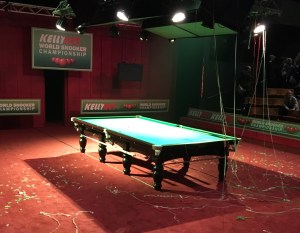
FullSizeRender-93Surveying a grubby Snooker hall, Bobby Spokes (Mark Addy) declares “What a dump, what a f***ing dump, not exactly the Crucible is it?”, thereby temporarily dashing the hope that this could be the best piece of site-specific theatre ever. Bobby is a part-time drug dealer, full-time layabout, father of young Snooker player Dylan (Jack O’Connell), ranked 107 in the World and rising. Richard Bean’s new comedy is a satirical and very timely look at how professional sport and corruption are entwined inextricably, suggesting that this particular sport was even tainted at birth. As with One Man, Two Guvnors, Bean excels in creating working class heroes and small time villains. Dylan is such a hero, his integrity unquestionable, he is (he thinks) incorruptible. The chief villain here is priceless – a one-armed transexual named Waxy Chuff (Louise Gold), a cross between Al Capone and Sheridan’s Mrs Malaprop. As Waxy works to lure Dylan into a betting scam, the young player’s incompetent manager (Ralf Little), drunken mother (Esther Coles) and her Irish beau (Dermot Crowley) become involved and a law enforcement couple (Youssef Kerkour and Rochenda Sendall) try to intervene. The plot is that of a thriller with a few twists and turns, but essentially, the play is an uproarious comedy, full of splendid running gags, ripe characterisations and spot-on performances. Of course, the action culminates in the exact spot where the play is being performed, a treat indeed, but the biggest joy comes from Bean’s incidental dialogue, particularly that between Bobby and Dylan (both actors superb), which is literally laugh-a-line. I don’t believe it, but Richard Wilson directs with a real feel for the characters, allowing the actors to flesh them out fully and giving the play time to breath, as in a lengthy display of real Snooker (by John Astley). There are a couple of quibbles: a dreamlike sequence, showing British army officers inventing Snooker in India, misses the pocket, as does an unconvincing romantic sub-plot. But such small things can be forgiven, because, overall, this is the funniest new comedy since 1M2G, theatre’s equivalent to a 147 break.

Performance date: 17 March 2016

The Painkiller*** (Garrick Theatre)

Posted: March 18, 2016 in Theatre

the-painkiller-small

The burning question here is whether a revered actor-knight can leave his Shakespearean gravitas in the dressing room and drop his trousers alongside a comic like Rob Brydon. It is difficult to envisage “Larry” doing it, but Kenneth Branagh passes the test with flying colours. On the other hand, there is no real test for Brydon who only needs to slip into his normal stage persona to become Swindonian Dudley, suicidal following the loss of his wife  (Claudie Blakley) to her psychiatrist (Alex MacQueen). Dudley arrives to end it all in a boutique hotel in London to find himself in the room next to Ralph (Branagh), a hit man on a mission to end it all for someone else. Alice Powers’ set for the two rooms is beautifully detailed and includes enough doors, cupboards and windows to accommodate all the mayhem that ensues. Yes, Francis Veber’s play (adapted by Sean Foley who also directs) is an old-fashioned farce in which the fun comes in bursts of physical comedy that are spread liberally through the 85 minute running time. There are no underlying serious themes to grapple with here, this being nothing more than a load of complete nonsense, best enjoyed with the brain in stand-by mode. The problem, as with most farces of this kind, is that everything is so cut adrift from reality that there is nothing for the audience to cling to when the madness subsides, as, inevitably, it has to. The script provides the actors with very little verbal wit, leading them to fill voids with over-playing; Brydon in particular sometimes shouts as if he is performing his stand-up act in the Millennium Stadium without a microphone. That said, Foley’s production skates over many cracks by moving at a frantic pace and the physical comedy set pieces are choreographed to perfection. Mark Hadfield as the droll hotel porter and Marcus Fraser as the policeman who takes all the knocks add a great deal to the fun. The play itself seems pretty feeble; inspired slapstick and top class performances only numb the pain, without completely killing it.

Performance date: 16 March 2016

Luce**** (Southwark Playhouse)

Posted: March 15, 2016 in Theatre

LuceWeb

With Edward Snowden still in enforced exile, arguments rage on about the point at which the right to privacy clashes with the need for security. TC Lee’s tightly written and compelling play makes an enlightening contribution to these debates. When a teacher becomes suspicious of a brilliant 17-year-old high school student, she invades his privacy by opening his locker and then notifying his adopted parents of the surprising contents. 10 years earlier the student, Luce (meaning light), had been an orphan caught up in an African war, rescued and brought to America by Peter and Amy, who refuse to believe ill of him. However, Luce now reflects that the sound of his name could be taken to mean “not attached to anything else”. Is he merely an innocent attracting the teacher’s suspicions because he is an outsider, or is he a liar with malevolent intent? It is a big ask of Martins Imhangbe as Luce to keep both possibilities credible for most of the play, making us root for him and doubt him at the same time. He pulls it off admirably and Natasha Gordon also makes the teacher an enigmatic character; sharp and full of self-importance, we want her to be proved a bigot, but fear that she could be right. Mel Giedroyc is a minor revelation as Amy, her natural warmth being perfect for this loyal Mum, but she adds the steel of a fighter and her convincing American accent is the icing on the cake (sorry!). Simon Dormandy’s spare production remains intensely focussed throughout and, even if the play offers few answers to the moral questions that it poses, its 90 minutes give plentiful food for thought.

Performance date: 15 March 2016

Miss-Atomic-Bomb-will-be-co-directed-by-Adam-Long-and-Bill-Deamer-NO-CREDIT-700x455.”What happens in Vegas stays in Vegas” they say, so why did the people behind this turkey ignore that golden rule? The book by Adam Long, Alex Jackson-Long and Gabriel Vick for this new musical has the feel of one of those abysmal Elvis Presley movies of the mid-60s in which the star would have been cast as Joey, the conscientiously objecting army deserter (here played by Dean John-Wilson). The team’s songs are about at the same level. The setting is Las Vegas in the early 1950’s, the US army is conducting nuclear tests in the Nevada desert and tourists are flocking in to take a look at the glowing sky, as if they are seeing the Northern Lights. Joey’s brother (Simon Lipkin) is manager of a failing Mob owned hotel and, to rescue it and save his own skin, he hatches the idea of staging the beauty contest of the title. Candy (Florence Andrews), a sheep farmer and her friend Myrna (Catherine Tate), a fashion designer, become involved to raise the cash to pay off debts and flee to far-off Californ-ya (isn’t it the adjacent State?). Andrews’ voice has a nice Country and Western twang that makes some of the songs sound better than they actually are and there are a couple of decent dance routines (Bill Deamer is choreographer, co-directing with Adam Long), but otherwise, the show is corny, dated, it looks cheap and, worst of all, it is frequently boring. The inimitable Miss Tate cannot help but be funny, yet even she struggles and Daniel Boys is also wasted, attacking the role of Mr Potts, an over-diligent debt collector, as if auditioning to play Javert in Les Mis. So there are a fair number of established musical theatre performers caught up in this debacle and most of them may soon be trying to remove the embarrassment from their CVs. Will someone please nuke this show!

Performance date: 12 March 2016

welcome...I confess to being unfamiliar with Le Voyageur Sans Lugage, a 1936 work by French playwright Jean Anouilh, but here we have it, in a new version by Anthony Weigh, moved in time and place to 1959 on Long Island, New York. The stroke of genius in this production is to present the play in the style of a screwball comedy from the Golden Age of Hollywood, incorporating influences as diverse as Oscar Wilde, Billy Wilder and the Coen Brothers. It all works brilliantly, playing out as something like a slightly more bitter take on The Philadelphia Story with touches of Martin Guerre. It seems a fair bet that director Blanche McIntyre had her company watching American film comedies from the 40s and 50s to perfect their timing and delivery and maybe to mould their performances on stars from that period. A lot of fun comes from guessing which star is suggested by each performance, For example “Gene” (Rory Keenan), the amnesiac war veteran returning to what might be his family after an absence of 15 years could easily be Cary Grant and Mrs Fox (Sian Thomas) his acid-tongued, snobbish would-be mother could only be Bette Davis. Family and supposedly lost son are brought together by the social climbing DuPont-Duforts (George Burns and Gracie Allen?), a warring couple, she (Katherine Kingsley) having previously re-homed dogs and he (Danny Web) being a wife-loathing curmudgeon who just wants someone to take out his garbage. “Gene” begins to question whether he really likes his new/old family very much and, when he unearths some of the misdemeanours of the man that he is supposed to be, he decides that he does not like him at all. The young Mr Fox’s past includes an affair with the drunken Valerie (Fenella Woolgar), his sister-in-law (too lower class for Katherine Hepburn, too sophisticated for Marilyn Monroe, so let’s settle for Grace Kelly). To make matters even more chaotic, 22 other families then come forward to claim “Gene” as their own. So is he or is he not a Fox? This hilarious play culminates in a blissful denouement that sends us all out of the Donmar wearing broad grins of satisfaction.

Performance date: 11 March 2016

Something Something Lazarus (c) Jamie Scott-Smith (10)This review was originally written for The Reviews Hub: http://www.thereviewshub.com

The saying goes that, even as the world outside falls apart, the show must go on. However, in John Myatt’s 80 minute musical satire of late night cabaret, it is the show that falls apart and the performers whose lives are in tatters, reflecting the lyrics of the mournful songs that they routinely sing. Pain, misery, heartache, death and despair are some of the constituents that feed this form of cabaret, a sub-culture with which we not so nocturnal creatures have only passing familiarity. Hence, it may be charitable to think that there are in-jokes in Myatt’s lyrics that fly over our heads, because, otherwise, incisive wit seems sadly missing. Simon Arrowsmith’s score makes easy listening, but the songs are much less than hilarious. The show could have been staged as a revue or song cycle, but it does have a plot of sorts. Daniel, owner of the gay club where the action takes place, receives a gift of an antique chair from his ex-boyfriend together with the news that he is planning to get married in eight days. Daniel declares his ex to be the only love of his life, goes into a tail spin and callously casts aside his current lover, the 20-year-old barman Jay. Dan Phillip’s production is a curate’s egg with good and bad parts matching each other almost evenly. It ranges from the near-inspired to the downright amateurish and it does not feel well-suited to the King’s Head’s thrust stage. At some points, characters huddle in corners, at others they engage with each other awkwardly from distance and, throughout, bright spotlights half blind many sections of the audience. The production’s inconsistencies carry through to the individual performances, but they all give at least some pleasure. Daisy Amphlett as musician Della seems too normal and nice to be working in a dive like this, but Valerie Cutko is deliciously catty as the torch singer Vee. Ralph Bogard’s neurotic, self-obsessed Daniel has the look of a Demis Roussos resurrected in a dressing gown and sounds a bit like him too. The surprise package is Daniel Cech-Lucas as Daniel’s rejected toy boy. After making an entrance resplendent in his underpants, he fades to the sidelines, gets deservedly strangled and then rises like the title character to grab a microphone and steal the whole show. His bravura solo routine re-energises a production that had been sinking rapidly. This is a show that refuses to be insulted. It could be described fairly as a chaotic mess, but it is likely that its creators intended it to be exactly that and much of the entertainment in it derives from its shambolic nature. Like late night cabaret itself, Something Something Lazarus is probably best enjoyed with a stiff drink in hand.

Performance date: 10 March 2016

Photo: Jamie Scott-Smith

trh-2