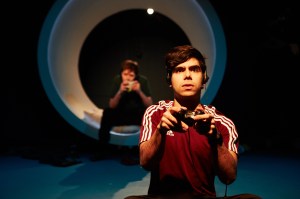
Correspondence (c) Richard Lakos (1)This review was originally written for The Reviews Hub: http://www.thereviewshub.com

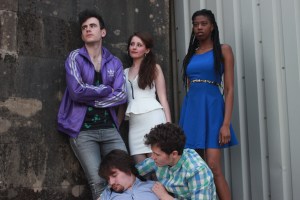
Think back five years. William and Katherine were getting wed, Katy Perry was dominating the pop charts and ripples from the Arab Spring were starting to reach Syria. Lucinda Burnett’s 80 minute one act play was first written at around that time and it now reaches the stage, refined with touches of hindsight. Ben (Joe Attewell) is a troubled teenager in Stockport, the son of divorced parents, victim of bullying and an aspiring journalist writing articles for his school newspaper, Jibreel (Ali Ariaie) is Syrian, wary of an oppressive regime, conscious of the growing insurgency, but fearful of the consequences for himself and his family. The two boys meet on the internet, competing in games on their X-Boxes. Burnett sows the seeds for a fascinating drama in a touching opening scene, with Dan and Jibreel, both played beautifully, enjoying their game and partaking in carefree banter on popular culture as seen from very different perspectives. However, the game of Modern Warfare is about to be encroached upon by actual modern warfare, virtual reality is to be replaced by cruel reality. The writer’s vision of innocent youthful friendship crossing international borders and breaking down cultural barriers resonates strongly and promises much for the scenes to follow. Essentially, this play needs only two characters and it begins to go wrong when others are introduced. Dan’s parents (Joanna Croll and Mark Extance) appear in long drawn out scenes of tedious bickering and, much worse, Dan’s tormenter at school, the irksome, shrill-voiced Harriet (Jill McAusland) turns up to bully him relentlessly. This character is poorly written and overplayed, becoming little more than a comic caricature that sits uncomfortably in a drama dealing with serious issues. Accepting that Burnett needs to establish factors contributing to Dan’s deteriorating mental health, she does not need to dwell on them for so long that they detract from the story that she is telling and prevent her from developing the central characters fully. There are faint suggestions of parallels being drawn between the boys’ relationship and interventions by Western nations in the Syrian catastrophe, but, again, such themes remain underdeveloped. Bethany Wells’ set, a visual representation of the internet, adapts well to suit the needs of the action and director Blythe Stewart uses it imaginatively, although she is not able to inject life into the play’s sticky patches. This is a drama that begins full of promise, goes nowhere for long stretches and ends just when the central story should be getting into its stride. It is the thought that the play is so full of interesting ideas that makes the end result so disappointing.

Performance date: 10 March 2016

Photo: Richard Lakos

trh-2


The Mother***** (Tricycle Theatre)

Posted: March 13, 2016 in Theatre

FullSizeRender-91The whiteness of Mark Bailey’s minimally furnished set dazzles at first. Here is a place that feels soulless and drained of life. It is the home of empty nesters pushing 50, the children are gone, the father is free to seek pastures new and the mother is bereft, her useful life over and facing a future of memories, loneliness and despair. This is the second play by French writer Florian Zeller, translated by Christopher Hampton, to be seen at the Tricycle in recent months, following The Father (now in the West End), and similarities between the ways in which the writer depicts the central characters’ mental confusion are striking. Scenes are repeated from different perspectives, furniture appears and disappears between scenes, dashes of colour are added and taken away. The effect is that the audience becomes as disorientated as Anne, the mother, never quite able to distinguish between the real and the imagined. Is Peter (Richard Clothier) a devoted husband drawn away reluctantly to a seminar in Leicester or is he a philanderer stalling plans to end the marriage? Does Nicholas (William Postlethwaite), the son, really return home in the middle of the night or is this just wishful thinking on Anne’s part? Is the seductive Jodie (Frances McNamee), everything Anne aspires to still be, Nicholas’ girlfriend or Peter’s mistress? Zeller’s style is, in some ways, Pinteresque, but it is also distinctive and director Laurence Boswell tunes into it perfectly. However, the key to this production’s success is a magnificent performance by Gina McKee in the title role, at times quietly accepting her fate, but then fighting desperately to win back the beloved son who is her sole reason for existing. This is a powerful and disturbing piece of theatre.

Performance date: 9 March 2016

Group Credit_ James WoodhamsThis review was originally written for The Reviews Hub: http://www.thereviewshub.com

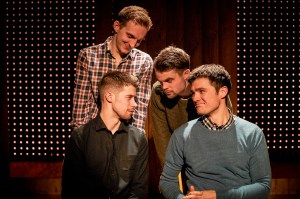
Teenagers high on drink or other substances are now so common a sight on our city streets that maybe we do not even bother to give them a second look. Martin Malcolm’s one act play, set in the West of England, invites us to spend around an hour taking a peek at what could lie behind the mayhem. Spook (Jack Cottrell) is unconscious outside the Eden club after a night out and his two mates argue whether they should haul him onto the Nightflyer bus home or leave him and head back into the club. Blowtorch (Harvey Bassett), swaggering and manly, is in no doubt that Spook can look after himself, but the more caring Jamster (Matthew Emeny) insists that both must stay with him, receiving homophobic taunts in response to his pleas. Enter two scantily clad young ladies to mirror the disregard and concern of the males. Chloe (Hannah Kelly) is described as “a slapper” being keener to disappear into a dark spot with Blowtorch than to tend for Spook, her ex. Churchgoer Genette (Anishka Klass) stays behind, but shows more interest in Jamster than the stricken Spook. Malcolm’s gritty play is set on the battleground where carefree childhood innocence clashes with adult reality and responsibility. These teenagers face up to the contradictions of relationships and religion and to the realisation that what their elders have warned them against could be true. It feels as if there are too many themes here to be developed fully in so short a play, but it is to the writer’s credit that he leaves us wanting to know more about the characters and their lives. Emeny’s sensitive portrayal of Jamster, tormented by an incident in the past and confused about his sexuality, stands out among five strong performances in James Woodhams’ taut and briskly paced production. No sets or props are used and club music pounds in the background throughout, adding to a feeling of raw energy that masks the play’s implausibilities and makes this an engrossing, if not completely satisfying, hour of theatre.

Performance date: 7 March 2016

Photo: Alex Knight

trh-2


Mr Salteena (Jake Curran), Ethel Monticue (Marianne Chase), Bernard Clark (Geordie Wright) and Narrator behind (Sophie Crawford). Pic credit Andreas GriegerThis review was originally written for The Reviews Hub: http://www.thereviewshub.com

An book written in 1890 by a nine year old would seem highly unlikely to have scaled the peaks of literary achievement, but The Young Visitors is exactly the type of obscure curiosity that has come to provide rich pickings for Rough Haired Pointer. Having unearthed a comic story first serialised in Punch magazine and a previously unperformed Joe Orton play, the company now revives its 2013 version of young Daisy Ashford’s work. When the book was first published (by JM Barrie) in 1919, it was noted for its wit in depicting the social climbers of the late Victorian era. Well little Miss Ashford is no Oscar Wilde and her spelling may have been dodgy, but her observation skills are remarkable for one so young. Any shortage of verbal wit is compensated for in this production by deft and imaginative touches of physical comedy. Mr Salteena (Jake Curran) is a lower middle class butcher’s son living in Dulwich who aspires to better things, but lacks refinement and confidence. When he is invited to visit the lonely and shy aristocrat Lord Bernard Clark (Geordie Wright), he jumps at the chance and takes along the apple of his eye, Ethel Monticue (Marianne Chase) who, with reddened cheeks and drooping blond ringlets, looks rather like an early prototype for Barbie. In their stuttering climb up the social ladder, which takes them all the way to Buckingham Palace, the couple encounter, among others, the arrogant Lord Clincham (Andrew Brock) and his insolent valet Procurio (Jordan Mallory-Skinner). Ashford’s choices of character names would have served her well had she gone on to script Carry On films. Adaptor Mary Franklin retains a flavour of the original writing through an ever-present narrator (Sophie Crawford). The show looks splendid, Christopher Hone’s set designs surrounding the stage with red and cream curtains, giving pride of place to an ornate wooden gazebo. Carin Nakanishi’s period costumes are also eye-catching and are quickly adaptable, useful for actors playing multiple minor roles. However, the biggest stand-out feature of Franklin’s brisk production is the comedy acting, all six members of her company showing precision timing and exuberance that reminds of a children’s tea party. From the slightest material, Rough Haired Pointer has conjured up 90 minutes of jolly fun. There is nothing to dislike here and nothing to give offence, so most should leave the Tabard with smiles on their faces.

Performance date: 4 March 2016

Photo:Andreas Grieger

trh-2


Quick Catch-up

Posted: February 23, 2016 in Theatre

I’ve fallen a bit behind in the last week and am now going to get some Winter sunshine, so here’s a quick catch-up on shows I’ve seen.

cleansed_picture__gallery_imageCleansed** (National Theatre, Dorfman)

Writer: Sarah Kane; Director: Katie Mitchell

Groundbreaking in its day (1998) and still shocking, the late Sarah Kane’s plotless play is a stark, vivid, harrowing, relentless and surreal montage of victims and abusers. Staged impressively and acted with total commitment by a cast of seven, the production presents many challenges to an audience and, sadly, I was not up to meeting them.

Performance date: 22 February 2016


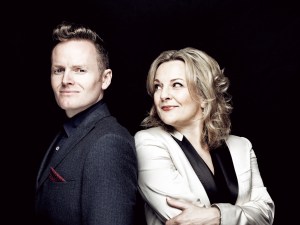
Claire-Martin-Joe-Stilgoe-by-Kenny-McCracken-Wesleyan_1922-1Just the Two of Us**** (St James Theatre)

Performers: Claire Martin & Joe Stilgoe

Mellow jazz for a Sunday evening. Just perfect!

Performance date: 21 February 2016


the encounterThe Encounter**** (Barbican Theatre)

Director/Performer: Simon McBurney

Endlessly inventive, but overlong telling of an engrossing story of jungle survival.

Performance date: 21 February 2016


Pianist-of-Willesden-Lane.8788The Pianist of Willesden Lane**** (St James Theatre)

Adaptor/Director Hershey Felder

Performer: Mona Golabek

Beautiful piano music soothes the pain of a true story of wartime tragedy.

Performance date: 13 February 2016

Four Play***+ (Theatre 503)

Posted: February 20, 2016 in Theatre

Four PlayThis review was originally written for The Reviews Hub: http://www.thereviewshub.com

To be faithful or not to be faithful? This is the question that has troubled characters created by many writers over the years. Does monogamy come naturally to the human race? Is it possible to maintain a loving relationship while, at the same time, having dalliances with others? Jake Brunger’s new one-act comedy takes a very modern look at these age old dilemmas. Pete is a high-flyer with an accountancy firm, wearing designer clothes and enjoying a good lifestyle with his partner of seven-and-a-half years, Rafe. The couple talk of adopting children and getting a dog and they plan a wedding at which the music will by Enya (definitely not Kylie). However, they are bored with monogamy and wonder what it would be like to have the excitement of just one fling. With this in mind, they proposition the handsome, gym-toned Michael to indulge each of them in turn, notwithstanding the fact that Michael is himself in a relationship with Andrew. The opening exchanges produce a sparkling comedy of embarrassment as Cai Brigden’s nervous and fussy Rafe skirts around delicate issues with Michael, while Pete (Michael Gilbert) sits as a silent, and apparently reluctant onlooker. However, it emerges that Pete is the driving force behind setting up the arrangement. Michael agrees to go along with the idea and what follows serves as a warning to be careful what we wish for. In later scenes, Brunger changes emphasis, toning down the comedy and bringing the secondary couple to the fore. Michael James’ wounded Andrew becomes the play’s beating heart, giving it emotional depth when it risks descent into shallow farce. Rating himself a six on the good looks scale that makes his partner a ten, he is touchingly self- deprecating and resilient in refusing to be left on the sidelines by the errant threesome. The vulnerability of the seemingly casual and confident Michael is brought out beautifully by Peter Hannah, cringing with feelings of disgust at where his carnal instincts lead him. The bond between Michael and Andrew is always believable and Brunger makes us think that this couple have reached a point where they can make the compromises necessary for them to stay together. The two couples mirror each other with Rafe, like Andrew, seeking domestic bliss and Pete, like Michael, being torn, scared by the thought of monogamy and tempted to roam. The final outcome is staged very effectively in Jonathan O’Boyle’s sharp production. Cecilia Carey’s minimalist design with a backdrop suggesting a chic cocktail bar emphasises that the play and its characters are outwardly modern, even though there is little new in the themes. That said, Brunger’s take on the crucial conundrum of human relationships proves to be lively and refreshing.

Performance date: 19 February 2016

Photo: Richard Lakos

trh-2


Uncle Vanya**** (Almeida Theatre)

Posted: February 18, 2016 in Theatre

uncle-vanya

Following his major success with Oresteia at the Almeida last Spring, Robert Icke returns as adaptor and director for a radical re-imagining of Anton Chekhov’s sorrowful comedy of resignation and despair, performed over three hours 20 minutes (including three intervals). In modern dress and Anglicised to the point that Vanya becomes John, the metaphors in the original for a dying Russian social order are all but lost, leaving a mellow reflection on themes that resonate universally – unrequited love, missed opportunities, lives wasted and people standing still while changes swirl all around, the latter emphasised by Hildegard Bechtler’s majestic open-sided set being on a constant revolve. The audience has the feeling of being onlookers through windows into a troubled home and, when characters descend into the audience, it is to confide in us their private feelings or to share bemusement at what is going on inside. Aesthetically, the design (complemented by exquisite lighting by Jackie Shemesh) is stunning, but there are practical problems. The revolve means that part of the drama is obscured from parts of the audience, in turn, by large pillars on the set. Furthermore, the contrasts of volume, the actors speaking softly when relaxed and loudly when tense, are very effective in heightening the drama, but there are audibility issues, particularly when actors are facing away. These are minor quibbles, but they matter during slow-paced Acts I and II, when an overriding theme is the characters’ boredom. It may be inevitable that boredom conveyed on stage will transmit itself to an audience and, notwithstanding a delightful late night revel that turns into an unexpected yet timely tribute to David Bowie, getting through to the second interval becomes something of a test of endurance. However,  the effort is repaid with rich dividends by a third act of searing brilliance in which cards are laid on the table, souls are bared and emotions are unleashed. Paul Rhys’ dishevelled, ramshackle and ultimately broken Uncle John now becomes a sparkling gem, matched by Tobias Menzies’ level-headed but still tormented Doctor, Jessica Brown Findlay’s distraught Sonya (Sofia) and Vanessa Kirby’s Elena (Helena), flirtatious, but trapped like a caged bird. Building to a chilling conclusion, Icke’s unique interpretation of this classic is marred only slightly by flaws in its execution, but lingers in the mind nonetheless as a haunting experience.

Performance date: 17 February 2016

Hand To God** (Vaudeville Theatre)

Posted: February 16, 2016 in Theatre

Harry-Melling-Jason-Tyrone..

In New York last Autumn, I stumbled across the theatre where this new play by Robert Askins was appearing. Emblazoned boldly across the hoardings, with a hint of triumphalism possibly similar to that of the Normans in 1065, were the words “Closing due to transfer to London’s WEST END”. New Yorkers certainly revere British theatre, so perhaps they are entitled to take pride in the export of homegrown material to us, or, more cynically, perhaps they are entitled to have a good laugh at having been able to dump an enormous pile of excrement on us. Anyway, here it is – the love child of Avenue Q and The Book of Mormon, heir to the traditions of unsubtle, vulgar gross-out American comedy, except that its parents’ primary features of wit, warmth and music have somewhere gone missing. The bulk of the play takes place in a church hall, made to look like a play school in Beowulf Boritt’s set. We find an unusual congregation, the God-fearing members of which converse with each other in expletives and look for guidance from the Kama Sutra more than the Bible. Unusual also is that a puppet group has prominence over the traditional choir. The group is run by the recently widowed Margery (Janie Dee), aided by her son Jason (Hogwarts alumnus Harry Melling), demure Jessica (Jemima Rooper) and randy teenager Timothy (Kevin Mains). The troubled Jason, shy and grieving for a father who died from over-eating, slips his left hand into a sock puppet, gives it the name Tyrone and develops a demonic alter ego that lets rip into everyone and everything. The central joke, a ventriloquist’s dummy that has a life of its own, dates back to music hall or earlier, so can it still be funny? Well, yes, intermittently it is and, in a second act set piece (no spoilers here), it is hysterical. Melling makes little effort to suppress lip movement, but his deadpan expressions as the timid Jason contrast beautifully with the manic appendage to his left hand and he handles the technical challenge of playing two opposite characters, sometimes in the same breath, admirably. The rest of the play, concerning a bizarre lust triangle between Margery, Timothy and the Pastor (Neil Pearson) is just horrible and it is embarrassing to see actors as accomplished as Dee and Pearson involved in it. As Moritz Von Stuelpnager’s production features an entirely British cast, it is hard to see why closure on Broadway was necessary but, if the closure was in fact for other reasons, this would give far more credit to American theatre than anything in the play itself.

Performance date: 14 February 2016

Orphans****+ (Southwark Playhouse)

Posted: February 13, 2016 in Theatre

orphansw300h250This review was originally written for The Reviews Hub: http://www.thereviewshub.com

Some plays refuse to fit into pigeon holes. American writer Lyle Kessler’s multiple award winner, first staged in 1983, defies expectations at all turns, taking in sickening violence, brutal bullying, incarceration and racism and leaving the audience laughing until it hurts. What about calling it the funniest tragedy in town? The success of Paul Tomlinson’s revival owes much to an astonishing performance by Chris Pybus as Philip, the younger of grown orphaned brothers living in their parents’ house in Philadelphia. A prisoner in his own home, denied the education for which he craves, he leaps around like a cat, pops his head around corners and from behind furniture and dribbles like a baby when spoon fed bouillabaisse. This young actor sometimes has the look of a new Stan Laurel, his gift for physical comedy being matched by his command of the pathos that is needed to underpin all great clowning. Phillip’s joy as he looks outside his “prison” window, clutching at a street map that he believes is showing him his position in the universe, tears at the heartstrings. Alexander Neal also impresses greatly as older brother Treat, the provider for the family who goes out scavenging while regarding Philip as if a domestic pet, kept indoors by deceit and brute force. Treat’s outbursts of rage are terrifying and even when he is subdued and vulnerable, violence is simmering only just beneath the surface. We are left in no doubt that the fraternal relationship is built on mutual dependency, but the equilibrium is upset by the arrival of Harold, a gangster on the run from Chicago who is kidnapped for ransom by Treat. Mitchell Mullen’s Harold is both a kindly uncle and a ruthless thug. He sets his sights on taming Treat and releasing Philip, using a combination of hugs and gifts, Treat receives designer suits and Philip yellow loafers; he just manages to squeeze his feet into them and then beams as if he is Cinderella winning her Prince. The play’s unorthodoxy keeps us on our toes, but it is the fascinating detail in Kessler’s writing that is most absorbing. He merges American popular culture with an absurdist vision, creating a surreal world in which Errol Flynn, The Price is Right and Hellman’s mayonnaise are jumbled together. Yet his key themes are rooted firmly in reality – the right of all human beings to freedom and education, the need of all human beings for kinship and affection. There is often mayhem in the play, but Tomlinson keeps it well controlled and stages the comedy sequences with aplomb. The re-enactment of a reported incident on a bus involving Treat, with Philip standing in as a rude passenger, is an absolute riot. The production takes a little time to find its stride and its ending feels overcooked, but what lies between is crisp and assured, the rapid shifts in tone being judged to perfection. Orphans has had top class productions on Broadway, in the West End and across the World, but it seems a fair bet that this small revival on the London fringe could stand proudly alongside any of them.

Performance date: 12 February 2016

trh-2


Round the Horne**** (Museum of Comedy)

Posted: February 12, 2016 in Theatre

Round the HorneThis review was originally written for The Reviews Hub: http://www.thereviewshub.com

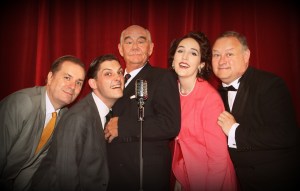
How bona to vada it’s back! In the mid-1960s, 16 million people would gather around their wireless sets (radios to youngsters) every Sunday lunchtime to listen to Round the Horne, a half hour comedy sketch show compered by Kenneth Horne and featuring Betty Marsden, Hugh Paddick and Kenneth Williams. The language of Polari sounded to most like nonsense, but it had been part of the gay subculture of the period and the show used it extensively, along with double entendres and innuendo, to disguise risqué topics. Audiences may have laughed because the words sounded weird or because they had an inkling of their real meaning, but, apart from the few who were outraged, they all laughed. For this stage version, Tim Ashley has taken original scripts by Barry Took and Marty Feldman and compiled them to make two lengthened episodes, performed as if in a 60s BBC studio, complete with a sound effects man (Conrad Segal) sitting in a corner. The show is now embarking on a 50th Anniversary (of the radio version) tour. For anyone not aware of the radio show, the best description could be a sound only equivalent to Little Britain, with familiar characters, catchphrases and variations on the same situations cropping up every week. The outrageous “folk” singer Rambling Syd Rumpo, the dirty old man J Peasemold Gruntfuttock (both Williams) and the ageing actors Dame Celia Molestrangler and Binkie Huckaback (Marsden and Paddick) all became household names and all can be seen here. Particularly daring in its day was the depiction of the unmistakably gay couple Julian (Paddick) and “my friend” Sandy (Williams). Times have changed and these characters are now just over-familiar stereotypes, but, in most other respects, the scripts remain as sharp and, yes, naughty as ever. Laugh-a-line gags and clever wordplay give them a timeless quality and they remain irresistibly funny. The often asked question is “how on Earth could they get away with it?” Modern theatre audiences seeing The Book of Mormon ask the same question and the answer in both cases is the same – when it is so obvious that there is no intention to offend anyone, no offence can be taken. The actors here show a lightness of touch that emphasises that the comedy is mischievous, but never malevolent. With one obvious exception, the radio performers were not prominent in visual media, so the actors here do not need to look like them. The important thing is that they all capture the essence of the originals. Julian Howard McDowell is Horne, the perennial straight (in all ways) man throwing in wry asides. Eve Winters and Jonathan Hansler are flamboyant and versatile as Marsden and Paddick and Nick Wymer perfects his BBC English as the pushy announcer Douglas Smith. Williams remains an iconic figure from radio, television and films, giving Colin Elmer the most difficult job in playing him. There is little physical resemblance, but he replicates the mannerisms, facial gestures and, most importantly, the voice brilliantly. He often gets the audience laughing before he has even reached the microphone. The show’s current home is in the Cooper (Tommy not Henry) Room at the Comedy Museum, where memorabilia from Britain’s comedy heritage is on permanent display. Round the Horne is an important part of that heritage, but this show proves that it is far more than a dormant exhibit. There is plenty of life in it and, although under-50s may wonder what a “thrupenny bit” is, young and old should still find it hilarious.

Performance date: 11 February 2016

trh