Big Brother Blitzkrieg (c) Jack Fisher (6)This review was originally written for The Reviews Hub: http://www.thereviewshub.com

Had Adolph Hitler lived, he would now be 126 years old. This is one of several compelling reasons why the idea that he could be a contestant in Big Brother 2016 requires considerable suspension of disbelief. However, the proposition that none of his fellow housemates would have the faintest idea who he was, sadly, rings very true indeed. Written and directed by Hew Rous Eyre and Max Elton, Big Brother Blitzkrieg is, for the most part, a riotous spoof of reality television and it falters only when it tries to take itself too seriously. Often something like Big Brother that is already inherently ridiculous can prove to be beyond parody, but a steady flow of very funny jokes carries this show through 75 minutes, stretching out a basic idea that could have been more naturally suited to a 15 minute sketch. Hitler, played with fervour by Stephen Chance, lands in the House after his application to enter Art School is rejected. He finds himself among a typical selection of housemates, all striving to live up to what is expected of the stereotypes that they have been selected to represent. M-Cat (Kit Loyd) is a teenage rapper, Charlie (Hannah Douglas) is a feminist and Lucy (Jenny Johns) is a snooty Public Relations Consultant. The Führer slots neatly into the fascist regime of Big Brother (voiced by George Smith), although taking orders does not come easily to him. He kindly reassures the flamboyantly gay Felix (Neil Summerville) that the viewers will not find him boring, by telling him “you are the most entertaining sub-human that I have ever met”. However, his persecution of the hapless Rachel (Tracey Ann Wood), trying to manipulate her eviction and getting other housemates to ostracise her, bears even more sinister undertones. Rachel offends Hitler by being dull, ordinary and Jewish. Presumably the writers want to demonstrate how easily history can repeat itself, but history as serious as this is seriously unfunny and a sombre note is introduced, sitting very uncomfortably with the lightweight material that surrounds it. Otherwise, sharp writing and over-the-top performances make this spoof Big Brother, arguably, a lot more entertaining than the real thing. It should see out its scheduled run at the King’s Head without fear of eviction.

Performance date: 15 January 2015

Photo: Jack Fisher

trh

(l-r) Cornelius Macarthy as AndreThis review was originally written for The Reviews Hub: http://www.thereviewshub.com

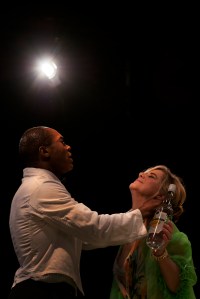
Seven years after the first black United States President took office, 1965 feels like a lot more than only half a century ago. Paul Minx’s searing comedy/drama, first seen at the Hope Theatre along the road from here in 2014, takes us back to a time when America was a country on the cusp of change as the burgeoning Civil Rights movement was beginning to make its mark. Set in Indiana, the play shows us a dying social order, represented by a white middle class family whose world is crumbling and their two black home helps who are taking tentative steps to break free and find the road to a better life. These characters, like the country that they live in, have reached a crossroads. Jake Price (Michael Brandon) has hit a career crisis, bur pretends that everything is normal. His wife Carol Ann (Imogen Stubbs) has hit the bottle, her life so lacking in purpose that she cannot be bothered to get dressed, but she clutches at a last claim to refinement by insisting “I don’t drink…I imbibe”. Their teenage daughter Ivy (Lydea Perkins) lounges on the patio, perfecting her suntan and filling the void in her life by attempting to seduce Andre, the “coloured” gardener. The play’s title alludes to the struggle of Andre (Cornelius Macarthy) and his intended wife, the house’s maid Grace (Krissi Bohn) to cast off the shackles of the past and move south to Alabama. He seeks reunion with his daughter, taken from him in cruel circumstances, and she, an aspiring writer, wants to play her full part as a Civil Rights activist. The dignity and fortitude of this couple, contrasting with the decadence of their white “masters”, gives the play its most haunting images. The confidence of Minx as a playwright is demonstrated by the ease with which he finds so much comedy in what is essentially a serious emotional drama. This is the right approach, because the frustrated and angry Jake, the drunken Carol Ann and the rebellious Ivy are all characters to be laughed at and pitied rather than despised. After all, they are merely filling roles that the society of their day had cast them into and, by 1965 standards, they would probably have considered themselves liberals. Sara Berger’s production moves seamlessly between the play’s changing tones, extracting five impeccable performances. The action takes place on a thrust stage, giving the audience a proximity to Adrian Linford’s patio set that heightens the play’s dramatic and comic impact. Minx’s work is a striking piece of new writing, telling us the way that things were in order to make us contemplate how racism persists in a much changed world. When Berger’s production reaches a point of optimism for the future, the Roy Orbison track It’s Over is heard playing in the background, prompting us to ask ourselves the question: “is it really?”

Performance date: 15 January 2016

Photo: Truan Munro

trh

Botallack O'Clock_2 © Zanna Wharfe

This review was originally written for The Reviews Hub: http://www.thereviewshub.com

In the early hours, with an evening’s entertainment over and birdsong still awaited, there can exist a sort of vacuum that will suck in strange thoughts. Eddie Elks’ one-act play covers an imagined 70 minutes of such time in the life of artist Roger Hilton (1911-1975), making his thoughts as abstract as his most famous paintings. Played by Ben Frost, Hilton is both a realist and a fantasist. He has no romantic illusions as to why he has moved his family to the picturesque Cornish coastal village of Botallack – he is there because property is cheap – yet he can quickly turn to playing King Lear with a dancing bear as his Cordelia. He is in his basement studio, with his family asleep in the house above him. Fuelled by detachment and alcohol, his thoughts take on a life of their own. Elks structures a large part of his play around a dreamed up edition of Desert Island Discs on which Hilton is the guest. The radio presenter (voiced by George Haynes) speaks in precise BBC English and takes on a combative persona that is reminiscent of Hal, the demented computer in 2001:A Space Odyssey. Hilton expounds on diverse topics, ranging from his love of Paris to his loathing of Blue Peter, and he explains why he believes that the World is perceived differently through the eyes of an artist. Elks’ writing and Frost’s intense portrayal reveal a creative mind that is out of step with everyday life and frustrated by it. Ken McClymont’s set uses the whole of the Old Red Lion’s space to create a realistic, drab and untidy basement studio, furnished with a single bed, side tables and an old fashioned wardrobe. Christopher Nairne’s lighting illuminates the fantasy sequences, but, for much of the play, Hilton is seen under a single hanging lamp, surrounded by semi-darkness, creating a lonely image familiar to all of us who have ever woken in the middle of the night. Directing the play himself, Elks opts for a leisurely pace. Several minutes pass before the first word is spoken, as Hilton stirs from a drunken stupor and gets his bearings. What follows is full of colourful philosophy that, in total, makes no more sense than the ramblings of a drunk ever do. Nonetheless the writer’s quirky humour and a compelling central performance turn this into an amusing diversion.

Performance date: 14 January 2016

trh

funny-girl

From Hedda to Cilla, Sheridan Smith loves filling big boots, but Barbara Streisand? Come on! This musical, telling the story of Fanny Brice’s rise from humble Brooklyn beginnings to become star of the Ziegfeld Follies in the 1920’s and of her ill-fated marriage to reckless gambler Nick Arnstein, is in many ways mediocre, not a patch on for example Gypsy. But it is an incredible star vehicle and, up to now, only one star (with her understudy) has ever jumped aboard it in the the UK. Courage is indeed needed, but, from her first appearance as a star-struck school girl to her last as a distraught leading lady abandoned by her husband, Smith nails it, absolutely, utterly and completely. No-one can cry real tears while wearing a broad smile on her face quite like this lady; physical comedy, gentle humour and heartbreaking drama all fit comfortably within her range and she has the audience in the palm of her hands throughout. Isobel Lennart’s book (revised by Harvey Fierstein) has plenty of wit, but the story falls into the “heard it all before” category. Don’t Rain On My Parade is easily the best of the songs (music Jules Styne, lyrics Bob Merrill) which are generally better than okay. Personally, I have always found the lyrics of People particularly excruciating, but once Smith starts to sell the song, who cares? Director Michael Mayer has assembled possibly the biggest company of actors and musicians yet seen at the small Menier and choreographer Lynne Page makes full use of the limited space. However, there is clear potential for further improvement when the show transfers to the Savoy. Marilyn Cutts as Fanny’s mother and Joel Montague as her neglected mentor stand out among the support. Little romantic chemistry develops between Smith and Darius Campbell as Arnstein, but perhaps that is how it is supposed to be. In the end, this production is only really about the funny girl herself and Smith’s performance, coming so soon after Imelda Staunton’s Mamma Rose, makes London theatregoers entitled to consider themselves “the luckiest people in the World”.

Performance date: 8 January 2016

Grey Gardens**** (Southwark Playhouse)

Posted: January 14, 2016 in Theatre

GreyGardensWeb

If history can be condensed into headlines and footnotes, the story told here falls most definitely into the latter category. In 1941, young Presidential hopeful Joe Kennedy (Aaron Sidwell) arrives at Grey Gardens, home in the Hamptons of the “aristocratic” Bouvier clan, to seal his engagement to Little Edie (Rachel Anne Rayham), daughter of the flamboyant Edith (Jenna Russell), described as “that worst of things, an actress without a stage”. Mother’s antics disrupt daughter’s plans, but maybe the actress gene has been passed on and the two women embark on a lifelong journey of mutual loathing and mutual dependence. Joe was fated to be killed in action three years later, but the great irony is that Jaqueline Bouvier (seen in this show as a little girl) was to become the bride of his younger brother Jack and eventually ascend to the White House. This musical (book Doug Wright, music Scott Frankel, lyrics Michael Korie) sheds light on the uneasy flirtation between politics and showbiz that, in many ways, characterised the Kennedy presidency. It was a success on Broadway and is now getting its UK premiere. The first half, set almost entirely in 1941, flows smoothly, mixing 40s swing music with simple songs in the style of Ivor Novello and Edith’s protege, gay pianist Gould (Jeremy Legat) is on hand to provide accompaniment and bitchy asides. However, this part of the show is not entirely satisfying in establishing the mother/daughter relationship that is at the heart of the story. Partly this is due to Rayham’s Little Edie being more like a precocious teenager than the “Miss Body Beautiful” aged 24 that she actually was, but also Russell looks uncomfortable when projecting the conflicting roles that life has cast her into. The second act fast forwards to 1973 and a media frenzy over Jacqueline (now Mrs Onassis) allowing her aunt and cousin to live reclusive lives at Grey Gardens in squalid conditions with over 50 cats. Octogenarian Edith is now played by Sheila Hancock, with wild white hair, complaining at the difficulties of bringing up a 56-year-old daughter. Russell steps down a generation to play Little Edie, her bald head hidden beneath a variety of hoods. The scene is reminiscent of Whatever Happened to Baby Jane? with a similar mic of pathos, comedy and camp horror. Russell and Hancock set the show ablaze with an unforgettable double act, each taking turns to have intimate conversations with the audience and to hurl vicious insults at each other. Edith still has her male sidekick, Gould having been replaced by Jerry, a dim-witted errand boy (Sidwell, unrecognisable from Act I), but Brooks (Ako Mitchell) remains their trusty servant, albeit 32 years older. The message is that the show must go on in the face of any adversity, as true for politics as for show business. Director Thom Southerland and choreographer Lee Proud know how to use every inch of this space to full advantage, even when negotiating the clutter of Tom Rogers’ set and a nine piece band, conducted by Michael Bradley, provides the richest sound heard here since Titanic. Southerland and his team have achieved a string of successes on the fringe by breathing fresh life into forgotten American musicals, but they have yet to get a West End transfer. Star casting could well help then to break through that barrier this time.

Performance date: 7 January 2016

Hapgood**** (Hampstead Theatre)

Posted: January 7, 2016 in Theatre

hapgppd

When it first appeared in 1988, Tom Stoppard’s espionage comedy/thriller may have been viewed as a requiem for the Cold War era, then drawing to a close. Now, Mr Putin could have given it renewed topical relevance. Stoppard’s cynical take is that all the MI6, CIA and KGB shenanigans were comparable to games of chess and served no greater purpose. He makes his case emphatically, beginning with a farcical exchange of packages in the changing room of a swimming pool and taking us through the duplicitous dealings of double/treble/quadruple agents. Elizabeth Hapgood (Lisa Dillon) is a very modern figure, juggling being a single mother with her role as a prominent secret agent, working alongside Blair (Tim McMullan), Ridley (Gerald Kyd) and her “Joe” (the Russian she recruited), Kerner (Alec Newman) to ferret out the traitor in their midst. It is all familiar from books, films and television, but novel for the theatre and it is this freshness that helps Howard Barker’s well paced production to glide over the absurdities of the plot. Ashley Martin Davis’ set with banks of television screens changing constantly also helps, as do four superb leading performances. Rambling passages of vintage, mind boggling Stoppard do not overwhelm the play nor interrupt its flow and some welcome human touches are surprisingly moving. Stoppard has a lot to say about relations between Russia and the West and delving deeper into the text could prove worthwhile. However, on a purely superficial level, Hapgood gives us one of the most entertaining evenings in the theatre seen for quite a while.

Performance date: 6 January 2016

les liaisons

The 18th Century French epistolary novel upon which Christopher Hampton’s play is based has inspired numerous adaptations for stage, big screen and television, with the result that the biggest enemy of Josie Rourke’s near-impeccable revival is over familiarity. The play is perfect for the three-sided Donmar, Tom Scutt’s shabby palatial sets making us feel part of the goings on in the sitting rooms and boudoirs of the idle aristocracy in Louis XIV’s France. Janet McTeer dominates the production as the scheming and manipulative La Marquise de Merteuil who wrecks lives for nothing better than her own amusement and purrs at the devastation that she causes. Le Vicomte de Valmont is her former lover and co-conspirator, seducing women at will, but, as played by Dominic West, he is her lap dog, blindly obeying her commands against his own more noble instincts. Elaine Cassidy, Morfydd Clark and Edward Holcroft are convincing as the pair’s not quite innocent victims. Rourke’s achievement in her slick production is to tell a story that we feel we know too well, yet still make it absorbing.

Performance date: 4 January 2016

2015 Theatre Round-up

Posted: December 31, 2015 in Theatre

This year I have seen a round 200 productions, 70 of them reviewed for The Reviews Hub (previously The Public Reviews). My year may not be the same as everyone else’s – for example I saw Imelda’s Gypsy for the first time in 2014, so it is left out of my “best of” contenders, whilst I still have Sheridan Smith’s Funny Girl to look forward to.

BEST PRODUCTIONS (alphabetical order)

Assassins (Menier Chocolate Factory)

Hangmen (Royal Court Theatre and Wyndham’s Theatre from January)

High Society (Old Vic)

Husbands and Sons (National Theatre)

Kinky Boots (Adelphi Theatre)

Man and Superman (National Theatre)

Mrs Henderson Presents (Theatre Royal Bath and Noel Coward Theatre from January)

Oresteia (Almeida Theatre and Trafalgar Studios)

People, Places and Things (National Theatre)

Photograph 51  (Noel Coward Theatre)

To Kill a Mockingbird (Barbican Theatre)

The Winter’s Tale (Garrick Theatre)

Honourable mentions: As You Like It (National Theatre)Bakkhai (Almeida Theatre)Carmen Disruption (Almeida Theatre), Jane Eyre (National Theatre)Medea (Almeida Theatre)Rules for Living (National Theatre)Temple (Donmar Warehouse), The Homecoming (Trafalgar Studios),

BEST FRINGE PRODUCTIONS (alphabetical order)

A Girl is a Half-formed Thing (Traverse Theatre Edinburgh)

French Without Tears (Orange Tree Theatre)

Grand Hotel (Southwark Playhouse)

Lela & Co (Royal Court)

No Villain (Old Red Lion Theatre)

Our Ladies of Perpetual Succour (Traverse Theatre Edinburgh)

Swallow (Traverse Theatre, Edinburgh)

Sweeney Todd – The Demon Barber of Fleet Street (Harrington’s Pie Shop)

The Clockmaker’s Daughter (Landor Theatre)

The Grand Tour (Finborough Theatre)

The Royale (Bush Theatre)

The Sum of Us (Above the Stag)

Honourable mentions: And Then Came the Nightjars (Theatre 503), As Is (Trafalgar Studios)Hatched ‘n’ Dispatched (Park Theatre), In the Dead of Night (Landor Theatre), Little Malcolm and his Struggle Against the Eunuchs (Southwark Playhouse)Radiant Vermin (Soho Theatre)Wink (Theatre 503)Xanadu (Southwark Playhouse)

BEST PERFORMANCES

Male in a play: Ralph Fiennes (Man and Superman). Honourable mentions: Simon Russell Beale (Temple and Mr Foote’s Other Leg) and James McAvoy (The Ruling Class)

Female in a play: Lia Williams (Oresteia). Honourable mentions: Kate Fleetwood (Medea)Denise Gough (People, Places and Things) and Nicole Kidman (Photograph 51).

Ensemble in a play: Husbands and Sons

Male in a musical: Tie between Killian Donnelly and Matt Henry (Kinky Boots). Honourable mention: Jamie Parker (Assassins and High Society).

Female in a musical: Emma Williams (Mrs Henderson Presents). Honourable mentions: Natalie Dew (Bend it Like Beckham) and Kate Fleetwood (High Society).

Ensemble in a musical: High Society

OTHER BESTS

New (to the UK) play: Hangmen by Martin McDonagh

New (to the UK) musical: Mrs Henderson Presents

Director (play): Marianne Elliot (Rules for Living  and Husbands and Sons)

Director (musical): Jerry Mitchell (Kinky Boots)

LAST AND VERY MUCH LEAST…

The year’s worst: A New Play for the General Election (Finborough Theatre), Bewitchment (Landor Theatre), d(ARE)/There Be Lions (Print Room), Dracula (Lion and Unicorn Theatre), Evening at the Talk House (National Theatre)How to Hold Your Breath (Royal Court Theatre), Muscovado (Theatre 503)Noonday Demons (King’s Head Theatre)Pardon/In Cuffs (Traverse Theatre Edinburgh)The Titanic Orchestra (Pleasance Theatre Edinburgh), Valhalla (Theatre 503)Women on the Verge of a Nervous Breakdown (Playhouse Theatre)

nutcracker iceThis review was originally written for The reviews Hub: http://www.thereviewshub.com

In a wet December during which temperatures have seldom dropped below 10 degrees, there is a certain irony in having to step inside the Royal Albert Hall to be reminded of what Winters look and felt like traditionally. Snowflakes fall from the domed roof, landing on an ice rink that covers half of the arena space and a snowy Christmas card image is projected onto a large back screen. Performances of Tchaikovsky’s ballet in the familiar format abound at this time of year, but this slippery twist given to it by the Imperial Ice Stars needs to justify itself by enhancing the experience and taking it in new directions. The first big plus is being able to hear the wonderful music played in this great concert hall by the London Concert Orchestra, conducted by Tim A Duncan. Many of the themes in this piece have been reduced to instantly recognisable catchy tunes used in tv adverts and the like, but here all the subtleties in the thrilling score can be heard clearly and appreciated fully. The first half of the production disappoints slightly in that it resembles little more than a fast-moving ballet and does not fully explore the possibilities that skating offers. Inevitably, skaters find it more difficult than dancers to keep time with the music. However the second half takes wing, in many cases quite literally, with skaters being thrown through the air and even performing acrobatics from a trapeze. The finale is an exhilarating, head-dizzying extravaganza of movement and colour. Mariia Vygalova as Maria, Vladislav Lysoi as the Nutcracker Prince and Anastasiia Ivanova as the Sugar Plum Fairy lead a large company that skates with grace, remarkable athleticism and precision, choreographed by artistic director Tony Mercer. Elena Predvodeteleva’s imaginative costumes make a huge contribution to the colourful spectacle, with small armies of cats and evil mice adding to the fun. There can be few happier ways of getting the whole family out of the warm and into the cold this holiday season.

Performance date: 29 December 2015

trh

goodnThis review was originally written for The Reviews Hub: http://www.thereviewshub.com

The National Theatre achieved phenomenal worldwide success with its adaptation of War Horse, a children’s novel set against the backdrop of war. This production, originating from Chichester Festival Theatre, is on a smaller scale, but it uses a similar formula. It tells a story that is, in turns, both gentle and cruel and it even incorporates some wonderful puppetry. David Wood’s play is an adaptation of Michelle Magorian’s 1981 novel centring on the evacuation of children from London to rural Dorset at the beginning of the second World War. Robert Innes Hopkins’ picture postcard set of the idyllic countryside, painted in warm pastel shades, transforms into a dark and threatening vision of London’s air raid shelters and homes during the Blitz. Thus Magorian’s story, showing how evacuation could have been a happy experience for children, rather than a period of unbroken trauma, is supported visually. William Beech is a damaged child, abused physically and mentally by a religious zealot mother who disapproves of touching. At the outbreak of war, he is billeted on Tom Oakley, a crusty and dispirited widower, and his faithful dog Sammy (puppeteer Elisa De Grey goes almost unnoticed). From an awkward and uncertain beginning, William and Tom form a bond and, through each other, both find a form of redemption. The play is at its most beguiling in the country scenes, creating a nostalgic air of wartime English eccentricity reminiscent of Dad’s Army. William shows a sense of wonder at seeing his first squirrel and discovering the meaning of the word “picnic”. There are displays of a community spirit that would have been alien to an urban setting even in peacetime, such as when an am-dram group stages Wind in the Willows and Peter Pan. These are acts of defiance to “keep the home fires burning” even as disastrous news filters in from outside their cocoon David Troughton’s solid and dependable Tom, well-meaning if cantankerous, provides credibility to the story even when it steps into unlikely territory. In contrast, Melle Stewart is a fearsome Mrs Beech, giving her scenes a Dickensian flavour as she explodes to press her warped version of Christianity. Many children seeing this performance may not want to go near a church for a very long time. The roles of William and his best friend, the extrovert Zach, are each being alternated by three child actors. Wood and director Angus Jackson do not entirely escape a feeling of contrived sentimentality and the strings tugging at our emotions are often too visible. Nonetheless, the mix of skilful storytelling and theatre magic proves hard to resist and it would be a cold heart indeed that remains unmoved.

Performance date: 17 December 2015

trh