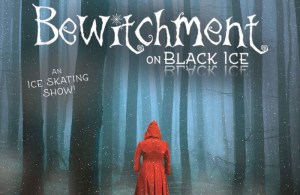
Bewitchment* (Landor Theatre)

Posted: December 21, 2015 in Theatre

Bewitchment-Square-700x455

My love for the Landor is well documented, so it goes without saying that what follows is written with a heavy heart and it will be brief. Under artistic director Robert McWhir, the little Clapham pub theatre has worked miracles with musicals, stretching out into areas that other comparable venues do not even dream of. But this time they have stretched themselves too far – a show performed on a synthetic surface described as “black ice”. The plot has got something to do with a princess under a curse that makes her skate around in circles looking quite nasty. Three handsome princes set off in pursuit and it would be much easier to explain plays by Pinter or Beckett than to detail the rest of it. The skating is abysmal, the singing is, well, patchy and the dialogue is littered with smutty double entendres. The songs are a mixed collection that don’t gel, but it is surprising when the princes burst into Agony (from Stephen Sondheim’s Into the Woods), showing us the heights that fairy tale musical theatre can reach. But, as the Landor gave us the wonderful The Clockmaker’s Daughter only a few months ago, such a demonstration is hardly necessary. The show is devised and choreographed by Nicky Scott and directed by McWhir, but I will allow the performers to remain unnamed. To put things into perspective, I have seen two shows worse than this in 2015, but only two. All that it left is to make the New Year wish that the Landor gets back on track in 2016 and brings us new delights that will consign this debacle to distant memory.

Performance date: 15 December 2015

as you like itIt is a curious feat by the National Theatre to have mounted two productions running concurrently in the Olivier when one of them highlights exactly what is wrong with the other. wonder.land is awash with the most up-to-date computer graphics, but they seem old hat and show us a land in which there is very little wonder. This revival of one of William Shakespeare’s silliest plays is performed in modern dress on a set made up of dreary office furniture and it is pure magic. One coup de théâtre is so eye-poppingly brilliant (I won’t spoil it) that it will surely be talked about for years and it all happens right there on stage. There is magic too of course in Shakespeare’s lyrical passages and in the performances. Rosalie Craig is a charming and very feminine Rosalind and Joe Bannister is a plucky, youthful Orlando. Particularly good also are Patsy Ferran’s schoolgirlish Celia, Mark Benton’s jovial Touchstone and Paul Chahidi’s sardonic Jaques. However, the big star of Polly Findlay’s production is Lizzie Clachan’s forest set, beautifully lit by Jon Clark. This is Shakespeare as you love it.

Performance date: 15 December 2015

The Dazzle*** (Found111)

Posted: December 21, 2015 in Theatre

dazzle

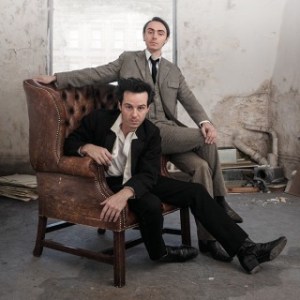
It is going to take a big star name to draw big audiences to the top floor of a disused something or other, next to Foyles in Charing Cross Road. The name is Andrew Scott, an actor with a wide range who seems to be specialising lately in characters who are bonkers, a trend that continues here. Can we guess in what direction he will take his Hamlet at the Almeida next year? To be fair, the whole set-up here is bonkers, the play being performed in what looks like a used furniture depositary, with the audience having to pick out the chair that appears least uncomfortable and least likely to collapse through age. In Richard Greenberg’s play set in the early 20th Century, Scott is Langley Collyer, a child protege pianist who has never grown up. He lives in a shambolic New York apartment, surrounded by junk, with his brother and minder Homer (David Dawson, every bit as eye-catchng as Scott) and is lined up to marry rich socialite Milly (Joanna Vanderham, also superb). The play is a surreal comedy that is at times very funny and ultimately very moving as we are shown three lost individuals who are reaching out for a firmer grip on existence. However, at well over two hours (with interval), it is too long and does not really go anywhere. In Simon Evans’ production, the actors dazzle, but the play sort of fizzles.

Performance date: 14 December 2015

No Villain**** (Old Red Lion Theatre)

Posted: December 11, 2015 in Theatre

No VillainThis review was originally written for The Reviews Hub: http://www.thereviewshub.com

It is said that the first work of all writers is, to some extent, autobiographical. Arthur Miller was the son of a Jewish New York women’s clothing manufacturer who lost everything in the Great Depression. Therefore, it should come as no great surprise that his debut play is set in 1936 and centred on a Jewish family, owners of a New York women’s clothing manufacturing business that is facing bankruptcy. What really surprises is that the play is only now getting its World Premiere. Themes that recurred throughout Miller’s career are prominent here and his sympathies towards the left of American politics are unmistakeable. At the play’s heart is a family that yearns for new generations to make further strides towards achieving the American dream, yet instinctively draws them back into its own fold. Personal ambitions and social conscience come into conflict. Cross-generational duty and guilt are seen to influence individuals’ actions. Perhaps Esther, the mother in this play, blinded by her unflinching devotion to the family, reappears as the grieving mother in All My Sons. Can Abe, the father facing up to his own failure, be the prototype for Willy Loman in Death of a Salesman? David Bromley and Nesba Crenshaw are moving as Abe and Esther, struggling in contrasting ways to hold the family together. A teenage daughter features little, but two older sons provide the focus for a clash of values. George Turvey’s Ben is solid and rational, unable to escape the family business, but realising that it needs to change with the times. Adam Harley’s Arnold is an idealist and aspiring writer, presumably based on Miller himself. He returns home from college on the West Coast with his head full of Marxist theories. When a choice has to be made between allowing the family business to go under and breaking a strike to save it, Ben shares his brother’s political views, but chooses the business. Arnold cannot bring himself to follow him. The play is not flawless. For example, the characters of the daughter (Helen Coles), grandfather (Kenneth Jay) and warehouse labourer (Anton Cross) need to be better fleshed out in order to support developments in the drama, However, it is remarkably well shaped for a first effort, painting a picture of the family during a short period of trauma, rather than building to a single dramatic climax. Sean Turner’s production, played in an intimate space in one act, is crafted lovingly in every detail and is riveting throughout its 90 minutes running time. Overcoming the problems of a play that requires four scene changes, Max Dorey’s simple living room design transforms quickly into a clothing warehouse. The reason why Miller’s early work has taken so long to reach the stage remains a mystery, but any argument that it is dated should be given little credence. At a time when the writer’s vision for America contrasts so sharply with that of, say, Donald Trump, the play could hardly ever have been more topical. .

Performance date: 10 December 2015

trh

nutcracker-the-musicalThis review was originally written for The Reviews Hub: www.thereviewshub.com

Tchaikovsky’s Nutcracker is everywhere each Christmas – in opera houses, on ice and now as a musical on the fringe – but isn’t stripping it of its dance a little bit like performing Shakespeare’s Hamlet without words? When the centrepiece of the second act could be called “walk of the Sugar Plum Fairy” it is hard not to jump to the conclusion that the people behind this show may well be simply nuts. There is a warm glow of familiarity to being greeted by Eleanor Field’s set, a Victorian Christmas card scene of red velvet curtains, cream fireplace and green tree. The story takes us from the reality of modern family life to the world of a dark ETA Hoffman fairy tale in which the real characters find parallels. As a ballet, this is magical. Glorious music, a full orchestra and visual spectacle overwhelm the plot, but, as a musical, the thin story becomes exposed. King Wilhelm (Henry Wryley-Birch) has a passion for bacon and, when his favourite dish is eaten by mice, he exterminates them and incurs the wrath of the Mouse Queen, a pantomime villainess with a fondness for scattering curses all around. One such curse is placed upon Princess Pirlipat, newly born to Queen Wanda (Ann Marcus) and only the world’s hardest nut can break it. As an adult, the Princess (Maria Coyne) awaits the arrival of her suitor (Peter Nash), the only man capable of cracking the nut. But the Mouse Queen is not to be thwarted….. Orchestrators Bruce Keating and Paul Rigano scale down the music, effectively reducing it to a succession of pleasant and very familiar tunes. Nancy Holson’s book and lyrics are self-mocking and director Ollie Fielding throws in regular touches of feigned amateurism (a pigeon flying away dangling from the end of a fishing rod, etc), but the cumulative impression given by all this is of a Gilbert and Sullivan operetta being performed in a village hall. Kris Webb is a warm, avuncular Drosselmier, bearing gifts for the real family and seeking out the nut in the fairy story. The star turn comes from Jamie Birkett, who is merciless in taking the mickey out of the Mouse Queen. Her hilarious death scene is the show’s highlight, as she realises mid-song that she is singing to a tune that actually comes from Swan Lake. Sadly, such flourishes of wit are scattered too thinly. Choreographer Alejandro Postigo could have been given the brief to avoid any hint of ballet at all costs, but just a little is allowed to creep in late on, making the most of the confined space. In all, this is a warm-hearted production, maybe iill-conceived, but, at this time of year, we rather expect a show to be crackers. R

Performance date: 9 December 2015

trh

Peter Pan**** (New Wimbledon Theatre)

Posted: December 9, 2015 in Theatre

IMG_0307

This review was originally written for The Reviews Hub: http://www.thereviewshub.com

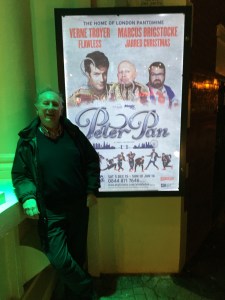
For children and others who have never grown up, the great news is that it’s panto time again. Spectacle, silliness, songs and star names are all on display here and, rest assured, the dark themes of JM Barrie’s 1904 play Peter Pan have already walked the plank long before the curtain goes up. Surprisingly, Barrie still gets the chief writing credit, even though adaptor Eric Potts has made this version almost unrecognisable from the original. Chief casualty is a coherent storyline, Potts seeming to assume, probably correctly, that we all know the story anyway and deciding that re-telling it would be pointless. What is left is familiar characters and situations, with additions to accommodate star names, strung together loosely under Ian Talbot’s direction to provide a fast flowing feast of fun. British pantomime is an entertainment form that owes its longevity as much to its ability to change with the times as to its deep-rooted traditions and it makes little sense to argue that any elements are sacrosanct. Nonetheless, the absence of a dame comes as a bodyblow and it is to be hoped that this character is not becoming another victim of political correctness. Principal boys (meaning girls) are long gone, but the title character in this story, the boy who never grows up, was usually played by a female in the not too distant past. Here a very animated George Ure takes the role, sounding as if he has flown in from a Scottish Neverland and looking, dare it be said, just a little grown up. Marcus Brigstocke, as a smarmy Captain Hook, submerges his own stand-up comedy persona in the character. He is joined by new shipmate Lofty, played by diminutive Hollywood actor Verne Troyer (“Mini-Me” in the Austin Power films), aboard the pirate ship, crewed by street dance group Flawless. Leading dance routinea and lip syncing to a Beyoncé track, Troyer proves to be worth many times his weight in comic gold. While Hook and Lofty rule over the ship, it is the very merry Jarred Christmas as the put upon Smee, a New Zealander “with a bad Australian accent”, who takes command of the show. He builds and maintains the vital bridge between stage and audience, particularly with a riotous singalong 12 Days of Christmas. Francesca Mills is a Tinker Bell so malevolent that many kids in the audience must wish that someone would cut her wires while she is floating over the crocodile. Victoria Fitz- Gerald is a warm Wendy, Sharon Ballard belts out soul classics and Flawless live up to their name with several eye-popping routines. The show is awash with garish colours and giant mushrooms, giving a psychedelic feel that, to older audiences, could suggest the wrong sort of trip to Neverland. Nothing really stands up to close inspection, but who cares? It’s the time of year to just sit back and enjoy.

Performance date: 8 December 2015

trh

Little Eyolf*** (Almeida Theatre)

Posted: December 9, 2015 in Theatre
© John Angerson Campaign for Almeida theatre, London. Design by Magpie Studio Licence to use expires September 2018

© John Angerson

When adapting and directing the plays of Henrik Ibsen, Richard Eyre’s “less is more” approach has huge advantages, but some drawbacks. His multi-award winning production of Ghosts, seen here two years ago, created a cauldron of intense passions to contrast with the icy Norwegian setting, but there were hints that the play’s swift progression was putting strains on its credibility. On this occasion, there is a similar setting, on the coast near to the Fjords and we witness similar tensions of a family tearing itself apart, but the strains are more pronounced.  The chief protagonists are Alfred (Jolyon Coy) and Rita (Lydia Leonard), parents of the crippled boy Eyolf, Alfred’s sister Asta (Eve Ponsonby) and her suitor Bjarne (Sam Hazeldine). Ibsen takes a scalpel to a family in which a child has intruded on the relationship between husband and wife in a marriage already threatened by the closeness of brother to sister. The drama is absorbing and, thanks to beautiful, precise acting, occasionally thrilling and no-one should complain at the 80 minutes (without interval) running time. Except that Ibsen shows us relationships that are constantly shifting and, in this shortened version, we struggle to comprehend how characters have moved from A to B quite so quickly. The problem lies under the surface from early on, but it culminates in a final scene that is barely credible.

Performance date: 7 December 2015

Macbeth*** (Young Vic)

Posted: December 6, 2015 in Theatre

macbethThis review was originally written for The Reviews Hub: http://www.thereviewshub.com

Superstition tells us never to speak the name of this play by William Shakespeare inside a theatre, a rule that could well be extended to warn against ever performing it in The Cut, London SE1. Memories of the infamous 1980 production starring Peter O’Toole at the Old Vic live long. Although no-one could accuse this revival just across the road of being inept, it is still only partially successful. Urban dance routines, pounding music and flickering lights stylise the play’s violence and accentuate its supernatural elements. Incidents typical of modern conflicts are suggested clearly, but the overall effect is a strange detachment of deeds from words which dampens the fiery passions at the play’s heart. Jamie Lloyd’s 2013 London production was mud- splattered and red blooded and, in comparison, this version is pristine and anaemic. The production, directed by Carrie Cracknell and choreographer Lucy Guerin, is performed in modern dress and has no hint of being set in Scotland. Lizzie Clachan’s stage design has the look of an empty underground car park. An exaggerated perspective gives the impression of the grey concrete walls extending back like a long corridor into oblivion. Harsh lighting (designer Neil Austin) casts long and threatening shadows. Visually, much of this is stunning. However, the appearance, combined with Guerin’s choreographed movement, represents stylising at the expense of substance. Scenes such as the slaughter of MacDuff’s family lose much of their horrific impact when enacted as dances. In this play, Shakespeare was chiefly concerned with the corrosive nature of unbridled ambition and the hollowness of ill-gained victory, themes which struggle to shine through here in the haze of imagery. Even when surrounded by mayhem, John Hefferman is a striking Macbeth, blinded by ambition and pushed along by his ruthless wife as he murders his way to the Scottish throne. He shows all the doubts brought about by his tenuous grip on power and all the torment of facing up to his inner demons. His clear and measured delivery confirms his potential to become one of the great Shakespeareans. Anna Maxwell Martin makes Lady Macbeth resemble a social climbing cocktail party hostess urging her husband to fork out for a grander house rather than coaxing him into committing regicide. The production does not serve this pivotal character well, preferring to show her being laid to rest in her grave over and over again rather than to explore her motives and her anguish. Cutting the play to just two hours, without an interval, the production moves with a strong sense of urgency. Cracknell and Guerin deserve credit for their bold if eccentric approach, but their end product is in many ways disappointing. Happily, Hefferman’s performance does not feature among the disappointments.

Performance date: 4 December 2015

trh


Linda**** (Royal Court Theatre)

Posted: December 4, 2015 in Theatre

linda

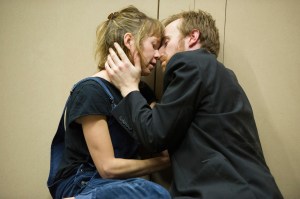
Penelope Skinner does not go in for subtlety in her new play, there is no lyricism in her writing, rather she treats the audience as if a punchbag, ramming home point after point and getting audible gasps in response. The play is a commentary on the world 45 years on from The Female Eunuch, seen through the eyes of Linda, a woman who has it all – successful career, happy marriage, grown children – and then, at the age of 55, finds it all starting to unravel. Her brand of feminism is expressed through her job of marketing anti-ageing cosmetics, fighting against a culture in which women slowly become invisible as they grow older; she has a clear vision of what modern society expects of women and, more specifically, what modern women expect of women and what she expects of herself. The playwright offers no strong male perspective – Linda’s schoolteacher husband Neil (Dominic Mafham) is presented as insipid, her boss Dave (Ian Redford) is a perfunctory character. Skinner’s play is all about the women: Linda herself, her two daughters and Amy (Amy Beth Hayes), the younger woman who threatens to usurp her in her career. The older daughter Alice (Karla Crome), now in her mid-20s, still hides her female form in a skunk costume following a cyber bullying attack in her schooldays, the younger one is an aspiring actor choosing between Hamlet or Lear for her audition piece because Shakespeare did not write interesting roles for women (really?!).  Michael Longhurst’s production is crisp and lucid and Es Devlin’s towering, multi-levelled, revolving set, alternating between home and workplace, has the perfect look of glossy modernity. As Linda, Noma Dumezweni is shaping a titanic performance, but she is not quite there yet because she stepped into the role very late and, at this performance (after press night) she still needed to refer to her script, This distraction meant that she was not 100% in character in some scenes and not engaging fully with other actors, but the good news is that she will get better and the production will get better with her. The play’s weakest point is the character, more caricature, of Amy. She is not ,as we may have expected, a worthy adversary to Linda, perhaps herself 30 years younger, but a shallow bitch who had, coincidentally, been Alice’s chief tormentor at school. Is Skinner trying to warn us that the vanguard of feminism, as represented by Linda, is in danger of being succeeded by a reversion to what preceded it? Post-curtain analysis and discussion may well reveal some of Skinner’s arguments to be confusing and even contradictory, but that hardly matters. The real point is that this bold, provocative and supremely theatrical production gets us thinking.

Performance date: 2 December 2015

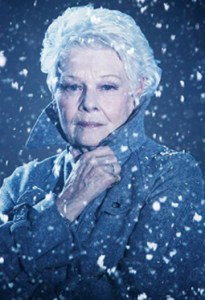
Branagh_Theatre_The_Winters_TaleLike going out at the interval of King Lear and returning to see the final act of Twelfth Night, William Shakespeare’s split personality play defies expectations and conventions. Sicilian King Leontes, consumed by unfounded jealousy at his Queen Hermione’s supposed infidelity, embarks on a path that takes him to the very brink of self destruction, whereupon he finds redemption and reconciliation. The play contrives a mythical world in which logic has yet to be invented and, if it succeeds in casting its spell, it is mainly because of the genius of the Bard’s writing, but an impeccable production that provides all the delicate touches required helps greatly. This sumptuous revival, directed by Rob Ashford and Kenneth Branagh, does the job perfectly. Christopher Oram’s set and costume designs are not over-elaborate, but they evoke a distinct feel of a chilly Victorian Christmas, melting into a sunny Spring, understanding that this is a production in which nothing needs to distract too much from the text and the acting. Branagh finds Leontes’ demented fury and his whimpering contrition well within his range, Miranda Raison is a bewitching Hermione, Tom Bateman and Jessie Buckley are enchanting as the young lovers Florizel and Perdita and formidable support from the likes of Michael Pennington, John Shrapnell, Hadley Fraser and John Dalgleish ensures a depth of quality unlikely to be surpassed anywhere. This is a delicious cake but it has a very rich icing – the warm performance of Judi Dench in the prominent role of Paulina, custodian of the banished Hermione and go-between with Leontes. If this is to be her final West End appearance, it will have been in a production well worthy of her.

Performance date: 2 December 2015