desperate measuresThis review was originally written for The Reviews Hub: http://www.thereviewshub.com

The saying goes that anyone who remembers the Swinging Sixties could not have actually been there. It is a fair bet that most if not all of the youthful cast and creatives involved in this throwback to the era of Profumo, Keeler and the Krays missed being there by several decades. The show is a musical adaptation of William Shakespeare’s Measure for Measure, in which the Duke Vincentio passes the reins of power over a licentious Vienna temporarily to Angelo, whose errant rule leads to an injustice that the novice nun Isabella is left to fight. The Bard’s message that power cannot be exercised without wisdom carries through to Robin Kingsland and Chris Barton’s re-working, which sticks to the core plot of the original fairly closely. “Oh What Times We Live In” chants the chorus as an array of peers, politicians, churchmen, prostitutes and gangsters parade before us. It is London circa 1963 and Prime Minister Dukes (Sam Elwin) takes a hiatus, handing over to moral crusader Simon Di Angelo (someone must have been there in the 60s to come up with the joke in that name). Pop star Milo Feather (Jojo Macari) falls foul of new puritanical laws by fathering a child outside wedlock and faces the gallows unless his sister Isabel can save him. Some would argue that even Shakespeare found difficulties in juggling the comedy and drama in his “problem” play. Kingsland and Barton face the additional challenges of tying the story to a specific time in recent history and turning it into it a musical. They struggle to make all the elements connect together and it takes some time for the show to get into its stride, but the first half ends on a high with the powerful duet, A Single Night. There are some long gaps between songs when it feels as if we are watching a modern language version of Shakespeare’s play and, ironically, it is these scenes that are performed with the greatest confidence. Many of the songs, played with the accompaniment of a three-piece band, lack distinctiveness and opportunities to replicate the musical styles of the 1960s are, sadly, missed. Overall, the level of the performances is inconsistent, but the three principals are a delight. James Wilson is both cynical and compassionate as the tabloid journalist Charlie Lucre and Charlie Merriman tears into the role of the hypocritical zealot Di Angelo. As Isabel, Ellie Nunn has a captivating stage presence and a sweet singing voice, perhaps signalling the emergence of another formidable theatrical dynasty. There can be no denying that this production is rough around the edges – writing, acting and singing all need more work particularly in a stuttering first half, and even the curtain call is a mess. However, notwithstanding all of that, much of the show is highly entertaining and enough promising young talent comes shining through to make it well worth a look.

Performance date: 1 december 2015

trh


wonder.land

A plump teenage girl of mixed race, harassed by battling parents and bullied at school, creates an alter ego that is white and has flowing blond hair and a Kate Moss figure. She gets groomed on the internet by a sleazy DJ who lures her into a virtual world of  weirdos, monsters and a grinning cat. The first 20 minutes of the National’s new “family” show is played without a hint of irony and is so off message that it can only be assumed that the creators are joking, as is usually the case when the writer is Moira Buffini.  This musical take on Lewis Carroll’s Alice in Wonderland is bang up to date and, after its very unsettling start, it follows the predictable course of hammering home messages about personal esteem, self-empowerment, etc. Rufus Norris’s production is awash with computer graphics, but, even when magnified to fill the Olivier stage, they look pretty old hat and it is the traditional values of costumes, props and choreography that work best, as in a splendid tea party that brings the first half to a close. Buffini supplies book and lyrics, Damon Albarn the 1990s pop-style score, most of which is pretty catchy, even if it sometimes seems as if the composer is trying to find 57 different varieties of Park Life. The sameness of the songs makes them all something of a blur (sorry), but the absence of the one killer number that all great musicals need could prove to be the show’s biggest problem. Lois Chimimba is an endearing real Alice, Carly Bawden is bubbly as her avatar equivalent, Golda Rosheuvel and Paul Hilton score highly as Mom and Dad (he doubling as the Mad Hatter). Buffini’s  book goes a little off-course when the villainous head mistress (Anna Francolini in Miss Hannigan mode) steals the Alice avatar and turns her into the Red Queen. This plot line is always strained, highlighting the problems of a book that is patchy, with Albarn’s score not being quite strong enough to lift it when it flags. Yes, much of the show is packed full of invention, colour and spectacle and there is not a great deal to dislike about it. However, I rather wish that I had been able to actually like it just a bit more.

Performance date: 30 November 2015

Howard-Barker-Double-Bill-724x1024This review was originally written for The Reviews Hub: http://www.thereviewshub.com

Howard Barker was never destined to be the darling of Shaftesbury Avenue, but his work gives a bold and distinctive voice to British theatre. Robyn Winfield-Smith here brings together two of Barker’s one-act plays, both dealing with male-female conflicts. They embrace harsh beauty and cruel irony, demonstrating fully the writer’s power to captivate and shock. The Arcola’s smaller studio, with exposed brick walls and black dust scattered on the floor, has the look of a coal cellar, but the appearance is consigned to memory once the first play, The Twelfth Battle of Isonzo, begins. The space is plunged into complete darkness, interrupted very occasionally by brief bursts of light from the stage area. Howling winds can be heard throughout and the audience is provided with headphones through which to listen to the voices. The play concerns the marriage of centenarian Isonzo (voiced by Nicholas Le Provost) to 17-year-old Tenna (Emily Loomes). Both are blind. They probe, test and taunt each other in a discourse that often has the feel of an epic poem in blank verse. Barker challenges conventional perceptions based on age and appearance, playing upon the audience’s inevitable discomfort at this unlikely match. Winfield-Smith’s decision to get the audience to share in the characters’ sensory deprivation distracts from the play as often as it focusses attention on the text. The two voices are heard from left then right, near then far and stage directions need to be whispered in our ears. In effect, this production consists of little more than listening to a recording, albeit beautifully spoken, in darkness and what we expect in a theatre is more of a live performance. Judith: A Parting from the Body gets a conventional staging. Holofernes (Liam Smith) is an army general, boastful of his control over life and death and of his attraction to women. He is visited in his bedroom on the night before a battle by the widow Judith (Catherine Cusack) and her much too talkative servant (Kristin Hutchinson). Barker’s play is a meditation on love and death, truth and lies, heroism and treachery, exploring the links that connect them all. Cusack is particularly striking as the volatile and unpredictable Judith, switching instantly between helpless vulnerability and ruthless determination. Smith has an arrogant swagger as the general and Hutchinson finds humour in the barely suppressed insolence of the servant. Stark and unsettling, this double bill provides a powerful antidote to the festive fare currently being offered elsewhere.

Performance date: 27 November 2015

trh

Evening-At-The-Talk-House-poster_0

We can’t say we weren’t warned. As best I remember it (I have tried hard to expunge it from the memory altogether), Wallace Shawn’s play The Designated Mourner, performed in this same theatre (then the Cottesloe) in 1996, consisted of several distinguished theatrical figures sitting in a line and talking directly to the audience. That set expectations for this new work, getting its World Premier, pretty low, but it still fails to live up to them. The opening sets the tone, with an anonymous figure strolling on stage as if to tell us to turn off our mobile phones and then launching into a turgid scene-setting monologue. Anyone in the audience who has stayed awake then sees various other figures emerge from darkness, apparently theatricals gathered to remember a play that had flopped ten years earlier. We are told that we are in an age when people no longer go to the theatre, so some time in the future we presume, possibly after a period during which theatres had been swamped with Shawn’s plays. It is a dystopian future in which actors and television personalities are targeted and terminated once they have passed the peak of their popularity. A satire on the modern culture of quickly disposable celebrities, Shawn has the germ of a good idea for a play – that is a real play in which things actually happen to the characters on stage and not this one in which other people just stand around talking about them. Talk, talk and then more talk is all we get in Ian Rickson’s static production. Shawn himself appears as a targeted old ham, showing facial bruises from a narrow escape; thankfully, these bruises are just make up and not the consequences of an adverse audience reaction to the performance on the previous evening. Other accomplished actors, deploying a variety of American and English accents, appear, but it is better to leave them nameless out of respect. The National has had a brilliant year in the Dorfman, but all good things come to an end.

Performance date: 24 November 2015

3guysnaked

Don’t call the police! No flashing, just a small gem of a show that should not need a gimmick title to sell it. A musical first seen in New York in 1985 – book and lyrics Jerry Colker, music Michael Rupert – the show follows the ups and downs of of a comedy trio through the club circuit of the 1980s, a hit American television sitcom and eventual movie stardom, battered and bruised as commercial pressures trespass into their art form. Simon Haines has a confident swagger as Ted, a club MC who is already cringing before his punchline is delivered. He recruits “angry” Phil (Benedict Hastings), a novice to stand-up and expectant father who is desperate for some cash. Ted’s buddy Kenny, a wacky comic who is battling chronic depression, makes up the trio and Guy Woolf is particularly touching in showing the thin line between humour and insanity. The simplest of formats – three performers, five musicians, comedy sketches and songs of the sort that could have just fallen short for a big Broadway musical. It adds up to a consistently entertaining couple of hour, performed with real panache. It does not take too many people to fill the Finborough, but this show deserves to pack them in every night.

Performance date: 24 November 2015

The Homecoming**** (Trafalgar Studios)

Posted: November 24, 2015 in Theatre

the homecomingThis review was originally written for The Reviews Hub: www.thereviewshub.com

Explaining the link between plays chosen for his recent seasons at Trafalgar Studios, Jamie Lloyd stated that they all question what it is to be British. He now brings his company back to the same theatre with a 50th Anniversary revival of Harold Pinter’s masterpiece, The Homecoming, a biting, dark comedy that rattles the foundations of the institution at the very heart of British life – the family. Lloyd’s production is charged with nervous energy, but takes meticulous care to perfect every inflection and emphasis loaded into Pinter’s dialogue. The setting is the living room of a working class London home, presented in Soutra Gilmour’s design as an open sided box, with its entrance/exit door set apart at the rear. The centrepiece of the room is an armchair, more a throne, normally occupied by the patriarch, Max (Ron Cook), a belligerent widower who spits out abuse at his family as if compensating for age having diminished his physical prowess. His brother Sam is a boastful chauffeur who “never married” and Keith Allen’s mincing, limp-wristed performance leaves no room for doubt as to why this would have been so. Max’s son Lenny is a chip off the old block, John Simm making him a sinister and menacing figure. He looks like a city executive, but is, in fact, a pimp, casually throwing accounts of violence and even rape into conversations. Younger son Joey is a dim-witted boxer, given a formidable physical presence by John Macmillan. The four men live together, sparring verbally with each other to sharpen their masculinity. The homecoming is that of oldest son Teddy (Gary Kemp assuming an upper class accent), a doctor of philosophy back from six years in the United States. His quiet acquiescence to the malign grip of his kin signifies that, in reality, he has never travelled very far from home. He brings with him Ruth, the wife that he married, unknown to the family, in London prior to his departure. The family greets her as a “whore”, which we learn may not be far from the truth, as Pinter continues to scrape away the household’s thin veneer of respectability. The arrival of this newcomer gives Pinter the opportunity to explore feminist themes relating to family life, by countering the men’s assumption that a woman’s roles must be limited to cooking, cleaning and bestowing sexual favours. Gemma Chan’s Ruth has the steel to upset the balance of power between genders; her calm exterior resembles that of a prim governess, but it masks a calculating mind and a manipulative disposition. She may be outnumbered five to one, but she is set on becoming queen bee in this hive. It is remarkable that hardly anything of significance in the play feels dated after the passing of half a century. Pinter’s subversive humour is typically enigmatic, at its most subtle when seemingly most crude, most unsettling when generating most hilarity. In painting this portrait of dysfunction, he is questioning whether families are held together by affection or just by habit. He is also telling us that, however far we journey, in some way, we all come home eventually to our familial roots. A chilling message indeed when the home is one such as this.

Performance date: 21 November 2015

trh

Faustaff** (Cockpit Theatre)

Posted: November 20, 2015 in Theatre

Faustaff Rehearsals 2This review was originally written for The Reviews Hub: http://www.thereviewshub.com

Being presented simultaneously in London and Mexico City and given the alternative title The Mockery of the Soul, Mexican writer Diego Sosa’s 90-minute one-act play is a modern take on the Faust story. The “aff” tagged onto the title is claimed to relate to Shakespeare’s Falstaff, but there is no obvious reference to the mischievous Knight in the play itself. Gily Jacoby (Lesley Lightfoot) is a writer who sells her soul to achieve success and save her ailing father. An impish manifestation of the Devil (Eddie Chamberlin) works with her to develop plots that grow ever more macabre and she becomes obsessed with the thin line between fiction and fact. Is art imitating life or life imitating art? Maybe Gily has been given powers of clairvoyance to write about horrific real events that have yet to happen. Jonson Wilkinson appears as Gily’s caring editor, concerned by her erratic behaviour, and also as the sinister killer in enactments of her stories, whose relationship with his fiancé (Alessia Gatti) is forecast to come to a bloody end. The prevailing tone is of a surreal and sinister melodrama, but two comic policemen (Bernard O’Sullivan and Charles Timson) bring a strain of absurdist humour that feels incongruous. In examining the travails of a writer, Sosa’s piece could be considered introspective, the non-linear narrative jumping backwards and forwards in time and between fact and fiction. Gily’s nervous unease as her torment edges towards madness is brought out very effectively in Lightfoot’s performance. If some of Sosa’s dialogue sounds stilted, it may be due to translation difficulties, but, more significantly, Mexican director Rodrigo Johnson’s production, performed in the round on a darkened stage, has not yet acquired the polish and flow that it needs. Partly as a result of this, the various elements in a potentially intriguing work do not always hold together and the play baffles as often as it beguiles.

Performance date: 19 November 2015

trh

Waste** (National Theatre, Lyttelton)

Posted: November 20, 2015 in Theatre

WASTEThe National Theatre has scored well with revivals of plays by Harley Granville Barker, most notably The Madras House and The Voysey Inheritance. This fascinating 1907 play has similar potential, centring on the political classes of that era and attempts to progress a bill to disestablish the Church from the State, a move that would still be controversial in modern, multi-faith Britain. The chief advocate of the bill is Henry Trebell (a fine performance by Charles Edwards), who damages his personal reputation by impregnating Amy O’Connell (Olivia Williams), flirtatious wife of an Irish Catholic (Paul Hickey). The acting is flawless, Sylvester Le Touzel being particularly moving as Trebell’s devoted sister. Granville Barker constructs the scenes superbly, giving an absorbing account of how public affairs and private lives are woven together by a prurient and judgemental society and how potentially great figures can go to waste because of matters of relative insignificance. The relevance of these themes to modern life is obvious and this is a play that I would happily see again and again, but not in this wayward production, directed by Roger Michell. The play’s themes may be timeless, but its specific details relate to the Edwardian era; the costumes are right for that era, but Hildegard Bechtler’s set designs are emphatically not. Yes, some of the images are stunning, moving white, grey and black screens form geometrical shapes between scenes and Trebell’s minimalist London house takes the breath away on first sight, but these images belong to another play, perhaps a Pinter. A play that draws its strength from subtle characterisations and detailed plotting needs intimacy with the audience and deserves better than to be performed in what looks like the lobby of a soulless ultra-modern hotel, with the actors appearing as if specks on a vast blank canvass. They are dressed as Edwardians, but surrounded by furniture that could have come from IKEA. Some sympathy must be accorded to Michell for having to contend with the notorious problems of the Lyttelton – the wide stage has never suited personal dramas, but, more significantly here, the dreadful acoustics make key words and sentences inaudible and Michell compounds the problem at one point by having an actor speak her lines while sitting with her back to the audience. A play should be able to explain itself to an audience, but, on this occasion, digesting a synopsis beforehand is strongly recommended. Waste could be a great play, but its title says everything about this production.

Performance date: 18 November 2015

Spincycle**+ (Theatre N16)

Posted: November 17, 2015 in Theatre

Steve Thompson's SpincycleThis review was originally written for The Reviews Hub: http://www.thereviewshub.com

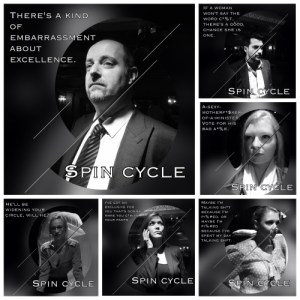
In an age when advertisers seem to believe that an old man sitting alone on the Moon is the best image to persuade us to spend our hard-earned cash in a certain department store, no account of the world of spin would seem likely to stretch credibility too far. This revival of Steve Thompson’s 2003 play is, probably more than was intended, a reminder of how things were a dozen or so years ago. Thompson has risen to prominence scripting hit television shows (Doctor Who, Sherlock, etc), but this play draws from his early experiences as an intern with an advertising agency. It is a world of men sporting designer stubble and women squeezed into figure- hugging business suits. The audience here is made to feel as if observing a series of business meetings, so basic is the staging with no more than very plain tables and chairs. Rachel (Abbiegale Duncan) is the new recruit from whose perspective we observe an agency that includes amongst the products that it is selling skin cream, butter, a theatre company and the Conservative party. Jane (Anneli Page) is the hard-nosed boss, Peta (Abi McLoughlin) is her unswervingly loyal PA, Miles (Gregory A Smith) is a gay account manager and Piers (Ash Merat) is a womanising media consultant. Yes, there are a few stereotypes among the characters. The collective ethos is “no ties, no affiliations, no loyalties…” to which could be added no morals and no principles. Thompson presents us with a superficial bunch of cynics and never really tries to delve under their skin to discover what, apart from avarice, makes them tick. The dialogue, some of it in rhyming verse, is sharp and delivered slickly by the eight-strong company in Stephen Oswald’s fluid production. Today all of these characters would be glued to their smart phones, but the absence of such accessories is not the only feature to date the play. What may once have seemed like insight now comes across as hindsight, particularly when Thompson takes the play off at a tangent to give us his angle on political spin. Telling us that no politician since Margaret Thatcher has been driven by conviction and that spin is the new political ideology, Thompson’s arguments seem a little naive, but perhaps his points were less obvious in 2003 than they are more than a decade further on. He is right of course and he could have added that many believe that even Thatcher’s first election victory owed more to Saatchi & Saatchi than to the lady herself. Long gone are the days when Spincycle could only have been a play about a washing machine.

Performance date: 16 November 2015

trh

Sparks***+ (Old Red Lion Theatre)

Posted: November 16, 2015 in Theatre

sparksThis review was originally written for The Reviews Hub: http://www.thereviewshub.com

After a 12-year absence, Jess turns up in pouring rain at her younger sister’s flat, carrying a goldfish bowl in her hands and a rucksack packed with alcoholic refreshments on her back. It is time for sparks to fly. Simon Longman’s play is is an exploration of loneliness in different guises. Jess (played at this performance by Sophie Steer) is a wanderer, roaming from east to west across the country, unable to settle anywhere. Her sister Sarah (Sally Hodgkiss) is rooted in their native West Midlands, with few friends and little life outside her sparsely-furnished flat. The two actors are playing these roles alternately. The awkwardness of the estranged sisters’ reunion is realised beautifully in Longman’s quirky dialogue. Sarah is at first rendered speechless, while Jess fills in all the silences as if struck by an attack of verbal diarrhoea, spouting nonsensical trivia almost non-stop. Gradually, alcohol removes inhibitions and the deep insecurities of the characters are revealed. Running for 95 minutes this is, in essence, a brisk one-act play, but Clive Judd’s production is performed with an interval, which causes the drama to lose some momentum. Early on, each sister downs a full bottle of what passes for wine in one go, a considerable feat by both actors, and, if the interval has been inserted as a kindness to them, perhaps it can be forgiven. The performances are strong, bringing out the absurdist humour in Longman’s script and capturing the underlying pathos of the two sisters. They are opposites who are both bound together and torn apart by blood ties and sisterly affection. It will be interesting to see if the dynamics in the sisters’ relationship change significantly when the actors’ roles are reversed. Bright, patterned wallpaper around Jemima Robinson’s set gives the flat the feel of a children’s play room, but the furnishings – a single armchair and stacks of up-turned cardboard boxes – reflect the emptiness of its inhabitant’s life; slats in Venetian blinds come to look like prison bars, confining Sarah to a world in which Jess could never be comfortable. Consistently amusing, yet underpinned by a feeling of melancholy, Longman’s play shows how holes in peoples’ lives can be filled temporarily by meaningless conversation and it builds to a moving and surprising climax. This is an engaging new work by a highly promising young writer.

Performance date: 12 November 2015

trh